
A Christmas tree stands 7 feet tall, yet guests judge the whole thing by the top 12 inches. The topper is the only part of the tree visible from every doorway in the house, and it is the last thing your eyes land on when you step back to admire your work. That is why these christmas tree toppers ideas 2026 treat the crowning piece as its own project, not an afterthought grabbed from a bargain bin on December 23.
You will get 21 complete topper ideas, each with exact sizing, weight limits, attachment methods, and honest prices. Every one is topper-only: no whole-tree looks, no garland tutorials, no ornament roundups. Just the piece that sits on top and pulls the entire tree together.
Pick the topper first, then build downward. A topper chosen after the tree is decorated almost always fights the palette, the scale, or the branch strength at the crown. Choose it now and the rest of the decorating gets easier.
Classic Brass Star Topper

Why This Works:
- A 10-inch star suits a 7-foot tree because the 1-to-8 topper-to-tree ratio reads balanced from 10 feet away
- Solid brass weighs 8 to 12 ounces, well under the 1-pound limit most crown branches hold
- The 5-point shape catches light from every side of the room, unlike a flat silhouette
- Brass patina deepens over years, so a $35 star looks better in year five than year one
Measure the crown before buying: the topper should span roughly one eighth of the tree height, which means 10 to 11 inches on a 7-foot tree and 8 inches on a 6-foot tree. Slide the star onto the top 6 inches of the trunk, then lash it with two 6-inch lengths of green floral wire twisted tight behind the trunk. Skip adhesive-only mounts because a 12-ounce brass star will creep sideways within a week on a warm tree. Compared with hollow tin stars at $8 to $12, solid brass at $30 to $45 holds its shape, resists bending when the tree is bumped, and never shows a dented seam. Keep toppers and ornaments at least 12 inches from heat sources, so check the crown against nearby vents before decorating.
Brass earns its place on traditional trees where gold ribbon, red berries, and warm white lights already set the palette. The metal reflects the string lights, so the crown glows without its own bulb. The trade-off is weight on slim or pencil trees: a 12-ounce star can bow a 3-inch-diameter crown on a narrow tree, so test by holding the star in place for 30 seconds and watching whether the trunk tip drifts. For a tabletop tree under 4 feet, drop to a 6-inch star at 4 ounces. Store brass wrapped in a soft cloth, since a single season in a cardboard box with ornaments will scratch the finish.
Pro Tip: Rub a pea-sized dab of beeswax on the star’s mounting sleeve before sliding it on. The wax grips the bark, stops slow rotation, and wipes off clean in January.
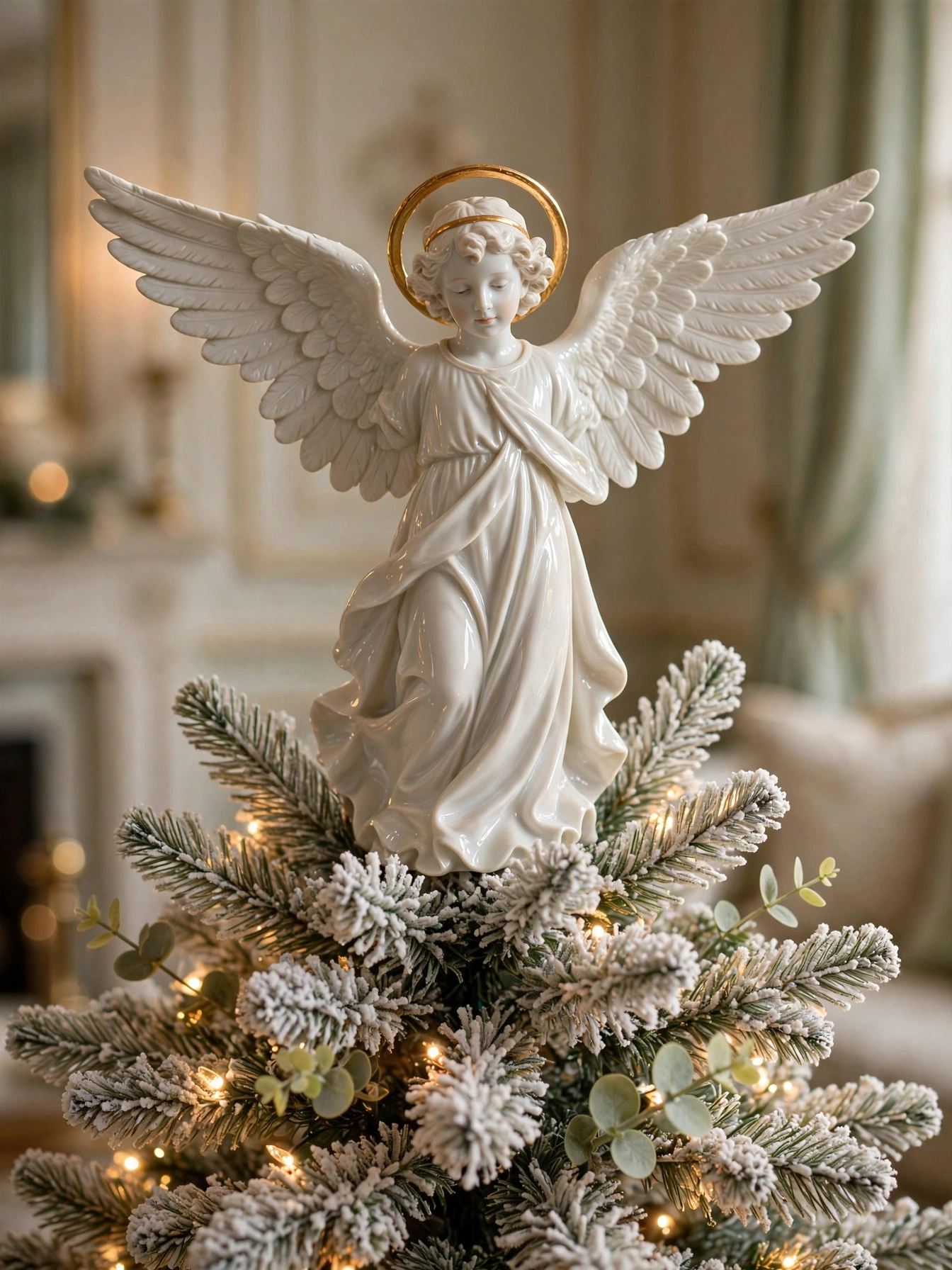
Porcelain Angel Topper
Why This Works:
- An 11-inch angel fits trees 6 to 8 feet tall without crowding the top 18 inches of branches
- Glazed porcelain reflects tree lights, so the gown glows softly even without a built-in bulb
- Wings span 7 to 8 inches wide, which reads clearly from across a 12-foot room
- At 10 to 14 ounces, porcelain sits safely under the 1-pound crown limit on most trees
Pick an angel whose base cone slides over the trunk tip rather than balancing on a flat foot. The cone grip holds the figure upright through door slams and curious pets, while a flat-foot angel tips at the first vibration. Budget porcelain angels run $18 to $28; hand-painted pieces with real gold accents land at $45 to $75 and show finer facial detail. Keep the angel 3 inches clear of the nearest branch tip so the wings do not snag needles when you adjust ornaments below. Compared with resin angels at half the price, porcelain carries a weight and cool surface that reads as genuine at close range, while resin can look plasticky under bright tree lights.
Angels suit families who want a calm, traditional crown and already lean toward white, gold, and ivory palettes. The figure becomes the tree’s focal point, so keep the top third of the tree lighter on ornaments: six to eight pieces in the crown zone, not twenty. The honest limitation is fragility. Porcelain chips on a hard floor, so unbox it over a bed or sofa and store it in its original foam cradle. In a house with toddlers who pull at low branches, the angel stays safe up top, but choose a resin lookalike if anyone climbs furniture.
Pro Tip: Thread a single warm white micro light behind the angel’s halo. One bulb at 2700K turns the halo into a glow ring for under $2 of battery lights.
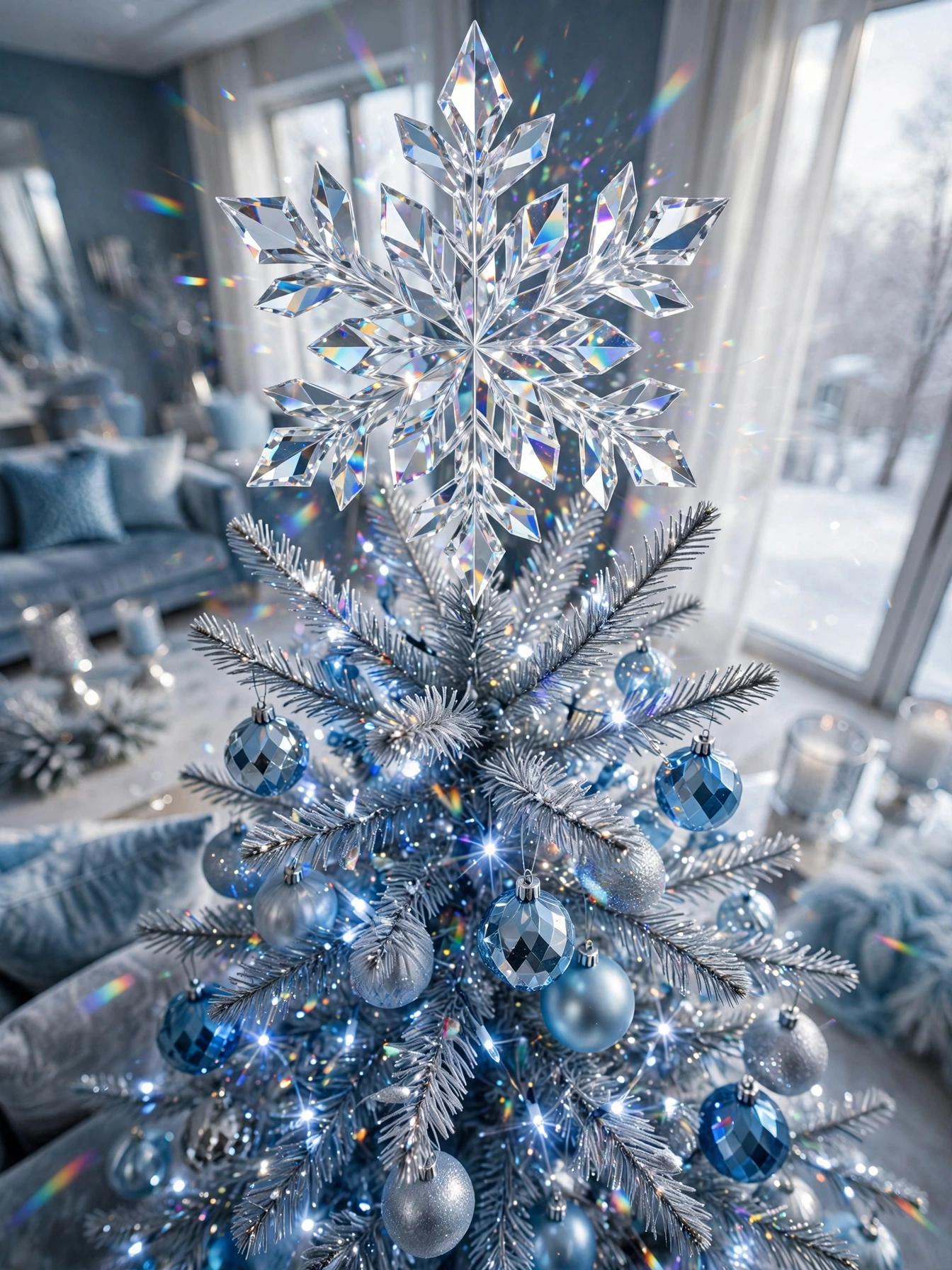
Crystal Snowflake Topper
Why This Works:
- Faceted crystal throws rainbow prisms across the ceiling when tree lights hit it from below
- A 9-inch snowflake matches the width of most 7-foot trees without overwhelming the crown
- At 6 to 9 ounces, crystal is lighter than brass or porcelain, so slim crowns hold it easily
- The 6-arm symmetry photographs cleanly from every angle, unlike one-sided figures
Choose a snowflake with beveled, not molded, facets. Beveled edges split light into visible prisms; molded acrylic copies scatter light into a flat white blur. Real crystal snowflakes cost $25 to $60, while acrylic versions run $10 to $18 and suit homes where a dropped topper is a matter of when, not if. Mount it with a clip grip that clamps the trunk tip, not a cone, because snowflakes have no base to slide over a trunk. Compared with a star, a snowflake reads as winter rather than Christmas-specific, so it stays up beautifully through January without looking out of season. Crystal ornaments show dust within two weeks of display, so wipe the facets with a dry microfiber cloth before guests arrive.
Crystal snowflakes shine on blue, silver, and white trees where cool light already dominates. The prisms need direct light to work, so position one warm or cool string-light bulb within 4 inches of the snowflake for maximum sparkle. The limitation is daylight dependence: on a cloudy afternoon with the tree lights off, crystal goes quiet and gray, while a brass star still reads warm. If your tree sits in a north-facing room, pair the snowflake with a battery micro light tucked 3 inches below it. Never hang a crystal topper in a window-facing crown where afternoon sun focuses through the facets onto dry branches.
Pro Tip: Aim one cool white clip light upward from 8 inches below the snowflake. The upward beam doubles the prism effect on the ceiling for the cost of a single clip light.
Christmas Tree Toppers Ideas 2026: Velvet Bow Cascade Topper

Why This Works:
- A 14-inch bow covers the bare trunk tip completely, hiding the awkward 6 inches of bare wood at the crown
- Wired 4-inch ribbon holds its loops all season, while unwired ribbon collapses within days
- Tails 30 to 36 inches long pull the eye down into the tree instead of stopping at the top
- Velvet weighs almost nothing at 3 to 5 ounces, the lightest statement topper available
Build the bow from 4-inch-wide wired velvet ribbon, cutting four 30-inch lengths for loops and two 36-inch lengths for tails. Pinch the loop centers together with a 12-inch piece of floral wire, then fluff each loop outward until the bow spans 12 to 14 inches. Tie the finished bow to the trunk with a separate 18-inch wire cinched below the top branch ring. Budget velvet ribbon costs $8 to $14 per 10-yard spool, and one spool makes the full topper with ribbon left over for gift wrap. Compared with a structured star or angel, a bow forgives a crooked crown because the soft loops hide the trunk angle entirely. Wired ribbon holds a bow’s shape longer than a week; unwired ribbon relaxes under its own weight.
Velvet bows suit trees with heavy ribbon already woven through the branches, because the crown bow reads as the source of all that ribbon. The softness also works where a hard topper would look harsh, such as on a flocked or pencil tree. The limitation is dust: velvet collects it, and a dusty bow photographs gray by week three. Run a lint roller over the loops once a week, and store the bow flat in a zip bag rather than crushed in a box. In homes with cats, expect batting; mount the bow with two wires, not one, so a single swat does not send it to the floor.
Pro Tip: Cut ribbon tails at a 45-degree angle instead of straight across. Angled ends look finished from below, which is the angle most people see them from.
Reclaimed Wood Star Topper

Why This Works:
- Reclaimed wood weighs 6 to 10 ounces, light enough for any real-tree crown
- Rough-sawn edges and nail holes make each star one of a kind, unlike factory-molded shapes
- An 11-inch star balances trees 6 to 8 feet tall at the standard 1-to-8 ratio
- Gray-brown barn wood pairs with burlap, pinecones, and cream ornaments without competing
Look for stars cut from genuine barn wood, not stained pine pretending to be old. Real reclaimed pieces show saw marks, nail holes, and uneven color, while stained pine looks uniform under tree lights. Prices run $15 to $30 at craft fairs and $25 to $45 from reclaimed-wood shops. Mount with jute twine looped through a drilled hole and tied around the trunk, since wood stars usually have no sleeve. Compared with metal stars, wood never conducts cold from a drafty window onto the crown, and it will not scratch ornaments if it swings. Keep the star 2 inches below the very tip of the trunk so the highest branch pokes above it slightly; that small imperfection is what makes a rustic crown look hand-placed rather than store-bought.
Reclaimed wood stars belong on natural trees with burlap ribbon, dried orange slices, and wooden ornaments. The rough texture contrasts beautifully with smooth glass balls. The trade-off is finish: barn wood sheds fine dust for the first few days indoors, so wipe it down with a dry cloth before mounting. If anyone in the house has splinter-sensitive hands, sand the back edges with 120-grit paper; the front keeps its character. A wood star also suits flocked trees, where its gray-brown tone reads as a branch that grew into a star.
Pro Tip: Rub the star with a walnut meat (the nut, not the shell) to deepen dry gray wood. The natural oil darkens the grain for one season and costs nothing.
Hand-Blown Glass Finial Topper

Why This Works:
- A 12- to 14-inch finial extends the tree’s vertical line, making a 7-foot tree read a full foot taller
- Hand-blown glass glows from within when tree lights sit 3 to 4 inches below it
- At 5 to 8 ounces, a finial is one of the lightest structured toppers you can buy
- The teardrop silhouette works on modern and traditional trees alike because it is pure shape, not theme
Finials slide onto the trunk tip through a hollow base, so measure the trunk diameter at the top before ordering. Most finials fit trunks up to 1 inch thick; a thicker crown needs the top 4 inches of the trunk trimmed with pruning shears. Hand-blown finials cost $30 to $80 depending on color complexity, while molded glass copies run $12 to $20 and show a visible seam line. Compared with a star, a finial never argues with a themed tree because it adds color and height without adding a symbol. Keep the finial centered by wedging a 2-inch piece of cork inside the base if the trunk is narrower than the sleeve.
Finials suit jewel-tone trees (emerald, sapphire, ruby) where the glass color can echo the ornament palette. The vertical shape also rescues a tree whose top branches are sparse, since the finial fills the gap between the last branch ring and the ceiling. The limitation is fragility squared: a finial is long, thin, and top-heavy, so a fall from 7 feet usually means a break. Handle it over a soft surface, and in homes with jumping cats, choose a shatterproof acrylic finial at $15 to $25 instead. Never hang a finial from a branch hook; it must sit on the trunk to stay vertical.
Pro Tip: Slip a 3-inch section of pool noodle over the trunk inside the finial base. The foam centers the glass, stops wobble, and removes cleanly in January.
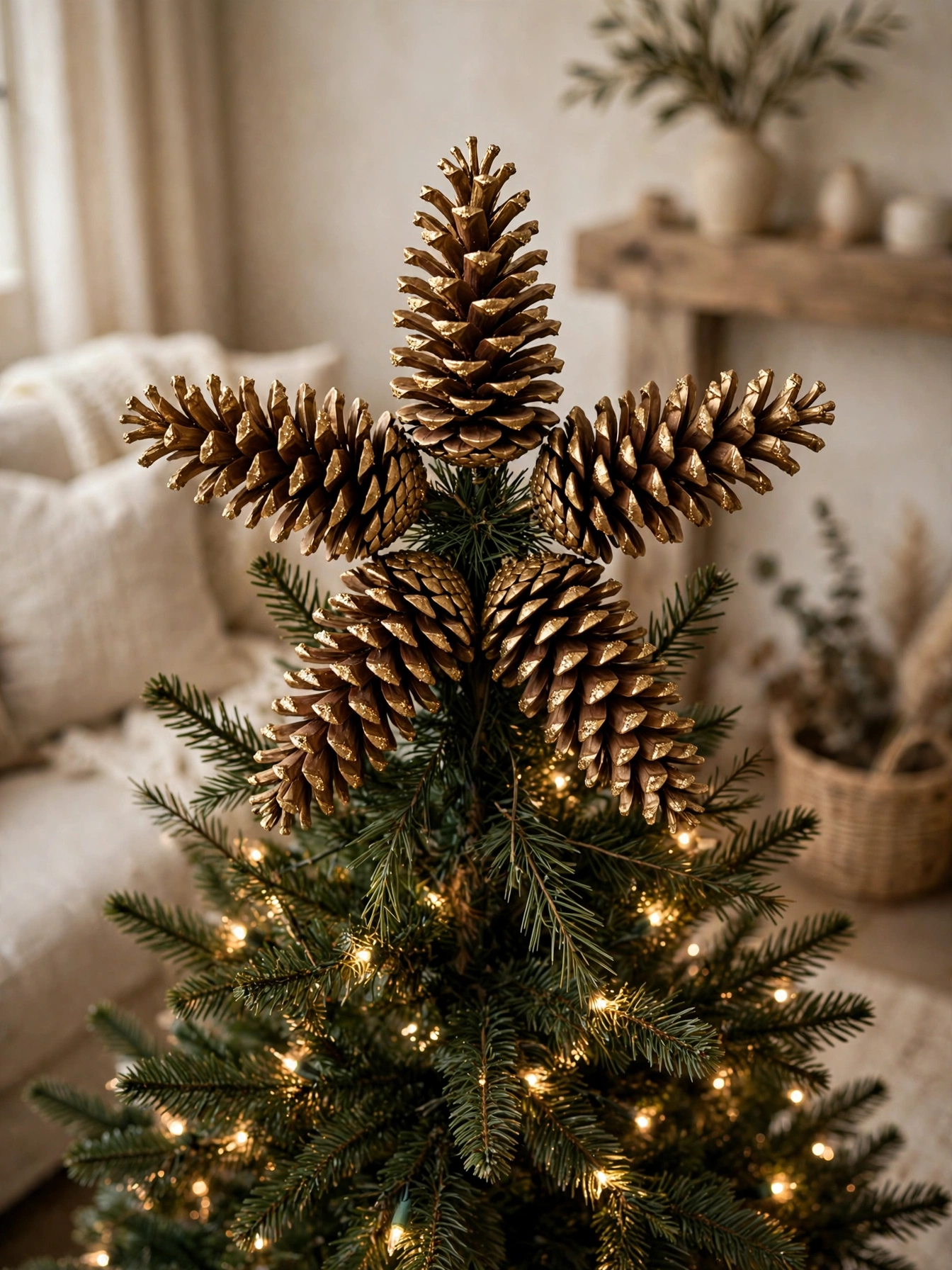
Gilded Pinecone Cluster Topper
Why This Works:
- Five pinecones at 4 to 6 inches each fill the crown without blocking the top 12 inches of branches
- Gold paint on real pinecones catches light at every angle because no two scales face the same way
- The cluster weighs 7 to 11 ounces total, inside the 1-pound crown limit
- Real pinecones cost $0 to $5 gathered, so the whole topper can come in under $12 with paint
Gather pinecones 4 to 6 inches long and bake them at 200 degrees Fahrenheit for 45 minutes on a foil-lined tray to kill insects and open the scales. Spray with two light coats of metallic gold, holding the can 10 inches away to avoid drips that pool between scales. Wire the five cones to a 6-inch grapevine or wire ring with 18-gauge floral wire, then tie the ring to the trunk with a second wire loop. Compared with a store-bought pinecone topper at $30 to $50, a gathered cluster costs a fraction and lets you control the exact gold tone. Pinecones are among the most forgiving natural decor materials because their irregular shape hides small mistakes.
Gilded pinecone clusters suit nature-themed trees with burlap, wood, and dried fruit ornaments. The gold elevates the natural material just enough to read as holiday rather than woodland. The trade-off is shedding: dry pinecones drop a few scales over a month, so place a small tray or the tree skirt directly below the crown to catch them. In humid rooms, pinecones slowly close their scales, which softens the starburst shape; a light coat of clear matte sealer before mounting locks the scales open. Keep the cluster 4 inches from any heat vent so the cones do not dry out and become brittle.
Pro Tip: Mix one 6-inch cone in the center with four 4-inch cones around it. The size step makes the cluster read as a designed burst instead of a pile.
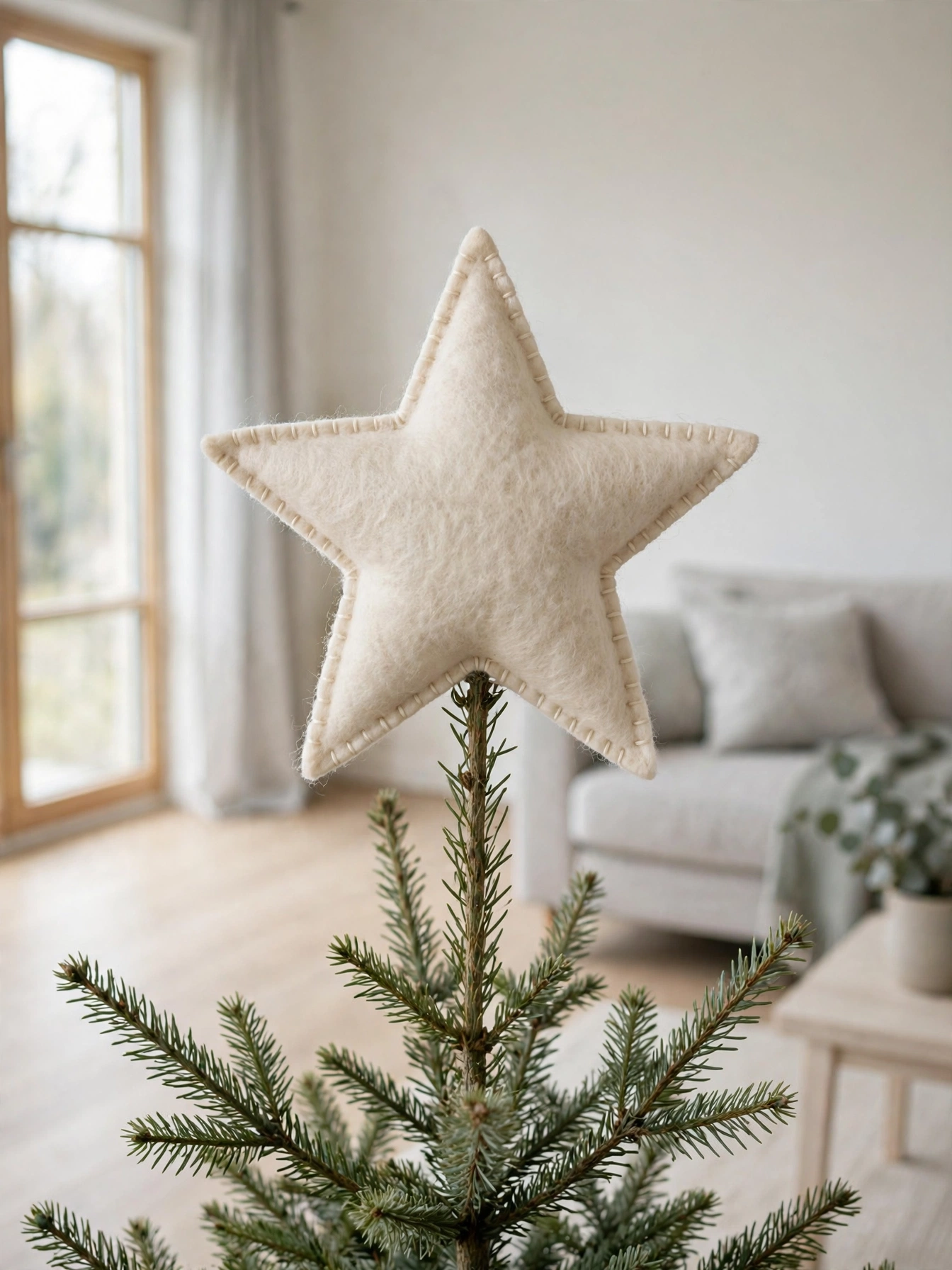
Nordic Felt Star Topper
Why This Works:
- Wool felt weighs 2 to 4 ounces, so even a sparse pencil-tree crown holds it without bending
- A 10-inch felt star reads as soft sculpture, not decoration, which suits minimalist rooms
- Cream felt reflects tree light gently instead of flashing, keeping the crown quiet
- Hand stitching hides the mounting wire inside the star’s bottom point
Choose 3-millimeter wool felt, not craft felt. Wool felt holds a crisp star point for years, while polyester craft felt softens and flops within one season. A handmade felt star costs $20 to $35; DIY takes one 12-inch square of felt, a star template, and 30 minutes with a needle. Stitch the two star faces together with a blanket stitch, leaving the bottom point open to slide over the trunk. Compared with a glitter star, felt never sheds sparkle onto the carpet and suits homes where a quiet tree beats a loud one. Felt toppers suit Scandinavian Christmas roundups for their restraint: one soft shape at the crown anchors a minimal tree better than a glittering one.
Felt stars suit trees decorated with paper ornaments, wooden beads, and a single strand of lights. The crown stays calm, which lets a few good ornaments do the talking. The limitation is scale on large trees: on a 9-foot tree, a 10-inch felt star can look lost, so size up to 13 inches for trees over 8 feet. Felt also absorbs cooking odors if the tree stands near the kitchen, so air it outside for an hour after the season before storing. If you want a touch more presence, add one small brass bell at the star’s center point.
Pro Tip: Stuff the star with a thin layer of quilt batting before closing the last seam. Batting keeps the points firm and stops the felt from creasing in storage.
Mercury Glass Ball Topper
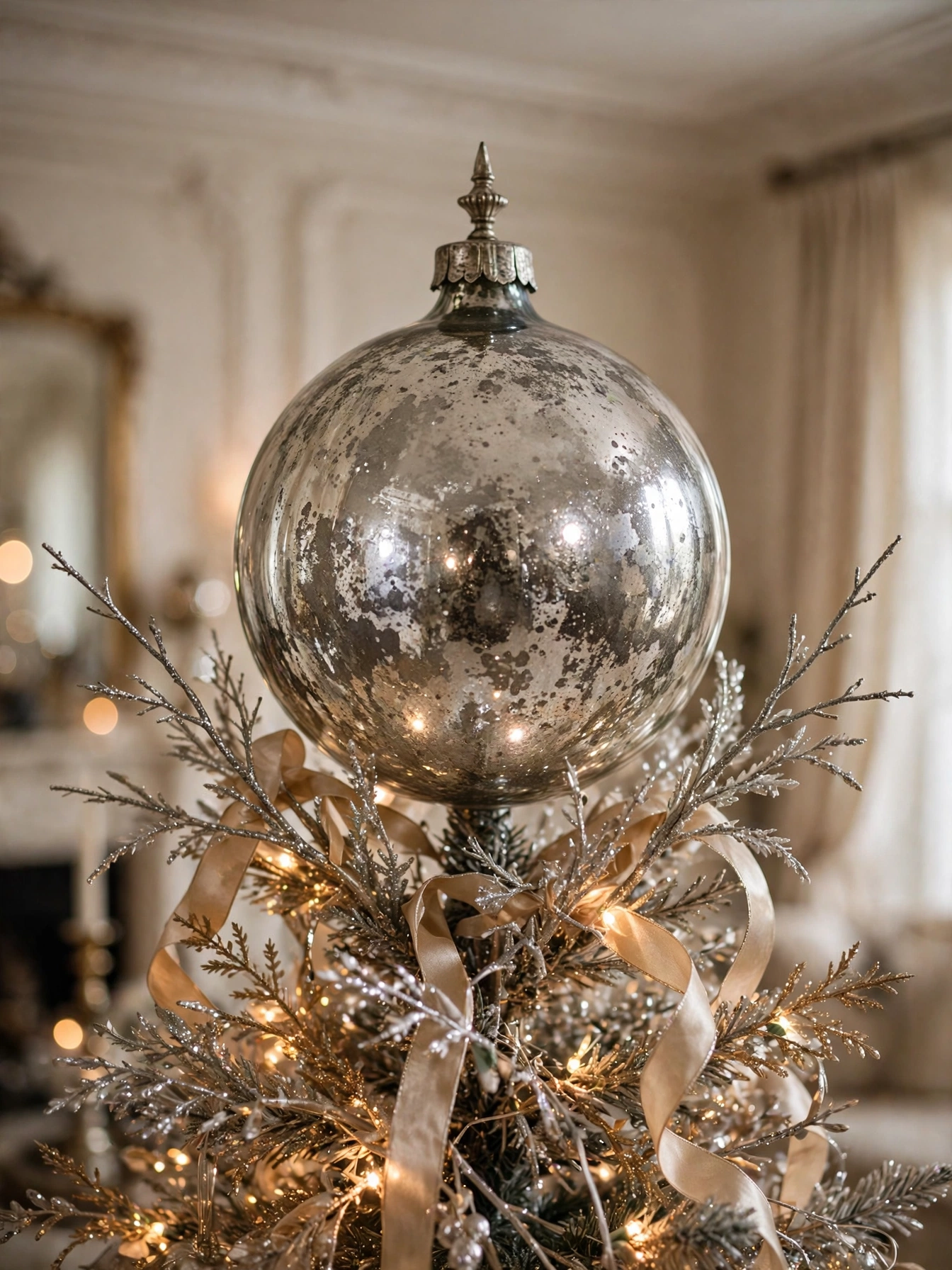
Why This Works:
- An 8-inch mercury glass ball mirrors the whole room in miniature, doubling the crown’s visual weight
- The mottled silver finish hides dust and fingerprints far better than polished chrome
- At 9 to 13 ounces, it sits just inside the 1-pound crown limit on healthy real trees
- One large ball replaces a star, angel, and finial in a single confident shape
Buy mercury glass, not spray-painted silver plastic. True mercury glass has a double-wall construction with silvering between the layers, which gives depth; painted copies look flat under tree lights. Vintage mercury balls cost $30 to $70 at antique shops, while new reproductions run $18 to $35. Mount the ball on a 4-inch metal spike pushed into the trunk tip, not on a branch hook, because a swinging 8-inch ball will crack ornaments below it. Compared with a star topper, a ball reads as modern and sculptural, which suits trees with oversized ornaments and minimal garland. Keep the ball 2 inches above the highest branch ring so it floats cleanly instead of tangling in needles.
Mercury glass suits silver, champagne, and blush trees where reflective surfaces already dominate. The ball becomes a mirror for the room’s lights, so it looks different at noon and at 8 PM. The trade-off is fragility combined with weight: a 13-ounce glass ball falling from 7 feet can dent a hardwood floor and shatter. In homes with active pets or toddlers who shake the tree, choose a shatterproof acrylic ball at $15 to $25 with the same speckled finish. Wipe the ball with a dry cloth before mounting; every fingerprint shows on mercury glass under a spotlight.
Pro Tip: Place one warm white bulb 3 inches directly below the ball. The bulb’s reflection in the mercury glass creates a glowing halo effect with no extra wiring.
Fiber-Optic Starburst Topper

Why This Works:
- Forty fiber strands at 12 inches each create a 32-inch halo of light around the crown
- LED fiber optics run cool, so the strands can touch dry branches without a heat risk
- The topper draws 3 to 5 watts, less than a single old incandescent bulb
- Color-changing tips cycle through warm white, red, and green on one remote setting
Pick a fiber-optic topper with a wired base that plugs into the tree’s light string, not a battery unit. Plug-in units run all evening without fading, while battery units dim after 4 to 6 hours. Prices run $25 to $50 for a 40-strand topper with a remote. Secure the base to the trunk with two zip ties, since the strand weight pulls the topper sideways over a week if it rests on branches alone. Compared with a traditional lit star, fiber optics spread light outward into the room instead of concentrating it in one shape, which makes the crown glow like a sparkler. LED fiber optics suit decorative use because they emit no UV and stay cool enough for direct contact with textiles.
Fiber-optic starbursts suit modern trees, kids’ rooms, and anyone who wants the crown to be the brightest point in the room. The moving color cycle reads as celebration, not calm, so skip it on a serene white-and-gold tree. The limitation is the plug: the topper needs an outlet or a light-string tap within 6 feet of the crown, which means planning the light layout before the topper goes on. If your tree lights end 3 feet below the crown, add one 6-foot extension cord rated for indoor use. Hire an electrician if you need a new outlet installed rather than running cords across a walkway; the National Electrical Code discourages extension cords as permanent wiring.
Pro Tip: Set the remote to steady warm white for the first hour of the evening, then switch to color cycle after dinner. The calm-to-festive shift feels like a second tree reveal.
Christmas Tree Toppers Ideas 2026: Monogram Letter Topper
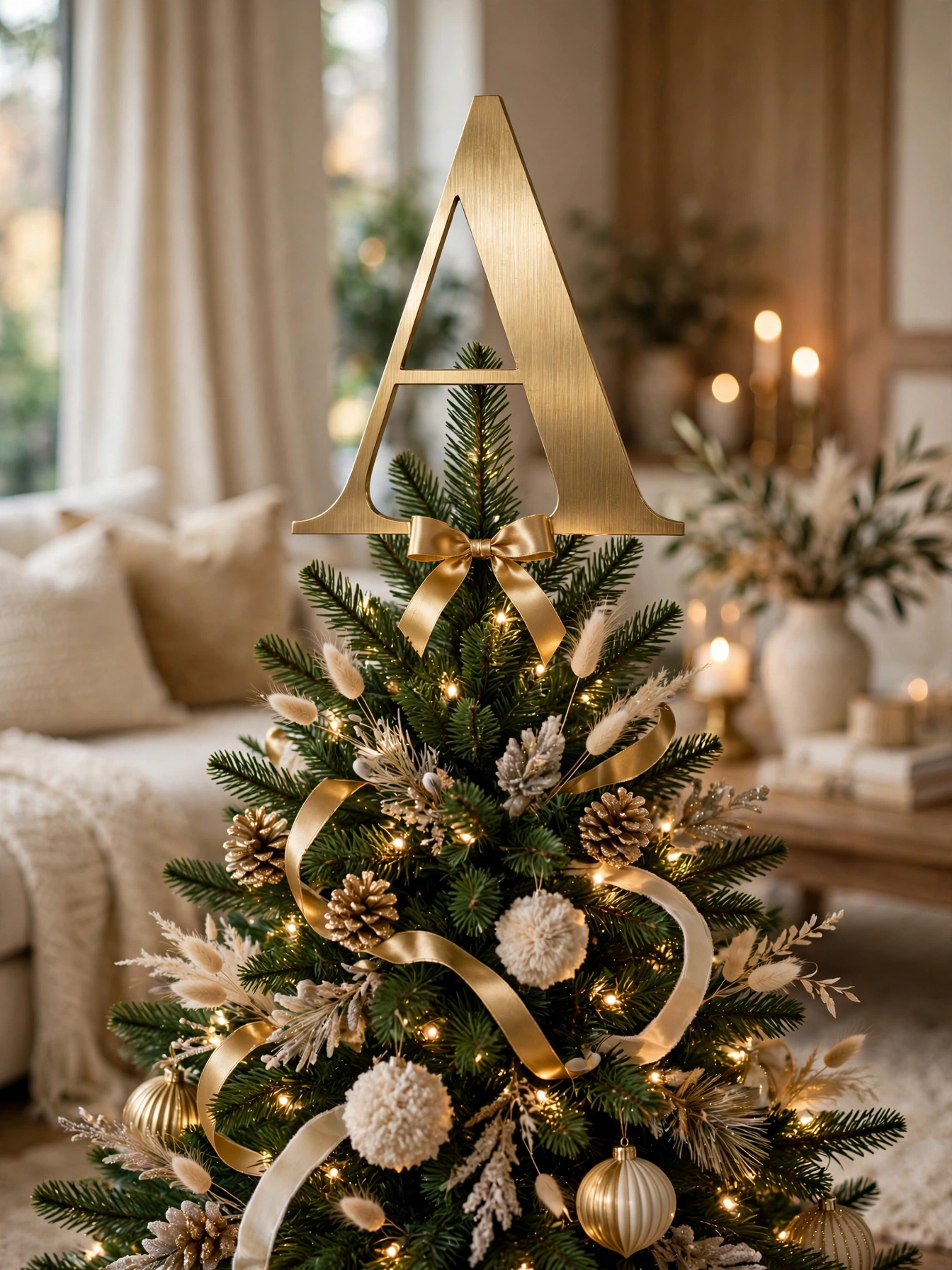
Why This Works:
- A 12-inch initial personalizes the tree more than any ornament because it is the first thing guests read
- Brushed gold metal at 10 to 14 ounces stays under the crown weight limit on most trees
- The flat letter profile reads clearly from 15 feet away, unlike fussy figurines
- One letter works for a family name, a couple’s shared initial, or a child’s first Christmas
Order a letter cut from 16-gauge steel or aluminum, not thin craft tin. The heavier gauge keeps the letter flat against the trunk and resists bending when the tree gets bumped. Custom metal letters cost $35 to $65 depending on size and finish; a painted wooden letter runs $15 to $25 and suits a farmhouse tree. Attach with two screws through pre-drilled holes into a 6-inch mounting dowel, then lash the dowel to the trunk with floral wire. Compared with a star, a monogram turns the tree into a family statement piece, which guests remember long after the ornaments blur together. Keep the letter 2 inches clear of the nearest branch so the shape reads as a single clean character.
Monogram toppers suit families who already personalize stockings and gift tags with the same initial. The crown letter ties the whole tree to the household. The trade-off is longevity of taste: a letter is forever, while a star can rotate through themes. If you redecorate in a different palette next year, the same letter still works because metal finishes pair with almost any color scheme. In rental homes where the tree moves rooms yearly, a monogram travels well because it needs no theme to make sense. Store it flat between two sheets of cardboard so the edges stay crisp.
Pro Tip: Match the letter finish to your curtain hardware, not your ornaments. Brushed gold letters with brass curtain rods look intentional; gold letters with chrome rods clash at a glance.
Boxwood Mini Wreath Topper

Why This Works:
- A 10-inch wreath ring sits flat around the trunk, so it cannot tip, lean, or fall
- Fresh boxwood holds its green color 3 to 4 weeks indoors with weekly misting
- The ring shape leaves the trunk tip visible, which reads as natural rather than decorated
- At 8 to 12 ounces, a boxwood wreath stays inside the crown weight limit
Build the wreath on a 10-inch wire ring, wiring 6-inch boxwood sprigs in overlapping bunches until no wire shows. A fresh boxwood wreath costs $20 to $35; a preserved boxwood version runs $30 to $50 and lasts three or more seasons. Slip the finished ring over the trunk tip and rest it on the top branch ring, tying it with one wire loop so it cannot slide down. Compared with a star or angel, a wreath topper reads as garden, not holiday, which suits homes that prefer greenery over symbols. Boxwood holds up better than any other fresh greenery indoors because its small, waxy leaves lose moisture slowly.
Boxwood wreath toppers suit nature-first trees with pinecones, dried oranges, and wooden ornaments. The crown looks like the tree grew a wreath. The limitation is drying: boxwood in a heated room near a vent crisps within 10 days, so keep the tree 6 feet from heat sources and mist the wreath twice a week. If fresh greenery feels like too much upkeep, a preserved boxwood ring gives 90 percent of the look with zero misting. Tuck three red berry picks into the ring for a holiday color pop that costs under $4.
Pro Tip: Mist the wreath on the same day you water the tree. Pairing the two chores means the wreath never gets forgotten in the weekly routine.
Ostrich Feather Plume Topper

Why This Works:
- Plumes 16 to 18 inches tall add height without weight, since seven feathers total under 3 ounces
- Feathers move gently in room air currents, so the crown looks alive in a way rigid toppers cannot
- Cream and blush feathers pair with white, champagne, and rose-gold trees
- The spray shape fills a wide 14-inch circle, covering sparse crowns completely
Buy ostrich feathers 16 to 18 inches long in bundles of five to seven; a quality bundle costs $15 to $30. Tape the quills together into a fan, then bind the fan to a 6-inch wooden dowel with gold floral tape. Push the dowel into the trunk tip and secure it with one wire loop. Compared with a star, a feather plume reads as couture rather than Christmas, which suits adults-only homes and New Year’s parties where the tree stays up into January. Keep feathers 12 inches from any open flame or candle, since feathers ignite quickly. Feather decor and open flames should never share a room, so flameless candles only anywhere near this topper.
Feather plumes suit white, blush, and champagne trees where softness matters more than sparkle. The crown becomes a cloud, not a point. The trade-off is static: feathers attract dust and cling together in dry heated air, so a light pass with a hair dryer on cool, 12 inches away, separates them again. In homes with cats, feathers are irresistible toys; mount the plume high and keep the tree in a room that closes. Store feathers flat in a garment bag, never crushed in a box, or they lose their curl permanently.
Pro Tip: Spray the finished plume once with unscented hairspray from 14 inches away. The light hold keeps feathers separated and stops them from collapsing onto each other by week two.
Copper Geometric Star Topper

Why This Works:
- An open wireframe star weighs 4 to 6 ounces, half the weight of a solid brass star
- The geometric lines echo modern interiors with black metal, glass, and clean angles
- Copper warms under tree lights, shifting from penny-bright to honey-gold by evening
- An 11-inch frame suits trees 6 to 8 feet tall at the usual 1-to-8 ratio
Look for wireframe stars built from 10-gauge copper wire, not thin craft wire. The heavier gauge holds its angles when bumped, while thin wire bends permanently at the first touch. Copper geometric stars cost $20 to $40 from metalwork shops and $12 to $20 from big-box stores. Mount with the star’s bottom point wired to the trunk, since wireframes have no sleeve. Compared with a solid star, the open frame lets the wall color show through, so the topper never blocks the room’s backdrop. Wipe copper with a lemon-juice cloth before mounting to remove tarnish; the shine lasts about three weeks indoors before dulling again.
Geometric copper stars suit modern trees with matte ornaments, negative space, and a restrained palette. The crown reads as architecture, not decoration. The limitation is visibility: an open frame can disappear against a busy patterned wall, so test it at night with the tree lights on before committing. If the star vanishes against wallpaper, switch to a solid brass star or add one micro light clipped 4 inches below it. Copper pairs naturally with emerald green and navy trees, where the warm metal pops against cool foliage.
Pro Tip: Thread one 20-light copper-wire micro string through the star’s frame. The lights inside the geometry make the copper glow from within for about $6.
Flocked Branch Spray Topper

Why This Works:
- A spray 18 to 20 inches tall adds snowy height without a single heavy ornament
- Flocked branches weigh 4 to 7 ounces total, safe for even the thinnest pencil-tree crowns
- The irregular branch shape hides a sparse or crooked crown better than any rigid topper
- White flocking ties a green tree to a white Christmas theme in one move
Gather five branches 16 to 20 inches long and spray them with two coats of flocking spray, holding the can 12 inches away for a snow-dusted finish rather than a solid white coat. A can of flocking spray costs $8 to $12 and covers the full spray with room left over for the tree. Wire the branch bases into a fan shape, then bind the fan to a 6-inch dowel and lash the dowel to the trunk. Compared with a star, a branch spray reads as though the tree kept growing upward into snow, which suits woodland and rustic themes. Keep flocked branches 6 inches from heat vents, since dry heat loosens flocking and leaves white dust on the ornaments below.
Flocked sprays suit trees already carrying snow-tipped ornaments, white lights, and wood or burlap accents. The crown becomes a snowy thicket. The trade-off is mess: flocking sheds for the first 48 hours after spraying, so spray the branches outdoors and let them cure overnight before mounting. In homes with white carpet, lay a sheet under the tree for the first two days to catch stray flocking. A spray also suits flocked trees where a hard topper would look glued on.
Pro Tip: Spray the branch undersides first, let them dry 20 minutes, then spray the tops. Flocking the hidden side first stops drips from running onto the visible side.
Plaid Ribbon Star Topper
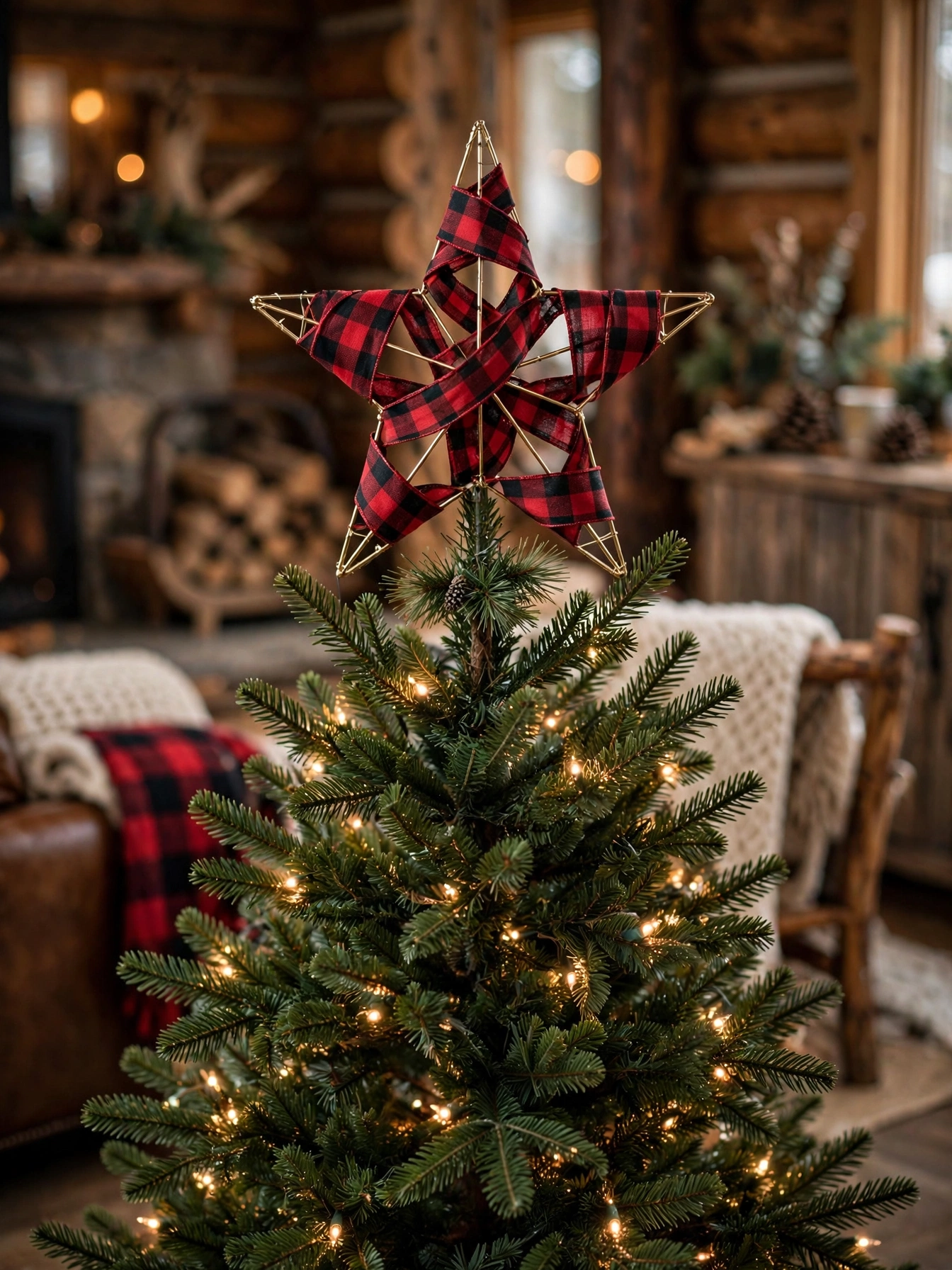
Why This Works:
- Wrapping a wire star in plaid ribbon turns a $6 frame into a $30-looking topper
- Buffalo plaid reads from 15 feet away, so the crown stays visible across an open-plan room
- The finished star weighs 5 to 8 ounces, inside the 1-pound crown limit
- Plaid pairs with flannel stockings, wood ornaments, and a lodge or cabin palette
Start with an 11-inch wire star frame from a craft store ($4 to $7) and one 10-yard spool of 2.5-inch buffalo plaid ribbon ($8 to $12). Wrap the ribbon around each star point, overlapping by half an inch, and secure the ends with hot glue on the back side only. The whole build takes about 25 minutes. Compared with a store-bought plaid star at $25 to $40, the DIY version costs under $15 and lets you match the exact plaid of your stockings. Keep the ribbon taut as you wrap; loose ribbon sags by week two and shows the wire underneath. Repeating one pattern at three scales (topper, stockings, tree skirt) is the simplest way to make a tree look professionally styled.
Plaid ribbon stars suit lodge, cabin, and farmhouse trees where the palette already runs red, black, and cream. The crown ties directly to the stockings below. The limitation is pattern fatigue: if the tree already carries plaid ornaments, a plaid topper tips the tree into costume territory. In that case, wrap the star in solid red ribbon instead and let the ornaments carry the plaid. In homes with a modern palette, skip plaid entirely; the same wire frame wrapped in solid navy ribbon reads as tailored rather than rustic.
Pro Tip: Glue a 4-inch pine sprig across the star’s bottom point after wrapping. The sprig hides the ribbon ends and makes the topper look store-finished.
Ceramic Dove Topper

Why This Works:
- A dove’s 10-inch wingspan fills the crown horizontally, balancing tall narrow trees
- White ceramic reflects tree lights softly, so the crown glows without a bulb
- At 9 to 12 ounces, ceramic sits just inside the 1-pound crown limit
- The dove reads as peace, which suits multifaith and secular trees better than an angel
Choose a dove with a hollow cone base that slides over the trunk tip. A cone mount keeps the bird level, while a flat-foot dove needs constant rebalancing. Hand-glazed ceramic doves cost $30 to $60; molded resin lookalikes run $12 to $20 and survive a fall that would shatter ceramic. Position the dove facing the room’s main entrance, since the wings read best from the front and look thin from behind. Compared with an angel, a dove carries no religious weight, so it suits households that decorate for the season without a nativity theme. Keep the dove 3 inches clear of the nearest branch so the wings do not catch needles when you straighten ornaments.
Ceramic doves suit white-and-gold trees, trees with olive branches in the garland, and homes that want a gentle crown. The bird becomes the tree’s quiet focal point. The trade-off is the same as any ceramic: one fall ends it. Unbox it over a sofa, and in homes with tree-climbing cats, choose resin. A dove also suits a flocked tree, where its white glaze blends into the snowy branches and reads as a bird resting in snow. Store it in its original foam, since bubble wrap alone will not protect wing tips.
Pro Tip: Tuck one small gold olive branch into the dove’s beak if the piece ships without one. A $3 craft-store branch finishes the symbol and adds a gold accent at the crown.
Christmas Tree Toppers Ideas 2026: Lit Snowflake Crown Topper
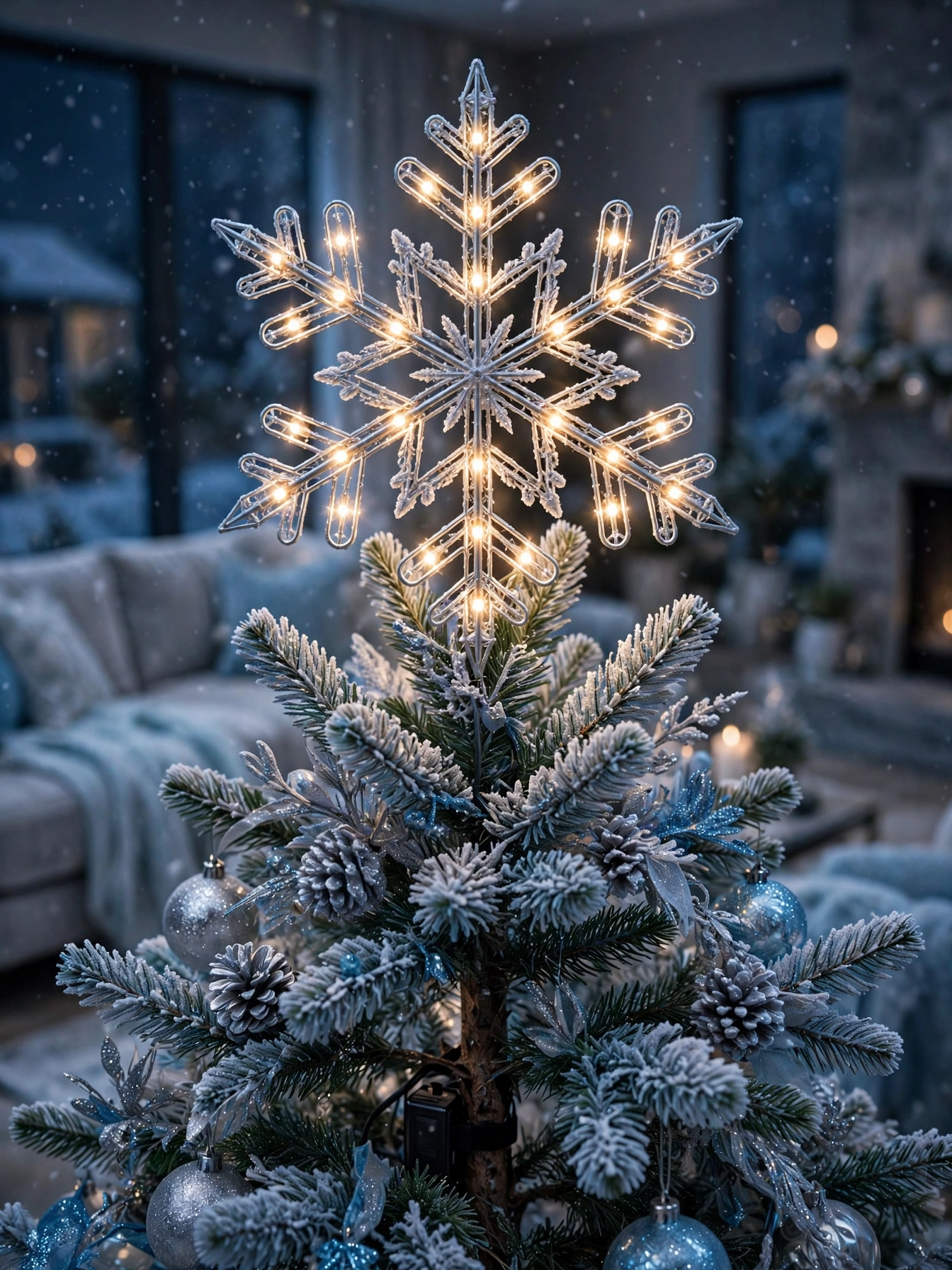
Why This Works:
- Twenty-four LEDs on a 12-inch snowflake make the crown the brightest point of the whole tree
- The battery pack hides behind the trunk, so no cord runs down the tree
- A 12-inch snowflake suits trees 7 to 9 feet tall at the 1-to-7 ratio for lit toppers
- At 11 to 15 ounces with batteries, it needs a firm crown, so test the trunk tip first
Buy a lit snowflake with a 6-hour timer built into the battery pack. Timer models switch off by themselves, while manual models stay on until someone remembers them at midnight. Prices run $30 to $55 for a 24-LED snowflake with a timer. Mount it with the snowflake’s center ring wired to the trunk, not clipped to a branch, because the battery pack’s weight pulls a branch-mounted topper sideways within days. Compared with an unlit snowflake, the lit version works in dark rooms where crystal goes quiet; the LEDs do the sparkle work that daylight used to do. Warm white LEDs at 2700K suit holiday decor because they flatter skin tones and wood finishes in the same room.
Lit snowflakes suit blue, silver, and white trees where cool light already sets the mood. The crown glows like a streetlamp over the tree. The limitation is battery life: 24 LEDs on two AA batteries run about 60 hours of continuous use, so the timer matters. Without a timer, expect fresh batteries every five days. In homes where the tree lights run on a smart plug, a plug-in lit snowflake at $35 to $60 beats batteries entirely, since it follows the same schedule as the rest of the tree. Never splice a topper into a light string with wire nuts; use the manufacturer’s connector.
Pro Tip: Set the snowflake timer to start 30 minutes before the tree lights. The crown glowing alone for half an hour each evening feels like a nightly tree-lighting ceremony.
Beaded Spiral Topper

Why This Works:
- A 15-inch spiral adds height without bulk, since the open coil lets wall color show through
- Graduated beads, 8 millimeters at the base to 4 millimeters at the tip, create a tapered silhouette
- The coil weighs 6 to 9 ounces, safe for most crowns
- Gold and crystal beads catch light at every angle, so the spiral sparkles as you walk around the tree
Build the spiral from 16-gauge gold craft wire, coiling it around a 2-inch dowel to set the shape, then threading beads before closing the top loop. A DIY beaded spiral costs $12 to $20 in beads and wire; ready-made versions run $30 to $55. Anchor the spiral’s base wire to the trunk with two wraps of floral wire, since a coil topper catches air currents and sways. Compared with a finial, a beaded spiral reads as jewelry rather than sculpture, which suits trees with beaded garlands and crystal ornaments. Keep the spiral 2 inches off-center toward the room’s main viewing angle so it catches the most light.
Beaded spirals suit art deco, gold-and-white, and champagne trees where sparkle is the whole point. The crown becomes a piece of jewelry. The trade-off is tangling: a spiral stored loose in a box will knot around every ornament in the same bin. Store it in its own tall gift bag, standing upright, with tissue paper around the coil. In homes with toddlers who grab at shiny things, mount the spiral high enough that the lowest bead sits 6 feet off the floor. If the coil wobbles in a draft, add one more wire wrap at the mid-point of the trunk.
Pro Tip: Mix three bead sizes in a repeating 3-2-1 pattern (three large, two medium, one small) instead of a smooth gradient. The rhythm catches the eye better than a perfect taper.
Birch Twig Star Topper

Why This Works:
- Pale birch twigs read as winter branches, so the topper looks grown, not manufactured
- A woven twig star weighs 5 to 8 ounces, light enough for any real-tree crown
- At 11 inches, this star keeps the right proportion on a 6- to 8-foot tree, about one eighth of the tree’s height
- Twine-wrapped joints hide the construction and add a handmade finish
Weave the star from birch twigs 3 to 5 millimeters thick, soaking them in warm water for 30 minutes first so they bend without snapping. A handmade twig star costs $10 to $18 in materials; ready-made versions run $22 to $38. Tie the five points with jute twine and lash the finished star to the trunk with a second twine loop. Compared with a reclaimed wood star, a twig star reads as lighter and airier because the open weave shows the wall behind it. Keep the star 1 inch below the trunk tip so the top branch pokes through the weave slightly, which sells the grown-not-made look. Birch is one of the most stable craft woods indoors because it resists warping as humidity changes.
Twig stars suit woodland, Scandinavian, and nature-first trees with wooden beads and dried fruit. The crown looks like the tree’s own branches formed a star. The limitation is brittleness after a dry season: twigs stored in a hot attic can snap when bent, so store the star flat in a cool closet. If a point breaks, re-tie it with twine rather than glue; twine matches the handmade look, while glue shines under tree lights. A twig star also suits a flocked tree, where its pale bark echoes the snowy branches.
Pro Tip: Weave one thin strand of warm white micro lights through the twig lattice. Ten bulbs hidden in the weave make the star glow like a lit branch for about $5.
Heirloom Brooch Cluster Topper
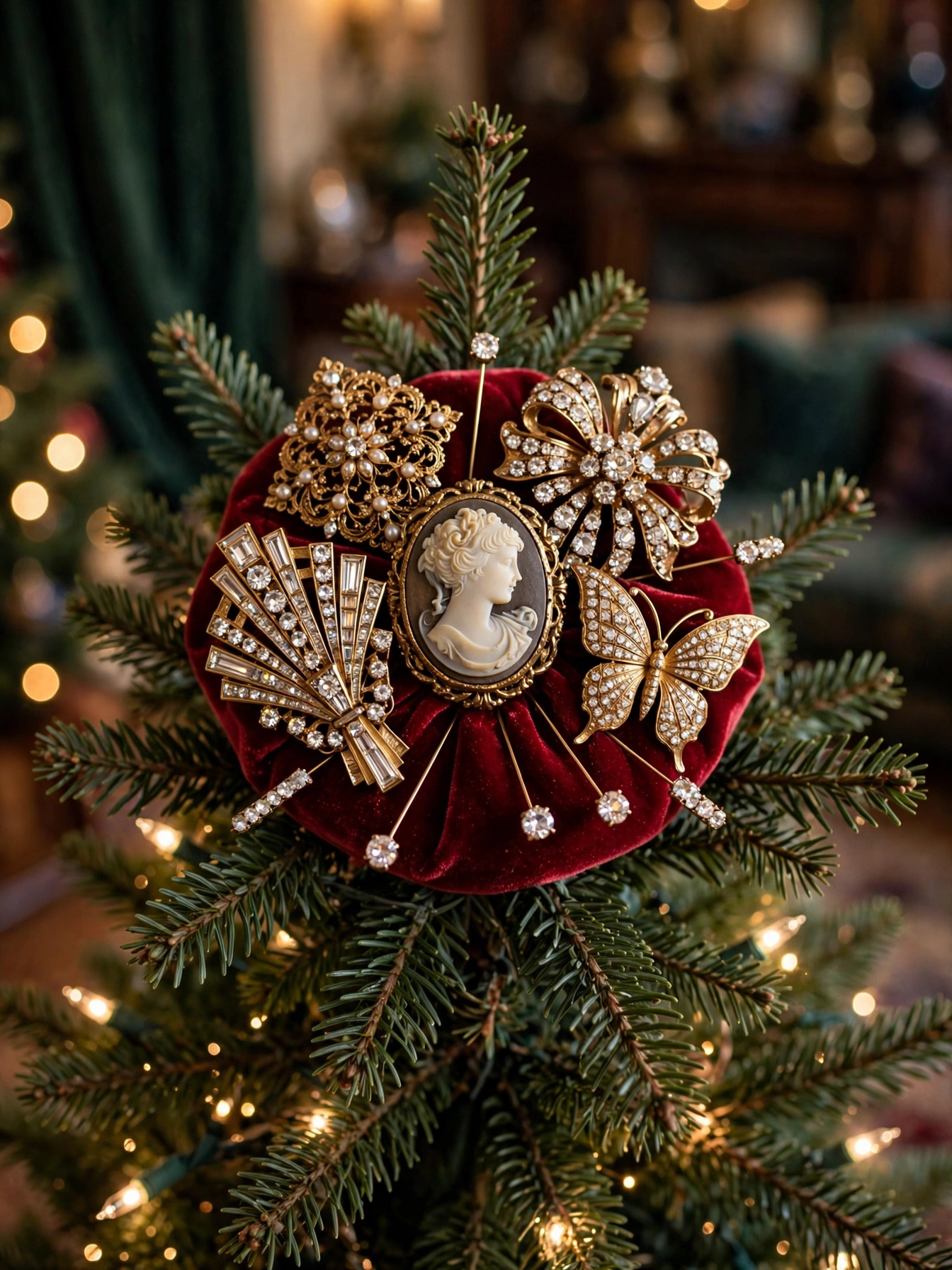
Why This Works:
- Five brooches from different decades make the topper a conversation piece no store can replicate
- A 9-inch velvet base holds the cluster flat, so the topper reads as one designed object
- Total weight runs 8 to 12 ounces, inside the 1-pound crown limit
- Rhinestones and gold pins catch tree light from every direction, so the crown sparkles without bulbs
Start with a 9-inch circle of stiff cardboard wrapped in deep red or black velvet. Pin five brooches through the velvet in a loose cluster, largest in the center, then back the cardboard with a 6-inch dowel for mounting. Thrifted brooches cost $2 to $8 each, so the full topper lands at $15 to $40 plus an hour of arranging. Compared with a store-bought topper, a brooch cluster carries family history: a grandmother’s cameo beside a flea-market rhinestone pin tells a story no catalog can match. Pin through the velvet into the cardboard twice per brooch so no piece rotates loose over the season. Keep the cluster 2 inches clear of the nearest branch so the pins do not snag needles.
Brooch clusters suit jewel-tone trees, vintage-themed trees, and anyone with a jewelry box of inherited pieces. The crown becomes a small museum. The trade-off is value: if any brooch is genuinely valuable, pin a costume copy to the tree and keep the original in a safe place, since a falling topper can lose stones. In homes with small children, mount the cluster with two wire loops and keep the tree in a room that closes at night. Photograph the arrangement before disassembly so next year’s rebuild takes 10 minutes instead of an hour.
Pro Tip: Photograph each brooch’s pin back before mounting. The photo proves the clasp type if a pin loosens mid-season and you need a matching replacement.
FAQs
Which size topper works best for christmas tree toppers ideas 2026 on a 7-foot tree?
Plan on a topper 10 to 12 inches tall for a 7-foot tree, following the 1-to-8 topper-to-tree ratio. Keep the total weight under 1 pound, since most crown branches hold 16 ounces safely. Measure the trunk tip diameter before buying, because finials and cone mounts need a trunk under 1 inch thick.
How do I keep a topper from leaning?
Lash the topper to the trunk with two wraps of floral wire, not one, and check it after 48 hours. A single wire loosens as the trunk dries and shrinks up to half an inch. Test by tapping the tree base gently; if the topper sways more than 1 inch, add a second wire lower down.
Are lit toppers safe to leave on overnight for christmas tree toppers ideas 2026?
LED and fiber-optic toppers are safe on a timer because they run cool and draw under 5 watts. Turn off all tree lights before bed or when leaving home. Use a smart plug or built-in timer set for 6 hours on, and never leave incandescent toppers running unattended.
What is the weight limit for a tree topper?
Most healthy real trees hold 16 ounces at the crown, while slim and pencil trees hold 8 to 10 ounces. Weigh the topper on a kitchen scale before mounting; a 14-ounce star feels light in your hand but tests a slim crown. Artificial trees hold more, usually 24 ounces, because the pole runs the full height.
Can I use the same topper on an artificial tree and a real tree?
Yes, with one change: artificial trees have a metal pole tip, so cone mounts slide on easily, while real trees need the trunk trimmed to under 1 inch. Check the pole diameter first, since some artificial trees use a 1.25-inch pole that rejects standard finial sleeves. A wire-lashed topper transfers between both tree types with zero changes.
Conclusion
These 21 christmas tree toppers ideas 2026 come back to three takeaways: size the topper to the tree with the 1-to-8 ratio, keep the weight under 1 pound, and lash it to the trunk with two wires, not one. Your first action tonight is simple: measure the crown and weigh the topper you already own before you decorate another branch. Follow HomelyCrafter on Pinterest for more ideas. Save this to your Pinterest boards so you can refer back to it!

Muhammad Israr is a home decor enthusiast and the writer behind Homely Crafter. He spends his days researching paint colors, layouts and budget-friendly styling ideas, then breaks them down into practical, easy-to-follow guides so you can decorate with confidence.