
Your windows are the only Christmas decor your neighbors see every single night. The tree glows for your family, the mantel shines for your guests, but the windows work a double shift: a warm display for the street after dark and a framed scene for you every morning. That is why these christmas window decor ideas for 2026 treat each window as its own small stage, not a leftover surface.
You will get 23 complete window ideas, each with exact measurements, hanging methods, costs, and what to avoid. Every idea works from both sides of the glass, because a window display that looks great indoors and messy outdoors is only half finished.
Start with the window your street sees first, then work inward. One well-dressed window beats five half-dressed ones, and the first one teaches you the measurements for the rest.
Warm Curtain Light Cascade

Why This Works:
- A 300-light curtain string covers a 48-inch by 60-inch window at 3-inch spacing with no gaps
- Warm white LEDs at 2700K read as candlelight through glass, while cool white reads as a shop display
- Hanging the curtain 2 inches inside the frame doubles the glow through reflection in the glass
- LED curtain lights draw 4 to 6 watts, so a full window display costs pennies per evening
Hang the curtain from a tension rod or four suction-cup hooks rated for 2 pounds each, spaced 12 inches apart across the top of the frame. A standard 10-foot by 5-foot curtain string (300 LEDs) costs $18 to $28 and fits most living room windows with one string. Tuck three 8-inch pine sprigs along the sill to ground the light in greenery. Avoid adhesive hooks on cold glass, since the bond fails below 40 degrees Fahrenheit; suction cups or a tension rod hold reliably through the season. Compared with plug-in icicle strands, a curtain string gives even coverage with no drips or tangles, and the vertical lines photograph beautifully from the street. 2700K suits living spaces because it flatters skin tones and wood finishes.
Curtain light cascades suit living rooms and dining rooms where the window is the room’s largest surface after dark. The display works from the sidewalk too, which gives you curb appeal without a single outdoor staple. The trade-off is daytime appearance: a curtain string looks like thin wire in daylight, so keep it tight to the glass and hide the top rail behind the curtain rod. In bedrooms, put the curtain on a timer that switches off by 10 PM, since 300 bulbs will keep light sleepers awake. If the window faces a streetlamp, the glow competes; a sheer curtain behind the lights softens the competition.
Pro Tip: Run the curtain lights on a smart plug set to switch on 30 minutes before sunset. The window lights itself as the sky darkens, and you never touch a switch all season.
Frosted Spray Snow Scene

Why This Works:
- One $6 can of frosted spray snow covers the lower third of a 36-inch by 48-inch window
- Cardboard stencils cut from cereal boxes create crisp house and tree silhouettes for free
- The frost layer diffuses streetlight, so the window glows softly instead of glaring
- Spray snow wipes off with warm water and vinegar in under 10 minutes in January
Cut house, tree, and church shapes from cereal-box cardboard, tape them to the inside of the glass, then spray the frost from 10 inches away in two light passes. Peel the stencils off while the second coat is still tacky for the sharpest edges. One can covers three average windows. Compared with static-cling snow scenes at $12 to $18 per window, spray snow costs a third as much and lets you design your own skyline. Avoid spraying the full window, since a fully frosted window blocks daylight and makes the room feel like a cave; the lower third gives the scene while the upper glass stays clear. Keep the spray 4 inches from the window edges so the seal stays clean.
Frosted spray scenes suit families with kids, who can cut their own stencils and claim a window each. The display reads as handmade from the street, which beats any store-bought cling for charm. The limitation is condensation: on single-pane windows, moisture collects behind the frost and streaks it within a week. On double-pane windows, the scene lasts the full season. In bathrooms, skip spray snow entirely; steam dissolves it in days. If you want the look without the upkeep, a static-cling scene at $15 per window lasts three seasons.
Pro Tip: Spray a test patch on a bathroom mirror first. The test shows how your can’s nozzle pattern lands, so the real window gets an even coat on the first pass.
Pinecone Sill Garland

Why This Works:
- Nine pinecones in mixed 3-inch to 6-inch sizes fill a 48-inch sill without crowding it
- Jute twine loops let the garland drape naturally instead of lying stiff on the sill
- One 20-light micro string woven through the garland lights every pinecone from below
- A 6-inch-deep sill holds the full display with 2 inches of clear space at the glass
Wire pinecones to a 5-foot length of jute twine with 18-gauge floral wire, spacing them 6 inches apart and alternating sizes for a gathered look. Bake gathered pinecones at 200 degrees Fahrenheit for 45 minutes first to kill insects and open the scales. A gathered garland costs under $10 in materials; a store-bought pinecone garland runs $25 to $40. Weave a 20-light battery micro string through the twine after the pinecones are wired, keeping the battery pack hidden behind the last cone. Compared with a mantel garland, a sill garland gets seen twice: once from inside the room and once from the street after dark. Leave a 2-inch gap between the garland and the glass so condensation drips clear of the twine.
Pinecone sill garlands suit homes with deep sills and a natural palette of wood, linen, and green. The display costs almost nothing and smells faintly of pine for the first week. The trade-off is shedding: dry pinecones drop a scale or two over the month, so brush the sill weekly. In homes with cats, expect batting; a garland set well above floor level weathers the season better than one at paw height. If the sill is narrower than 4 inches, switch to a hanging garland on hooks instead of a resting one.
Pro Tip: Dab one drop of cedar essential oil on the back of three pinecones. The scent carries for a week and makes the whole window smell like a fresh-cut tree.
Lantern Pair in the Window
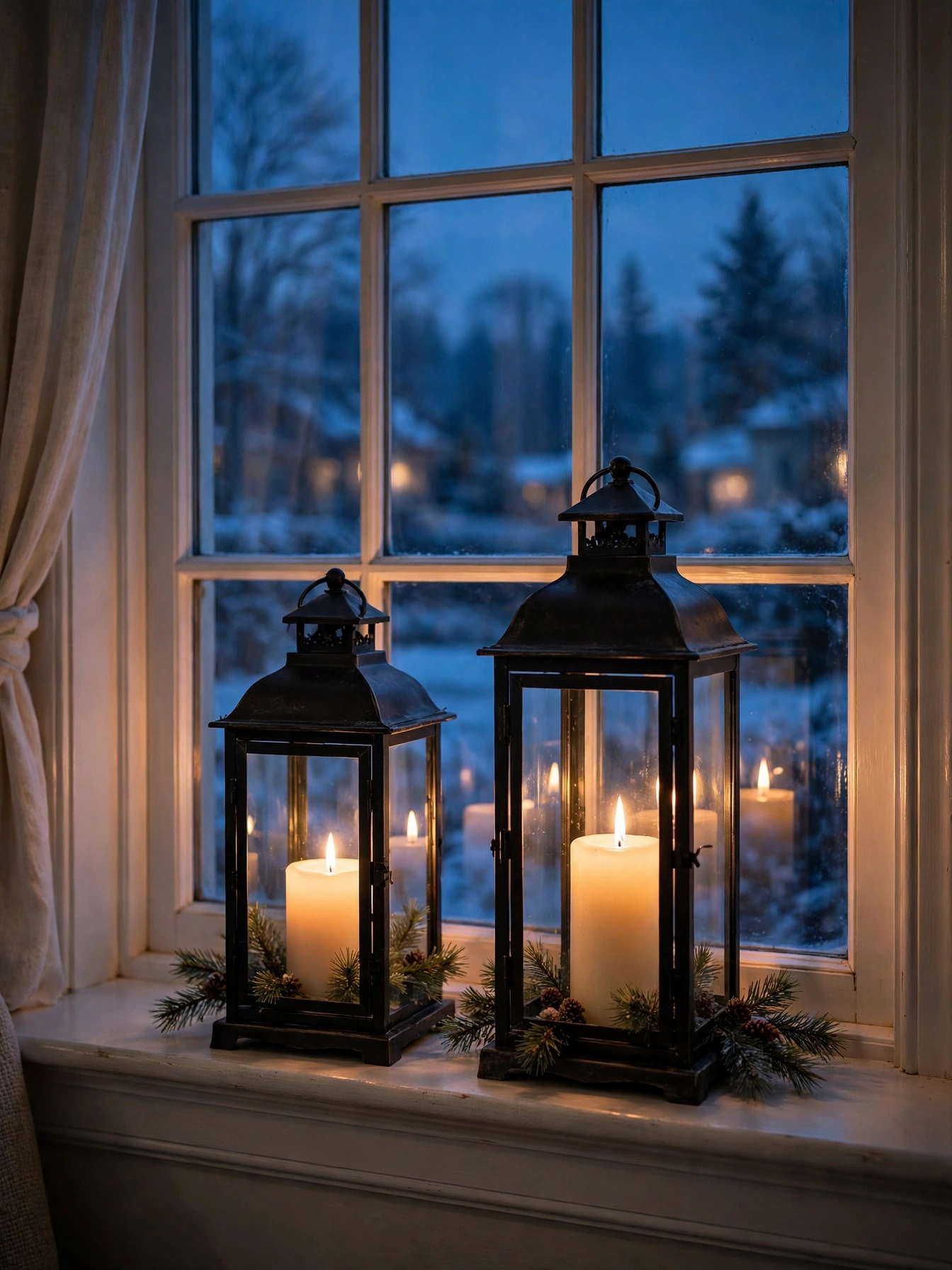
Why This Works:
- Two lanterns at 12 and 14 inches tall create a stepped pair that reads as styled, not random
- Flameless pillar candles run 300 hours on two C batteries, so one set lasts the whole season
- Black metal frames read as silhouettes against evening glass, which makes them visible from the street
- An 8-inch-deep sill holds both lanterns with 2 inches of clearance from the glass
Set the taller lantern 6 inches from the left frame and the shorter one 10 inches to its right, leaving the center of the sill open. A pair of metal lanterns costs $25 to $45; flameless pillars add $8 to $12 each. Tuck one 10-inch pine sprig at each lantern base to soften the metal edges. Compared with a row of candles, lanterns protect the flame effect from drafts and keep wax off the sill entirely. December is the peak month for home candle fires, so flameless candles in windows are the safest choice where curtains hang nearby. Keep lanterns 12 inches from curtain panels to be safe.
Lantern pairs suit traditional homes where the window is already the room’s focal point after dark. The display needs no wiring and moves to the mantel or table in seconds. The limitation is sill depth: sills under 6 inches cannot hold a lantern safely, so measure before buying. In a rental, lanterns are ideal because they need no hooks, no adhesive, and no holes. If the window gets direct afternoon sun, the metal frames can get hot; move the lanterns 2 inches back from the glass on south-facing windows.
Pro Tip: Set both lantern candles to the same 6-hour timer starting at 4 PM. The pair lighting together at dusk looks choreographed and costs zero nightly effort.
Christmas Window Decor Ideas for 2026: LED Candle Arch Trio

Why This Works:
- Three candles at 6, 8, and 10 inches form an arch that mirrors the window’s own shape
- LED tapers with a flicker mode read as real flames past 6 feet of viewing distance
- Brass holders add 1 pound of ballast per candle, so the trio never tips on a breezy sill
- The arch formation uses only 18 inches of sill, leaving room for garland on either side
Buy LED tapers in a graduated set (6, 8, and 10 inches) with a single remote, which costs $18 to $30 for the trio. Place the 10-inch candle in the center and the shorter ones 4 inches to each side, with the flames forming a shallow arch. Set all three to the same 6-hour timer so they switch on together. Compared with real tapers, LED versions need no wax cleanup, never drip onto the sill, and stay cool enough to sit 4 inches from a curtain panel. Candle arches in windows are a colonial-era tradition that still reads as the warmest possible welcome from the street. Keep the trio 6 inches from the glass so condensation does not fog the brass.
Candle arch trios suit colonial, traditional, and farmhouse homes where the window already carries a wreath or garland. The arch echoes the window’s proportions. The trade-off is battery management: three tapers on AA batteries need fresh cells every 10 to 12 days on a 6-hour timer. Buy one bulk pack of 24 AA batteries in November and change all three on the same day. In a house with real candles elsewhere, keep the window trio flameless so the one display nobody watches stays the safest.
Pro Tip: Place a small mirror tile behind the candle trio. The mirror doubles the visible flames from the street and costs under $3 at a craft store.
Hanging Snowflake Mobile
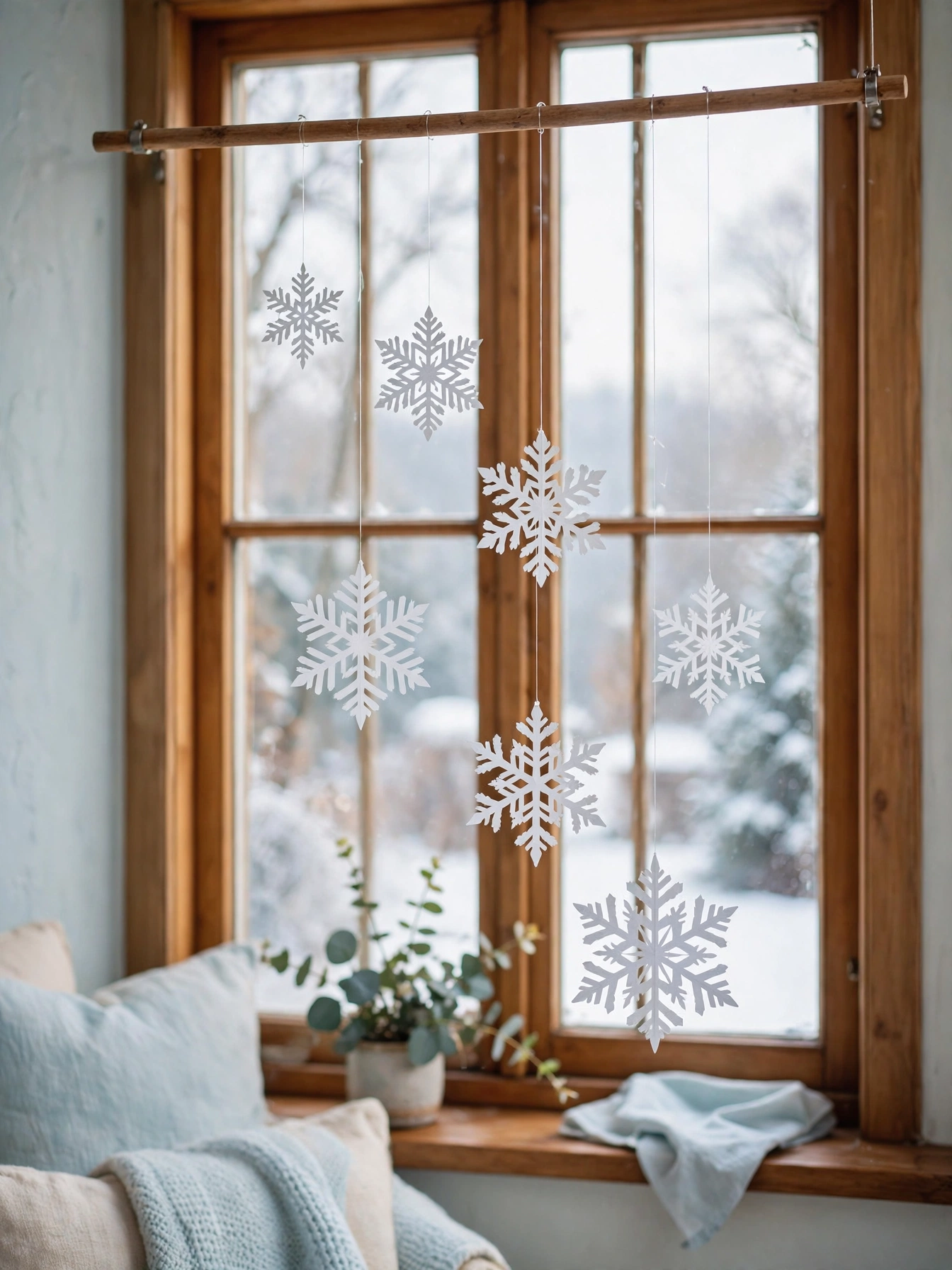
Why This Works:
- Seven snowflakes at staggered heights fill a 36-inch window without blocking daylight
- Clear fishing line vanishes past 3 feet, so the snowflakes appear to float
- Paper snowflakes cost under $5 total when cut from coffee filters or white cardstock
- The mobile moves in room air currents, so the window never looks static
Cut snowflakes in three sizes (4, 6, and 8 inches) from white cardstock or coffee filters, then hang them from a 36-inch dowel on fishing line cut to 8, 12, and 16 inches. Rest the dowel on two hooks screwed into the top of the window frame, or use two adhesive hooks rated for 1 pound. A ready-made paper snowflake set costs $10 to $18 if cutting is not your thing. Compared with static clings, a mobile adds motion, which catches the eye from the street and from the sofa. Keep the lowest snowflake 6 inches above the sill so it never tangles with garland or candles below. Choose cardstock over tissue paper for window mobiles because cardstock holds its shape in humid rooms.
Snowflake mobiles suit kids’ rooms, playrooms, and anyone who wants a window display that costs almost nothing. The display takes 30 minutes to build and delights every age. The limitation is durability: paper snowflakes crease if they brush the glass in a draft, so keep the mobile 3 inches inside the frame. In a sunny south-facing window, white cardstock yellows within three weeks; switch to pale blue cardstock, which hides yellowing. Store the snowflakes flat between two sheets of cardboard to reuse them next year.
Pro Tip: Cut each snowflake from a different fold pattern. Seven identical snowflakes look factory-made; seven different ones look like real snowfall.
Wreath on Every Window
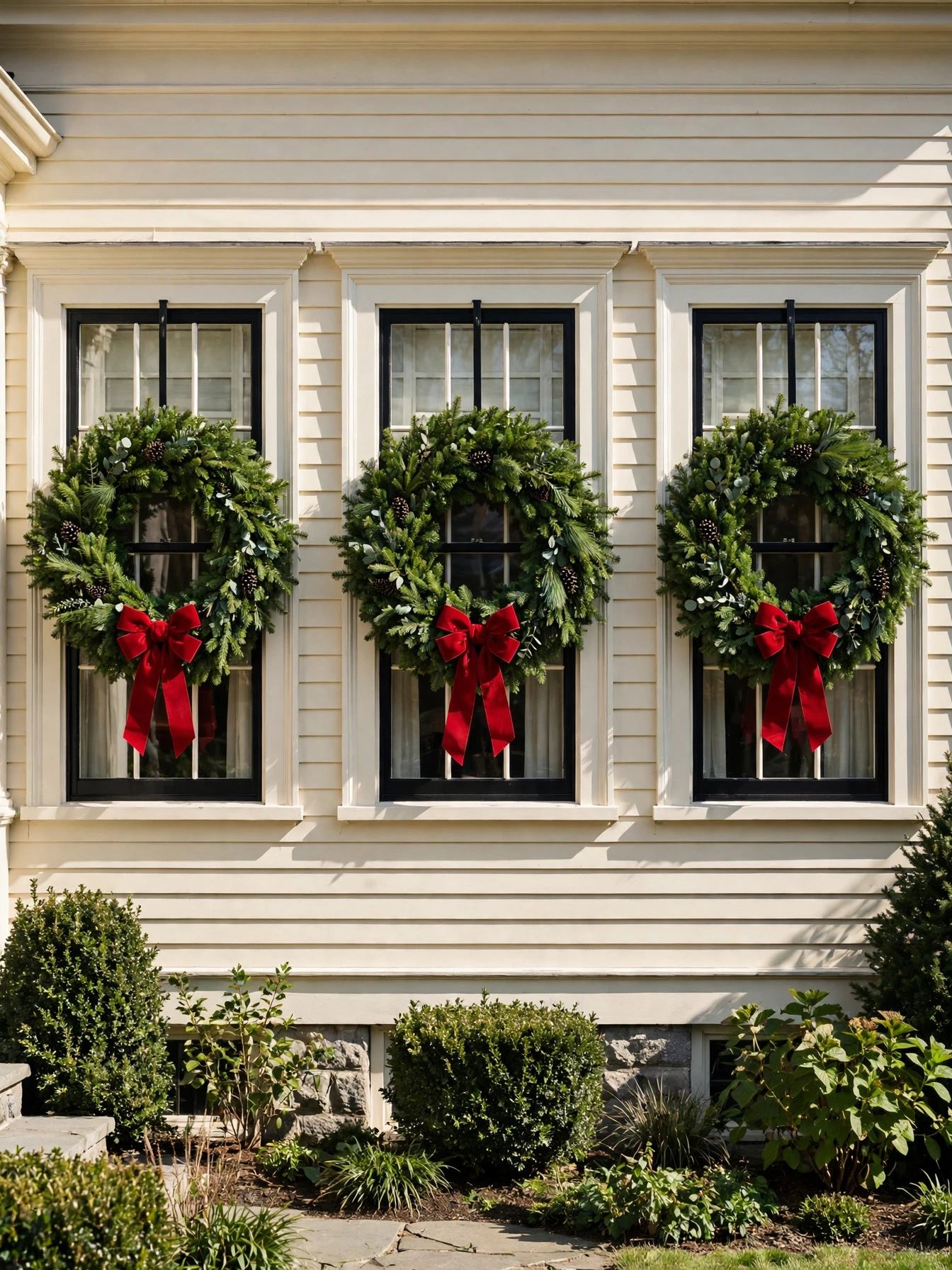
Why This Works:
- Three matching 24-inch wreaths on three windows read as one designed statement from the street
- Fresh fir wreaths last 4 to 5 weeks outdoors in cold weather, longer than any indoor wreath
- A 24-inch wreath suits a standard 36-inch-wide window at the 2-to-3 proportion
- Red velvet bows at the bottom of each wreath tie the windows to the front door
Hang each wreath from an over-the-window hook or a single 3M outdoor hook rated for 5 pounds, centered 4 inches above the window frame. Fresh fir wreaths cost $25 to $45 each; faux wreaths with the same fullness run $30 to $60 and last five or more seasons. Tie a 2.5-inch velvet bow at the bottom of each wreath, not the top, so the bow shows below the sill line from the street. Compared with one wreath on the door alone, wreaths on every window make the whole facade feel decorated for a third of the cost of a full porch display. Keep wreaths 2 inches off the glass so wind does not rub needles against the window and scratch the finish.
Matching window wreaths suit any home with two or more front-facing windows and a visible facade. The repetition is what makes the street stop and look. The trade-off is maintenance: fresh wreaths on a south-facing wall dry out in two weeks, so choose a north or east wall for fresh wreaths and save faux for sunny exposures. In a rental, over-the-window hooks leave no marks and carry a 24-inch wreath easily. If your windows have shutters, hang the wreaths on the shutters instead to avoid crowding the glass.
Pro Tip: Buy all wreaths from the same batch on the same day. Wreaths from different batches vary in green tone, and the mismatch shows from the street.
Birch Branch Window Forest

Why This Works:
- Five birch branches at 36 to 48 inches tall fill a standard window without blocking the view
- White birch bark reflects window light, so the display glows even with the lights off
- A 20-light micro string woven at 4-inch spacing lights every branch from within
- Branches cost $0 to $15 gathered, making this the cheapest large-scale window display
Stand the branches in a heavy 8-inch-tall vase or crock on the sill, wedging them with crumpled paper so they stay upright. Gather birch branches after a storm or buy a bundle for $12 to $20 from a craft store. Thread a 20-light battery micro string through the branches after they are standing, starting at the back and working forward. Compared with a full garland, a branch forest uses vertical space, so it suits narrow windows where a garland would crowd the glass. Keep the tallest branch 4 inches below the top of the frame so the display reads as contained, not crammed. Birch branches hold up indoors for months because the bark is naturally stable.
Birch branch forests suit minimalist and Scandinavian homes where a garland would feel heavy. The display is sculpture first, Christmas second. The limitation is stability: a tall branch in a light vase tips easily, so use a crock that weighs at least 3 pounds empty. In homes with cats, expect climbing; a branch forest on a high windowsill survives better than one on a low sill. If the branches lean toward the glass, tie the tallest one to a small adhesive hook at the top of the frame.
Pro Tip: Spray the branch tips with a light coat of white flocking. Frosted tips make the forest read as snowy for $8 of spray and 10 minutes of work.
Ribbon-Tied Ornament Drops
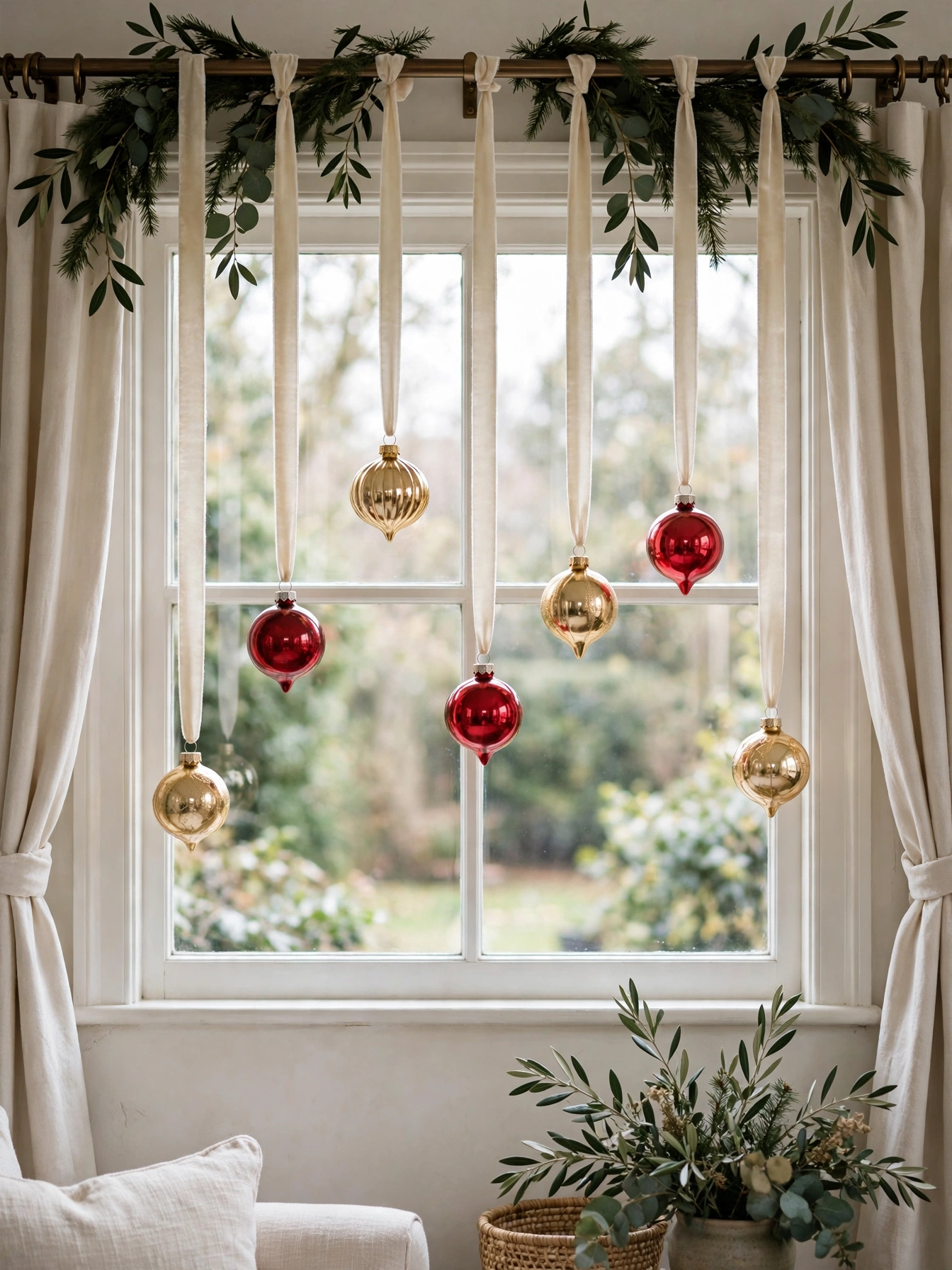
Why This Works:
- Seven ornaments on ribbons 12 to 24 inches long fill a window at staggered heights with no two alike
- Velvet ribbon at 1.5 inches wide holds a 4-inch ornament securely without slipping
- Hanging ornaments from the curtain rod needs zero hooks and zero holes
- Staggered heights at 4-inch steps keep the display from reading as a straight line
Tie each ornament to the curtain rod with a 12- to 24-inch length of velvet ribbon, knotting the ribbon through the ornament cap and over the rod. Use seven ornaments in two colors (red and gold, or silver and blue) in a 4-to-3 split for a coordinated look. Glass ornaments cost $2 to $4 each; shatterproof versions run $1 to $2 each and suit homes with kids or pets. Compared with a window garland, ornament drops take 15 minutes to hang and 5 minutes to remove. Keep the longest drop 6 inches above the sill so the ornaments never rest on garland or candles below. Hanging ornaments at varied heights is the fastest way to make a window look professionally styled.
Ornament drops suit any window with a curtain rod and a clear view. The display moves with the curtain, so it works in rooms where the window is opened daily. The trade-off is tangling: ribbons twist together in a draft, so space the ornaments 6 inches apart and check them weekly. In a windy room, tie each ribbon with two knots instead of one. If the window faces the street, the ornaments read as floating jewels from outside, which gives you curb appeal from a $15 display.
Pro Tip: Use ornaments with a flat cap, not a wire hook. Flat caps knot cleanly to ribbon, while hooks slip and drop ornaments onto the sill.
Paper Star Lanterns
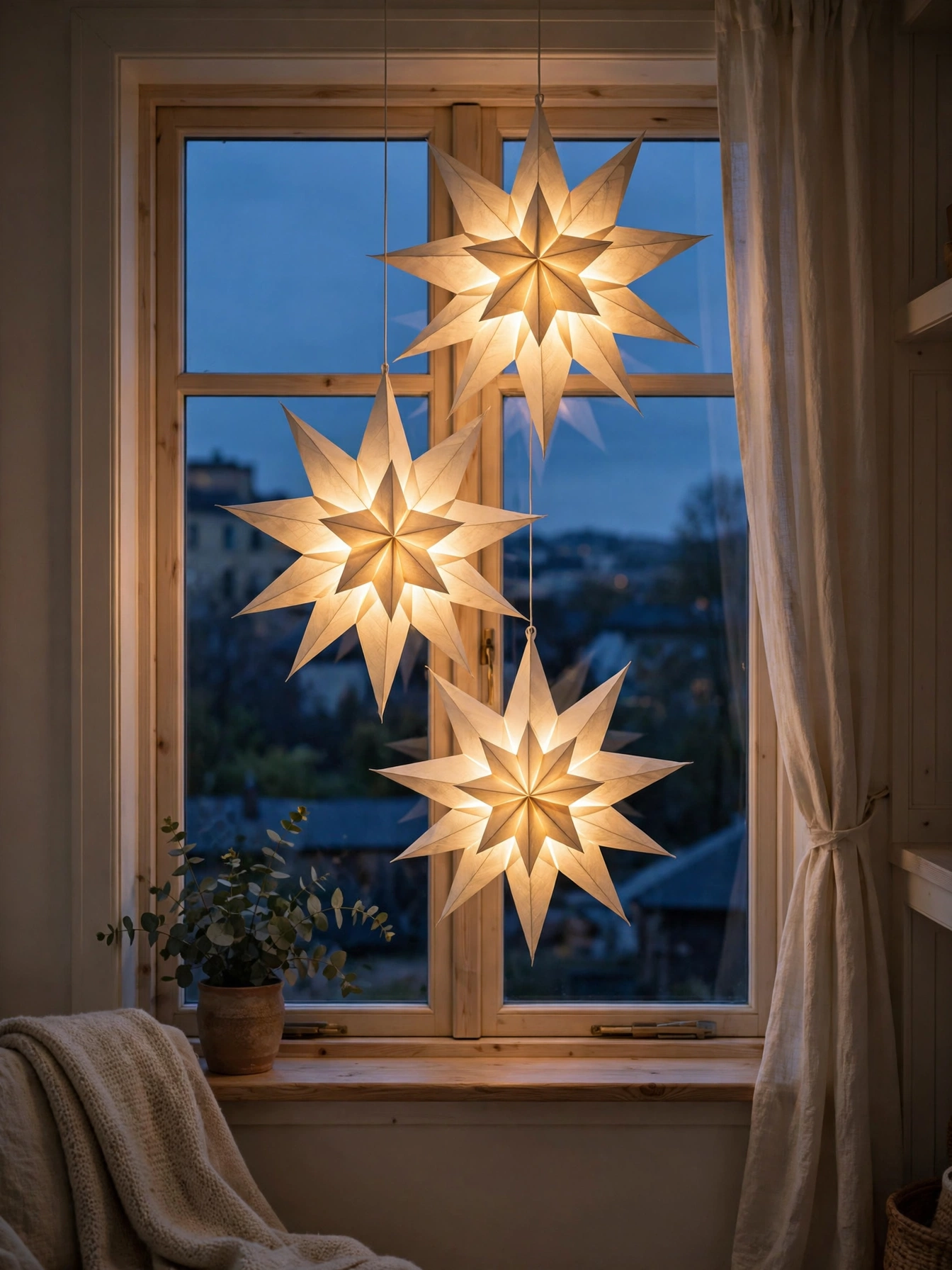
Why This Works:
- Three paper stars at 12, 14, and 16 inches fill a window without blocking the glass
- LED tea lights inside each star run 100 hours on one coin battery
- Paper stars glow warmly from within, so the window reads as lit even without a light string
- A set of three paper stars costs $12 to $20, the cheapest glowing window display available
Hang the stars from the curtain rod or two adhesive hooks on fishing line cut to 10, 14, and 18 inches, staggering the heights. Place one LED tea light inside each star, centered on the bottom point so the glow spreads evenly. Compared with electric star lights at $25 to $40 each, paper stars with tea lights cost a tenth as much and fold flat for storage. Keep the stars 4 inches from the glass so condensation does not dampen the paper. Use flameless lights inside any paper decoration, so never place a real tea light in a paper star. Choose stars in cream or white for the warmest glow.
Paper star lanterns suit Nordic, minimalist, and kids’ rooms where a soft glow beats a bright one. The display takes 10 minutes to hang. The limitation is paper itself: in a humid room, the points soften within two weeks. On a dry winter window, the stars hold their shape all season. In a bathroom window, skip paper stars entirely; steam dissolves them in days. Store the stars flat in a large envelope with tissue paper between them to reuse next year.
Pro Tip: Use warm white tea lights, not cool white. Cool white makes paper stars look blue and clinical, while warm white reads as candlelight.
Evergreen Window Box Fill

Why This Works:
- A 36-inch window box holds 12 to 15 evergreen boughs at 18 to 24 inches long
- Fresh boughs last 6 to 8 weeks outdoors in cold weather with no watering
- Boughs spilling 8 inches over the box edge read as abundant from the street
- Red winterberry stems at $3 per bunch add the only color the display needs
Fill the window box with a base of damp floral foam, then push boughs in at a 45-degree angle, longest at the back and shortest at the front. A 36-inch box needs 12 to 15 boughs; gather them free from your own tree trimmings or buy a bundle for $15 to $25. Tuck five pinecones and three winterberry stems into the gaps for texture and color. Compared with a planted window box, a cut-bough fill costs half as much, needs no soil, and looks full on day one. Keep the boughs 2 inches below the window frame so they do not touch the glass and streak it in the rain. Cut boughs at a 45-degree angle to maximize water uptake, even outdoors.
Evergreen window box fills suit any home with existing window boxes and a visible facade. The display works from Thanksgiving through January with zero upkeep. The trade-off is weight: a wet 36-inch box with foam and boughs weighs 15 to 20 pounds, so check the box brackets before filling. In a rental, a railing-mounted box with a clamp avoids drilling. If the box faces a hot south wall, fresh boughs brown in three weeks; switch to faux boughs at $30 to $50 per box for sunny exposures.
Pro Tip: Push the boughs into the foam on the same day you buy them. Fresh-cut boughs lose 20 percent of their flexibility within 48 hours, so same-day filling gives the fullest shape.
Christmas Window Decor Ideas for 2026: Stained-Glass Clings

Why This Works:
- Stained-glass clings turn morning sun into colored light without a single hook or nail
- A set of 12 clings at 6 to 10 inches tall fills a 36-inch window with room to spare
- Static clings peel off cleanly in January with no residue, unlike adhesive decals
- Sets cost $10 to $18 and reuse for three or more seasons if stored on their backing sheets
Apply clings to clean, dry glass, smoothing from the center outward with a credit card to push out air bubbles. Work in the morning when the glass is cool; clings applied to warm glass trap bubbles that show in the sun. A 12-piece set covers one average window; buy two sets for a picture window. Compared with real stained glass at $200-plus per panel, clings deliver the colored-light effect for under $20. Keep clings 2 inches from the window edges so the seal stays clean and the clings peel off easily. Stained-glass window films are the easiest way to add color to a rental without altering the glass.
Stained-glass clings suit kids’ rooms, playrooms, and anyone who wants color without commitment. The display takes 15 minutes and delights every age. The limitation is light dependence: on a cloudy day or a north-facing window, the clings look flat and dark. On a sunny window, they glow like a church window. In a bathroom, steam loosens clings within days, so save them for dry rooms. Store the clings on their original backing sheets or wax paper to reuse them next year.
Pro Tip: Mist the glass with a spray bottle before applying each cling. A thin water film lets you slide the cling into place, then it grips as the water dries.
Garland Swag Over the Window
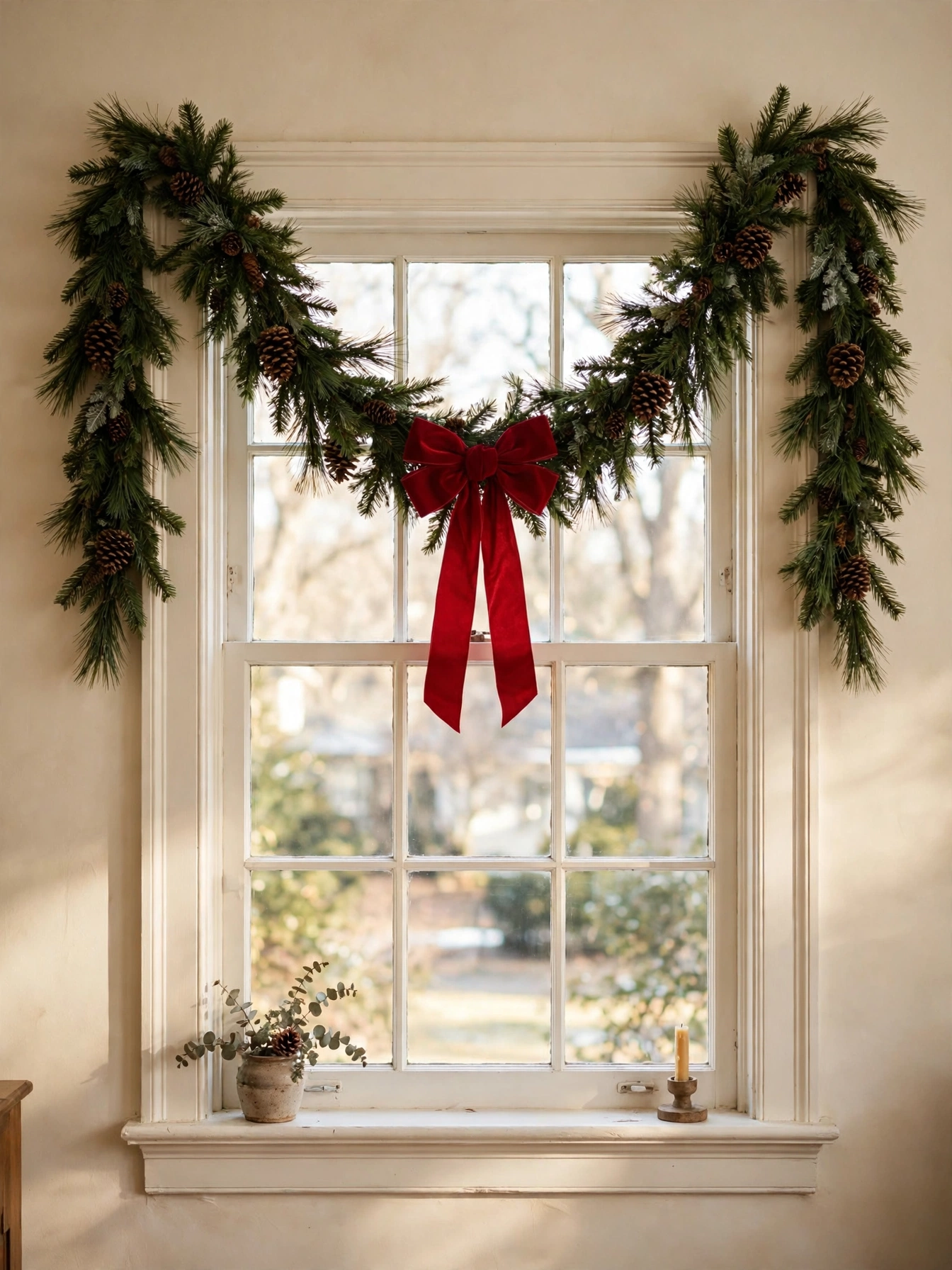
Why This Works:
- An 8-foot garland on a 4-foot window leaves 2 feet of drape on each side for a full swag
- A 10-inch center dip reads as intentional, while a flat garland looks like it was hung in a hurry
- Two hooks rated for 5 pounds each hold a fresh garland with lights safely
- A red bow at the center dip gives the eye a focal point and hides the hook
Hang the garland from two hooks placed 6 inches above the window frame and 6 inches outside it, letting the center dip 10 inches below the hook line. A 9-foot fresh garland costs $25 to $40; a faux garland with the same fullness runs $30 to $55 and lasts five seasons. Weave a 50-light micro string through the garland before hanging it, since threading lights into a hung garland takes twice as long. Compared with a garland stretched straight across, a swag with a dip uses the same garland but looks twice as designed. Keep the garland 3 inches above the window glass so it does not block daylight or rub the frame in the wind.
Garland swags suit living rooms, dining rooms, and entryways where the window is a focal point. The display frames the window like a picture. The trade-off is weight: a fresh garland with lights weighs 4 to 6 pounds, so adhesive hooks rated under 5 pounds will fail. Use screw-in hooks or over-the-frame hangers. In a rental, a tension rod across the top of the frame holds a garland without holes. If the window is wider than 5 feet, use two garlands joined in the center rather than one stretched thin.
Pro Tip: Zip-tie two garlands together end to end before hanging. A doubled garland reads twice as full as a single one for half the cost of a premium garland.
Mercury Glass Votive Row
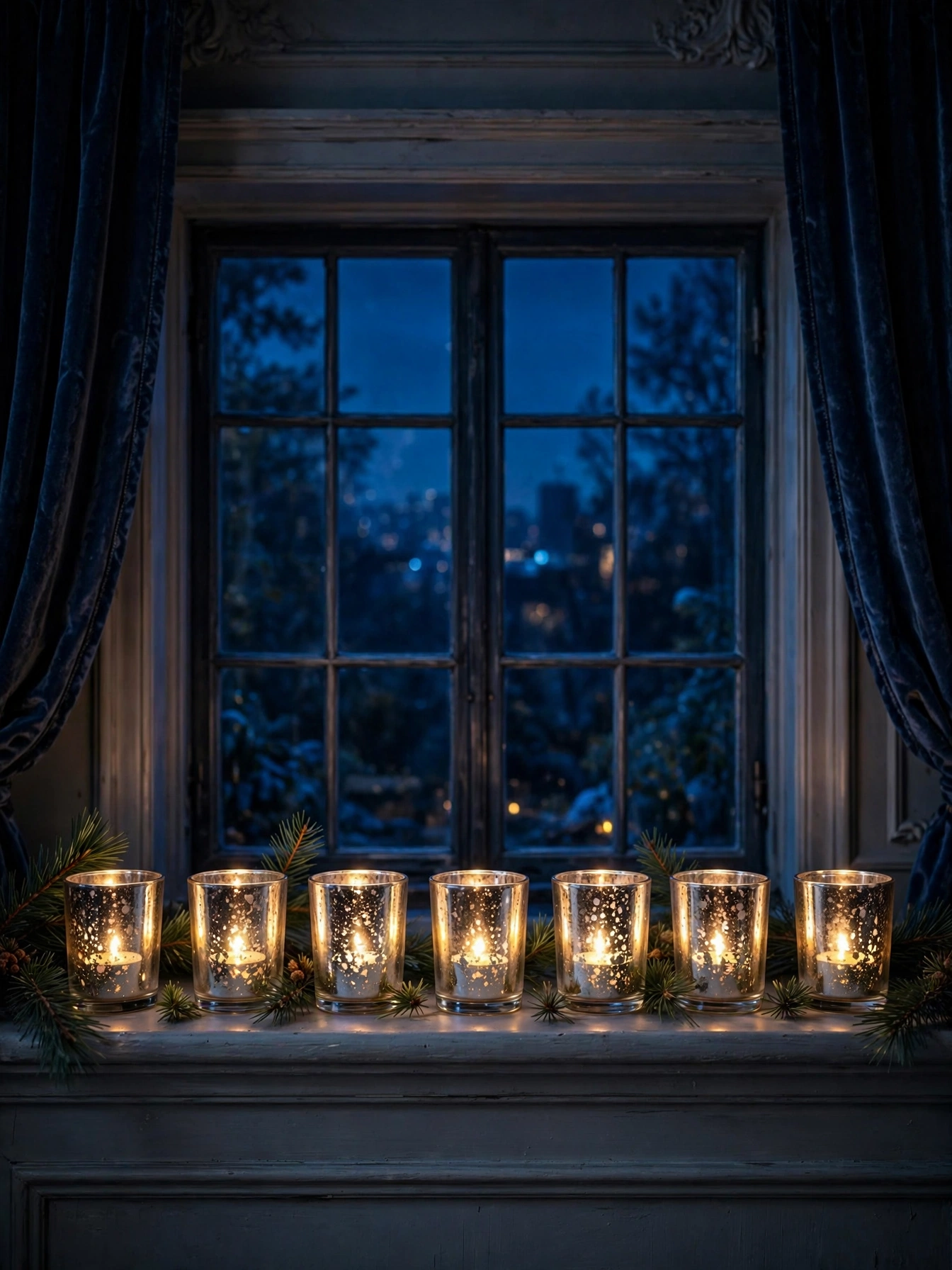
Why This Works:
- Seven votives at 5-inch spacing fill a 48-inch sill with a rhythm of light
- Mercury glass reflects each tea light, so seven flames read as fourteen from across the room
- LED tea lights run 100 hours on one coin battery, so the row glows all season on one set
- Votives at 3 inches tall sit below the window sightline, so the view stays clear
Space the votives 5 inches apart on the sill, alternating silver and gold finishes in a 4-to-3 split for depth. Mercury glass votives cost $2 to $4 each; LED tea lights add $0.50 each in bulk packs of 24. Tuck one 6-inch pine sprig between every other votive to break up the row. Compared with a single large candle, a votive row spreads light evenly across the whole window, which photographs better from the street. Keep votives 3 inches from the glass so condensation does not spot the mercury finish. Mercury glass votives are the easiest way to add vintage sparkle to a window because they work with every palette.
Votive rows suit any window with a sill at least 4 inches deep. The display takes 5 minutes to set up and moves to the table in seconds. The limitation is the coin batteries: 24 tea lights need 24 batteries, so buy a bulk pack of 48 in November. Where real candles already burn elsewhere in the house, keep the window votives flameless so the display nobody watches stays the safest. If the sill is narrow, use a 1-inch-deep tray to hold the row and stop votives from tipping.
Pro Tip: Use tea lights with a flicker mode, not steady. Flickering votives read as real flames from the street, while steady ones read as electric dots.
Velvet Ribbon Window Bows

Why This Works:
- Two 10-inch bows at the top corners frame the window like a picture
- Velvet ribbon at 4 inches wide holds its loops all season, unlike satin which relaxes
- Tails 18 inches long add vertical movement without blocking the glass
- A pair of bows costs $12 to $18 in ribbon, the cheapest framed-window effect available
Cut two 36-inch lengths of 4-inch wired velvet ribbon, form each into a six-loop bow, and wire the centers to the curtain rod ends. Fluff the loops until each bow spans 10 inches, then trim the tails at a 45-degree angle. Compared with a full garland, a bow pair takes 10 minutes, costs a third as much, and leaves the window view completely clear. Keep the bows at the rod ends, not the center, so the eye reads them as a frame rather than a blockage. Choose wired ribbon for bows that must keep their shape past a week, since unwired ribbon softens and sags under its own weight.
Velvet ribbon bows suit any window with a curtain rod and a traditional or farmhouse palette. The display is the fastest window dressing in this article. Dust is the weak point: velvet gathers it, and a dusty bow looks gray in photos by the third week. A weekly pass with a lint roller over the loops keeps the nap fresh. In a modern room, swap velvet for grosgrain ribbon in a solid color, which reads as tailored rather than festive. If the curtain rod is a tension rod, check its weight rating before adding bows; a bow pair weighs under 8 ounces, so almost any rod holds them.
Pro Tip: Wire one small pine sprig behind each bow. The greenery peeking out makes a $6 bow look like a $25 store-bought window treatment.
Gingerbread House Sill Scene

Why This Works:
- An 8-inch gingerbread house fits a standard sill with room for two bottle-brush trees beside it
- A 20-light micro string woven around the scene makes the icing glow at night
- A gingerbread kit costs $15 to $25 and builds in under an hour with kids
- The scene works in a kitchen window, where the baking theme makes sense
Build the gingerbread house from a kit, not from scratch, since kit walls are cut to fit and bake evenly. Assemble with royal icing, which hardens in 2 hours and holds the walls rigid. Set the house on a 12-inch round tray on the sill, then add two 4-inch bottle-brush trees and a candy cane fence of six canes. Compared with a ceramic village, a gingerbread scene costs a third as much and involves the whole family in building it. Keep the scene 3 inches from the glass so condensation does not soften the icing. Gingerbread houses last 3 to 4 weeks indoors if kept dry, which covers the full December display window.
Gingerbread sill scenes suit kitchen windows and family rooms where kids can see them up close. The display smells faintly of spice for the first week. The trade-off is humidity: in a kitchen, steam from cooking softens icing within days. Keep the scene in a window away from the stove, and never place it above a kettle. If the house starts to sag, a toothpick brace inside the roofline holds it for another week. In a house with pets, keep the scene on a high sill; gingerbread is not safe for dogs.
Pro Tip: Brush the finished house with a thin coat of clear corn syrup. The syrup seals the icing against humidity and makes the snow look wet and fresh.
Icicle Light Curtain

Why This Works:
- Icicle drops 12 to 24 inches long mimic real icicles at the top of the window
- A 10-foot icicle string with 100 LEDs covers a 48-inch window with one string
- LED icicles draw only 3 to 5 watts, so running a full window display for an evening costs just pennies
- Hanging the string inside the glass protects it from wind and rain damage
Hang the icicle string from the curtain rod or four adhesive hooks rated for 2 pounds, keeping the top wire straight so the drops hang evenly. A 10-foot LED icicle string costs $15 to $25. Tuck two 8-inch pine sprigs at the ends to hide the wire. Compared with a curtain light string, icicles give a more natural winter shape, since the uneven drops read as ice rather than fabric. Leave at least 8 inches between the lowest icicle tip and the sill so the lights never rest on garland or candles. Warm white LEDs at 2700K suit living spaces because they flatter skin tones and wood finishes.
Icicle curtains suit any window where the top of the frame is visible, since the display lives in the upper third. The glow reads as frosty from the street. The limitation is the straight top wire: if the wire sags, the icicles hang unevenly and look messy. Pull the wire taut and support it every 12 inches. In a bedroom, put the icicles on a timer that switches off by 10 PM. Where a streetlamp shines straight at the glass, the warm bulbs lose their edge; a sheer curtain behind the icicles softens the competition.
Pro Tip: Hang the icicle string 2 inches inside the frame, not on the glass. The gap creates a double reflection in the glass that doubles the visible lights.
Plaid Panel Tiebacks
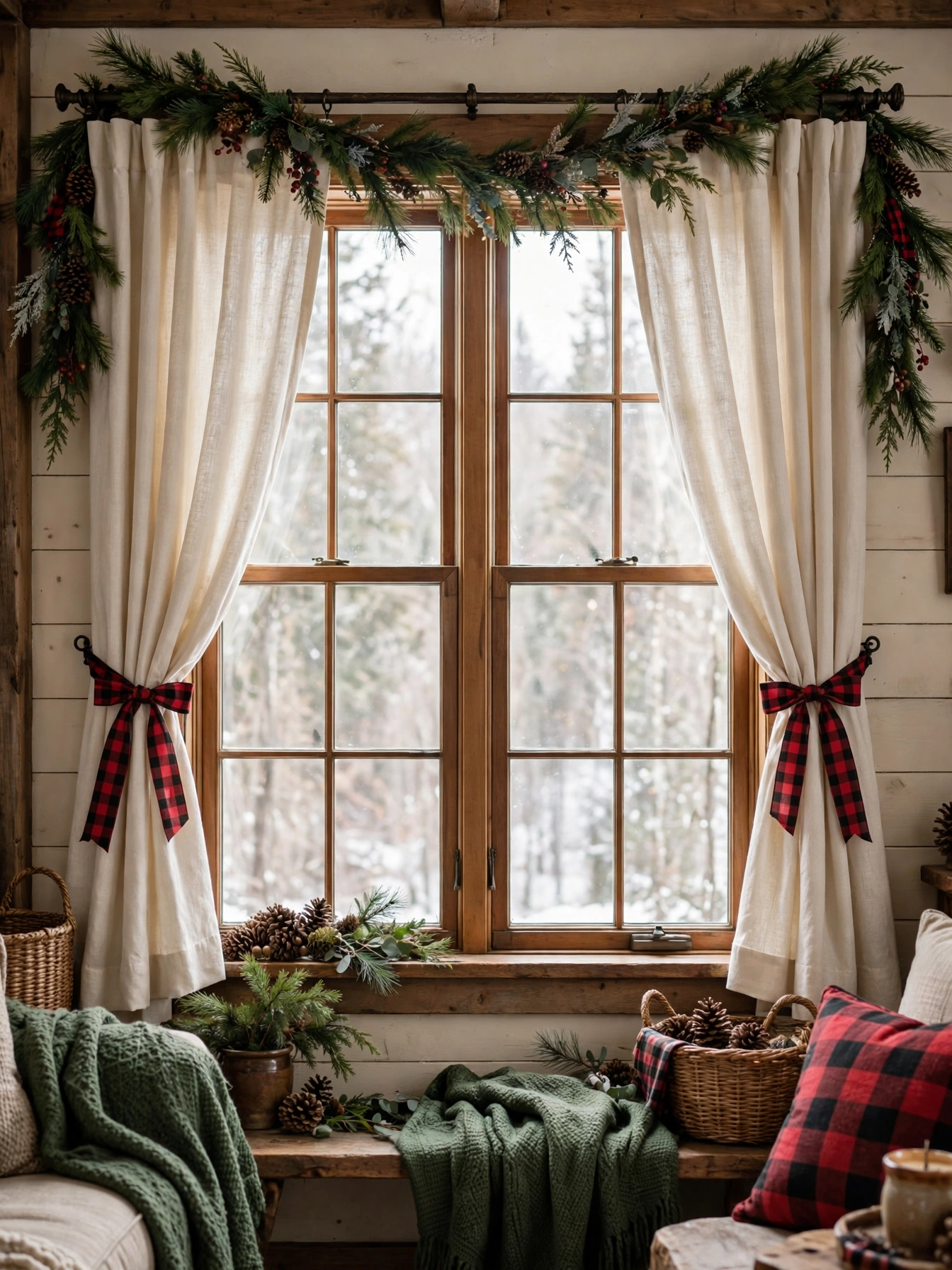
Why This Works:
- Plaid tiebacks at 36 inches high frame the window without covering the glass
- Panels pulled 12 inches from the window edge show the full window display behind them
- Buffalo plaid reads from across the room, so the window looks dressed even without garland
- A pair of plaid tiebacks costs $10 to $16 in ribbon, the cheapest curtain upgrade available
Measure out two 30-inch lengths of 2.5-inch buffalo plaid ribbon, tie each curtain panel at 36 inches from the floor, and knot the ribbon with a simple bow. The tieback position matters: at 36 inches, the panels frame the window’s lower two-thirds, which is where the sill display sits. Compared with buying holiday curtains at $60 to $120 per panel, $14 of ribbon gets you 90 percent of the effect. Keep the tiebacks snug but not tight; a panel squeezed to half its width looks strangled, while a loose tieback slips down by evening. Tiebacks at two-thirds of the window height make windows look taller, which flatters low-ceiling rooms.
Plaid tiebacks suit lodge, cabin, and farmhouse rooms where the curtain panels are already the room’s largest fabric surface. The display is the fastest curtain upgrade in this article. The limitation is curtain weight: heavy blackout panels need a 3-inch ribbon to hold them, while 2.5-inch ribbon slips on thick fabric. In a modern room, swap plaid for solid velvet ribbon in a deep green, which reads as tailored rather than rustic. If the curtains are sheer, skip tiebacks entirely; sheers look best hanging straight.
Pro Tip: Tie the ribbon with the knot facing the room, not the window. The knot is the part guests see, and a front-facing knot looks finished.
Christmas Window Decor Ideas for 2026: Star Garland Across the Glass

Why This Works:
- Nine gold stars on two swags fill a 48-inch window with a rhythm of shine
- Gold foil paper reflects daylight, so the garland glows without a single bulb
- A star garland costs $8 to $15 in materials and strings in under 20 minutes
- Two swags with a 6-inch dip read as designed, while one straight strand looks flat
Cut nine stars from gold foil cardstock in two sizes (4 and 6 inches), punch a hole at the top point of each, and thread them onto two 36-inch lengths of cream twine. Hang the swags from the curtain rod with the center dip 6 inches below the rod. A ready-made gold star garland costs $12 to $20 if cutting is not your thing. Compared with a pine garland, a star garland weighs almost nothing and never sheds. Keep the swags 3 inches inside the frame so they do not brush the glass. Paper garlands last for months indoors because they face no weather, only dust.
Star garlands suit minimalist and Scandinavian rooms where a pine garland would feel heavy. The display is paper, so it stores flat and reuses for years. The limitation is night visibility: a paper garland goes dark after sunset unless a light string sits nearby. Pair it with a curtain light string 2 inches behind it, and the stars glow from behind at night. In a sunny south-facing window, foil cardstock fades within three weeks; switch to matte gold cardstock, which holds its color. Store the garland coiled in a zip bag to stop the stars from creasing.
Pro Tip: Alternate star sizes in a 6-4-6-4 pattern along each swag. The size rhythm keeps the eye moving instead of stopping at one big star.
Eucalyptus and Berry Sill Runner
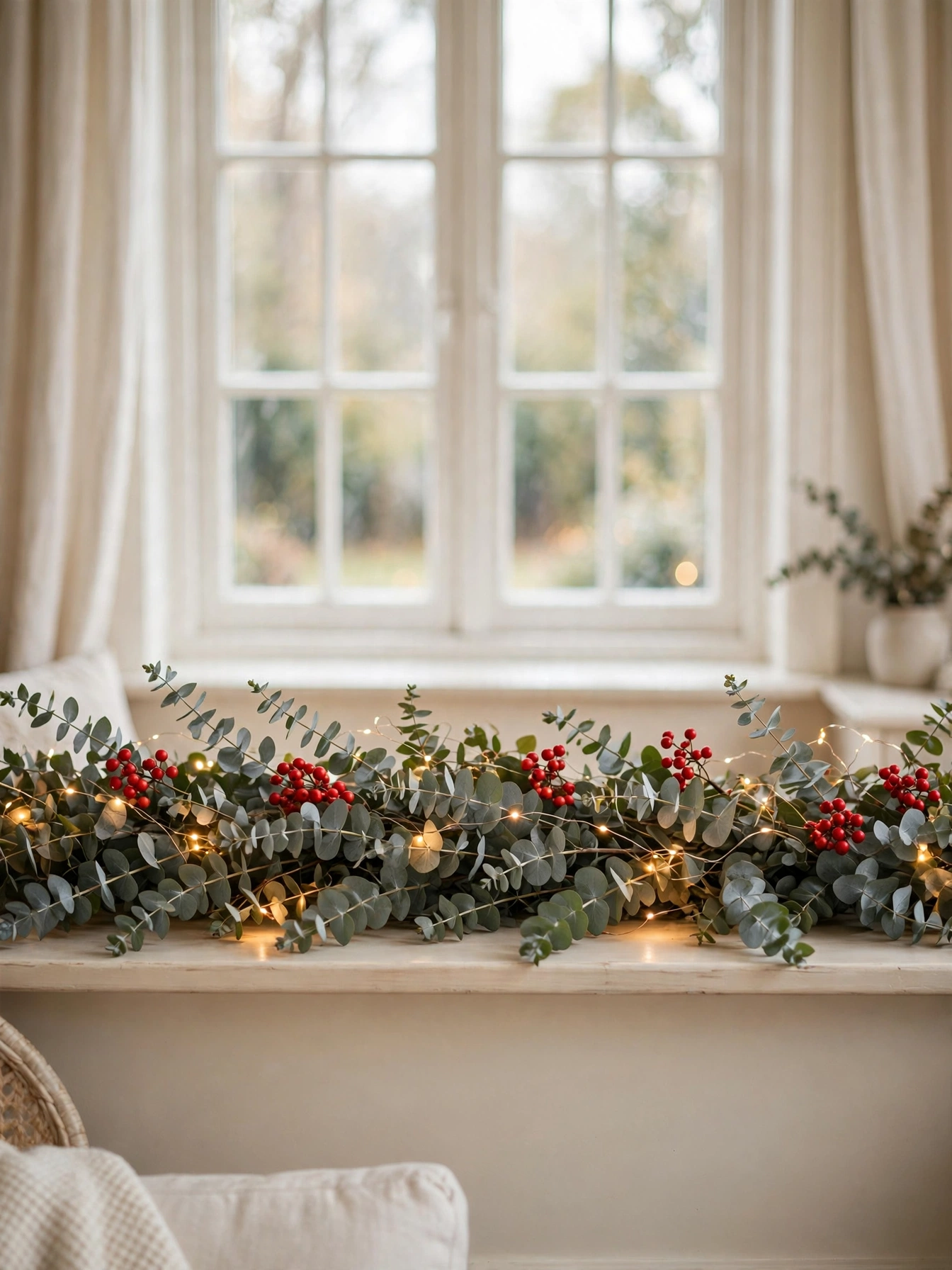
Why This Works:
- A 48-inch runner of eucalyptus layered 3 stems deep reads as lush, not sparse
- Silvery eucalyptus pairs with every palette because it reads as neutral, not green
- Red berry clusters every 8 inches give the runner a holiday color pop
- A 20-light micro string woven through the runner lights it from within
Layer eucalyptus stems in three overlapping rows along the sill, stems pointing toward the center, then tuck winterberry clusters every 8 inches into the gaps. A bundle of eucalyptus costs $8 to $12; winterberry stems run $3 per bunch. Finish by threading a 20-light battery micro string through the runner, keeping the battery pack hidden behind the last stem. Compared with a pine garland, eucalyptus sheds nothing, smells faintly of menthol, and dries gracefully instead of browning. Keep the runner 2 inches back from the glass so condensation does not soak the stems. Eucalyptus is the most forgiving fresh greenery indoors because it dries into a usable form rather than wilting.
Eucalyptus runners work on any window whose sill is 5 inches deep or more. The display costs under $20 and lasts the full season as it dries. The trade-off is the drying itself: eucalyptus turns brittle by week three, so handle it gently after that point. In a kitchen window, steam keeps the stems supple longer but fades the silver color. If the runner looks thin after drying, add three fresh stems on top in week three rather than rebuilding the whole thing.
Pro Tip: Mist the runner once a week with water. A weekly mist keeps the eucalyptus supple for 4 weeks instead of 2, doubling the fresh window.
Copper Bell Strand
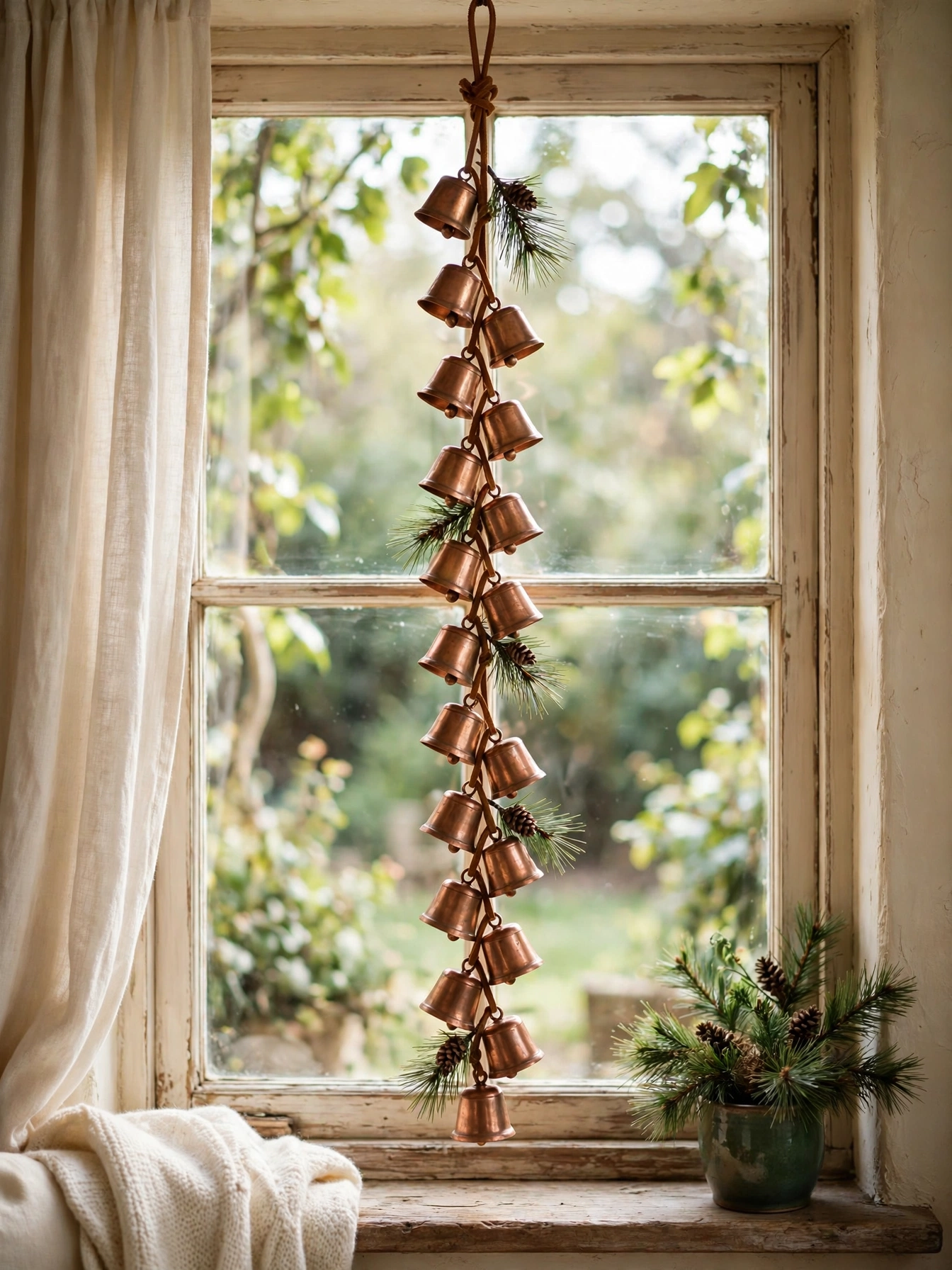
Why This Works:
- Twelve copper bells on a 48-inch cord give the window sound as well as sight
- Copper bells at 1 to 2 inches across read as jewelry, not noise-makers
- A leather cord holds the bells without stretching, unlike ribbon which relaxes
- The vertical strand uses the window’s height, leaving the sill completely free
Thread twelve copper bells onto a 48-inch leather cord, knotting the cord between each bell so they stay spaced 4 inches apart. Copper bell strands cost $15 to $30 ready-made; a DIY version with craft bells runs $8 to $12. Hang the strand from a single adhesive hook at the top of the frame. Compared with a garland, a bell strand takes 5 minutes to hang, weighs under 8 ounces, and adds a gentle jingle when the window opens. Keep the strand 3 inches inside the frame so the bells never tap the glass in a draft. A single strand of bells is the oldest form of window decor, predating electric lights by centuries.
Copper bell strands suit farmhouse, rustic, and traditional rooms where the window already carries a garland or wreath. The display is the simplest in this article. The limitation is sound: in a drafty room, the bells jingle all night. If the window sits in a bedroom, hang the strand in a living room window instead. In a house with cats, expect batting; a bell strand on a high window survives better than one on a low sill. If the bells tarnish, a lemon-juice cloth restores the shine in minutes.
Pro Tip: Tie a small pine sprig at the top of the strand. The greenery hides the hook and makes a $12 strand look like a $30 store-bought piece.
Frosted Glass Paint Motifs
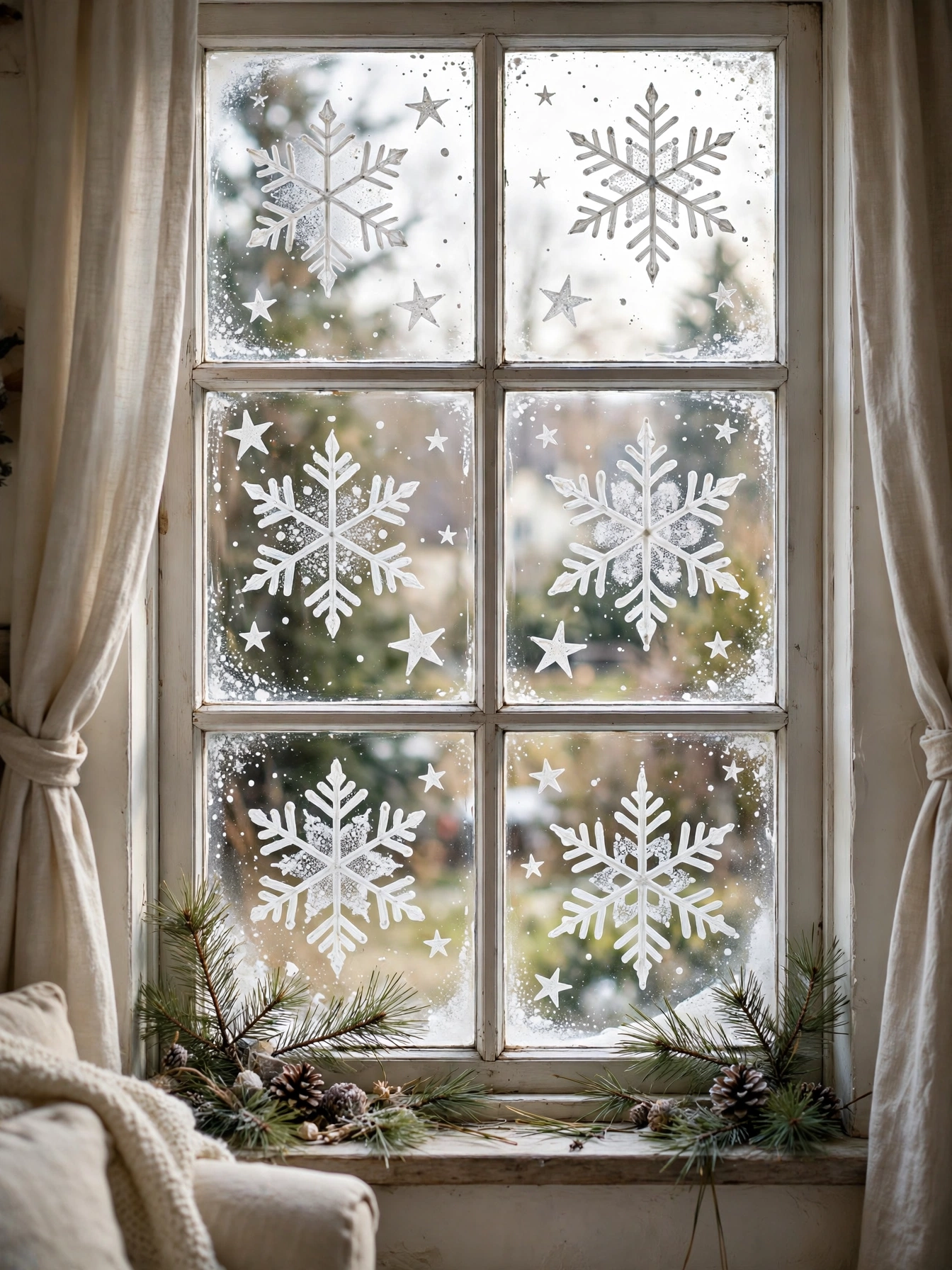
Why This Works:
- Glass paint snowflakes at 6 to 10 inches across read as etched glass from the street
- One $8 bottle of frosted glass paint covers an entire window with motifs
- Painted motifs survive condensation, unlike spray snow which streaks on single-pane windows
- Glass paint scrapes off with a razor blade in January, leaving zero residue
Paint snowflakes and stars freehand with a small round brush, or use a stencil for symmetrical shapes. One bottle of frosted glass paint costs $6 to $10 and covers a full window. Let each motif dry 2 hours before adding a second coat for a denser frost. Compared with spray snow, paint motifs survive bathroom steam and single-pane condensation without streaking. Keep motifs 2 inches from the window edges so the razor blade can reach them cleanly in January. Frosted glass paint is the most durable temporary window decoration because it bonds lightly to the glass without adhesive.
Painted glass motifs suit anyone who wants a permanent-looking etched effect without the etched-glass price. The display takes an hour and delights every age. The limitation is skill: freehand snowflakes look wobbly without practice. Practice on a mirror first, then paint the window. In a rental, check the lease before painting; a razor blade removes the paint, but some landlords object to any paint on glass. If freehand feels risky, a stencil set at $10 gives crisp shapes with no drawing skill.
Pro Tip: Paint the motifs on the inside of the glass. Inside paint survives rain and wind, while outside paint weathers off within two weeks.
Warm Exterior Uplight
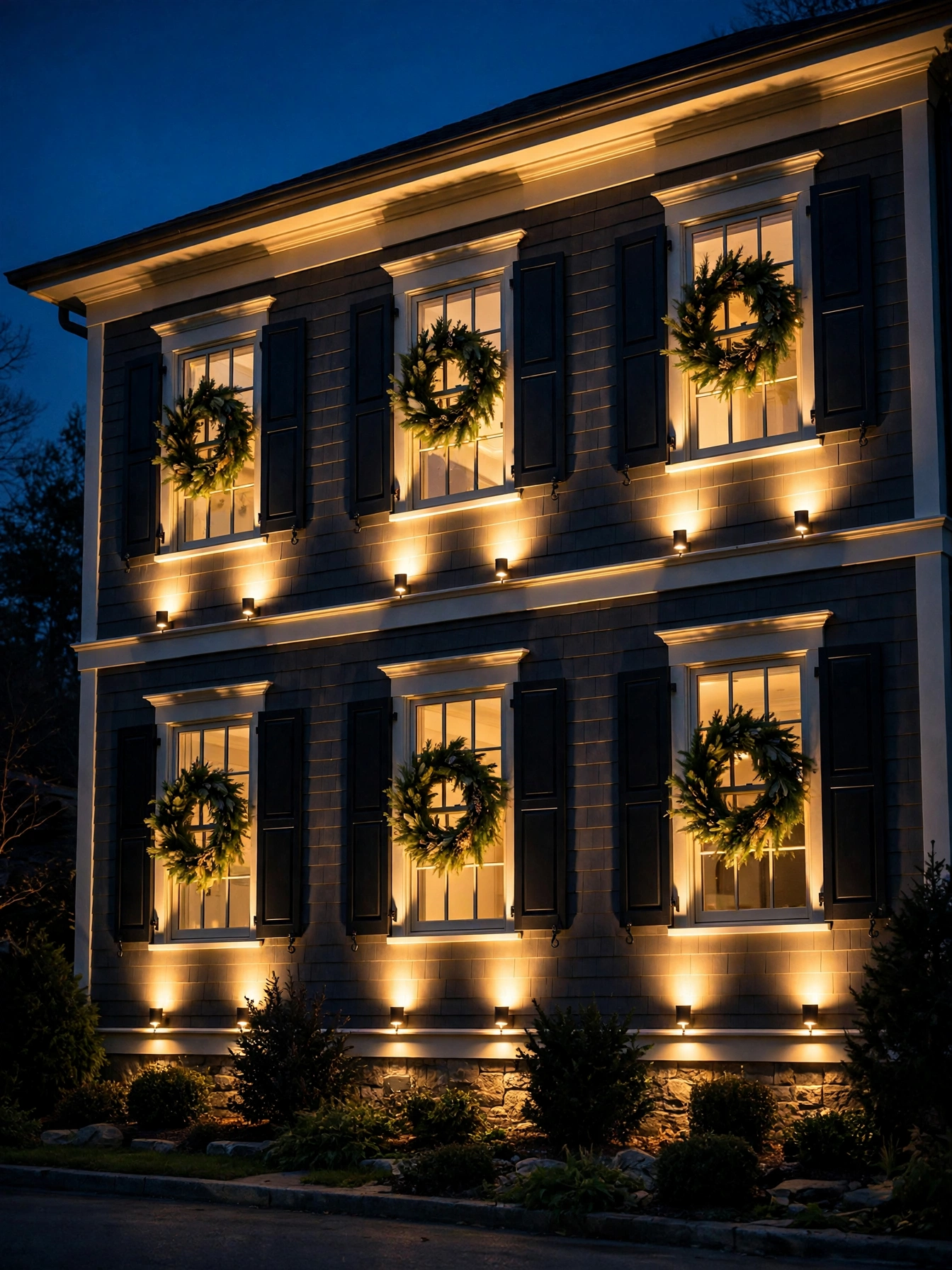
Why This Works:
- Two uplights per window at 2700K make the whole facade glow without a single roofline staple
- Solar uplights cost $15 to $25 each and need no wiring or outlet
- Light from below makes wreaths and garlands cast soft shadows, adding depth to the display
- Uplights work from dusk to midnight on a 6-hour solar charge, even in December
Set two solar uplights per window, one at each bottom corner, angled 45 degrees up toward the glass. A pair of solar uplights costs $30 to $50 per window; plug-in landscape uplights run $20 to $35 each plus an outdoor extension cord. Charge the solar panels in direct sun for 6 hours before the first evening. Compared with roofline lights, uplights take 10 minutes to place, need no ladder, and light the windows you already decorated. Keep uplights 12 inches from the foundation so the beam spreads evenly across the window. For outdoor use, lighting designers favor 2700K because it flatters brick, siding, and wood trim.
Exterior uplights suit any home with a visible facade and a yard that gets sun. The display makes every window decoration look twice as good after dark. The trade-off is December sun: solar uplights in a cloudy northern climate may run only 3 to 4 hours per night. In that case, switch to plug-in uplights on a timer. If your home faces a street with heavy foot traffic, angle the uplights so the beam stays on your facade, not in a neighbor’s eyes. Hire an electrician if you need a new outdoor outlet installed rather than running an extension cord across a walkway.
Pro Tip: Aim the uplights at the wreath, not the glass. A lit wreath photographs beautifully from the street, while a lit window just glares.
FAQs
How do I hang christmas window decor ideas for 2026 without damaging the window?
Use suction-cup hooks rated for 2 pounds, tension rods, or over-the-frame hangers for most displays. Adhesive hooks work on warm glass above 50 degrees Fahrenheit but fail below 40 degrees. Never drill into a vinyl window frame; the frame warranty usually voids on the first hole. Command strips rated for outdoor use hold 5 pounds on clean glass.
Are window candles safe to leave on overnight?
LED candles run safely on a timer: they stay cool and draw under 1 watt each. Switch off all decorative lights before bed or whenever you leave the house. Set window candles to a 6-hour timer starting at 4 PM, and never place a real flame within 12 inches of a curtain.
What is the best light color for christmas window decor ideas for 2026?
Warm white at 2700K wins for windows because it reads as candlelight from the street and flatters every interior. Cool white at 5000K reads as a shop display and washes out wood tones. 2700K suits living spaces, so make 80 percent of your window display warm white and save cool white for one accent.
How do I keep window garland from blocking daylight?
Keep garland in the top 8 inches of the window and the sill display under 10 inches tall. A 48-inch window with an 8-inch garland and a 10-inch sill display still passes 60 percent of its daylight. Frosted spray on the lower third only preserves the upper glass for light, which keeps the room bright at noon.
Can renters decorate windows without losing the deposit?
Yes, with removable methods only: suction cups, tension rods, static clings, and freestanding displays on the sill. Avoid adhesive hooks on painted frames, since the adhesive can peel paint on removal. Photograph every window before decorating so you can restore the original condition in January and document the deposit.
Conclusion
These 23 christmas window decor ideas for 2026 come back to three takeaways: dress the window from both sides, keep every display removable, and let warm 2700K light do the heavy lifting after dark. Your first action tonight is simple: pick the window your street sees first and give it one string of warm curtain lights. Follow HomelyCrafter on Pinterest for more ideas. Save this to your Pinterest boards so you can refer back to it!

Muhammad Israr is a home decor enthusiast and the writer behind Homely Crafter. He spends his days researching paint colors, layouts and budget-friendly styling ideas, then breaks them down into practical, easy-to-follow guides so you can decorate with confidence.