
Farmhouse style has stayed in the top tier of Pinterest’s most-searched home styles for years running, and editors at The Spruce have noted that layered natural textures are a big reason why rooms in this style feel genuinely restful. These cozy farmhouse living room ideas show how to build that warmth yourself, from shiplap walls and worn woods to plaids, gathered textiles, and honest rustic details.
Inside you’ll find 23 specific ideas, each with exact measurements, material guidance, price ranges, and honest trade-offs, so you can pick the ones that fit your room and your budget. Every idea follows the same practical format: why it works, how to do it right, and a pro tip with real numbers.
Shiplap Focal Wall
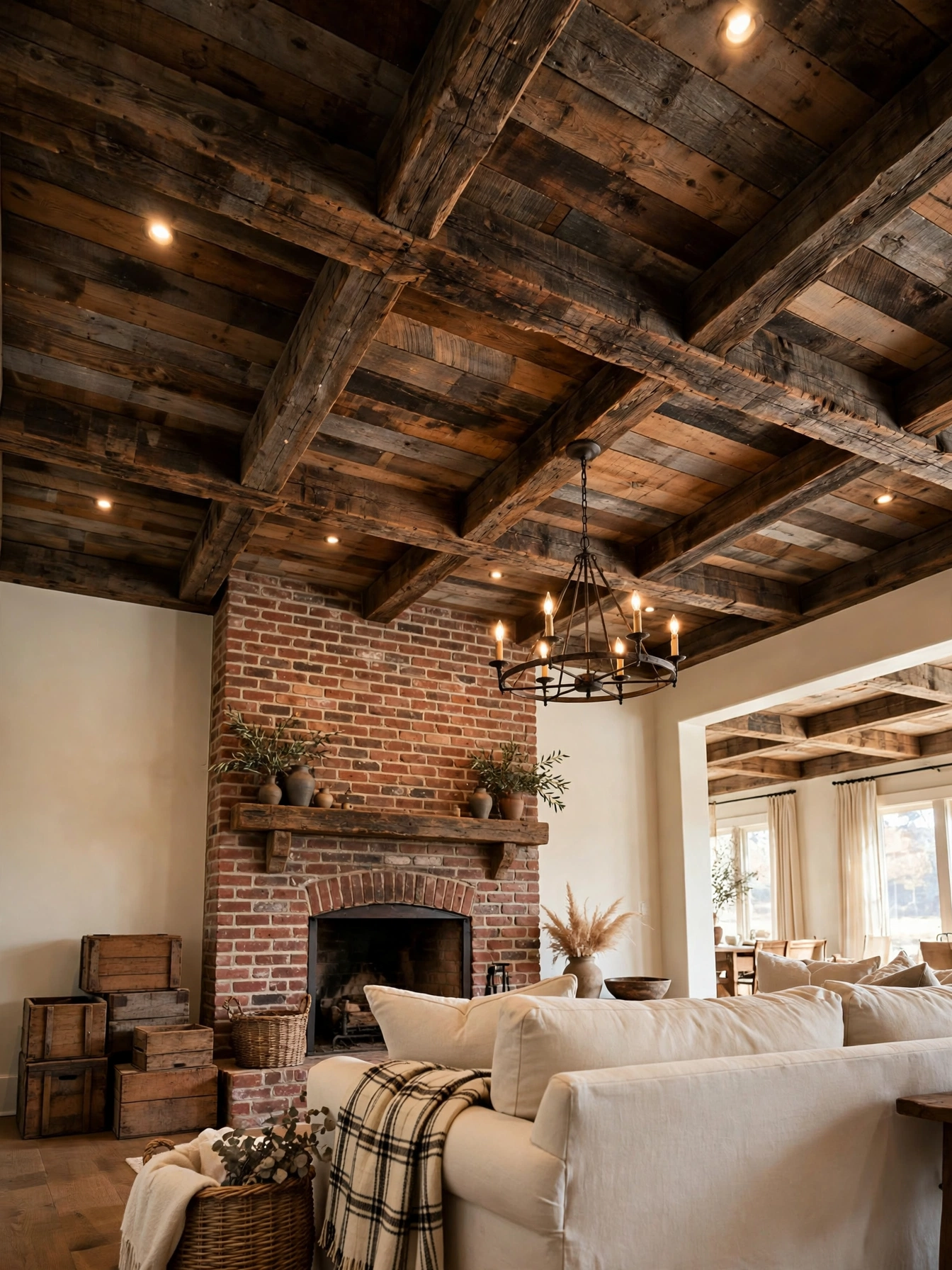
Why This Works:
- Horizontal lines stretch the eye across the wall, making narrow rooms feel wider.
- Painted shiplap hides minor drywall flaws behind crisp, uniform shadow lines.
- One accent wall gives farmhouse character without committing to a whole room.
- The 1/8 inch nickel gap between boards adds rhythm that flat drywall cannot.
Install 6 inch wide pine shiplap boards horizontally over a wall stud base, leaving a 1/8 inch nickel gap between each row for the classic shadow line. Prime knots with shellac-based primer, then finish with two coats of warm white paint (try a color with an LRV above 80 so the wall still bounces light). Budget pine runs about $2 to $4 per square foot, while pre-primed MDF shiplap drops to $1.50 per square foot with slightly less grain character. Mount boards with construction adhesive plus 18-gauge brad nails every 16 inches into studs, and never skip an expansion gap of 1/4 inch at the ceiling and floor, since wood moves with seasonal humidity.
This suits anyone wanting instant farmhouse identity in a rental-friendly-adjacent weekend project, because one wall takes a single day for a confident DIYer. On the downside, the grooves collect dust, so plan a monthly pass with a vacuum brush head. In rooms under 12 feet wide, keep the shiplap to one wall only, since four walls of horizontal lines can make a small room feel like a crate. Wallpaper costs less up front, but shiplap survives kids, dogs, and picture-hanging far better.
Pro Tip: Stop the shiplap 3/4 inch short of the ceiling and cap it with a 1×4 inch pine trim board to hide uneven drywall lines cleanly.
Worn Wood Beams

Why This Works:
- Beams pull the eye upward, adding architectural weight to flat, modern ceilings.
- Dark wood against a light ceiling creates contrast without any paint color.
- Faux beams weigh a fraction of real timber, so installation stays simple.
- Spaced 4 to 6 feet apart, they give rhythm without darkening the room.
Choose 6×8 inch faux wood beams in polyurethane (about $10 to $15 per linear foot) for ceilings under 10 feet, since real reclaimed timber weighs 40 to 60 pounds per linear foot and needs structural blocking. Space beams 48 to 72 inches apart across the ceiling, running perpendicular to the longest wall for the strongest visual pull. Stain-grade faux beams take gel stain well in one coat, and a dark walnut finish hides seams at joints. When to hire a professional: if you suspect the ceiling has knob-and-tube wiring or you need new electrical runs, an electrician should handle that before beams go up.
Renters should skip this one entirely, since even faux beams mount with screws into joists. Ceiling height is the real constraint here: in rooms under 8 feet, beams can feel oppressive, so choose slim 4×6 inch profiles instead. Real reclaimed beams win on authenticity and patina, but they cost $30 to $60 per linear foot and need two people plus a scaffold to lift. Faux beams deliver 90 percent of the look for a third of the cost, and nobody standing on the floor can tell the difference.
Pro Tip: Stain sample offcuts first and view them at 7 PM under your actual bulbs, since beam color shifts dramatically between daylight and lamplight.
Plaid Throw Layers
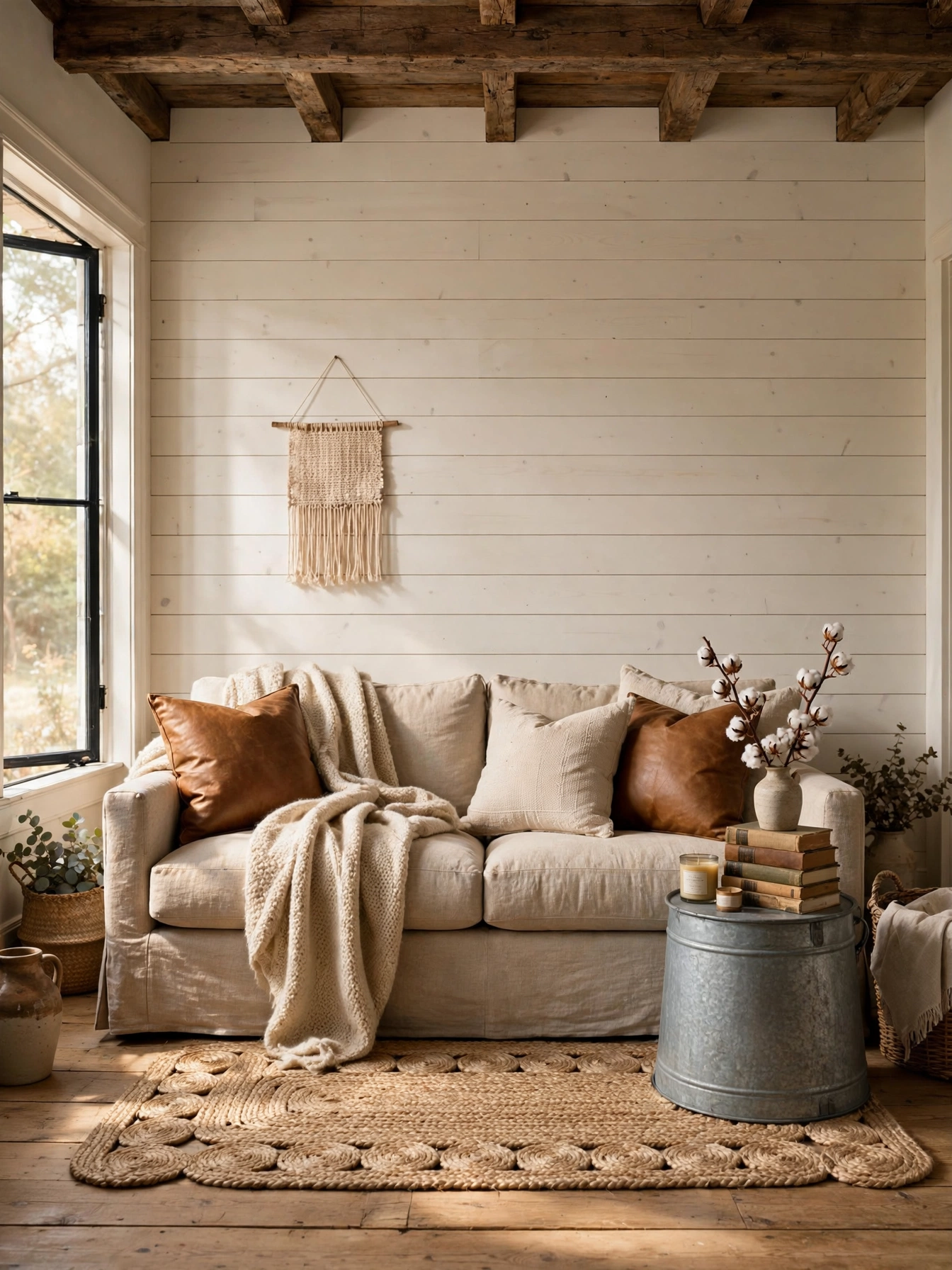
Why This Works:
- Plaid reads as farmhouse instantly, even in a room with zero rustic furniture.
- Layered throws add color and pattern at the lowest cost of any decor change.
- Wool blends regulate temperature, warm in winter without overheating in fall.
- Two overlapping throws look styled; one flat throw looks like an afterthought.
Layer a 50×60 inch plaid wool throw folded in thirds over one sofa arm, then drape a second 60×70 inch solid throw loosely across the seat cushions for a collected look. Budget acrylic plaids start around $15, good wool blends run $40 to $80, and pure lambswool throws reach $120 with noticeably softer hand feel. Machine-wash wool blends on cold and line dry to avoid the 5 to 10 percent shrinkage a hot dryer causes. Avoid placing dark red plaids on light upholstery in sunny spots, since prolonged UV exposure fades one side and leaves a visible line where the throw sat.
This idea suits seasonal decorators best, because throws swap out in minutes when you want a new mood. Maintenance is the catch: textured wool pills, so keep a fabric comb handy and plan a de-pilling pass every few months. New pillows cost more per unit of visual change, while throws double as actual blankets on cold evenings. Homes with shedding pets should choose tight-weave patterns in mid tones, which hide hair far better than cream solids.
Pro Tip: Fold throws to exactly 12 inches wide before draping, so the layers look intentional rather than tossed.
Gathered Linen Curtains
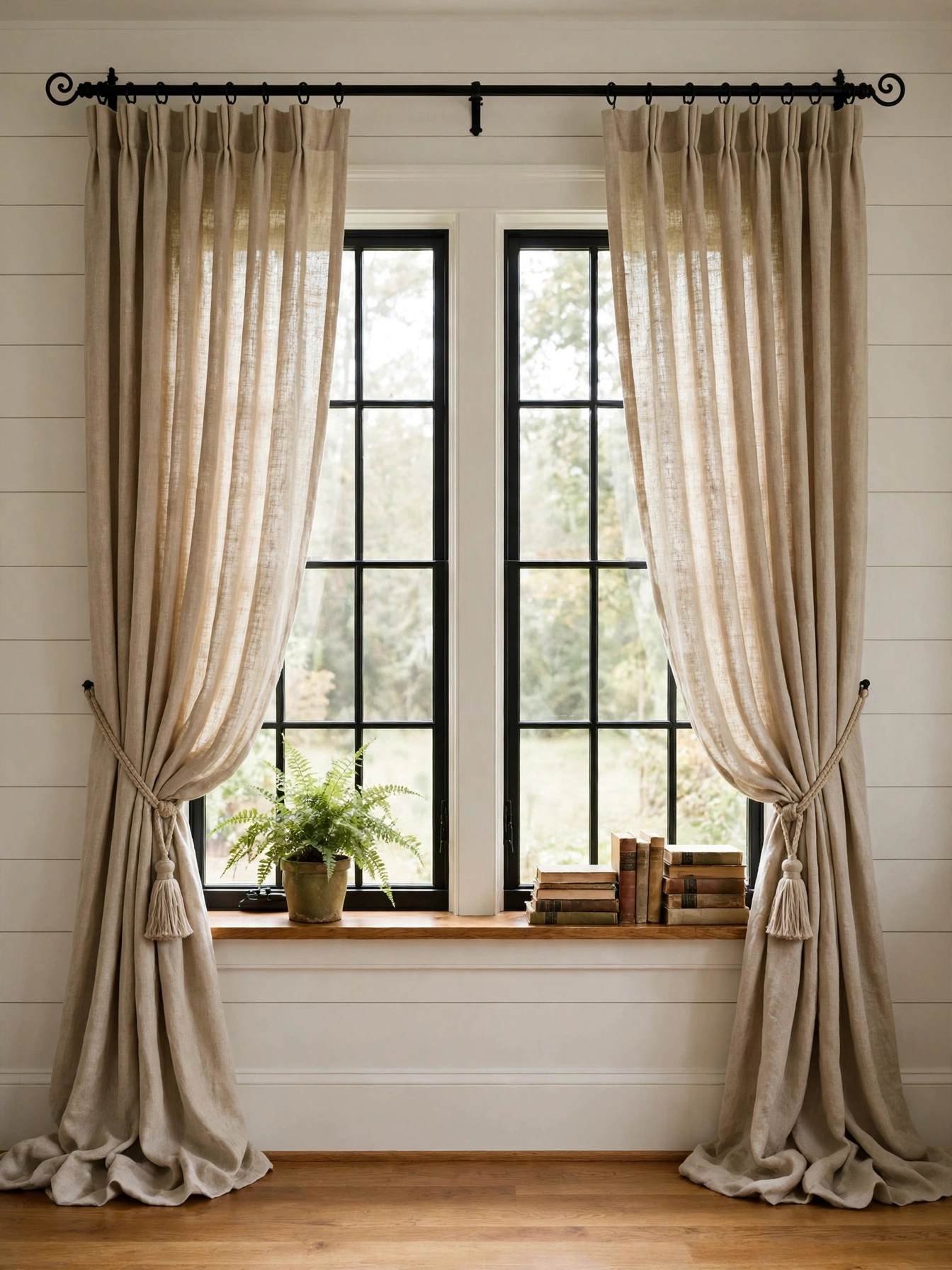
Why This Works:
- Gathered linen softens hard window lines better than any blind or shade.
- Natural linen filters light to a warm glow while keeping daytime privacy.
- Full-length panels hung high make standard 8 foot ceilings read taller.
- The slight wrinkle of linen is the farmhouse look, so no ironing is needed.
Mount a 1 inch diameter iron rod 4 to 6 inches above the window trim and 8 to 12 inches wider than the frame on each side, then hang 96 inch linen panels so they just kiss or pool 1 to 2 inches on the floor. For proper fullness, size panels at 2 to 2.5 times the window width; a 60 inch window needs roughly 150 inches of combined panel width. Budget cotton-linen blends start near $30 per pair, mid-range washed linen runs $80 to $140 per pair, and true Belgian linen reaches $200 with a softer drape that improves with every wash. Avoid dry cleaning, since linen shrinks up to 4 percent; machine wash cold and hang damp for the best finish.
North-facing rooms benefit most, because linen turns flat gray light into something warm. Insulation is the weak point: unlined linen does almost nothing for drafts, so add a separate thermal liner (about $25 per panel) if your windows are old. Heavy velvet drapes close a small room in, while linen keeps it feeling open and still frames the window. Pet owners should note that linen snags on claws, so keep panels hemmed above floor level if cats treat curtains as climbing walls.
Pro Tip: Buy panels 2 inches longer than you need and let them puddle, since trimmed-to-floor linen shrinks to high-water length after the first wash.
Distressed Coffee Table
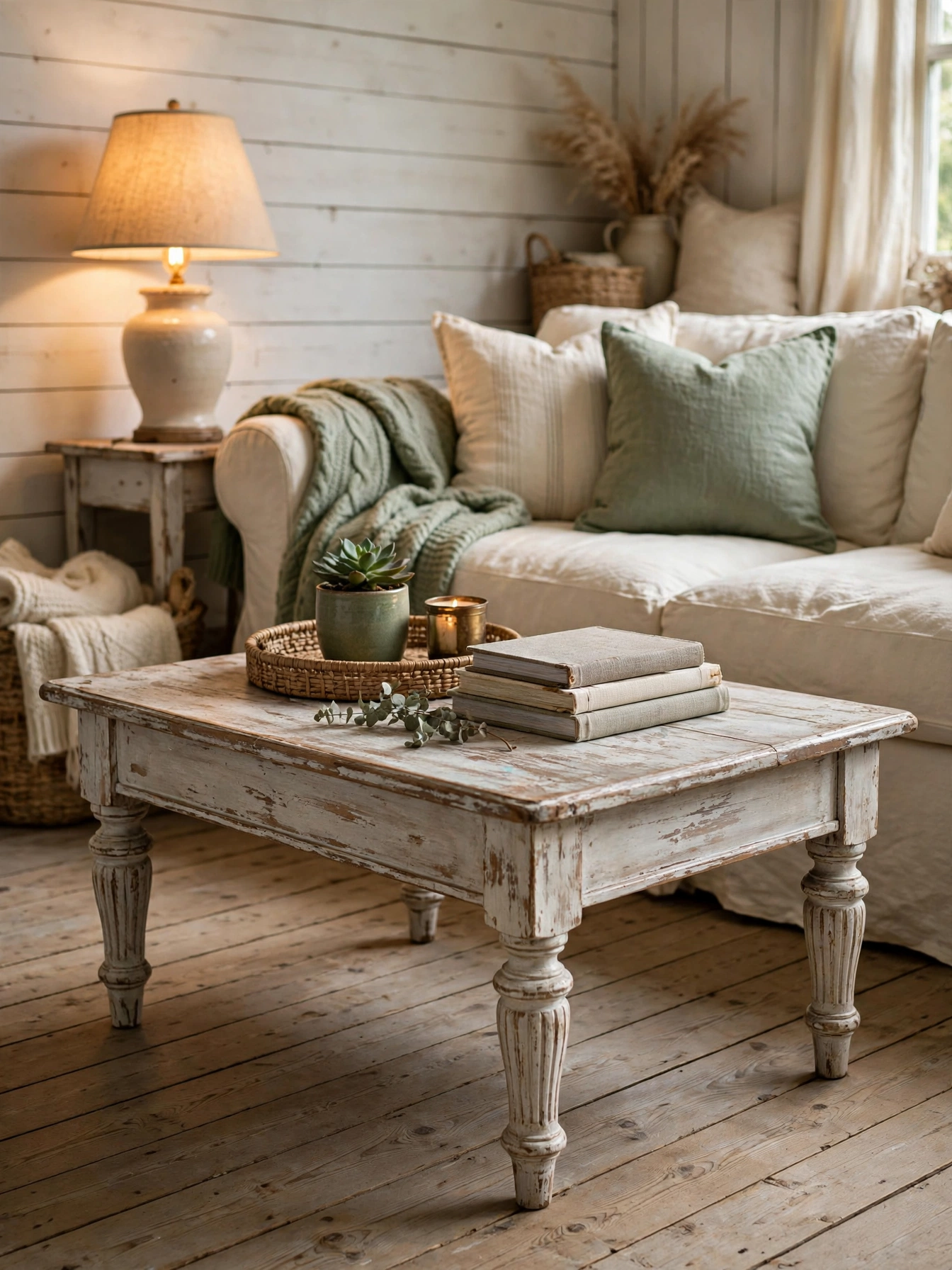
Why This Works:
- A distressed finish hides scratches, rings, and kid damage instead of showing it.
- Whitewashed wood brightens the center of the seating area without a rug change.
- The right table size anchors the sofa, making the whole arrangement feel planned.
- Turned legs and plank tops are farmhouse shorthand that need no other cues.
Size the table at two-thirds the sofa length and 16 to 18 inches high, which matches standard seat height and keeps the surface reachable from a seated position. Leave 14 to 18 inches of clearance between the table edge and the sofa front so legs fit underneath comfortably. Budget distressed tables start around $120 in pine veneer, solid pine runs $250 to $450, and reclaimed oak pieces reach $600 with genuinely aged grain. Seal whitewash with two coats of water-based polyurethane in matte, since unsealed chalk paint marks from a single sweaty glass. Avoid glass tops on farmhouse tables, because they erase the wood texture that makes the style work.
Families with toddlers gain the most here, because a pre-distressed surface treats new dings as patina. Weight is the drawback: solid wood tables run 60 to 90 pounds, so rearranging is a two-person job. A sleek modern table needs more careful maintenance, while the farmhouse version never looks precious. If you already own a plain wood table, distressing it yourself with sandpaper, a chain, and whitewash costs under $30 and takes one afternoon.
Pro Tip: Distress edges and corners first with 80-grit sandpaper, since those are the spots that wear naturally on real antique furniture.
Slipcovered Sofa Comfort
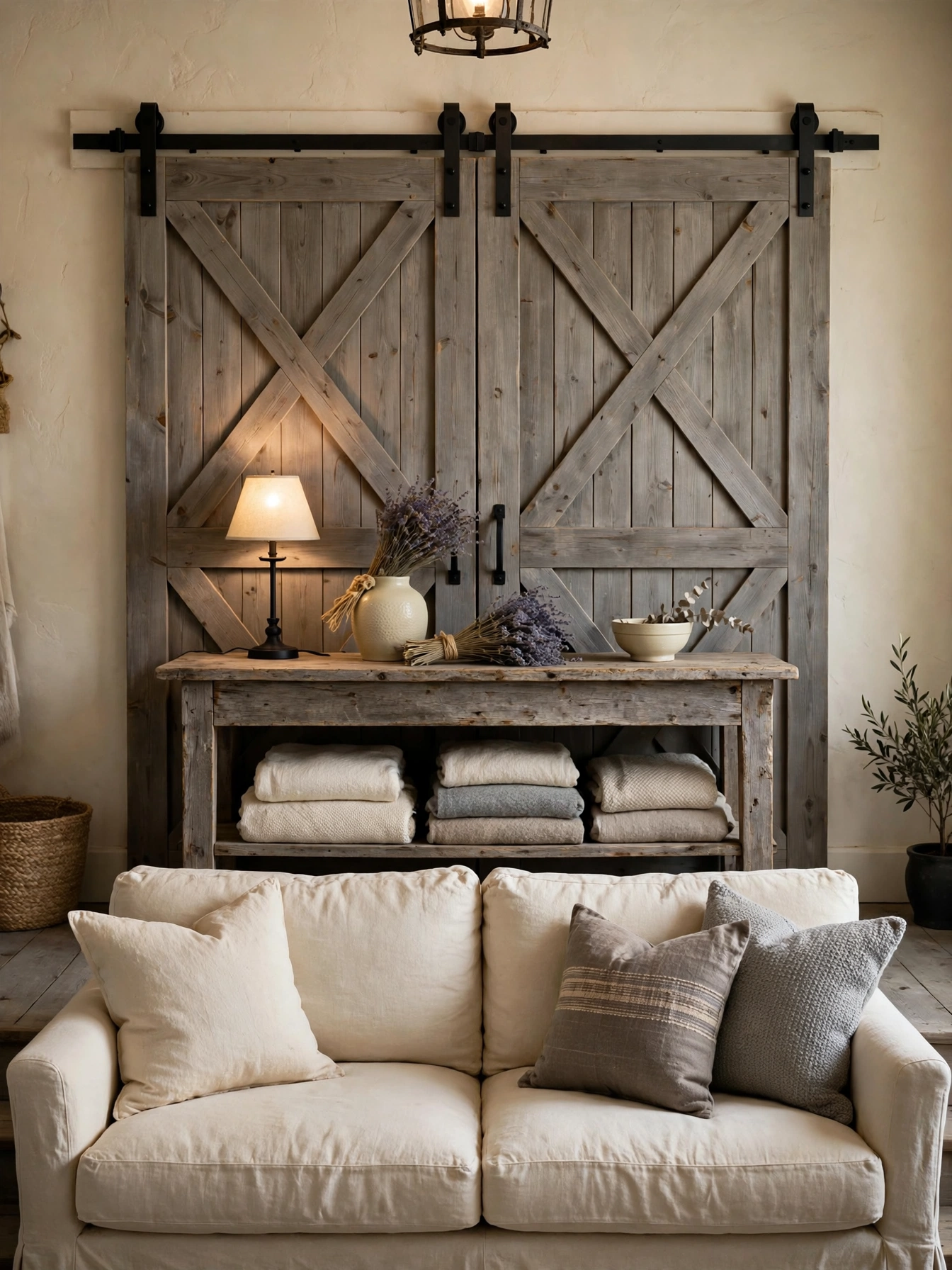
Why This Works:
- A slipcover lets you wash away spills instead of living with stains.
- The relaxed, slightly rumpled fit is the whole point of farmhouse upholstery.
- White slipcovers bounce light, keeping a farmhouse room bright and open.
- Replacement covers cost far less than reupholstering when styles change.
Buy the slipcover 2 to 4 percent larger than your sofa’s measured dimensions, since cotton shrinks on the first wash and a too-tight cover splits seams. Budget polyester slipcovers start around $40 but look flat and pill fast, mid-range cotton duck covers run $80 to $150 with good washability, and custom linen covers reach $400 to $800 with a tailored fit. Wash in cold water and tumble dry on low for 10 minutes, then pull the cover on while slightly damp so it molds to the cushions. Avoid dark slipcovers on light pets, because fur shows more on dark fabric and light fur weaves into the fibers.
Homes with kids or dogs get the biggest payoff, since the whole cover goes in the wash instead of the whole sofa going to the dump. Upkeep is the price you pay: a slipcovered sofa needs re-tucking weekly to keep its shape. Leather costs roughly ten times more and feels colder in winter than a slipcover. Industry guidance from furniture makers suggests rotating seat cushions monthly, which extends foam life by roughly a third on heavily used sofas.
Pro Tip: Keep a second slipcover in storage so the sofa never sits naked while one cover is in the wash.
Barn Door Console
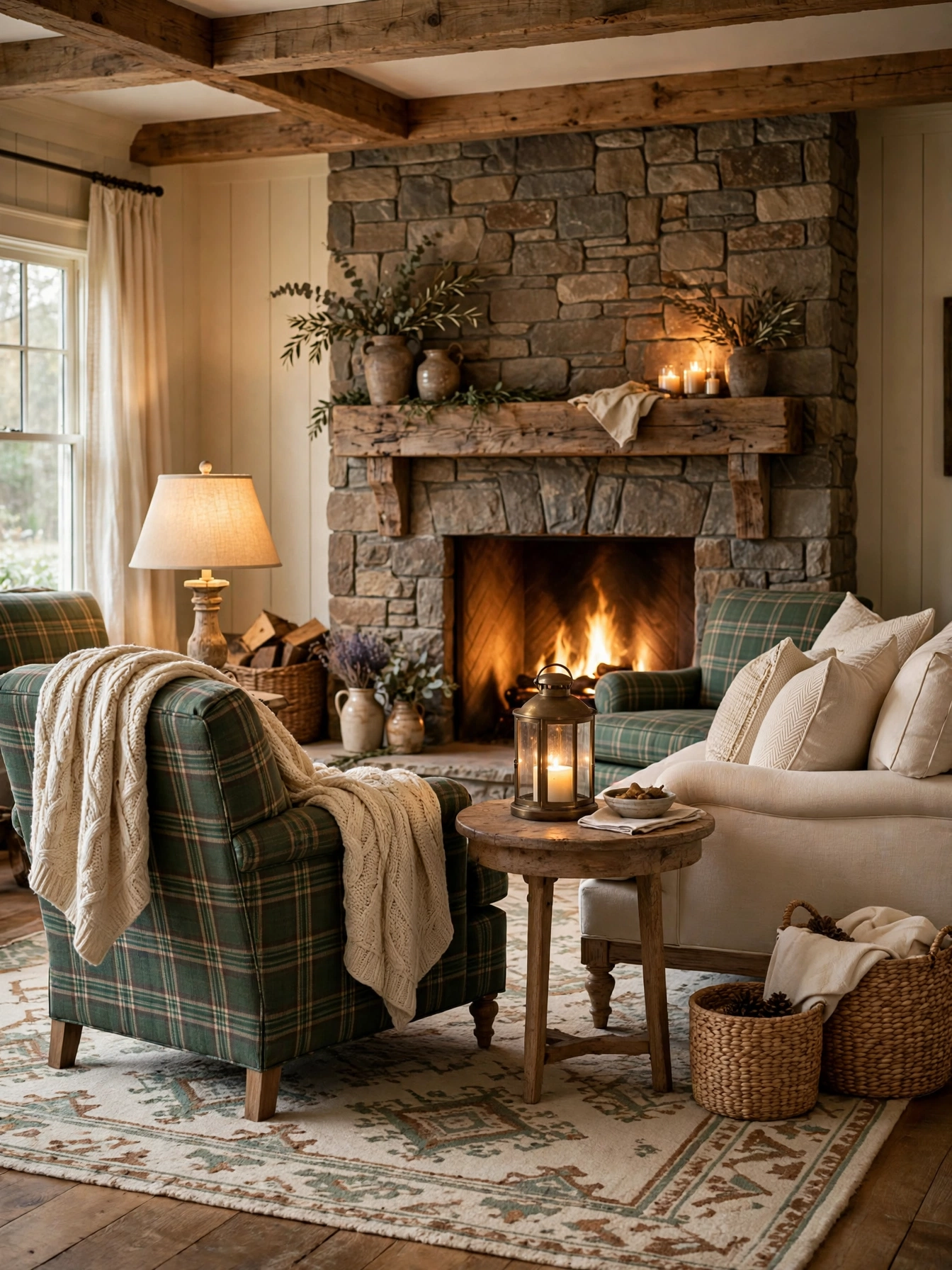
Why This Works:
- Sliding doors hide clutter without the swing clearance a hinged door needs.
- The X-brace pattern is the single most recognizable farmhouse motif.
- A 14 inch deep console fits behind sofas and in narrow hallways.
- Open shelving above the doors keeps remotes and books within reach.
Mount the black metal track 2 inches above the console top with 3 inch lag screws into studs, since a loaded console door can weigh 30 to 50 pounds. Choose a console 12 to 16 inches deep and 48 to 60 inches wide, with doors that overlap the opening by at least 1 inch on each side to hide gaps. Budget MDF barn-door consoles start near $150, solid pine versions run $300 to $500, and reclaimed wood pieces reach $800 with real nail holes and saw marks. Leave 1/2 inch of clearance under the doors so they slide over rugs without dragging. Never mount the track into drywall anchors alone, because the sideways pull of a sliding door will rip them out within months.
Apartment dwellers should measure doorways first, since a 60 inch console may not fit through a 30 inch hall turn. Access is the compromise: only half the storage is reachable at a time, which frustrates people who dig through bins daily. A standard credenza costs about the same but adds none of the farmhouse character. Families find the soft-close rollers worth the extra $20, since slamming doors wake napping toddlers fast.
Pro Tip: Wax the metal track twice a year with paste wax so the doors glide silently for a decade.
Cozy Farmhouse Living Room Ideas With Inviting Seating

Why This Works:
- Chairs angled toward each other invite conversation better than a straight sofa line.
- A U-shaped seating group around the fireplace makes the room feel gathered and warm.
- Mixed patterns in one palette look collected over time, not decorated in a day.
- Two chairs plus a sofa seats five without crowding a 15 foot room.
Arrange seating with 7 to 9 feet between facing pieces, which keeps conversation comfortable without shouting across the room. Keep 30 to 36 inches of walkway behind chairs so traffic flows without squeezing. Budget accent chairs in plaid upholstery start around $180, mid-range solid wood frames with good foam run $350 to $550, and eight-way hand-tied chairs reach $900 with decades of comfort. Choose seat depths of 20 to 22 inches for upright sitting and 23 to 25 inches for lounging. Avoid pushing every piece against the wall, since floating the arrangement 3 to 4 feet out creates the intimate grouping farmhouse rooms need.
This layout suits households that actually use their living room for talking, reading, and board games. TV viewing is the sacrifice: angled chairs fight a wall-mounted screen, so decide which activity rules the room. A sectional locks you into one layout, while separate chairs flex for parties and cost less to replace one at a time. Research from Houzz consistently shows seating arranged for conversation ranks among homeowners’ top regrets when skipped, so anchor the chairs on an 8×10 foot rug that extends 6 inches beyond each chair leg.
Pro Tip: Angle both chairs 15 degrees toward the fireplace instead of dead-on, which feels natural and leaves a clear walkway.
Layered Jute Rugs

Why This Works:
- Two rugs layered beat one big rug for texture, and cost less than a single 9×12.
- Jute adds natural fiber warmth underfoot that synthetic rugs cannot match.
- The top rug can be swapped seasonally while the jute base stays put.
- Layering defines the seating zone in open-plan rooms without any walls.
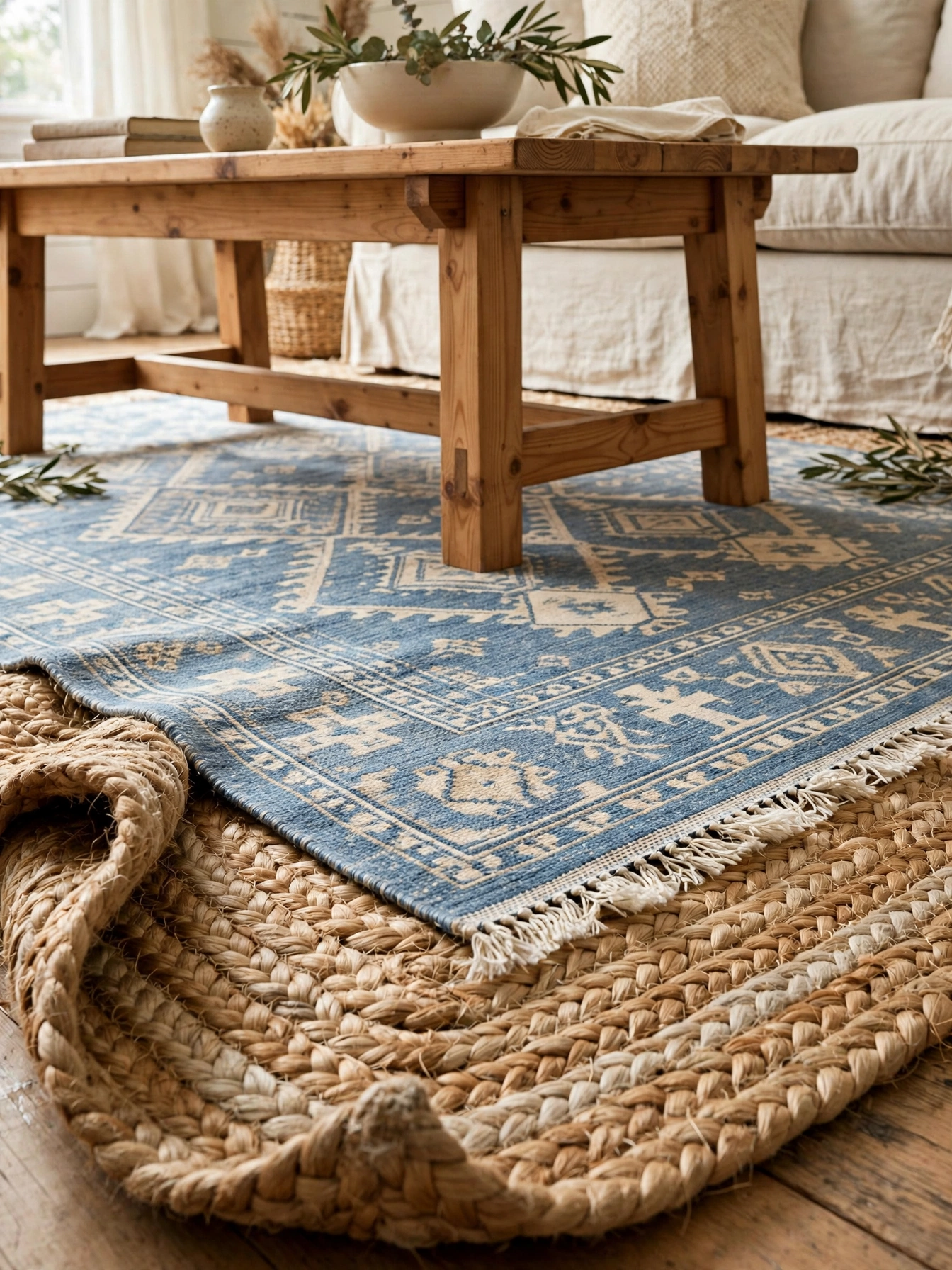
Start with an 8×10 foot jute base rug, then layer a 5×7 foot patterned flatweave on top, offset 6 to 12 inches toward the sofa so the layering looks casual. Budget jute rugs run $80 to $150 for 8×10, mid-range hand-braided jute reaches $250, and the patterned top rug adds $60 to $200 depending on material. Add a felt rug pad 1/4 inch thick underneath, which stops the jute from scratching hardwood and adds cushioning. Avoid jute in dining zones of the living room, since food stains sink into natural fiber and cannot be spot-cleaned easily.
Open-plan homes gain the most, because the layered edge visually fences the seating area. Expect some upkeep: jute sheds for the first 2 to 3 months and needs weekly vacuuming without a beater bar. One large wool rug costs 40 to 60 percent more and offers less design flexibility than the layered pair. Homes with allergies should note that jute traps dust, so shake the top rug outdoors monthly and vacuum the base thoroughly.
Pro Tip: Rotate the top rug 180 degrees every 3 months so foot traffic wears it evenly instead of creating a path.
Galvanized Metal Accents
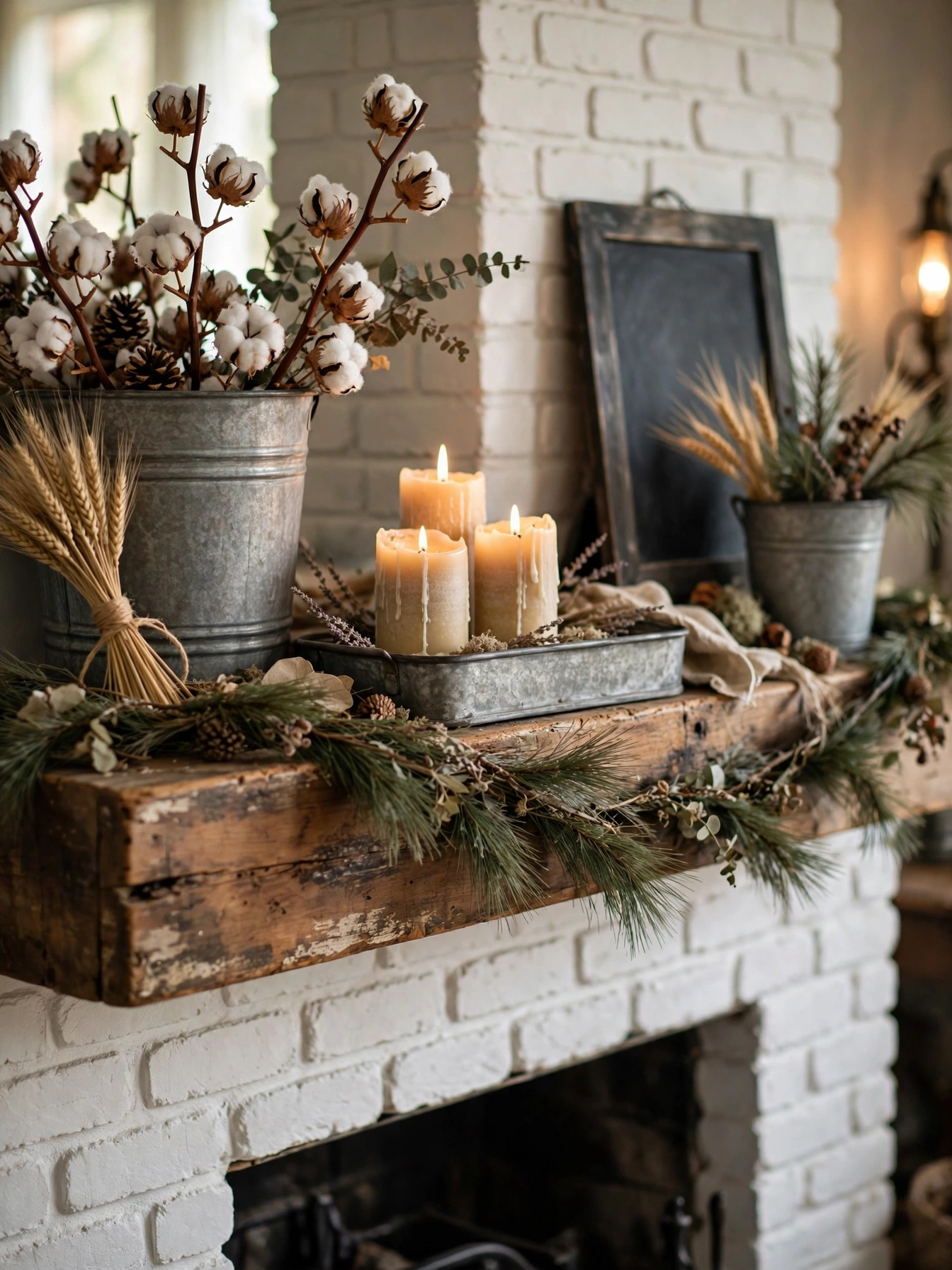
Why This Works:
- Cool galvanized gray balances all the warm wood so the room stays fresh.
- Metal buckets and trays corral small items that would otherwise scatter.
- The industrial edge keeps farmhouse style from tipping into shabby cliché.
- Most pieces cost under $25, making this the cheapest idea on the list.
Group galvanized pieces in odd numbers (three or five) with heights varying by at least 4 inches, since matched sets look like a store display. Line buckets with a plastic insert before adding live plants, because the zinc coating corrodes with constant soil moisture. Budget buckets and trays run $8 to $20, vintage-feeling planters reach $30 to $45, and large galvanized tubs for firewood cost $50 to $70. Keep metal away from direct fireplace heat above 200 degrees Fahrenheit, since prolonged heat discolors the finish. Avoid the shiny new look by choosing pieces labeled “aged” or “vintage finish,” which carry the matte patina farmhouse rooms need.
Renters love this idea because every piece is freestanding with zero installation. Rust is the enemy in humid climates: wipe pieces dry and apply a clear matte sealant once a year. Ceramic planters cost twice as much and crack when dropped on hardwood. Overuse is the real risk here; five pieces across a room read as accents, while fifteen read as a hardware store.
Pro Tip: Spray the inside of galvanized planters with rubberized undercoating to make them fully waterproof for live plants.
Vintage Crate Shelving
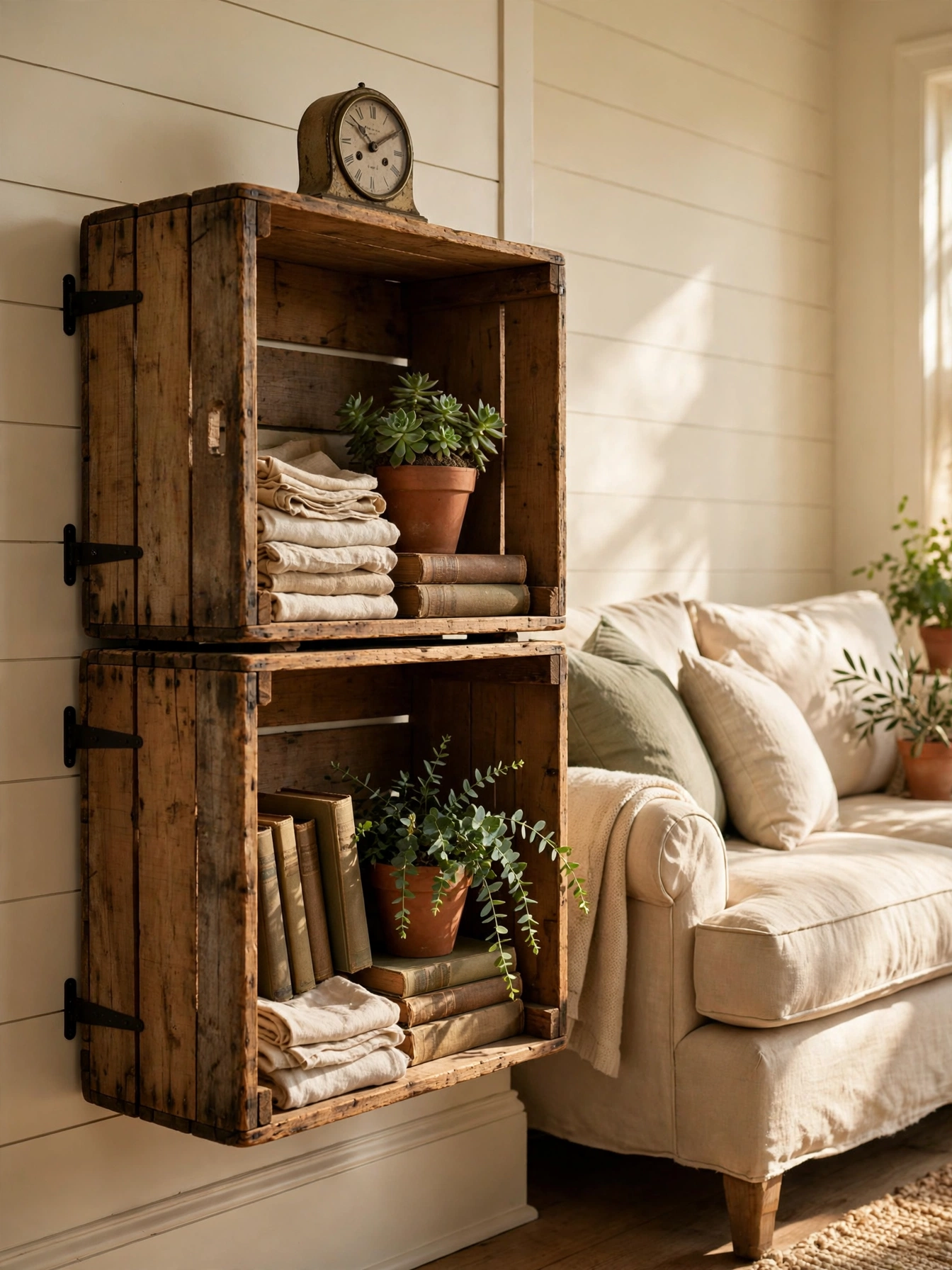
Why This Works:
- Crates add storage and display in one piece with genuine aged character.
- Stacking two crates creates a 30 inch side table height without any building.
- Open cubbies keep books and throws visible, which suits the farmhouse ethos.
- Real vintage crates cost less than most flat-pack shelving units.
Choose crates 18x12x12 inches or larger, stacking no more than three high (about 36 inches) without wall anchoring for stability. Secure stacked crates to each other with 1.5 inch wood screws through the bottom of each crate into the top of the one below. Budget reproduction crates cost $15 to $25, authentic vintage apple crates run $30 to $60 depending on stenciled branding. Sand rough interiors with 120-grit paper to prevent splinters on books and linens. Never stack crates holding heavy items like hardcover book collections above 40 pounds without anchoring the whole unit to a stud with an L-bracket.
Small rooms benefit most, because one crate stack replaces both a side table and a bookshelf. Dust settles fast on open shelves, so plan a quick wipe every two weeks. A bookcase offers double the storage but a third of the character. Check vintage crates for mold or chemical smells before bringing them indoors, and let suspect pieces air outside for 48 hours first.
Pro Tip: Stencil your family name and a date on a plain crate with craft paint for a custom heirloom look in under an hour.
Stone Fireplace Surround
Why This Works:
- Stone to the ceiling makes the fireplace the undisputed heart of the room.
- Natural stone veneer weighs far less than full stone, so most walls handle it.
- The texture contrasts beautifully with soft slipcovers and knit throws.
- A chunky mantel beam gives you a deep display shelf for seasonal styling.
Install manufactured stone veneer (about 8 to 12 pounds per square foot) over cement board with polymer-modified mortar, working from the bottom up in 2 foot sections. Run the stone floor to ceiling for maximum impact, typically 8 to 10 feet, and cap it with a mantel beam 6×8 inches and at least 6 feet long. Budget stone veneer runs $6 to $10 per square foot, natural thin-cut stone reaches $15 to $25 per square foot, and a reclaimed mantel beam adds $200 to $500. Keep combustible mantel wood at least 12 inches above the firebox opening per most building codes. Bring in a mason if the wall needs structural reinforcement, and never skip the building permit for fireplace modifications.
Rooms with an existing boring drywall fireplace surround gain the most dramatic before-and-after here. Permanence cuts both ways: stone veneer installs in a weekend but takes demolition to remove. A painted brick surround costs a third as much but cannot fake genuine stone texture. Dust the ledges with a soft brush monthly, since stone crevices collect it visibly.
Pro Tip: Mix 3 different stone boxes during installation so color repeats never line up in an obvious pattern.
Homespun Knit Throw Blankets

Why This Works:
- Oversized knit stitches add sculptural texture that flat blankets cannot.
- One chunky throw on a chair reads as an invitation to sit down.
- Merino versions are genuinely warm, not just decorative.
- Cream and oatmeal tones work in every farmhouse palette without clashing.
Choose a 40×60 inch throw for draping over a chair back or a 50×70 inch size for full sofa coverage. Budget acrylic chunky knits start around $30, merino wool blends run $80 to $150, and hand-knit pure merino reaches $200 to $350 with noticeably loftier stitches. Hand wash merino in cool water and dry flat, since machine agitation felts the fibers into a stiff mat. Avoid hanging chunky knits on hooks, because the 3 to 5 pound weight stretches the stitches permanently. Store folded, never hung, to protect the knit structure.
Reading corners and chilly rooms get the most use from this one. Shedding is the nuisance: new chunky knits drop fibers for the first month, so shake them outdoors weekly at first. A standard fleece throw costs less, but the chunky knit photographs beautifully and feels like a luxury hotel amenity. Pet claws snag the open weave easily, so this belongs in adult zones or on high chair backs.
Pro Tip: Fold the throw in thirds lengthwise before draping so the thick stitches stack into neat, even rows.
Farmhouse Ladder Decor
Why This Works:
- A ladder displays your prettiest textiles as decor instead of hiding them away.
- The vertical shape fills awkward empty wall corners that art cannot.
- At 5 to 6 feet tall, it adds height without overwhelming a small room.
- Quilts stay aired and accessible rather than compressed in a closet.
Lean a 5 to 6 foot ladder with 4 to 6 rungs at a 75 degree angle against the wall, securing the top with a clear adhesive hook rated for 10 pounds or an L-bracket for real stability. Budget pine blanket ladders start around $40, distressed finishes run $70 to $120, and reclaimed wood versions reach $150. Fold quilts to 12 inches wide so each rung shows a neat band of pattern. Avoid placing the ladder in main traffic paths, since a leaning ladder tips if bumped hard by kids or large dogs. Anchor it if toddlers climb, because a 6 foot ladder falling forward is a genuine hazard.
Textile collectors and quilters love this most, since it turns a stash into a display. Folded quilts collect dust, so rotate which one sits on top every month or two. A quilt rack costs more and needs a wider wall than the ladder. Homes short on blanket storage find the ladder holds 4 to 5 throws in 2 square feet of floor space, which no basket can match for visibility.
Pro Tip: Hang quilts with the folded edge facing out so the pattern shows at its fullest width.
Cozy Farmhouse Living Room Ideas Around the Hearth

Why This Works:
- Styling the hearth itself extends the fireplace’s warmth into the whole room.
- A stacked wood pile looks abundant and rustic even beside a gas fireplace.
- Lanterns at two heights create the layered glow designers call visual warmth.
- The hearth zone becomes a vignette, not just the floor under the mantel.
Stack split firewood 16 inches long in a neat crisscross pile 24 to 36 inches wide beside the firebox, keeping it 36 inches from an active wood-burning opening per fire safety guidance. Place lanterns 12 and 18 inches tall on opposite sides of the hearth for balanced asymmetry, using LED pillar candles with timers for safety. Budget iron lanterns run $15 to $30 each, a firewood log holder costs $40 to $80, and a 3×5 foot plaid hearth rug runs $50 to $100. Keep real candles 12 inches from any fabric and never leave them burning unattended. Avoid storing more than a day’s worth of wood indoors if you have termite concerns in your region.
Anyone with a fireplace, working or decorative, can use this idea immediately. Shallow hearths limit this idea: anything under 18 inches deep cannot hold much styling safely. A bare hearth wastes the coziest zone in the room; this styling delivers outsized warmth for under $100 total. The American Lighting Association notes that layered light sources at multiple heights make rooms feel warmer at lower overall brightness, which is exactly what the lantern pairing achieves.
Pro Tip: Set lantern candles on 6-hour timers starting at dusk so the hearth glows automatically every evening.
Butcher Block Mantel

Why This Works:
- A thick wood mantel grounds a tall fireplace and gives the eye a resting line.
- Butcher block is food-safe finished, so it doubles as a sturdy display shelf.
- The 8 inch depth holds leaning art and plants without crowding.
- Warm maple tones bridge white shiplap and darker furniture below.
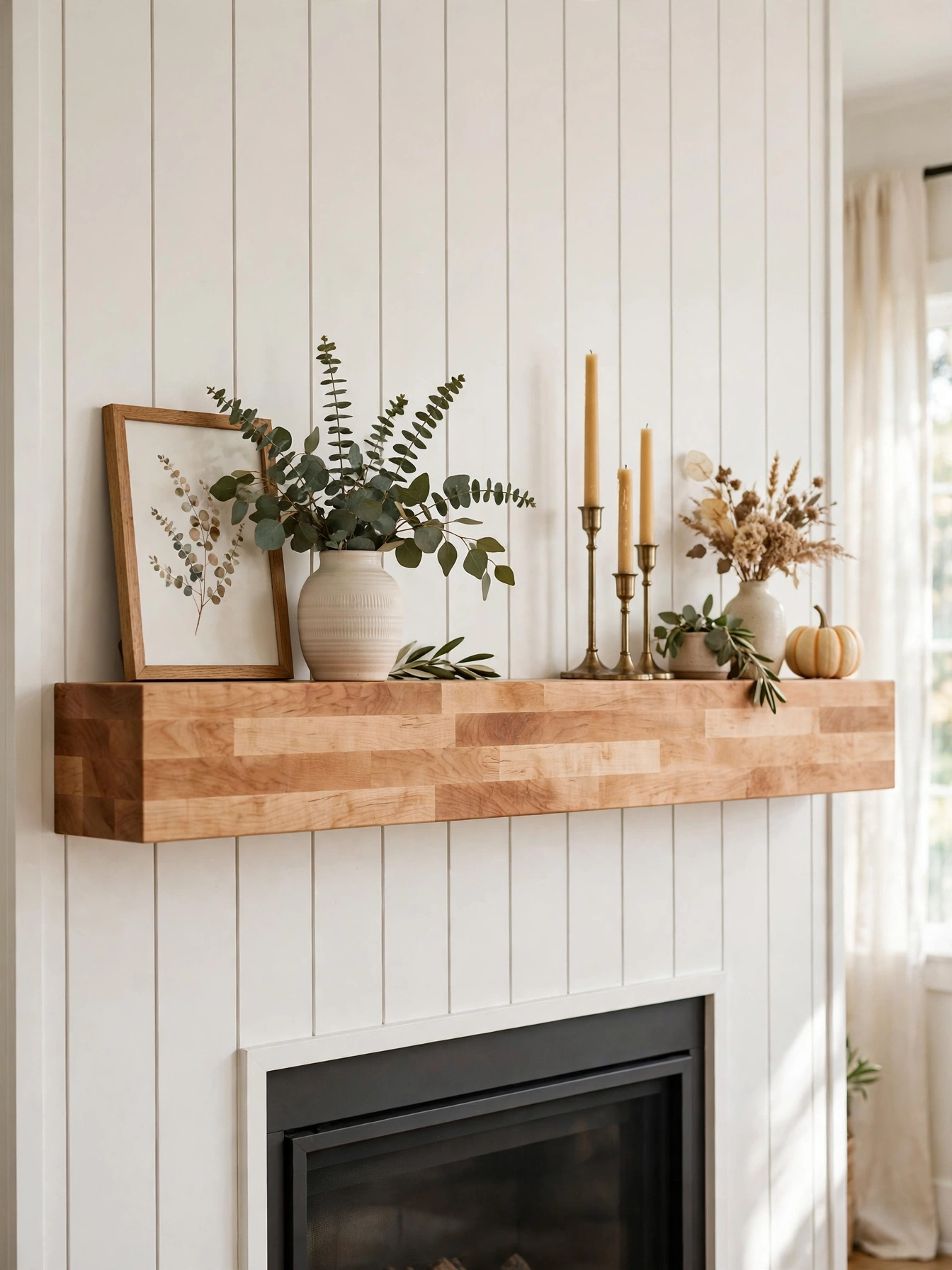
Mount a 6 foot long, 8 inch deep, 3 inch thick butcher block mantel 54 to 60 inches from the floor, which suits standard 8 foot ceilings and keeps decor above the heat zone. Support it with two 12 inch steel corbels rated for 100 pounds each, lag-bolted into studs, since a loaded mantel easily exceeds 60 pounds. Budget acacia butcher block runs $80 to $120 for a 6 foot piece, maple reaches $150 to $250, and walnut tops $300 with richer grain. Finish with three coats of water-based polyurethane, sanding with 220-grit between coats. Avoid mounting with adhesive alone, because seasonal wood movement will pop a glue-only joint within a year.
Fireplace owners with bare drywall above the firebox see the biggest transformation. Heat is the constraint: keep the mantel at least 12 inches above the opening and never rest candles directly on wood without a tray. A stone mantel costs four times more and needs a full weekend to install. Style it in odd-numbered groupings with heights varying 6 inches or more for a collected, not staged, look.
Pro Tip: Leave a 1/4 inch shadow gap between the mantel and the wall so seasonal expansion never cracks the paint line.
Cotton Stem Arrangements
Why This Works:
- Cotton stems are the signature farmhouse botanical, recognized instantly.
- Dried stems last for years with zero water, light, or maintenance.
- White bolls brighten dark corners without needing a lamp.
- One $12 bundle fills a pitcher; the cost per year of use is tiny.
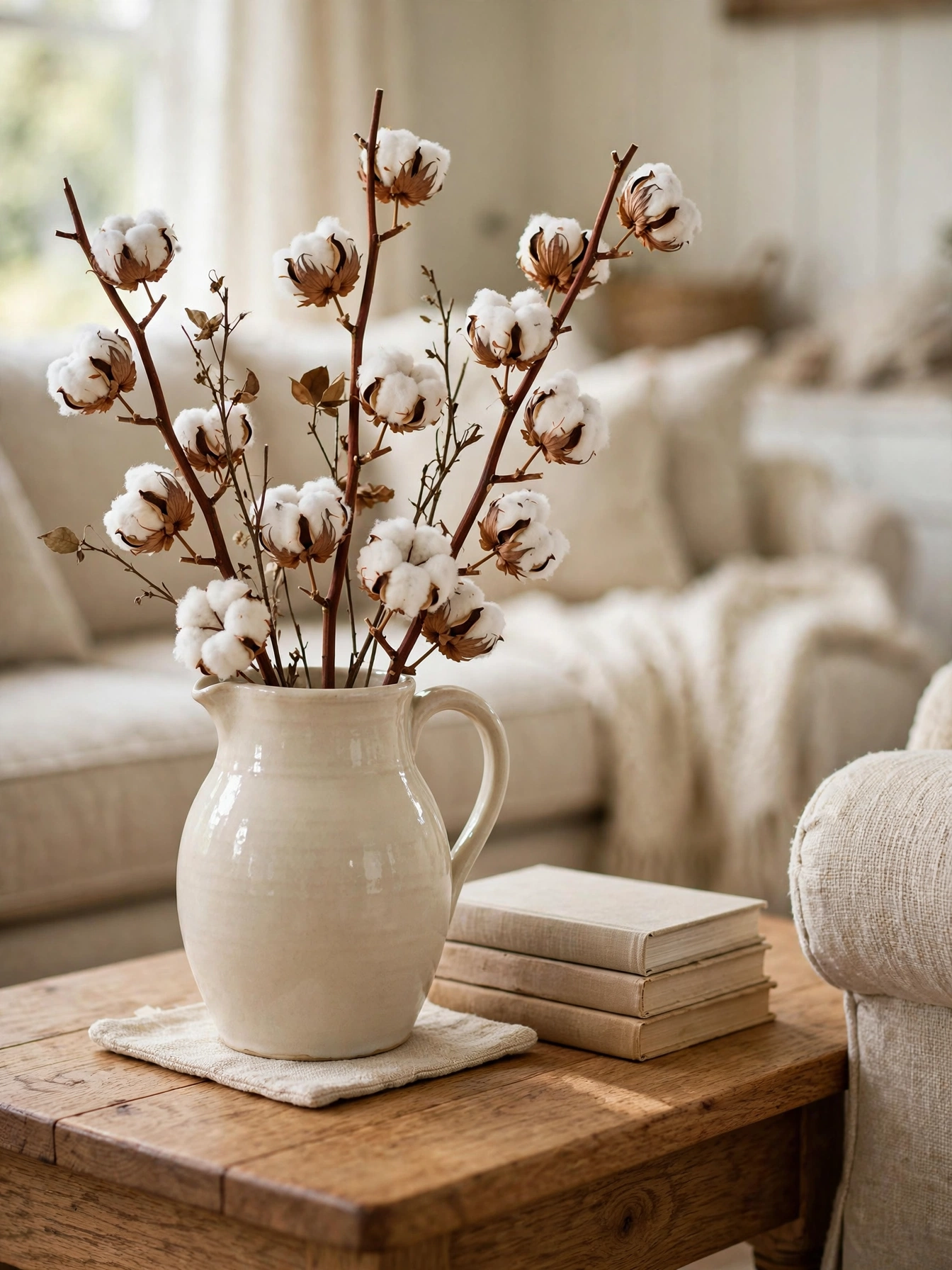
Arrange 5 to 7 cotton stems (each 24 to 30 inches tall) in a pitcher 8 to 10 inches high, trimming stems at an angle so the tallest sits 1.5 times the vessel height. Budget cotton stem bundles run $10 to $18 for 6 stems, fuller premium bundles reach $25. Fluff each boll gently with your fingers, since shipping compresses them flat. Keep dried cotton away from open flames and high-heat bulbs, because the fibers ignite easily. Avoid placing them in humid bathrooms, since moisture mats the bolls and encourages mildew over time.
Anyone wanting farmhouse flavor without new furniture should start here. Delicacy is the downside: cotton bolls shed fibers when brushed and crush if squeezed. Two grocery bouquets cost the same as one cotton bundle but last a week instead of years. Dust the bolls with a cool hairdryer every few months to keep them bright white.
Pro Tip: Bend the bottom 2 inches of each stem at a right angle so the bundle wedges firmly and never topples.
Handwoven Basket Organizers
Why This Works:
- Baskets swallow clutter (throws, toys, magazines) while looking like decor.
- Natural fiber texture reinforces the farmhouse material story everywhere.
- Two sizes grouped look intentional; a single basket looks like an afterthought.
- Open tops keep contents visible and grabbable, so the system actually gets used.
Choose a large basket 18 to 22 inches in diameter for throw blankets and a medium 12 to 15 inch basket for remotes and magazines. Budget seagrass baskets run $20 to $35, handwoven water hyacinth reaches $45 to $70 with tighter, more durable weaves. Roll throws instead of folding them to fit 30 percent more in the same basket. Avoid placing unlined baskets on light rugs in damp rooms, since natural fibers can transfer tannin stains when wet. Line toy baskets with a $5 fabric liner to stop small pieces falling through the weave.
Families drowning in living room clutter gain the most immediate relief here. Open baskets still show mess, just tidier mess, so they suit casual households best. Lidded ottomans cost three times more and are harder to move for vacuuming. The Spruce’s organizing editors frequently recommend the one-basket-per-category rule, which keeps the system from becoming a single junk basket.
Pro Tip: Tuck a lavender sachet at the bottom of each throw basket so blankets smell fresh every time you pull one out.
Edison Bulb Lighting
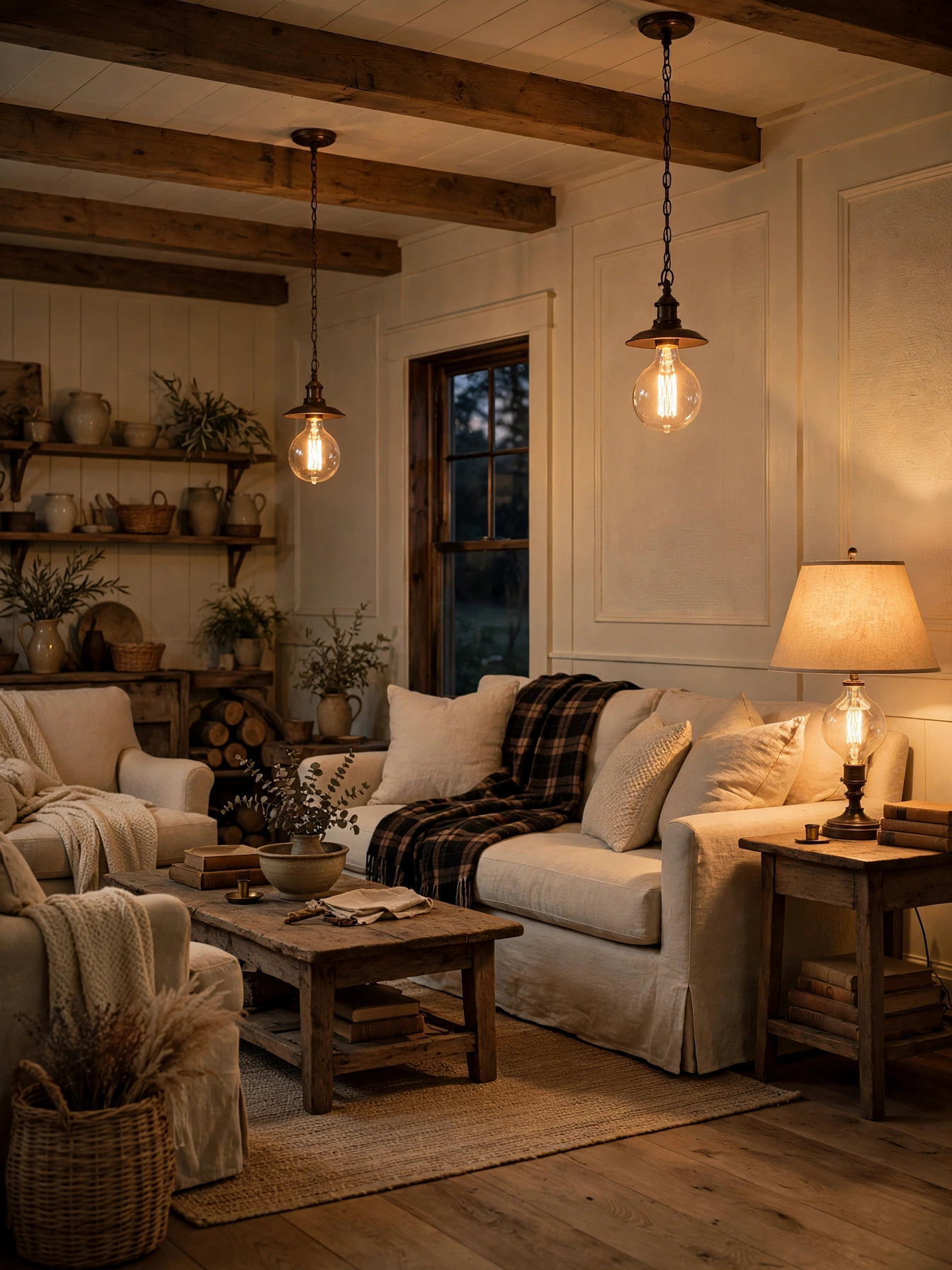
Why This Works:
- Visible filaments add vintage character that standard bulbs cannot.
- Warm 2700K light flatters wood tones and skin better than cool daylight bulbs.
- Pendants over the seating area define the zone without a single wall.
- LED Edison bulbs use 85 percent less energy than the original incandescents.
Choose LED Edison bulbs at 2700K and 400 to 800 lumens each, dimmable if your switch supports it (check for trailing-edge dimmers to avoid flicker). Position pendants 30 to 36 inches above the coffee table, keeping them a full 7 feet above the floor over walkways. Budget LED Edison bulbs cost $6 to $10 each, designer filament styles reach $15 to $25. Space pendants 24 to 30 inches apart for even glow. Avoid old-style incandescent Edisons as primary lighting, since each burns 40 to 60 watts and runs hot enough to scorch nearby fabric. Bring in an electrician for any new pendant box or dimmer switch, since incorrect wiring is a fire risk.
Evening-heavy households feel the biggest mood shift from this change. Task lighting is the gap: Edison bulbs are atmospheric, so keep a 1000-plus lumen reading lamp nearby for actual reading. Recessed cans cost about the same installed but add none of the vintage style. The American Lighting Association recommends three light layers per room (ambient, task, accent), and Edison pendants cover the ambient layer with farmhouse personality.
Pro Tip: Buy one extra bulb and store it with the fixture manual, since matching filament styles get discontinued without warning.
Cozy Farmhouse Living Room Ideas With Antique Window Frames

Why This Works:
- A salvaged window adds architecture to a flat wall for the price of wall art.
- The divided panes create a grid that organizes whatever hangs around them.
- Chippy original paint carries authentic age that reproductions fake poorly.
- At 30×36 inches, one frame fills the space above most console tables.
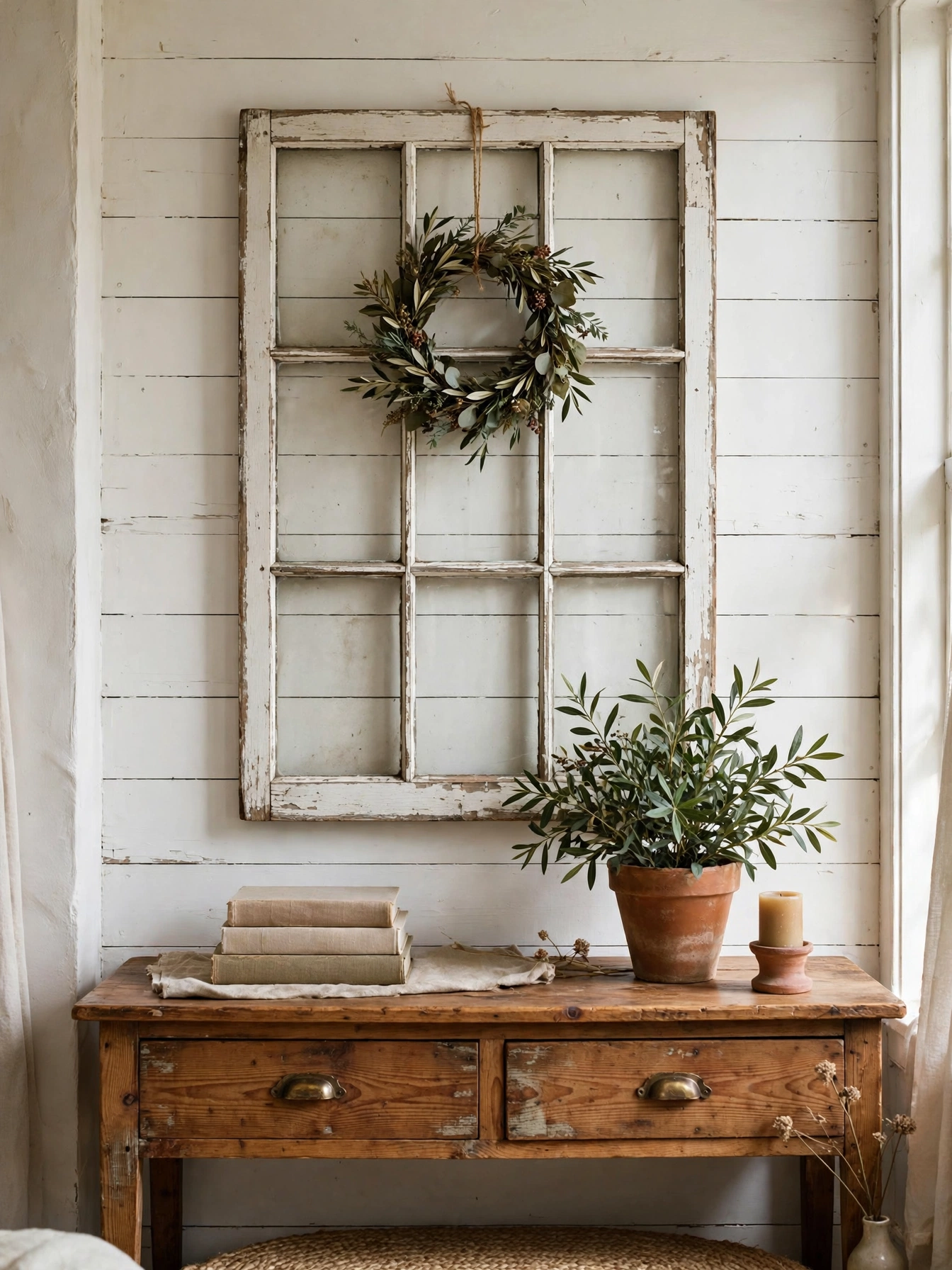
Hang a 28 to 36 inch wide window frame centered 57 inches from the floor to its midpoint, the standard gallery height that suits most viewers. Secure it with two D-rings and picture wire rated for at least twice the frame’s weight, since old wood and glass run 15 to 25 pounds. Budget salvage frames cost $25 to $60 at architectural salvage yards, cleaned and sealed versions reach $80 to $120. Test old paint for lead with a $10 swab kit before sanding or handling around children. Avoid hanging glass-paned frames above seating without safety film, since a falling pane is a real hazard in earthquake-prone regions.
Salvage lovers and history buffs get the most joy from this piece. A canvas print of the same size weighs less and never shatters, which is the real trade-off here. New farmhouse wall decor costs the same or more yet always risks looking mass-produced. Seal chippy paint with clear matte sealer so the flakes stay put instead of raining onto the console below.
Pro Tip: Hang a small 10 inch wreath from the top rail with jute twine to make the frame feel styled instead of stored.
Plush Area Layering
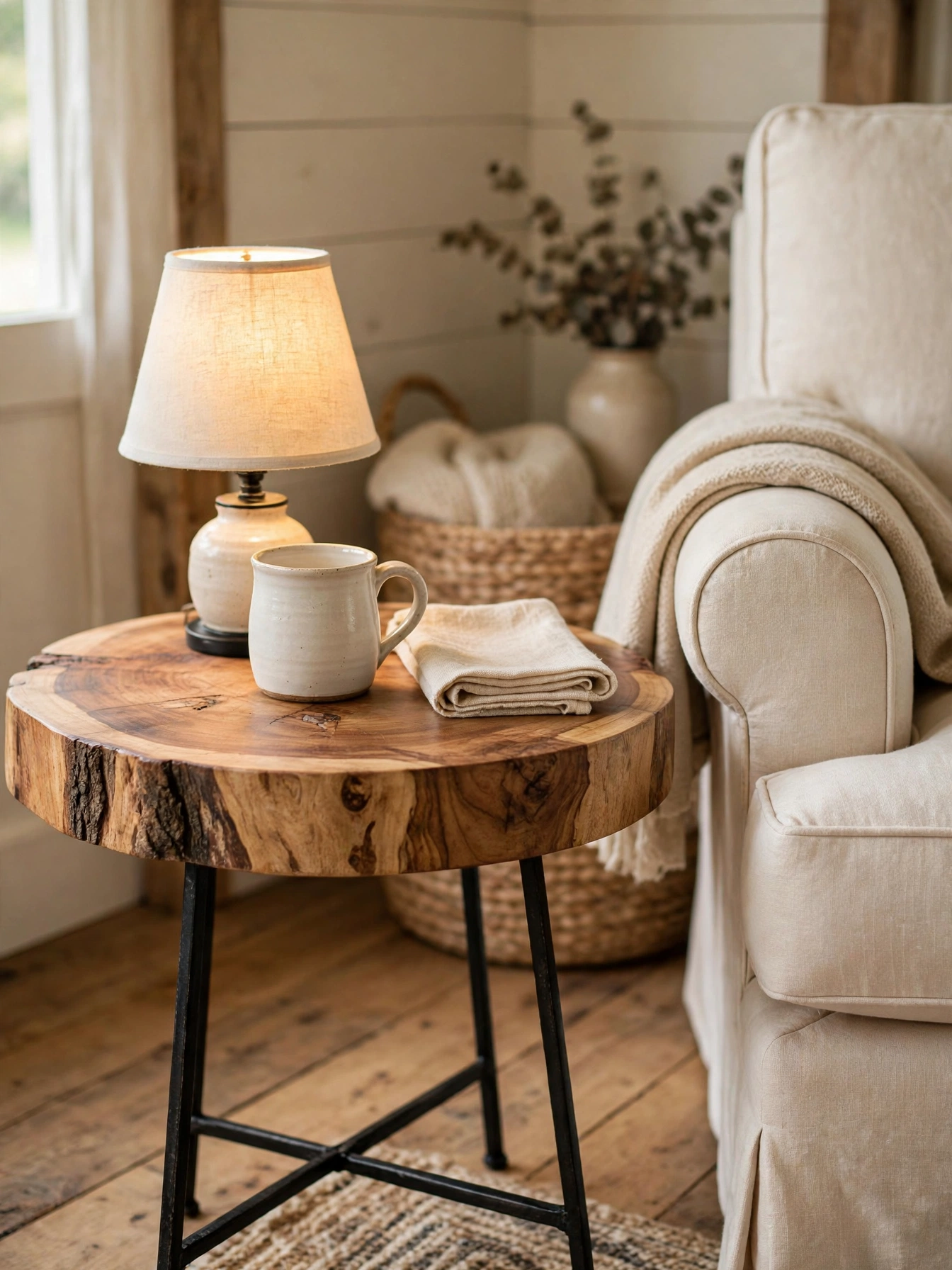
Why This Works:
- A plush top layer adds the softness farmhouse style sometimes lacks.
- Deep pile feels luxurious under bare feet on cold mornings.
- The cream tone lightens the heavier wood and leather around it.
- Layering at a slight angle looks relaxed and collected, not stiff.
Layer a 4×6 or 5×7 foot shag rug with 1.5 to 2 inch pile over a flat 8×10 foot natural fiber base, offsetting the top rug 8 to 12 inches toward the main seating. Budget polyester shags run $60 to $120, wool-blend shags reach $250 to $400 with far better resilience. Vacuum shag with suction only (no beater bar) weekly, and shake it outdoors seasonally to release deep grit. Avoid placing shag under dining chairs or rolling office chairs, since the pile crushes permanently under concentrated weight. Choose a rug pad 1/8 inch thinner than usual under layered rugs to keep the total height under 1 inch at doorways.
Barefoot households and cold-climate readers get the most comfort per dollar here. Cleaning takes more effort: shag traps crumbs and pet hair that flat weaves release easily. Wall-to-wall carpet costs more, stays put, and spreads softness where nobody walks. Rotate the top rug quarterly, because sunlight fades one side faster and foot traffic mats the center.
Pro Tip: Sprinkle baking soda on the shag monthly, wait 20 minutes, then vacuum to keep it smelling fresh without washing.
Rustic Side Tables
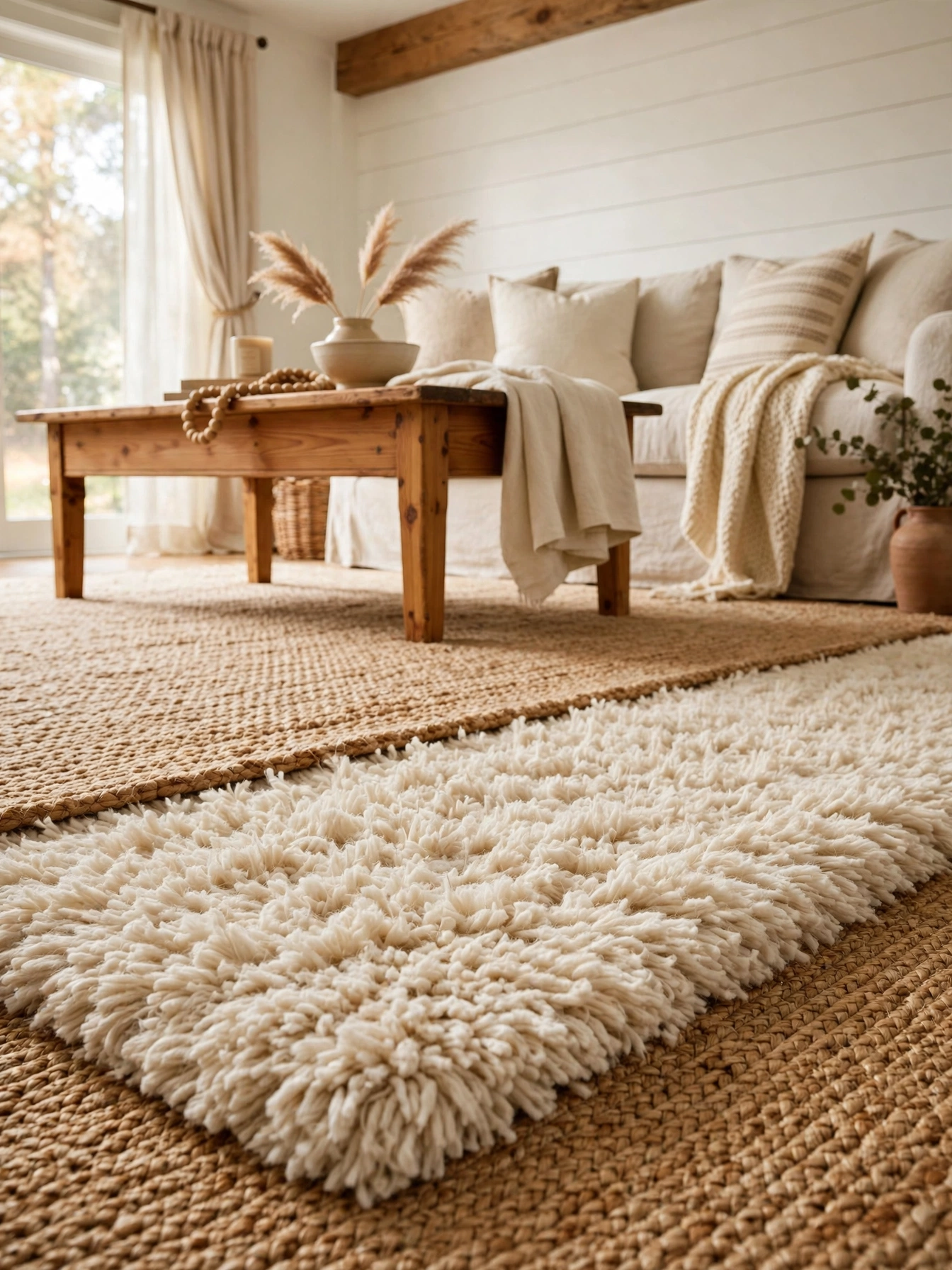
Why This Works:
- A side table within arm’s reach makes a chair a true reading spot.
- Live-edge tops bring organic shape into rooms full of straight lines.
- At 22 to 24 inches high, the right table meets the chair arm perfectly.
- One distinctive table elevates the whole corner for under $150.
Match side table height to within 2 inches of the chair arm, typically 22 to 24 inches, so lamps and drinks sit at natural reach. Choose a top 16 to 20 inches in diameter for lamps plus a book, or 12 inches for a drink-only perch. Budget live-edge style tables run $60 to $120 in acacia, solid walnut live-edge reaches $200 to $350. Seal the top with hardwax oil, which resists rings better than plain polyurethane on raw-edge wood. Avoid wobbly three-leg designs on thick rugs, since the uneven surface rocks; four legs or a solid base stays stable. Check that the lamp base fits with 3 inches of clearance around it before buying.
Readers and tea drinkers use this piece daily, making it high value per dollar. Surface area is the limit: a 16 inch top holds a lamp and a mug, not a lamp, a mug, and a laptop. A matching set costs more and looks less collected than one characterful table. Live-edge purists should confirm the bark edge is stabilized with epoxy, because loose bark sheds onto the rug within months.
Pro Tip: Put felt pads under the legs even on rugs, since iron bases snag fibers when you slide the table to vacuum.
Warm Neutral Palette

Why This Works:
- Warm neutrals (beige, oat, caramel) flatter every wood tone farmhouse rooms use.
- A limited palette makes mixed vintage pieces look cohesive instead of random.
- Warm whites feel cozy where cool grays can feel clinical and flat.
- Neutrals let texture (linen, wool, wood grain) become the visual interest.
Build the palette on three levels: walls in warm white (LRV 75 to 85), large pieces in mid neutrals like oatmeal and greige, and accents in deep caramel or soft black for grounding. Keep the total palette to 4 to 5 colors, repeating each at least three times around the room so nothing looks accidental. A gallon of quality warm-white paint covers about 400 square feet and costs $45 to $70. Test paint on a 2×2 foot board and view it morning, noon, and night, since warm neutrals shift dramatically under different bulbs. Avoid mixing warm and cool neutrals in one room, because beige walls plus gray sofa read as dirty rather than designed.
Anyone starting from scratch or repainting gains the most, since paint is the cheapest transformation available. Blandness is the risk: all-neutral rooms need texture and pattern (plaid, knit, jute) to stay interesting. Bold color schemes cost the same to execute but resell worse and age faster. Designers at HGTV frequently note that warm neutrals photograph best for listings, a useful bonus if you ever sell.
Pro Tip: Add one black accent (frame, lamp, or hardware) per room, since black sharpens warm neutrals like eyeliner sharpens a face.
FAQs
What are the easiest cozy farmhouse living room ideas to start with?
Start with textiles: layered plaid throws ($15 to $80), gathered linen curtains ($30 to $140 per pair), and a jute rug ($80 to $150 for 8×10). These three changes take one afternoon, need zero tools, and deliver most of the farmhouse warmth for under $300 total.
How do I keep a farmhouse living room from looking cluttered?
Follow the one-in-one-out rule for decor and give every category its own basket or bin. Limit open shelving to 30 percent styled decor and 70 percent breathing room, and keep surfaces to groupings of three items with 6 inches of empty space between groups.
Can cozy farmhouse living room ideas work in a small apartment?
Absolutely. Choose the small-footprint ideas: cotton stem arrangements, galvanized accents, a blanket ladder (2 square feet of floor), and layered throws. Skip beams and stone veneer, and keep the palette warm and light, which designers at The Spruce note makes rooms under 200 square feet feel larger.
What paint colors work best for farmhouse walls?
Warm whites with an LRV of 75 to 85 (like creamy off-whites) suit most farmhouse rooms, while soft greige works in north-facing spaces. The NKBA guidelines suggest testing 2×2 foot samples for 48 hours before committing, since undertones shift between morning and evening light.
How much does a full farmhouse living room refresh cost?
A textile-and-accent refresh runs $300 to $800, a mid-range update with furniture like a slipcovered sofa and barn door console runs $1,500 to $3,000, and a full renovation with shiplap, beams, and stone veneer reaches $5,000 to $10,000 for a 300 square foot room.
Conclusion
These cozy farmhouse living room ideas prove that warmth comes from layers, not spending: shiplap and stone add architecture, plaids and knits add softness, and honest materials like worn wood and galvanized metal tie it all together. Start with textiles this weekend, add one statement piece like the barn door console next, and save the bigger projects for when the budget allows. Your first action: pick the three ideas that fit your room today and measure your space before buying anything. Follow HomelyCrafter on Pinterest for more ideas.
Save this to your Pinterest boards so you can refer back to it!

Muhammad Israr is a home decor enthusiast and the writer behind Homely Crafter. He spends his days researching paint colors, layouts and budget-friendly styling ideas, then breaks them down into practical, easy-to-follow guides so you can decorate with confidence.