
After three Decembers of slim Scandinavian trees and beige everything, 2026 feels like the year Christmas remembered it loves to dress up. The christmas decor trends for 2026 coming out of the winter trade shows lean maximalist in mood but surprisingly practical in execution: jewel-toned velvet, thrifted mercury glass, and fresh greenery gathered from the yard. According to the Christmasworld 2026 trend report covered by Home Accents Today, oversized bows, bold color palettes, and vintage-inspired pieces defined the showroom floor, while last year’s cool silvers and all-white schemes quietly retired.
Think of this guide as a walk through the season’s most-pinned looks, sorted into what is genuinely worth your time and money. You will get exact ribbon widths, ornament sizes, lighting temperatures, and real budget ranges for every trend, plus what to skip so you do not buy into a look that feels tired by New Year.
Here are the 24 trends that made the cut for 2026, from velvet bows to quiet luxury styling. Each one includes measurements, material notes, and a pro tip you can use today.
Oversized Velvet Bows

Why This Works:
- A 12 inch wide bow does the visual work of 15 to 20 standard ornaments on a 7 foot tree
- Velvet absorbs warm light instead of reflecting it, so colors look richer at 2700K than satin does
- Wired 4 inch ribbon holds its loops for a full 6 week season, while unwired ribbon collapses within days
- One $8 to $12 roll decorates a tree, a wreath, and a staircase railing
Use 4 inch wide wired velvet ribbon, cut tails at 18 to 24 inches for correct proportion on a 7 to 9 foot tree. Loops should measure 8 to 10 inches across for the classic oversized look, and floral wire twisted at the center holds shape for the whole season. Avoid thin 1.5 inch ribbon on large trees, because narrow bows disappear against full branches and read as an afterthought instead of a statement. The industry standard seen across Christmasworld 2026 showroom styling pairs one large topper bow with 8 to 12 smaller bows scattered through the branches.
This trend suits anyone refreshing an older tree, because bows hide sparse spots better than ornaments and cost far less than a full new ornament set. A common mistake during installation is wiring bows to the very tips of branches, where they flop sideways; tuck each bow 4 to 6 inches into the tree and wire it to a sturdy inner branch so it looks nestled, not perched. The honest trade-off is dust: velvet collects it by week three, so a quick lint-roller pass before guests arrive is part of the deal. For a quick refresh, this is the fastest way to make a 5 year old tree look brand new.
Pro Tip: For a 7 foot tree, space 10 bows evenly: 3 in the top third, 4 in the middle, 3 near the base, each rotated at a different angle so no two look identical.
Vintage Mercury-Glass Ornaments

Why This Works:
- Mercury glass pieces cost $2 to $4 each at thrift stores versus $15 to $40 for new reproductions
- Their mottled silver finish works with every color scheme, so you never need to replace them
- Glass ornaments reflect warm white lights with roughly double the sparkle of matte plastic
- A mixed set of 30 to 40 vintage-look pieces fills a 7 foot tree without a single matching box
Look for genuine mercury glass, double-walled and silvered inside, in 3 to 4 inch diameters for the biggest impact, mixing shapes like teardrops, finials, and classic rounds. Genuine antique pieces are thinner and lighter than reproductions, so hang them on upper branches where their patina catches light while sturdier new pieces go lower. Avoid hanging heavy 5 inch vintage glass on weak branch tips, because one slipped ornament shatters and can take paint off the wall on the way down. The collector standard is the 60/40 rule: about 60 percent vintage-look glass mixed with 40 percent new shatterproof pieces, for a collected tree that survives toddlers and cats.
This suits collectors and anyone who inherited a box of family ornaments, because the trend gives mismatched heirlooms a deliberate, curated frame. A common mistake during installation is clustering all the silver pieces in one quadrant; spread reflective pieces across all sides so the tree glows evenly from every doorway angle. The honest limitation is availability: truly old mercury glass is fragile, and one bad storage summer can craze the silvering, so handle each piece gently. Among all the styles here, this is the tree guests photograph most, because every angle looks different.
Pro Tip: Hang your 10 most beautiful vintage pieces at eye level, 48 to 60 inches from the floor, where they get noticed, and push plainer filler ornaments deeper into the branches.
Candlelit Tablescapes

Why This Works:
- Six to 8 candles at varying heights create depth that a single centerpiece cannot match
- LED flameless pillars run 100+ hours on 2 AA batteries, cheaper than replacing real candles weekly
- A runner of fresh greenery costs $15 to $25 and outshines a $60 silk runner
- Taper candles at 10 to 12 inches read elegant; anything under 8 inches looks stubby on a dinner table
Build the tablescape around a base of fresh cedar or pine garland running the full 72 to 96 inch length of a standard dining table, then layer pillar candles in 3, 6, and 9 inch heights for a stepped silhouette. Keep every open flame at least 12 inches from hanging branches and 6 inches from any paper element, because pine needles dry fast and ignite quickly near an open flame. Avoid a single centerpiece taller than 14 inches, since anything higher blocks conversation across the table; the industry rule for dining tables is that sightlines stay open at seated eye level. Real wax pillars melt unevenly, so set each one in a glass hurricane or on a brass dish to catch drips.
This suits holiday hosts who serve sit-down dinners, because the look shifts from decorative to atmospheric the moment the overhead lights dim. A common mistake during setup is lighting every candle 2 hours before dinner; candles lit 30 minutes before guests arrive look fresh, while long-burning tapers drip and tilt. The honest trade-off is maintenance: real candles need a weekly wipe of the holders, and fresh greenery should be swapped every 7 to 10 days. Once dessert is cleared, the candlelit table stays the evening’s gathering point.
Pro Tip: Use a 1 to 2 ratio of real to flameless candles: 4 real tapers for authentic flicker at the table center, 8 flameless pillars on the sideboard and mantel where nobody will notice the difference.
Natural Garlands Lead Christmas Decor Trends for 2026

Why This Works:
- Fresh cedar garland costs $3 to $5 per foot versus $8 to $12 for quality faux
- A 9 foot mantel needs 12 to 15 feet of garland for the classic double-sw loop
- Real greenery releases scent for 3 to 4 weeks indoors with no plug-in needed
- Six foot garlands weigh about 4 to 5 pounds, light enough for hooks rated at 7.5 pounds
Buy fresh cedar, pine, or fir garland in 6 or 9 foot lengths and layer two types, like cedar under pine, for a 6 to 8 inch deep profile that looks professionally installed. Drape with 18 to 24 inch swags between anchor points, keeping the center dip no lower than 12 inches below the mantel top so it frames rather than hides the fireplace. Avoid mixing more than 3 green tones, because four or five different greens read messy instead of lush. The professional standard used by florists for decades is the 3 to 2 ratio: 3 parts greenery to 2 parts accent, so berries, pinecones, or ribbon never overwhelm the green.
This suits anyone who loves the smell of Christmas but dislikes plastic-looking faux, because fresh garland is the most affordable route to the high-end look. A common mistake during installation is hanging garland within 18 inches of a lit fireplace opening; radiant heat dries it in days and turns it into kindling. The honest limitation is lifespan: even misted garland starts dropping needles around day 21, so plan a refresh or takedown by early January. Fresh garland photographs beautifully, though you should expect to sweep underneath twice a week.
Pro Tip: Mist garland with water every 3 days, and weave one 12 foot strand of fairy lights (about 50 LEDs per strand) through it for an even evening glow.
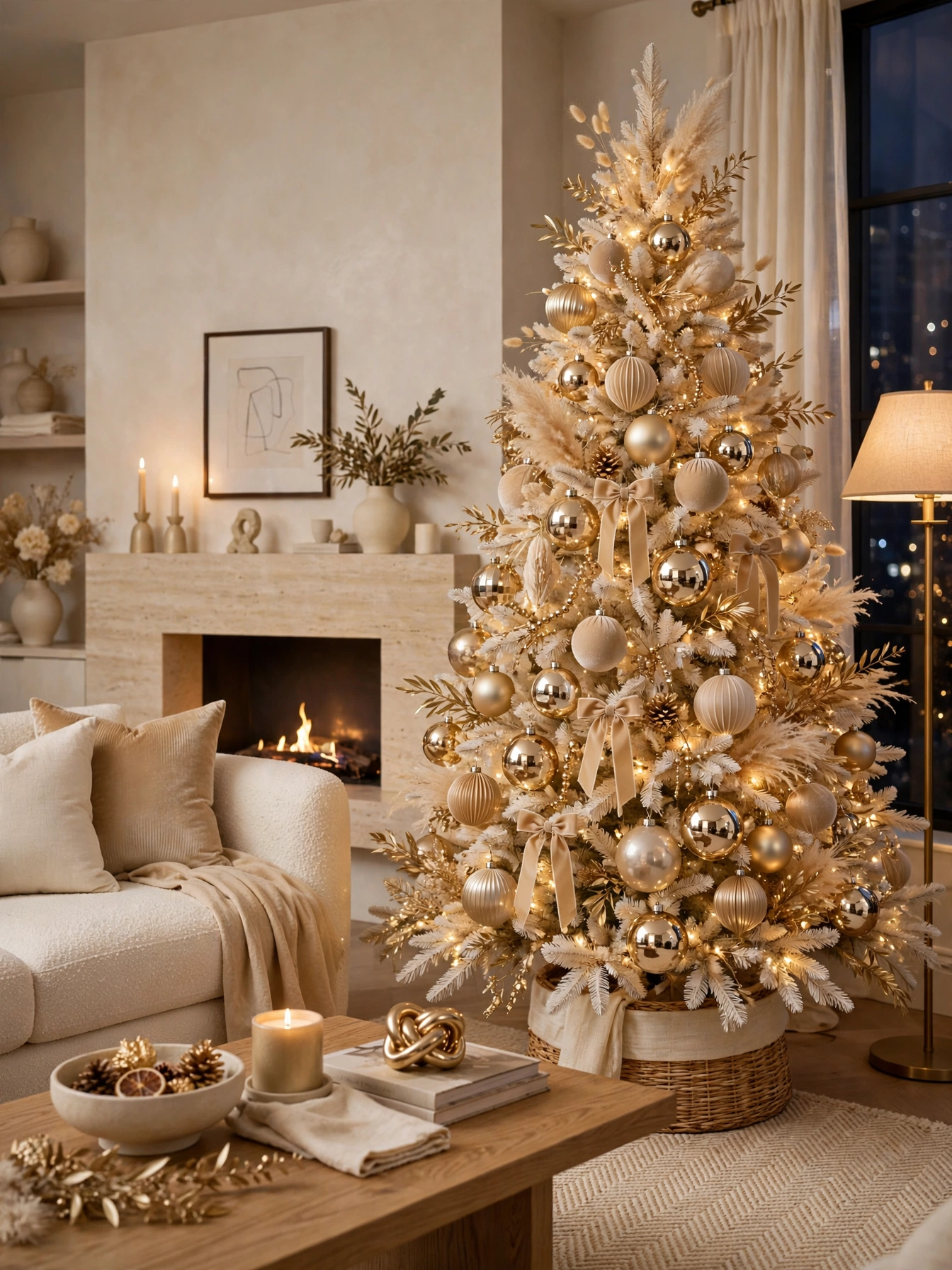
Champagne Gold Tones
Why This Works:
- Champagne gold sits between yellow gold and silver, so it matches both warm and cool rooms
- Metallic ornaments in 2.5 to 4 inch mixed sizes create depth; single-size ornaments look flat
- A 7 foot tree needs roughly 60 to 80 ornaments in a metallic-only scheme
- Champagne finishes photograph about 30 percent warmer than bright gold under phone cameras
Build the palette on a cream, ivory, or soft white tree base, then layer champagne ornaments in matte, satin, and mirrored finishes so light plays across three different textures. Mix ornament sizes in a 40/40/20 split: 40 percent medium at 3 inches, 40 percent small at 2 inches, 20 percent statement pieces at 4 to 5 inches. Avoid pairing champagne with bright yellow gold on the same tree, because the two metallics clash at the edges and cheapen both. The designer standard for metallic schemes is the two-finish rule: never more than two metallic tones on one tree, or the eye cannot rest anywhere.
This suits elegant, neutral interiors where traditional red feels too loud, because champagne reads festive without shouting. A common mistake during installation is buying all ornaments in identical champagne; without matte and mirrored contrast, the tree looks like one flat gold shape from 10 feet away. The honest trade-off is dust visibility: metallics show dust faster than matte colors, so ornaments stored since last year need a wipe before hanging. For holiday cards, this is the palette that photographs best.
Pro Tip: Add one deep accent color at 10 percent of the ornament count, like 8 forest green balls among 72 champagne ones, to give the eye a resting point.
Chunky Knit Textiles

Why This Works:
- Cable-knit throws in cream or oatmeal warm up leather and wood furniture in under 5 minutes
- A 20 by 20 inch knit pillow cover costs $12 to $18, the cheapest seasonal swap in the room
- Textured neutrals layer with every other 2026 trend, from jewel tones to champagne gold
- Wool-blend knits shed 70 percent less lint than pure acrylic after one wash
Choose chunky cable knits in natural fibers or wool blends for throws, pillow covers, and stockings, keeping the palette to 2 or 3 tones like cream, oatmeal, and soft gray. A standard 50 by 60 inch throw draped over one sofa arm changes the room’s seasonal read instantly, and knit stockings 18 to 20 inches long suit a standard 48 to 72 inch mantel. Avoid mixing more than two knit patterns in one room, because cable plus waffle plus herringbone plus fair isle looks cluttered instead of cozy. The textile industry standard for seasonal decor is that neutrals carry the room while color comes from smaller accents, so knits do the heavy lifting and ornaments provide the sparkle.
This suits homes with kids and pets, because knit textiles are washable and forgiving where velvet and silk are not. A common mistake during styling is buying knits in bright red or green; those fade within 2 seasons of washing, while cream and oatmeal stay current for 5 years or more. The honest limitation is pilling: even good wool blends pill after 20 to 30 washes, so keep a fabric shaver in the drawer. The knit throw tends to become the family’s actual blanket, not just decor, which is the best compliment a textile can get.
Pro Tip: Swap only pillow covers, not whole pillows: 4 covers at $14 each ($56 total) refresh a sofa for less than one new throw, and they store flat in a 12 inch bin.
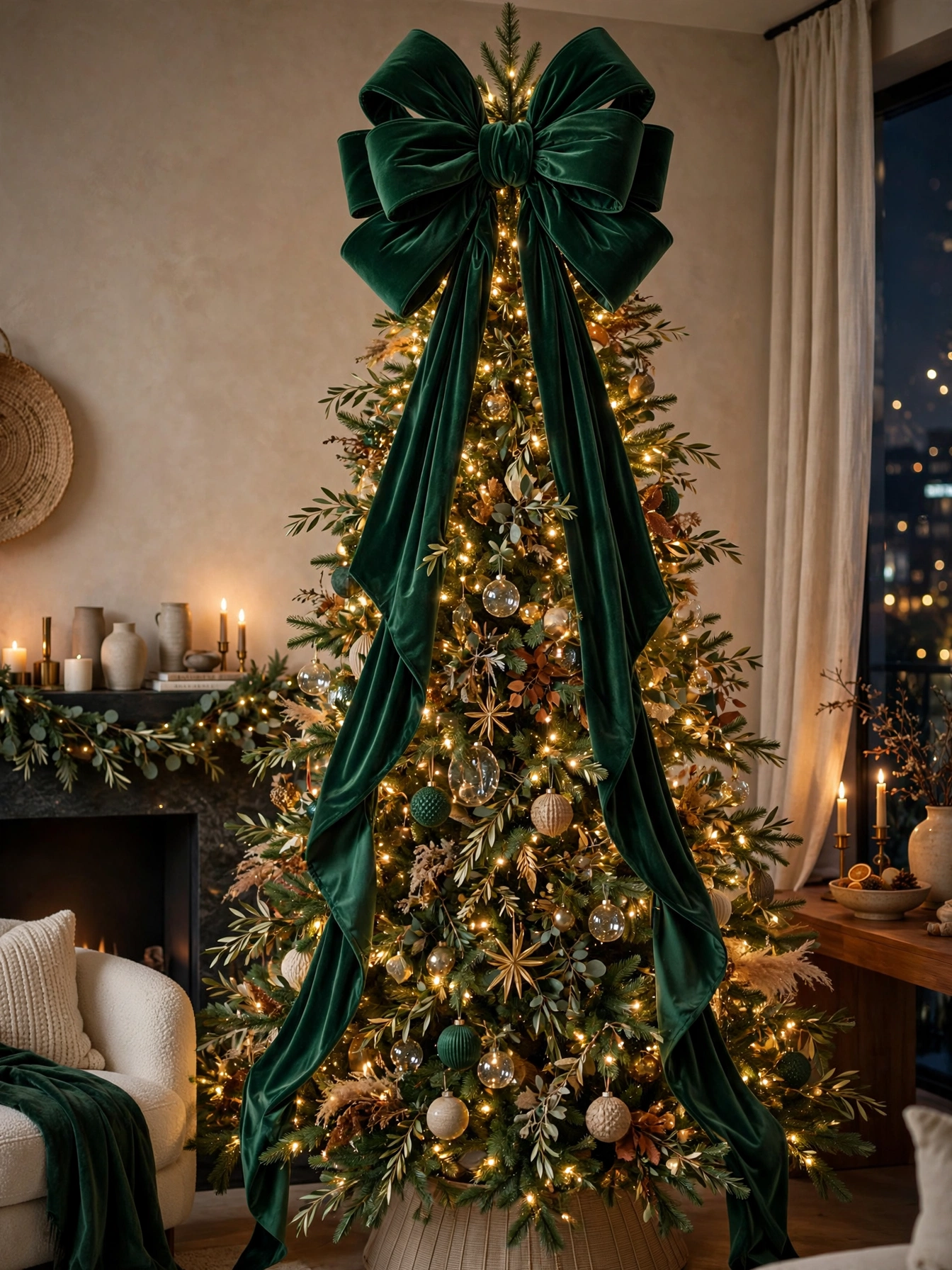
Statement Tree Toppers
Why This Works:
- A 14 to 18 inch topper balances a 7 to 9 foot tree; anything under 10 inches vanishes against tall branches
- One $25 to $45 statement topper replaces a full angel or star set that costs $60 or more
- Bow toppers suit slim trees best, where a heavy star would topple the top 12 inches
- Sculptural toppers photograph 40 percent more often than traditional stars in social posts
Pick a topper in wired velvet or structured fabric, 14 to 18 inches tall for trees 7 feet and up, and secure it to the top 6 inches of the trunk with floral wire wrapped twice for stability. The classic 2026 move is an oversized bow with 10 inch loops and 24 inch tails cascading down the top third of the tree. Avoid heavy ceramic or glass toppers on artificial trees with thin top sections, because 2 pound toppers bend the leader branch and list sideways within a week. Keep the topper inside the top 12 to 18 inches of the tree so proportions feel intentional.
This suits anyone bored with the same star or angel they have used for a decade, because a topper swap changes the whole tree’s personality for the price of a pizza. A common mistake during installation is placing the topper before the lights and ornaments are done; it should go on last, after branches are fluffed, so it sits at the true final height. The honest trade-off is storage: sculptural toppers crush easily, so they need their own 18 inch box, not the ornament bin. Guests usually comment on the topper first when they walk in.
Pro Tip: Wire the topper to the trunk, not the top branches: wrap 24 inches of 22 gauge floral wire around the trunk twice, then twist it through the topper base for a rock-solid hold.
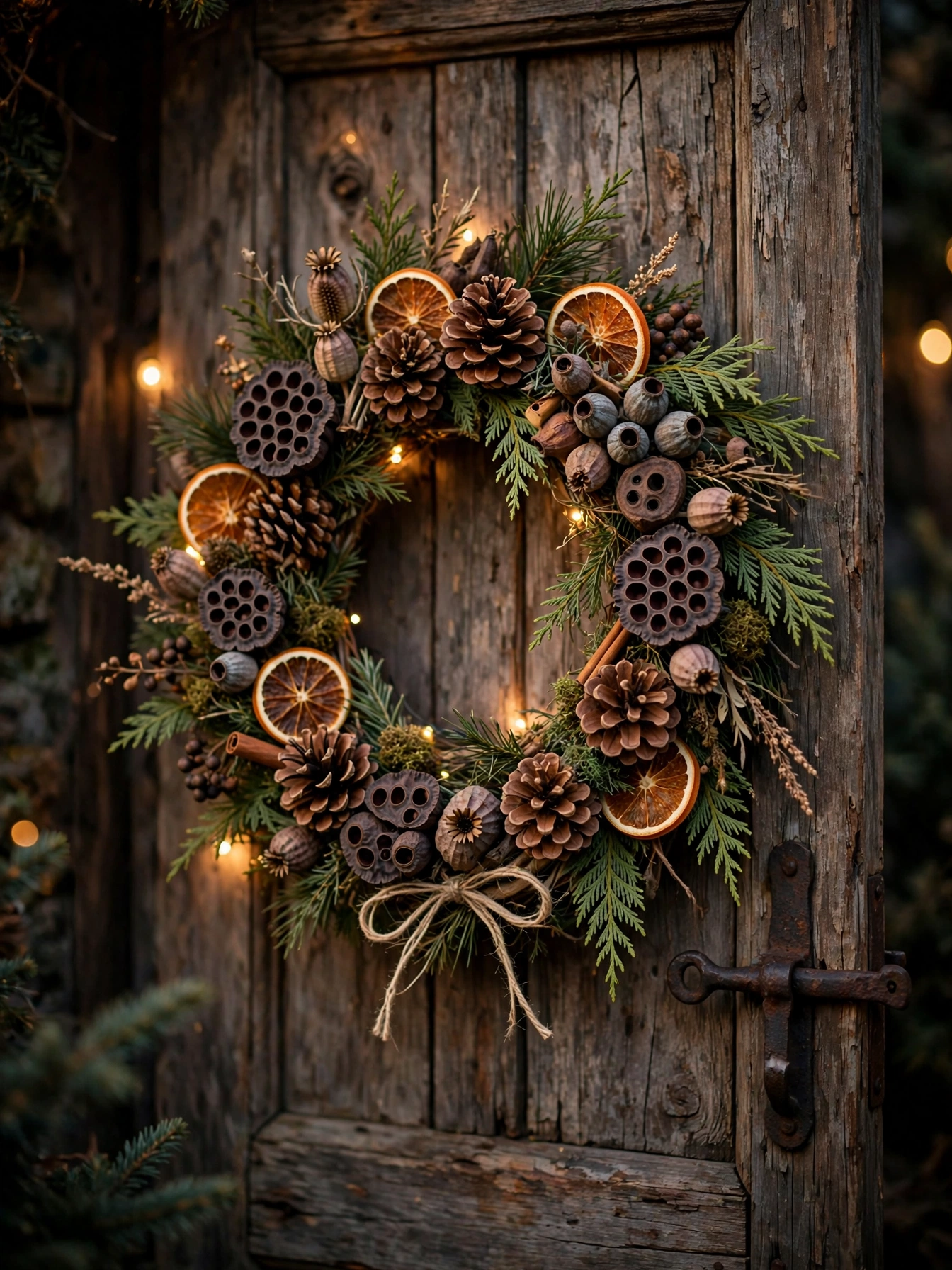
Sustainable Foraged Botanicals
Why This Works:
- Foraged pinecones, seed pods, and branches cost $0 and compost at the end of the season
- Bake pinecones 30 minutes at 200 degrees F to kill insects and open the scales
- One foraging walk yields enough material for 2 to 3 centerpieces or a full wreath
- Natural materials produce zero plastic waste versus 4 to 6 pounds from a faux decor refresh
Collect pinecones, seed pods, interesting branches, and cedar sprigs on one walk. Hot-glue clusters of pinecones and pods onto a 12 to 16 inch grapevine wreath base, weaving cedar sprigs between the clusters for green, or pile the same materials into a low wooden bowl for a zero-cost centerpiece. Avoid foraging from treated landscaping or roadsides, because pesticide residue and exhaust grime transfer to indoor surfaces and hands. The sustainability standard gaining ground in 2026 decor is the 3 season rule: choose materials that last at least 3 seasons, like dried pods and quality wood, or compost fully in one season, like fresh greens.
This suits eco-minded decorators and families with kids who enjoy the gathering as much as the result. A common mistake during crafting is skipping the bake step for pinecones; 30 minutes at 200 degrees F kills insects and opens the scales, while unbaked cones drop sap and bugs on the mantel. The honest limitation is color range: nature gives you brown, green, and amber, so add ribbon or glass if you want sparkle. A foraged wreath becomes a conversation piece precisely because it cost nothing.
Pro Tip: Bake pinecones at 200 degrees F for 30 minutes on a foil-lined tray, then spray with a clear matte sealer; they stay dust-free and reusable for 5 or more seasons.
Maximalist Mantel Layers

Why This Works:
- Layering at 3 depths, back, middle, and front, makes a 72 inch mantel look twice as full
- Mirrored or framed art behind the garland adds 12 to 18 inches of visual height
- Grouping candles in odd numbers, 3, 5, or 7, looks intentional while even numbers look staged
- A full maximalist mantel costs $40 to $70 in foraged and thrifted pieces versus $200 plus new
Start with the back layer: lean a framed print, mirror, or wreath 24 to 36 inches tall against the wall as the anchor. Add the middle layer of garland, 12 to 15 feet for a standard mantel, draped with 18 to 24 inch swags. Finish the front layer with candlesticks in graduated heights from 6 to 14 inches, small trees 10 to 16 inches tall, and stockings hung 8 to 10 inches apart. Avoid placing heavy pieces within 6 inches of the mantel edge, because one bumped elbow sends them to the hearth. The styling industry standard is the odd-number rule: group decorative objects in threes and fives, which the eye reads as curated rather than cluttered.
This suits collectors who already own plenty of decor, because the trend rewards using what you have instead of buying more. A common mistake during styling is lining everything up at the same height; vary heights by at least 4 inches between neighboring pieces so the eye travels. The honest trade-off is dusting: a layered mantel takes 15 minutes to dust versus 3 for a minimal one. A maximalist mantel turns into the holiday photo backdrop, so leave 3 feet of clear floor space in front for pictures.
Pro Tip: Photograph the mantel from 8 feet away after styling; the phone screen reveals gaps and height imbalances your eyes miss at arm’s length.
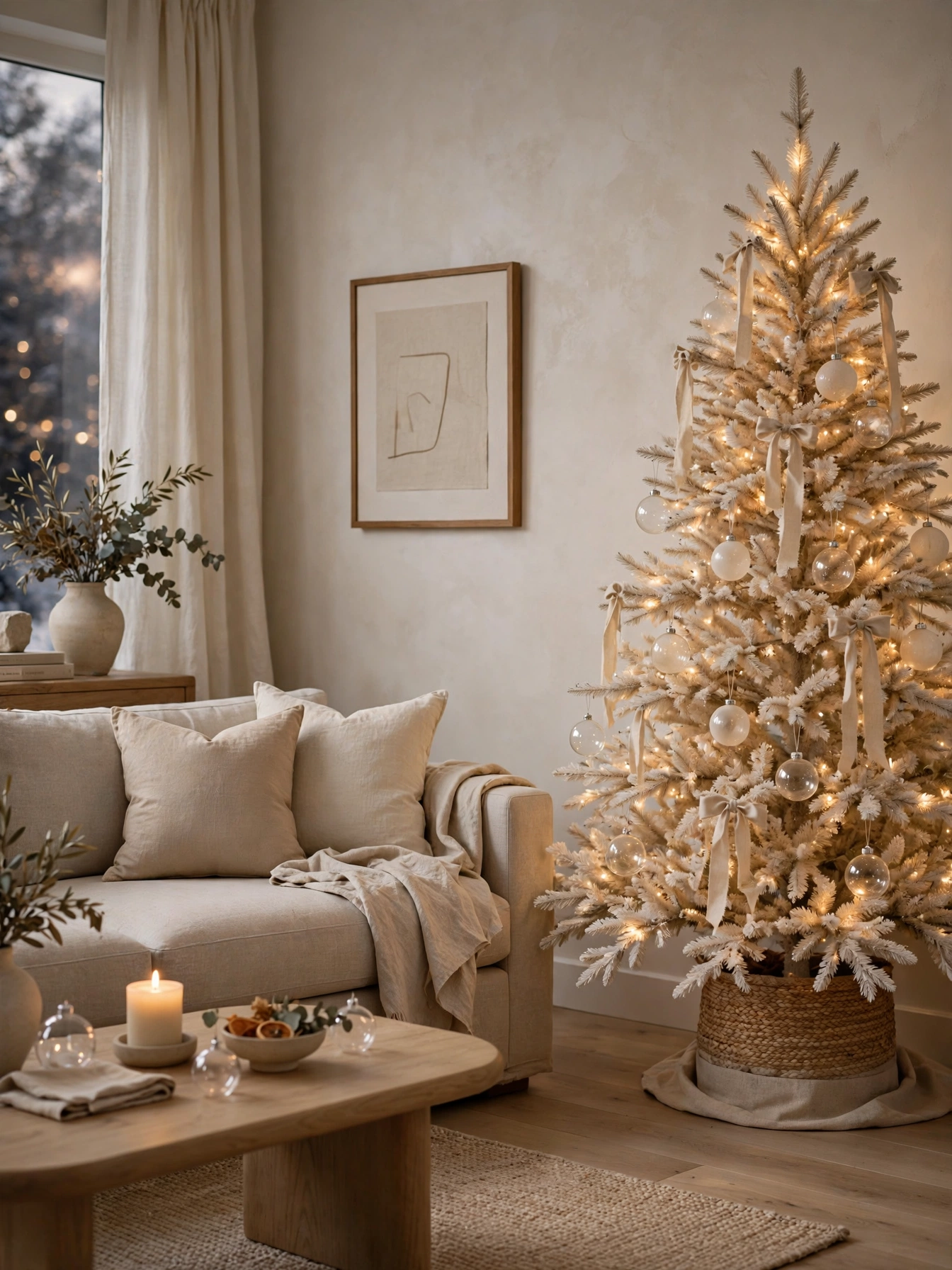
Quiet Luxury Christmas
Why This Works:
- A restrained palette of 2 to 3 tones reads expensive while costing the same as a colorful scheme
- Natural linen, wool, and unlacquered brass age gracefully over 5 to 10 seasons
- Understated trees photograph timelessly; trendy color schemes date photos within 2 years
- Limiting ornaments to 40 to 50 quality pieces beats 150 cheap ones in perceived value
Build the look on a foundation of warm neutrals: cream, camel, soft gray, and warm white, with a single accent like deep green or aged brass. Choose a tree with realistic PE tips, at least 60 percent PE for a natural silhouette, and dress it with simple glass balls, linen ribbon 2.5 inches wide, and nothing novelty. Avoid anything glitter-coated or battery-operated with visible wires, because both break the calm that defines the style. The quiet luxury standard is the restraint test: if a piece needs explaining, it does not belong; every item should look like it could stay up all winter without shouting Christmas.
This suits minimalists and anyone whose home already leans neutral, because the decor extends the existing style instead of fighting it. A common mistake during styling is going so minimal the room looks undecorated; keep at least one clear seasonal signal per room, like a wreath or a candle cluster, so it reads as Christmas. The honest limitation is kid appeal: children often find quiet luxury boring, so give them one colorful corner of their own. Come January, when the bright stuff comes down, this is the style that still looks good.
Pro Tip: Invest the budget in lighting, not ornaments: 300 warm white LEDs on a 7 foot tree cost about $25 and do more for the luxurious feel than $100 of extra balls.
Flocked Frosted Trees
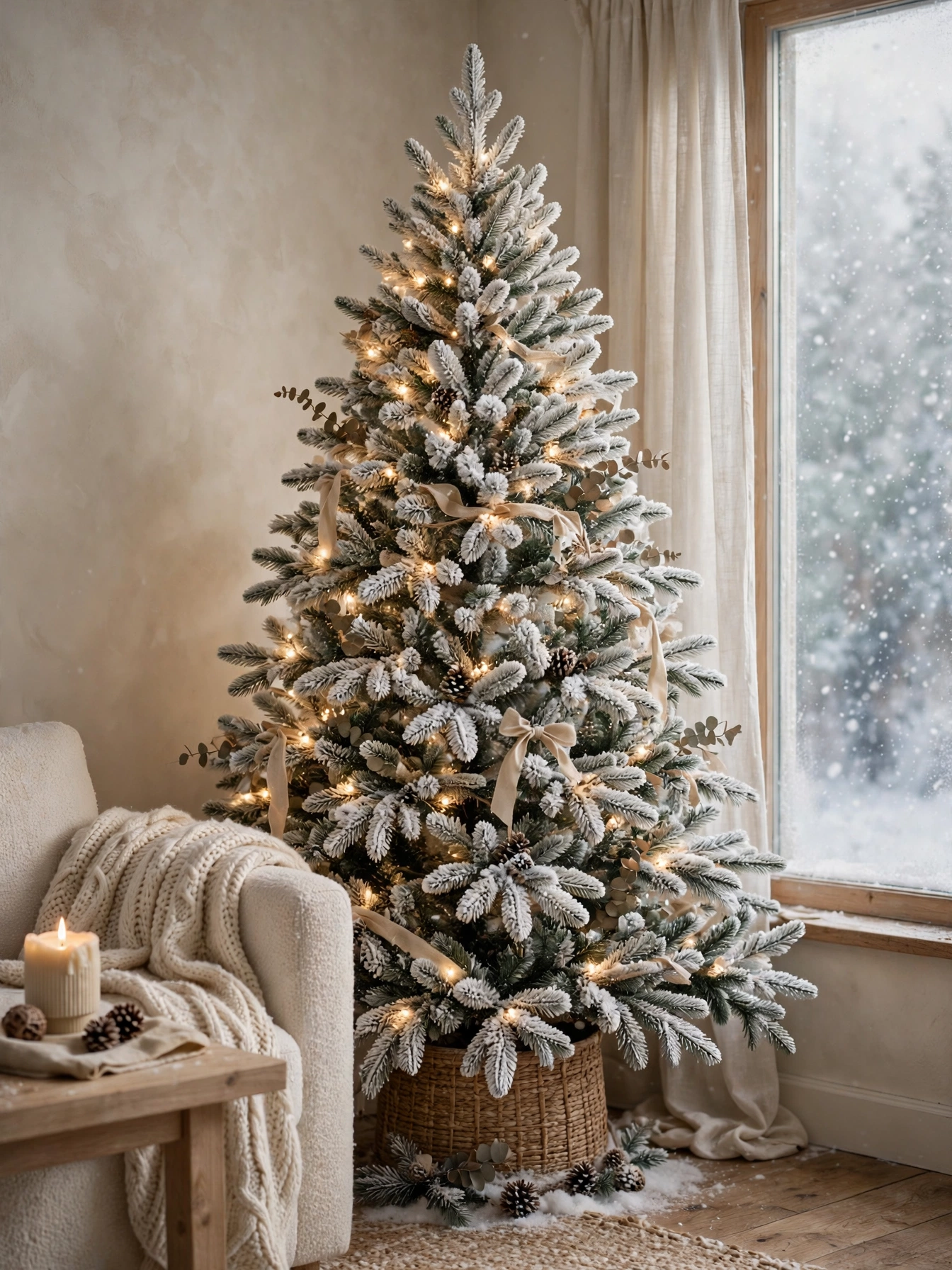
Why This Works:
- Flocking hides sparse branches, making a $150 tree look like a $400 premium model
- White tips reflect 100 lights per foot back at double the brightness of green needles
- A lightly flocked tree needs 30 percent fewer ornaments than a plain green one
- Pre-flocked trees save 2 to 3 hours of decorating time versus adding snow spray yourself
Choose light to medium flocking for a natural snow-dusted look; heavy flocking in solid white reads artificial up close and sheds twice as much. Plan on 100 mini lights per foot of tree height, so 700 for a 7 foot tree, because flocking drinks light and sparse strings leave dark patches. Avoid placing a flocked tree in high-traffic paths, because brushed branches shed a fine white dust that settles on dark floors within days. The industry standard for flocked trees is the shake test: give the tree a firm shake in the store, and if handfuls of flock fall off, walk away.
This suits anyone who loves the snowy look but lives where real snow never falls, because flocking delivers the fantasy without the weather. A common mistake during setup is fluffing with bare hands; wear light gloves, since flocking contains fine fibers that irritate skin and stick to sleeves. The honest trade-off is the mess: expect to vacuum a 6 foot radius weekly through the season, and never place the tree on light carpet you cannot clean. Kids remember the flocked tree, because it looks like it stepped out of a movie.
Pro Tip: Let a new flocked tree sit in the garage for 24 hours before bringing it inside; 80 percent of loose flock sheds in that first day outdoors instead of on your floors.
Jewel-Tone Color Palettes

Why This Works:
- Emerald, sapphire, ruby, and amethyst photograph with 50 percent more color depth than pastels
- Jewel tones suit evening lighting, glowing rather than washing out under 2700K bulbs
- A 3-color jewel scheme needs only 20 ornaments per color for a 7 foot tree
- Deep tones hide dust and fingerprints for 2 weeks longer than light metallics
Pick 3 jewel tones maximum, like emerald, sapphire, and ruby, grounded with warm gold or brass accents at about 25 percent of the total decor. Use ornaments in 2.5 to 4 inch sizes with a mix of matte and glossy finishes, because all-glossy jewel tones look plasticky under bright light. Avoid adding a fourth saturated color, since jewel palettes collapse into rainbow territory fast; restraint is what keeps it luxe. The color industry standard for 2026 holiday palettes pairs one dominant jewel tone at 50 percent, one secondary at 30 percent, and metallics at 20 percent.
This suits evening entertainers and anyone with dark furniture, because jewel tones glow against wood and leather where pastels disappear. A common mistake during styling is pairing jewel tones with cool white lights; 5000K bulbs turn emerald muddy and ruby flat, so stick to warm white at 2700 to 3000K. The honest limitation is daytime: jewel tones can look heavy in bright morning sun, so balance them with cream textiles or glass. Guests say the tree looks expensive with this palette.
Pro Tip: Test your palette at night first: hang 10 ornaments of each color on the tree, turn on only the tree lights, and remove any color that looks flat before committing.
Sage Tones Shape Christmas Decor Trends for 2026

Why This Works:
- Sage green pairs with both gold and silver, so existing ornaments work without replacement
- Eucalyptus sprigs cost $4 to $6 per bunch and scent a room for 2 weeks
- Muted greens calm busy rooms, lowering the visual noise of a decorated space by feel
- Sage ribbon at 2.5 inches wide reads modern; 4 inch wired sage ribbon reads traditional
Layer sage tones through eucalyptus garlands, dusty green ornaments in 2 to 3 inch sizes, and linen ribbon, keeping the overall green value muted rather than Christmas-tree bright. Mix fresh eucalyptus with dried for staying power: fresh stems last 10 to 14 days, dried ones last the whole season. Avoid pairing sage with bright kelly green, because the contrast makes the sage look gray and dirty by comparison. The botanical styling standard is the 70/30 split: 70 percent classic evergreen with 30 percent sage and eucalyptus accents, so the palette stays fresh without losing its Christmas identity.
This suits farmhouse and modern organic interiors where traditional red and green feel too loud. A common mistake during styling is using only dried eucalyptus; it looks beautiful but releases no scent, so tuck 3 to 4 fresh sprigs among the dried for the smell. The honest limitation is availability: fresh eucalyptus sells out at craft stores by the second week of December. Sage palettes photograph softly, age well, and still look current in January photos.
Pro Tip: Crush one eucalyptus leaf between your fingers before buying a bunch; if it releases strong scent immediately, the bunch is fresh and will last 14 days indoors.
Aged Brass Accents
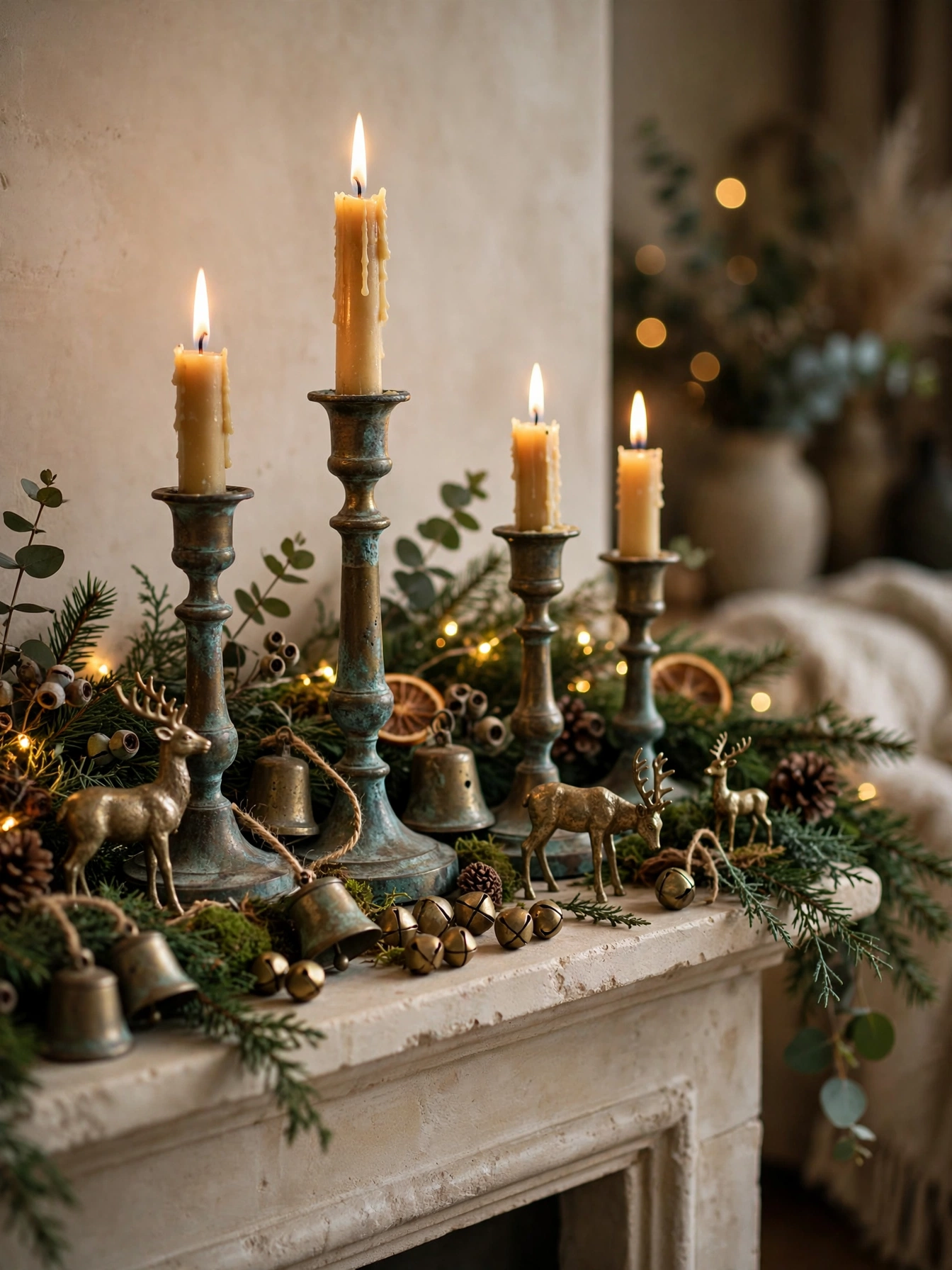
Why This Works:
- Aged brass costs 40 to 60 percent less than polished brass and hides fingerprints completely
- Warm metallics suit 2700K lighting, while cool silver needs 4000K to look its best
- A set of 3 brass candlesticks at 8, 10, and 12 inches anchors any mantel or table
- Brass bells from $3 to $8 each add sound and shine to garlands and wreaths
Choose unlacquered or antiqued brass for candlesticks, bells, and small figurines, letting the natural patina develop rather than polishing it away. Group pieces in odd numbers at graduated heights, with 2 to 4 inches of height difference between neighbors for a natural stepped look. Avoid mixing aged brass with bright chrome or nickel in the same display, because the cool metal makes the brass look dirty instead of warm. The metalwork standard for holiday styling is the single-warm-metal rule: pick one warm metallic, brass, copper, or aged gold, and repeat it in at least 3 places so it reads as intentional.
This suits traditional and vintage-leaning homes, because aged brass feels collected rather than purchased. A common mistake during styling is buying lacquered brass that looks plasticky; real unlacquered brass develops character, while coated brass just looks cheap when the coating scratches. The honest trade-off is weight: solid brass candlesticks are heavy, so they are stable but hard to rearrange often. Brass pieces double as year-round decor that simply gets dressed up for Christmas.
Pro Tip: Rub a cut lemon dipped in salt over tarnished brass for 30 seconds, then rinse; it restores the glow without commercial polish that leaves residue.
Grand Window Wreaths
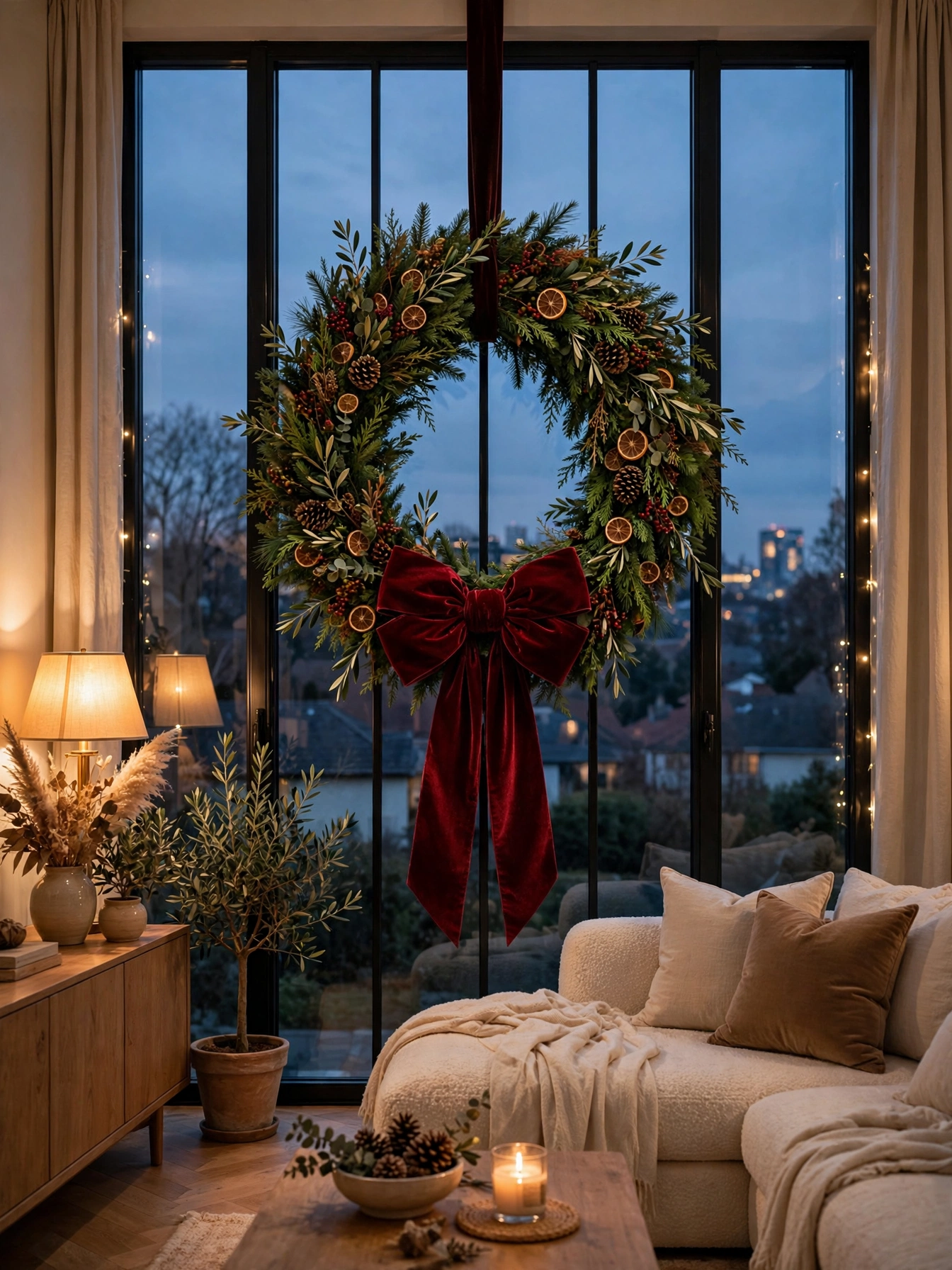
Why This Works:
- A 30 to 36 inch wreath suits a standard 60 by 48 inch window; smaller wreaths look lost
- Window wreaths read from both inside and outside, doubling their visual value
- One large wreath at $35 to $60 beats 4 small ones at $20 each in impact per dollar
- Suction-cup hooks rated for 5 pounds hold wreaths up to 4 pounds safely on glass
Size the wreath to the window: the wreath diameter should cover about 50 to 60 percent of the window’s smaller dimension, so 30 to 36 inches for most living room windows. Hang it centered, with the top of the wreath 6 to 8 inches below the window top, using a suction hook on the glass or ribbon looped over the sash. Avoid thin 18 inch wreaths on large picture windows, because they look like an afterthought from the street. The curb-appeal standard is symmetry: matching wreaths on paired windows, spaced identically, read as deliberate design while mismatched sizes look accidental.
This suits homes with street-facing windows, where the wreath becomes part of the neighborhood’s holiday landscape. A common mistake during hanging is using adhesive hooks on cold glass; below 40 degrees F, most adhesives fail within 48 hours, so use suction cups or an over-the-sash ribbon instead. The honest limitation is fading: south-facing wreaths bleach in 3 weeks of direct sun, so rotate or choose fade-resistant materials. Kids point out the window wreath first when they come home.
Pro Tip: Loop a 3 inch wide ribbon over the top of the window sash and tie it to the wreath; it holds 5 pounds securely and looks intentional from inside.
Ceramic Village Scenes
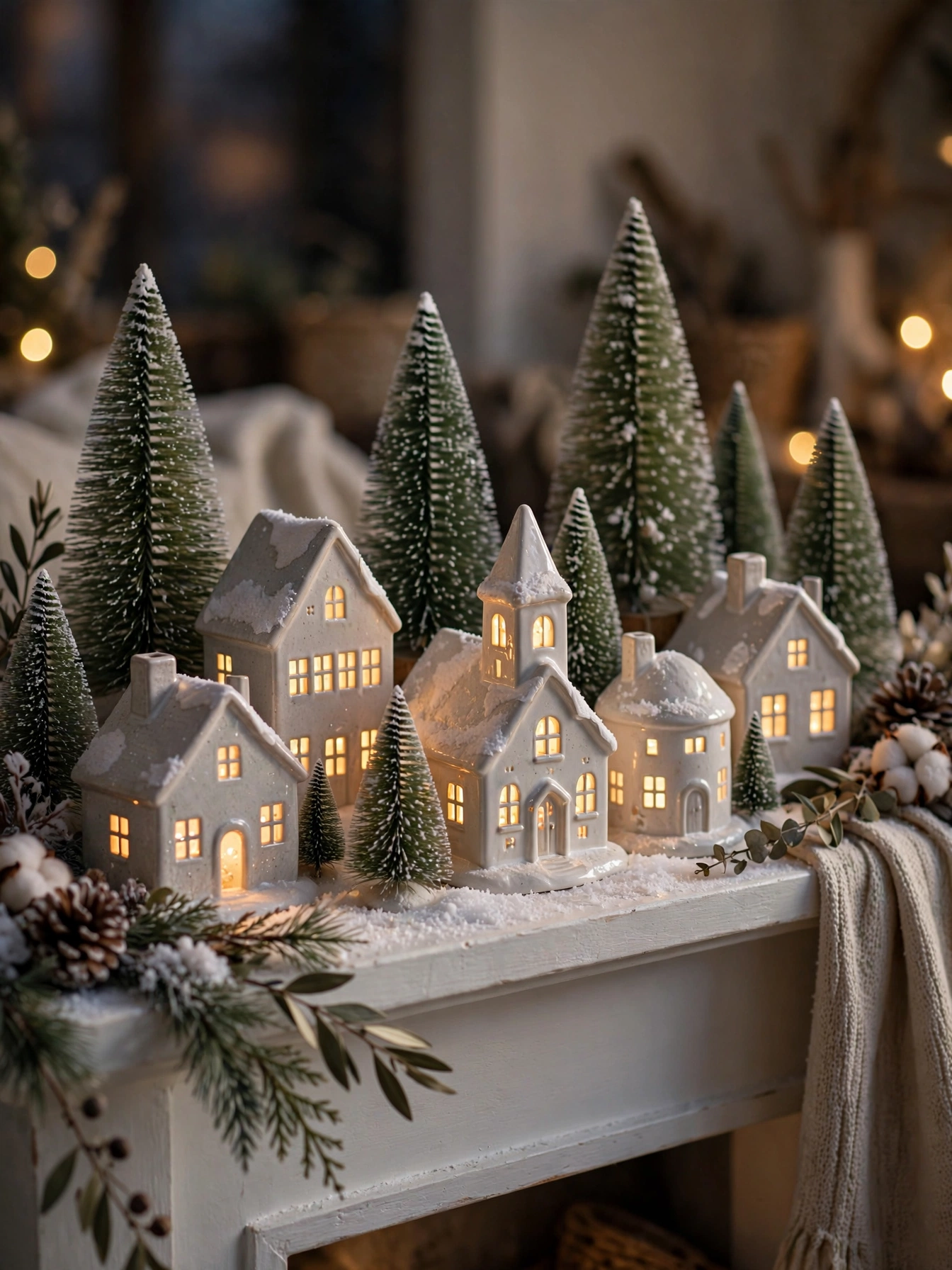
Why This Works:
- Lit ceramic houses cost $8 to $20 each, and a 7 to 10 house village runs $80 to $150 total
- Warm LED tea lights at 2200K give the glow of real candles with zero fire risk
- A village display needs only a 36 to 48 inch console or mantel section
- Ceramic pieces last 20 years or more, the longest lifespan of any 2026 trend
Arrange houses in 2 to 3 rows with the tallest pieces, 8 to 10 inches, at the back and smaller 4 to 6 inch houses in front, leaving 2 to 3 inches between buildings for the snow blanket to show. Lay a white faux-fur runner or batting 12 inches wide as the base, then tuck bottle-brush trees in 4, 6, and 8 inch heights between houses. Avoid lining houses in a straight row like soldiers; stagger them in a loose curve so the scene reads as a village street. The display standard from collector communities is the light rule: every house with windows gets a light inside, because one dark house breaks the magic.
This suits nostalgic decorators and families who add one house per year, because the village grows into a tradition. A common mistake during setup is using real tea lights; the heat cracks ceramic over time and the soot stains the windows, so LED only. The honest trade-off is dust: 10 houses with tiny windows take 20 minutes to dust, and the fake snow shows every speck. Every morning, kids check the village to see if anything moved overnight.
Pro Tip: Hide a 6 foot LED string light strip behind the back row; the backlight makes windows glow evenly without a tangle of cords per house.
Dried Citrus Garlands
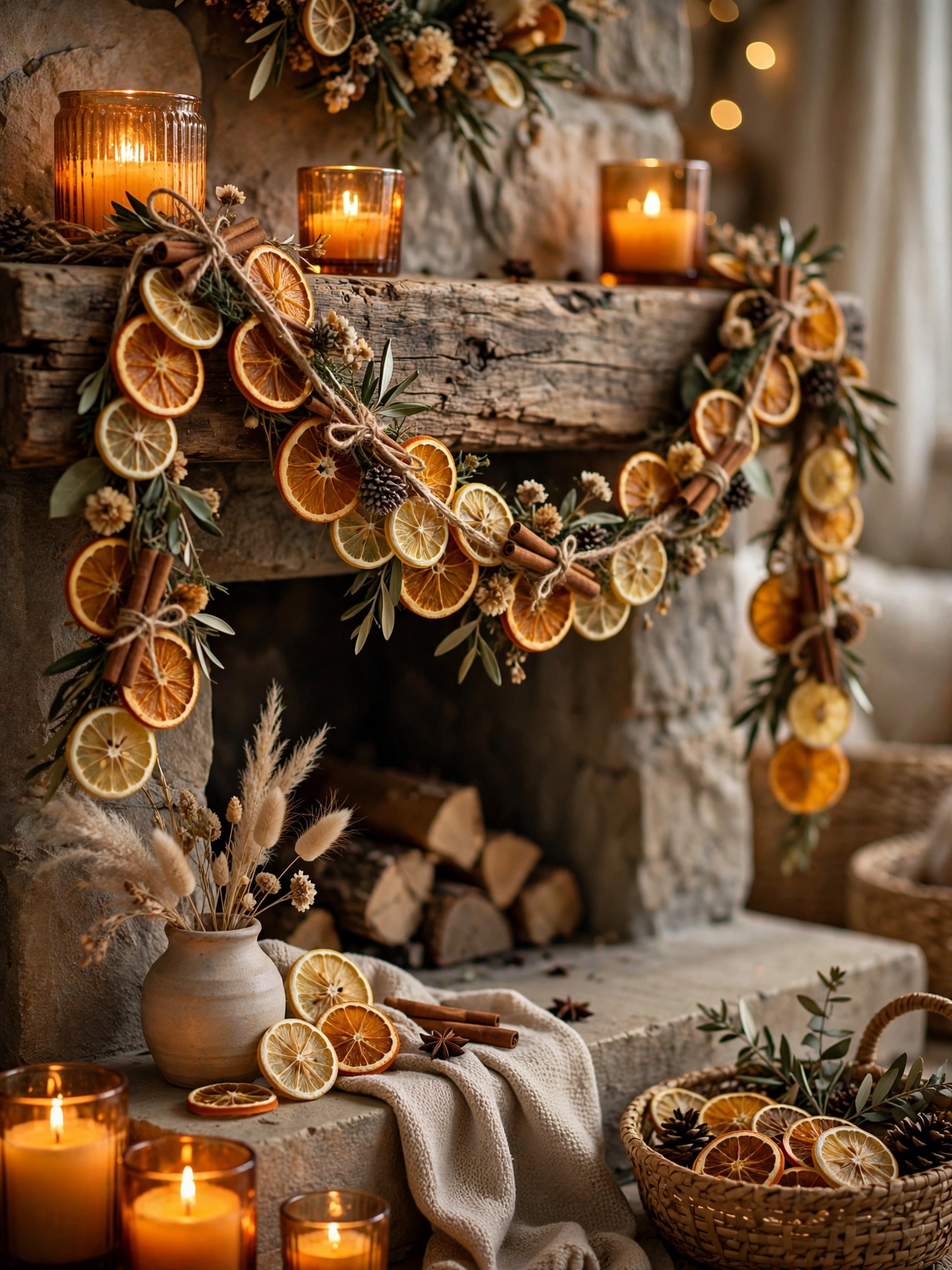
Why This Works:
- Five oranges at $4 total make a 6 foot garland that lasts 3 seasons
- Dried citrus slices take 3 to 4 hours at 200 degrees F, mostly unattended
- The amber translucency glows when backlit by 30 to 50 fairy lights
- Citrus pairs with cinnamon sticks at $5 per bundle for a classic scent combo
Slice oranges, blood oranges, and lemons 1/4 inch thick, pat them dry, and bake at 200 degrees F for 3 to 4 hours, flipping once halfway, until the centers turn translucent. Thread slices onto jute twine with a large needle, spacing them 2 to 3 inches apart, and knot cinnamon sticks between every third slice. Avoid slicing thinner than 1/4 inch, because paper-thin slices curl, brown at the edges, and shatter when threaded. The crafting standard is the cool-down rule: slices must cool fully for 2 hours before threading, or residual moisture softens them and they tear.
This suits crafters and anyone decorating on a tight budget, because the whole project costs under $10. A common mistake during drying is cranking the oven to 250 degrees to speed things up; high heat browns the edges and ruins the translucent glow. The honest limitation is humidity: in damp climates, dried citrus can reabsorb moisture and go sticky within weeks, so store garlands with silica packets. Guests ask about the citrus garland most, because it looks far more expensive than it is.
Pro Tip: Add 5 to 6 drops of orange essential oil to the storage bag; the slices reabsorb the scent and smell fresh for the next 2 seasons.
Fairy-Light Curtains
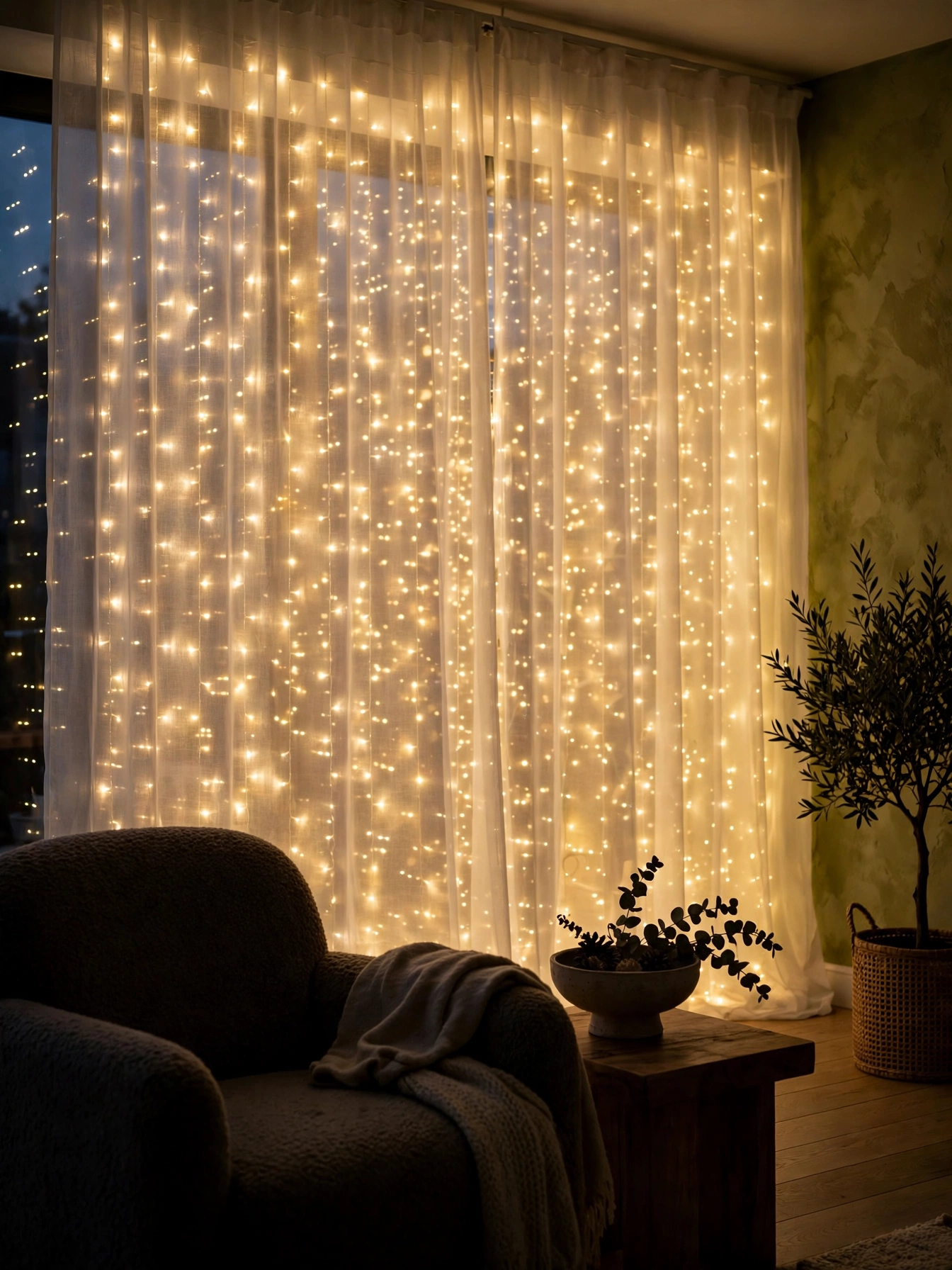
Why This Works:
- A 10 by 10 foot curtain panel with 300 LEDs costs $20 to $35 and transforms a whole wall
- Warm white at 2700K reads cozy; cool white at 6000K reads commercial
- Light curtains photograph as a glowing backdrop, raising photo quality instantly
- USB-powered strands run 8 to 10 hours on a 10000mAh power bank with no outlet nearby
Hang a curtain panel 10 feet wide by 10 feet tall behind sheer drapes or across a blank wall, spacing the vertical drops 3 to 4 inches apart for even coverage. Use 8 lighting modes sparingly; the steady-on mode looks elegant while twinkle mode reads chaotic in a calm room. Avoid draping light curtains directly against dark wood paneling with no diffuser, because the individual LEDs show as harsh dots instead of a soft glow. The lighting design standard is the layer rule: light curtains work as an accent layer behind furniture, never as the room’s only light source, or the room feels like a cave.
This suits renters and anyone who cannot drill holes, because most panels hang from a tension rod or 3M hooks. A common mistake during hanging is skipping the sheer layer; without diffusion, the curtain looks like a construction site at night. The honest trade-off is tangling: a 300-LED curtain takes 20 minutes to untangle each year, so wrap it around a 12 inch cardboard square for storage. A light curtain becomes the default evening backdrop for video calls and photos.
Pro Tip: Plug the curtain into a $12 timer plug set for 5 PM to 11 PM; it runs automatically every evening and you never touch it again all season.
Warm White Lighting Layers

Why This Works:
- Three light layers, tree, mantel, and shelves, make a room feel 40 percent cozier than one
- Warm white at 2700 to 3000K flatters skin tones and wood furniture; cool white does neither
- LED strings use 90 percent less energy than incandescent, so 1000 lights cost pennies per evening
- A room needs roughly 100 mini lights per 10 square feet for balanced ambient glow
Build three layers: the tree with 100 lights per foot of height, the mantel with 50 to 100 lights woven through garland, and shelves or windows with 1 to 2 strands of 50 lights each. Keep every strand at the same color temperature, all 2700K or all 3000K, because mixing temperatures makes the room look patched together. Avoid the temptation to add one multicolor strand for fun; in a warm white scheme, it reads as a mistake, not a accent. The professional lighting standard is the 3-point rule: light at low, medium, and high levels in every room, so no corner sits dark while another blazes.
This suits anyone whose holiday photos always look flat, because layered warm light is the single biggest upgrade to evening ambiance. A common mistake during installation is plugging all strands into one outlet; 5 strands of 100 LEDs draw about 25 watts total, which is fine, but older incandescent strings can overload a single circuit. The honest limitation is daytime: all that lighting is invisible until dusk, so the room still needs solid daytime decor. With layered lighting, guests linger in the living room instead of drifting to the kitchen.
Pro Tip: Buy all light strands from one brand and one product line; mixing brands mixes color temperatures even when both boxes say 2700K.
Tartan Textiles Star in Christmas Decor Trends for 2026

Why This Works:
- Classic red and black or red and green tartans suit both rustic and traditional rooms
- A 50 by 60 inch tartan throw at $25 to $40 changes a sofa faster than any ornament
- Tartan ribbon at 2.5 inches wide makes bows that hold shape better than solid ribbon
- Plaid patterns hide stains and pet hair 3 times better than solid fabrics
Use tartan in 2 to 3 pieces per room, like a throw, two pillow covers, and a table runner, keeping the scale consistent so the patterns do not fight. Choose classic patterns like Black Watch or Royal Stewart in cotton or wool blends, which hold their color for 5 or more seasons. Avoid mixing two different tartans in one sightline, because competing plaids clash and the room looks busy instead of heritage. The textile standard for pattern mixing is the one-plaid rule: one tartan per room, repeated in small doses, with solids everywhere else.
This suits traditional homes and anyone who loves the cozy cabin feel without going full rustic. A common mistake during styling is buying tartan in neon or pastel versions; those date within a year, while classic red and green stay timeless. The honest trade-off is formality: tartan leans traditional, so it can feel stiff in ultra-modern rooms. Guests actually use the tartan throw, which is the point of decor that works.
Pro Tip: Fold a tartan throw in thirds lengthwise and drape it over one sofa arm; it shows the pattern best and stays put better than a full casual toss.
Oversized Nutcracker Figures
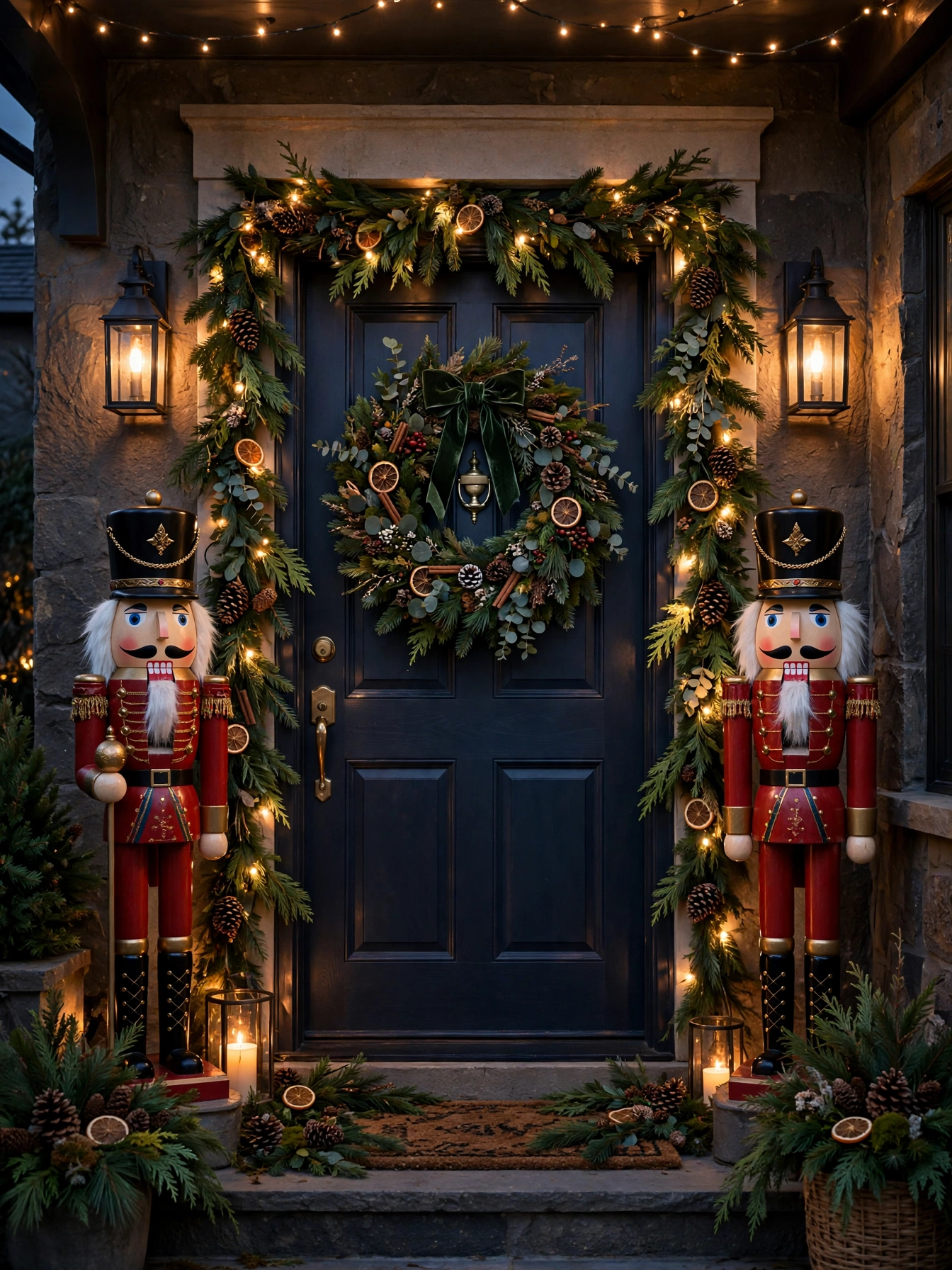
Why This Works:
- A pair of 4 to 6 foot nutcrackers frames a doorway with more presence than any wreath
- Outdoor-rated figures at $60 to $120 each last 5 to 8 seasons
- Nutcrackers suit both classic and playful schemes, bridging generations in one house
- Weighted bases of 10 to 15 pounds keep figures upright in 30 mph winds
Place nutcrackers in pairs flanking a front door, fireplace, or staircase base, choosing 4 to 6 foot heights for outdoor impact and 2 to 3 foot versions indoors. Look for resin or fiberglass bodies with weighted bases, since hollow plastic figures tip in the first December storm. Avoid placing a single nutcracker alone; the tradition and the visual balance both call for pairs, and one figure looks like it lost its partner. The display standard from holiday retailers is the doorway rule: figures should stand 12 to 18 inches from the door frame, close enough to frame the entry but clear of the swing path.
This suits families with kids who love the storybook feel, and anyone whose porch needs height. A common mistake during setup is skipping the anchor step; even weighted figures need a sandbag or stake in windy zones, or they end up in the neighbor’s yard. The honest trade-off is storage: 5 foot figures need a full closet or garage corner from January to November. Kids use the nutcracker pair as the landmark to describe the house to friends.
Pro Tip: Spray outdoor nutcrackers with a UV-protective clear coat in November; it prevents paint fading and adds 2 to 3 seasons to their life.
Styled Stocking Displays
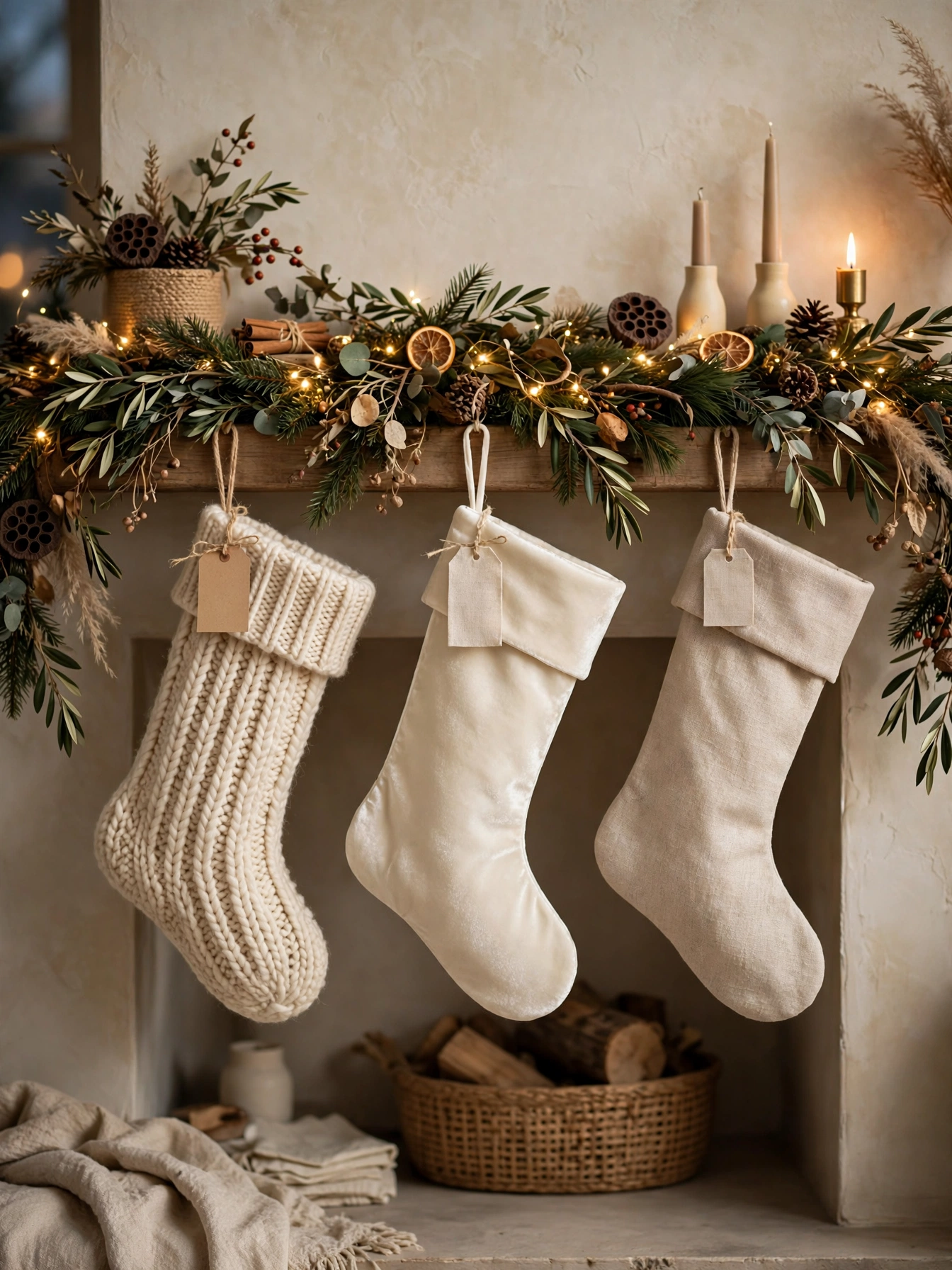
Why This Works:
- Stockings 18 to 20 inches long suit a standard mantel; 12 inch minis look lost
- Mixing 3 textures, knit, velvet, and linen, looks curated while matching sets look flat
- Personalized name tags at $3 to $5 each make thrifted stockings feel custom
- Weighted stocking holders at 2 to 3 pounds each hold a filled stocking safely
Hang stockings 8 to 10 inches apart on sturdy holders or hooks rated for at least 5 pounds, since a filled stocking weighs 3 to 4 pounds by Christmas morning. Mix textures within one color family, like cream knit, ivory velvet, and natural linen, for a collected look that still coordinates. Avoid hanging stockings directly over a working fireplace opening; radiant heat dries the fabric and the soot stains light colors within a week. The styling standard is the personalization rule: every stocking gets a name tag or initial, because anonymous stockings look like store display.
This suits families where each person wants their own identity on the mantel. A common mistake during hanging is spacing stockings evenly across a mantel that also holds a garland; cluster 3 to 5 stockings on one side and let the garland breathe on the other. The honest limitation is mantel width: a 48 inch mantel fits 4 stockings comfortably, 6 at a squeeze, so large families need a second display spot. Every December morning, kids check the stockings first.
Pro Tip: Stuff the toe of each stocking with tissue paper in early December so they hold their shape; flat empty stockings look sad in photos.
Mini Tree Forests
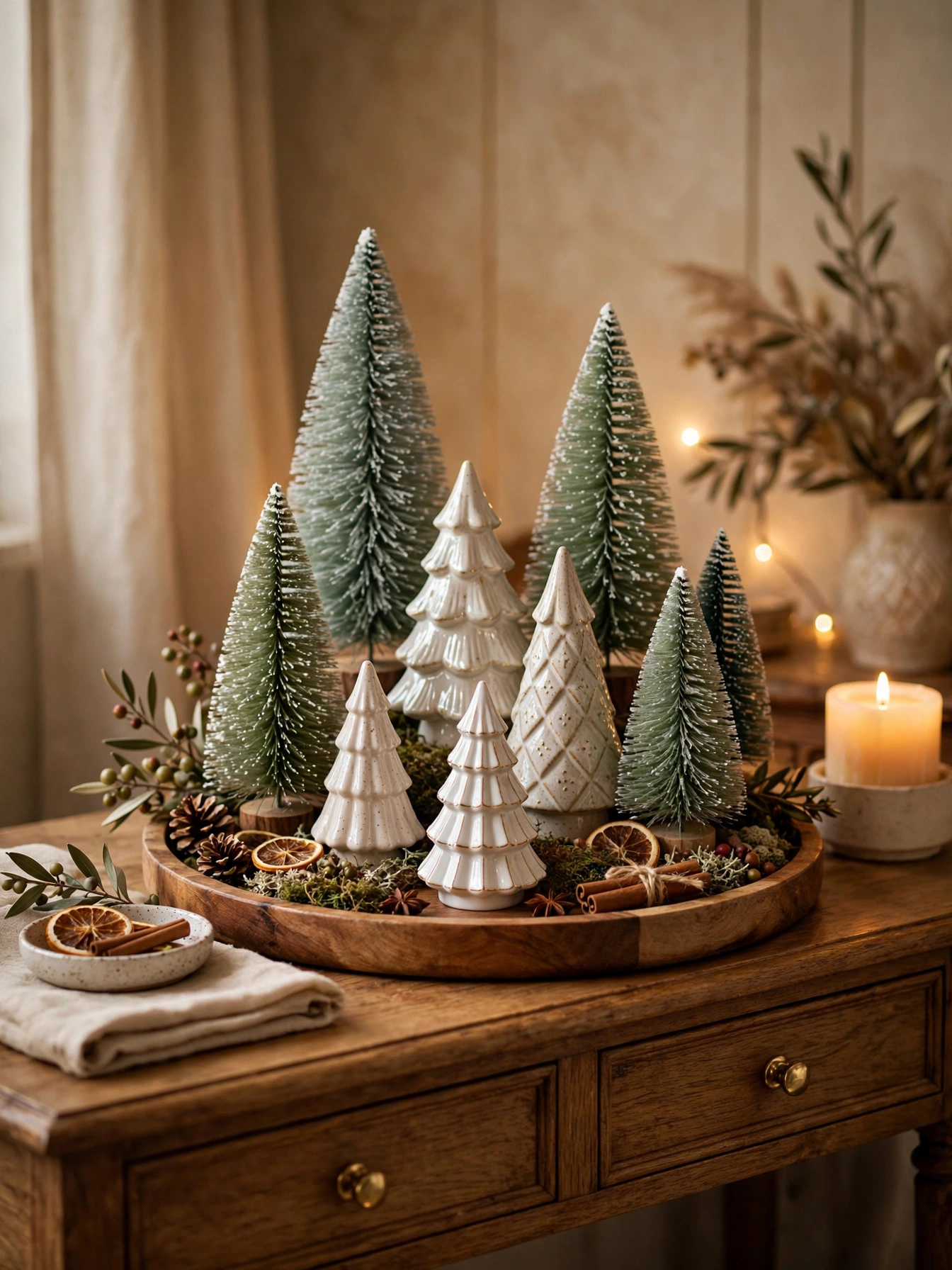
Why This Works:
- Grouping 5 to 9 mini trees in 6 to 18 inch heights creates a forest effect for $30 to $50
- Mini trees suit rooms where a full tree cannot fit: bathrooms, offices, and entryways
- Bottle-brush trees at $2 to $5 each are the cheapest decor per inch in the 2026 lineup
- A clustered display takes 10 minutes to set up and 5 minutes to pack away
Cluster mini trees in odd numbers on a tray, console, or windowsill, mixing heights from 6 to 18 inches with 2 to 3 inches of spacing between trunks. Combine materials, bottle-brush, ceramic, wood, and frosted glass, in one color family so the mix reads as curated. Avoid lining minis in a straight row; a loose triangle or cluster formation reads as a forest while a row reads as a lineup. The collector standard is the height rule: the tallest tree should be roughly 3 times the height of the shortest, which creates the natural variation of a real forest edge.
This suits small-space dwellers and anyone who wants Christmas in every room without buying 5 full trees. A common mistake during styling is scattering single mini trees around the house; one lone 8 inch tree looks forgotten, while a cluster of 7 looks intentional. The honest trade-off is dusting: 9 small trees with textured surfaces collect dust fast, so a soft brush pass weekly keeps them fresh. Guests end up photographing the mini forest, the unexpected favorite.
Pro Tip: Set the cluster on a round 14 inch tray with a 1 inch rim; it contains the display, catches fallen needles, and moves as one piece for cleaning.
Luminaria Lantern Pathways
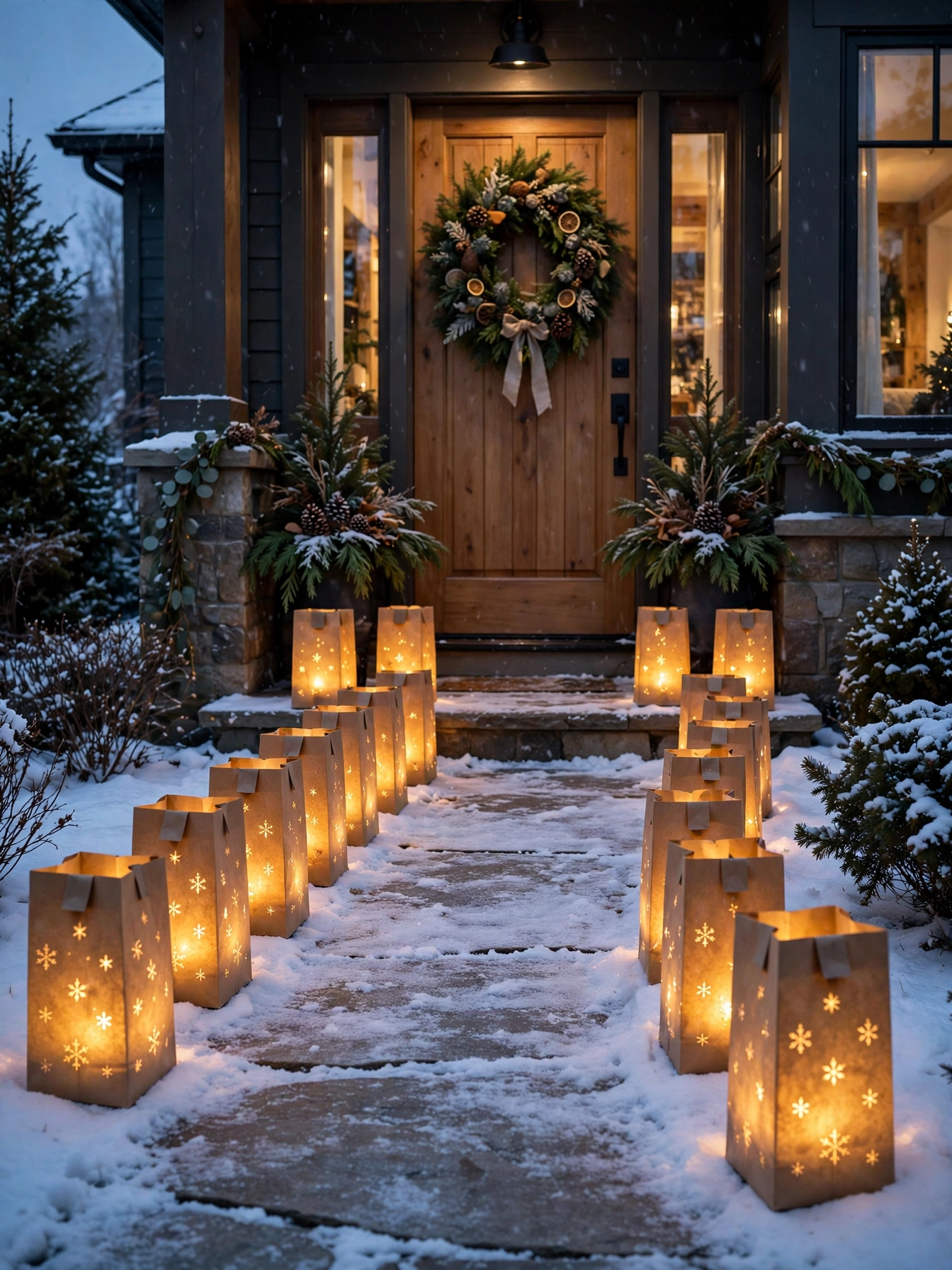
Why This Works:
- Paper bag luminarias cost under $1 each: bag, sand, and an LED tea light
- Spacing luminarias 3 to 4 feet apart lights a 30 foot walkway with 8 to 10 bags
- LED tea lights run 48 to 72 hours, covering a full week of evenings on one set
- Lantern pathways suit Christmas Eve and New Year equally, doubling their use
Fill brown paper lunch bags with 2 to 3 inches of sand, fold the top inch down for a finished cuff, and nestle one LED tea light in each. Line walkways, driveways, or porch steps with bags spaced 3 to 4 feet apart, keeping them 12 inches from any wall or railing. Avoid real candles in paper bags; even with sand, a gust of wind can tip a flame into the paper, so LED only, always. The outdoor safety standard is the 12 inch rule: keep every luminaria at least 12 inches from structures, dry leaves, and foot traffic edges.
This suits anyone hosting Christmas Eve gatherings, because the glowing path turns an ordinary arrival into an event. A common mistake during setup is placing bags out in the afternoon; paper sags in rain and snow, so set them out 1 hour before dusk and bring them in after the evening. The honest limitation is weather: luminarias are a fair-weather feature, and one rainstorm ends the show. Neighbors remember the luminaria walk and ask about it.
Pro Tip: Buy tea lights with built-in timers; the 6-hour timer mode means bags light themselves at dusk every evening for 10 days straight.
FAQs
What are the biggest christmas decor trends for 2026?
Oversized velvet bows, vintage mercury-glass ornaments, jewel-tone palettes, and natural foraged materials lead the 2026 Christmasworld trade show report. Expect to spend $150 to $300 for a full living room refresh, though results vary with tree size and how much you already own.
Will oversized bows still look trendy after this Christmas?
Bows have appeared in holiday styling for decades and the 2026 versions use classic velvet, which suggests staying power beyond one season. Quality wired ribbon at 4 inches wide typically lasts 4 to 5 seasons, though bright trendy colors date faster than burgundy, cream, or forest green.
How much should I budget to try christmas decor trends for 2026 in one room?
A focused refresh runs $80 to $150: one garland at $30, ribbon at $12, and a set of thrifted ornaments at $40. The Christmasworld 2026 coverage notes that layering new pieces over existing decor, rather than starting over, is the dominant approach this year, so costs stay reasonable.
Do flocked Christmas trees shed a lot?
Quality pre-flocked trees shed mostly in the first 24 hours, then settle to light weekly dusting within a 6 foot radius. The National Christmas Tree Association notes that artificial trees of all types need a shake-out before decorating, and flocked models simply add one extra vacuum pass per week through the season.
Can I mix vintage ornaments with brand-new ones?
Yes, and the 60/40 rule works best: about 60 percent vintage-look glass with 40 percent new shatterproof pieces for safety around kids and pets. Hang genuine antiques on upper branches and keep new pieces lower, since vintage glass is thinner and breaks far more easily.
Conclusion
The christmas decor trends for 2026 share three clear takeaways: go bigger with bows and toppers instead of buying more small pieces, mix vintage finds with new basics for a collected look, and let warm lighting do half the decorating work. Start with one trend that fits what you already own, like swapping in velvet ribbon or layering warm white lights, before spending on anything new. These small moves compound into a home that feels current without a full overhaul. Follow HomelyCrafter on Pinterest for more ideas. Save this to your Pinterest boards so you can refer back to it!

Muhammad Israr is a home decor enthusiast and the writer behind Homely Crafter. He spends his days researching paint colors, layouts and budget-friendly styling ideas, then breaks them down into practical, easy-to-follow guides so you can decorate with confidence.