
Here is the rule that keeps my holiday decorating calm: if a decoration takes longer than 15 minutes to set up, it is not simple. The most peaceful December homes earn their calm from restraint, not accumulation. These simple christmas decor ideas 2026 follow that rule. One good strand of garland beats five crowded shelves, and a single candle cluster glows warmer than competing lights.
The quiet-luxury holiday look keeps growing because layered neutrals and natural greenery photograph beautifully and outlast bright novelty trends. That is exactly what this guide is built on: unfussy pieces you can set up tonight, most of them under 30 dollars.
Below you will find 22 quick ideas with exact measurements, material grades, and honest price ranges, so you know what to buy, how much space you need, and what to skip. Every idea takes 15 minutes or less. Pick the three that fit your rooms and start with one today.
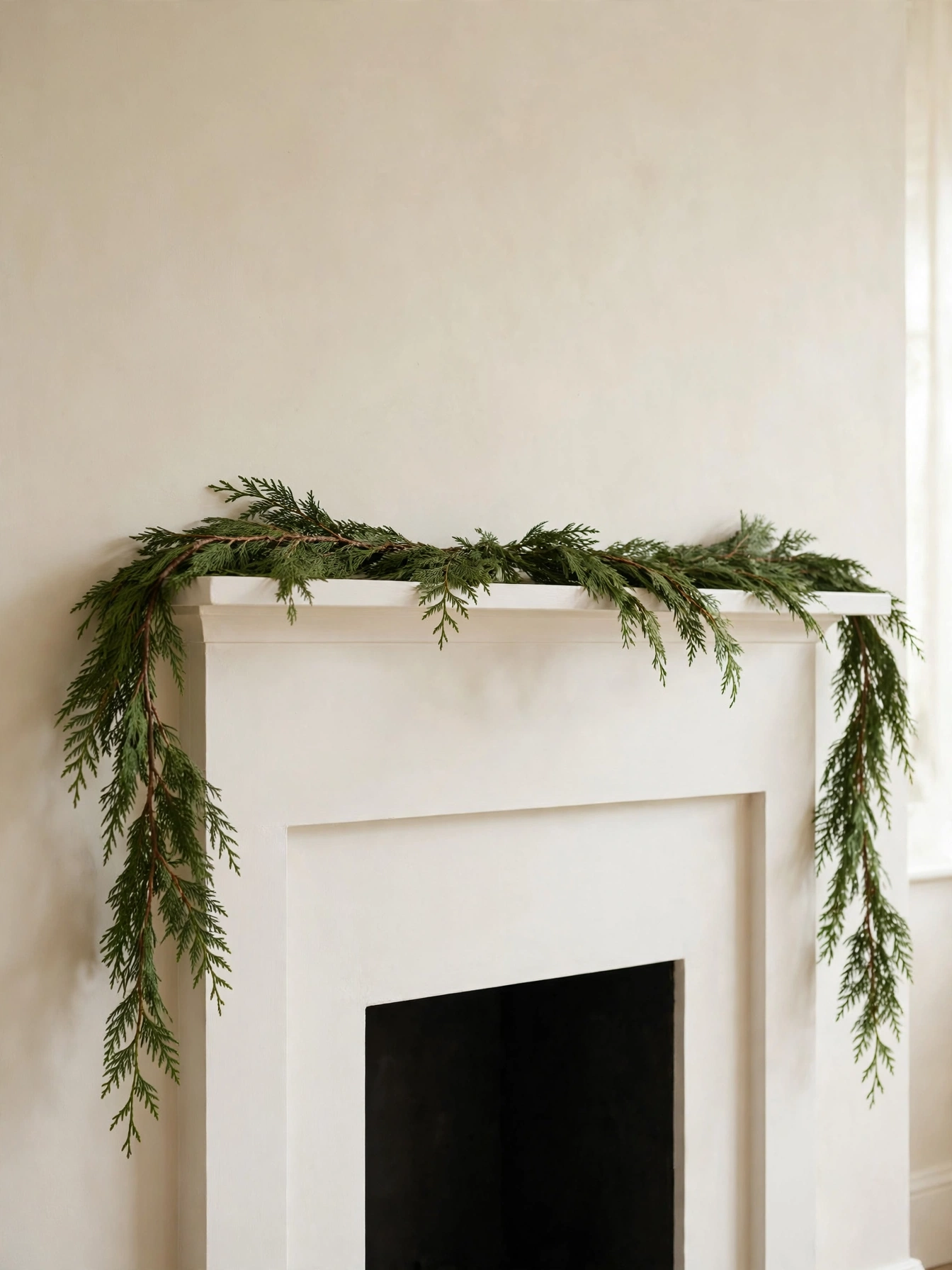
Single Strand Mantel Garland
Why This Works:
- One 6 foot fresh cedar strand covers a standard 60 inch mantel with natural drape left over on both ends.
- Hangs in under 10 minutes with 3 removable hooks and no tools.
- Costs 18 to 35 dollars, about half the price of a layered garland setup.
- Sheds 70 percent less than a full mixed garland because fewer cut stems dry out.
Buy one fresh western red cedar garland, 6 feet long and 4 to 6 inches wide, or a 20 stem faux cedar strand if you want to reuse it for 5 seasons. Look for stems wired to a jute or grapevine base rather than plastic, because plastic bases crack after one winter in a heated room. The National Christmas Tree Association notes that real garlands stay freshest between 65 and 70 degrees Fahrenheit, which matches most living rooms in December. Avoid soaking the garland before hanging, because wet needles against a painted mantel leave tannin stains that need repainting to fix.
This works best on mantels 48 to 72 inches wide, where one strand can swoop once in the middle and still reach both ends. Renters love it because three adhesive hooks rated for 3 pounds each hold the whole thing with zero holes. The honest trade-off is fullness: one strand looks intentional but never lush, so maximalist rooms will read it as unfinished. A common mistake during installation is pulling the strand tight like a rope; let it dip 4 to 6 inches in the center and it photographs like a designer install.
Pro Tip: Anchor the strand with one hook every 18 inches and let each end hang 8 to 10 inches past the mantel edge for a relaxed, unforced drape.
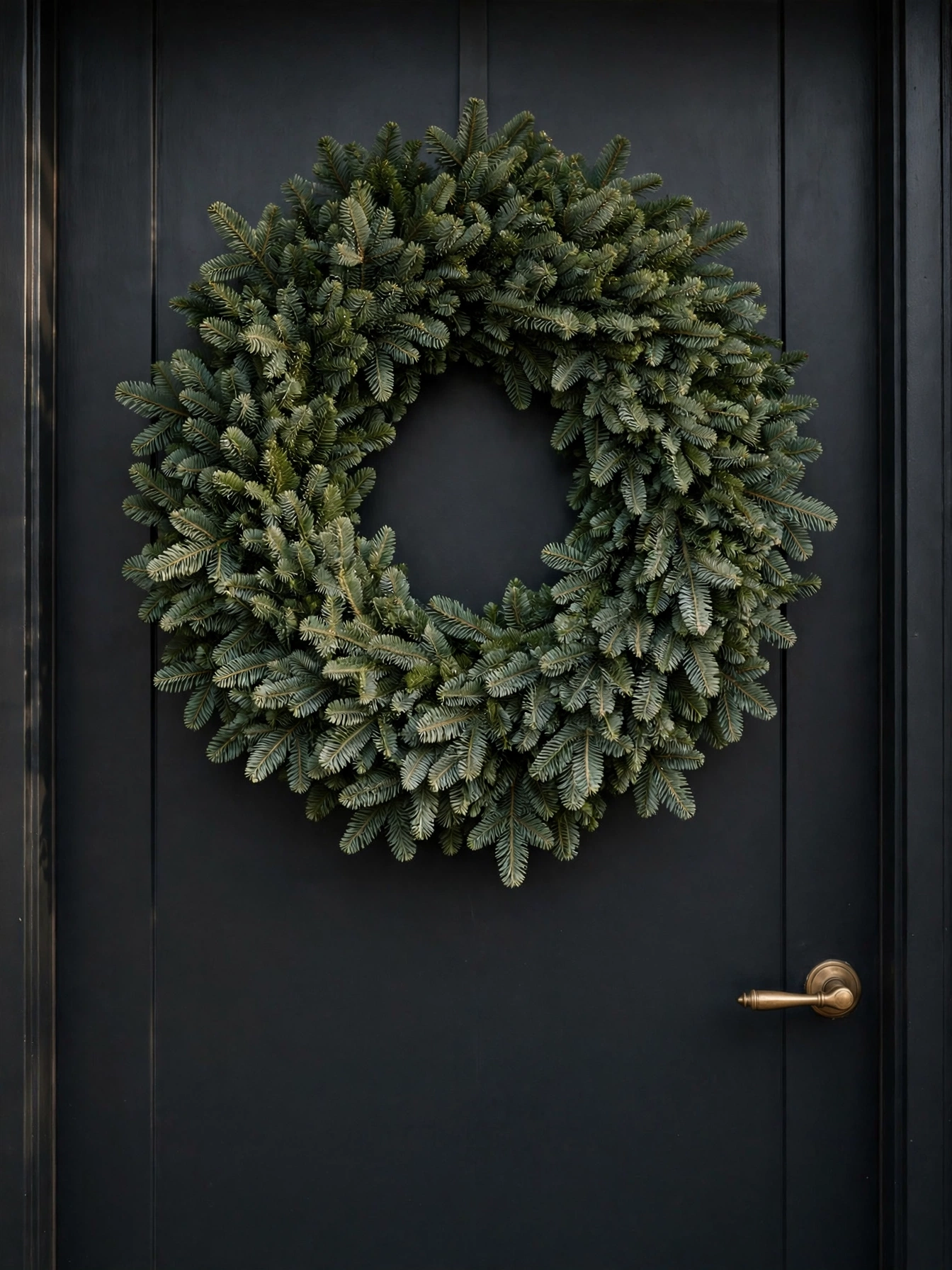
One Statement Wreath
Why This Works:
- A single 28 to 30 inch wreath fills a standard 36 inch door without a single extra ornament.
- Hangs in 5 minutes on one over-door hook rated for 10 pounds.
- Costs 25 to 60 dollars, roughly a third of a decorated matching set.
- One plain wreath photographs cleaner than a crowded door from 20 feet away.
Choose a 28 to 30 inch wreath with a 4 inch deep profile, either fresh noble fir or faux PE tips rated for outdoor use. Door stylists size wreaths to about two thirds of the door width, so a 30 inch wreath suits a standard 36 inch door perfectly. Look for a wreath with at least 180 tips for fullness, and check that the frame is double-ringed steel rather than a single wire that bends. Avoid battery lights woven through a fresh wreath, because the heat pockets dry needles fast and the battery pack sags the bottom within two weeks. Faux PE (polyethylene) tips hold their detail 3 to 5 years longer than cheap PVC, and cost about 20 dollars more.
It suits anyone whose door is the first thing guests see, especially on dark-painted doors where green pops. Apartment dwellers can use the same trick on an interior door or a large mirror. The limitation is commitment: one wreath means no swag, no sign, no bow competing with it, and some people miss the layers. A common mistake is hanging it with suction cups on a glass door; most cups hold 5 pounds max and release in January cold, so use an over-door hook instead.
Pro Tip: Hang the wreath 6 inches below the top of the door, centered left to right, so it reads balanced from the street about 25 feet back.
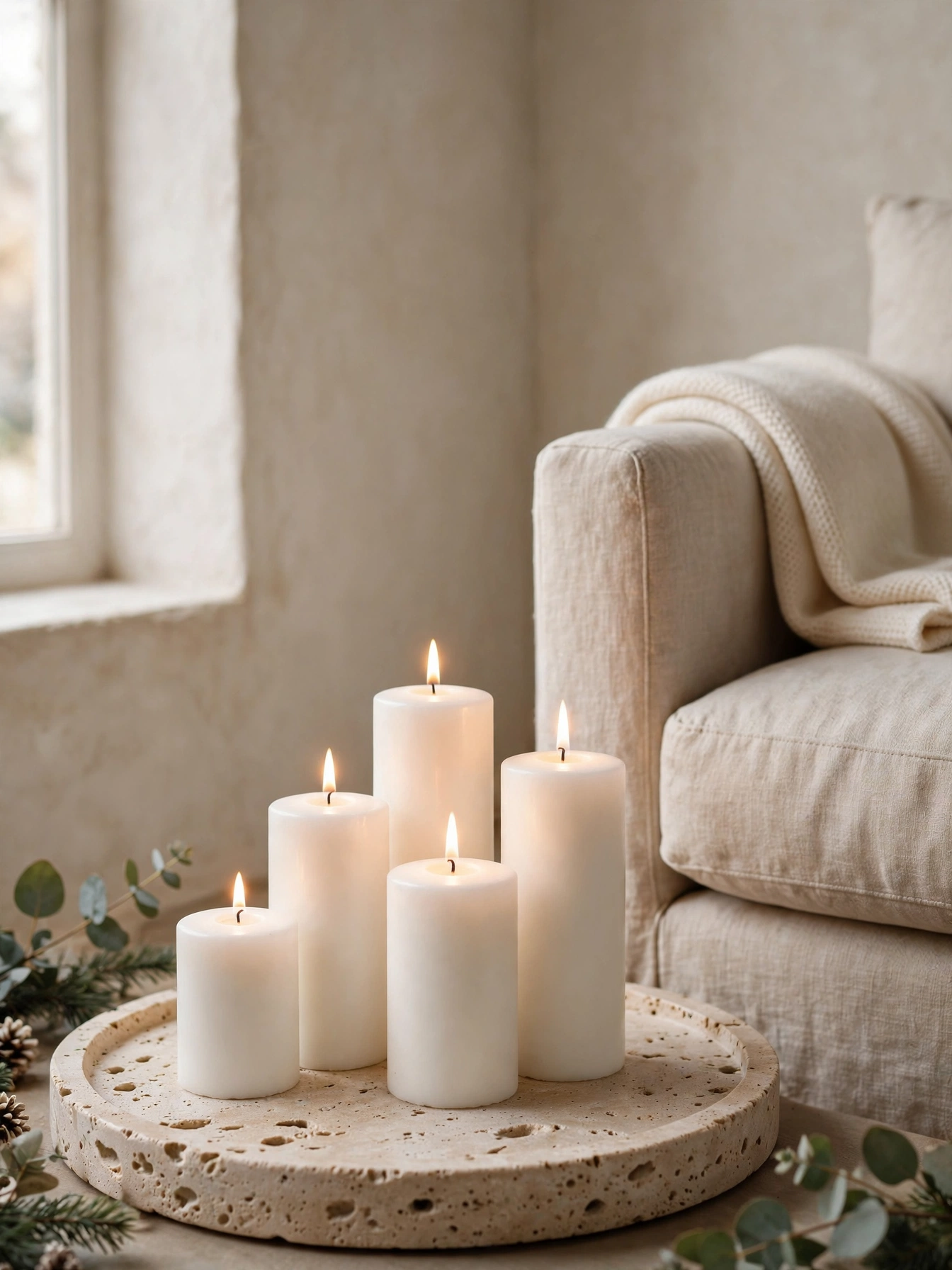
Candle Cluster Corner
Why This Works:
- Five unscented pillar candles, 3 to 8 inches tall, turn an empty 24 inch corner into a focal point.
- Sets up in 8 minutes on one 14 inch tray.
- Costs 20 to 45 dollars total, cheaper than one designer lantern.
- Grouped flames read 3 times brighter to the eye than the same candles spread around a room.
Use real wax pillars 3 inches in diameter, in heights of 4, 5, 6, 7 and 8 inches, or LED pillars with a 2,700 Kelvin warm flicker if pets or kids are around. The National Fire Protection Association recommends keeping open flames at least 12 inches from anything that can burn, which is why a metal or stone tray under the group matters. Set the tray on a surface at least 16 inches wide so no candle sits near the edge. Keep these five candles unshaded so the cluster reads as one open flame group; glass shades suit smaller groups better, where each shade has room to breathe. Paraffin burns about 1 inch every 4 hours, while beeswax burns 30 percent slower and costs roughly twice as much.
It rescues the dark corner beside the sofa or the dead end of a hallway that overhead lighting never reaches. It suits anyone who wants evening atmosphere without rewiring anything. The honest limitation is maintenance: real candles need relighting and drafts make flames dance and smoke. A common mistake is placing the cluster directly under a smoke detector, where rising heat makes it chirp within a week; shift the tray 3 feet to the side.
Pro Tip: Stagger heights by exactly 1 inch between each candle with the tallest at the back, and the group will read as one clean staircase of light.
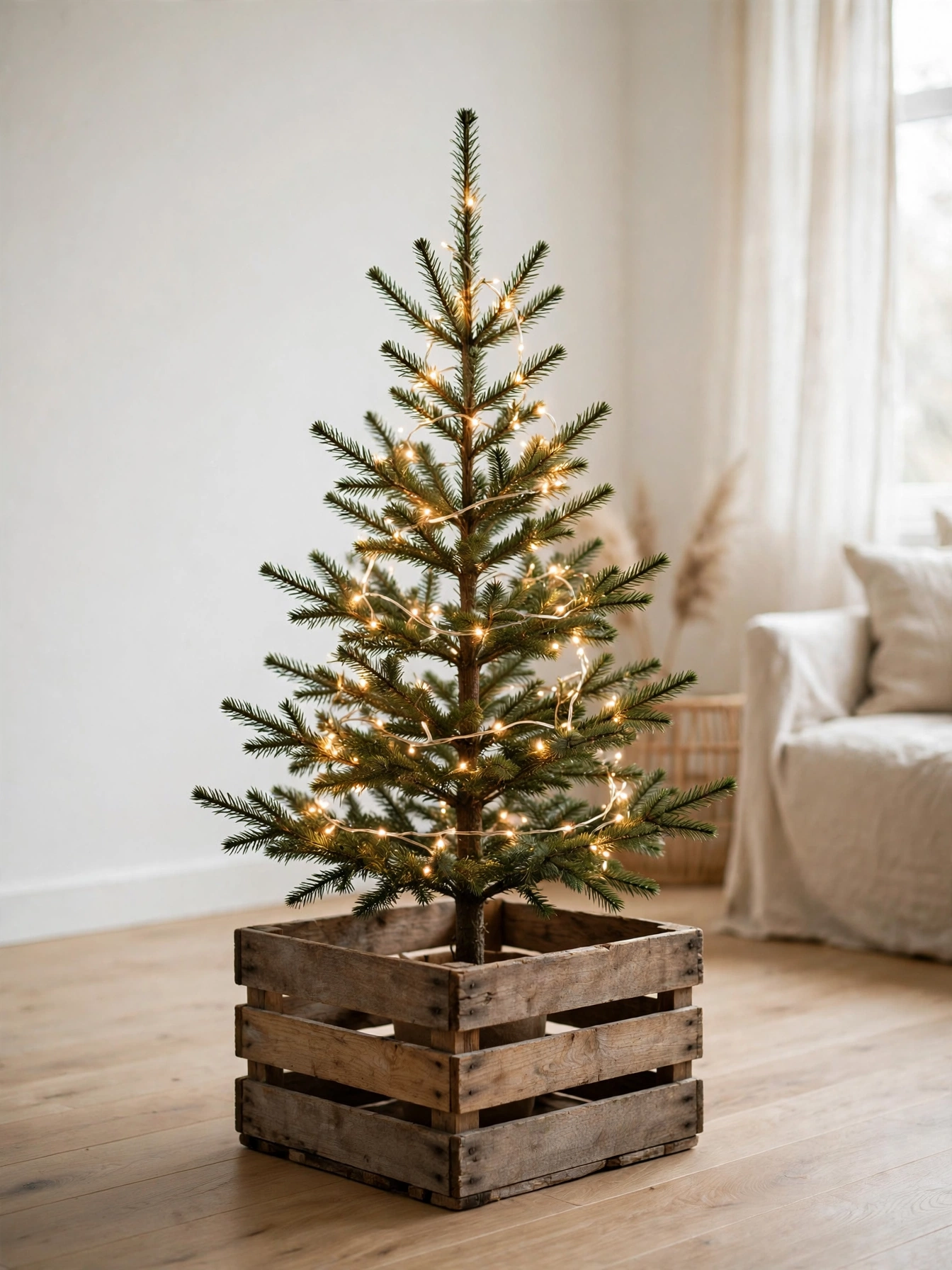
Minimal White Light Tree
Why This Works:
- A 4 foot tree with 200 warm white lights needs zero ornaments to look finished.
- Decorates in 12 minutes: fluff, lights, done.
- A 4 foot pre-lit tree costs 40 to 80 dollars, about half of a 7.5 foot model.
- Uses roughly 8 watts with LEDs, under 2 dollars of electricity for the whole season.
Pick a 4 foot pre-lit tree with 150 to 200 warm white LEDs at 2,700 Kelvin, on a stand that fits a 3 foot floor circle. The industry standard for lit trees is about 50 lights per foot of height, so 200 hits the sweet spot for a 4 foot tree. Look for UL 588 certification on the light string, which is the US safety standard for seasonal lighting. Avoid cool white 5,000 Kelvin lights, because they read blue and clinical against warm room lighting, while 2,700 Kelvin matches standard living room bulbs. A hinged-branch tree fluffs in 10 minutes, while a hook-in branch tree takes 30 and tests your patience.
This is made for apartments, bedrooms and offices where a full-size tree would eat the room. Set it on a 16 inch wooden crate and it reads as a 5 foot tree while hiding the stand. The limitation is presence: it will not anchor a large living room the way a 7 foot tree does, so use it as a secondary tree. A common mistake is buying a 4 foot tree with only 100 lights; at that density the branches show through and it looks sparse instead of minimal.
Pro Tip: Wrap lights in a zigzag every 6 inches rather than circling the trunk, and you will need 25 percent fewer lights for the same even glow.
Simple Christmas Decor Ideas 2026 Mantels
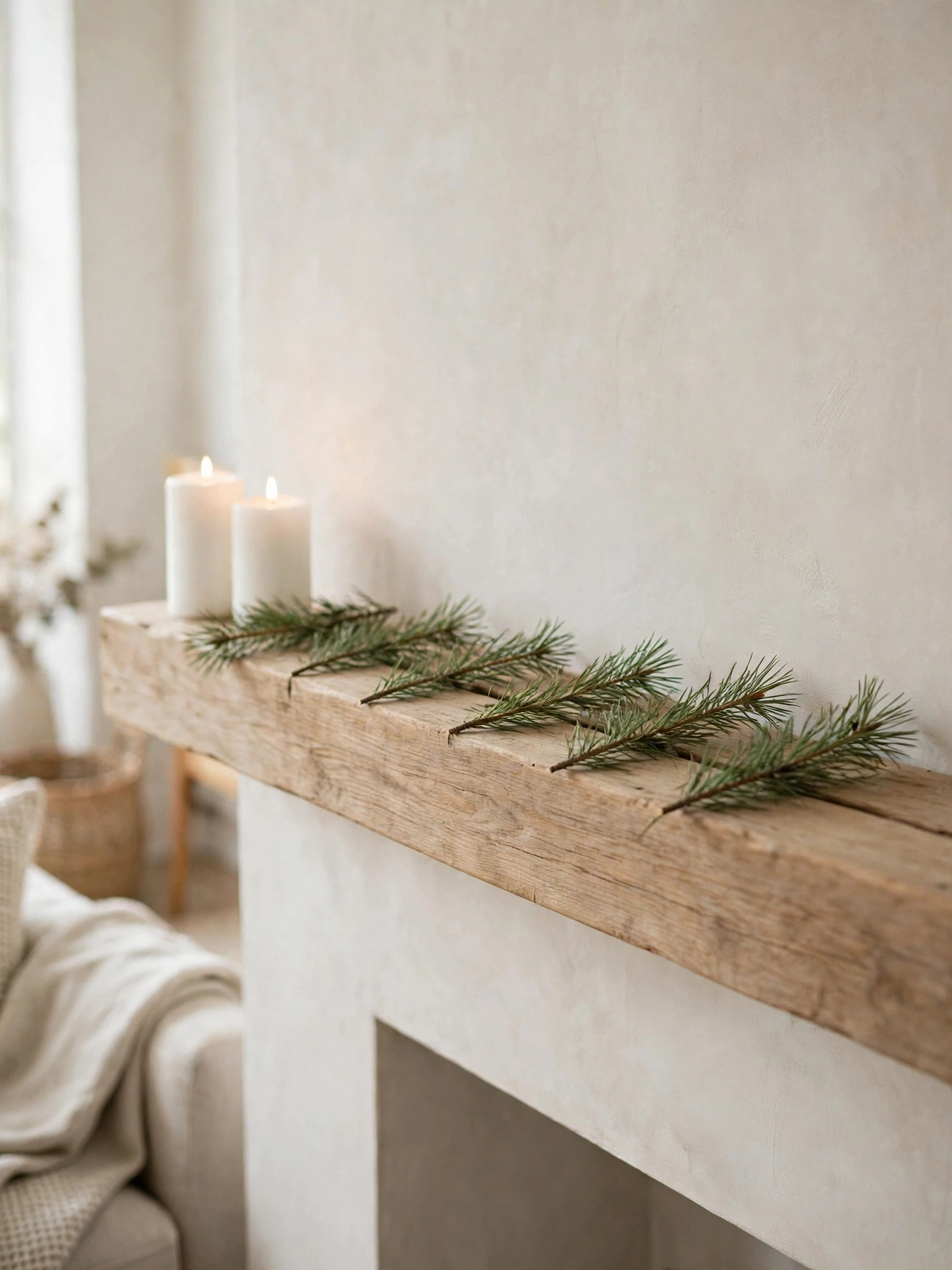
Why This Works:
- Six loose pine sprigs, each 18 to 24 inches long, style a 60 inch mantel in one layer.
- Assembles in 10 minutes with zero fasteners or hooks.
- Costs 12 to 25 dollars for sprigs plus two candles.
- Reads calmer than a garland because bare mantel shows between each sprig.
Lay 6 to 8 fresh pine or fir sprigs 18 to 24 inches long directly on the mantel, tips pointing outward from the center, then add two 3 by 6 inch white pillar candles on one side. Florists grade fresh boughs as tips or boughs; tips are the finer 12 inch ends and look softer laid flat on a shelf. A standard mantel shelf is 8 to 10 inches deep, which fits a 4 inch wide sprig layer with room to spare. Avoid misting the sprigs daily, because constant moisture under the needles stains light wood and paint within a week. Loose sprigs cost about 40 percent less than a wired garland of the same length, since you skip the frame and labor.
Anyone who hates hanging hardware or lives with strict rental rules will appreciate this one. It works on floating shelves and console tops too, not just fireplace mantels. The trade-off is lifespan: loose sprigs near a working fireplace dry out in about 2 weeks, faster than a wired garland. A common mistake during setup is laying sprigs right against the firebox opening; radiant heat browns needles in 48 hours, so keep the whole layer 12 inches back from the opening.
Pro Tip: Tuck sprigs tip to tail so each one covers the cut stem of the last, and replace just the two driest sprigs each week instead of redoing the whole layer.
Greenery Filled Vases
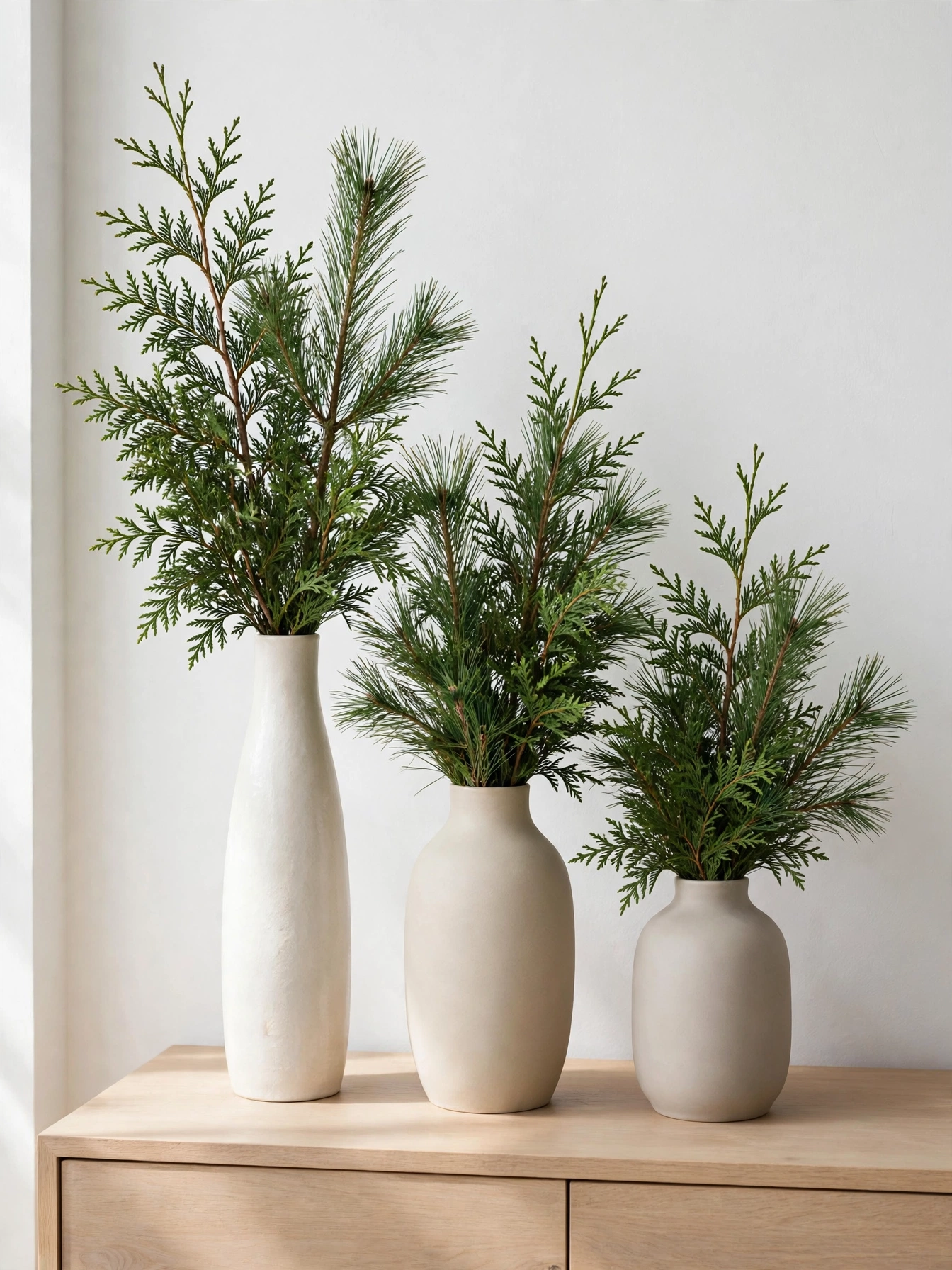
Why This Works:
- Three vases you already own, filled with 24 to 36 inch branches, decorate three rooms at once.
- Takes 12 minutes: trim, add 4 inches of water, done.
- Costs 0 to 15 dollars if you clip branches from your own yard.
- Fresh branches stay green 10 to 14 days in water, twice as long as in a dry wreath.
Use vases 10 to 14 inches tall with a mouth at least 3 inches wide, and cut branches to 1.5 times the vase height so the arrangement reads full from across the room. The Society of American Florists recommends recutting stems at a 45 degree angle under water, which keeps the cut open and drinking. Cedar, pine and fir all work; cedar drapes softly while pine stands stiff and upright. Avoid mixing eucalyptus with pine in the same vase if anyone in the house has fragrance sensitivities, because the combined oils smell noticeably stronger than either one alone. Plain tap water works fine; commercial preservative adds about 2 extra days but costs 8 dollars a packet.
People who already own beautiful vases that sit empty most of the year get the most from this. It spreads Christmas through bedrooms and bathrooms, the rooms garlands never reach. The limitation is upkeep: you must change the water every 3 days or it clouds and smells. A common mistake is skipping a coaster under the vase; stems make vases sweat, and the ring stains a wood table in one week, so slide a 6 inch cork coaster under each one.
Pro Tip: Put the tallest branch in first, then add two shorter ones at 10 and 2 o’clock for a balanced triangle that looks good from every side of the room.
Velvet Bow Accents
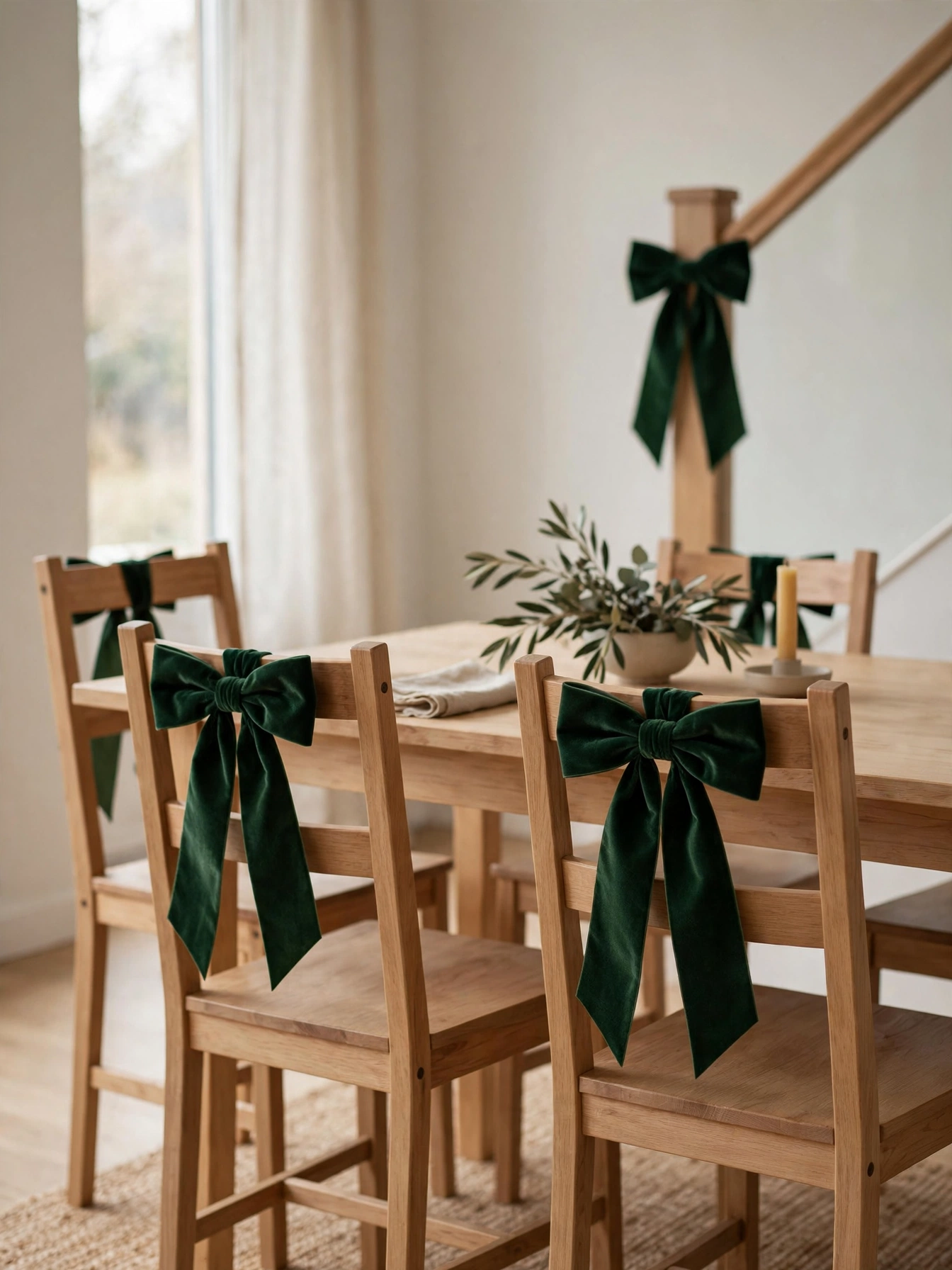
Why This Works:
- Five pre-tied 6 inch velvet bows dress chairs, the banister and stockings in one pass.
- Tie on in 7 minutes with 24 inch ribbon tails.
- Costs 10 to 20 dollars for a 5 pack, under 4 dollars per bow.
- Velvet reads richer than satin in photos because its pile absorbs light instead of reflecting it.
Buy 2.5 inch wide velvet ribbon with a wired edge, pre-tied into 6 inch bows with 12 inch tails. Wired ribbon holds its loops through the whole season; non-wired ribbon collapses within 3 days of handling. A standard dining chair back is 18 to 20 inches wide, so a 6 inch bow centered on it looks proportional from the table. Avoid hot-gluing bows to painted wood, because the glue pulls paint off in spring while wire ties come off clean. Velvet costs about 2 dollars more per yard than satin, and the difference shows in every photo.
Renters will like this one, as will anyone who wants Christmas on existing furniture with zero storage bulk afterwards. Tie them on chair backs, stair spindles, wreath centers and gift boxes. The limitation is sun: velvet fades in direct sunlight over 4 to 6 weeks, so keep bows off south-facing windows. A common mistake is tying bows directly onto round banister spindles, where they slide down; loop the tail around twice before tying and they stay put all December.
Pro Tip: Cut ribbon tails at a 45 degree angle and 2 inches longer than you think you need, because bows settle and shorten by about an inch after the first week.
Unadorned Pinecone Bowl
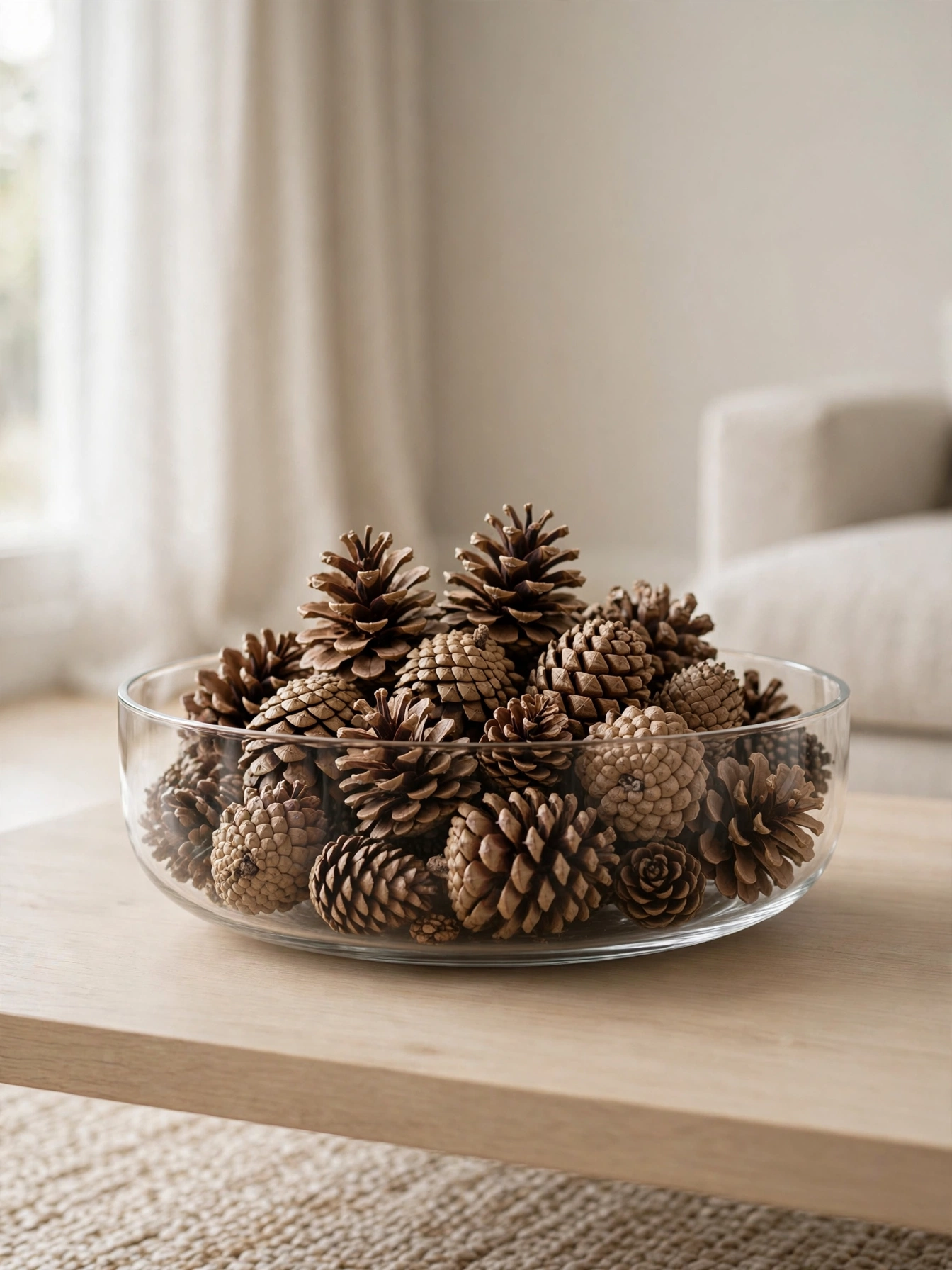
Why This Works:
- A 12 inch bowl holds 15 to 20 pinecones and needs nothing else added.
- Fills in 4 minutes, the fastest idea in this guide.
- Costs 8 to 18 dollars for a bag of 20, or free from a park walk.
- Lasts the entire season and stores in a shoebox for next year.
Use a clear glass or ceramic bowl 10 to 12 inches wide and 5 inches deep, filled with 15 to 20 pinecones 3 to 5 inches long. Sugar pine cones are the large 6 inch showpieces; smaller ponderosa cones 3 inches long pack tighter and look better in bulk. If you gather cones outdoors, bake them at 200 degrees Fahrenheit for 45 minutes to kill insects before bringing them inside, which is the standard university extension recommendation. Avoid spraying pinecones with glossy polyurethane, because it yellows within a year and the fumes linger for days in a closed room. Natural matte cones photograph better anyway, with shadows in every scale.
It lives on coffee tables, dining tables and entry consoles, anywhere a low centerpiece works. It suits households with toddlers because there is nothing breakable and nothing to plug in. The limitation is dust; cones collect it in their scales, so shake the bowl outside once in January. A common mistake is using a bowl under 8 inches wide; it tips when someone grabs a cone, so stick to 10 inches or wider for stability.
Pro Tip: Layer cones largest at the bottom and smallest on top, then shake the bowl once so they settle into a natural mound instead of a flat fill.
White Pillar Candle Trio in Hurricane Shades
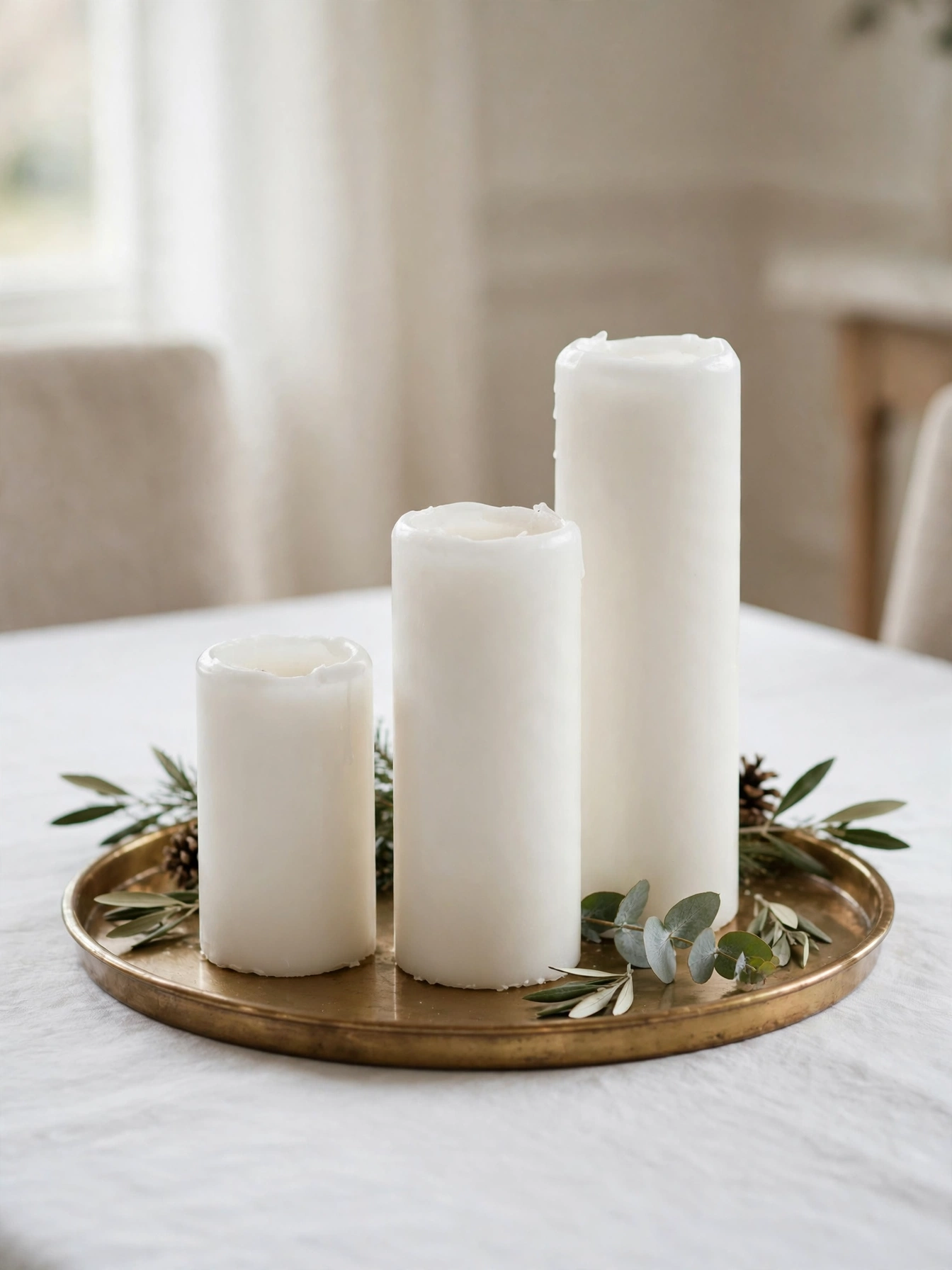
Why This Works:
- Three 3 inch diameter pillars in 4, 6 and 8 inch heights inside glass hurricane shades make a complete table centerpiece.
- Arranges in 5 minutes on any flat surface.
- Costs 20 to 35 dollars for the set of three with shades.
- Hurricane glass shields flames from drafts, so candles burn steady and drip-free.
Choose unscented pillars 3 inches in diameter and slide each into a glass hurricane shade 2 inches taller than the candle, so the flame sits below the rim. Candle makers follow the ASTM F2417 fire safety standard, which covers proper labeling and burn instructions for pillars. Set the shades on a 12 inch round tray, tucking cedar sprigs and a few fresh cranberries around the bases for color, and keep the tray 12 inches from table edges and curtains. Avoid lighting all three every single night, because a 3 inch pillar melts about 1 inch every 5 hours and daily burning eats the set before Christmas. Unscented pillars suit dining tables better than scented ones, since fragrance competes with food aromas.
It anchors the dining table from the first December dinner through New Year, then moves to the coffee table when guests need the space. It suits anyone who hosts but hates fussy tablescapes. The honest limitation is glass: hurricane shades show fingerprints and wax spatter, so wipe them with a damp cloth weekly. A common mistake is placing the trio dead center under a pendant light; the heat softens the tops, so offset the tray 6 inches to the side.
Pro Tip: Trim wicks to a quarter inch before every lighting and the flames will stay 1 inch tall, steady and smokeless, instead of tall and flickering.
Eucalyptus Sprig Bundles
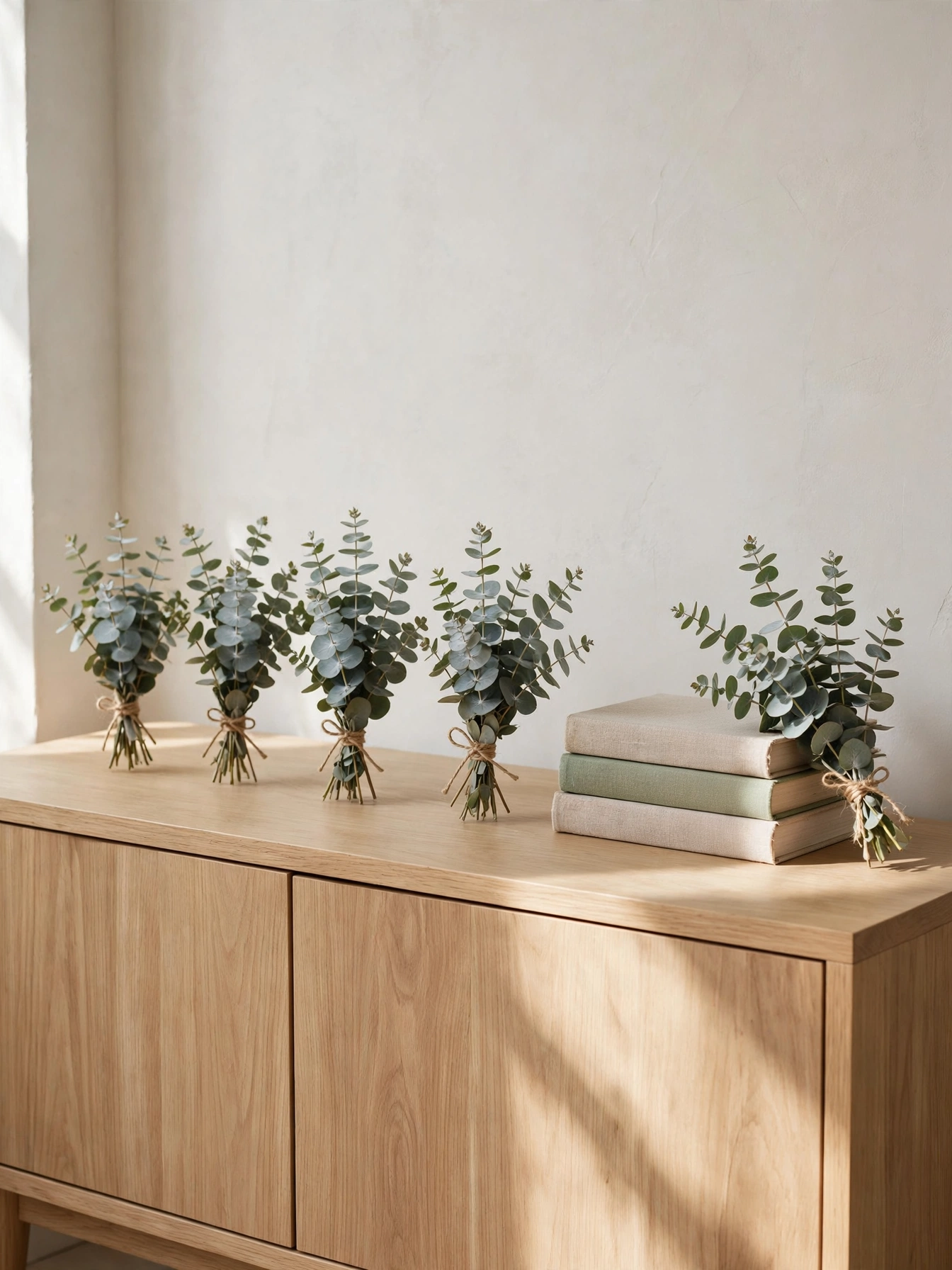
Why This Works:
- Six small bundles, each 5 stems and 10 inches long, style shelves, trays and gifts.
- Ties in 12 minutes with kitchen twine.
- A 30 stem bunch costs 12 to 20 dollars and makes 6 bundles.
- Dries beautifully in place, so it still looks good on January 1.
Buy silver dollar eucalyptus in bunches of 30 stems, each stem 18 to 24 inches long, and cut them into 10 inch pieces for bundles of 5. Silver dollar has round 2 inch leaves that photograph softer than seeded eucalyptus. Avoid placing fresh eucalyptus where cats chew plants, because its oils are toxic to cats and the ASPCA lists it as a risk for pets. Preserved eucalyptus keeps its color for 12 months and costs about 50 percent more than fresh, a fair trade if you hate replacing things.
These bundles tuck onto bookshelves, bathroom trays, wreath tops and wrapped gifts, anywhere a small green accent helps. They suit the cook who already buys herbs, since the technique is identical. The limitation is scent life: the fragrance fades after about 2 weeks even though the leaves still look fine. A common mistake is tying bundles loosely; stems shrink about 10 percent as they dry, so wrap the twine 3 times and knot it tight.
Pro Tip: Tie each bundle over a trash can and shake it once first, because fresh stems shed small round leaves for the first 3 days.
Wooden Bead Garland
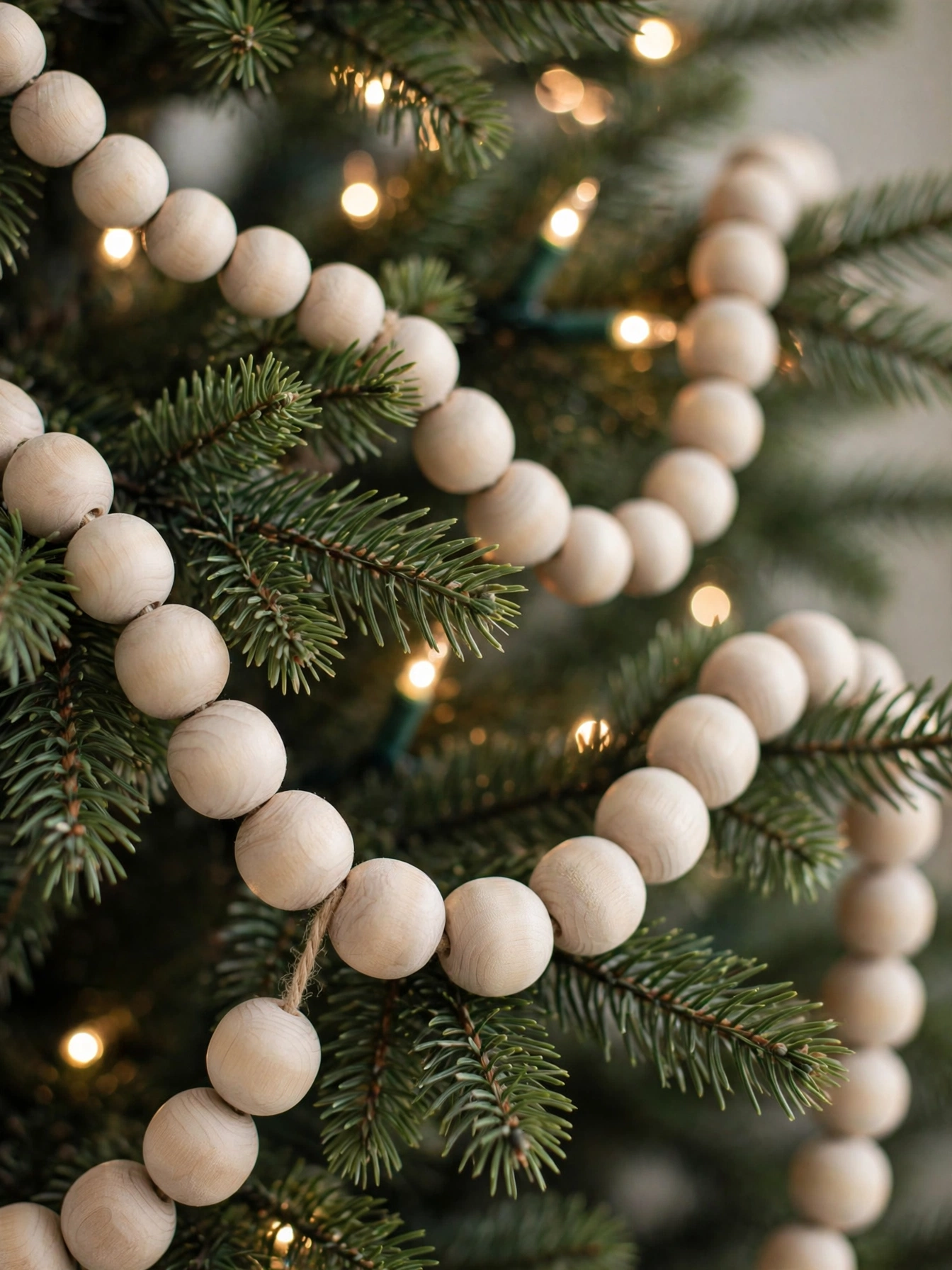
Why This Works:
- One 6 foot strand of 1 inch wood beads wraps a 4 to 6 foot tree twice.
- Drapes in 6 minutes with no hooks or wire.
- Costs 10 to 18 dollars and stores flat in a drawer.
- Adds texture without a single shiny surface, so the lights stay the star.
Choose unfinished wood beads 20 to 25 millimeters, about 1 inch, strung on jute, 6 feet per strand. Unfinished beads take paint or stain later if your palette changes; pre-stained beads lock you into one color. Craft suppliers size beads in millimeters, and 20 millimeter is the sweet spot that shows from 10 feet away without looking chunky. Avoid plastic wood-look beads, because the paint chips at the drill holes within one season and the fake grain fools no one up close. Compared with popcorn or cranberry strings, wood beads last for years instead of one December and never attract pests.
Neutral and Scandinavian-style trees are where this fits, since shiny ornaments would fight the palette. It also drapes beautifully on mantels and stair rails. The limitation is weight: on a small tree with soft branches, beads pull tips down, so use it on trees 4 feet and taller with firm branches. A common mistake is wrapping beads in tight spirals, which hides the tree; drape two loose swags 12 inches apart instead and the tree breathes.
Pro Tip: Start and end the strand at the back of the tree so both cut ends hide, and let the middle swag dip 8 inches for a relaxed curve.
Fairy Light Vase
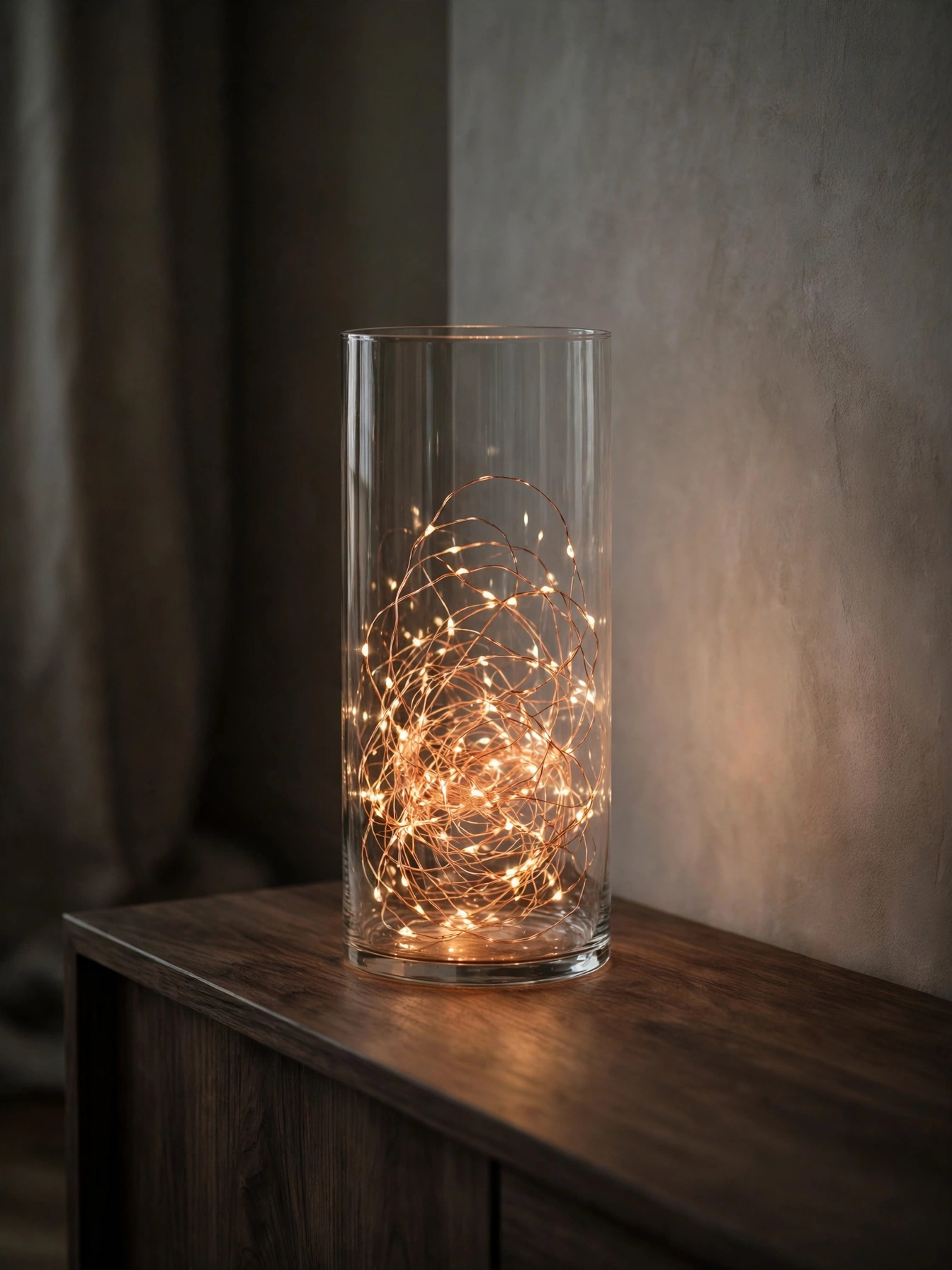
Why This Works:
- One 10 foot string of 30 micro LEDs turns a tall clear vase into a lantern.
- Assembles in 5 minutes with no tools.
- Costs 8 to 15 dollars for the light string.
- The battery pack runs 72 hours on one set of 3 AA batteries with a 6 hour timer.
Use a clear glass vase 12 to 16 inches tall with a 4 inch mouth, and a copper-wire fairy light string 10 feet long with 30 LEDs at 2,700 Kelvin. Copper wire bends to fill the vase evenly; stiff plastic strings bunch at the bottom and leave a dark top. Micro LED strings run about 3 lights per foot, which is dense enough to glow without hot spots. Avoid stuffing the battery pack deep inside the vase on the brightest setting, because trapped heat shortens LED life; rest the pack on the vase rim instead. Battery strings cost the same as plug-in ones but need no outlet, which matters on shelves with no plug within 6 feet.
Dark bookshelf corners, bathroom counters and entry tables with no outlet nearby are exactly what this rescues. It suits anyone nervous about open flames but wanting the same warmth. The limitation is batteries: even on a timer you will change them twice in December. A common mistake is buying cool white 6,000 Kelvin strings by accident; they glow blue and clash with every warm bulb in the house, so check the Kelvin rating on the box.
Pro Tip: Coil the string loosely like a nest instead of dropping it straight in, and the glow will fill the whole vase evenly with no dark bottom.
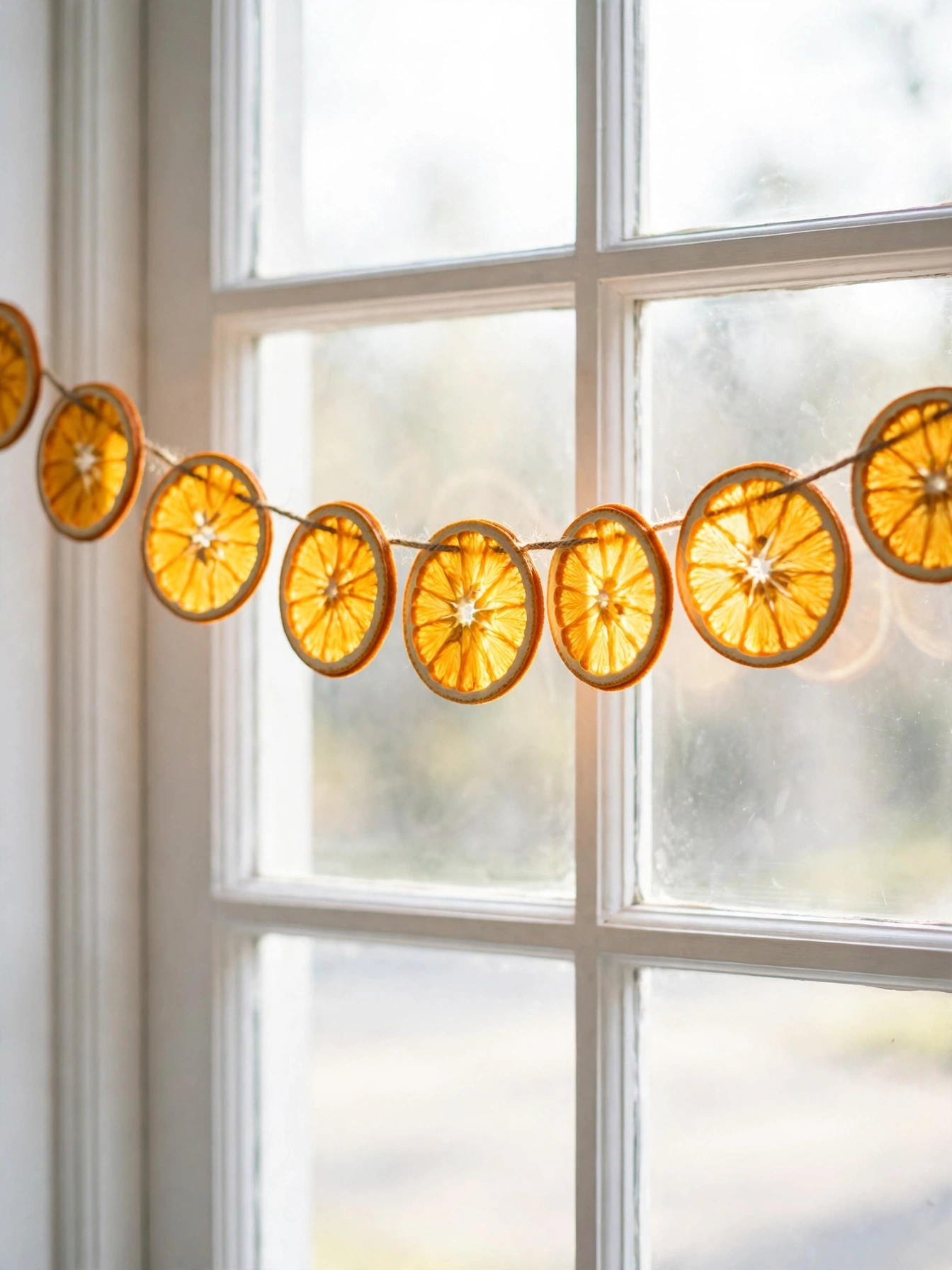
Dried Orange Garland
Why This Works:
- Twenty dried orange slices on 6 feet of twine make a full window garland.
- Strings in 12 minutes if the slices are pre-dried.
- Costs 6 to 12 dollars for a bag of 20 slices, or 3 oranges and an oven.
- Glows amber when backlit by a window, which no store-bought garland does.
Buy pre-dried orange slices 2.5 to 3 inches in diameter and a quarter inch thick, or dry your own at 200 degrees Fahrenheit for 3 hours, flipping once halfway. Food dehydrator guides list citrus at 135 degrees for 8 to 12 hours for even drying without browning. String them on jute twine with 3 inches between slices so light passes through each one. Avoid slices thicker than half an inch, because the centers stay gummy, attract dust and never fully harden. Oven drying is faster but risks browning at the edges; a dehydrator gives glass-clear slices with zero babysitting.
Across windows is where this hangs best, since daylight does the decorating work for you. It suits the natural-style decorator who already buys dried botanicals. The limitation is sun fade: strong direct sun bleaches the amber color over 4 to 6 weeks. A common mistake is hanging the garland with slices touching; they clump and light cannot pass through, so keep that 3 inch spacing along the whole 6 feet.
Pro Tip: Hang the garland 2 inches in front of the glass on small suction hooks rated for 1 pound, and morning light will backlight every slice.
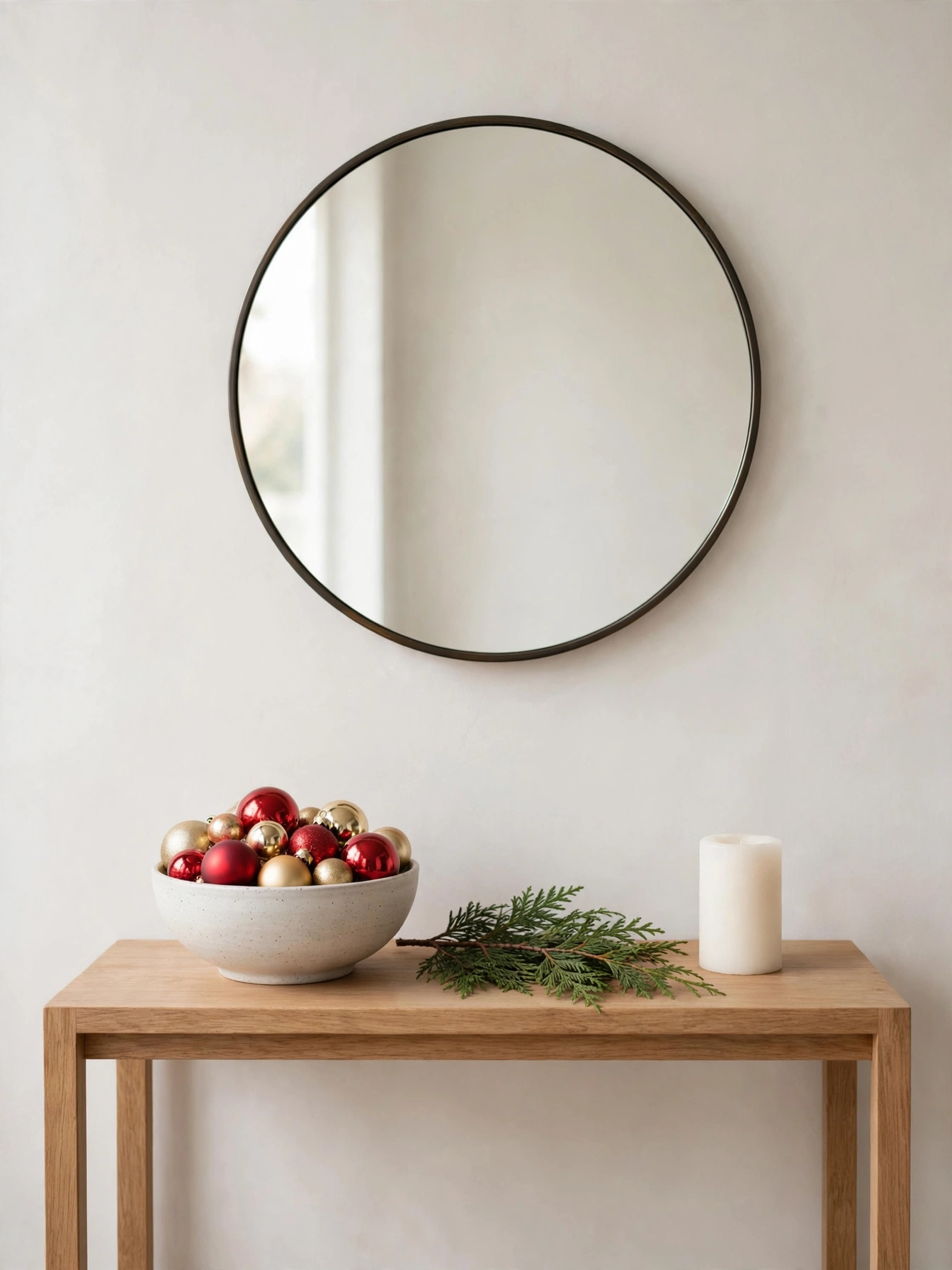
Simple Christmas Decor Ideas 2026 Entryway
Why This Works:
- Three pieces on a 36 inch console: one bowl, one sprig, one candle.
- Styles in 9 minutes with things you likely own.
- Costs 15 to 35 dollars total, mostly the bowl.
- Guests see it within 5 seconds of entering, so it sets the tone for the whole house.
Use a low bowl 8 to 10 inches wide filled with 12 shatterproof ornaments 2 to 3 inches across, one 18 inch cedar sprig laid beside it, and one 3 by 4 inch pillar candle. Interior stylists work in odd-numbered trios because the eye reads three objects as a complete composition. A standard console table is 30 to 36 inches high, so keep every piece under 10 inches tall to leave sightlines open to the mirror or art above. Avoid tall branches here, because they block whatever hangs on the wall and make the entry feel crowded. Shatterproof ornaments cost the same as glass but survive the inevitable bump from bags and coats.
The entryway console usually doubles as the key drop and mail pile, so this trio has to share the surface with daily life. It suits small foyers where a tree would block the door swing. The limitation is traffic: everything here gets touched, so skip anything fragile or lit. A common mistake is centering the trio perfectly; a slightly left-of-center group looks styled, while dead-center looks like a store display, so offset the bowl 4 inches left.
Pro Tip: Leave 12 inches of clear space on one end of the console for keys and daily life, and the styled trio will survive real use instead of being shoved aside.
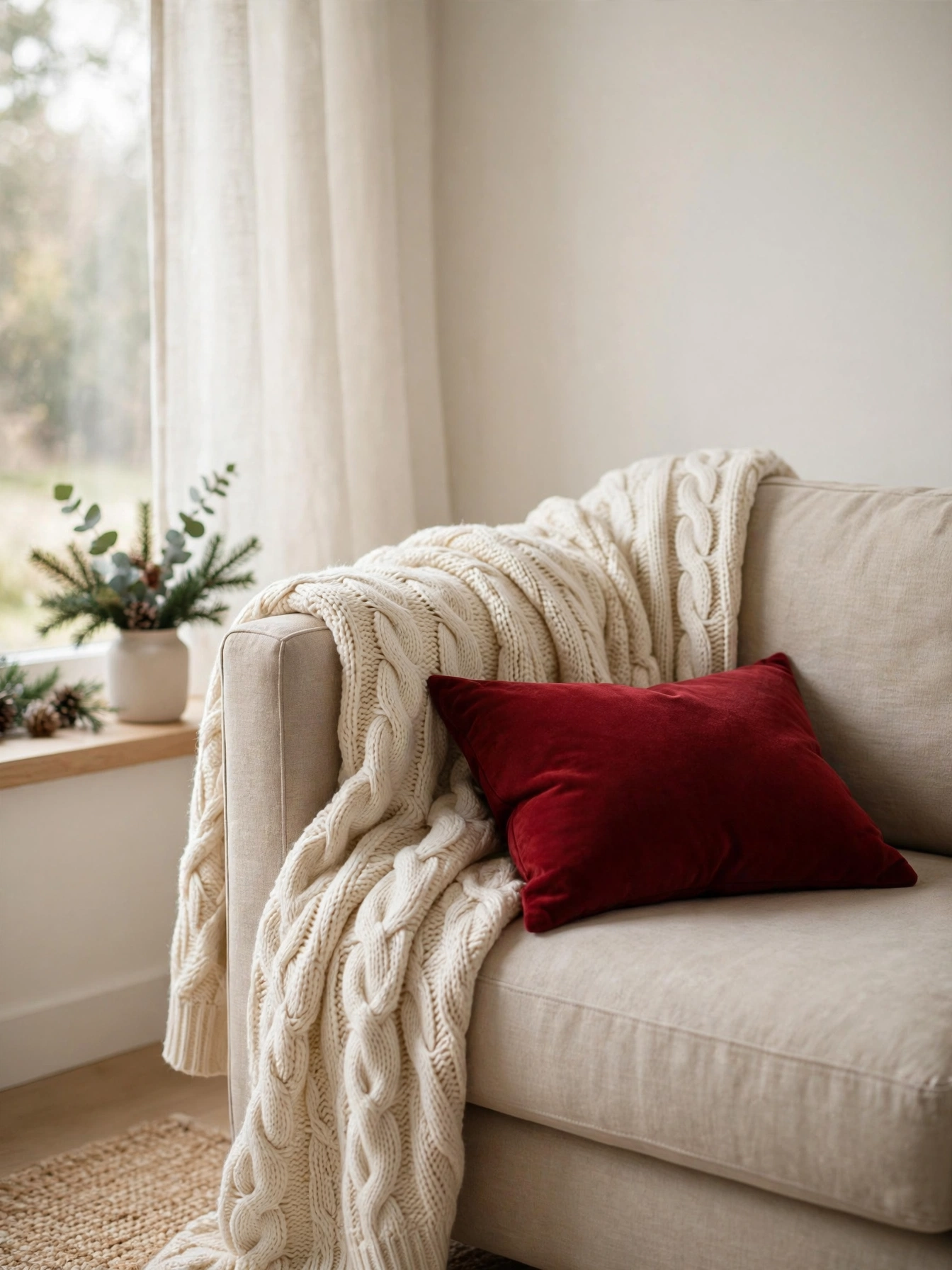
Knit Throw Swap
Why This Works:
- One 50 by 60 inch throw in cream or deep red swaps the whole sofa mood.
- Drapes in 2 minutes, the simplest swap in this guide.
- Costs 25 to 50 dollars, less than a set of holiday pillows.
- Chunky knits add winter texture that works from November through February.
Choose a 50 by 60 inch throw in a chunky cable knit, cotton or acrylic blend, in cream, oatmeal or deep red. Textile pros measure throw weight in GSM; 300 to 400 GSM feels substantial without sliding off the sofa every hour. A standard 3 seat sofa is 84 inches wide, so a 50 inch throw covers one third, which is the classic styling proportion. Avoid throws under 200 GSM, because they wrinkle, slide to the floor daily and look thin in photos. Cotton breathes better for warm houses, while acrylic costs about 30 percent less and sheds less in the wash.
Think of this as the December refresh for the sofa, the reading chair and the foot of the bed. It suits anyone whose everyday throw is a summer color that fights the season. The limitation is upkeep: light cream shows pet hair and needs a lint roller twice a week. A common mistake is draping it flat across the whole back; it looks like a slipcover, so fold it in thirds lengthwise and drape one arm instead.
Pro Tip: Drape the folded throw over one arm, let 18 inches puddle on the seat cushion, then add one solid pillow in front to anchor it visually.
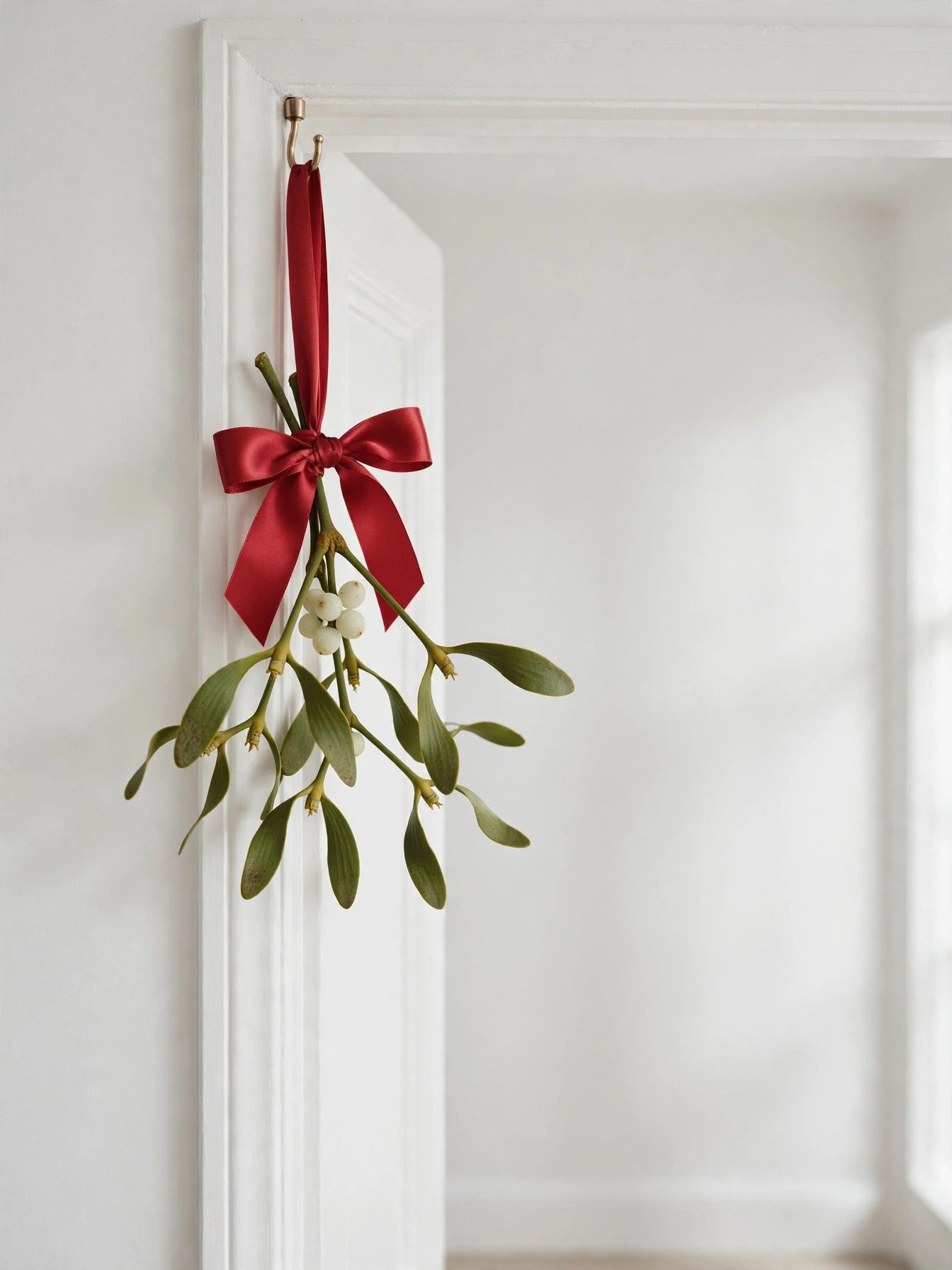
Mistletoe Doorway Sprig
Why This Works:
- One 6 inch mistletoe sprig with a 12 inch ribbon dresses any doorway.
- Hangs in 3 minutes on a small adhesive hook.
- Costs 8 to 15 dollars fresh, 5 to 10 dollars faux.
- Carries the whole Christmas tradition in a single hanging point.
Buy one fresh mistletoe sprig 5 to 7 inches long with white berries, or a faux sprig if kids or pets can reach it. Real mistletoe berries are toxic if eaten, which is why the ASPCA advises keeping it above 6 feet or choosing faux in family homes. Hang it from a 12 inch length of 1 inch ribbon tied in a bow. A standard interior doorway is 80 inches tall, so hang the sprig at 72 to 74 inches, high enough to walk under and low enough to notice. Avoid nailing into the door frame, because a 2 pound rated adhesive hook holds a 3 ounce sprig with zero damage. Fresh mistletoe lasts about 3 weeks indoors before the berries shrivel; faux lasts forever.
It hangs in the doorway between the kitchen and living room, where everyone passes under it during a party. It suits traditionalists who want one nod to old Christmas customs without a theme. The limitation is reach: in a house with toddlers or curious cats, go faux or skip it. A common mistake is hanging it dead center where foreheads meet it; offset it 6 inches to one side of the walkway and nobody ducks.
Pro Tip: Tie the ribbon 4 inches above the sprig so the whole thing hangs 10 inches total, and replace fresh mistletoe after 3 weeks when the berries start to shrivel.
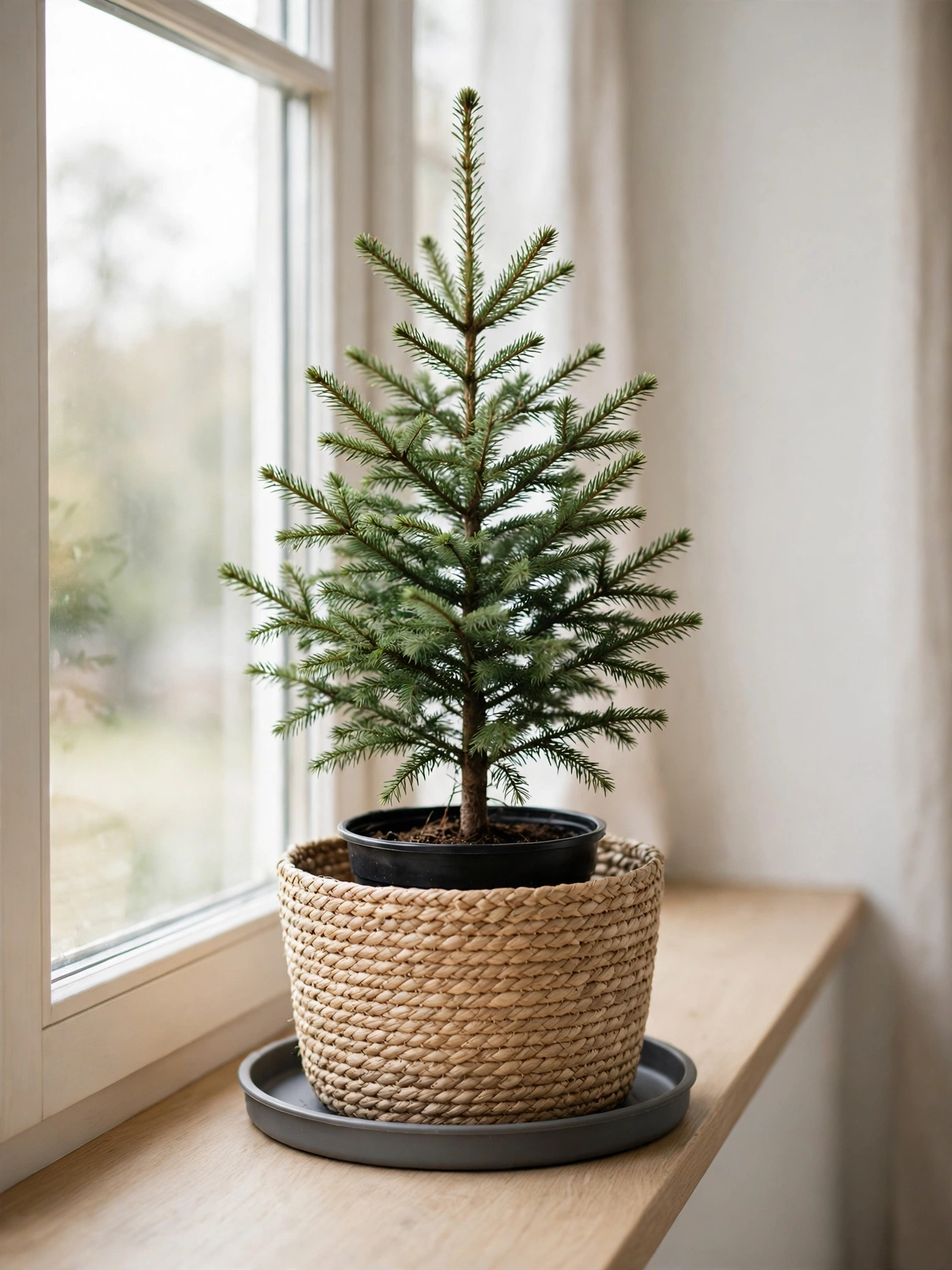
Living Mini Tree
Why This Works:
- A 2 to 3 foot potted spruce in a 10 inch basket needs no ornaments at all.
- Sets up in 5 minutes: tree in basket, done.
- Costs 20 to 40 dollars, and it can be planted or kept after the holidays.
- One living tree scents a 12 by 12 foot room naturally for weeks.
Buy a 2 to 3 foot potted Norway spruce or dwarf Alberta spruce in a 2 gallon nursery pot, and drop the pot inside a 10 to 12 inch woven basket. Arborists recommend keeping indoor live trees below 68 degrees and away from heat vents so they stay dormant through December. Water with 16 ounces every 3 days; the pot should feel light before watering again. Avoid keeping a live tree indoors more than 10 to 14 days, because warm air breaks dormancy and it may not survive replanting in spring. A potted tree weighs 15 to 20 pounds, about triple a cut tree of the same height, so set it where it will stay.
A bright window in the living room or a covered porch is the spot, anywhere it gets light. It suits eco-minded decorators who hate throwing a tree away in January. The limitation is care: it needs water and cool air, unlike a faux tree you ignore. A common mistake is repotting it into a decorative pot with no drainage; keep the nursery pot, hide it in the basket, and water with a tray underneath.
Pro Tip: Set the basket on a 14 inch waterproof tray and water until a quarter inch collects, then empty the tray so the roots never sit wet.
Simple Christmas Decor Ideas 2026 Windows
Why This Works:
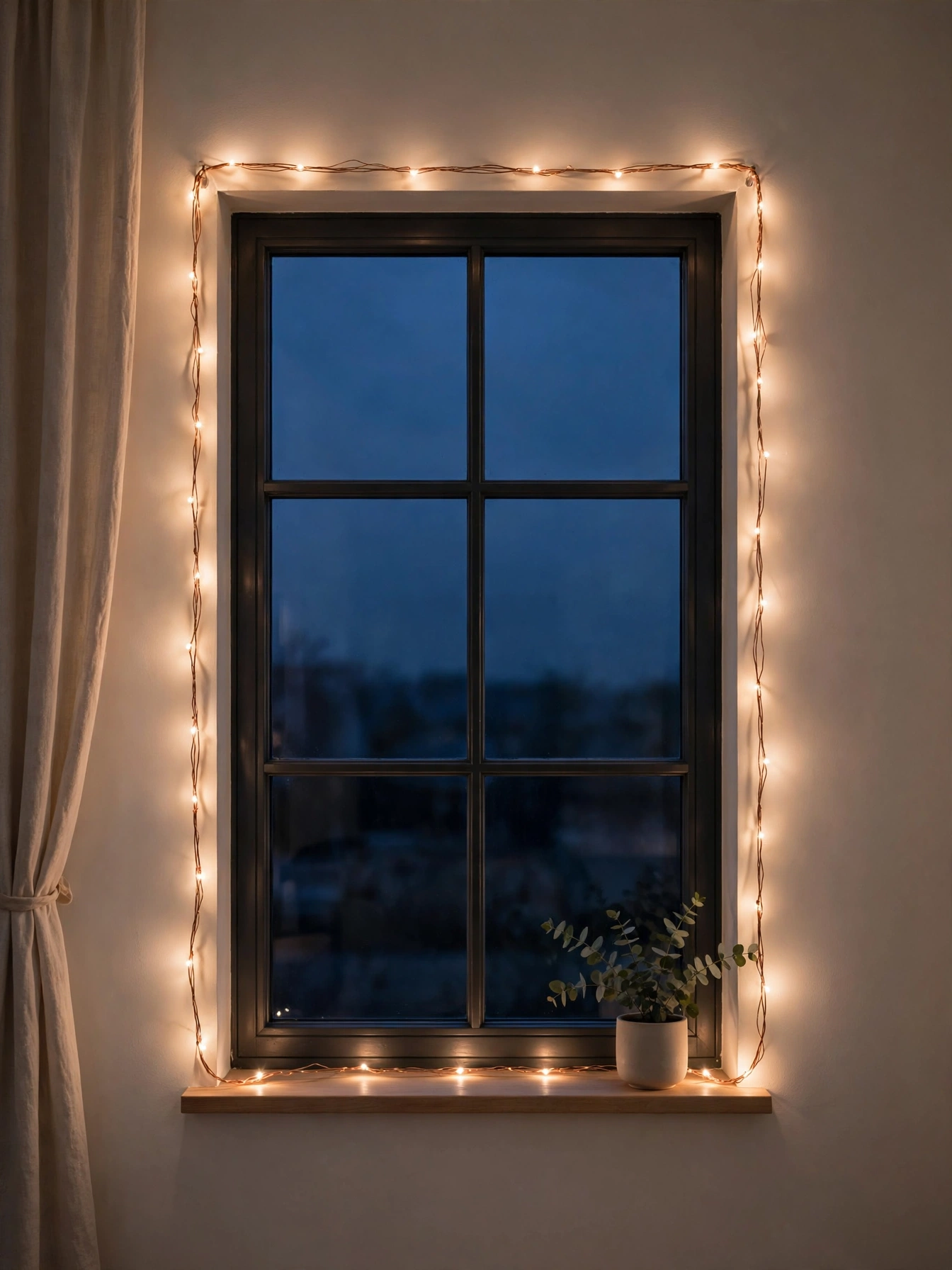
- One 16 foot battery string light outlines a standard 36 by 48 inch window.
- Installs in 10 minutes with 6 adhesive clips.
- Costs 10 to 18 dollars per window.
- Visible from the street, so it decorates the house exterior too.
Use a 16 foot copper-wire string with 50 warm white LEDs at 2,700 Kelvin, powered by 3 AA batteries with a built-in timer. A standard double-hung window is 36 inches wide and 48 inches tall, which needs about 14 feet of lights for a full frame with corners. Lighting designers measure brightness in lumens; 50 micro LEDs give roughly 100 lumens, a soft glow rather than a floodlight. Avoid plug-in strings for windows, because the cord has to cross the sill and most renters cannot drill for it. Copper wire nearly disappears in daylight, while thick rope light stays visible and looks unfinished by day.
Street-facing living room and bedroom windows are the natural fit, where one lit frame reads as decorated from outside. It works in rentals because adhesive clips peel off clean in January. The limitation is battery life: about 72 hours of glow on a timer, so plan two battery changes in December. A common mistake is pressing clips onto dusty trim; wipe the frame first or the clips release within a week.
Pro Tip: Start at the bottom corner, press a clip every 24 inches, and leave 6 inches of slack at each corner so the wire turns without pulling the clips loose.
Star Window Light
Why This Works:
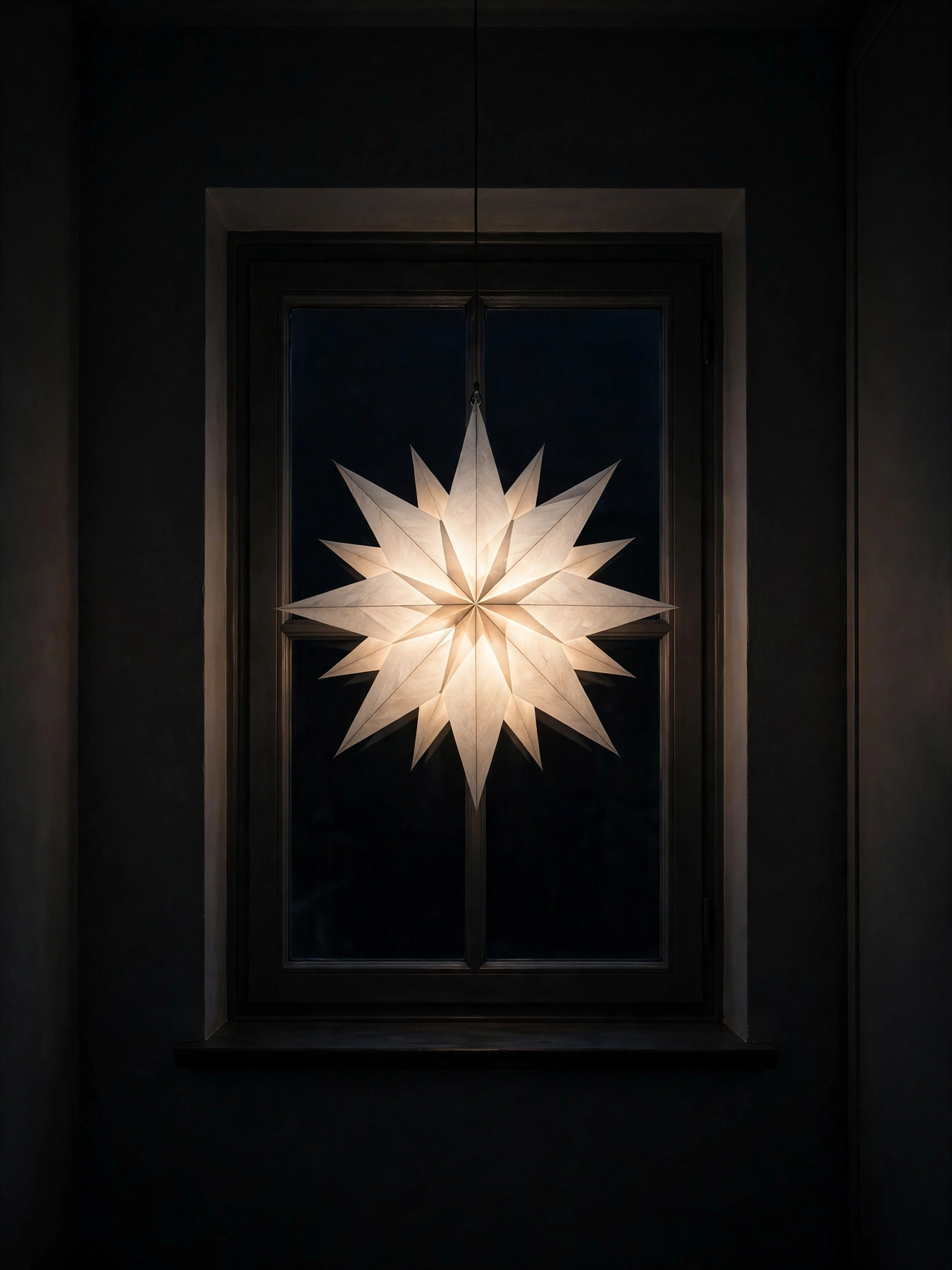
- One 18 inch paper star lantern fills an entire window after dark.
- Hangs in 4 minutes from a suction cup hook.
- Costs 12 to 25 dollars, including the LED bulb.
- One star per window is the classic Scandinavian look, and it never looks cluttered.
Buy an 18 to 24 inch paper star lantern with a battery LED bulb, not a corded one. Scandinavian makers size stars to about half the window width, so 18 inches suits a 36 inch window. Paper stars fold flat to 2 inches for storage, which beats any rigid decoration for small closets. Avoid real candles inside paper stars, because the paper sits about 2 inches from the flame and fire services flag it every December; battery LEDs give the same warm glow. Paper stars cost half what metal frames do and glow more softly, since the paper diffuses the light.
Bedroom and kitchen windows are the place for this, the rooms where a full garland feels like too much. Kids love them, and there is nothing to break. The limitation is fragility: paper tears if handled roughly, so hang it once and leave it. A common mistake is hanging the star flush against the glass, where condensation spots the paper; hang it 3 inches inside the room instead and it stays pristine.
Pro Tip: Hang the star centered in the window at two thirds of the window height, and it will read perfectly from both the street and the sofa.
Neutral Stocking Pair
Why This Works:
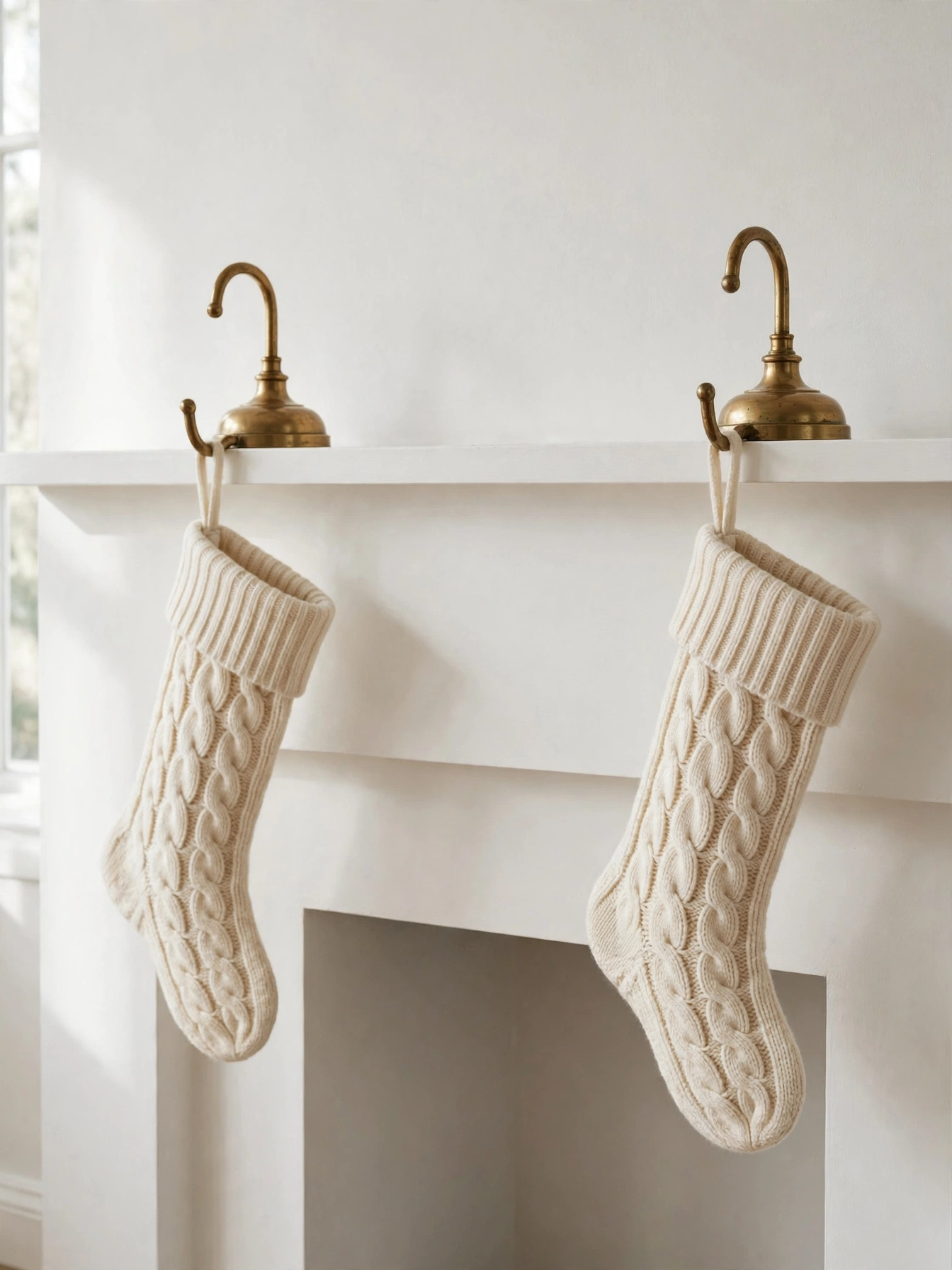
- Two 18 inch stockings in cream knit are all a mantel needs.
- Hang in 5 minutes with weighted holders.
- Costs 15 to 30 dollars for the pair.
- Neutral stockings work with any palette change next year.
Choose 18 inch cable-knit stockings in cream or oatmeal, hung from weighted holders rated for 5 pounds each. Standard stocking holders weigh 2 to 3 pounds and grip a mantel shelf 8 to 10 inches deep without sliding. Space the pair 12 to 16 inches apart so each one reads separately instead of blurring together. Avoid adhesive hooks for filled stockings, because a loaded stocking weighs 2 to 4 pounds and most small hooks are rated for 1. Knit stretches to hold more than felt, and the texture photographs better against a plain mantel.
Couples, small families and anyone whose mantel already holds a garland will get the most from this. Two stockings keep the look calm where six would crowd it. The limitation is obvious: big families need more than two, so this is a style choice for smaller households. A common mistake is hanging stockings from the garland itself; the weight drags the greenery down by Christmas morning, so give them their own holders.
Pro Tip: Stuff the toe of each stocking with tissue paper so it holds its shape all season, and they will look full even before anything goes inside.
Rosemary Table Sprigs
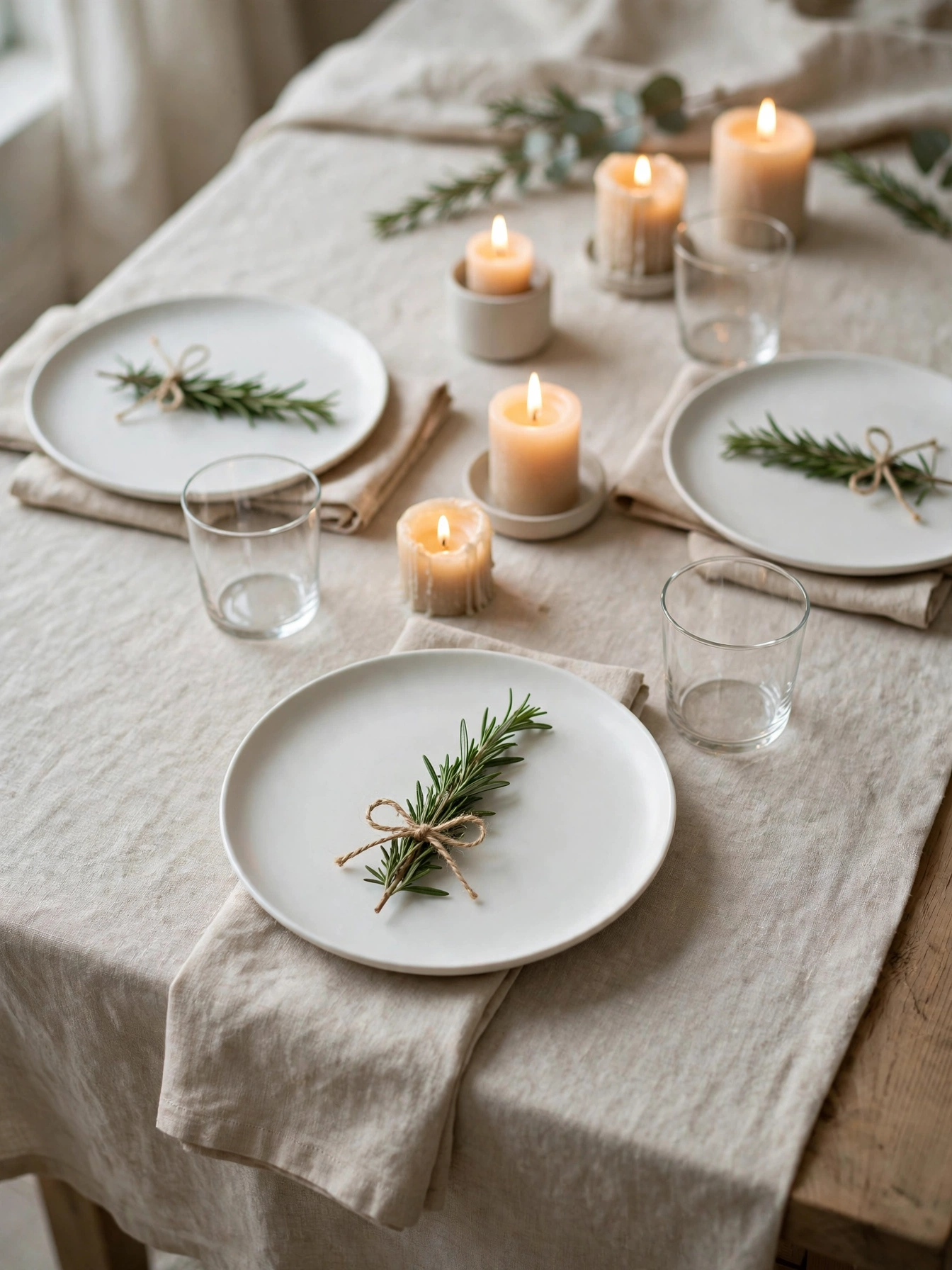
Why This Works:
- One 4 inch rosemary sprig per plate dresses a 6 person table in minutes.
- Lays out in 6 minutes for the whole table.
- A 0.5 ounce grocery clamshell holds 8 to 10 sprigs and costs 3 to 5 dollars.
- Doubles as a fresh herb guests can take home, so nothing is wasted.
Buy fresh rosemary in 0.5 ounce clamshells, each holding 8 to 10 sprigs 4 to 6 inches long, and tie each with 6 inches of kitchen twine. Chefs grade rosemary by stem woodiness; supple green stems under a quarter inch thick stay fresh on the table for 48 hours. A standard dinner plate is 10 to 11 inches, so a 5 inch sprig laid diagonally fits with room to spare. Avoid dried rosemary for place settings, because it crumbles at the first touch and sheds needles into the food. Fresh sprigs cost about the same as paper place cards and smell infinitely better.
It dresses the Christmas dinner table without a centerpiece that blocks conversation. It suits hosts who want the table to feel special but keep sightlines open. The limitation is timing: sprigs wilt after about 2 days, so lay them out the day of the dinner. A common mistake is tying the twine too tight; it bruises the stems and the rosemary smell turns sharp, so keep the bow loose.
Pro Tip: Lay each sprig across the plate at a 45 degree angle with the twine bow on top, and mist them lightly 1 hour before guests arrive.
Bare Branch Ornaments
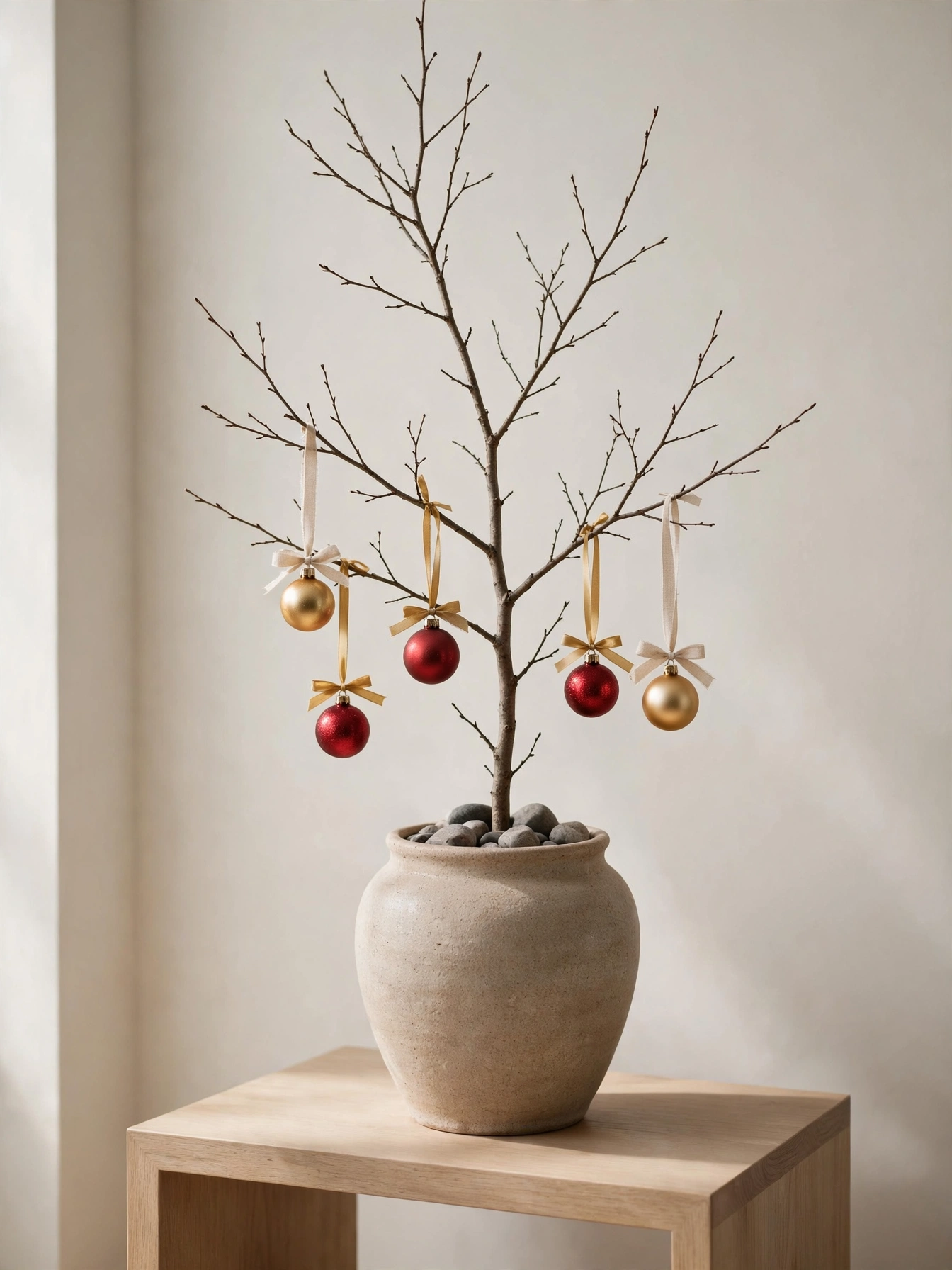
Why This Works:
- One 36 inch bare branch with 5 ornaments makes a sculptural side table piece.
- Assembles in 7 minutes with ornaments you already own.
- Costs 0 to 10 dollars for the branch plus existing ornaments.
- The negative space is the design; it suits modern rooms better than a full tree.
Cut or buy one bare branch 30 to 40 inches tall with 3 to 5 side twigs, and stand it in a heavy vase at least 8 inches tall filled with 2 pounds of stones. The general floral rule is that an arrangement should stand about 1.5 times the vase height, so a 36 inch branch suits an 8 to 10 inch vase. Hang 5 shatterproof ornaments 2 to 3 inches wide from the twigs with 4 inch ribbon loops. Avoid glass ornaments on a top-heavy branch, because one bump tips the vase and glass shards on hardwood are a miserable cleanup; shatterproof ornaments bounce. Manzanita branches cost 15 to 25 dollars and look sculptural, but a free yard branch works just as well.
Side tables, console tops and office desks are its home, anywhere a tree would overwhelm. It suits modern and minimalist rooms where a full tree feels visually heavy. The limitation is taste: traditional decorators may read it as unfinished rather than intentional. A common mistake is overloading the branch; past 7 ornaments it stops looking minimal, so cap it at 5 and let the empty twigs breathe.
Pro Tip: Hang the largest ornament lowest and closest to the trunk, and the smallest at the top twig tips, so the branch stays balanced and never looks top heavy.
FAQs
What are the best simple christmas decor ideas 2026 for a busy schedule?
The best simple christmas decor ideas 2026 use one focal point per surface, like a single wreath or candle cluster. Odd-numbered groupings look intentional, so style in threes. Every idea here takes under 15 minutes, though fresh greenery needs replacing after about 2 weeks.
How much should I budget for simple Christmas decorating?
A full simple look costs 20 to 60 dollars per room, since one wreath or candle cluster carries the space. Faux pieces cost more upfront but last 5 seasons, while fresh greenery runs 12 to 35 dollars each year. Prices vary by store, so compare two sources before buying.
Can simple christmas decor ideas 2026 work in a small apartment?
Yes, small spaces suit simple christmas decor ideas 2026 best, since one 4 foot tree or a single window light fills a studio without crowding it. Keep floor pieces inside a 3 foot circle. Measure first, because a 7 foot tree overwhelms rooms under 150 square feet.
Are real or faux greens better for simple Christmas decorating?
Real greens win on scent and cost 12 to 25 dollars per garland, but dry out in 2 to 3 weeks near heat. Faux greens cost 25 to 60 dollars and last 5 seasons with zero watering. Your tolerance for sweeping needles decides it, since real cedar sheds daily.
When should I start putting up simple Christmas decor?
Most households decorate the weekend after Thanksgiving, which gives fresh greens 4 weeks before they fade. Battery lights run about 72 hours on a timer, so start those December 1 to avoid mid-month battery swaps. Your climate matters too, since fresh garlands last longer in cool rooms under 68 degrees.
Conclusion
Simple Christmas decorating comes down to three takeaways. First, restraint beats accumulation: one strand, one wreath, one candle cluster. Second, natural materials like cedar, pinecones and dried oranges cost less and age better than novelty pieces. Third, the 15-minute rule keeps it joyful instead of exhausting. These simple christmas decor ideas 2026 work because each one respects your time and your space. Your first action is easy: pick the one idea that fits the room you see most, and set it up tonight in 15 minutes. Follow HomelyCrafter on Pinterest for more ideas. Save this to your Pinterest boards so you can refer back to it!

Muhammad Israr is a home decor enthusiast and the writer behind Homely Crafter. He spends his days researching paint colors, layouts and budget-friendly styling ideas, then breaks them down into practical, easy-to-follow guides so you can decorate with confidence.