
Most December decorating advice tells you to fight the darkness with more white light. Moody Christmas decor takes the opposite route. It leans into the season’s long evenings with deep wall colors, candlelight, and shadow, and the result feels like a lodge library rather than a showroom. These moody Christmas decor ideas 2026 show how to build that atmosphere room by room, with exact measurements, real material names, and honest trade-offs. Deep, dramatic rooms have become one of the defining looks of recent holiday seasons, and the logic holds up: dark backdrops make every warm light source read twice as bright.
Inside: 22 complete ideas, each one measured, with material picks, pitfalls to dodge, and one specific pro tip. Nothing here needs a full room repaint to work. A single dark accent wall, a tray of black candles, or one emerald tree corner can shift a whole living room toward moody without turning it gloomy.
Read straight through or jump to the room that needs the most help. Every idea stands alone, so you can start with one corner tonight and add the rest across the weekend.
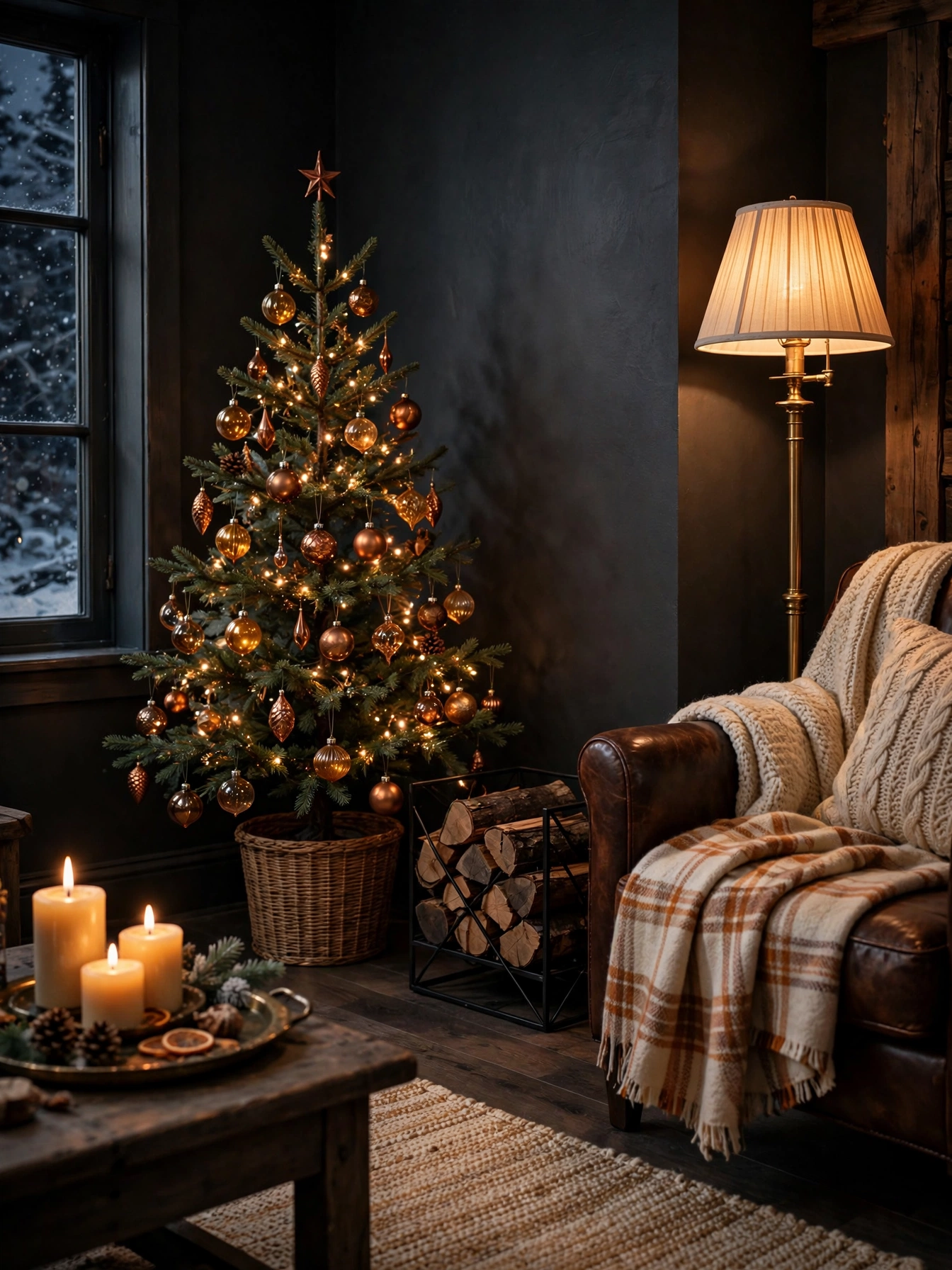
Charcoal Wall Glow
Why This Works:
- A charcoal wall behind the tree doubles the perceived brightness of warm lights against the dark surface
- Amber and copper ornaments at 2.5 to 4 inches read as candlelight reflections, not flat color
- One 8 by 10 foot accent wall costs about 1 gallon of matte paint and a single afternoon
- Leather and wool textures keep the dark corner warm instead of cold or cave-like
Paint one wall in a flat or eggshell charcoal (Benjamin Moore Kendall Charcoal or a similar deep gray) and keep the other three walls light so the room still breathes. A 6-foot tree in front of an 8-foot-wide accent wall leaves roughly 12 inches of dark border on each side, which frames the tree like artwork. Hang warm white LED strings at 2700K, 100 lights per foot of tree height, and skip cool white entirely because 5000K turns charcoal walls blue-gray. Avoid glossy paint on the accent wall: satin and gloss reflect the tree lights in streaks, while flat paint absorbs them and lets the ornaments glow.
A charcoal corner suits anyone whose living room already gets little winter sun, since it stops pretending the room is bright and starts using the darkness. The trade-off is dust: dark walls show every speck, so run a microfiber duster over the wall weekly and keep the tree 6 inches off the surface. If repainting feels like too much, a 9 by 12 foot charcoal fabric panel hung from two 3M hooks gives the same backdrop for about $40 and comes down in January with no patching.
Pro Tip: Place a brass tray with three pillar candles (3, 4, and 6 inches tall) 18 inches in front of the wall. The reflected candlelight adds a second warm layer that string lights alone cannot produce.
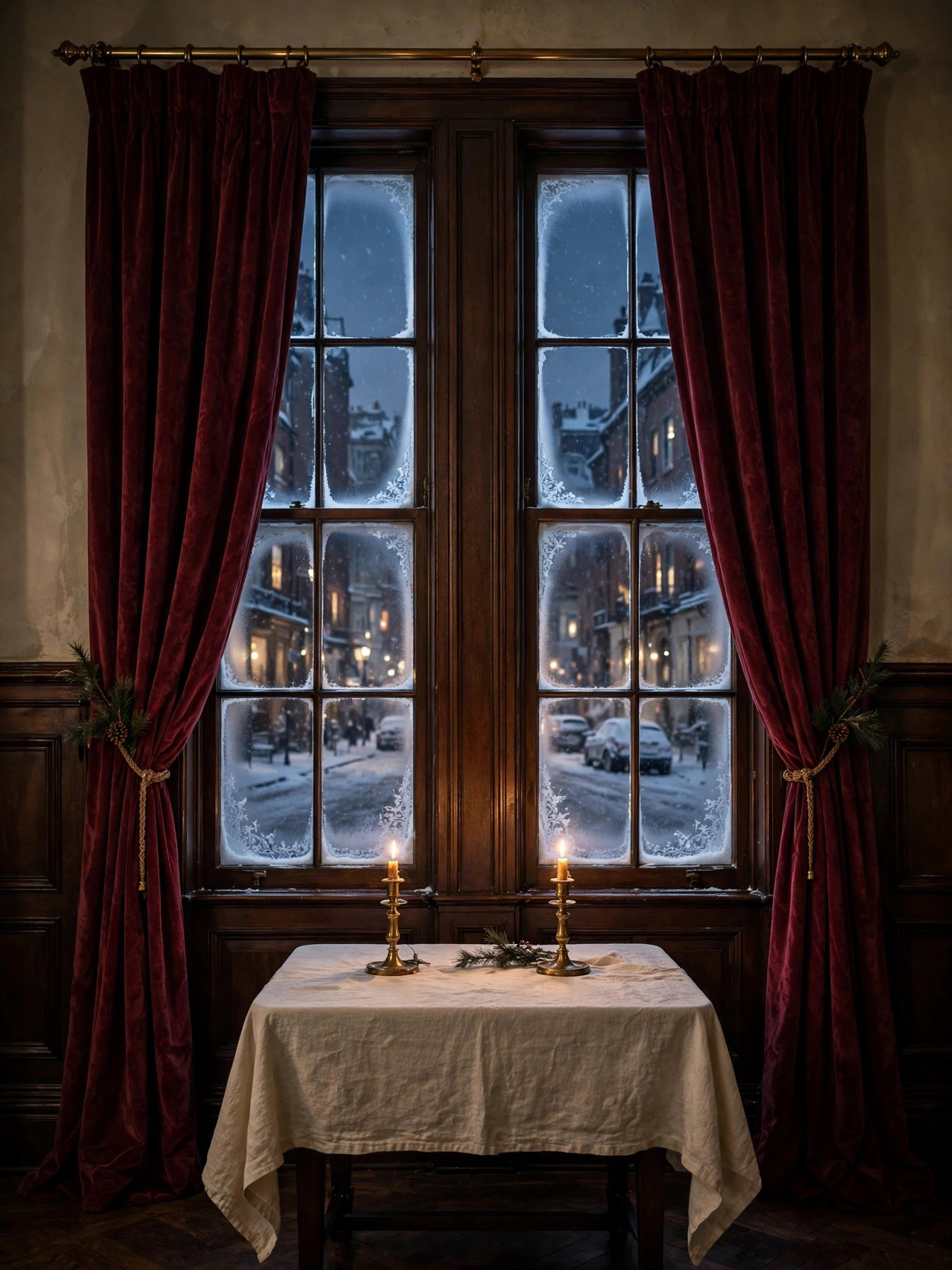
Burgundy Velvet Drapes
Why This Works:
- Velvet at 2.5 times the window width hangs in deep folds that swallow daylight and deepen the room
- Burgundy pairs with brass and cream without the candy-cane contrast of brighter reds
- Thermal velvet panels cut window drafts, a real benefit on single-pane windows in December
- One pair of 96-inch panels dresses a standard 60-inch window for about $90 to $140
Mount the rod 4 to 6 inches above the window frame and 6 to 8 inches wider than the frame on each side so the panels stack on the wall, not over the glass. For a 60-inch window, two 50-inch-wide panels give the full 2.5-times fullness ratio without looking flat. Choose cotton velvet over polyester when you can: cotton falls in heavier folds and holds a pressed crease better, while polyester can shine under lamps. Keep the hem 0.5 inch above the floor for easy vacuuming and to avoid wicking up melted snow from boots.
Heavy drapes work best in rooms where you want evening privacy and a theater feel, and they earn their keep on drafty windows where a thermal lining cuts the cold radiating off the glass. The downside is weight: a pair of lined velvet panels can weigh 8 to 12 pounds, so use a 1-inch-diameter rod with center support for any span over 48 inches. In a rental, tension rods fail under that weight; use two adhesive hooks rated for 7 pounds each per side instead, and test them for 24 hours before hanging.
Pro Tip: Tuck a single 12-inch pine sprig behind each tieback. The greenery breaks the solid burgundy field and adds scent without a single ornament.
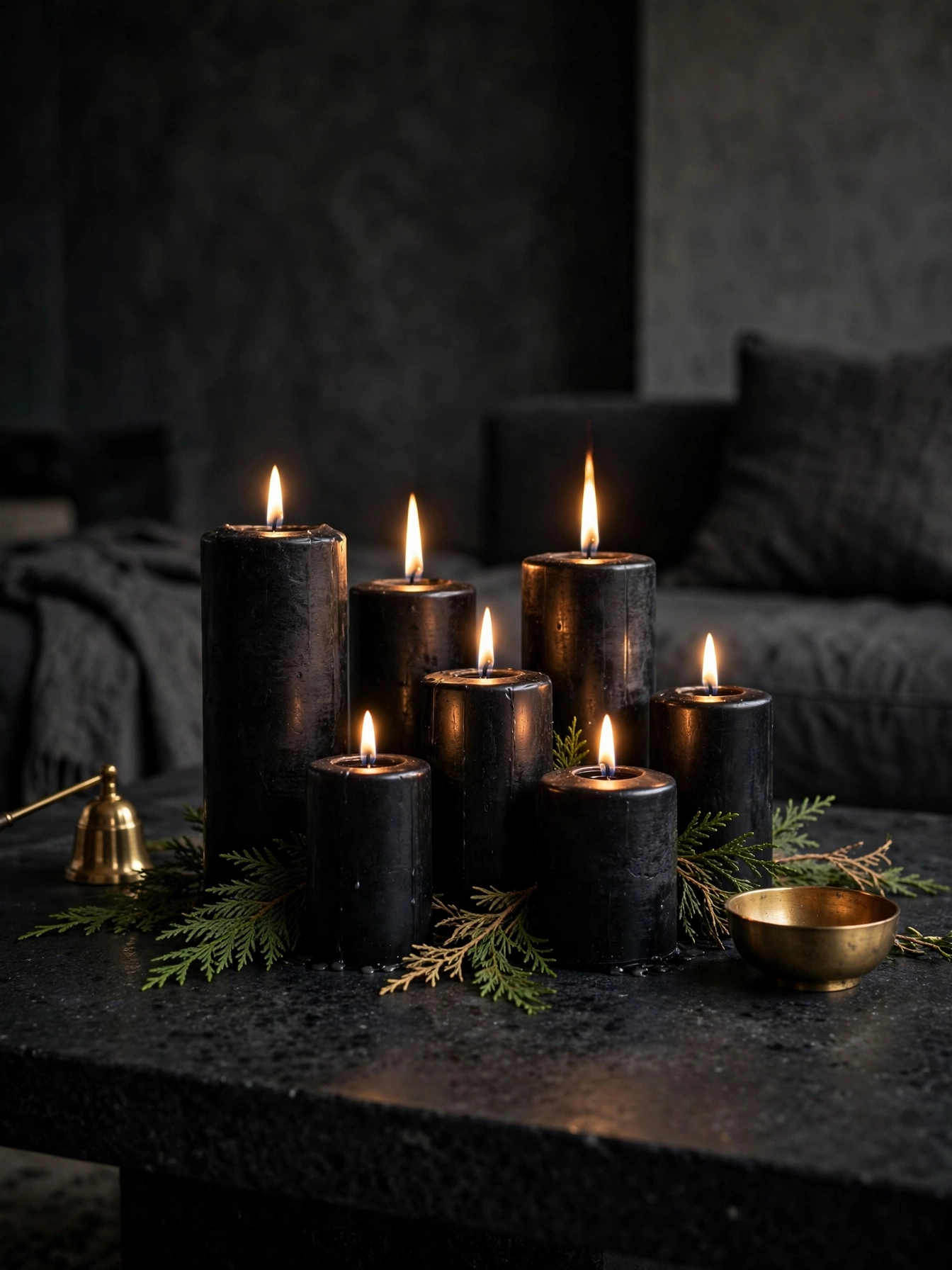
Black Candle Cluster
Why This Works:
- Black pillars disappear into a dark room, so only the flames and cedar shapes read
- Odd-numbered groups (5 or 7 candles) look gathered rather than staged
- Soy wax burns 30 to 50 percent longer than paraffin at the same diameter
- A 12 by 18 inch stone tray contains drips and satisfies fire-safety spacing rules
Build the cluster on a non-flammable tray at least 12 by 18 inches, with 3-inch pillars at heights of 3, 4, 6, and 8 inches so the flames sit at staggered levels. Leave 2 inches between each candle so the wax pools do not merge and the flames do not lean toward each other. Choose unscented or cedar-scented soy pillars: strong fragrance oils compete with real greenery and can trigger headaches in small rooms. Never place a cluster within 12 inches of curtains, books, or dried florals, and trim every wick to 0.25 inch before lighting to keep flames under 1.5 inches tall.
Candle clusters suit rooms where the overhead light feels too harsh after dark, because five small flames give enough light to read a menu or pour a drink without flooding the space. The limitation is maintenance: pillars need a weekly wipe to remove dust, and a draft from a door will make one flame smoke. If you have pets or small children, swap real pillars for flameless LED versions with a flicker mode; the black wax shell looks nearly identical at 6 feet, and candles remain a leading December fire risk.
Pro Tip: Light the tallest candle first and the shortest last. The staggered start times keep the wax pools even and prevent the cluster from melting into a single sheet.
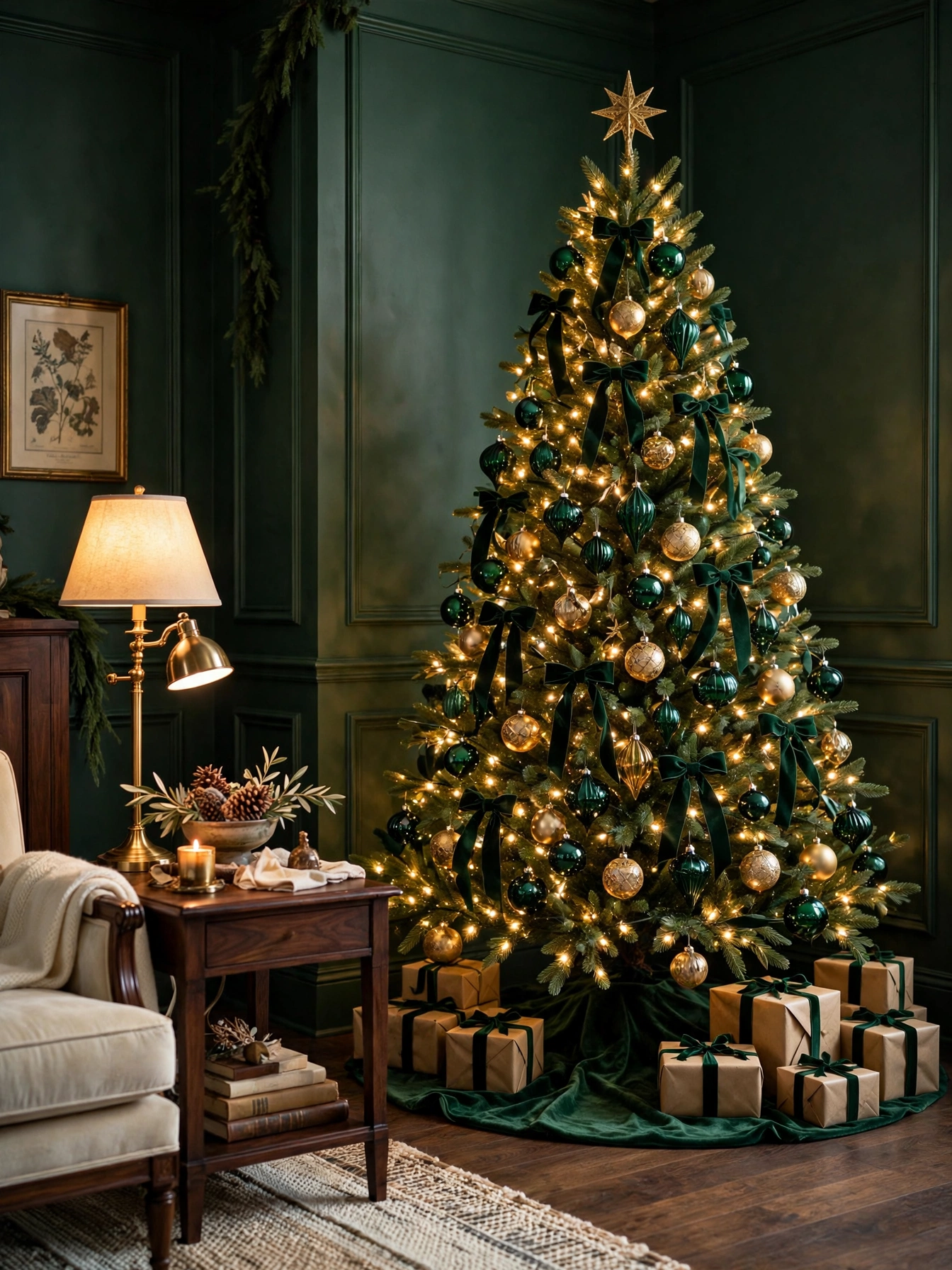
Moody Christmas Decor Ideas 2026: Emerald Tree Corner
Why This Works:
- Emerald ornaments on a green tree create tone-on-tone depth instead of a flat color block
- Gold accents at 20 percent of the ornament mix stop the tree from reading as all-green
- A 7-foot tree in a corner needs only a 4 by 4 foot footprint with a 6-foot clearance to seating
- Kraft wrapping with green ribbon costs about $12 for 10 gifts and matches the palette
Wrap the tree with 700 warm white mini lights (100 per foot) before adding ornaments, working from the trunk outward so the glow sits inside the branches. Mix ornament sizes deliberately: 60 percent at 3 inches, 25 percent at 4 inches, and 15 percent oversized 5-inch pieces near the base for weight. Velvet ribbon garland in a 2.5-inch width, tucked in loose S-curves rather than wrapped in rings, reads as fabric rather than tinsel. Avoid red entirely in this palette; a single red ornament pulls the eye and breaks the emerald-gold spell, so keep berry tones to deep burgundy if you want a third color.
An emerald corner works in rooms that already carry green (plants, a green sofa, walnut wood) because the tree extends a palette the room already owns. The honest trade-off is brightness: emerald absorbs light, so the tree needs the full 700-light count plus one nearby lamp or it looks dim at 7 PM. For a real tree, water daily and keep it 3 feet from any heat vent; a dry tree in a dark corner is a fire risk that no color scheme justifies.
Pro Tip: Hang 10 to 12 ornaments on the inner branches near the trunk. Interior ornaments catch the lights and make the tree glow from within instead of looking decorated only on the surface.
Plum Ornament Layers
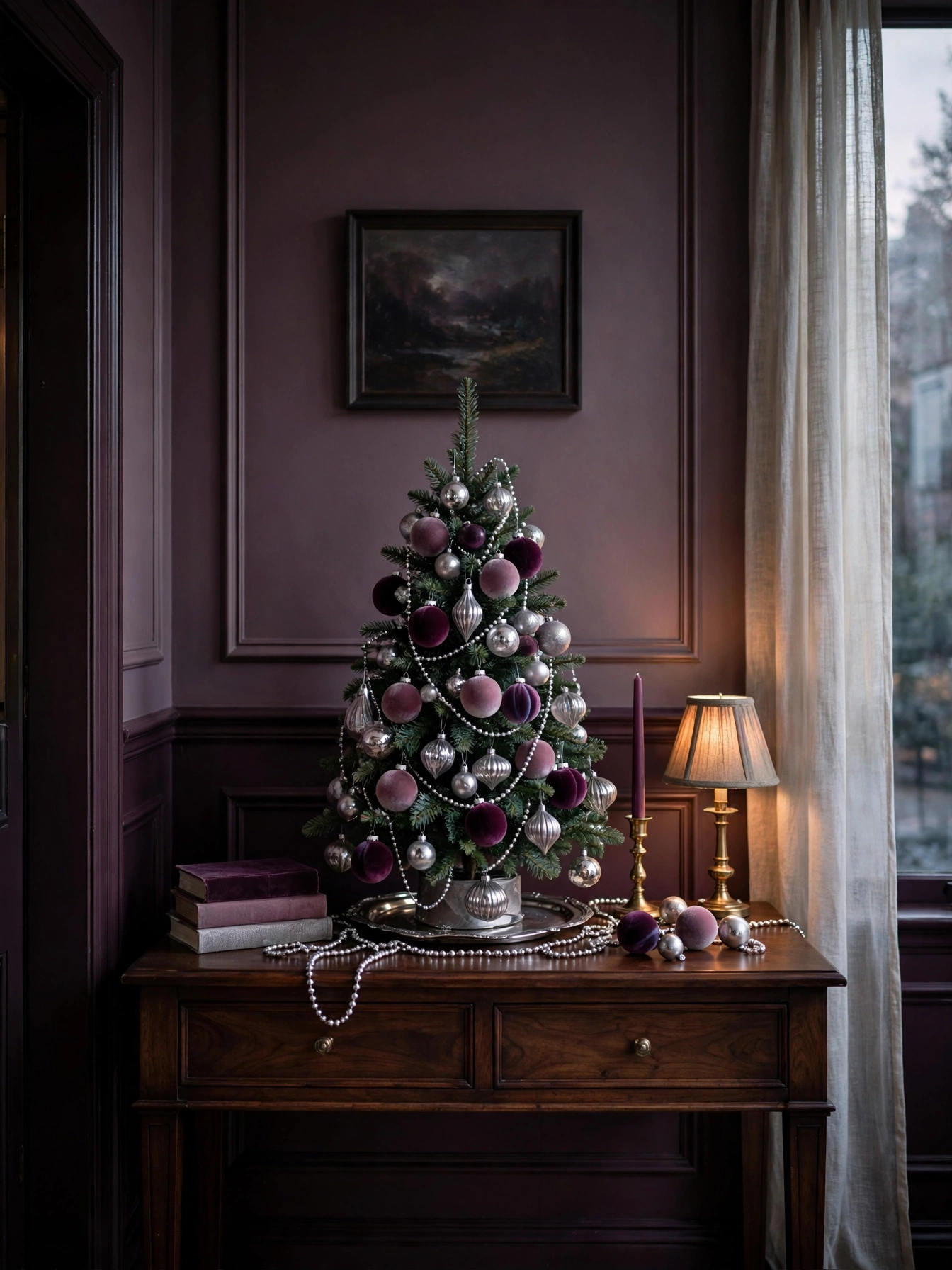
Why This Works:
- Plum sits between purple and red, so it reads as seasonal without matching any sports team
- Matte, shiny, and velvet finishes in a 50/30/20 split give the tree dimension at arm’s length
- A 3-foot tabletop tree needs only 24 inches of console depth and about 40 ornaments
- Silver bead garland at $8 to $12 a strand adds metallic rhythm for almost nothing
Start with the largest ornaments (4-inch) at the bottom third of the tree, then graduate to 2.5-inch pieces at the top so the eye travels upward naturally. Drape one strand of silver beads in a loose zigzag rather than a spiral: the zigzag catches window light in short segments instead of one long glint. Place the tree on a silver tray 2 inches larger than its base to catch dropped needles and give the display a finished edge. Skip plastic ornaments here; on a small tree, glass and velvet finishes show at close range, and acrylic looks cheap under a lamp.
A plum tabletop tree fits entryways, bedrooms, and offices where a full tree would swallow the room, and it gives guests a styled moment within 3 seconds of walking in. The limitation is scale: tabletop trees dry out faster than full trees, so a real 3-foot tree needs water every other day and a spot 3 feet from any radiator. If the console wobbles when the door slams, anchor the tree with a 2-pound sandbag inside the pot, hidden under the tray.
Pro Tip: Put the velvet ornaments on the outer branch tips only. Velvet fades fastest in direct light, and the outer tips are the easiest spots to rotate or swap mid-season.
Smoked Glass Vases
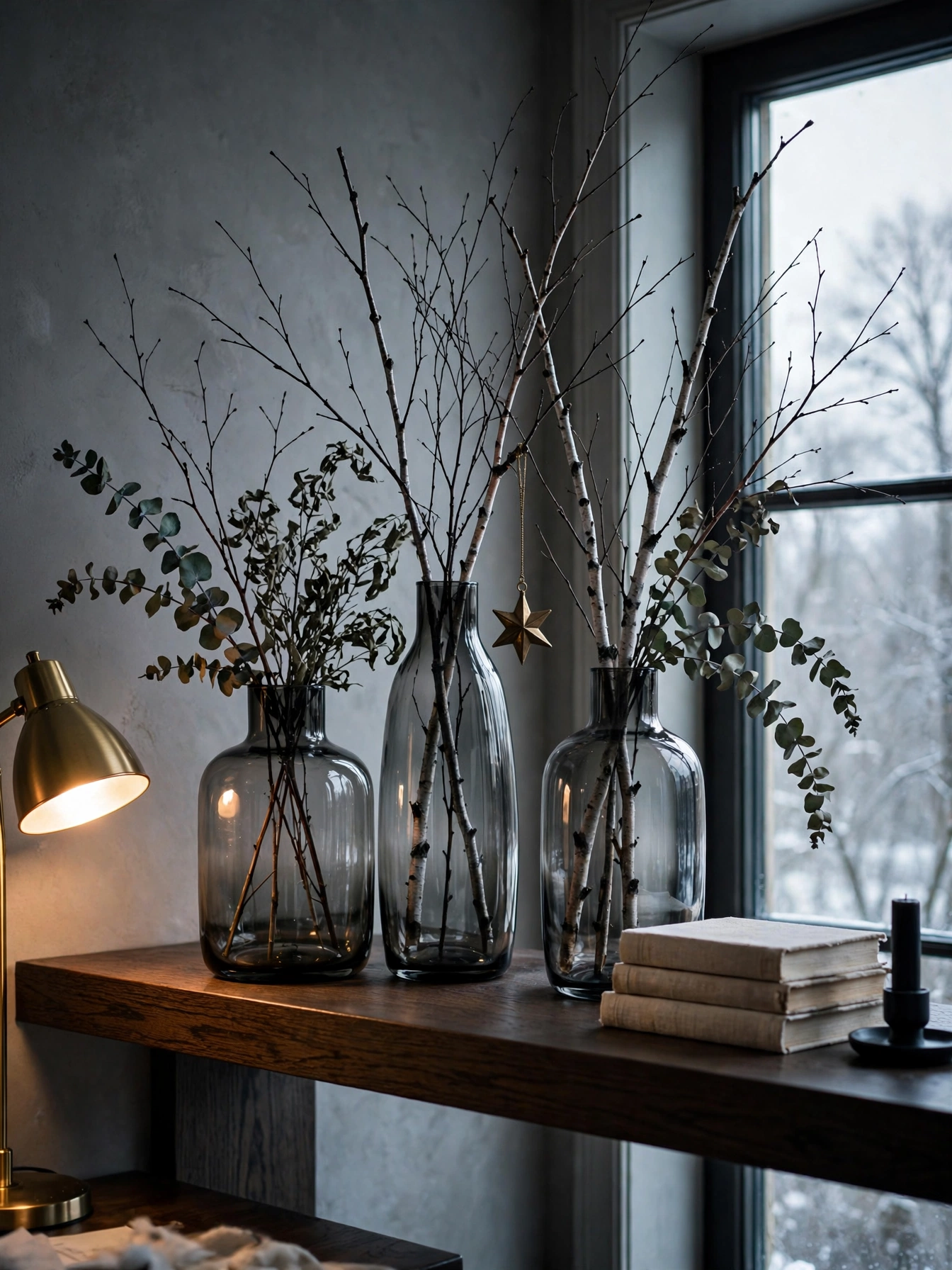
Why This Works:
- Smoked glass hides stems and water lines, so dried arrangements look clean for weeks
- Bare branches cost nothing from the yard and read as sculpture against a dark shelf
- Three vases at 8, 11, and 14 inches tall create a natural stair-step silhouette
- Dried eucalyptus keeps its shape for 6 to 8 weeks with zero watering
Cut branches to 1.5 times the vase height so the arrangement reads as tall, not stubby: a 14-inch vase takes a 21-inch branch. Strip any leaves below the waterline on fresh cuts, and switch to dried stems once the shelf is set, because standing water in smoked glass grows cloudy within a week. Arrange the vases as a tight triangle, 2 inches apart, tallest at the back, so they read as one arrangement. Avoid filling all three with the same branch; one eucalyptus, one bare birch, and one pine stem gives the eye three textures to compare.
Smoked-glass arrangements suit shelves and sideboards where a full garland would overwhelm the surface, and they survive the whole season with no maintenance. The downside is fragility: a 14-inch glass vase on a shelf edge is one elbow away from the floor, so keep vases 4 inches back from the shelf front and use museum putty under the base. If you have cats, skip bare branches at tail height; a single swat can scatter glass, so place the grouping above 48 inches.
Pro Tip: Hang one 2-inch brass ornament from the tallest branch with a 6-inch ribbon. A single ornament says Christmas; a dozen on bare branches says craft fair.
Brass Lantern Row
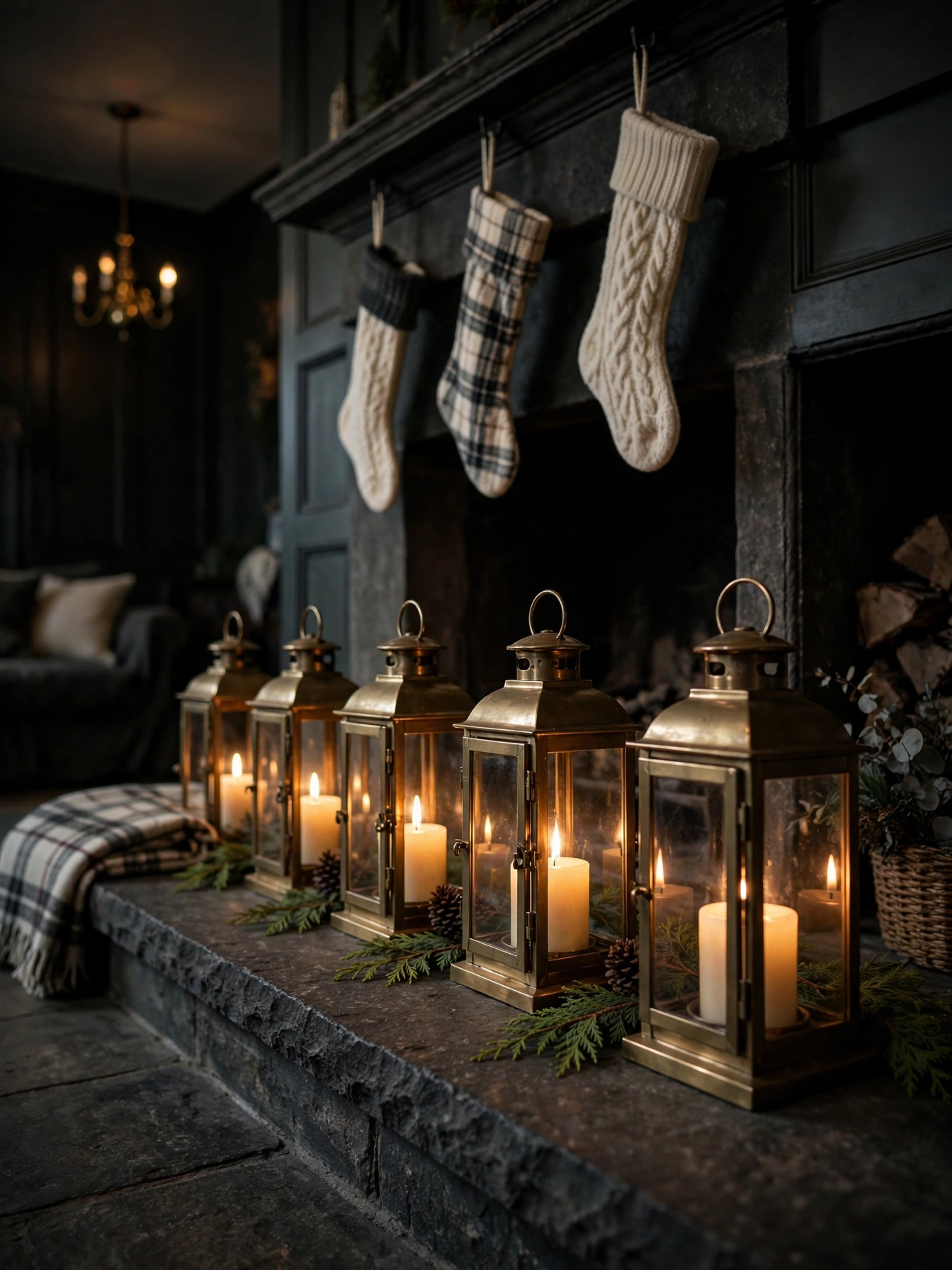
Why This Works:
- Brass lanterns throw patterned light through their glass panels, doubling the glow per candle
- A row of 3 or 5 lanterns at graduated heights (10, 13, 16 inches) reads as intentional, not cluttered
- Glass panels block drafts, so flames stay steady near doors and fireplaces
- Solid brass lanterns at $25 to $45 each last for decades and polish back to new
Space lanterns 8 to 10 inches apart along the hearth so each pool of light stays separate and the row reads as a rhythm rather than a wall. Use 3-inch-diameter pillars inside 4-inch-wide lanterns, leaving 0.5 inch of air on each side so the glass never heats enough to crack. Keep the lantern doors latched; an unlatched panel swings in a draft and can tip a lit candle. Place the tallest lantern at the center or at one end, never in the middle of a doorway path, and keep every lantern 12 inches from the fireplace opening.
A lantern row suits hearths, console tops, and stair landings where open candles feel risky, because the glass barrier satisfies the safety question while keeping real flame. The trade-off is cleaning: brass tarnishes in humid rooms, so a monthly wipe with a brass cloth keeps the shine, and soot from the candle builds on the glass after about 20 hours of burning. If you burn them nightly, budget 10 minutes weekly to wash the glass panels in warm soapy water.
Pro Tip: Tuck one 8-inch cedar sprig behind each lantern, not in front. Sprigs behind the glass read as greenery through the glow instead of blocking the flame.
Midnight Garland Swag

Why This Works:
- Dark pine garland on a dark door frame creates a tone-on-tone frame that guests notice at second glance
- Black ribbon at 1.5 inches wide reads as tailored, while thin ribbon disappears on dark wood
- A 9-foot garland swagged with a 12-inch drop fits a standard 80-inch door frame with two hooks
- Deep red berries at 0.5 inch diameter give the only bright note, so they carry the whole display
Hang the garland with two adhesive hooks rated for 3 pounds each, placed 6 inches inside the frame corners, and let the center dip 12 to 14 inches below the top of the frame. Wire the black ribbon into the garland every 18 inches with floral wire so it stays put when the door slams. Cluster berries in groups of 3 to 5 rather than scattering singles: clusters read as intentional fruit, singles read as mistakes. If the garland is fresh pine, mist it every 3 days and keep it 24 inches from any heating vent so the needles hold for 3 weeks.
A midnight swag suits doorways that already carry dark trim, black doors, or walnut frames, because the garland extends the architecture instead of fighting it. The limitation is weight: a 9-foot fresh garland with ribbon and bells weighs 4 to 6 pounds, so test the hooks for 24 hours with a bag of flour before hanging. In a high-traffic doorway, pin the ribbon tails to the frame with two small pins so they do not catch on coats and bags.
Pro Tip: Hang a single brass bell at the swag center with a 4-inch ribbon. One bell rings softly when the door moves; three bells sound like a shop door.
Moody Christmas Decor Ideas 2026: Pewter Stocking Line
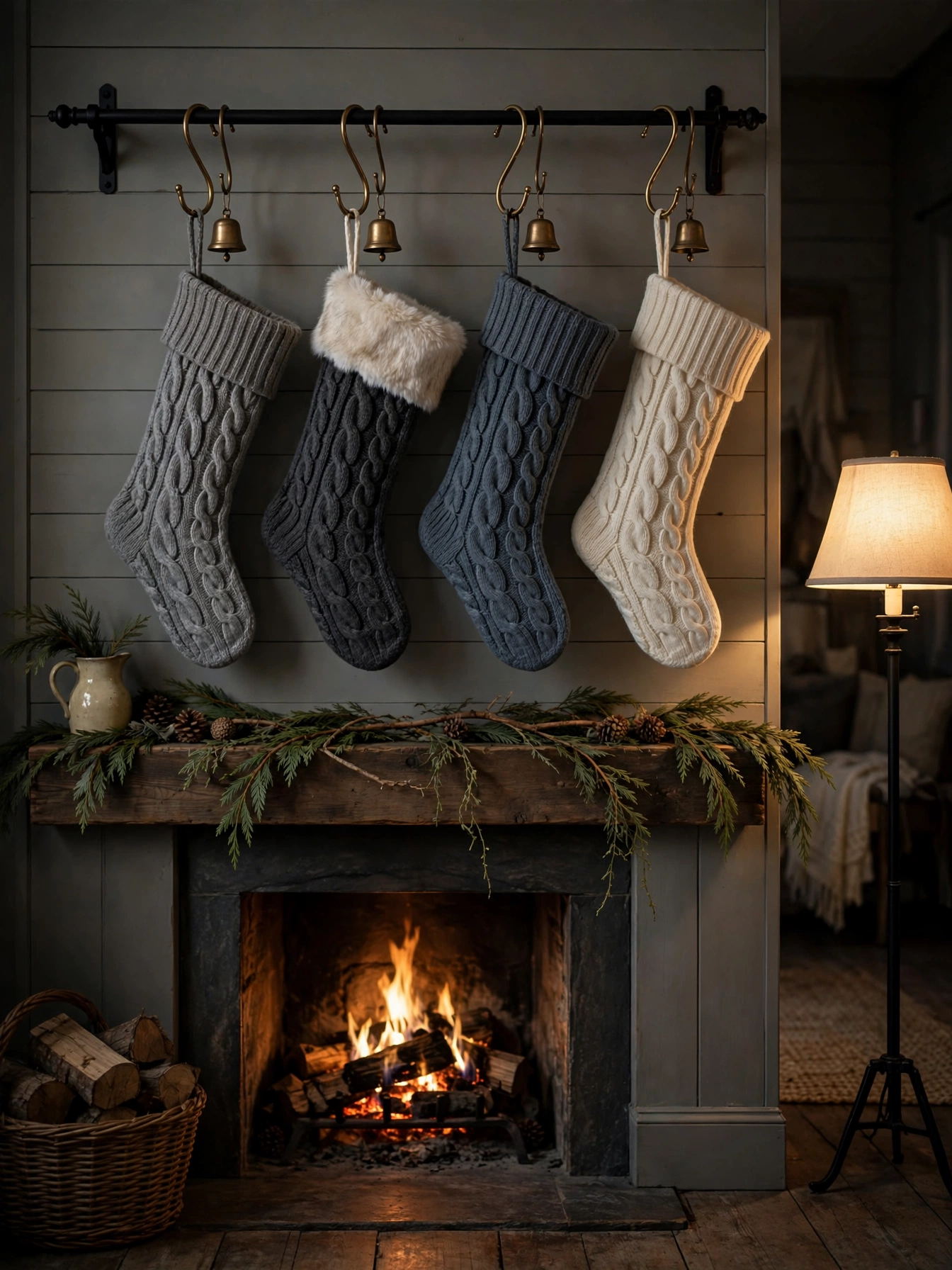
Why This Works:
- Pewter and slate stockings keep the mantel palette calm while cream cuffs add contrast
- Brass S-hooks at 3 inches hold 5 pounds each, enough for a stuffed stocking
- A black iron rail screwed into studs carries 4 stockings without sagging or tipping
- Cable-knit wool at 18 to 20 inches long fits gifts without stretching the cuff
Mount the rail 2 inches below the mantel shelf lip, into wall studs, using 2.5-inch screws so a loaded stocking cannot pull it free. Space hooks 10 to 12 inches apart so the stockings hang straight instead of bunching. Keep the stocking tops 6 inches below the mantel shelf so the garland above does not tangle with the cuffs. Choose stockings with a knit cuff rather than a sewn one; knit cuffs grip the hook and do not slip when a child tugs. Avoid hanging stockings from an unsecured garland: a 5-pound stocking will drag a light garland down by Christmas morning.
A pewter stocking line works on mantels that already carry dark or metal finishes, because the stockings read as part of the architecture. The trade-off is visibility: pewter stockings vanish against a black fireplace at night, so add one brass bell or cream cuff per stocking to keep them legible after dark. If you have no mantel, a 36-inch iron rail on a bookshelf or a heavy console works the same way, as long as it anchors into studs.
Pro Tip: Stuff each stocking with one tissue-paper ball in October to set the shape. Stockings that hang empty for two months stretch at the heel and look tired by Christmas Eve.
Forest Green Tablescape
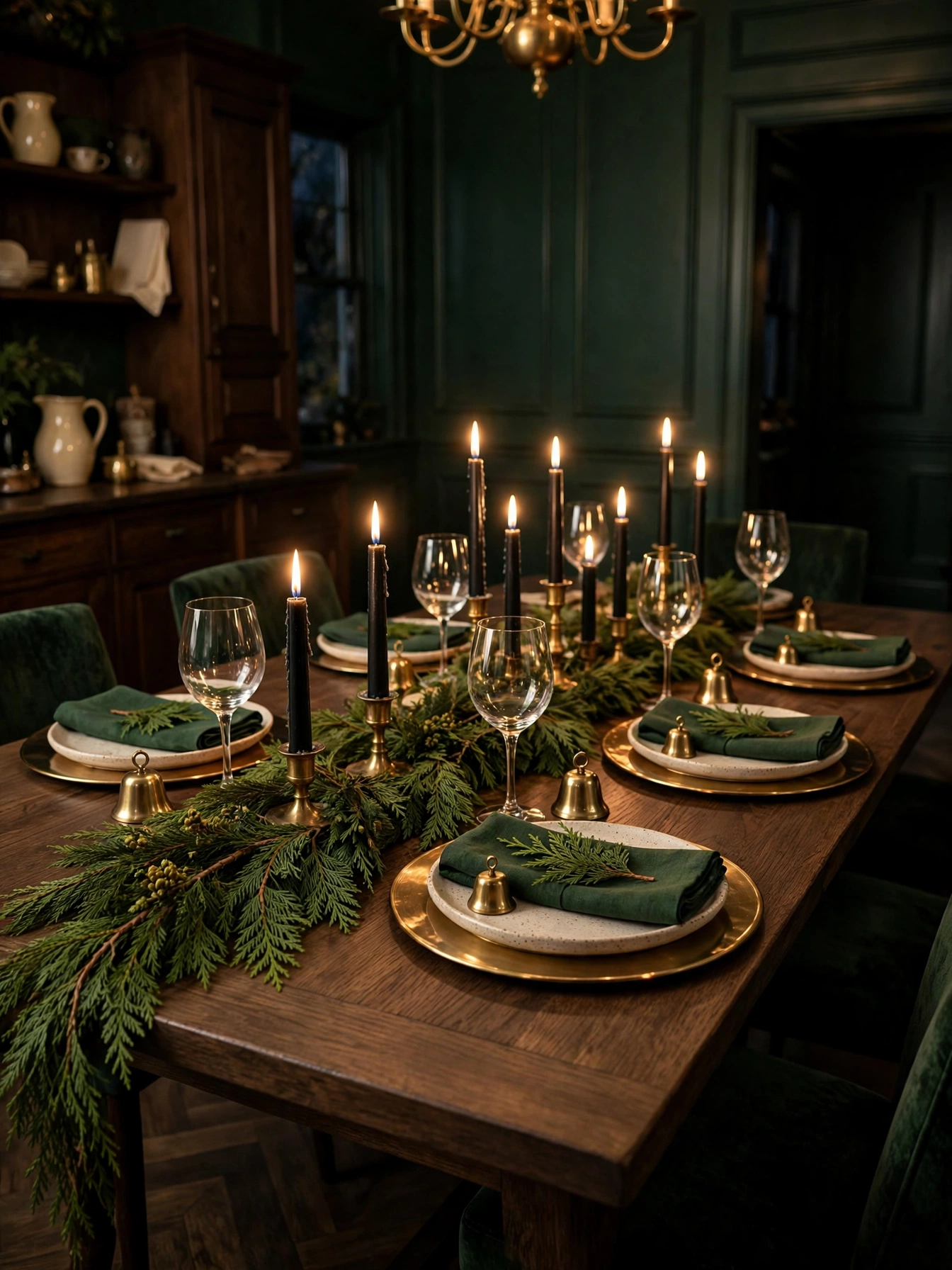
Why This Works:
- Forest green linens against brass chargers read as holiday without a single red accent
- A low cedar runner at 3 inches tall keeps sightlines open across a 72-inch table
- Black tapers at 10 inches tall clear plates and glasses without blocking faces
- Stoneware plates in cream break the dark palette at every place setting
Build the table in layers: a cream tablecloth first, a 14-inch-wide cedar runner down the center, then brass chargers at 13 inches diameter with cream stoneware on top. Fold napkins in a simple rectangle and lay one 8-inch cedar sprig across each, which takes 30 seconds per place and looks arranged. Set candles in brass holders with a 2-inch drip cup so wax never reaches the runner. Keep serving dishes to the sideboard: a 72-inch table seats 6 with elbow room of 24 inches per person only when the center stays clear of bowls.
A forest green table suits evening dinners where the lighting stays low, because the palette glows under candles instead of washing out. The honest drawback is staining: cedar sap and candle wax mark linen, so lay a clear vinyl runner under the cedar for the meal and lift it off afterward. For families with children, swap black tapers for black LED tapers; the color reads the same at 6 feet and the table survives an elbow.
Pro Tip: Chill the brass chargers for 10 minutes before guests arrive. Cold metal under warm candlelight fogs slightly at first, then shines harder as it warms, which reads as polish.
Candlelit Mirror Glow
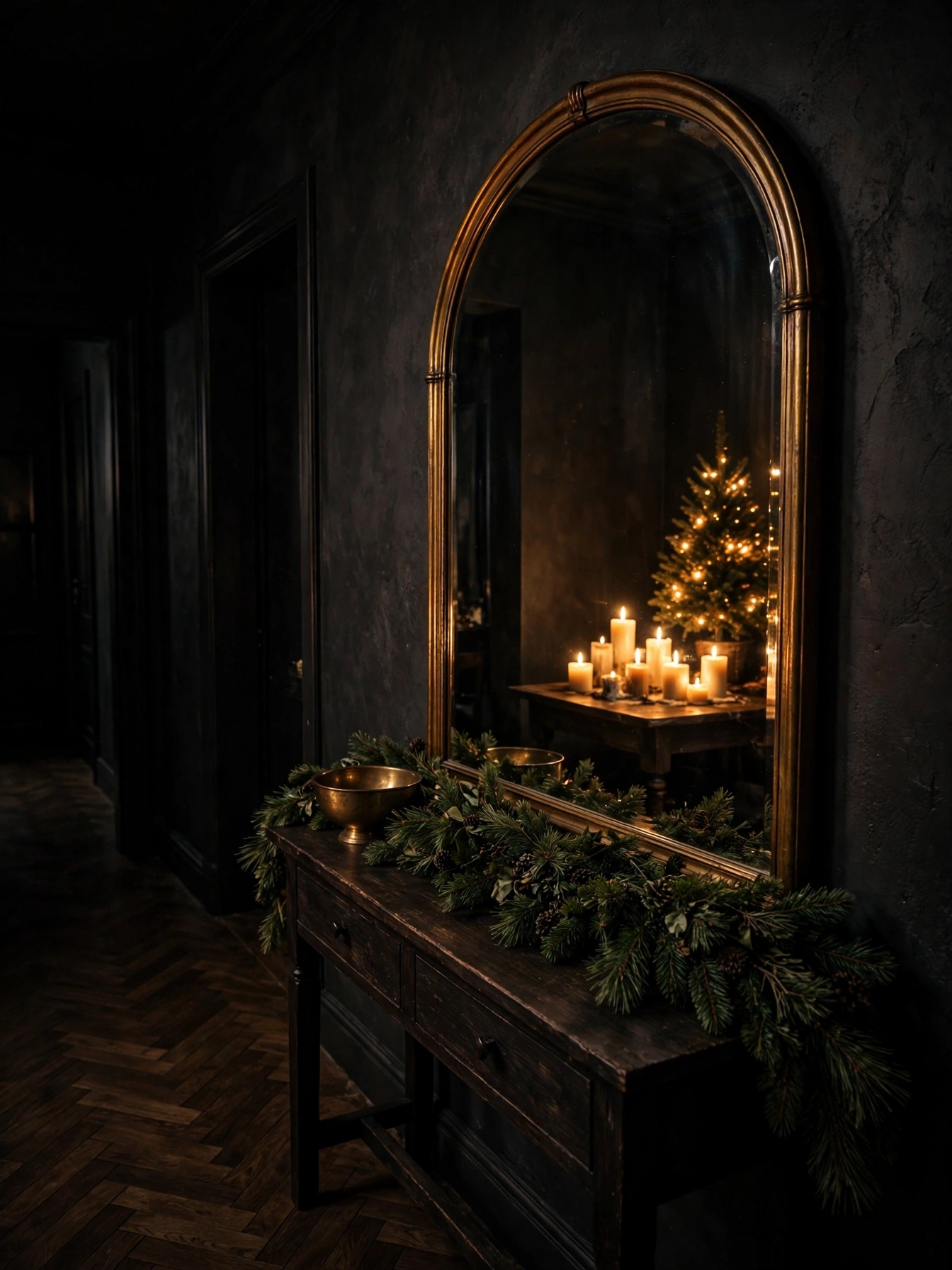
Why This Works:
- A mirror doubles every candle flame visually, so 5 candles read as 10
- A 24 by 36 inch mirror hung at eye level reflects the tree, not the ceiling
- Brass frames warm the reflection, while silver frames cool it toward blue
- A console table 12 inches deep holds candles without blocking the hallway
Hang the mirror so its center sits 57 to 60 inches from the floor, the standard eye-level gallery height, and angle it 2 degrees forward at the top so it reflects the candles rather than the ceiling. Set 5 pillar candles on the console in a loose arc 6 inches in front of the mirror, with 3 inches between each flame. Lay a 4-foot pine garland along the console back edge to frame the reflection with greenery. Check the reflection from the doorway, not from the side: the doorway view is what guests see, and a mirror that reflects a blank wall from that angle wastes the effect.
A candlelit mirror works in hallways and entries where there is no room for a tree, because it borrows light from another room and throws it down the hall. The limitation is placement: a mirror that faces a front door reflects everyone who enters, which some guests find startling at night. If the hallway is narrower than 36 inches, use a 18 by 24 inch mirror instead; anything larger makes the passage feel like a funhouse.
Pro Tip: Clean the mirror with a 50/50 mix of water and white vinegar the day you set the candles. A single fingerprint shows up as a smudge in candlelight at 10 feet.
Dark Berry Wreath

Why This Works:
- Dark berries on a charcoal door read as texture first, color second, which suits a moody entry
- A 24-inch wreath fits a standard 36-inch door with 6 inches of margin on each side
- Faux berries survive freeze-thaw cycles that split real cranberries within a week
- Magnolia leaves hold their shape for 4 to 6 weeks outdoors without wilting
Build on a 24-inch grapevine base and wire berry clusters in groups of 5 to 7, working around the circle in one direction so the berries all lean the same way. Tuck magnolia leaves behind the berries with the glossy side out, overlapping each leaf by 1 inch so no grapevine shows. Hang the wreath from a 3-inch brass hook rated for 5 pounds, placed 4 inches below the top of the door, and add a 6-inch black satin ribbon loop for a finished hang. Keep the wreath 2 inches above the door knocker so it does not swing against the brass.
A dark berry wreath suits entries where a bright red wreath would clash with black or charcoal doors, because it harmonizes instead of shouting. The trade-off is visibility from the street: dark on dark disappears past 20 feet, so add 3 to 5 cream or gold berries near the outer edge to give drivers something to catch. If your porch is uncovered, use fully faux berries; real cranberries freeze, split, and stain a door within a week of the first hard frost.
Pro Tip: Spray the finished wreath with a clear matte sealant from 12 inches away. One light coat keeps the berries from fading to gray by mid-December.
Antique Brass Bells
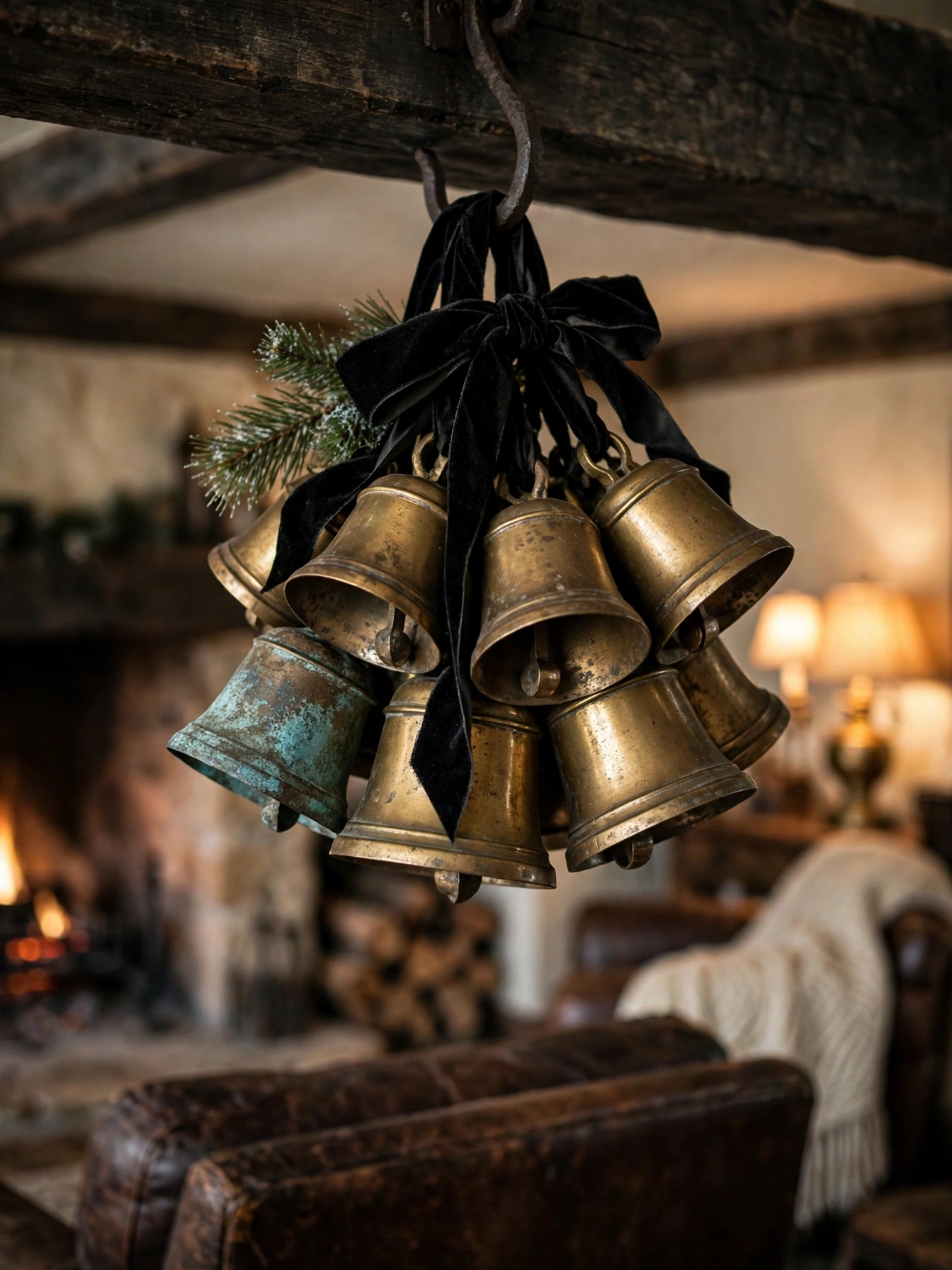
Why This Works:
- Aged brass with patina reads as collected over decades, not bought in a set
- A cluster of 5 bells at 1 to 2 inches diameter rings softly instead of jangling
- Black velvet ribbon at 1 inch wide contrasts the brass without adding color
- One iron hook into a beam holds 3 pounds, more than enough for a bell cluster
Tie each bell with its own 8-inch ribbon tail, then gather the tails into one knot so the bells hang at staggered lengths from 2 to 6 inches below the hook. Vary the bell sizes: two at 1 inch, two at 1.5 inches, and one at 2 inches gives a chord rather than a single note. Hang the cluster from a beam, a mantel corner, or a door handle where passing air moves it gently. Never hang bells over a sleeping baby’s room; the soft ring carries farther than you expect at 2 AM.
Antique bells suit rooms where you want a sound as well as a look, because the soft ring marks every door opening with a small ceremony. The limitation is tone: cheap plated bells sound tinny, so test each bell with a fingernail flick before buying and keep only the ones with a clear, sustained ring. If you cannot find true antiques, solid brass reproductions at $6 to $10 each age well with a vinegar-and-salt patina wash.
Pro Tip: Dab a tiny dot of clear nail polish on the inside clapper of any bell that rings too loudly. It softens the strike without silencing the bell.
Moody Christmas Decor Ideas 2026: Noir Window Frame
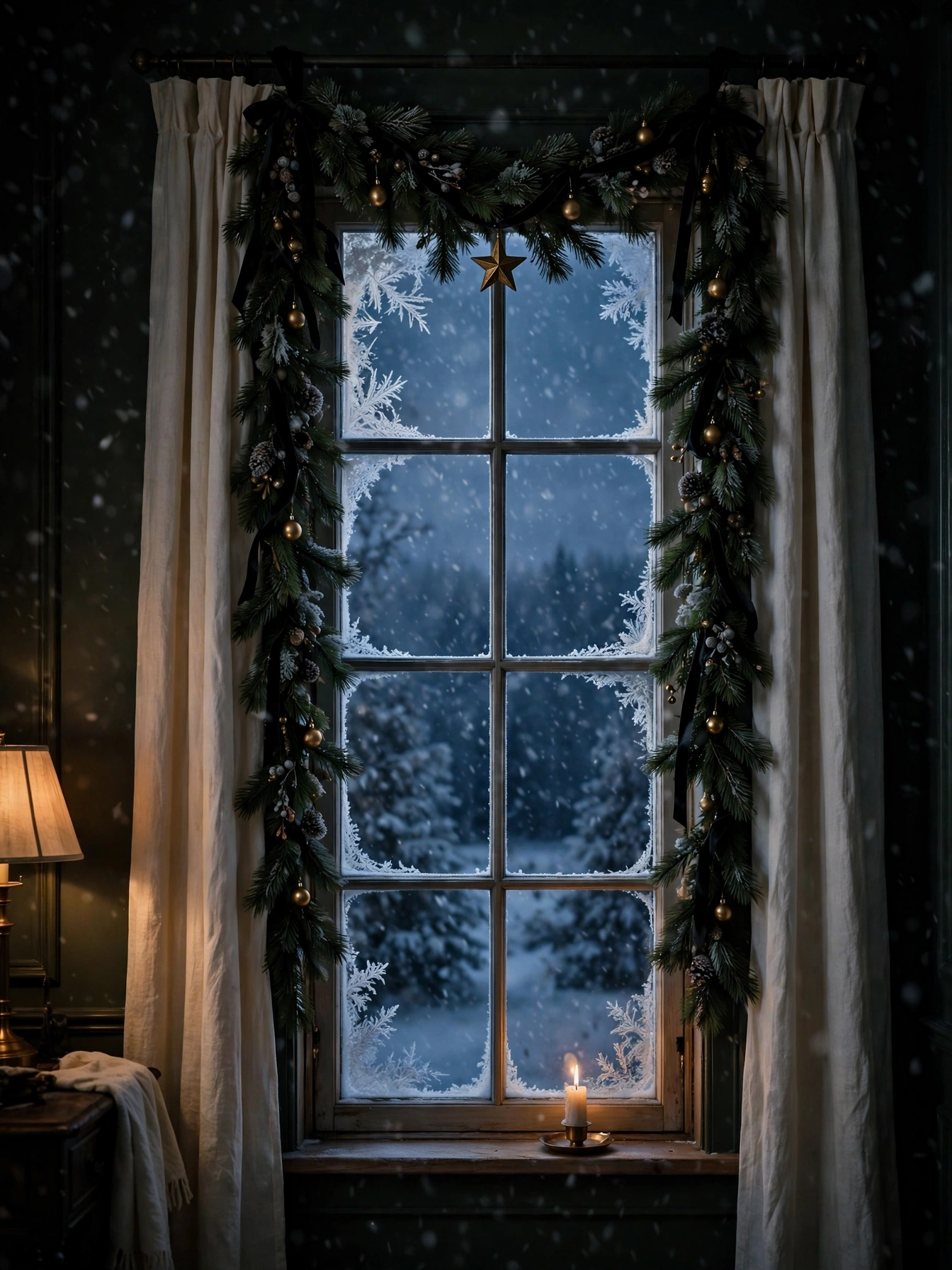
Why This Works:
- A dark garland frame turns an ordinary window into a picture of winter outside
- Brass ornaments at 2 inches catch lamplight and read as stars against the dark pine
- A 6-foot garland fits a standard 36 by 60 inch window with two top hooks
- Black ribbon ties at the corners hold the garland flat against the wall
Mount two adhesive hooks at the top corners of the window trim, 2 inches in from each edge, and drape the garland in a shallow U with a 6-inch drop at the center. Wire 5 brass ornaments into the garland at 12-inch intervals so they hang at the same depth. Tie black ribbon at the two corners and let the tails fall 10 inches. Keep the garland 3 inches above the sill so it does not block the window latch, and check that the curtains still close behind it.
A noir window frame suits rooms where the winter view is the main event, because the dark garland makes the snow outside look brighter by contrast. The drawback is light loss: a thick garland on a small window can cut daylight by 15 percent, so keep the garland to 4 inches of depth on windows under 30 inches wide. For fresh garland, mist every 3 days; for faux, dust monthly with a feather duster.
Pro Tip: Place one LED candle on the sill behind the garland. The glow through the pine reads as a lantern in the window from outside after dark.
Chocolate Plaid Throws
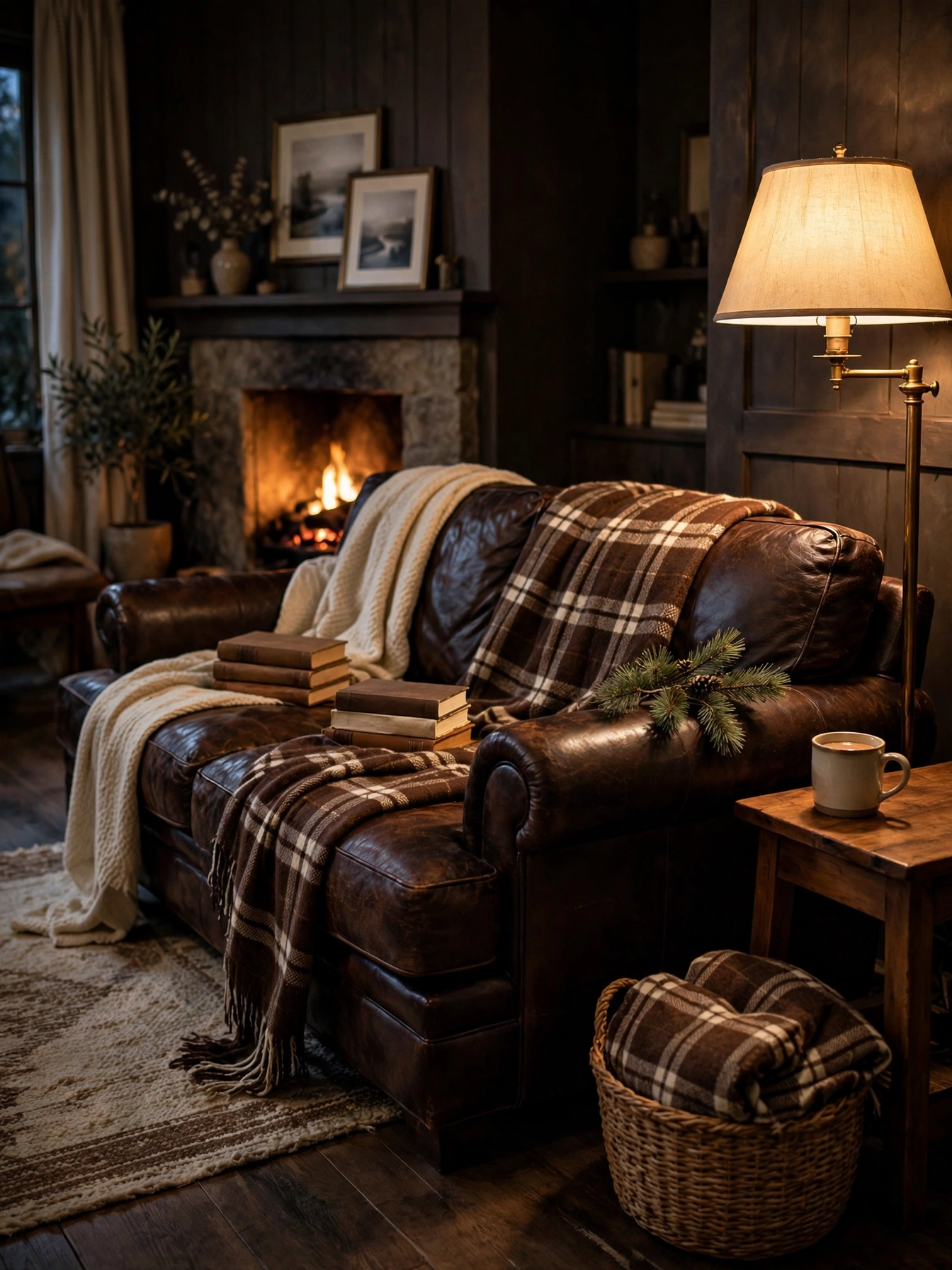
Why This Works:
- Chocolate plaid reads as holiday without a single green or red thread
- Wool throws at 50 by 60 inches cover a lap fully and drape over a sofa arm without pooling
- Two throws in the same palette look layered, while two different palettes look accidental
- Merino and lambswool blends at $45 to $80 each survive years of winter use
Drape one throw over the sofa back with 12 inches hanging on each side, and fold the second into thirds across the seat cushion so it invites someone to sit. Keep the plaid scale consistent: two large-scale plaids fight each other, so pair one bold check with one fine check in the same chocolate and cream palette. Wash wool throws in cold water on a gentle cycle and air-dry flat; a dryer shrinks wool by 10 percent or more and turns a 60-inch throw into a lap blanket. Store the summer throw in a lidded basket so the seasonal swap takes 2 minutes.
Plaid throws suit family rooms where the sofa is the main gathering spot, because they add holiday color without a single ornament. The trade-off is shedding: new wool throws shed fibers for the first 3 to 4 washes, so run them through one cold wash before the first use and keep a lint roller in the basket. If anyone in the house has a wool allergy, choose a cotton flannel plaid in the same colors; the look holds and the sneezing stops.
Pro Tip: Fold the throw so the fringe faces the room, not the sofa back. Visible fringe reads as styled; hidden fringe reads as a blanket someone forgot.
Blackened Branch Display
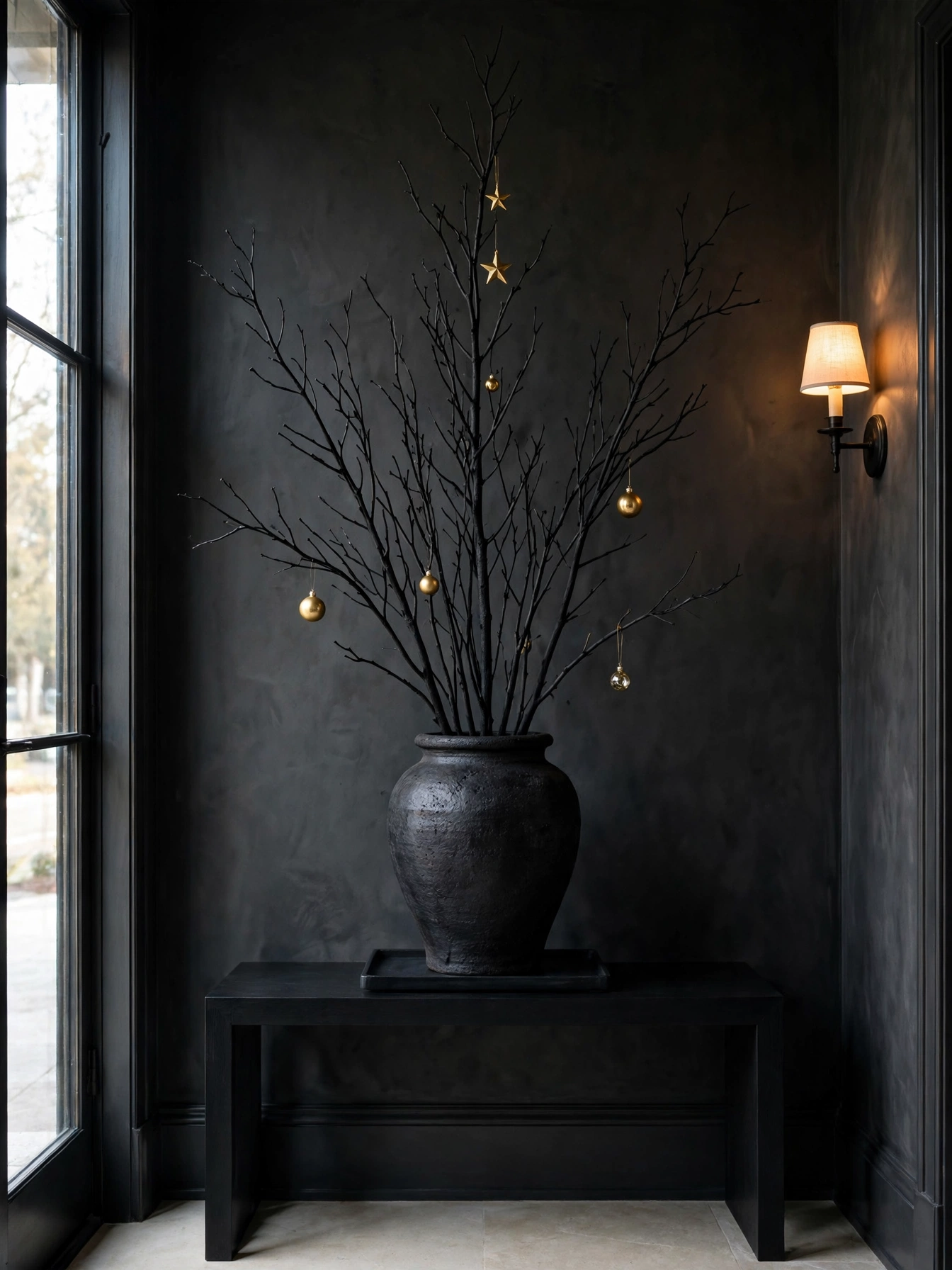
Why This Works:
- Blackened branches read as sculpture first and holiday decor second, which suits minimal rooms
- A 24-inch vase with a 10-inch base holds 36-inch branches without tipping
- Matte black spray paint at $8 a can transforms yard branches in one afternoon
- Gold ornaments at 2 inches give the display a single warm accent against the black
Choose branches with 3 to 5 forks each, spray two light coats of matte black paint 12 inches away, and let each coat dry 1 hour before the next. Set the vase on a black tray 4 inches wider than the base to catch any paint chips. Hang 3 to 5 gold ornaments from the outer twigs with 4-inch ribbon loops, keeping the center of the arrangement bare so the branch shapes show. Weigh the vase with 2 pounds of sand if the branches lean; a top-heavy vase on a console is one bump from disaster.
Blackened branches suit entries and corners where a tree would crowd the walkway, because they give height without width. The limitation is the paint: matte black shows fingerprints and dust within a week, so wipe the branches with a dry cloth weekly and keep the display 3 feet from the front door, where coats and bags brush past. If you want zero maintenance, buy pre-painted branches; they cost about $20 each but arrive sealed and dust-resistant.
Pro Tip: Bend one branch tip slightly outward before painting. A single branch reaching toward the room breaks the symmetry and keeps the display from looking like a store fixture.
Cognac Leather Accents
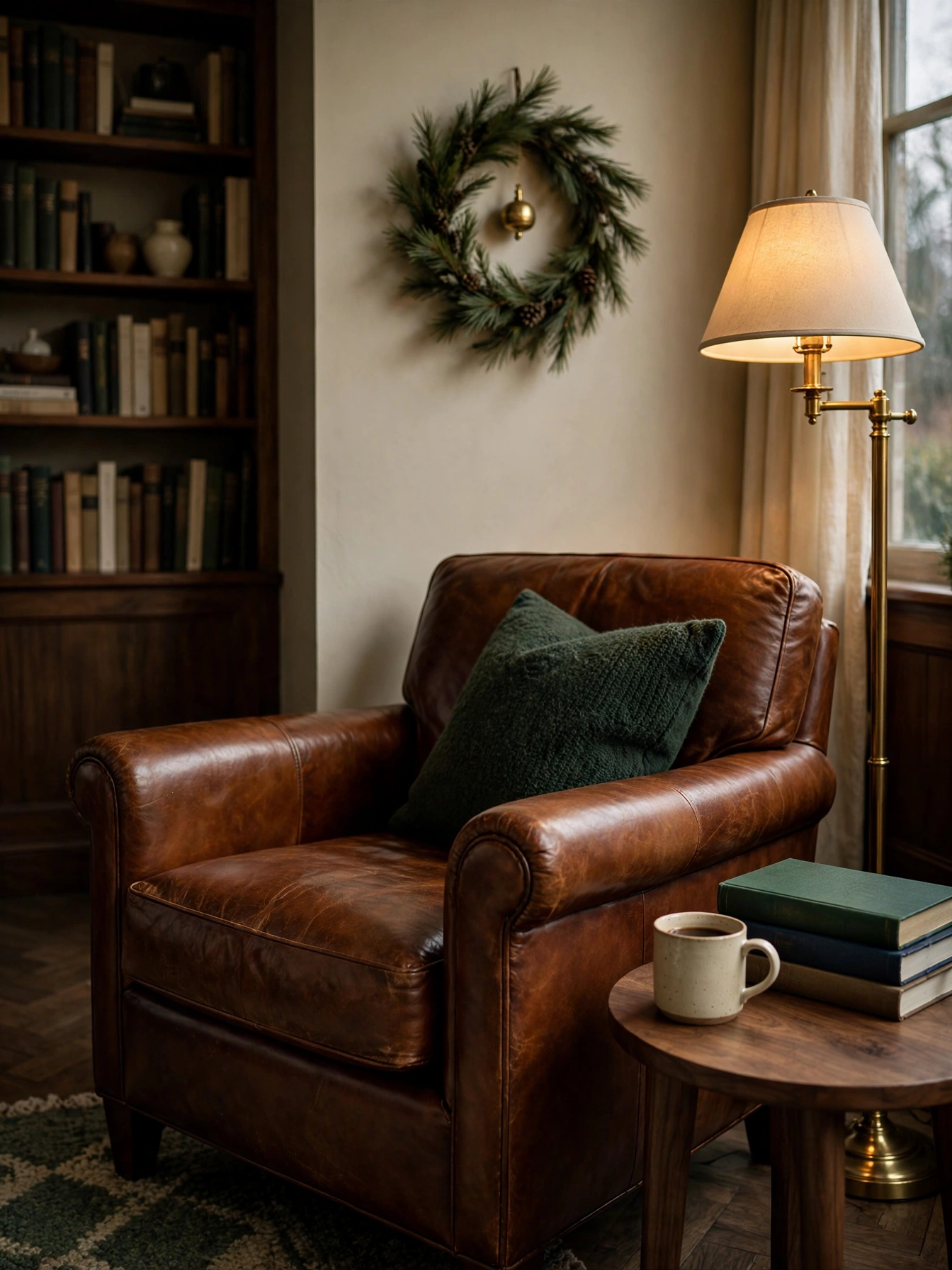
Why This Works:
- Cognac leather warms a dark room the way a wood fire does, without any flame
- A 30-inch-wide armchair fits a reading nook as small as 6 by 6 feet
- Full-grain leather at $600 to $900 for a chair ages into patina instead of peeling
- Dark green textiles against cognac read as a hunting-lodge palette, not a sports bar
Place the chair 18 inches from the side table so a book and a drink sit within reach, and angle it 30 degrees toward the room rather than flat against the wall. Condition the leather once before the season with a lanolin-based conditioner, applied in thin coats with a soft cloth, and let it cure 12 hours. Layer a dark green pillow in a 20-inch square on the chair to tie it to the wreath behind. Keep the chair 3 feet from any radiator; direct heat dries leather and cracks the finish within one winter.
Cognac leather suits reading corners and studies where the chair gets daily use, because the leather improves with wear instead of wearing out. The drawback is cost: genuine full-grain costs 3 times bonded leather, and bonded leather peels within 2 years. If the budget is tight, a cognac leather tray or a pair of leather pillow covers gives the same color note for under $60.
Pro Tip: Hang the small wreath 12 inches above the chair back, not centered on the wall. A wreath floating just over the chair reads as part of the seat, not as random wall decor.
Sapphire Ornament Bowl
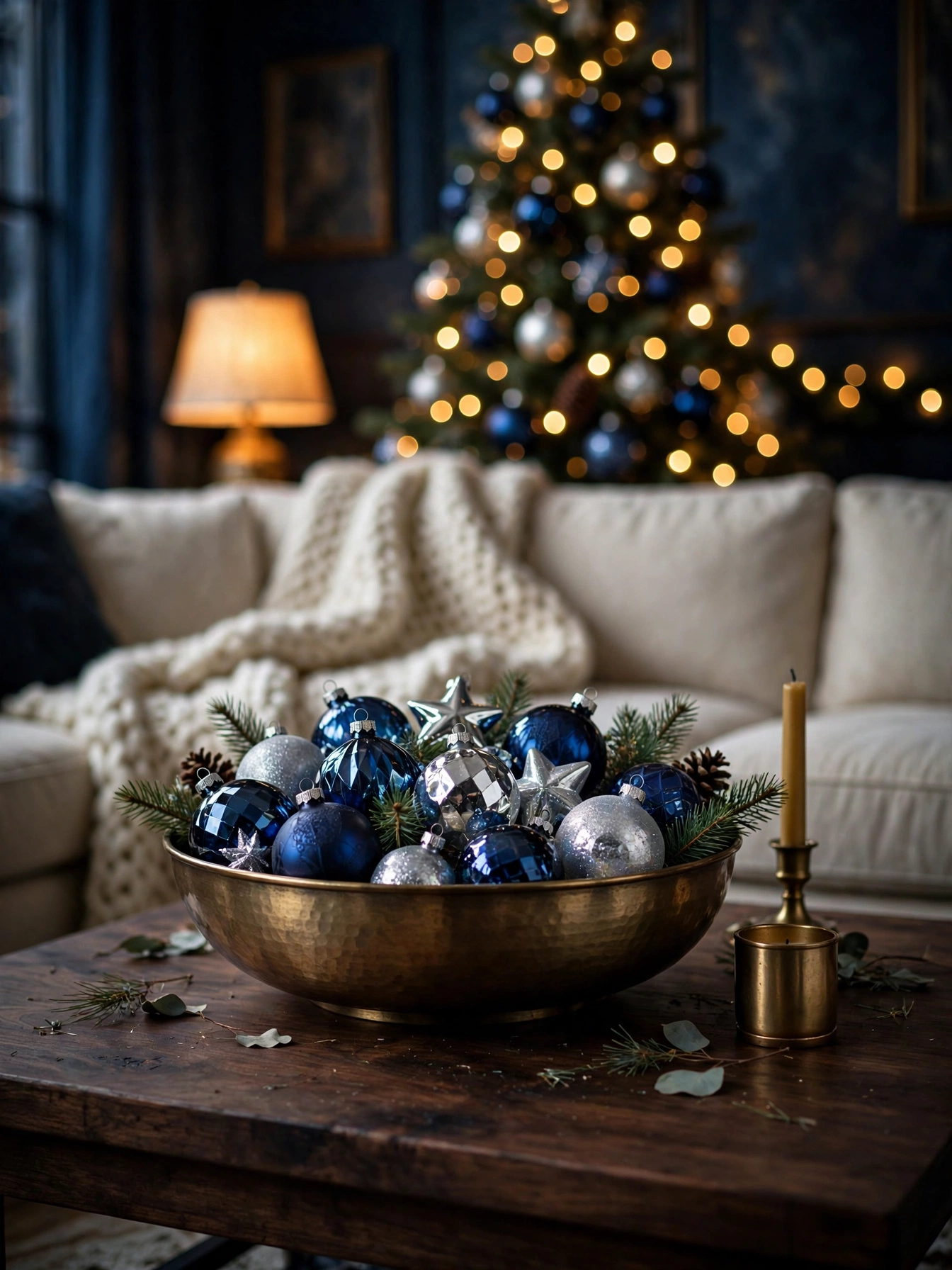
Why This Works:
- Sapphire against walnut gives a jewel-box effect that red and green never achieve
- A 14-inch bowl holds 25 to 30 ornaments at 2.5 to 3 inches with room to breathe
- Brass bowls at $30 to $50 weigh enough to stay put when someone reaches in
- Three finishes (matte, shiny, glitter) in equal thirds keep the bowl from looking flat
Fill the bowl in layers: a base of pine sprigs first, then the largest ornaments at 3 inches, then 2.5-inch pieces to fill the gaps, with 3 glitter pieces on top as the catch-light. Keep the bowl centered on the coffee table with 12 inches of clear space on each side for drinks. Choose shatterproof ornaments if the table is under 18 inches high and children or pets reach it; glass at coffee-table height breaks on the first kick. Rotate the bowl a quarter turn weekly so the same ornaments do not face the room all season.
A sapphire bowl suits coffee tables that already carry books and candles, because it adds color without adding height. The limitation is glare: shiny ornaments under a direct lamp throw bright spots across the ceiling, so position the bowl 24 inches from any lamp or use matte ornaments on the lamp side. If sapphire feels too bold, navy alone with silver reads quieter and still beats red-green.
Pro Tip: Nestle one 3-inch silver ornament at the exact center. A single bright piece in the middle gives the eye a landing spot instead of a scattered pile.
Ember Fireplace Glow
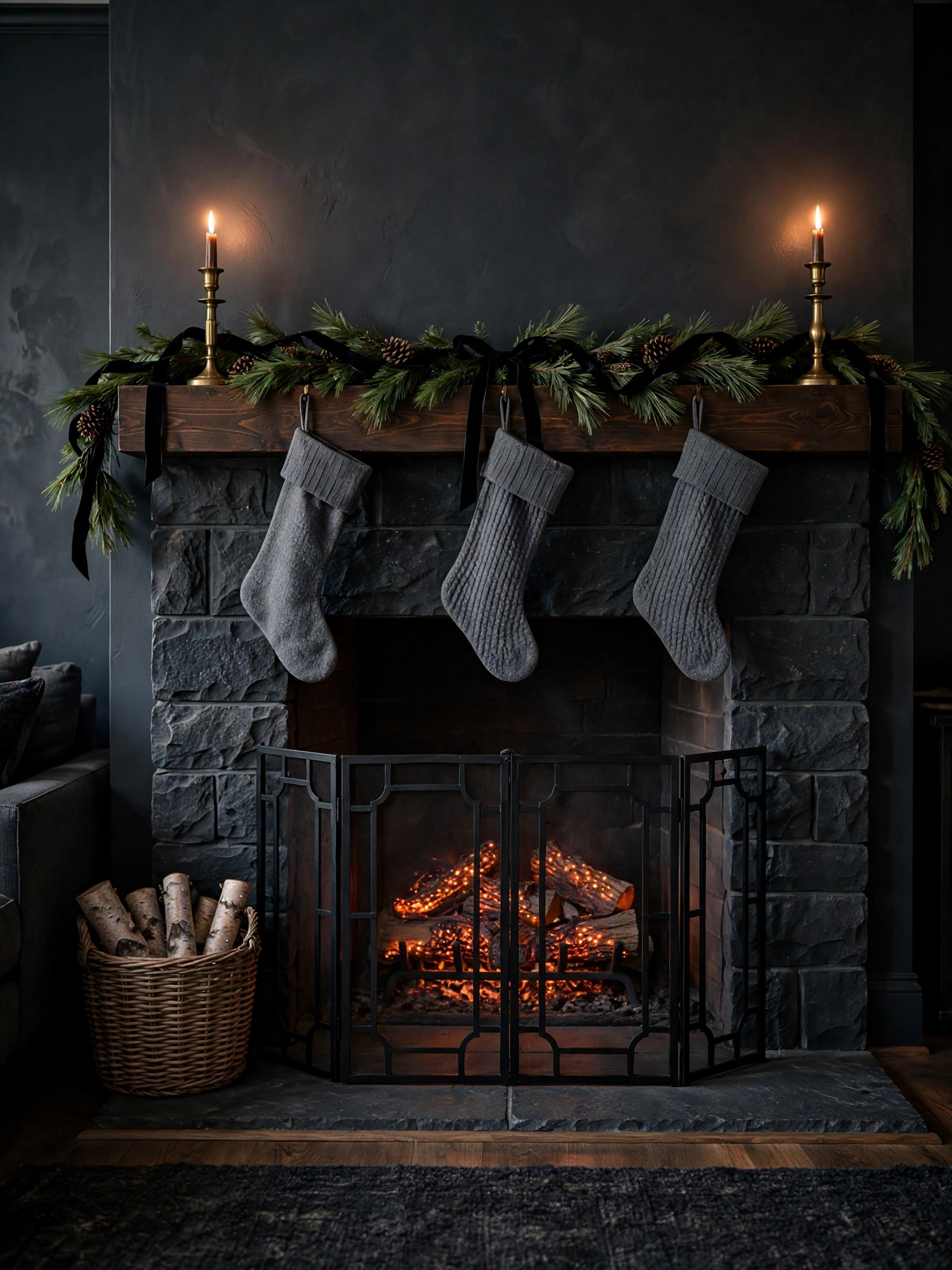
Why This Works:
- Ember-effect LEDs give a working fireplace look to homes with a sealed or decorative firebox
- A 24-inch log set fits a standard 30-inch firebox with 3 inches of clearance per side
- LED ember logs use about 15 watts, roughly the same as one small bulb
- The flicker mode reads as real flame at 10 feet without heat, smoke, or ash
Set the log insert on the firebox floor, centered, with the ember bed facing the room and the cord routed through the rear clean-out or a 0.5-inch gap behind the screen. Pair the insert with a black iron screen to hide the cord and sell the illusion. Keep the mantel garland 12 inches above the firebox opening; even LED logs warm the stone slightly, and pine garland dries out if it sits on hot stone. If your firebox is decorative and shallow (under 12 inches deep), choose a flat ember mat instead of a log set; it needs only 4 inches of depth.
An ember glow suits homes where a real fire is impractical: rentals, apartments, and houses with sealed flues. The illusion itself is the weak spot; up close, LED logs never fool anyone, so treat them as ambiance, not as a fireplace replacement. For a real wood fire, hire a chimney sweep to inspect the flue before the first burn of the season; annual chimney inspection is the safe habit.
Pro Tip: Set the ember insert on a timer for 5 PM to 11 PM. A fireplace that lights itself before you walk in beats one you have to remember every night.
Moody Bookcase Vignette

Why This Works:
- A styled bookcase adds holiday feeling to a room without a single tree or garland
- The 60/40 rule (60 percent books, 40 percent objects) keeps shelves from looking like a store
- One small object per shelf at 4 to 6 inches tall reads as intentional, not cluttered
- Pine sprigs cost nothing and scent the shelf for 2 weeks before drying
Work shelf by shelf: pull everything off, group books in stacks of 3 to 5 with spines alternating left and right, then place one object per shelf (a brass reindeer, a black candle, a small bowl). Leave 30 percent of each shelf empty so the eye can rest; a shelf packed edge to edge reads as storage, not styling. Tuck one 6-inch pine sprig behind the books on each shelf so the greenery peeks out instead of sitting in front. Keep candles unlit on bookshelves; the heat discolors book spines over a season.
A bookcase vignette suits rooms where the shelves are the main visual wall, because it uses furniture you already own. Dust is the weak spot here: styled shelves show it within days, so a weekly feather-duster pass keeps the vignette sharp. If the bookcase is in a child’s room, skip the candle entirely and use a brass bell or a wooden ornament as the shelf object.
Pro Tip: Turn one book spine-out on each shelf to face the room with its cover showing. A single visible cover acts like art and breaks the wall of spines.
Fig and Cedar Scents

Why This Works:
- Fig and cedar read as winter woods, not as a candle-store candy shop
- One 8-ounce candle scents a 200-square-foot room for about 40 hours of burn time
- Black glass jars disappear into a dark kitchen instead of adding visual clutter
- A brass tray under the candle catches wax and makes the scent station portable
Place the candle on a brass tray at least 4 inches wider than the jar, on a heat-safe surface 12 inches from the stove and any paper towels. Burn the candle for 2 hours at a time so the wax melts edge to edge; short 20-minute burns tunnel the wax and waste half the jar. Trim the wick to 0.25 inch before each lighting to keep the flame under 1 inch and the soot off the ceiling. Pair the candle with one real pine sprig on the tray; the fresh greenery adds a top note that no fragrance oil reproduces.
Scent suits kitchens and entries where guests form their first impression, because smell registers before decor does. The limitation is sensitivity: some people find strong fragrance irritating, so keep the candle to one room and never burn two scented candles at once. For a house where someone has asthma, choose a simmer pot (water, orange slices, cloves, cedar sprigs) instead; it scents the same room with zero fragrance oil.
Pro Tip: Burn the candle for 30 minutes before guests arrive, then blow it out when they walk in. The scent lingers for an hour, and the room never smells like a burning candle.
Velvet Ribbon Cascade
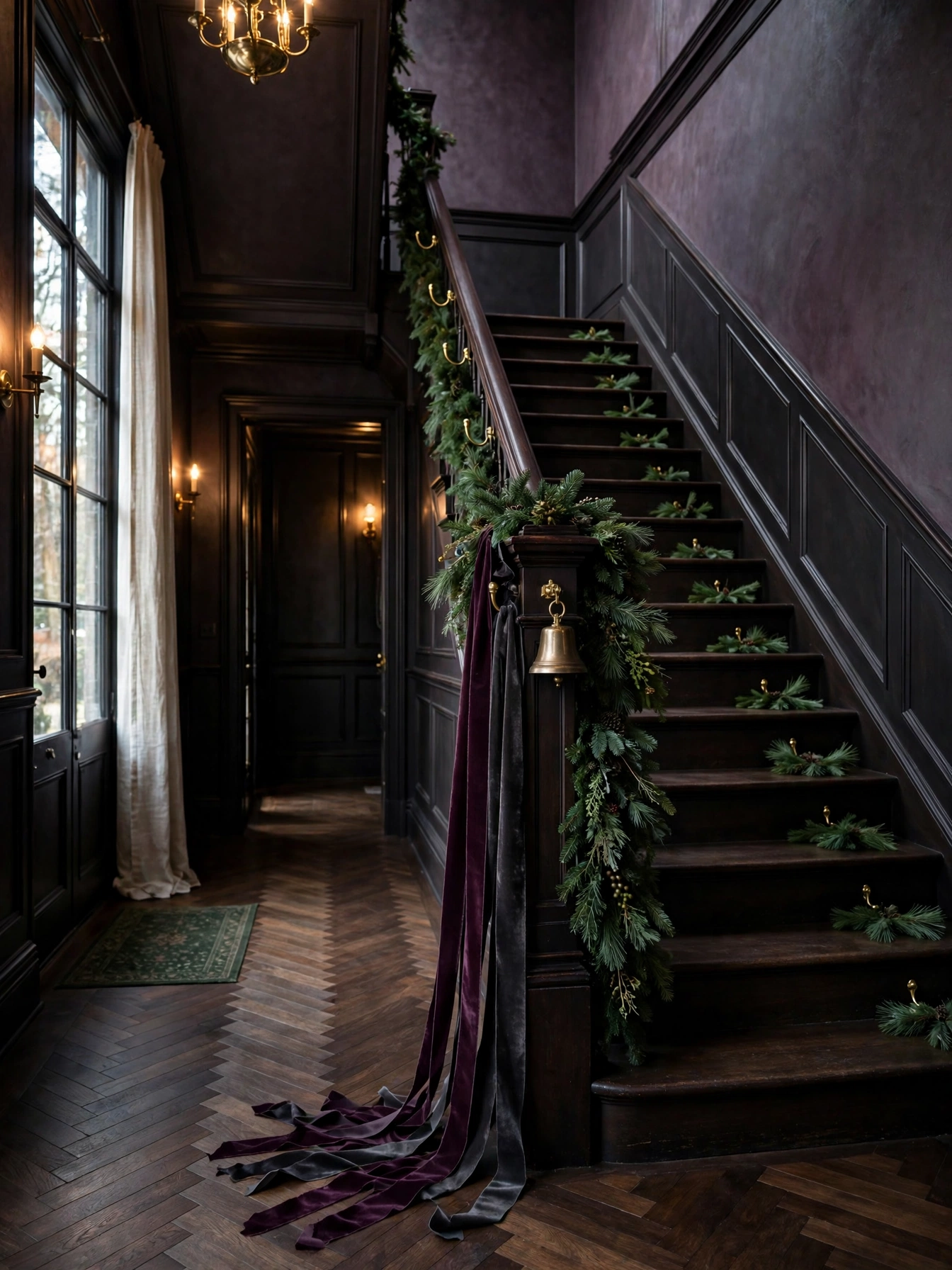
Why This Works:
- Long ribbon tails on a banister turn a staircase into a vertical display
- Velvet ribbon at 2.5 inches wide holds its shape instead of curling like satin
- A 12-foot garland covers a standard 10-step banister with one swag per 3 steps
- Two ribbon colors (plum and charcoal) keep the cascade rich without rainbow noise
Wire the garland to the banister every 3 steps with floral wire, letting it dip 8 inches between attachment points. Tie ribbon tails at the newel post and at every third baluster, cutting each tail 24 inches long with a V-notch at the end. Alternate plum and charcoal tails so the colors rhythm down the stairs. Keep ribbons 6 inches clear of the handrail grip; a ribbon across the handrail is a slip hazard when someone grabs for balance. Anchor the garland with a 5-pound-rated hook at the newel so the whole display does not slide downhill.
A ribbon cascade suits staircases that guests see on arrival, because it makes the entry feel decorated from the first step. The trade-off is maintenance: ribbon tails tangle in drafts and need a weekly straighten, and velvet shows pet hair. If the stairs get heavy daily use, shorten the tails to 12 inches so they clear bags and coats.
Pro Tip: Cut ribbon tails with pinking shears instead of straight scissors. The zigzag edge stops velvet from fraying and looks finished without hemming.
FAQs
What makes moody Christmas decor ideas 2026 different from traditional Christmas decor?
Moody decor trades bright red and white for deep colors like charcoal, emerald, plum, and burgundy, plus candlelight instead of multicolor strings. A moody room uses 70 percent dark tones and 30 percent warm metallics, so every light source reads brighter. The style suits evening-heavy December living.
How dark is too dark for a moody Christmas room?
Keep at least one light wall or one large mirror in every dark room so the space never reads as a cave. If a room has under 50 square feet of window, limit dark paint to a single accent wall of 8 by 10 feet. Three warm light sources at 2700K per room keep moody rooms glowing, not gloomy.
Can I do moody Christmas decor ideas 2026 in a small apartment?
Yes, a single charcoal accent wall, one black candle cluster, and a 3-foot tabletop tree deliver the look in under 40 square feet. Skip the full-size tree and the heavy drapes, which need 100-plus square feet to breathe. Small rooms benefit most from tone-on-tone palettes because they blur boundaries.
Are black candles and dark decor safe around children and pets?
Real candles need 12 inches of clearance from anything flammable and should never burn unattended. For homes with kids or pets, flameless LED pillars in black wax shells give the same look with zero flame. Keep glass ornaments above 36 inches and use shatterproof pieces below that height.
How much does a moody Christmas living room cost to style?
A single-corner refresh runs $60 to $120: one gallon of paint ($45), a candle cluster ($25), and ribbon ($10). A full-room makeover with drapes, a tree, and lanterns lands between $250 and $450. Start with the corner you see at 6 PM, since that is the view you live with all December.
Conclusion
These 22 moody Christmas decor ideas 2026 all come back to three takeaways: lean into the darkness instead of fighting it, keep warm light at 2700K, and let one deep color lead each room. Start with the corner you see first at dusk, add one candle layer, and let the season’s long evenings do the rest. Your first action tonight is simple: pick one dark accent in a room you already love and give it a candle or a sprig of pine. Follow HomelyCrafter on Pinterest for more ideas. Save this to your Pinterest boards so you can refer back to it!

Muhammad Israr is a home decor enthusiast and the writer behind Homely Crafter. He spends his days researching paint colors, layouts and budget-friendly styling ideas, then breaks them down into practical, easy-to-follow guides so you can decorate with confidence.