
According to Nielsen, the average American adult watches roughly three hours of television per day, which makes the stand beneath your screen one of the most-seen pieces of furniture in your home. Yet most TV consoles collect remotes, tangled cords, and a single dust-covered candle. These living room tv stand decor ideas change that without a remodel: with the right proportions, layered textures, and calm colors, a media console can anchor the whole room. This guide walks through 22 serene ways to style your TV stand, from floating consoles and symmetrical book stacks to hidden cord solutions. You will get exact measurements, honest trade-offs, and clear styling rules for every surface.
Floating Console Lines
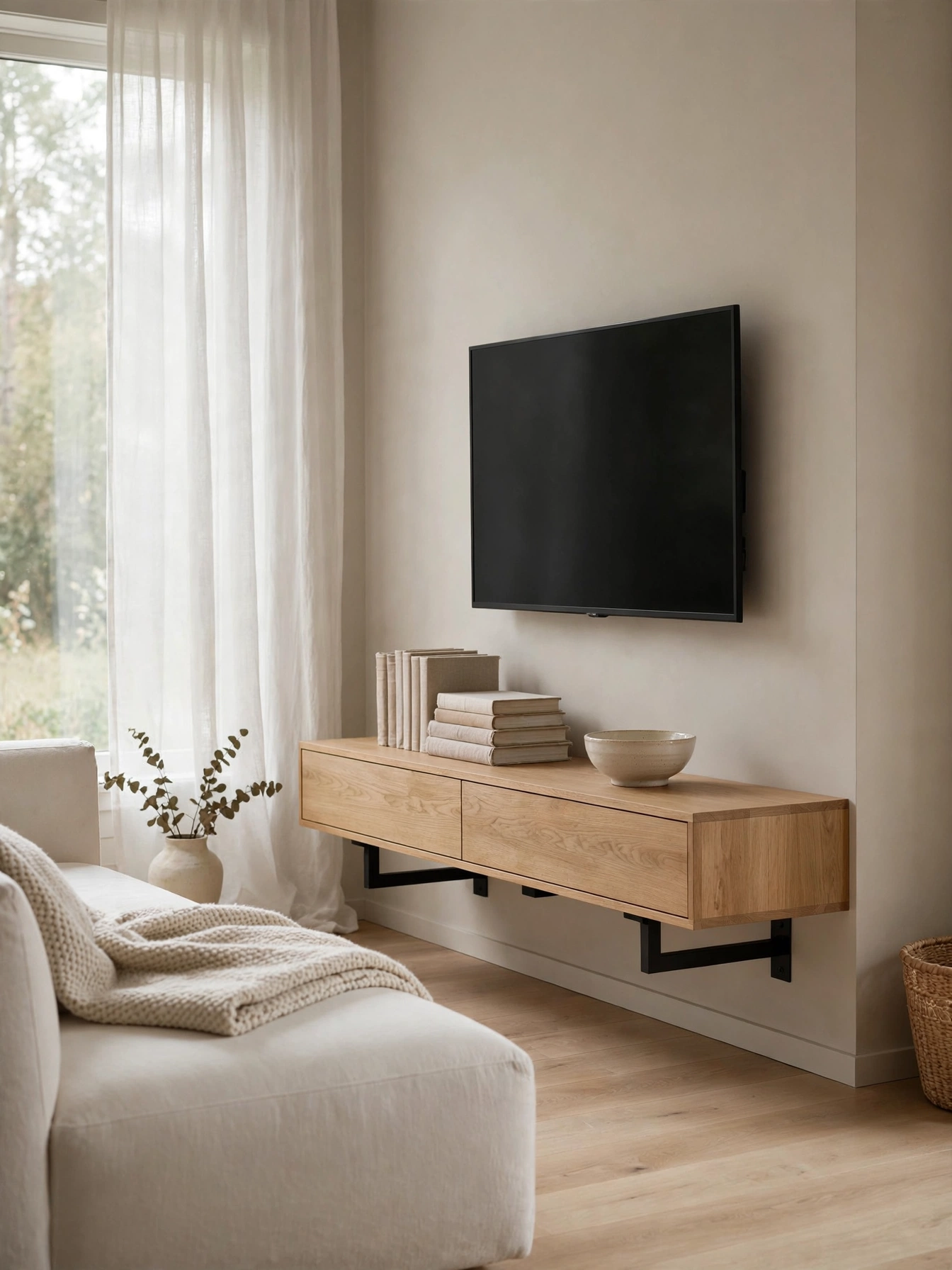
Why This Works:
- Lifting the console off the floor exposes 8-12 inches of open floor, which makes small rooms feel larger instantly.
- A continuous floating line draws the eye horizontally, so the wall reads wider and calmer.
- Cables route through the wall cavity, removing the biggest source of visual clutter.
- Dust and pet hair cannot hide underneath, so weekly cleaning takes minutes.
Floating consoles should be mounted so the top edge sits 24-30 inches above the floor, with the TV center aligned to seated eye level, roughly 42 inches from the floor. Choose a unit rated for at least 150 percent of your TV’s weight (a 65-inch TV weighs 50-60 pounds, so aim for a 90-pound rating), and anchor into studs, never drywall alone. Leave 2-3 inches of ventilation space behind any console holding a cable box or game console, because trapped heat shortens component life. Avoid consoles deeper than 18 inches in narrow rooms, since the protruding edge breaks the floating illusion and narrows walkways. Versus legged credenzas, floating units hide less storage but deliver a cleaner silhouette; pick one with closed fronts if you hate dusting.
This approach suits renters in new-build apartments and anyone chasing a light, modern feel, though it works best on solid walls rather than plasterboard partitions. What you give up is permanence: moving a floating console leaves bolt holes to patch, and the in-wall cable route usually needs an electrician if you want a truly cord-free look. That is exactly when to hire a professional, since running power behind drywall must meet local electrical code. Budget brackets run 20-40 dollars and flex over time, mid-range reinforced systems cost 80-150 dollars, and premium custom floating consoles start around 400 dollars with built-in cable channels.
Pro Tip: Mount the console first, then position the TV so its bottom edge clears the console top by exactly 6 inches. This gap keeps remotes reachable while hiding soundbar cables behind the unit.
TV Stand Decor Ideas

Why This Works:
- Closed cabinets hide gaming controllers, DVDs, and chargers, so the top stays decorative only.
- A mid-tone wood like walnut warms up rooms that feel cold with all-white furniture.
- Grouping vases in odd numbers creates a focal point that competes with the black screen.
- The low 20-24 inch height keeps the TV at a comfortable viewing angle from a standard sofa.
Pick a credenza 10-20 percent wider than your TV: for a 55-inch set (48 inches wide), a 56-60 inch stand gives balanced proportions, a guideline The Spruce recommends for media furniture. Solid wood or plywood cases outlast particleboard in humid climates, and soft-close hinges add years of quiet use. Keep the top styling to 3-5 objects so the surface breathes, and avoid placing anything taller than 12 inches next to the TV, since tall pieces shrink the screen visually. Mid-century legs add airiness but wobble on thick carpet; solid plinth bases suit carpeted rooms better. Walnut veneer shows dust less than black lacquer, while painted white finishes reflect more light in dark rooms.
Families with young children benefit most here, because closed doors keep little hands off electronics and remotes off the floor. The honest limitation is cable access: rear panels with pre-cut holes make rerouting simple, but solid-back units force you to drill. Budget credenzas cost 120-250 dollars in engineered wood, mid-range solid-wood pieces run 400-800 dollars, and premium walnut lowboards start near 1,200 dollars. If the unit wobbles on uneven floors, adhesive felt pads or adjustable feet solve it for under 10 dollars.
Pro Tip: Style one side of the console 2-3 inches taller than the other (a vase versus a flat book stack) to create gentle asymmetry that keeps the arrangement from looking staged.
Symmetrical Book Stacks

Why This Works:
- Mirrored stacks on both sides balance the wide black rectangle of the TV.
- Books add height and color without the visual noise of small knickknacks.
- Matching stacks read as intentional, which calms a screen-dominated wall.
- You can swap the top book seasonally for a free refresh.
Stack 3-5 books per side, keeping total height under 10 inches so the display stays below the TV’s bottom edge. Vary the stack widths slightly (9, 10, and 11 inches) to avoid a rigid tower look, and place the widest book at the bottom for stability. Skip glossy dust jackets, which reflect TV light and look busy; linen or matte covers photograph and feel calmer. Against sculptures, book stacks are forgiving because you can restyle them in minutes. Leave at least 6 inches between the stack and the screen edge so the books never visually crowd the picture.
Book lovers and minimalists both win here, since the stacks double as actual reading material. One drawback is weight: five large art books can reach 15-20 pounds, so check that your console top is rated for it and never stack on glass shelves without a weight rating. Thrifted hardcovers cost 2-8 dollars each, new art books run 25-60 dollars, and a pair of brass bookends adds 15-40 dollars. Keep stacks near the console ends rather than center, where heat from a soundbar can warp paper over time.
Pro Tip: Turn the top book’s spine to face outward on one side and the pages outward on the other for subtle asymmetry inside perfect symmetry.
Ceramic Vase Trio

Why This Works:
- Three vessels at different heights create a natural triangle that the eye finds restful.
- Matte ceramic absorbs light instead of reflecting it, which keeps the screen area calm.
- Dried stems need zero watering and never shed leaves onto electronics.
- The handmade texture contrasts nicely with the TV’s flat glass.
Arrange heights in a 2:3:4 ratio (roughly 10, 14, and 18 inches) with the tallest piece holding dried stems up to 24 inches above the console. Keep the grouping tight, within an 18-inch footprint, so it reads as one composition rather than scattered clutter. Avoid placing vases with fresh water near a soundbar or game console, since one spill can kill electronics; dried stems remove that risk entirely. Relative to a single large vase, a trio fills the horizontal space beside a TV more gracefully. Position the trio off-center, about one-third along the console length, following the classic rule of thirds.
This suits anyone who wants an artisan look without collecting dozens of objects. The price you pay is fragility: ceramic chips if knocked by a remote or a pet’s tail, so place trios toward the back edge of consoles in busy households. Handmade stoneware vases cost 18-45 dollars each at craft markets, budget sets run 25-50 dollars for three, and premium studio pieces start near 90 dollars per vase. Dust matte ceramics with a soft dry brush monthly, because damp cloths leave streaks.
Pro Tip: Add stems to only the tallest vase and leave the other two empty; one vertical line of greenery is calmer than three competing bouquets.
Woven Basket Storage
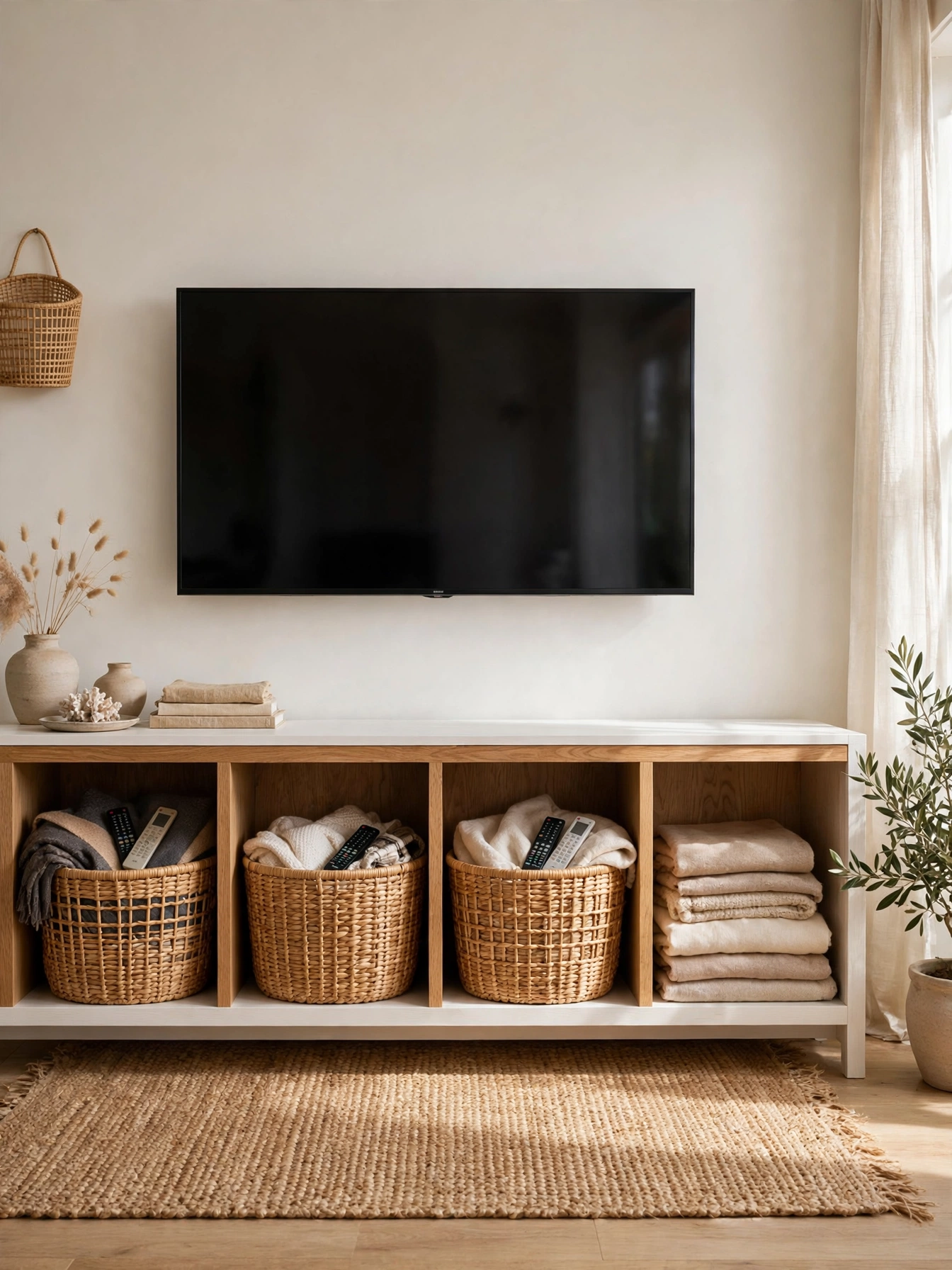
Why This Works:
- Baskets convert open cubbies into hidden storage, so clutter disappears in seconds.
- The woven texture softens the hard rectangle of the TV above.
- Light seagrass tones keep the console from feeling heavy or dark.
- Each family member gets one basket, which ends the remote-control wars.
Measure your cubbies before buying: baskets should be 1-2 inches narrower and 1 inch shorter than the opening for an easy slide-in fit. Standard 12×12 inch cube baskets fit most media consoles, while 15-inch widths suit wider units. Avoid baskets with protruding handles on consoles you open daily, since they snag; recessed cut-out handles work better. In contrast to fabric bins, woven seagrass holds its shape for years and wipes clean with a damp cloth. Reserve the top surface for decor only, and let the baskets do the storage work below.
Households with kids or gamers get the most value, because controllers, chargers, and toys vanish behind the weave. The honest limitation is capacity: deep baskets swallow small items, so add a small tray inside each one for remotes and dongles. Seagrass baskets cost 12-25 dollars each, rattan versions run 20-40 dollars, and premium handwoven pieces start around 55 dollars. Replace baskets every 3-4 years if they sit in direct sun, since UV makes natural fibers brittle.
Pro Tip: Line each basket’s base with a 1-inch felt pad so sliding it in and out never scratches the console interior.
Layered Frame Art

Why This Works:
- Leaning frames soften the hard edge where the TV meets the wall.
- Layering two frames adds depth without drilling a single hole.
- Abstract line art in beige tones calms the wall instead of competing with the screen.
- You can swap prints in minutes when the mood changes.
Use frames sized 16×20 and 11×14 inches, overlapping the smaller in front by 2-3 inches, and keep the tallest frame at least 4 inches below the TV’s bottom edge. Lean frames at a slight 5-10 degree tilt against the wall for stability, never fully vertical, which invites toppling. Avoid glass glazing directly beside a TV, since it throws screen glare across the room; acrylic or matte museum glass reflects far less. Stacked against a full gallery wall, two leaning frames deliver the art effect with zero commitment. Houzz editors often note that leaning art suits renters best because nothing damages the wall.
Renters and commitment-phobes will love this, as will anyone who rotates seasonal art. The catch is dust: leaning frames collect it along the top edge, so wipe weekly with a microfiber cloth. Budget frames cost 8-20 dollars each, mid-range solid wood frames run 25-60 dollars, and archival prints add 15-40 dollars. Anchor the arrangement 6-8 inches from the TV so art never overlaps the screen bezel.
Pro Tip: Place a small adhesive bumper pad behind the back frame to keep it from sliding forward on polished console tops.
Living Room TV Stand Decor Ideas With Trailing Plants
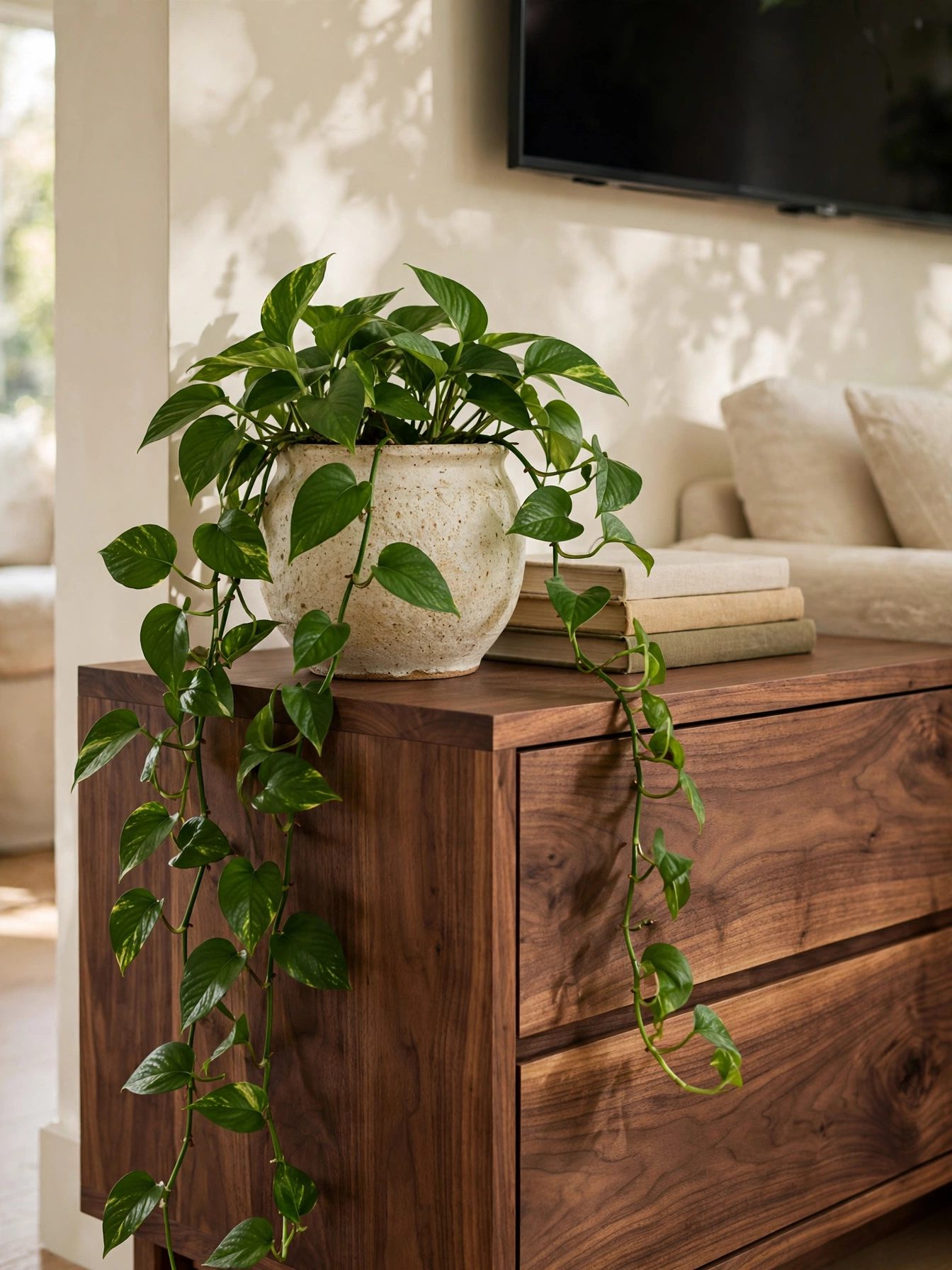
Why This Works:
- Trailing vines break the console’s straight lines with soft, living curves.
- Green is the only color you need; it reads calm against any neutral palette.
- One plant at the console corner anchors the whole arrangement.
- Pothos tolerates the low light many TV walls get.
Choose a pot 6-8 inches wide so it fits the console depth with 2 inches of clearance front and back, and let vines trail 12-24 inches before trimming. Water pothos only when the top 2 inches of soil feel dry, roughly every 7-10 days, and keep the pot on a waterproof saucer to protect the wood. Avoid placing plants directly above heat vents or electronics that run hot, because warm dry air browns leaf tips. Put beside faux plants, a real pothos costs less and purifies nothing measurable, but it genuinely lifts the mood of a screen-heavy corner. The Spruce notes pothos among the most forgiving houseplants, which is why it survives the forgotten corners of media walls.
Beginner plant owners get an easy win, and renters add life without drilling anything. The exchange is leaf drop: a few yellow leaves per month are normal, so shake the plant gently over the trash during watering day. A pothos in a ceramic pot costs 12-30 dollars, premium handmade pots run 25-50 dollars, and a wall-mounted plant shelf alternative starts near 20 dollars. Keep vines trimmed above soundbars, since leaves can muffle upward-firing speakers.
Pro Tip: Rotate the pot a quarter turn every two weeks so the vines grow evenly instead of leaning toward the window.
Candle Glow Corners
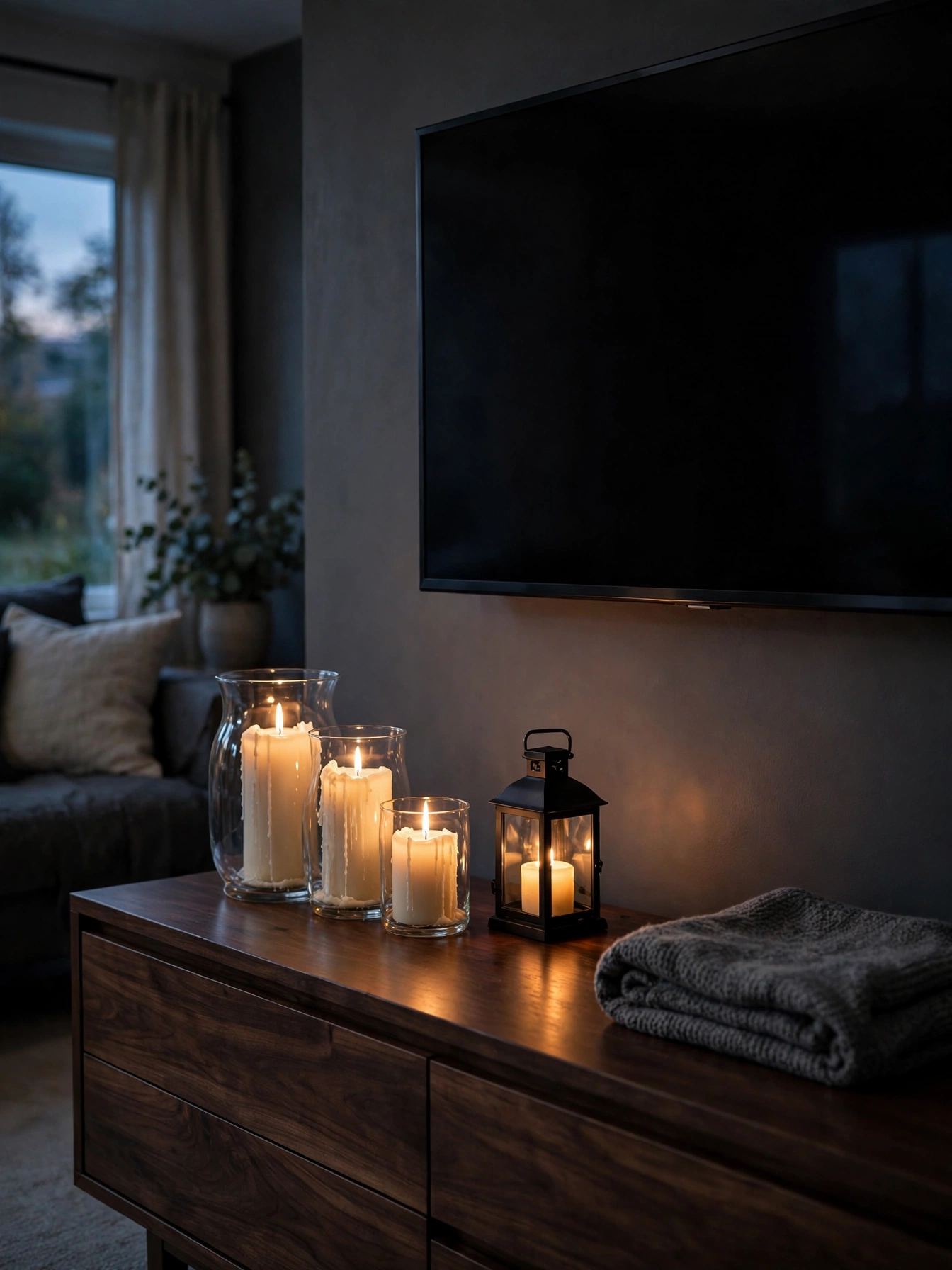
Why This Works:
- Candlelight softens the black screen’s harsh rectangle during evening movie time.
- Hurricane glass protects flames from ceiling-fan drafts and curious pets.
- Grouping candles at one end balances a tall plant or vase at the other.
- Unscented pillars avoid competing with the room’s existing scent.
Group three pillars at 4, 6, and 8 inch heights inside glass hurricanes at least 2 inches taller than the flame, which keeps heat from scorching the TV above. Place the cluster 8-10 inches from the TV bezel and at least 12 inches from any fabric throw, following the National Fire Protection Association’s 3-foot clearance guidance for open flames around combustibles. Never leave candles burning during a 2-hour movie unattended, and choose flameless LED candles if kids or cats roam the room. When measured against string lights, candles add no cable clutter and cost less to run. Extinguish with a snuffer rather than blowing, which avoids wax splatter on the console.
Evening entertainers and cozy-night-in fans get the most from this styling. A real downside is maintenance: real candles need trimming to a quarter-inch wick before each burn and leave soot on nearby walls if burned for 4+ hours. Quality pillar candles cost 8-18 dollars each, glass hurricanes run 12-30 dollars, and realistic flameless sets start near 25 dollars with a remote timer. Store matches in a small ceramic dish beside the cluster for a styled, practical touch.
Pro Tip: Burn candles for at least 2 hours on first use so the wax melts edge to edge, preventing the tunneling that ruins pillar candles.
Serene TV Stand Styling

Why This Works:
- Leaving 60-70 percent of the console top empty makes the room feel twice as calm.
- Two well-chosen objects beat ten small ones every time.
- Negative space lets the TV wall read as designed, not storage.
- Less styling means dusting the console takes under two minutes.
Limit styling to 2-3 objects total: one vertical piece (vase with stems), one horizontal piece (book stack or tray), and optionally one small bowl. Keep a clear 10-12 inch zone in front of the TV for remotes and daily use, because functional space beats decoration you must move constantly. Avoid symmetry here; one strong object placed at the one-third mark creates more visual interest than mirrored pairs. Set against maximalist styling, restraint photographs better for resale listings too, which is why stagers strip media consoles to near-empty. The Spruce’s styling guides consistently recommend editing down to fewer, larger pieces.
Minimalists and busy professionals who hate dusting thrive with this approach. The honest trade-off is that sparse styling can feel cold if the rest of the room is also minimal, so add warmth through a rug or throw nearby. This styling costs almost nothing: a 20-40 dollar vase and a 15-30 dollar book stack finish the job. Resist the urge to fill the empty space later; the emptiness is the design.
Pro Tip: Photograph the console from your sofa with your phone; if the image looks calm and balanced, the styling is done.
Sculptural Object Mix
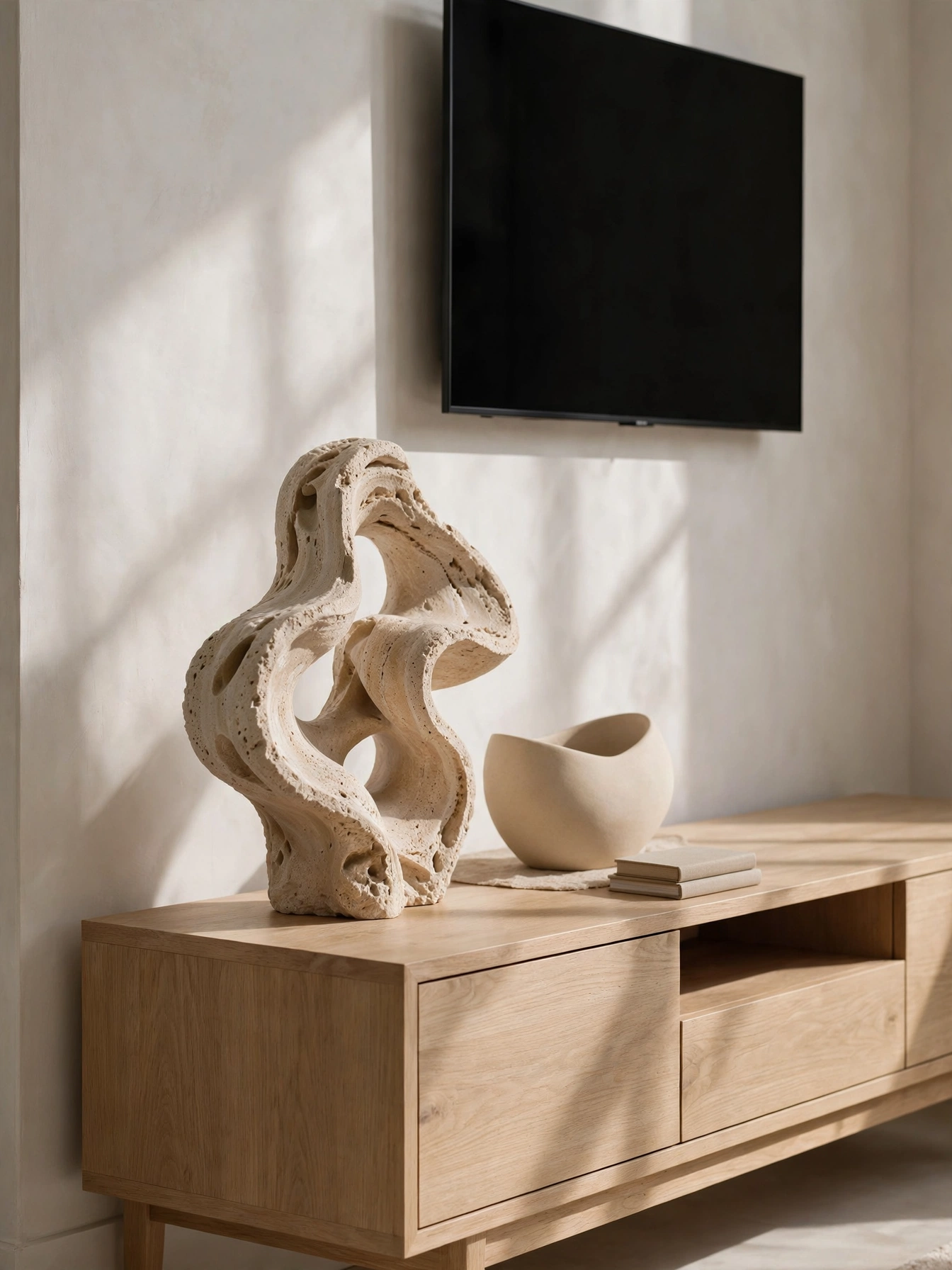
Why This Works:
- One sculptural piece gives the console a gallery feel that elevates the whole room.
- Organic curves contrast with the TV’s hard rectangle, softening the wall.
- Stone and ceramic add weight and permanence next to lightweight electronics.
- A single statement object needs no companion styling to look finished.
Select a sculpture 12-16 inches tall for consoles 60-72 inches wide, keeping it proportional to a 55-65 inch TV. Place it on a stack of 2-3 large books to add height and protect the console from stone’s rough base, adding felt pads underneath. Avoid top-heavy pieces on narrow consoles in earthquake-prone areas or homes with toddlers; museum putty secures bases discreetly. Versus vases, abstract sculpture reads more modern and less “decorated.” Travertine, alabaster, and cast stone all work, though genuine stone weighs 5-12 pounds, so confirm the console’s top rating.
Art-minded decorators who want a grown-up media wall will love this. The main risk is price: genuine stone sculpture costs more than decor-store resin, though the visual difference is obvious in person. Budget resin sculptures run 25-60 dollars, mid-range cast stone pieces cost 80-180 dollars, and artisan carved stone starts near 250 dollars. Dust crevices with a soft paintbrush monthly, since stone’s texture traps dust.
Pro Tip: Light the sculpture with a 2700K picture light or small spot 12 inches above it for a gallery effect that works beautifully after dark.
Glass-Front Cabinets

Why This Works:
- Fluted glass blurs the contents, so storage looks styled instead of messy.
- Light passes through the doors, keeping the console from feeling like a dark box.
- Brass handles add a jewelry-like detail that lifts the whole unit.
- You can find the remote without opening a door, which is oddly satisfying.
Reeded or fluted glass obscures 70-80 percent of what sits behind it, which means moderately tidy shelves look perfect. Keep interior shelves styled in the same neutral palette, since blurred color still reads through the glass. Avoid clear glass doors on media consoles, because every cable and controller stays visible and defeats the purpose. Against solid doors, glass fronts need occasional wiping; a microfiber cloth handles fingerprints in seconds. Interior LED strips on a 3000K warm setting, costing 15-30 dollars, make fluted glass glow beautifully after dark.
Design lovers who want storage that doubles as display get the best of both worlds. The real limitation is cleaning: glass shows dust and fingerprints more than wood, so expect a weekly wipe. Budget consoles with glass fronts run 200-400 dollars, mid-range solid-wood versions cost 500-900 dollars, and premium custom pieces start near 1,500 dollars. Choose tempered glass at least 5mm thick for safety, especially with kids around.
Pro Tip: Style the visible shelf behind the glass first, then close the door and step back 8 feet to check the blurred effect before finalizing.
Warm Oak Finishes

Why This Works:
- Visible wood grain adds warmth that painted consoles cannot match.
- White oak’s pale honey tone stays light while feeling natural.
- A linen runner protects the finish from remotes and mugs.
- Side lighting turns the console top into a textural feature.
White oak rates 1360 on the Janka hardness scale, which means it resists dents from daily remote drops far better than pine at 380. Oil finishes need reapplication every 12-18 months, while hardwax-oil lasts 2-3 years and polyurethane protects for 5+ years with zero maintenance. Avoid placing hot mugs directly on oiled oak, since heat rings penetrate the finish; a runner or coaster prevents the issue entirely. Relative to walnut, white oak reflects more light, making it the better pick for north-facing rooms. Keep the runner 2-3 inches narrower than the console top on each side for a tailored look.
Anyone with cool-toned walls or gray flooring benefits, because warm oak balances the palette. The balancing cost is price: genuine oak costs more than oak-look laminate, though it refinishes beautifully after a decade. Budget oak-look consoles run 150-350 dollars, mid-range oak veneer pieces cost 400-750 dollars, and solid white oak consoles start near 900 dollars. Wipe with a barely damp cloth and dry immediately; standing water is oak’s only real enemy.
Pro Tip: Run the linen runner lengthwise with a 1-inch overhang at each end; the slight drape softens the console’s hard edges.
Calm Living Room TV Stand Decor Ideas in Neutral Tones
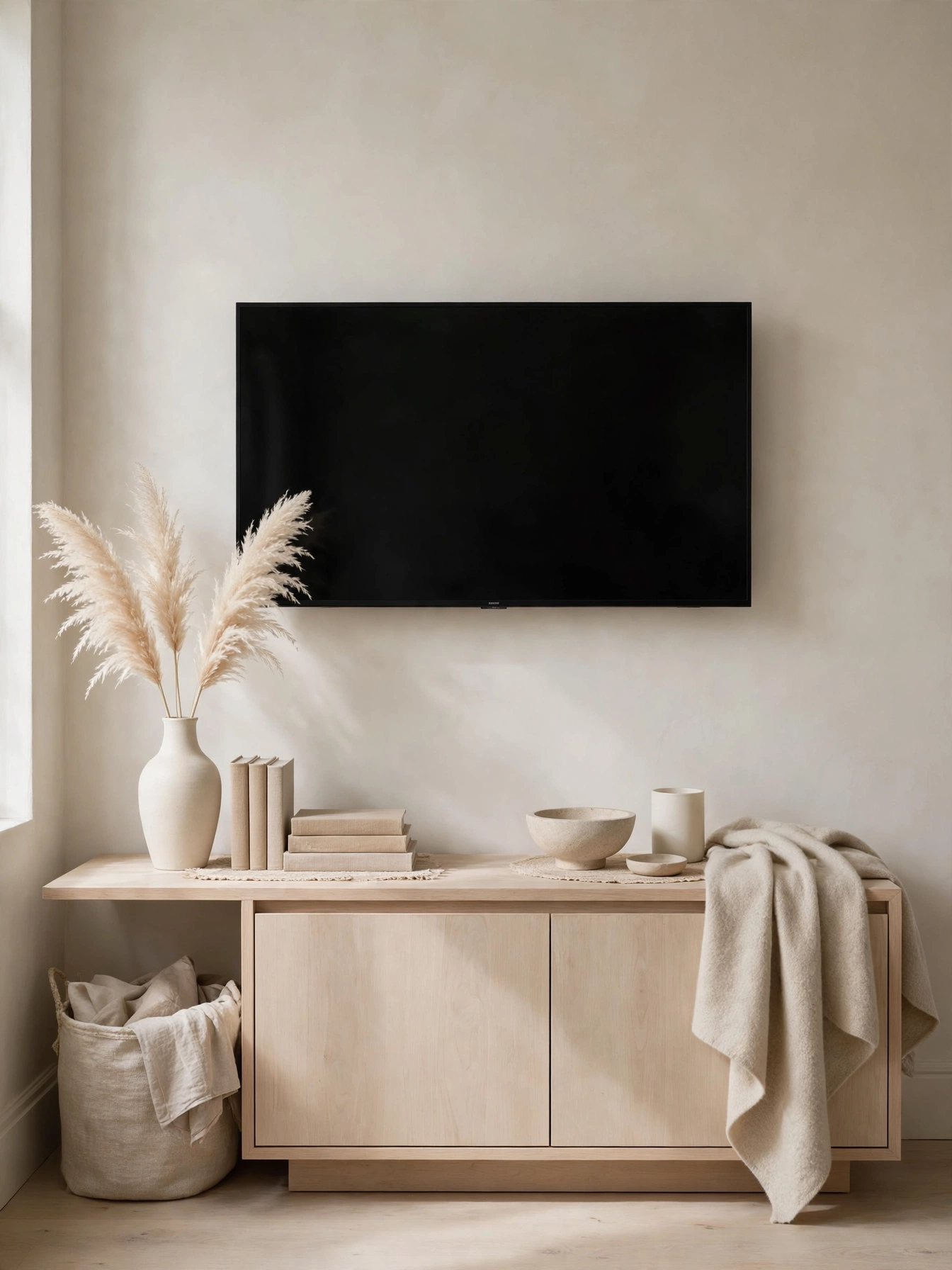
Why This Works:
- Sticking to one tonal family removes every decision and every clash.
- Texture variety (linen, ceramic, stone) keeps neutrals from looking flat.
- A single palette makes the TV wall recede, so the room feels bigger.
- Everything coordinates automatically, so future swaps stay effortless.
Build the palette from 3-4 tones within one family: ivory (LRV 85+), sand (LRV 60-70), greige (LRV 45-55), and one deeper anchor like warm taupe. Mix at least 4 different textures, because tonal schemes live or die on tactile contrast. Avoid introducing a single bright accent, which will scream against the calm and unbalance the composition. In contrast to colorful styling, neutrals hide dust better and age gracefully through trend cycles. The NKBA’s design guidance often favors restrained palettes in multi-use rooms, since they reduce visual fatigue over time.
This palette suits overstimulated households and anyone whose living room doubles as a workspace. The weak point is that pure neutrals can read as bland in photos; vary undertones slightly (warm sand versus cool greige) for depth. Styling a neutral console costs little: most pieces come from existing decor in other rooms. Spend 30-80 dollars on one new textured piece, like a hand-thrown vase, to anchor the look.
Pro Tip: Photograph the arrangement in black and white; if the shapes still look interesting without color, your texture mix is working.
Low Profile Consoles
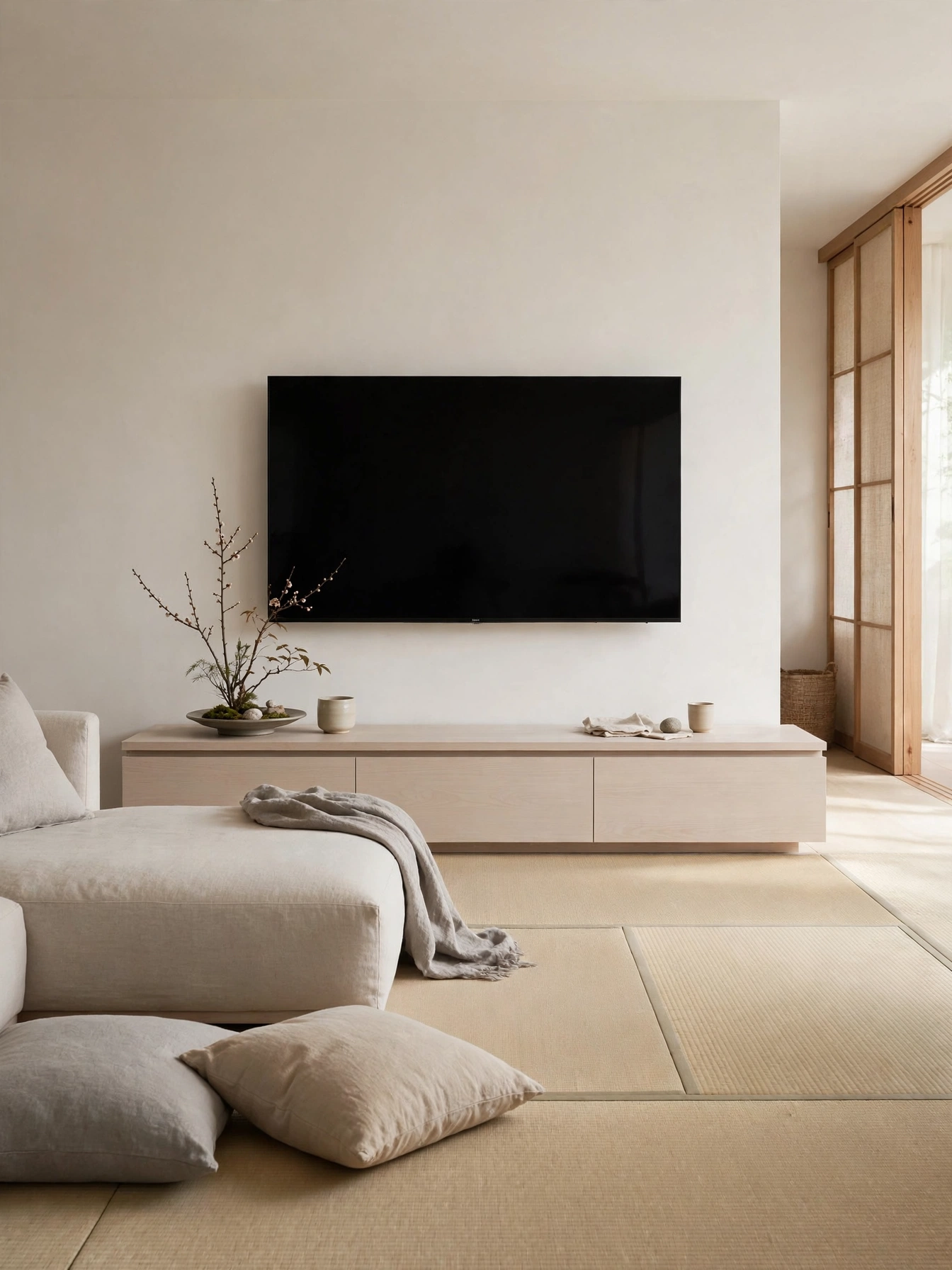
Why This Works:
- A 14-16 inch console drops the TV closer to true eye level on low sofas.
- The low line makes 9-foot ceilings feel dramatically taller.
- Long horizontal proportions suit wide 65-75 inch TVs best.
- Floor-level consoles ground rooms with a calm, Japanese-inspired feel.
Standard consoles measure 22-28 inches tall, but low-profile units run 12-18 inches, which pairs with sofas whose seat height is 15-17 inches. Keep the TV’s bottom edge 4-8 inches above the console top, and center the screen 36-42 inches from the floor for floor-seating arrangements. Avoid low consoles if you have toddlers or large dogs, since the screen sits within bump range. Stacked against standard-height units, low consoles offer less enclosed storage, so choose models with at least two drawers. Houzz’s living room guides note that low media furniture works best in rooms with 8-foot-plus ceilings, where the extra wall space above creates breathing room.
Floor-sitting households, meditation corners, and fans of Japanese minimalism will feel at home. The concession is accessibility: bending to reach drawers gets old, so store only rarely used items inside. Budget low consoles cost 100-250 dollars, mid-range solid wood versions run 350-700 dollars, and premium Japanese-crafted pieces start near 1,000 dollars. Add a 2-inch riser under the TV if the bottom bezel sits below 30 inches, which strains necks during long viewing.
Pro Tip: Sit on your sofa and have someone hold a tape measure at eye level; mount the TV so its center hits that exact mark for strain-free viewing.
Open Shelf Balance
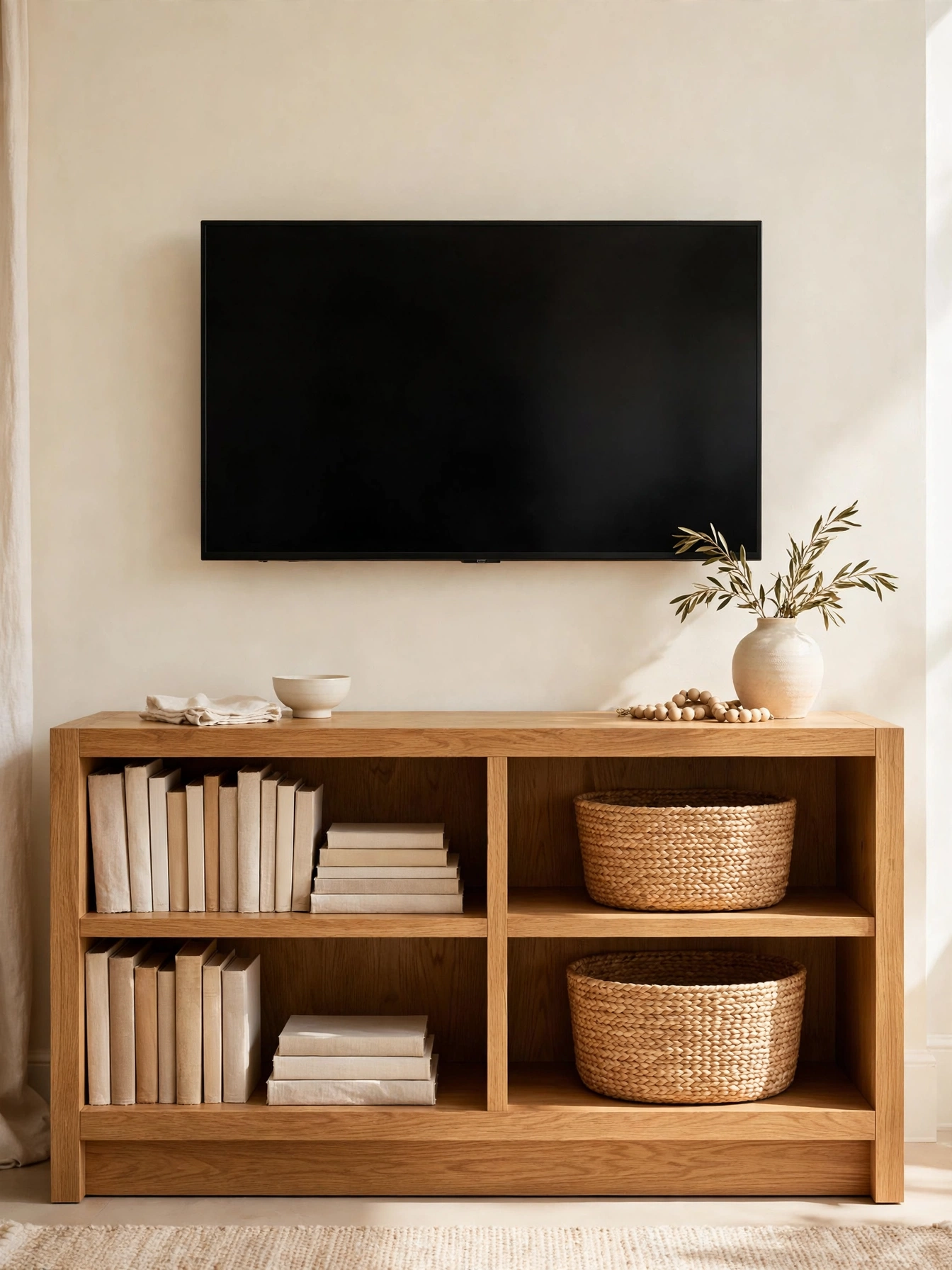
Why This Works:
- Weighting books left and baskets right creates balance without mirror symmetry.
- Open shelves keep remotes and controllers grabbable in seconds.
- Breathing room between objects stops the unit from looking like a bookcase.
- The mix of vertical books and horizontal baskets adds rhythm.
Fill open shelves to 60-70 percent capacity; anything denser reads as storage, not styling. Place the heaviest items (book stacks, 8-15 pounds) on the bottom shelf to lower the center of gravity and prevent tipping. Leave a 3-4 inch gap above each object so shelves feel airy rather than crammed. Avoid stacking electronics on open shelves without 2 inches of side ventilation, since receivers and consoles run hot. Put beside closed cabinets, open shelves demand 5 minutes of weekly tidying but reward you with instant access. Anchor any unit taller than 30 inches to the wall with anti-tip hardware, which costs under 15 dollars.
Readers and gamers who reach for items daily get the most convenience. One thing to watch is dust: open shelves collect it faster than closed storage, so keep a microfiber duster nearby. Budget open-shelf consoles run 120-300 dollars, mid-range solid wood versions cost 350-700 dollars, and premium modular systems start near 900 dollars. Corral small items in one basket per shelf to contain the inevitable drift.
Pro Tip: Turn book spines inward on one shelf for a soft cream texture that hides clashing cover colors.
Calm TV Stand Decor

Why This Works:
- Integrating the soundbar into the styling stops tech from looking like an afterthought.
- A single orchid adds living elegance without the fuss of a plant collection.
- The slim profile keeps a 3-4 inch soundbar from dominating the console.
- Everything has a home, so the surface stays clear for daily life.
Center the soundbar under the TV with its front edge flush to the console edge, which prevents muffled audio bouncing off the wood. Orchids need bright indirect light and 3 ice cubes or 3 ounces of water weekly; a bathroom-adjacent living room’s humidity suits them well. Avoid placing the orchid’s pot directly on oiled wood without a saucer, since mineral deposits stain finishes. When measured against a full plant display, one orchid delivers the biophilic effect with a tenth of the maintenance. The American Lighting Association recommends keeping decorative objects 6+ inches from heat-producing electronics, so give the soundbar its breathing lane.
Movie lovers who upgraded their audio will appreciate styling that respects the tech. What it costs you is that soundbars collect dust on their speaker grilles; a soft brush every two weeks keeps them clear. A healthy orchid costs 15-35 dollars, ceramic pots run 12-28 dollars, and slim soundbars range from 100 dollars budget to 400+ dollars premium. Replace the orchid’s bark medium yearly for reliable reblooming.
Pro Tip: Angle the orchid’s blooms toward the sofa, not the TV; the flowers are for you to enjoy, not the screen.
Tray Anchored Styling
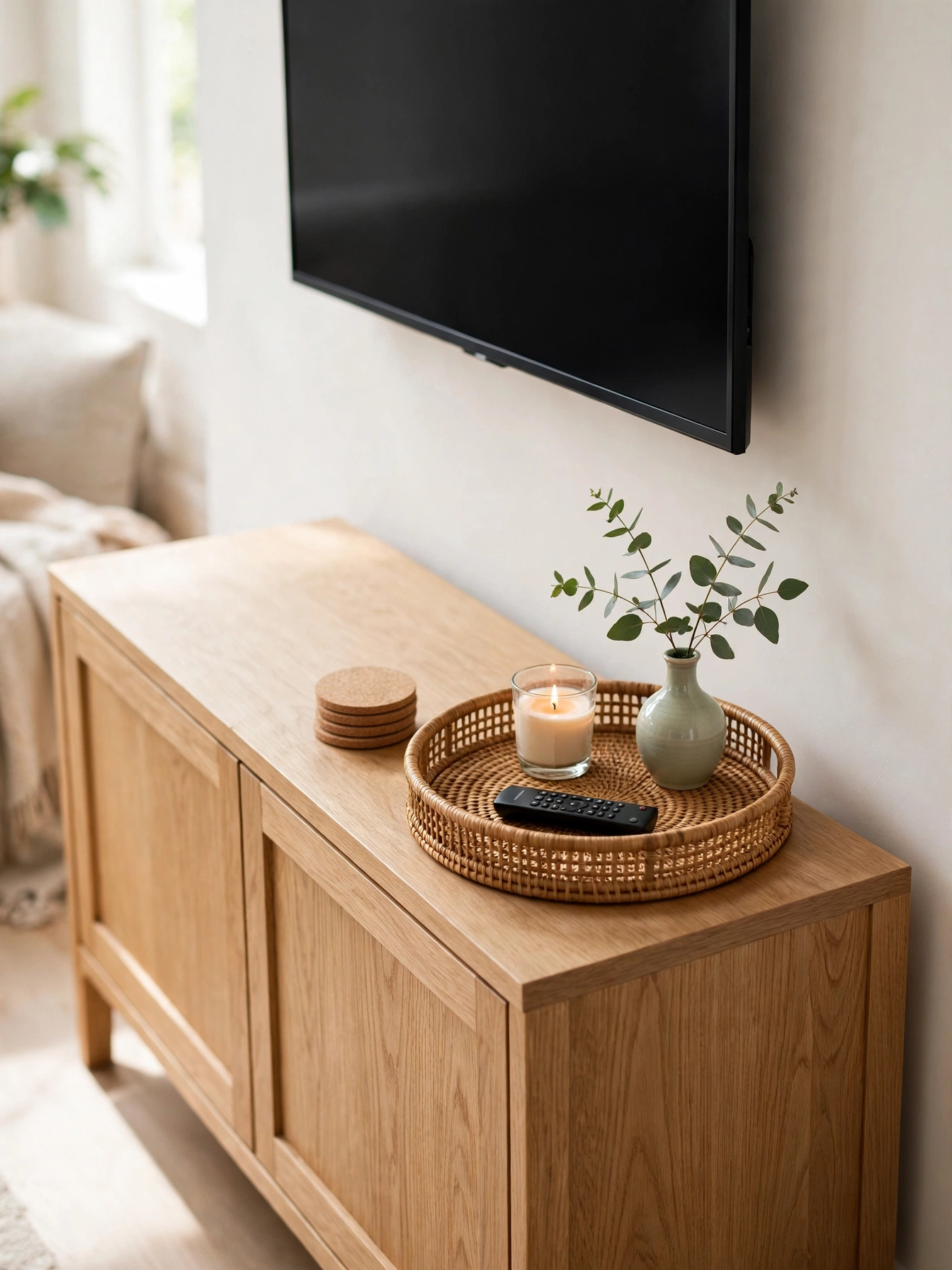
Why This Works:
- A tray turns scattered remotes and candles into one deliberate composition.
- The defined boundary stops everyday items from migrating across the console.
- Rattan texture warms up the tech zone instantly.
- Guests instantly understand the tray is the “landing zone,” which keeps order.
Choose a tray 12-16 inches wide, large enough for 2 remotes, a candle, and one small vase without crowding. Keep tray contents to 3-4 items maximum; the tray is a corral, not a junk drawer. Avoid tall items in the tray, since anything above 8 inches blocks the screen’s lower edge from low seating. Set against loose styling, trays cut daily tidying to a 10-second straighten. HGTV’s organizing features often highlight trays as the simplest way to make open surfaces look styled, and media consoles prove the point.
Anyone whose console doubles as the household command center will feel the difference. A genuine concern is that trays invite piling; enforce the 4-item rule ruthlessly. Rattan trays cost 15-35 dollars, wooden trays run 20-45 dollars, and marble trays start near 40 dollars but chip if remotes drop on them. Felt pads underneath prevent the tray from scratching the console when guests slide it.
Pro Tip: Keep one slot in the tray permanently empty; the breathing room is what makes the other items look styled instead of stored.
Soft Textile Layers

Why This Works:
- Fabric softens the console’s hard edges and the TV’s glass in one move.
- A draped throw adds casual warmth that rigid styling cannot fake.
- Textiles absorb sound, slightly reducing the room’s echo.
- Swapping throws seasonally refreshes the whole media wall for free.
Drape a throw 50×60 inches folded in thirds over one console end, letting 8-10 inches hang for a relaxed cascade. Layer a linen runner 14-16 inches wide underneath vases to protect the finish and add a second texture. Avoid placing textiles within 6 inches of heat vents or on top of warm electronics, since trapped heat and lint do not mix. Contrasted with hard decor alone, textiles make a media wall feel 10 degrees warmer psychologically. Wash throws every 4-6 weeks, because console tops collect more dust than sofas do.
Cozy-style lovers and cold-climate homes get instant warmth. The honest trade-off is lint: knit throws shed onto dark consoles, so choose oatmeal or cream throws for dark wood and darker throws for pale wood. Chunky knit throws cost 30-70 dollars, linen runners run 20-45 dollars, and cashmere-blend throws start near 120 dollars. Keep a lint roller in the nearest drawer for 30-second touch-ups before guests arrive.
Pro Tip: Fold the throw with the finished edge facing the room and the raw fold hidden at the back for a polished drape.
Minimal Living Room TV Stand Decor Ideas for Media Walls
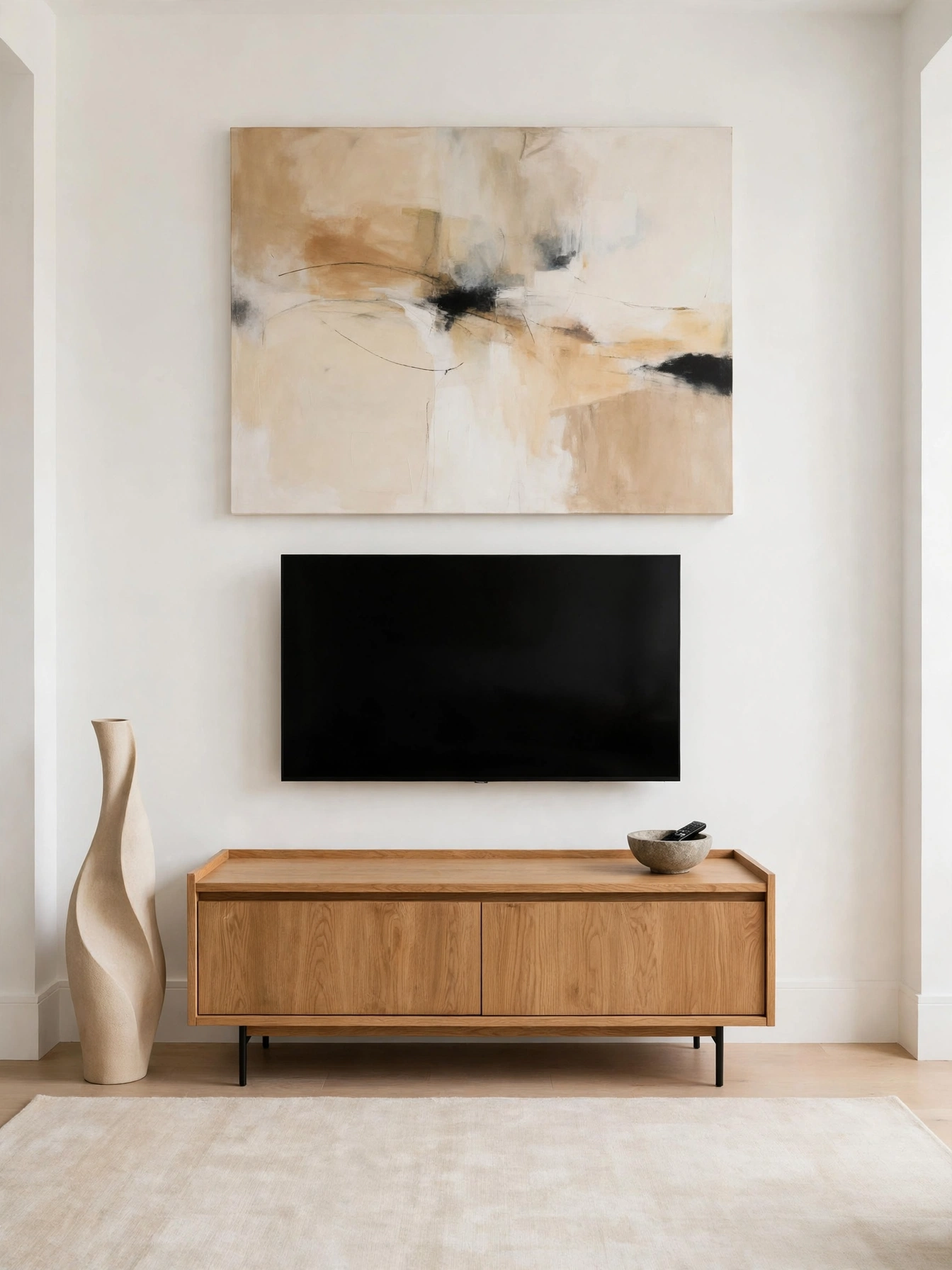
Why This Works:
- Moving the art above the TV shifts focus upward, so the screen stops dominating.
- A 70-percent-empty console reads as confident, not unfinished.
- The tall floor vase adds height that consoles usually lack.
- One bowl corrals the remote, keeping the minimal look functional.
Hang art 4-8 inches above the TV’s top edge, sized 60-80 percent of the TV’s width so the two read as one composition. Choose a floor vase 28-36 inches tall placed 12-18 inches from the console end for a grounded vertical accent. Avoid art with heavy black frames directly above a TV, since the double dark rectangle feels oppressive; light wood or thin metal frames work better. Weighed against console-top styling alone, the media-wall approach treats the whole wall as the canvas. Gallery hanging height (center at 57-60 inches) still applies to the art, not the TV.
Design-forward households with large blank walls get a gallery effect for the price of one print. The downside is scale judgment: small art above a big TV looks lost, so measure twice. Large abstract prints cost 40-120 dollars, tall floor vases run 35-90 dollars, and stone bowls add 15-35 dollars. Secure tall vases with museum putty if the floor gets bumped by vacuum cleaners.
Pro Tip: Match the art’s widest tone to your wall color so the piece adds texture without adding a new color to the room.
Botanical Shelf Accents
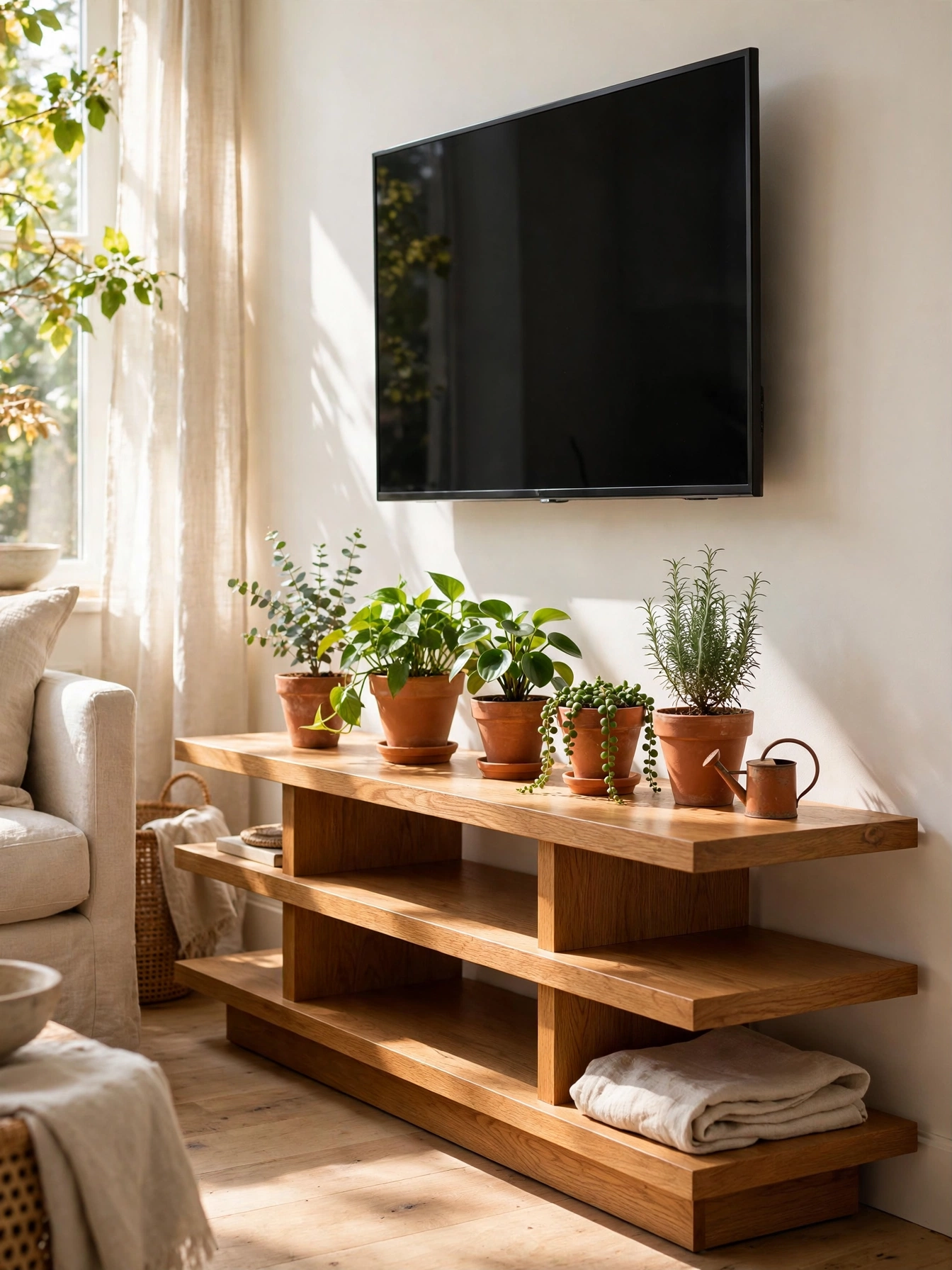
Why This Works:
- A row of small plants creates a living green band that balances the screen.
- Terracotta’s warm orange plays beautifully against oak and cream.
- Small pots let you group 5-7 plants in just 36 inches of shelf.
- The collection reads as one garden, not seven separate chores.
Use 4-inch terracotta pots spaced 1-2 inches apart along a 30-36 inch shelf tier, varying plant heights between 6 and 12 inches for a natural rhythm. Terracotta breathes, so plants in these pots need water every 5-7 days versus 7-10 in glazed ceramic. Avoid placing the collection where TV heat vents blow directly, since constant warm air dries soil in 2-3 days. Measured against one large plant, a collection lets you remove a struggling plant without ruining the display. Set all pots on a single 36-inch waterproof tray, which makes watering day a 2-minute lift-and-carry.
Plant people with bright TV walls finally have a use for that sunny spot. The flip side is watering frequency: small pots dry fast, so this suits attentive owners, not frequent travelers. Small potted plants cost 5-12 dollars each, terracotta pots run 3-8 dollars, and a long tray adds 10-20 dollars. Group plants with similar water needs together to simplify the routine.
Pro Tip: Slip a 1-inch pebble layer under each pot inside the tray so pots never sit in drained water and roots stay healthy.
Seasonal Console Refresh
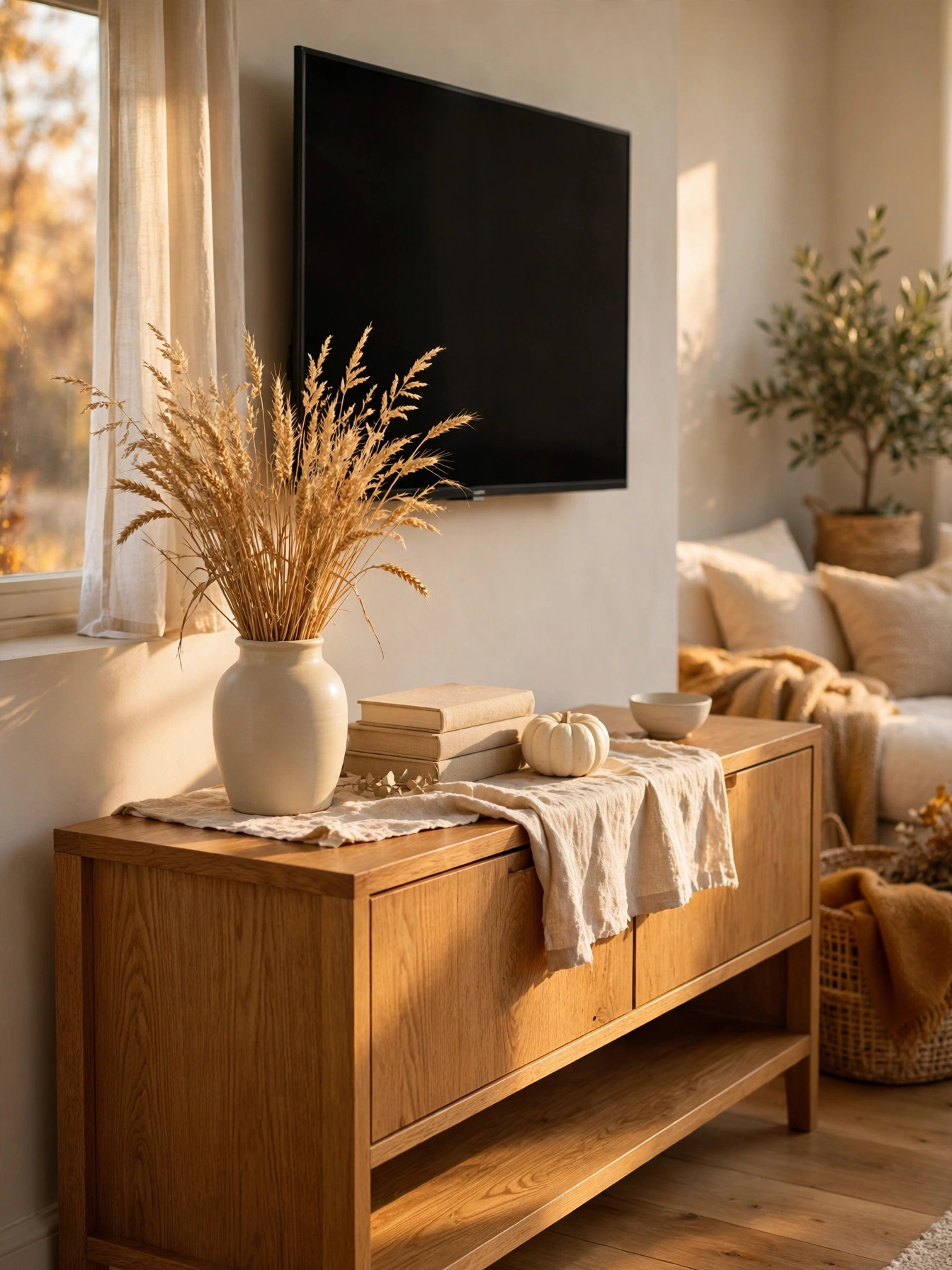
Why This Works:
- Swapping 2-3 items seasonally keeps the console feeling fresh for under 20 dollars.
- Dried wheat and one pumpkin nod to fall without a full redecoration.
- Keeping the base styling neutral means seasonal swaps take 10 minutes.
- Natural seasonal items photograph beautifully for Pinterest.
Limit seasonal additions to 3 items maximum: one tall (dried stems 18-24 inches), one small (a 4-6 inch pumpkin or pinecone bowl), and one textile swap (a rust or sage throw). Store off-season items in one labeled 12-quart bin so the swap stays effortless. Avoid themed figurines and plastic pumpkins near a serene console, since they clash with the calm aesthetic; natural materials blend in. Side by side with redecorating the whole room, a console refresh delivers 80 percent of the seasonal feeling for 10 percent of the effort. Swap back promptly after the season, because lingering pumpkins in December look forgotten.
Seasonal decorators and Pinterest savers get maximum impact per dollar. The caveat is storage: even 3 items per season need a bin, so commit to one small container. Dried wheat bundles cost 8-15 dollars, small real pumpkins run 3-6 dollars, and a seasonal throw adds 20-40 dollars. Buy dried stems once and reuse them for 2-3 years; they age gracefully.
Pro Tip: Photograph your everyday console styling before the seasonal swap so restoring the original look takes seconds, not guesswork.
Hidden Cord Solutions

Why This Works:
- Hidden cords remove the single biggest source of media-wall visual noise.
- A 20-dollar cord cover delivers a result that looks professionally installed.
- Bundled cables behind the console make dusting a one-wipe job.
- The calm surface finally matches the serene styling above it.
Gather all cables with reusable velcro ties every 8-12 inches, then route the bundle into a cable box 12-16 inches long holding the power strip. Run one paintable cord cover (1.5 inches wide) from the console to the floor outlet, painted to match the wall with a small foam roller. Avoid coiling excess cable into tight loops, which traps heat; loose figure-eight bundles run cooler. Next to in-wall routing, surface cord covers install in 20 minutes with no electrician and cost 90 percent less. Label each cable with a 1-dollar tag so future swaps take seconds.
Anyone bothered by cable spaghetti gets instant relief here. One honest drawback is perfectionism: surface covers never look quite as clean as in-wall routing, though painted channels come close. Velcro ties cost 6-10 dollars per pack, cable boxes run 15-30 dollars, and paintable cord covers cost 12-25 dollars. Unplug and inspect the bundle yearly, since dust buildup around warm power strips is a genuine fire consideration.
Pro Tip: Plug everything into the power strip inside the cable box first, then close the lid; the box hides the strip while its open back keeps air flowing.
FAQs
How wide should a TV stand be for the best living room tv stand decor ideas?
Choose a stand 10-20 percent wider than your TV: a 55-inch TV measures about 48 inches wide, so a 56-60 inch console gives balanced proportions. The Spruce recommends this range for media furniture. Stands narrower than the TV look unstable and leave no room for styling at the ends.
What is the right height for a TV console?
Standard consoles measure 22-28 inches tall, which puts a wall-mounted TV’s center near the 42-inch seated eye level most sofas need. Low-profile units run 12-18 inches for floor-seating rooms. Keep the TV’s bottom edge 4-8 inches above the console top for comfortable viewing.
How do I hide cords in living room tv stand decor ideas without drilling?
Bundle cables with velcro ties every 8-12 inches, hide the power strip in a 15-30 dollar cable box, and run one paintable 1.5-inch cord cover to the outlet. Houzz editors note these install in 20 minutes with no electrician. Paint the channel to match your wall.
How many decorative objects belong on a TV console?
Style 3-5 objects on the top surface and fill open shelves to 60-70 percent capacity. The American Lighting Association suggests keeping decor at least 6 inches from heat-producing electronics. Fewer, larger pieces photograph calmer than many small ones, and dusting takes half the time.
Should the TV be mounted or placed on the stand?
Wall mounting frees the full console top for styling and suits most rooms, while stand placement works better for renters avoiding wall holes. Mounted setups need a 6-inch gap between the TV’s bottom edge and the console. Center the screen at seated eye level, roughly 42 inches.
Conclusion
A serene TV console comes down to three things: right-sized furniture, a restrained hand with decor, and invisible cords. These living room tv stand decor ideas work because they treat the console as part of the room’s design, not just a shelf for electronics. Start with one clear action today: unplug everything, bundle the cables with velcro ties, and restyle the top with just three objects. Follow HomelyCrafter on Pinterest for more ideas. Once the cords disappear and the surface breathes, the whole living room feels calmer. Save this to your Pinterest boards so you can refer back to it!

Muhammad Israr is a home decor enthusiast and the writer behind Homely Crafter. He spends his days researching paint colors, layouts and budget-friendly styling ideas, then breaks them down into practical, easy-to-follow guides so you can decorate with confidence.