
White cabinets look crisp on the day they are painted, then every fingerprint, scuff and splash shows up by the end of the week. Blue kitchen cabinets solve that daily frustration without turning the room dark or dated, because a mid-tone blue hides small marks while it still reads as a classic kitchen color. A navy base with white uppers feels grounded, a powder blue reads soft in a small room, and both pair with the same brass pulls, white counters and wood floors most kitchens already have.
Across the 24 ideas below, paint names sit beside finish choices, hardware sizes and the measurements that keep a blue room balanced, while cost, upkeep and the rooms where blue struggles least get an honest look too. Every idea names the cabinet style, the finish worth asking for, and the small detail that stops the color feeling flat.
Deep Navy Base
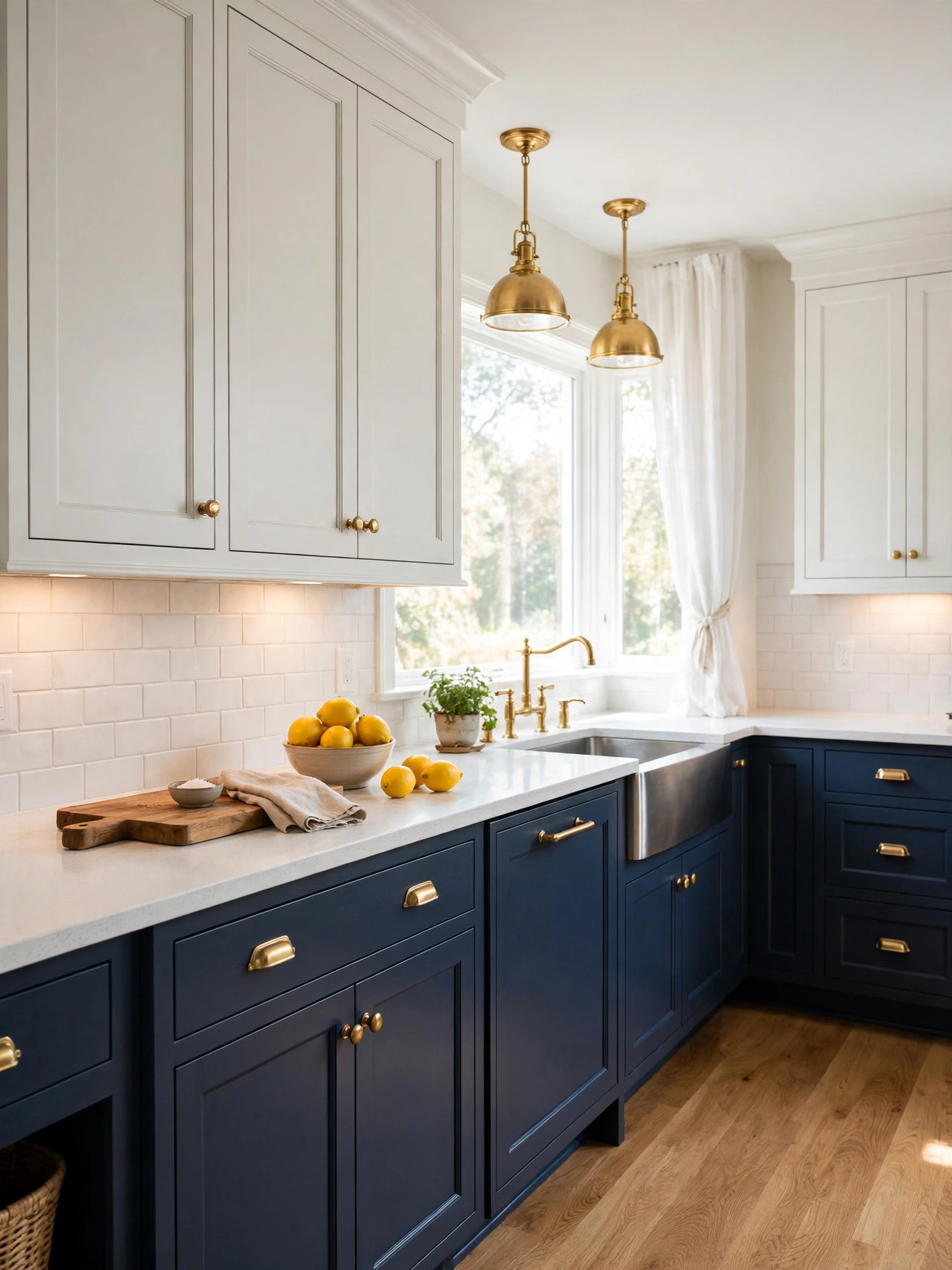
Why This Works:
- Navy bases ground the room while white uppers keep the light
- A satin finish wipes clean and hides small fingerprints
- Brass pulls warm up the cool blue tone
- Dark lowers show fewer scuffs than white lowers
A deep tone is the safer pick for navy bases, such as Benjamin Moore Hale Navy or Sherwin-Williams Naval, on maple or MDF doors that hold the dark color without the grain showing through. Keep upper cabinets white or cream so the room keeps its brightness, and set uppers 18 inches above the 36 inch countertop, which is the National Kitchen and Bath Association guideline for clearance. Cabinet paint needs a satin or semi-gloss finish rated for kitchen use, since flat paint absorbs grease and marks within weeks. A satin sheen across the full run keeps brush marks out of sight, and the finish stands up to a weekly wipe without dulling.
Navy hides the scuffs and splashes of daily cooking far better than white, and the dark base keeps looking tidy between weekly wipes. A gallon of quality cabinet paint covers about 350 square feet, and a full repaint of base cabinets usually needs 2 gallons plus primer. Oil-based paint levels smoother than latex but smells stronger and dries slower, so water-based acrylic enamel dries faster and cleans up with water. Test the navy on a 2 foot by 2 foot board and view it at morning and evening light before committing.
Powder Blue Uppers
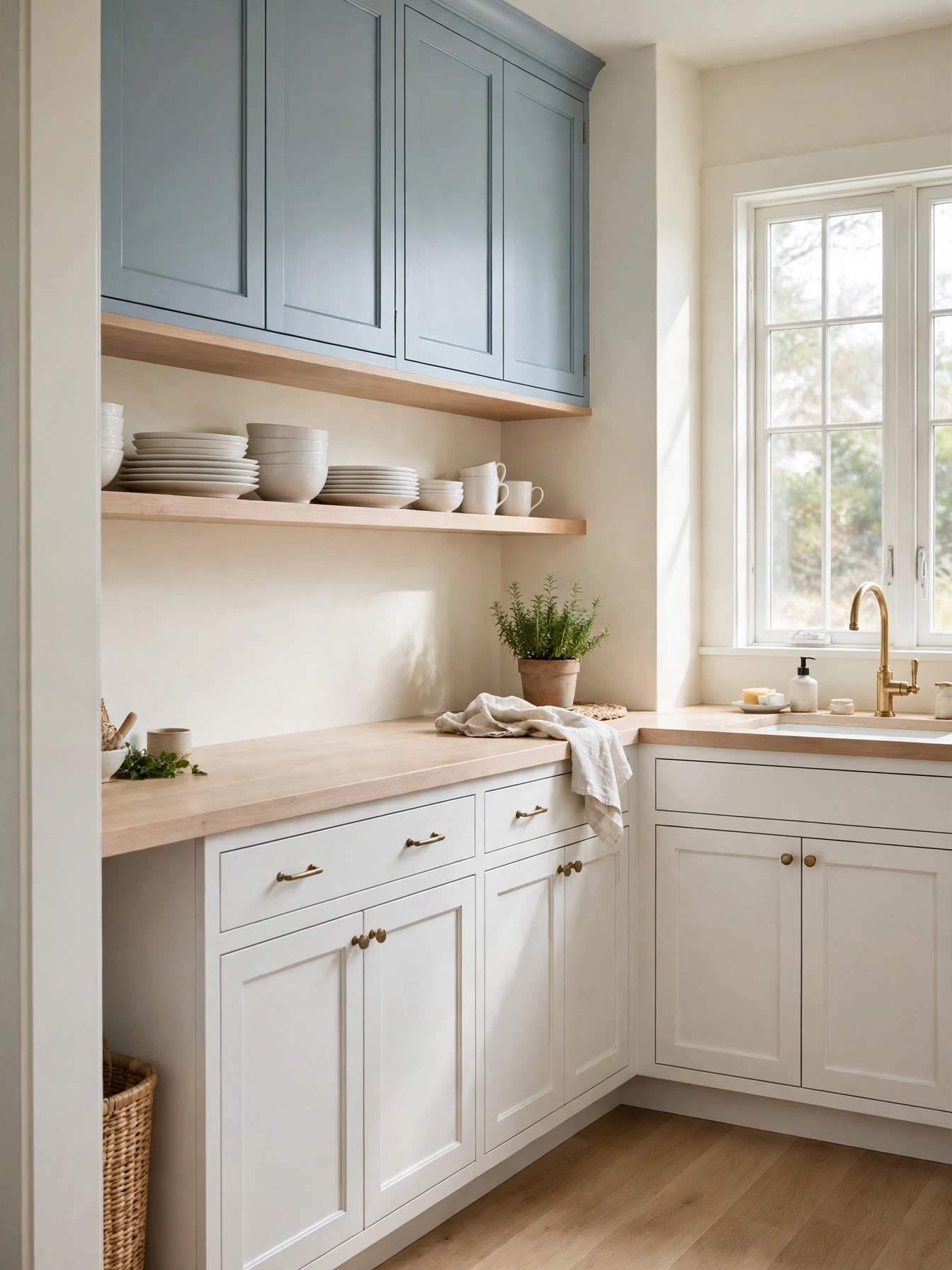
Why This Works:
- Pale blue uppers lift a small kitchen without glare
- White lowers keep the floor line bright and clean
- Powder blue pairs well with pale oak and cream
- Soft color hides dust better than pure white
Powder blue uppers lift a small kitchen because the pale tone reflects light instead of absorbing it, and a color such as Benjamin Moore Palladian Blue keeps the room airy. Keep the uppers in a satin finish and the lower cabinets white, so the contrast stays soft rather than sharp and the pale doors still read as blue in daylight. Upper cabinets should measure 12 inches deep and sit 18 inches above the counter, which leaves room for a coffee maker and a cutting board below. A room with one small window needs the palest blue on the card, or the uppers turn gray by evening.
A pale blue upper run makes a galley kitchen feel wider, especially when the backsplash stays white. The Spruce notes that light cabinet colors reflect more daylight than dark ones, which matters in a north-facing room. Laminate doors wipe clean easily and need no special cleaner. Their edges chip within a few years, and only painted maple takes a brush touch-up. Keep the hardware simple, with slim bar pulls 5 inches long, so the pale doors stay the focus.
Navy Blue Kitchen Cabinets
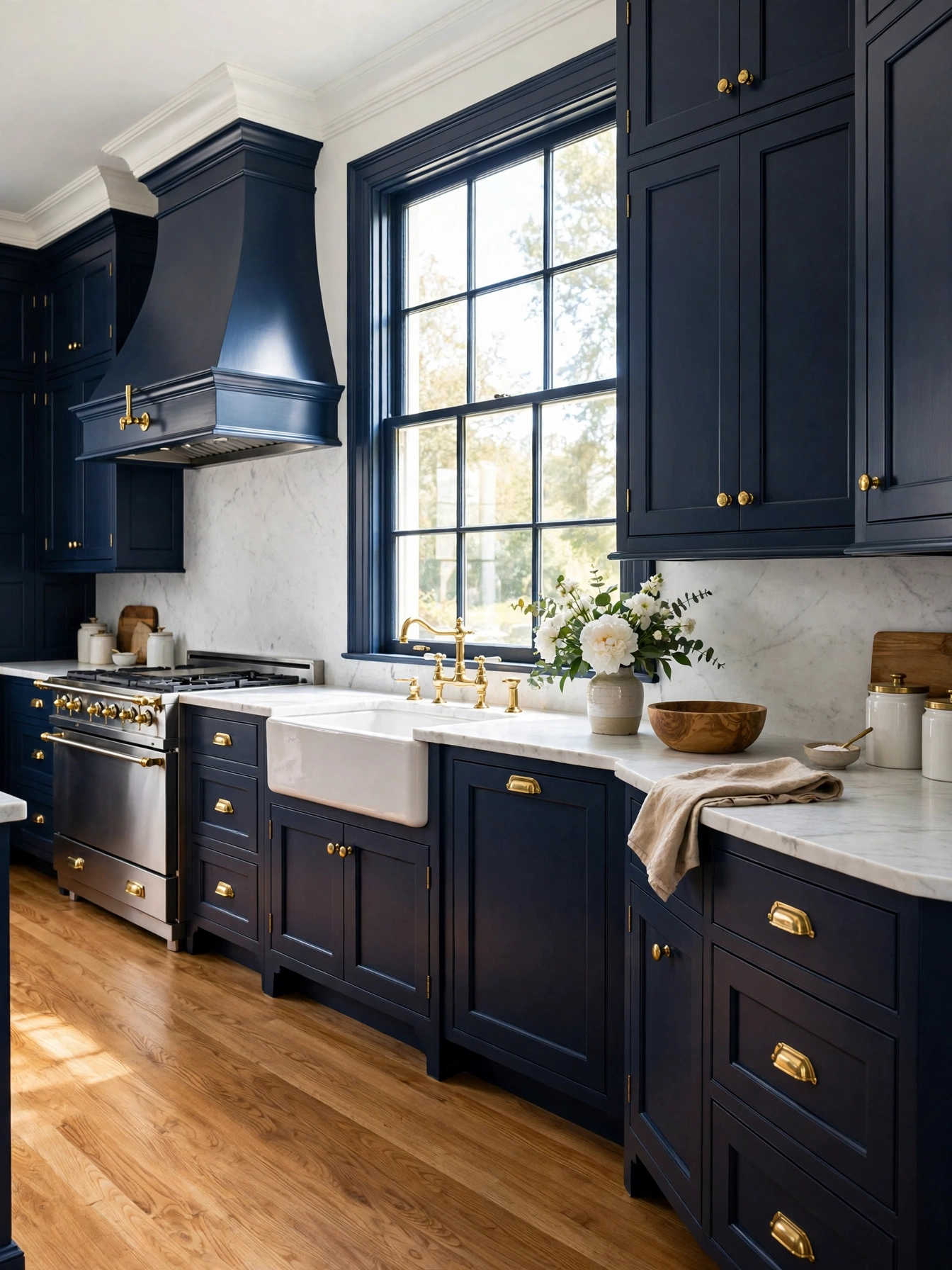
Why This Works:
- Full navy reads as one confident design choice
- White marble breaks up the dark cabinet run
- Brass hardware adds warmth to every door
- A large window keeps the dark color from feeling heavy
Without strong daylight or good lighting, a full navy kitchen falls flat. A window over the sink plus under-cabinet LED strips at 2700K to 3000K keeps the color readable after dark. Use the same navy on uppers and lowers, in a satin finish, on maple doors that are 3/4 inch thick, so the color reads as one confident run from floor to ceiling. Keep the countertop white, such as quartz or marble, and the backsplash white subway tile 3 by 6 inches, so the navy has a bright frame. Rooms under 10 by 12 feet with a single small window keep navy to the base run only, where the white uppers still carry the light.
The payoff is a kitchen that hides wear and still looks intentional years later. Navy pairs with oak, walnut and brass, while it clashes with cool gray floors and chrome-heavy fittings. A full repaint takes about 5 days for a medium kitchen, with doors removed and sprayed off site for the smoothest finish. Quartz counters need no sealing and shrug off citrus. Marble needs sealing every 6 months, and a lemon left sitting on it leaves a stain.
Two Tone Blue

Why This Works:
- Two blues add depth without a second color family
- Dark lowers hide kicks and scuffs at floor level
- Light uppers keep the ceiling line bright
- One paint brand keeps both tones in the same family
For two-tone blue, the two shades need at least 3 steps between them on the same paint card, such as navy below and powder blue above. Give lowers and uppers the same satin sheen, so the two blues match in light as well as color, with the darker navy below and the powder blue above. Keep the island in the darker navy to anchor the floor, and use white for the countertop and backsplash so the blues stay the focus. Three steps of separation on the paint card is the minimum gap that reads as a deliberate pair.
The split keeps navy to the base run, so a single band of dark paint reads as a deliberate accent rather than a full-room commitment. Repainting only the lowers takes a weekend and about 2 gallons of paint plus primer, and the uppers can change later without touching the base run. A professional spray finish leaves no brush marks, which matters on flat slab doors. The smooth result comes from the spray equipment, not the paint itself. Keep hardware the same across both tones, with 5 inch bar pulls on drawers and knobs on doors, so the room reads as one plan.
White Marble Pairing
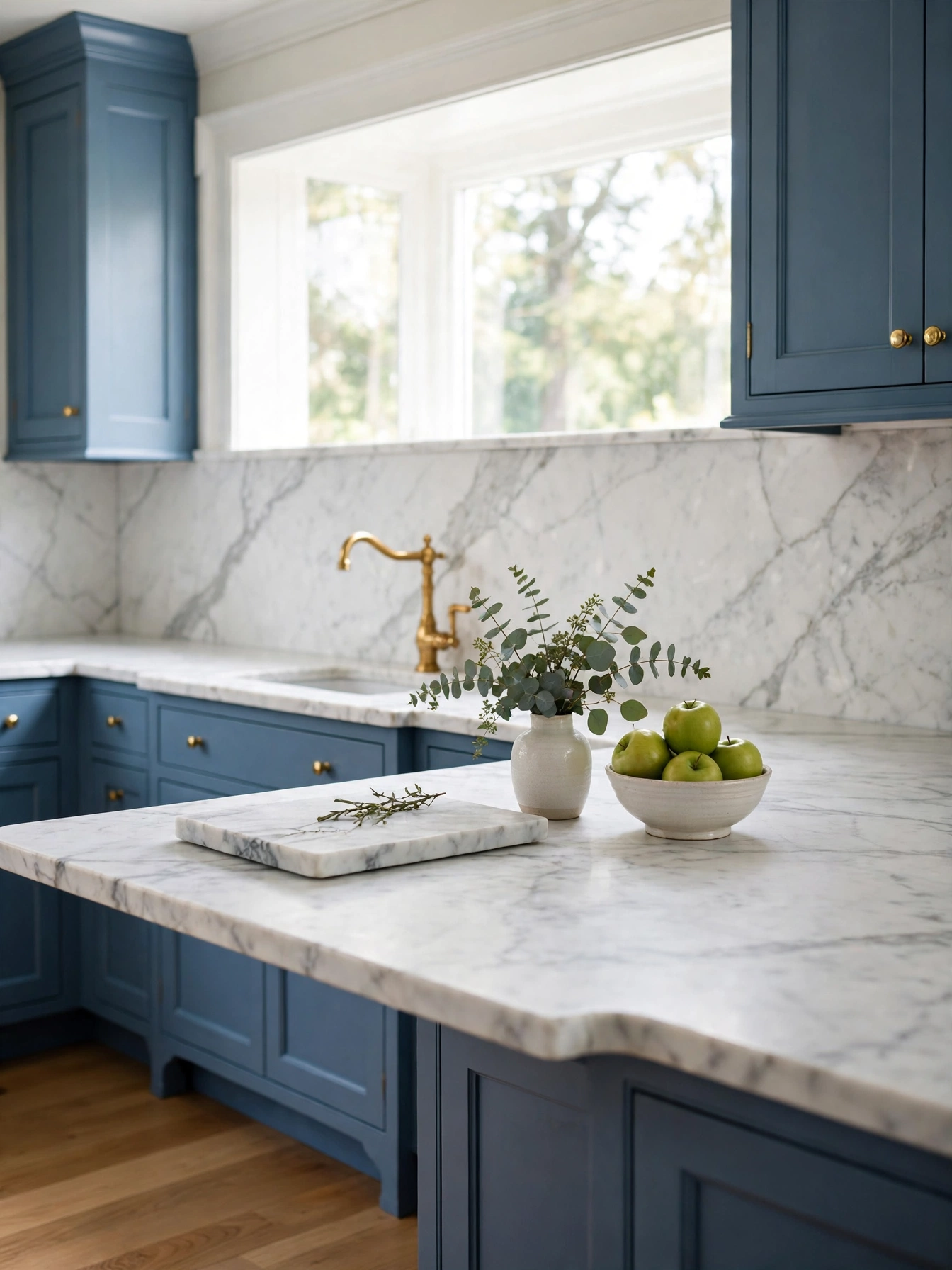
Why This Works:
- White marble cools the blue and adds natural pattern
- Gray veining ties the counter to the cabinet tone
- A marble backsplash removes the grout line at the counter
- Brass warms the cool stone and blue pairing
Lemon juice or vinegar left sitting for more than a few minutes will etch marble, so a sealer plan comes first when white marble pairs with blue cabinets. Choose a marble slab 3 centimeters thick for the countertop, with a 4 inch backsplash or a full-height slab behind the range. Keep cabinet blue in a mid-tone, such as a dusty navy, so the marble veins read against it without fighting a very dark base. Three pale surfaces in one run blur into each other, so the marble needs a mid-tone blue beside it to hold its edge.
Marble runs 75 to 200 dollars per square foot installed, and sealing takes 30 minutes every 6 months. With daily use, marble develops a soft patina, and the veining keeps the surface looking natural even as small marks appear. Quartz resists stains better and asks almost nothing afterward, while marble brings a pattern no factory slab can copy. Wipe spills at once, and keep a trivet near the range for hot pans.
Brass Hardware Accent

Why This Works:
- Brass warms cool blue in a way chrome cannot
- Bar pulls 5 inches long suit wide drawers
- Matching faucet and pulls tie the room together
- Unlacquered brass gains a soft patina over time
Keep brass hardware matched across pulls, knobs and faucet on blue cabinets, or the metals will fight each other at a glance. Wide drawers take a 5 inch bar pull, doors take a round knob about an inch and a quarter across, and the screw length has to match 3/4 inch door stock. Leave 2.5 inches between the pull and the drawer edge, with the pull centered, so hands never brush the door frame. One metal family across pulls, knobs and faucet reads collected; a third metal reads unfinished.
Hardware is the cheapest way to change the feel of blue cabinets, and the swap needs no paint, no dust and no drying time. Solid brass lasts longer than plated zinc, which flakes at the edges after a few years of daily use. Lacquered brass stays bright, while unlacquered brass darkens with touch, so pick the finish that matches how much change feels welcome. A full set of brass pulls for a medium kitchen costs 200 to 500 dollars, depending on the count, and fitting takes about 2 hours with a drill template.
Shaker Blue Doors
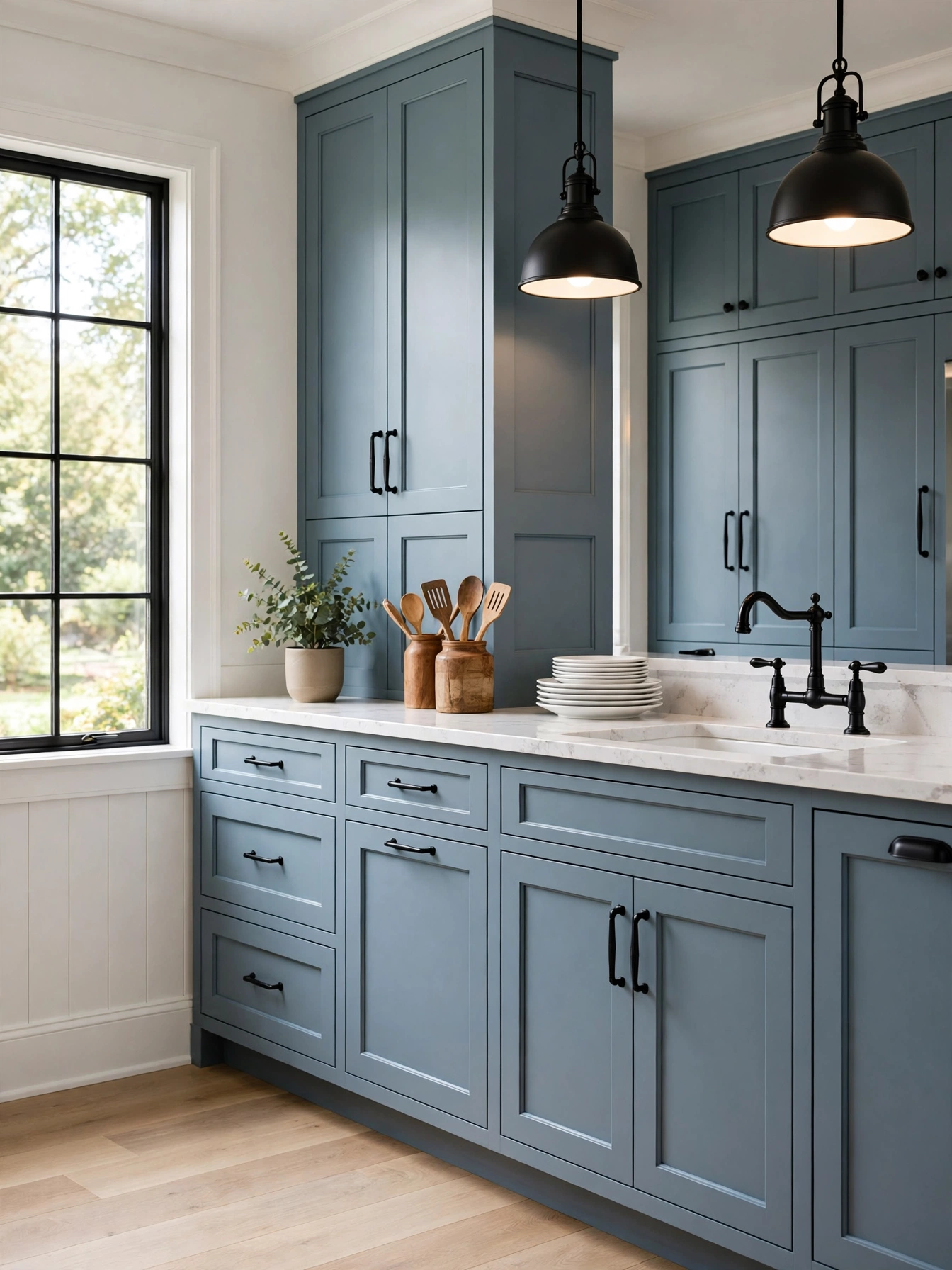
Why This Works:
- Shaker panels add texture without ornate carving
- The dusty tone suits the simple frame and flat panel
- Recessed panels hide small dents better than flat slabs
- Black hardware gives the soft blue a clear edge
At the recessed panel corners, brush marks show up fast, which is why a paint that levels well matters for blue shaker doors. Choose maple shaker doors with a 2.5 inch frame, painted in 2 coats of satin acrylic enamel over primer, and keep the panel flat rather than raised. Door thickness should measure 3/4 inch, with soft-close hinges rated for 100 pounds per pair, so heavy doors close without slamming. Satin keeps the panel shadow even; gloss turns every recess into a highlight.
The recessed panel has stayed in demand for decades, and that steady demand keeps the style from dating fast. Houzz notes that shaker cabinets remain one of the most requested door styles, because the plain frame has stayed in demand across decades of kitchen trends. Slab doors carry a clean face with no frame to catch dust. Every fingerprint shows on a dark blue surface, so keep a cloth nearby. Keep the blue dusty rather than bright, and pair it with white counters for a calm result.
Blue Island Centerpiece
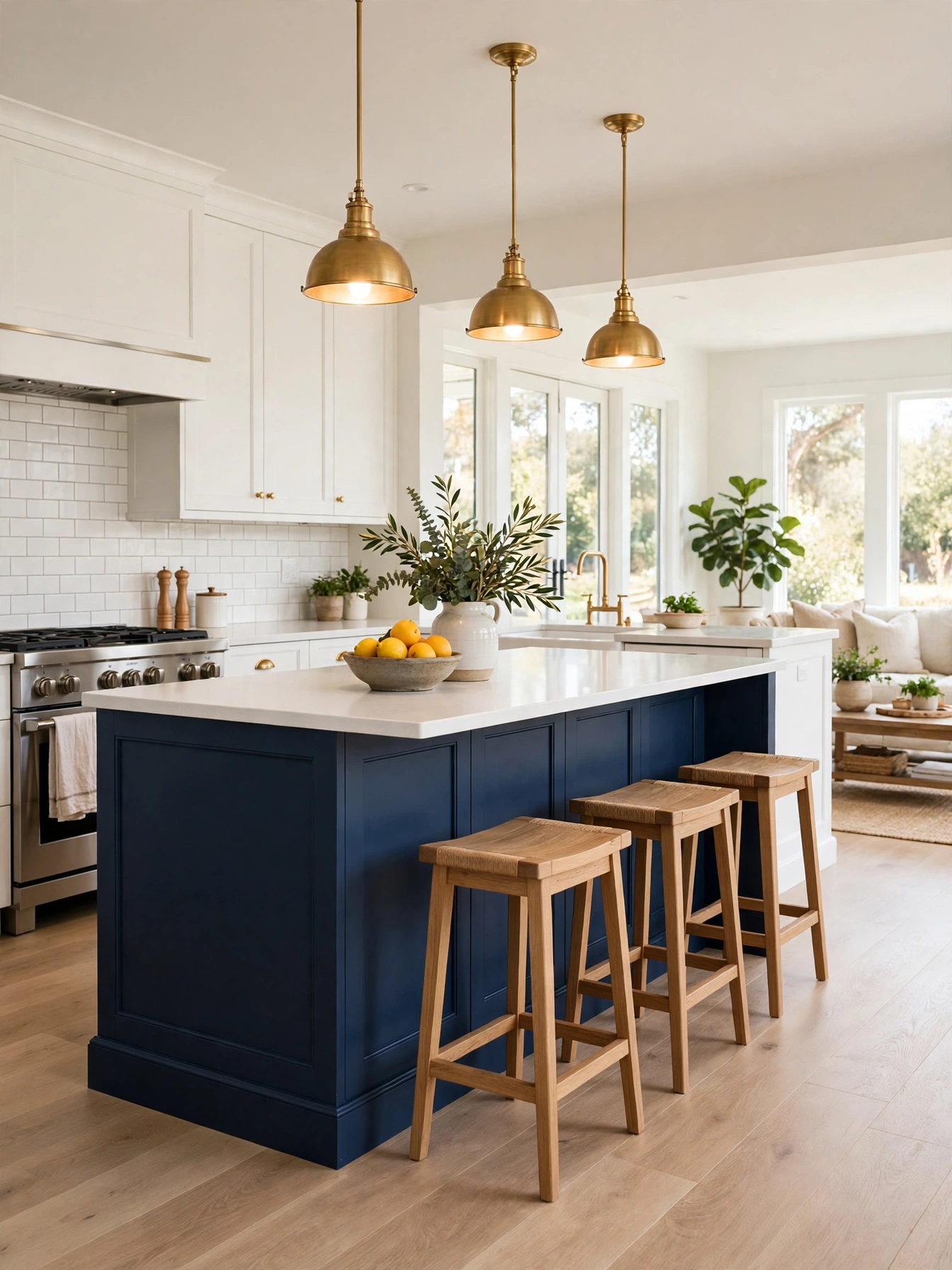
Why This Works:
- One blue island adds color without repainting the room
- White perimeter cabinets keep the kitchen bright
- A 12 inch overhang gives knees room at the stools
- Brass pendants link the island to the rest of the room
With the perimeter kept white, a blue island becomes the room anchor, and the island size decides the seating. Build the island 72 to 96 inches long and 36 inches wide, with a 12 to 15 inch overhang on the seating side and 24 inches of width per stool. Leave 42 to 48 inches of walkway on every side, the working-kitchen clearance from the National Kitchen and Bath Association. Pendant lights should hang 30 to 36 inches above the countertop, spaced 24 to 30 inches apart, so the island lights evenly. A 72 inch island is the smallest size where the blue reads as a centerpiece rather than an accent.
Painting only the island takes a weekend and often under 500 dollars in paint and primer. The island becomes the spot for breakfast, homework and conversation, while cooking stays at the perimeter. A stone waterfall edge adds drama for 800 to 2,500 dollars in extra stone. A simple eased edge needs no extra stonework, so the top stays a standard fabrication job. Choose a durable satin finish, since island bases take more kicks than wall cabinets.
Coastal Blue Palette
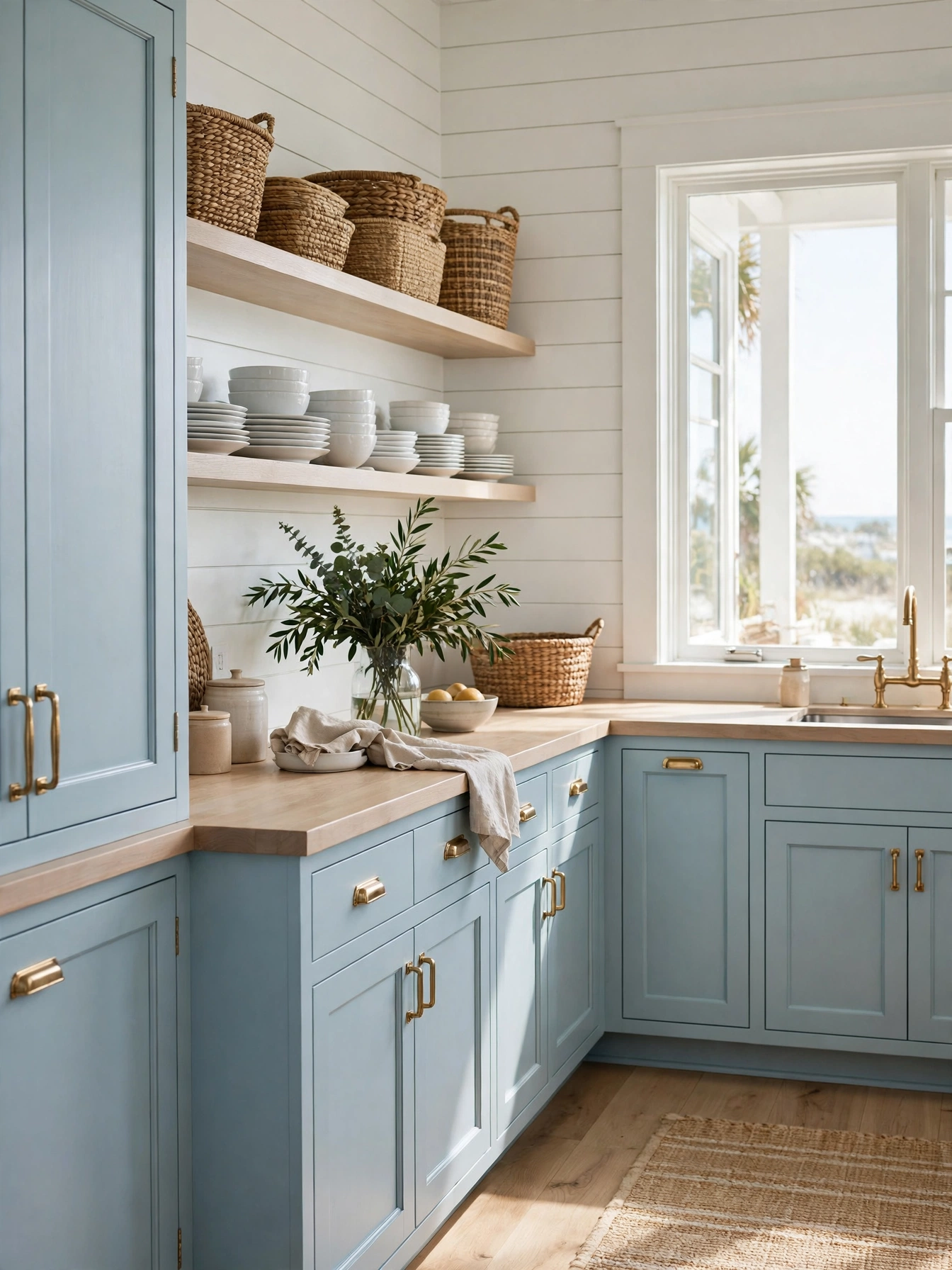
Why This Works:
- The pale shade reads as sea and sky without a theme
- White shiplap adds texture behind the pale cabinets
- Pale oak warms the cool coastal palette
- Woven baskets add natural texture to the shelves
Pale, gray-blue is the coastal range to stay inside, not bright turquoise, so the room feels calm rather than themed. Use a color such as a soft sea blue on maple doors in a satin finish, and pair it with white shiplap and pale oak counters that warm the cool tone. Keep the backsplash simple, with white subway tile 3 by 6 inches, and limit the palette to blue, white and one wood tone. Shells and rope belong in a beach cottage, not on cabinet doors; the pale blue alone carries the coastal feel.
Good daylight and a view bring this palette alive, and it reads just as well in a city flat as in a beach house. A wood countertop needs oiling every 3 months to stay sealed, while quartz needs no oiling at all and wipes clean with a damp cloth. Open shelves with baskets need a weekly wipe, since dust settles on every open surface. Keep only daily dishes up there, and the wipe takes five minutes. Keep the hardware in brushed nickel or white, which leaves the pale blue as the lightest tone in the room.
Matte Blue Finish
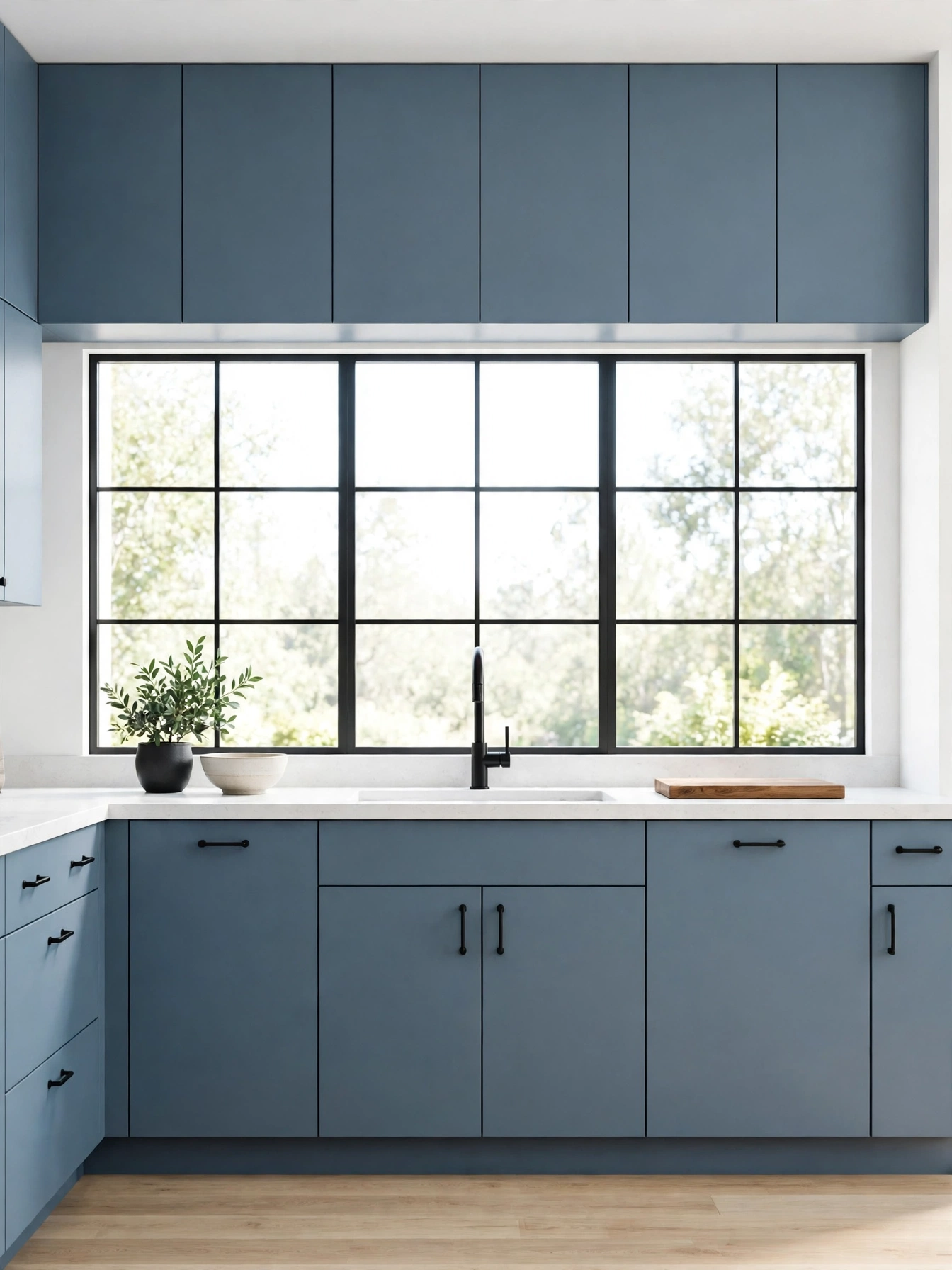
Why This Works:
- Matte blue softens a modern flat door
- No shine means fewer visible fingerprints
- Flat panels suit a handleless kitchen well
- Matte pairs cleanly with black fixtures
A damp cloth leaves marks on a standard matte finish, so only a washable formula belongs on matte cabinets. Choose a matte or dead-flat acrylic enamel rated for cabinets, on MDF flat doors 3/4 inch thick, since the flat door shows the finish with nothing to hide behind. Keep the blue dusty and mid-tone, since a very dark matte blue looks chalky under bright light. Touch up with a small foam roller rather than a brush, so the repair blends into the flat surface. Beside the sink, only a washable label earns the matte finish; everywhere else the formula is safe.
A matte surface soaks up light instead of throwing it back, so the room reads softer and the flat doors show no glare at any hour. The finish hides small dents better than gloss, but it shows grease near the range, so a wipe after cooking matters. A licensed cabinet painter can spray a matte finish evenly for about 3,000 to 6,000 dollars for a medium kitchen, and the even coat comes down to spray equipment and dust control, which a pro brings to the job. Brushed matte leaves visible strokes on flat doors. The paint itself is cheap; the finish is the problem.
Brass on Blue Cabinets
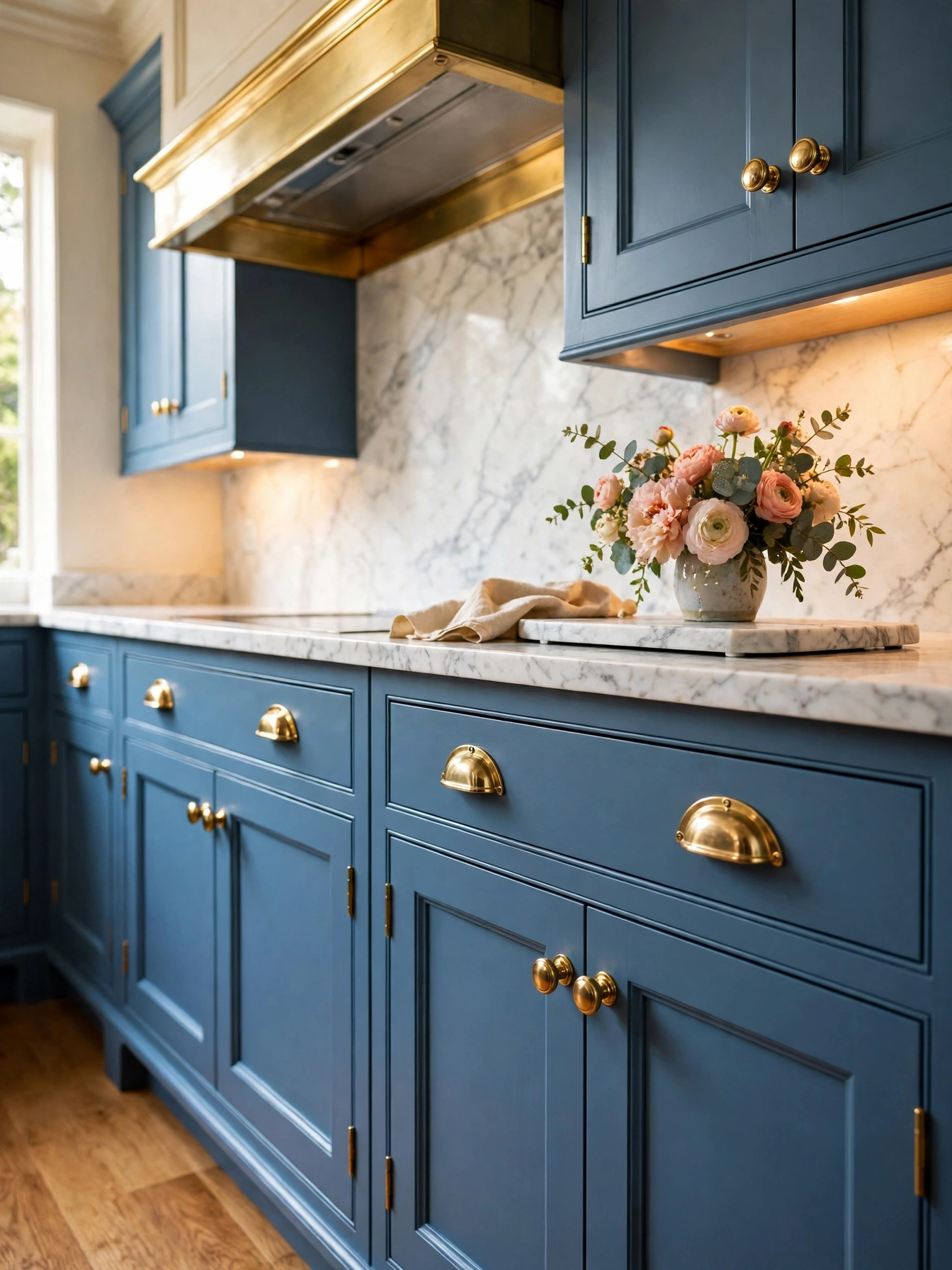
Why This Works:
- Polished brass pops against medium blue
- Cup pulls suit drawers that open dozens of times a day
- Brass trim on the hood repeats the hardware tone
- Medium blue keeps the brass from looking too formal
With medium blue cabinets, one brass tone carried across every pull, knob and faucet keeps the metal from fighting itself, so choose polished, satin or unlacquered and stay with it. Fit cup pulls on drawers 24 inches wide or more, with the pull centered and 2.5 inches from the top edge, and knobs 1.25 inches in diameter on doors. Fit 3/4 inch doors on soft-close hinges, so the heavier brass hardware does not pull the door out of square. Warm brass needs a warm or neutral blue beside it; a cool gray-blue leaves the metal looking out of place.
A full brass hardware set runs 300 to 700 dollars for a medium kitchen, and solid brass outlasts plated zinc by years. The pairing reads warm and a little formal, and the brass tone repeats across pulls, knobs and the hood trim. Polished brass shows fingerprints and needs a weekly polish, while satin brass hides touch marks and keeps its tone with a quick wipe. Keep the countertop white, so the blue and brass stay the clear focus.
Glass Front Blues

Why This Works:
- Glass fronts break up a long blue cabinet run
- White dishes inside brighten the blue frame
- Interior lights make the display glow at night
- Two glass doors are enough, the rest can stay solid
Tempered glass 1/8 inch thick, set in a maple frame painted the same dusty blue as the solid doors, is the starting point for glass front uppers in blue. Limit glass to 2 doors, usually flanking the range hood or the sink, so the display stays edited and the storage stays practical. Fit a warm white LED strip, at 2700K to 3000K, along the top of each glass cabinet, on a wall switch, so the dishes glow after dark. Two glass doors give the display; the remaining uppers stay solid and hold the everyday clutter.
Each glass door adds about 150 to 300 dollars to the door price, and the glass needs a wipe every week to stay clear. Matching white dishes read as a single bright band behind the glass, and the blue frame turns a plain shelf into the room’s focal point. Frosted glass forgives a crowded shelf, though the display loses some glow, and clear glass keeps the brightest view when the shelves stay edited. Paint the inside shelves white and the dishes take over the display, pale plates glowing against the blue frame.
Farmhouse Blue Cabinets
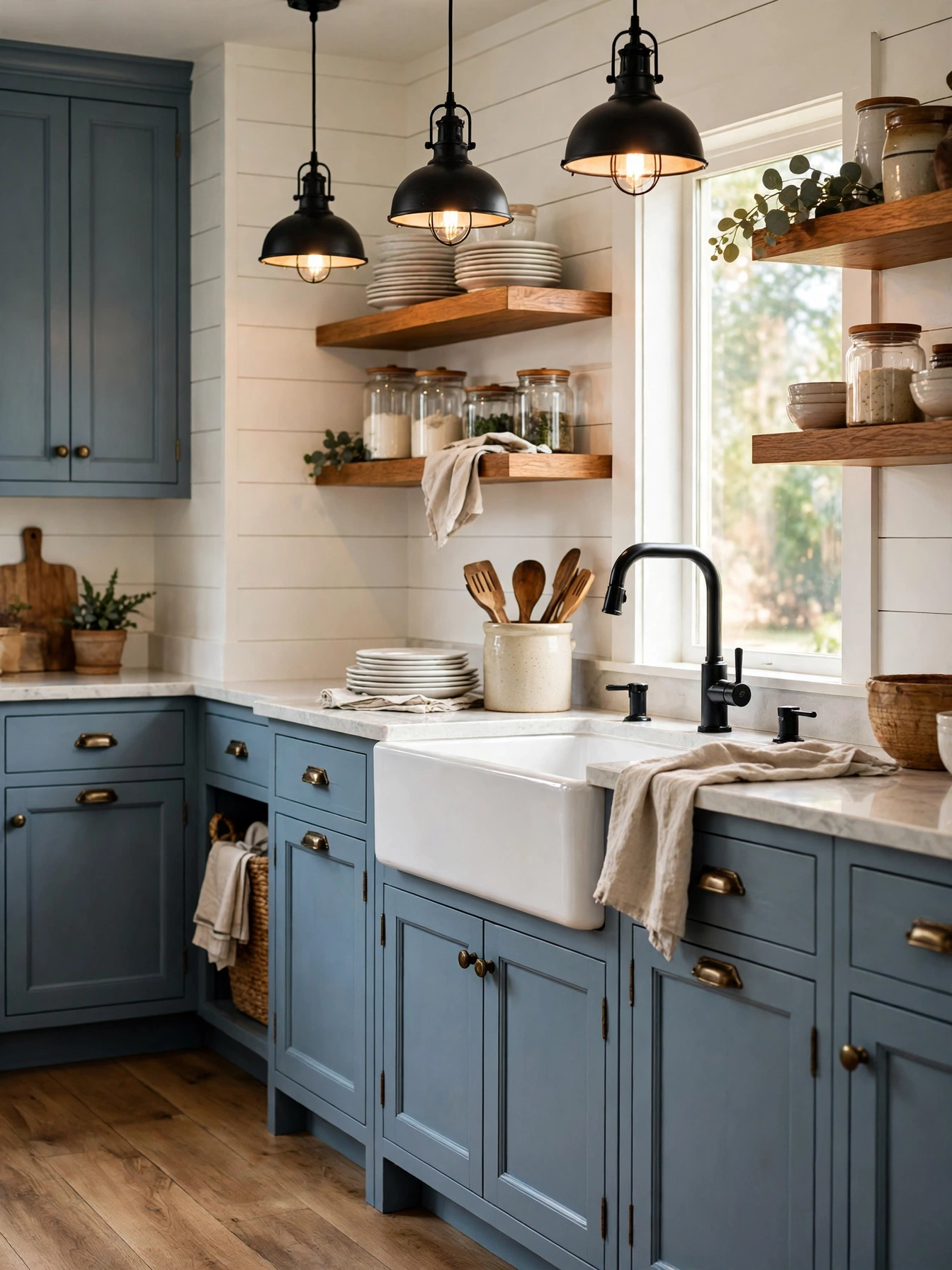
Why This Works:
- Muted blue softens the farmhouse look without gray
- A white apron sink gives the blue a bright center
- Wood shelves warm the painted cabinets
- Black pendants add a clear farmhouse edge
On shaker or beadboard doors, a dusty, gray-blue tone gives farmhouse blue cabinets their relaxed character, and the muted color lets the white sink and wood shelves carry the brightness. Pair the blue with a white fireclay apron sink 30 inches wide, which needs a cabinet base 33 inches wide to support its 80 pound weight. Keep the countertop light, such as white quartz or pale wood, and use open wood shelves 12 inches deep beside the sink for daily dishes. A dusty gray-blue sits easily beside linen and wood; royal blue belongs in a bolder scheme than farmhouse.
The dusty blue, white sink and wood shelves build a lived-in look from the materials themselves, with no ornament needed to soften the room. Butcher block counters warm the room with real wood grain. They need oiling every 3 months to stay sealed. Keep the palette to blue, white, wood and black, so the room stays calm. A fireclay sink costs 400 to 900 dollars. It resists chips, and the thick fireclay wall holds up to heavy pots without marking.
Light Blue Kitchen Cabinets

Why This Works:
- A pale blue opens a small kitchen visually
- White tile keeps the pale color from looking washed out
- Pale oak floors add warmth under the cool cabinets
- Slim hardware keeps the small doors in scale
Under room lights, a light blue with too little pigment reads as white, so the color for a small kitchen has to carry enough pigment to stay blue. Choose a light blue such as Benjamin Moore Breath of Fresh Air, in a satin finish on maple doors, and pick a chip with enough pigment to stay blue under the room lights. Keep uppers 12 inches deep and 18 inches above the 36 inch counter, and use slim bar pulls 3 inches long so the hardware stays in scale with the small doors. The backsplash should be white subway tile 3 by 6 inches, which gives the pale blue a clear edge. One pale surface too many erases the cabinets entirely, so at least one element in the run must carry real color.
Pale blue gives a small room a clear color story, and the white tile beside it keeps the pale tone from washing out. Better Homes and Gardens notes that pale cabinet colors help small kitchens feel larger when paired with white counters and good light. Keep the floor pale oak, which reflects light better than a dark floor. A repaint of a small kitchen costs 1,500 to 3,000 dollars when sprayed. A DIY brush job runs under 400 dollars in paint and primer, and the flat doors will show the brush marks.
Blue Gray Blend

Why This Works:
- Blue-gray bridges blue cabinets and gray counters
- Stainless steel suits the cool tone of the blend
- Gray tile keeps the palette in one family
- The muted tone hides dust and water spots
Blue-gray cabinets sit between a clear blue and a plain gray, holding a hint of color while the overall palette stays neutral. Pick a blue-gray such as Benjamin Moore Boothbay Gray, in a satin finish, and pair it with gray quartz counters and stainless steel appliances that keep the cool palette in one family. Keep the hardware in brushed nickel, which keeps the cool palette in one family from doors to faucet. Cabinet doors should measure 3/4 inch thick, with soft-close hinges, so the muted color still feels solid. A north-facing room turns a green-leaning blue-gray murky by afternoon, which is the chip to reject at the paint counter.
Gray floors and white walls keep the blend in one cool family, and the muted blue-gray ties the two together. Gray quartz needs no sealing, so the upkeep stays at zero after fitting. A blue-gray repaint for a medium kitchen comes to roughly 3,000 to 6,000 dollars sprayed. A DIY job runs under 600 dollars in materials. Keep the backsplash gray subway tile 3 by 6 inches, so the counters and cabinets stay in one cool family.
Open Shelf Blue
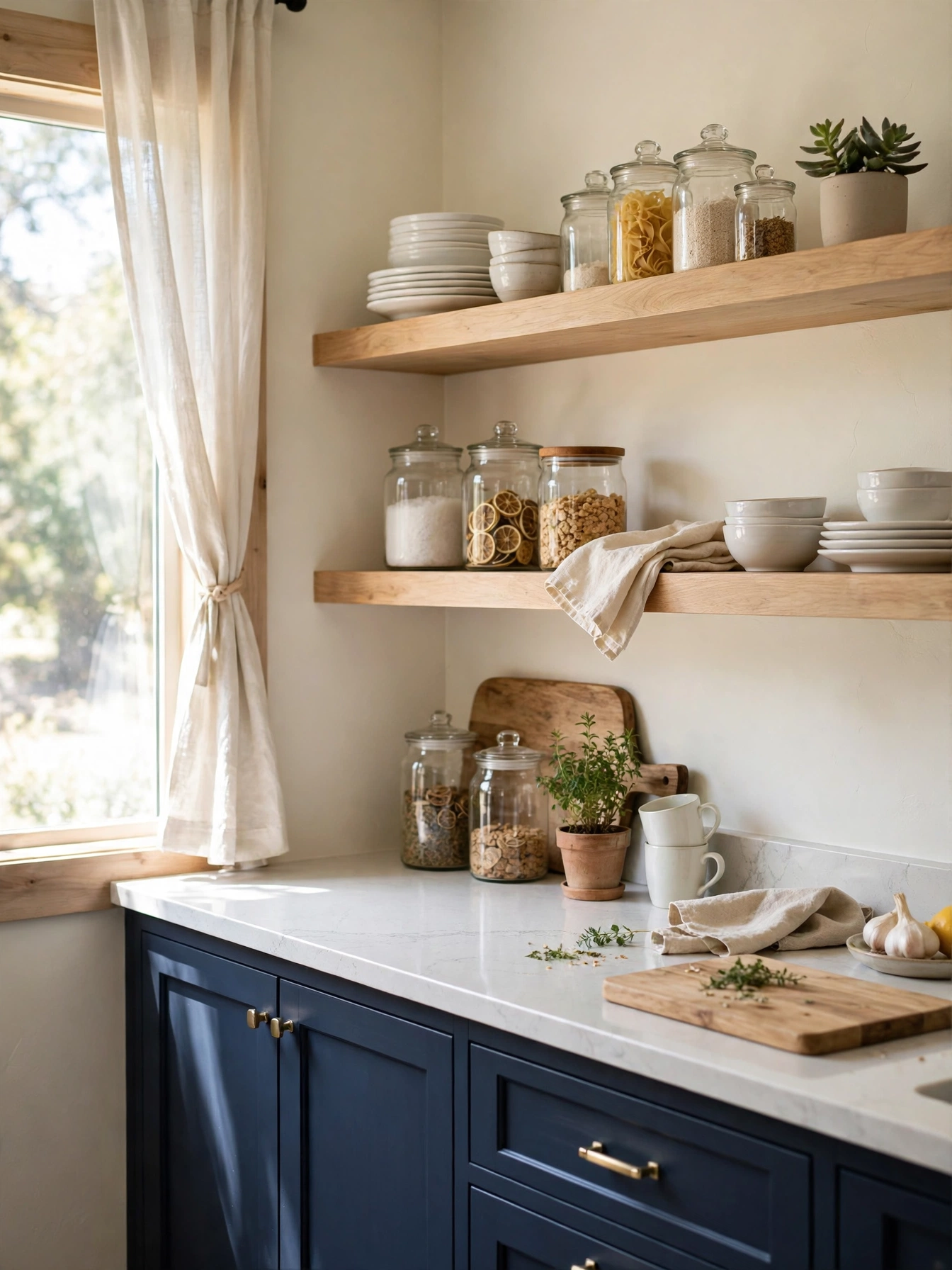
Why This Works:
- Open shelves lighten a navy lower run
- Wood shelves warm the dark blue below
- Daily dishes stay within arm’s reach
- Two shelves cost less than upper cabinets
A loaded shelf weighs more than it looks, so the fixing above blue lowers has to be solid. Fix oak shelves 10 inches deep and 2 inches thick to the wall on steel brackets rated for 50 pounds per shelf, each bracket screwed into a stud, with studs spaced 16 inches apart. Keep shelves 18 inches above the counter, which matches the usual upper cabinet gap, and limit each shelf to one category, plates on one and glasses on the next. Cast iron belongs in a base cabinet; a wall shelf rated at 50 pounds per shelf is no place for it.
Fitting two wood shelves lands at 150 to 400 dollars. A run of upper cabinets asks for 1,500 to 3,000 dollars. Two open shelves put daily dishes on show, and the wood warms the navy run below without adding another cabinet box. Dust settles on open shelves weekly, so a quick wipe belongs in the same routine as wiping the counters. Two shelves are the limit here; any more and the wall loses its calm, with the blue lowers pushed out of focus.
Moody Midnight Blue

Why This Works:
- Midnight blue adds drama without black
- Warm pendant light stops the dark tone feeling cold
- Walnut counters add a rich wood layer
- Brass hardware glows against the dark paint
Warm light makes midnight blue work. Pendant lights at 2700K and under-cabinet strips at the same temperature keep the color soft instead of flat. Use a near-black navy on maple doors in a satin finish, and pair it with a walnut countertop 1.5 inches thick that warms the darkest run in the room. Keep the floor pale oak, which reflects light back into the room, and use brass hardware to warm the dark run. A windowless kitchen with a single ceiling light needs a mid-tone blue; midnight turns black there after dark.
Evenings around a dining table, with good lighting, are where this moody color earns its keep. Walnut counters need oiling every 3 months to keep their color. Quartz asks for no upkeep at all, while walnut keeps its color only with oiling every 3 months. A dark cabinet repaint shows dust sooner than a mid-tone blue, so a weekly wipe with a damp cloth matters. Keep the backsplash light, with white or cream tile, to frame the dark cabinets.
Blue And Oak

Why This Works:
- Natural oak warms dusty blue instantly
- Oak shelves repeat the island top tone
- Pale counters keep the wood and blue balanced
- Black hardware gives the warm pairing a clear edge
Pale, natural oak is what keeps this pairing fresh, not orange-stained wood, so the surface reads as clean rather than dated. Use white oak for shelves and the island top, finished with a clear matte oil, and pair it with dusty blue cabinets in a satin finish. Keep the island top 1.5 inches thick and 36 inches high, matching the perimeter counters, with a 12 inch overhang for seating. The oak shelves should measure 12 inches deep and sit 18 inches above the counter. A pale oak stain keeps the pairing fresh; dark walnut drags the dusty blue toward a heavy, dated look.
Dusty blue brings color into the room, and the pale oak beside it keeps the overall feel warm. White oak stays pale beside dusty blue, which is the tone this pairing needs. Price it per board foot at the lumber yard before ordering. A wood island top needs oiling every 3 months, while the quartz perimeter needs no upkeep, so the mix gives warmth where hands rest and easy care where cooking happens. Keep hardware black and simple, with 5 inch bar pulls on drawers.
Small Kitchen Blue

Why This Works:
- Light blue adds color without shrinking the galley
- One cabinet wall keeps the other side open
- Slim stools 16 inches wide tuck fully under the counter
- Bright counters bounce light down the narrow room
Light blue belongs on one wall only in a small galley kitchen, with the opposite wall kept white or open. Give the cabinet wall a pale blue satin finish, and keep the countertop white quartz 36 inches high, so the single colored wall reads as a focal point rather than a full repaint. Leave 36 inches of walkway between the counter and the opposite wall, which is the minimum for one cook to pass comfortably. Use slim stools 16 inches wide with 24 inches of elbow room each, and keep the overhang at 12 inches. One blue wall is the limit in a galley; the second wall stays white so the narrow room keeps its air.
The single blue wall gives the galley a focal point without a full repaint. Open shelves on the white wall keep the room open and the dishes in reach. A full upper run on both sides would turn the galley into a corridor. Keep the floor pale, so light travels down the room. A galley repaint costs 1,200 to 2,500 dollars when sprayed, and under 300 dollars in paint for a DIY brush job on one wall.
Blue Pantry Doors
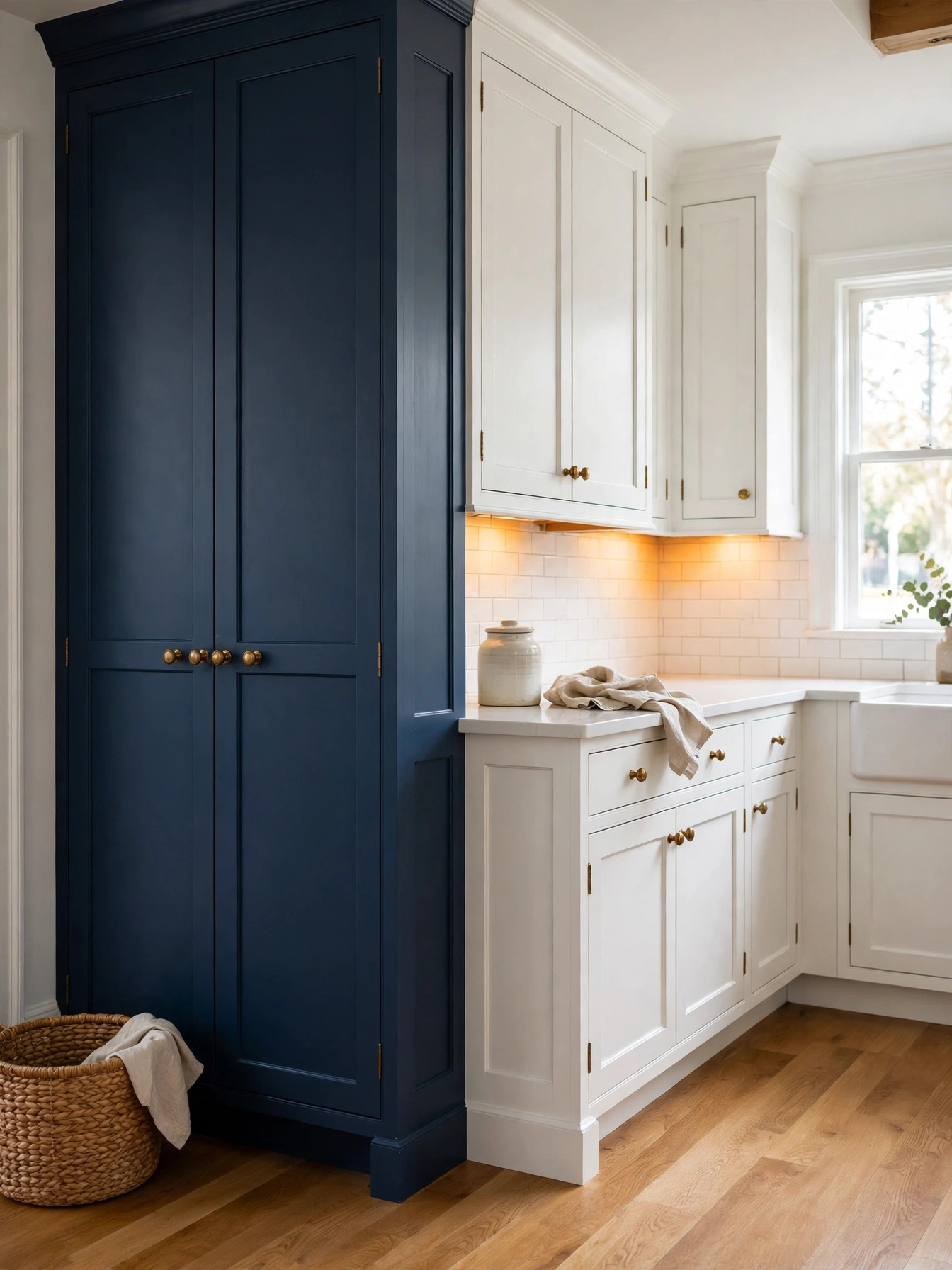
Why This Works:
- Blue pantry doors add color in one tall sweep
- Tall doors hide food storage behind a calm face
- Brass knobs repeat the kitchen hardware tone
- One blue element is enough in a white kitchen
A mostly white kitchen needs only one strong blue element, and a tall run of pantry doors carries that color on its own, with the door height setting the impact. Use tall pantry doors 84 inches high and 24 inches wide, painted navy in a satin finish on maple. Fit soft-close hinges rated for 100 pounds per pair, since tall doors carry more weight than standard doors. Inside, fit shelves 12 inches deep with 14 inches between them, so cereal boxes and jars fit without stacking. A blue island already anchors the room, so the pantry doors stay white and let the island hold the color.
A tall pantry cabinet costs 800 to 1,800 dollars, depending on the interior fittings, and pull-out shelves add about 150 dollars per shelf. The pantry keeps food behind closed doors while the blue adds character to a plain wall. Fixed shelves hide food at the back of a deep pantry. Pull-outs bring every jar forward, so nothing expires unseen. Label the shelves by category, so the family finds food without opening every door.
Vintage Blue Charm
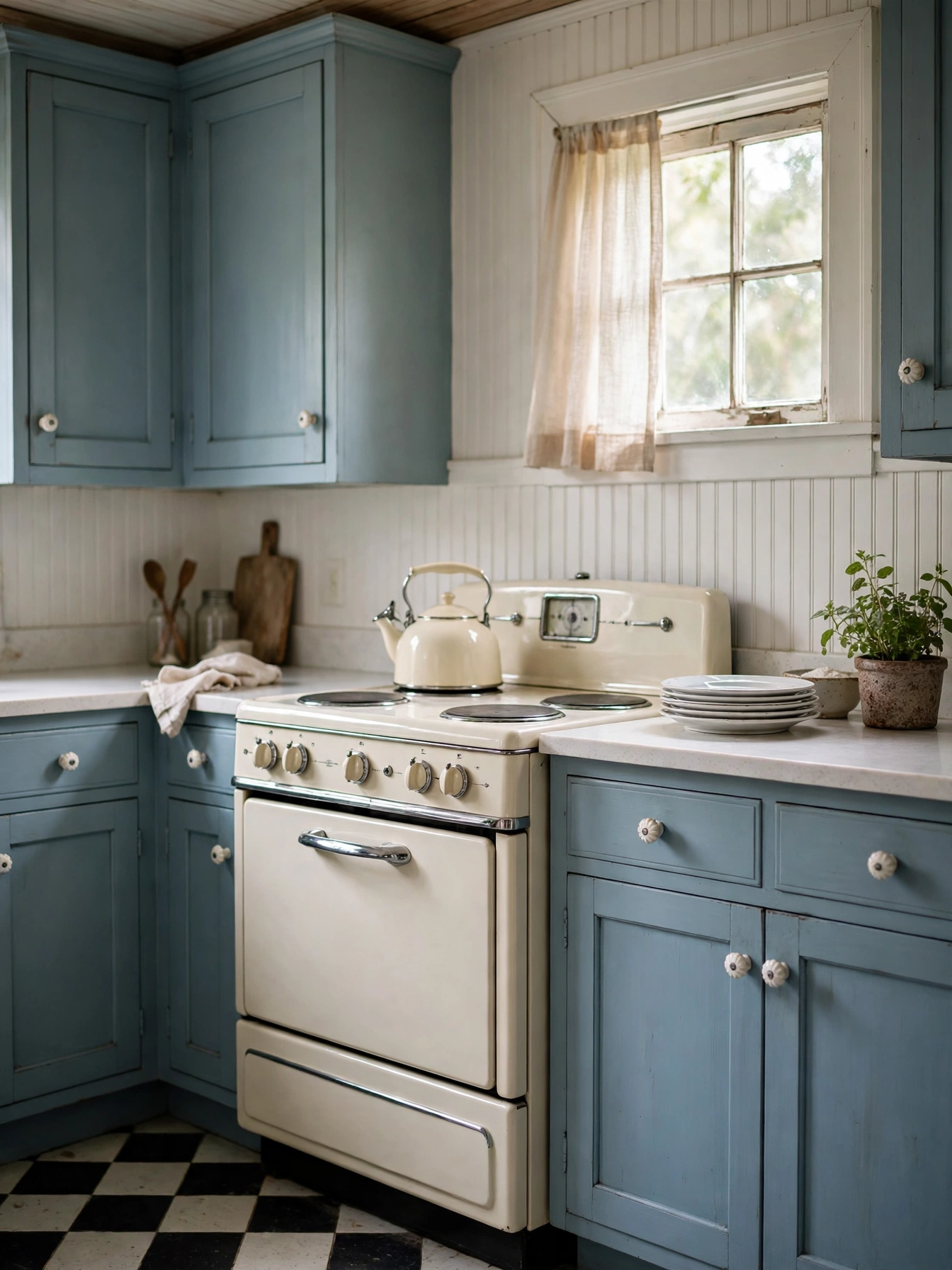
Why This Works:
- Soft blue suits beadboard and vintage details
- Ceramic knobs add a handmade feel to the doors
- A cream range softens the blue without white glare
- Beadboard texture keeps the pale color interesting
A soft, slightly gray blue, not a bright one, gives vintage cabinets their aged-in-a-good-way feel. Brush maple or wood doors in a satin finish, and pair them with a white beadboard backsplash made from 3 inch boards that adds texture without a second color. Use ceramic knobs 1.25 inches in diameter, with a painted floral or plain cream design, and keep the range cream rather than stainless steel. A 3/4 inch door on hinges that close softly keeps the vintage look working smoothly. Brushed nickel or black hardware keeps the soft palette calm; chrome’s cool shine fights it.
Wood floors, a small footprint and soft blue paint build the vintage feel together, with beadboard adding texture behind the range. Ceramic knobs cost 4 to 8 dollars each, and a full set for a small kitchen runs under 200 dollars. Keep the countertop white quartz, which resists stains better than the wood tops a vintage kitchen once used. A beadboard backsplash costs 5 to 10 dollars per square foot installed, and it paints easily to match the cabinets.
Modern Slab Blue
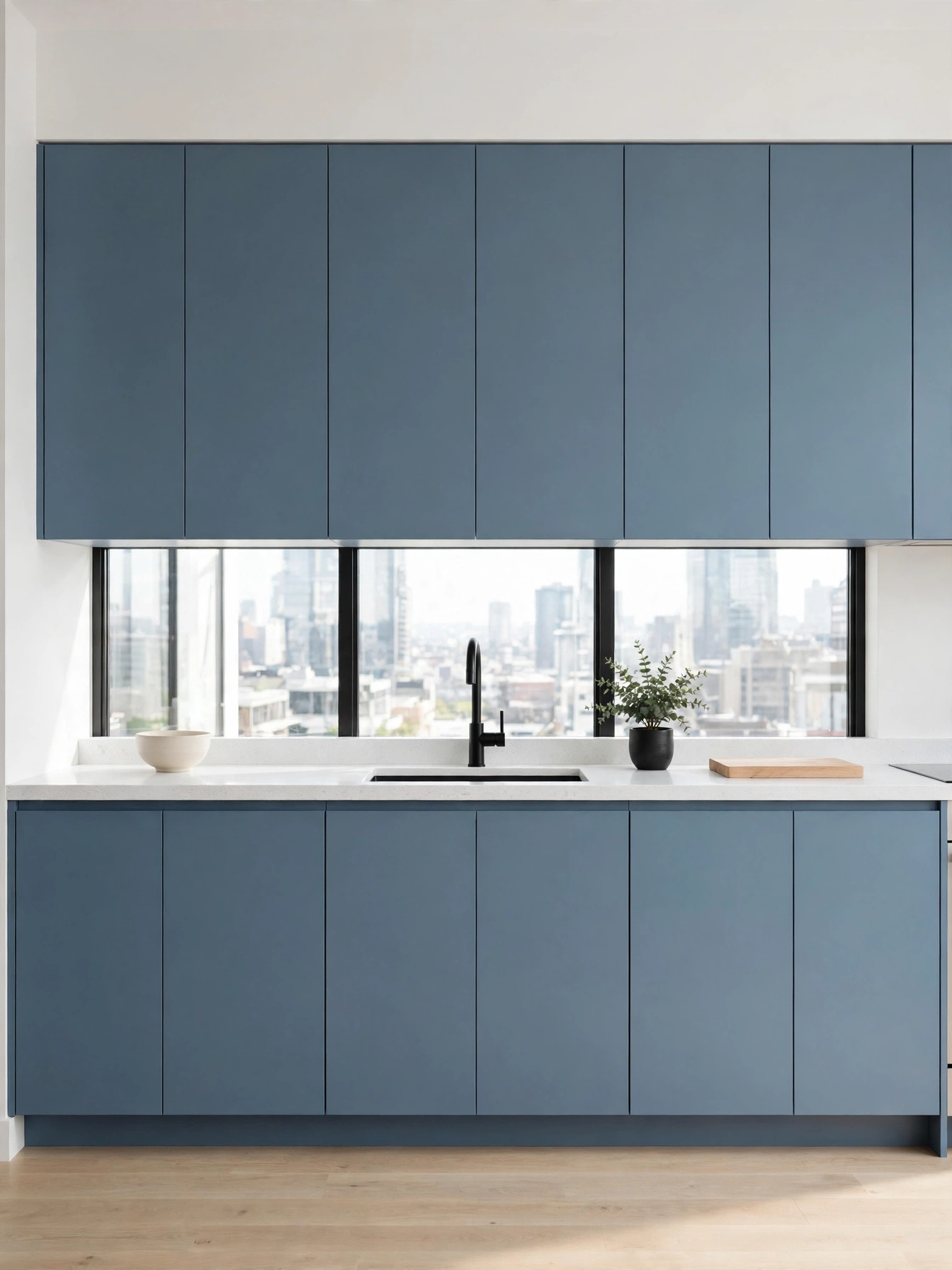
Why This Works:
- Flat slab doors suit a handleless modern kitchen
- Dusty blue softens the sharp modern lines
- Push-to-open doors keep the face completely clean
- White counters frame the blue without pattern
Every flaw shows on a flat door, so a flawless paint finish is non-negotiable for modern slab blue cabinets. Choose MDF slab doors 3/4 inch thick, sprayed in 2 coats of satin acrylic enamel over primer, with push-to-open latches rated for 100,000 cycles. Keep the blue dusty and mid-tone, so the flat face reads as color rather than a dark panel. The countertop should be white quartz 3 centimeters thick, with an eased edge, and the backsplash a single slab of the same quartz. A sprayed coat is the only finish that stays invisible on a flat slab; brush strokes show across the whole face.
The handleless face stays completely clean, with no knobs or pulls breaking the flat blue run. Slab doors keep the door budget modest. The saving goes toward a spray finish, which is the coat a flat face needs. Push latches wear out after years of daily use, and a replacement latch costs about 15 dollars. Keep the floor pale oak, which warms the modern blue without adding pattern.
Blue Backsplash Pairing
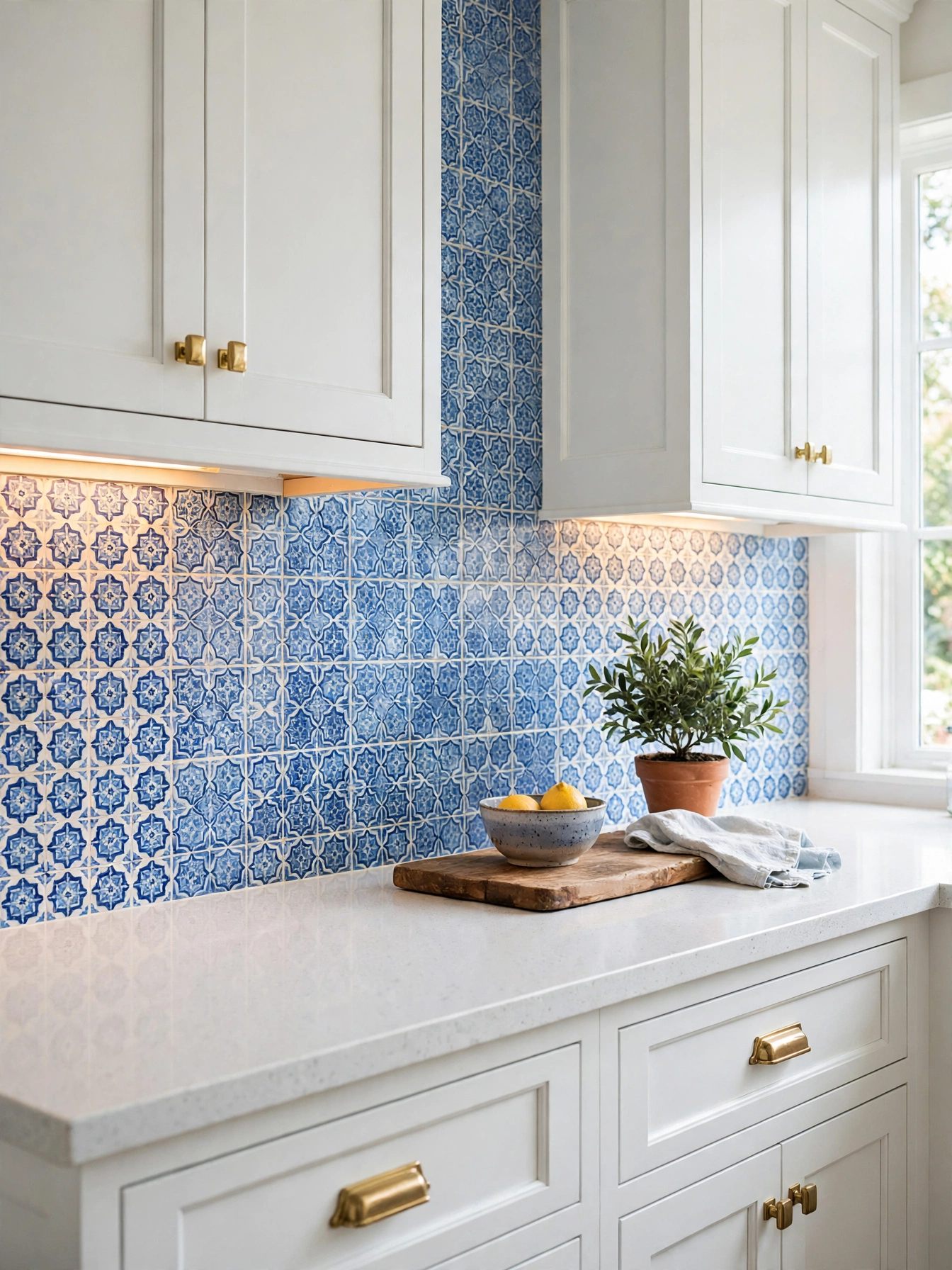
Why This Works:
- A blue backsplash adds color without painting cabinets
- Patterned tile gives a white kitchen a focal point
- White cabinets keep the patterned tile from overwhelming the room
- Brass pulls pick up the warm tones in the tile
A blue backsplash puts color on the wall for the price of tile, not a repaint. Choose patterned ceramic tile 4 by 4 inches or 6 by 6 inches, set 18 inches high between the counter and the upper cabinets, with grout in a pale gray that hides stains. Keep the cabinets white in a satin finish, and the countertop white quartz, so the tile stays the single pattern in the room. Tile should be sealed with a grout sealer every 12 months, since kitchen grout absorbs grease near the range. One pattern per room is the rule here, so patterned counters mean a plain backsplash.
Patterned tile costs 10 to 25 dollars per square foot installed, and a standard backsplash runs 30 square feet, so the total stays under 800 dollars in most kitchens. The tile route changes the room for the price of tile alone, and the whole backsplash swaps out without touching a single cabinet door. A plain blue subway tile keeps the wall calm and lets the white cabinets carry the room. A patterned tile turns the same band into the one lively element in an otherwise plain kitchen. Keep the pattern to the backsplash only, and leave the rest of the room plain.
Calm Blue Renewal
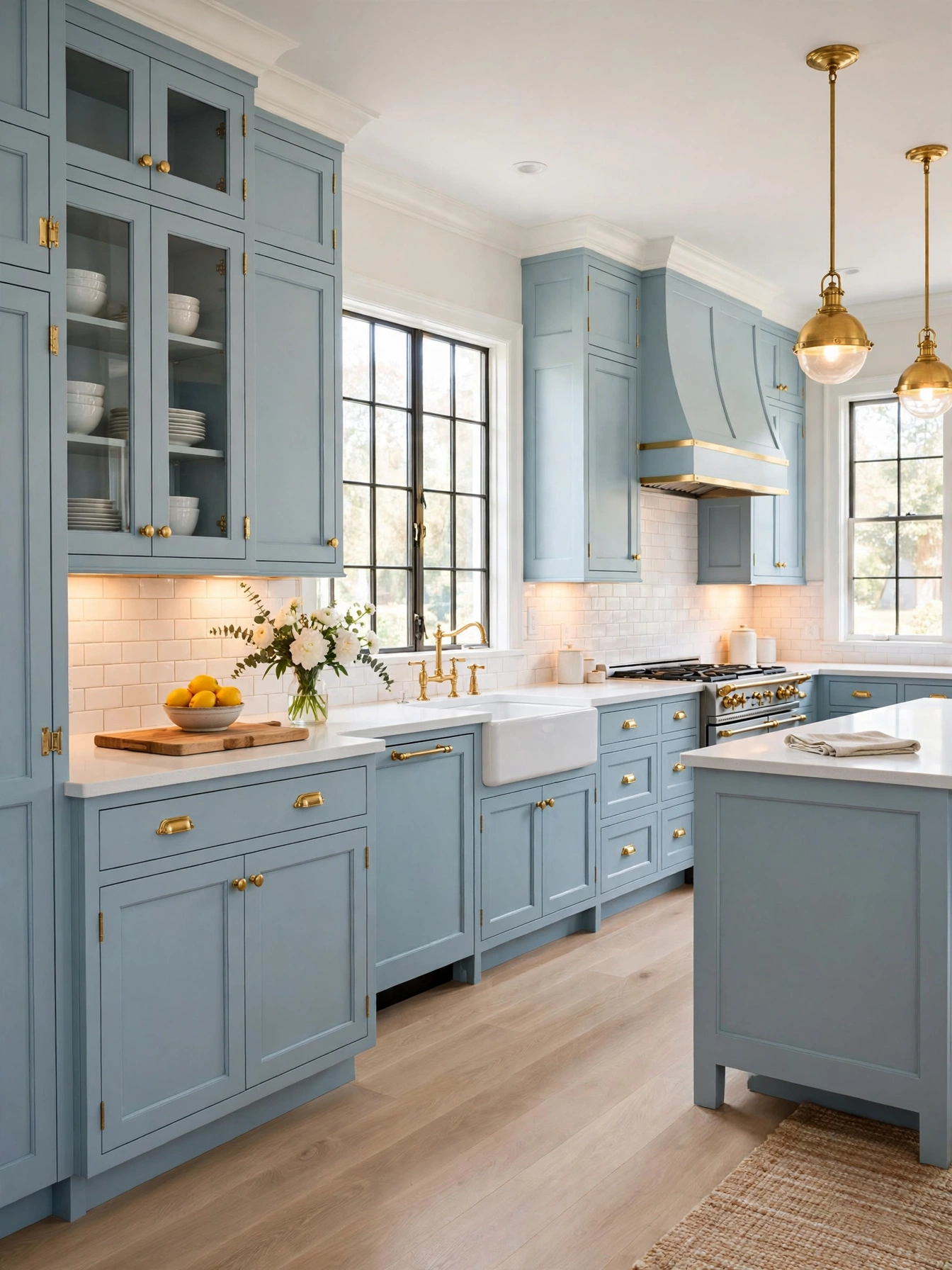
Why This Works:
- A repaint renews the kitchen without new cabinets
- Soft blue feels new yet stays classic for years
- New brass hardware lifts the repainted doors
- White counters make the fresh blue read clean
A blue renewal starts with prep, because paint sticks only to a clean, sanded surface. Remove the doors, clean them with a degreaser, sand with 220 grit paper, prime, then apply 2 coats of satin acrylic enamel, allowing 24 hours of drying between coats. Keep the existing cabinet boxes if the frames are solid, since new boxes add 5,000 to 10,000 dollars to the job. Replace the hardware at the same time, with 5 inch bar pulls on drawers and knobs on doors, so the old holes do not dictate the new look. Peeling paint must be stripped first; a fresh coat over it lifts off within months.
Sound cabinet boxes in a dated color take paint well, so the frames stay and only the color changes. HGTV notes that painting cabinets is one of the lowest-cost ways to change a kitchen, provided the prep is thorough. Keep the blue soft and dusty, so the renewal still looks fresh in 5 years. A DIY repaint of a medium kitchen costs 400 to 700 dollars in paint, primer and sandpaper, and takes about 4 days with drying time.
FAQs
Are blue kitchen cabinets a good choice for a small kitchen?
Light blue cabinets suit a small kitchen well, because pale tones reflect daylight and keep the room feeling open. Keep uppers 12 inches deep, leave 18 inches above the 36 inch counter, and pair the blue with white counters so the color adds interest without shrinking the space.
What paint finish lasts best on blue kitchen cabinets?
A satin or semi-gloss acrylic enamel lasts best, since it wipes clean and resists grease near the range. Apply 2 coats over primer on maple doors 3/4 inch thick, allow 24 hours between coats, and avoid flat paint, which absorbs marks and stains within weeks of daily cooking.
How do I pick the right shade of blue kitchen cabinets?
Brush the test color onto one whole door and check it at 7 AM and 7 PM under the kitchen lights. Test colors in the real room, since navy that looks rich at noon can read almost black by evening.
What hardware suits blue kitchen cabinets best?
Brass hardware suits most blue cabinets, because the warm metal balances the cool paint. A 5 inch bar pull on wide drawers and a knob about 1.25 inches across on doors keep one metal finish across pulls, knobs and faucet for a calm result.
How much does it cost to paint blue kitchen cabinets?
Expect 400 to 700 dollars for paint, primer and sandpaper when you repaint a medium kitchen yourself, against 3,000 to 6,000 dollars for a sprayed finish. Prep decides the result, so degreasing, sanding with 220 grit paper and priming matter more than the paint brand.
Conclusion
Blue kitchen cabinets earn their place by hiding daily wear, holding a classic look, and pairing with white counters, brass hardware and pale wood without a full remodel. Paint one full door in the shade you like first, checking it in morning and evening light, then commit to the finish and hardware that suit how the household cooks. Pick the shade in daylight, keep the finish satin, and let brass or black hardware give the color its edge. Follow HomelyCrafter on Pinterest for more ideas. Save this to your Pinterest boards so you can refer back to it!

Muhammad Israr is a home decor enthusiast and the writer behind Homely Crafter. He spends his days researching paint colors, layouts and budget-friendly styling ideas, then breaks them down into practical, easy-to-follow guides so you can decorate with confidence.
4 thoughts on “24 Fresh Blue Kitchen Cabinets That Feel Calm and New”