
What can you do with a corner that feels too narrow for furniture but too visible to ignore? A well-planned gallery can turn that awkward area into a useful focal point, and these Corner Wall Gallery Ideas show how to make the most of limited wall space. The best Corner Wall Gallery Ideas rely on careful spacing, appropriate frame sizes, and a controlled color palette rather than simply filling every inch. Whether you rent a flat in London or own a home in Texas, these Corner Wall Gallery Ideas can work with compact layouts and different decorating styles.
You will learn how to arrange framed artwork, family photographs, shelves, and decorative objects around corners without making the room feel crowded. These Corner Wall Gallery Ideas also cover practical measurements, mounting methods, color proportions, and styling mistakes to avoid. Each setup uses real materials and clear dimensions so you can recreate the look with confidence.
Framed Corner Nook
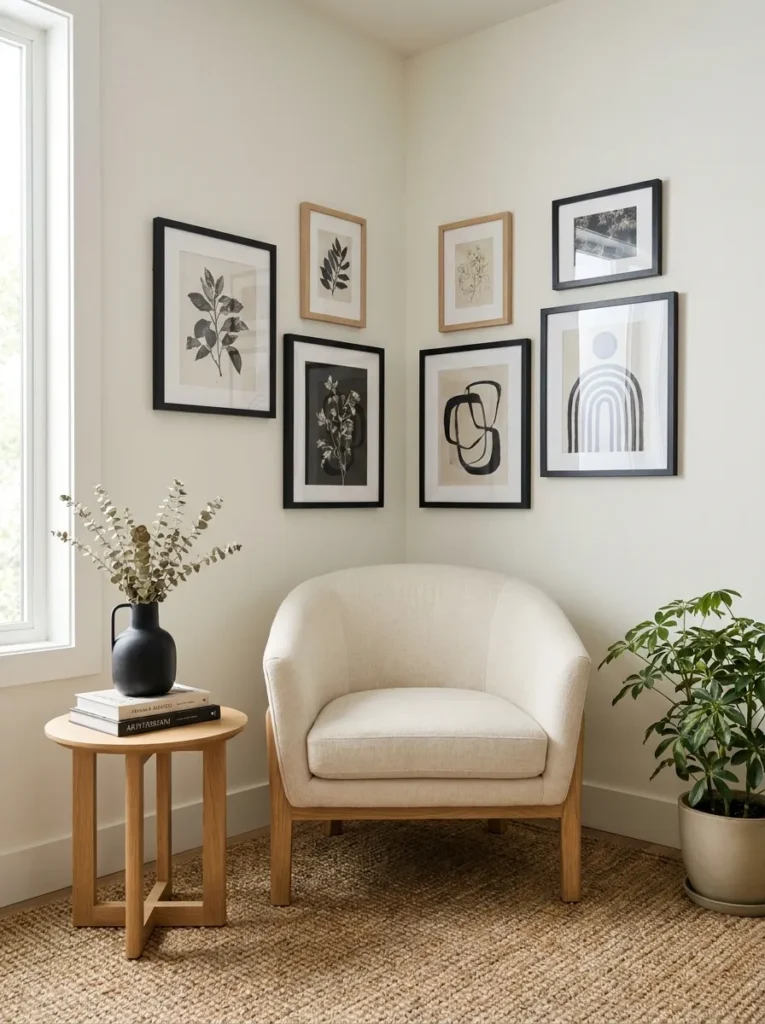
- Uses two walls to make a narrow corner feel intentional.
- Six frames provide visual weight without overcrowding the area.
- Oak and charcoal finishes create contrast against a warm white wall.
- The chair and plant give the gallery a practical destination.
A corner gallery should leave enough breathing room for furniture and foot traffic. Keep the lower edge of the arrangement at least 30 inches above the floor and position the artwork centerline around 57 to 60 inches from the floor. Use frames between 8 by 10 and 16 by 20 inches, leaving 2 to 3 inches between neighboring pieces on the same wall. For a corner turn, leave approximately 4 inches from the inside corner so frames do not visually collide. Avoid placing oversized frames directly against the corner because their depth can make the junction look cramped.
This setup works particularly well for homeowners who want a defined reading or seating zone without adding bulky furniture. It also suits gallery wall decor because the artwork can combine family photos, small prints, and one stronger graphic piece. Keep the dominant wall color warm white, use oak and charcoal as the secondary tones, and reserve terracotta for approximately 10 percent of visible accessories. Avoid using more than three frame finishes because too many materials can make a small corner appear disorganized.
Pro Tip: Use removable picture-hanging strips rated for the actual frame weight when studs are unavailable, and keep each frame at least 2 inches from the nearest furniture edge.
Layered Picture Ledge
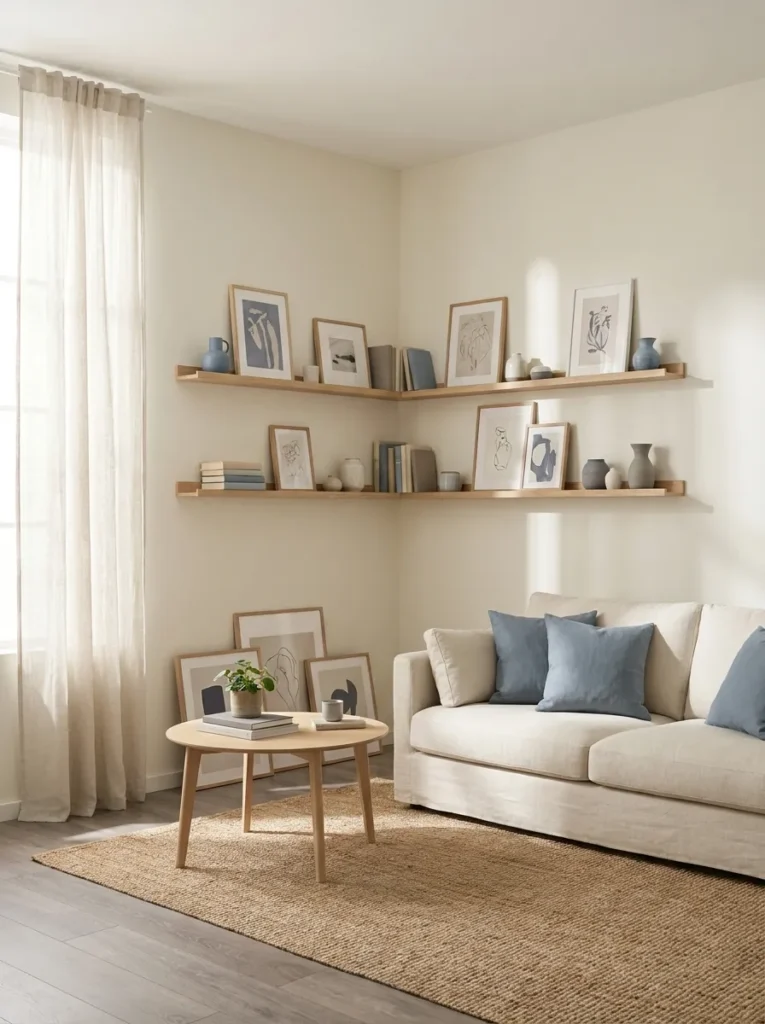
- Picture ledges allow artwork to change without new wall holes.
- Two horizontal shelves create continuity around the corner.
- Leaning frames add depth without requiring complex measuring.
- The arrangement suits renters and frequent decor changes.
Install two ledges, each 24 to 36 inches long, with each shelf approximately 5 to 7 inches deep. Mount the lower ledge around 48 inches from the floor and the second one 10 to 12 inches above it. Use solid oak or hardwood with a minimum thickness of 3/4 inch for a substantial appearance and secure the brackets into studs whenever possible. Avoid shelves deeper than 8 inches in narrow rooms because they can visually and physically reduce the walking clearance.
This arrangement is especially useful for picture ledges because you can rotate seasonal prints, books, and photographs without rebuilding the composition. It works well above a sofa, beside a desk, or in a rental where permanent holes are undesirable. Keep approximately 60 percent of the display visually light, 30 percent in pale oak and warm gray, and 10 percent in dusty blue or another restrained accent. Avoid filling every inch of the ledges because leaving 3 to 5 inches of space at the ends keeps the corner looking deliberate.
Pro Tip: Place the heaviest frame closest to the center of each ledge and use small clear museum putty dots behind leaning frames to prevent slipping.
Small Corner Gallery
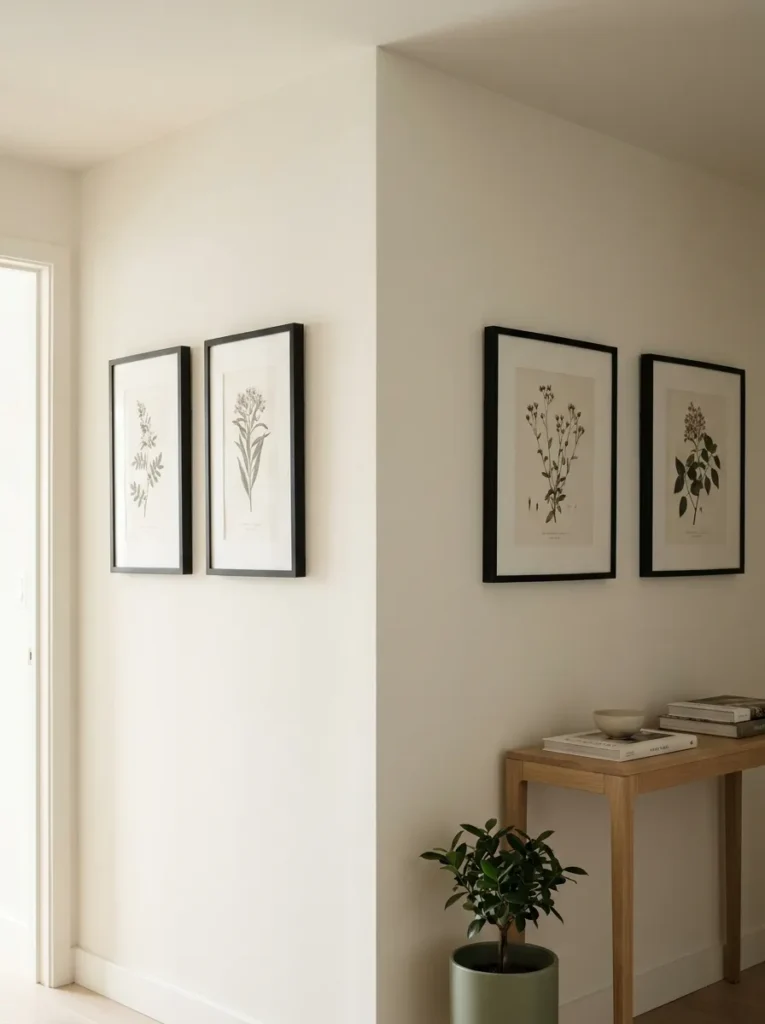
- Compact frames preserve circulation in narrow spaces.
- A vertical layout makes short walls appear taller.
- Four pieces create a complete composition without visual clutter.
- The limited palette keeps the small area visually calm.
For a compact corner, choose frames from 5 by 7 to 11 by 14 inches and keep 2 inches between each piece. Center the overall arrangement at approximately 58 inches from the floor, then build upward and downward from that point. Leave at least 30 inches of clear passage in a hallway and use slim frames that project less than 1 inch from the wall. Avoid using a 24 by 36 inch artwork in this location because the scale can overwhelm the corner and narrow the perceived walkway.
This is one of the most adaptable small space decorating approaches because it gives an empty junction a clear purpose without requiring furniture. Choose botanical prints, line drawings, or small photographs that share one visual characteristic, such as a sage green accent. The arrangement is particularly useful in apartments, hallways, and compact bedrooms where every inch matters. Avoid combining several unrelated frame colors because a small composition benefits from repetition.
Pro Tip: Lay the four frames on kraft paper first, mark the hanging points, and tape the paper to the wall before drilling to test the arrangement at full scale.
Corner Wall Gallery Ideas for Entryways
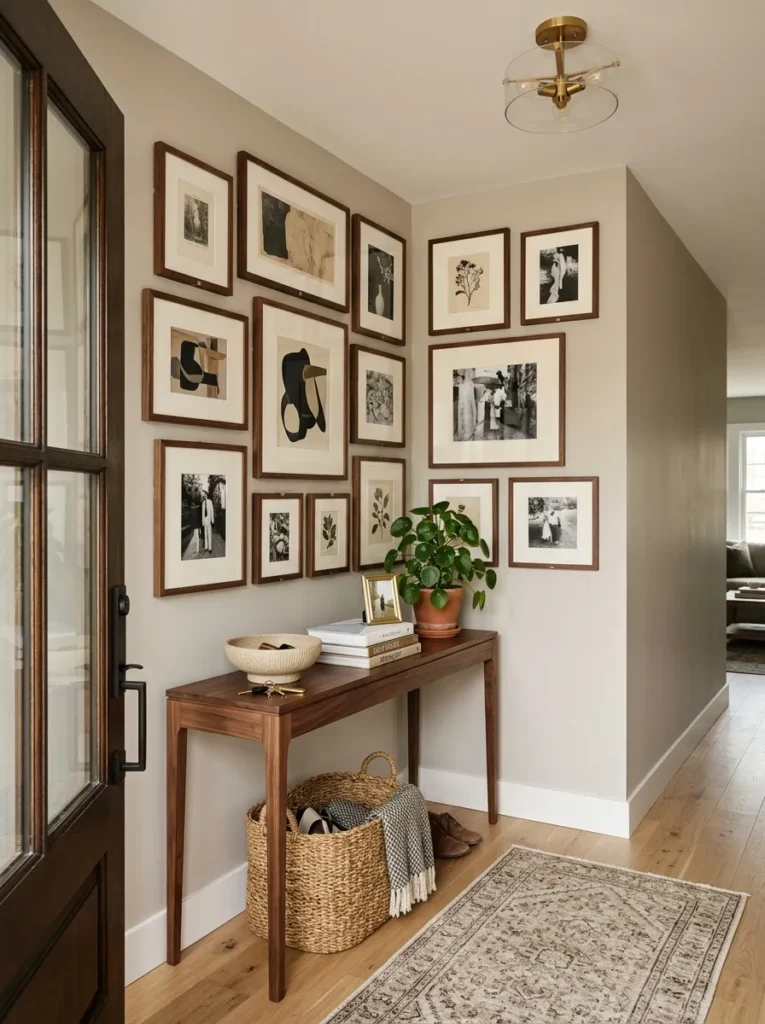
- The gallery gives an entryway an immediate focal point.
- A corner arrangement makes use of otherwise wasted wall space.
- Walnut and brass add warmth without requiring large furniture.
- The layout can accommodate art, photographs, and meaningful objects.
Keep the artwork centerline between 57 and 60 inches from the floor and maintain at least 8 inches between the bottom frames and the top of a console. Choose frames from 8 by 10 to 18 by 24 inches, with 2 to 4 inches between individual pieces. A console should generally be 30 to 34 inches high, so the lower artwork does not feel disconnected from the furniture. Avoid positioning frames where coats, bags, or door swings can strike them because repeated impact can loosen hardware and damage corners.
These Corner Wall Gallery Ideas work particularly well in entryways because they establish a visual welcome while using a surface that often receives little attention. A transitional arrangement suits both traditional American homes and UK terraces where hallways can be narrow. Use warm greige as the dominant color, walnut and soft black as the secondary palette, and brass for the 10 percent accent. Avoid placing delicate glass-fronted frames directly beside a busy doorway if the area receives frequent daily traffic.
Entryway corners can combine artwork with practical storage while keeping the walkway clear. If you are planning a more functional entrance, these mudroom decor ideas can help you organize shoes, bags, and everyday essentials without sacrificing style.
Pro Tip: Choose D-rings or French cleats rated above the frame’s actual weight, and place a discreet 1/8-inch clear bumper on each lower frame corner to protect the wall.
Black Frame Arrangement
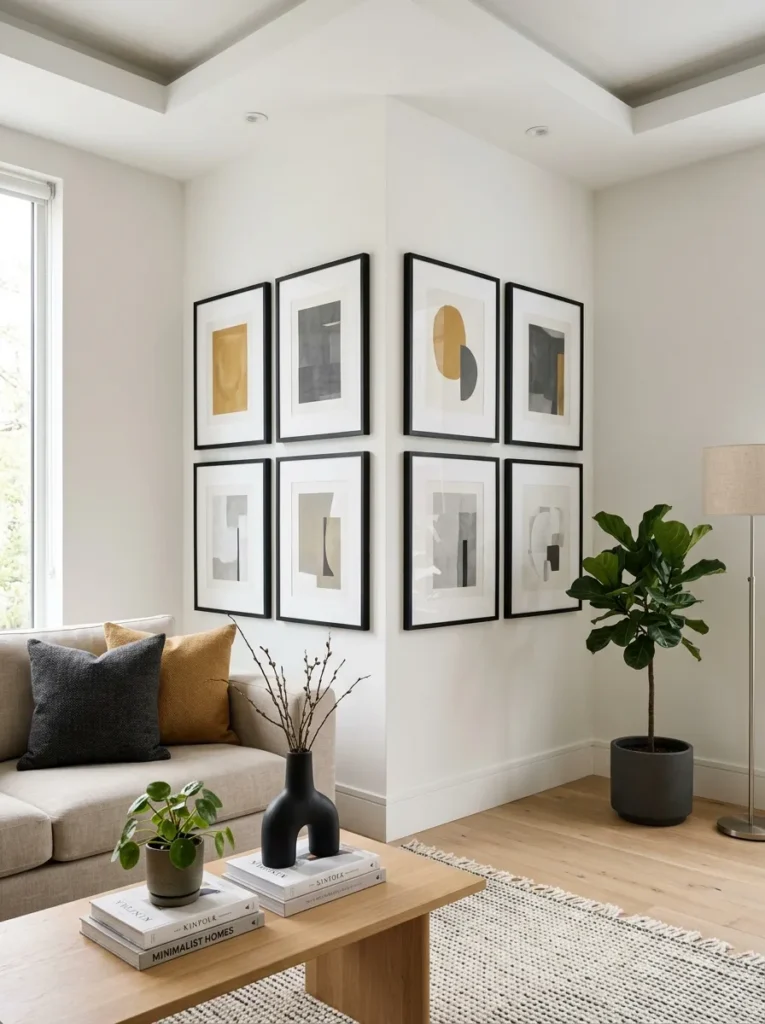
- Repeated black frames create strong visual rhythm.
- A grid keeps multiple artworks looking organized.
- The high contrast works well against pale walls.
- Consistent frame dimensions simplify installation.
For a grid, use eight frames measuring 12 by 16 inches or 16 by 20 inches, depending on the available wall width. Keep horizontal and vertical gaps consistent at 2 to 3 inches, and center the complete grid at 57 to 60 inches from the floor. Use metal frames with acrylic glazing in busy households because acrylic weighs less and reduces breakage risk. Avoid mixing five or six different frame sizes in a strict grid because inconsistent edges will weaken the geometric effect.
A black frame arrangement is ideal for framed artwork with similar margins, such as photography, architectural prints, or monochrome illustrations. The repeated borders create structure around a corner without requiring every image to match perfectly. Keep 60 percent of the visual field light, 30 percent black and charcoal, and 10 percent ochre or another warm accent. Avoid adding too many decorative objects directly beneath the gallery because the strong frame pattern already provides substantial visual activity.
Pro Tip: Measure from the center of each frame rather than its outer edge, then use a laser level to keep both walls aligned at the same visual height.
Gallery Shelf Styling
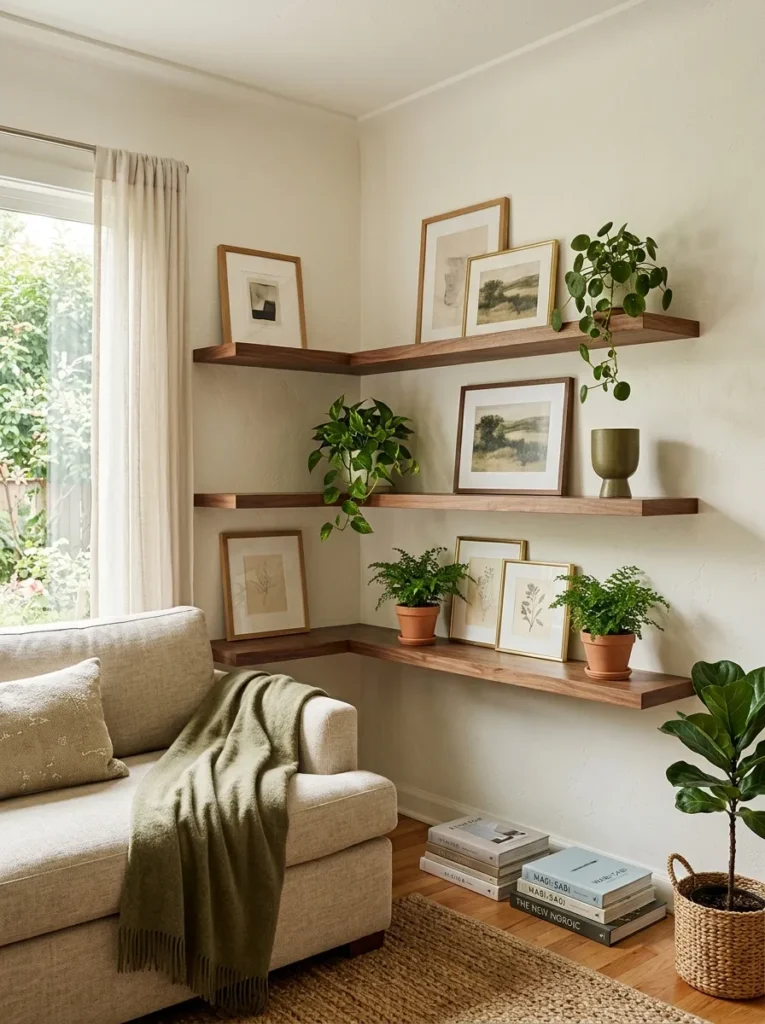
- Shelves add dimension while displaying smaller artwork.
- The corner arrangement creates continuity between two walls.
- Books and ceramics make the display feel lived-in.
- Flexible styling makes seasonal updates simple.
Use three shelves measuring approximately 24 to 30 inches long and 6 to 8 inches deep, with 10 to 12 inches of vertical space between levels. Anchor each shelf to studs where possible, or use heavy-duty hollow-wall anchors rated for the combined load. Keep individual objects below the shelf’s stated weight capacity and distribute heavier books near the brackets. Avoid placing deep objects at the front edge because they can make the shelves appear crowded and increase the chance of items falling.
This approach combines art display ideas with useful storage, making it practical for living rooms, home offices, and bedrooms. Place one larger framed print on the lowest shelf, then layer smaller frames behind books and ceramics on the upper levels. A 60 percent creamy white, 30 percent walnut and beige, and 10 percent olive palette gives the display a controlled appearance. Avoid filling every shelf because approximately 20 percent empty surface area helps individual pieces remain visible.
Pro Tip: Keep the tallest object below two-thirds of the shelf width and leave at least 2 inches of clearance from each side edge.
Family Photo Corner
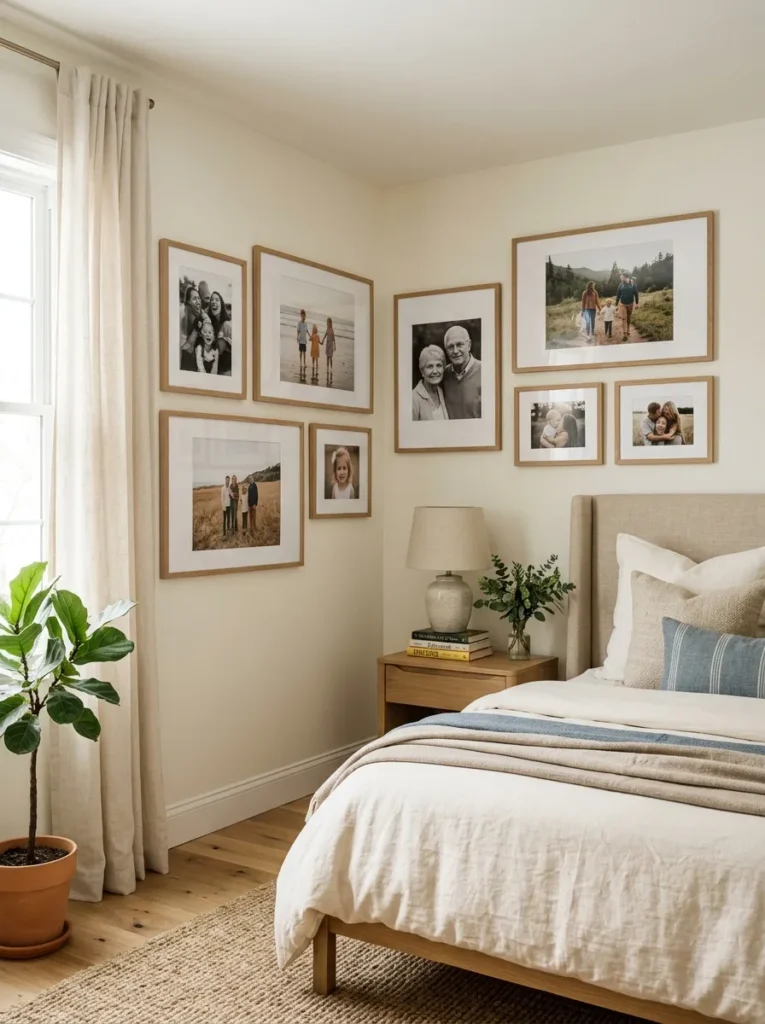
- Coordinated frames make different photographs feel connected.
- Seven images provide personality without covering the entire wall.
- Natural wood softens the look of personal photography.
- The arrangement works well above a dresser or beside a bed.
Select seven frames between 8 by 10 and 11 by 14 inches, using the same oak finish for consistency. Keep the photo centers approximately 57 to 60 inches above the floor, or 6 to 8 inches above a dresser if the arrangement sits over furniture. Leave 2 to 3 inches between frames and use acid-free photo mats if prints are exposed to direct daylight. Avoid hanging irreplaceable photographs in bathrooms or areas with sustained humidity because moisture can damage paper and adhesives.
This family arrangement is a practical form of photo wall ideas for bedrooms, stair landings, and family rooms. Use photographs from different years but apply the same crop or mat style so the display feels intentional. Keep the dominant ivory background at roughly 60 percent, use oak and beige for 30 percent, and introduce muted blue through one or two photographs or accessories for the final 10 percent. Avoid using every available family photograph because selective editing gives the collection more visual importance.
Pro Tip: Print all photos with the same white border width, ideally 1 to 1.5 inches, before framing so different image sizes still look cohesive.
Mixed Art Composition
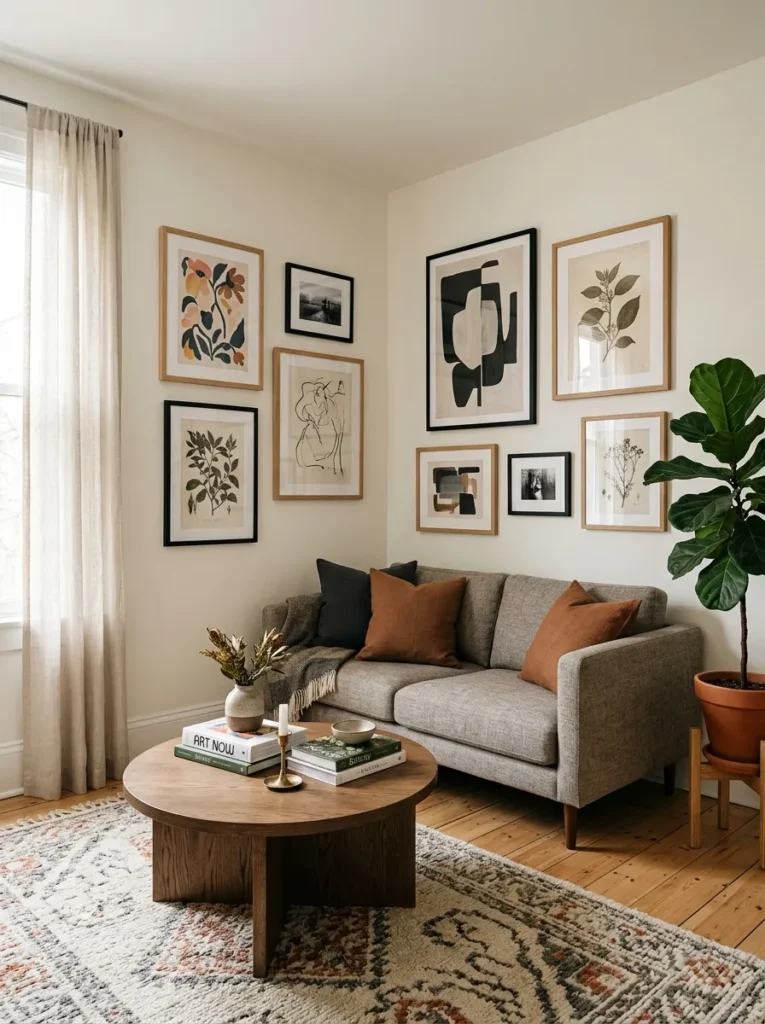
- Different art styles create a collected appearance.
- Repeated frame colors provide enough visual consistency.
- The corner becomes a focal point without requiring large furniture.
- A limited accent color prevents the arrangement from feeling chaotic.
Choose five to seven pieces with at least one shared characteristic, such as a black border, oak frame, or warm neutral background. Use artwork from 8 by 10 through 18 by 24 inches and maintain 2 to 4 inches between frames. Keep the largest piece near the visual center and position the composition so its center sits around 57 to 60 inches from the floor. Avoid combining more than four dominant colors because unrelated colors can make a mixed collection look accidental rather than curated.
These Corner Wall Gallery Ideas are especially useful when you already own artwork from different rooms or travels. Pair abstract art with botanical prints and photography, then repeat one frame material to establish continuity. A 60 percent warm white, 30 percent charcoal and oak, and 10 percent dusty rust palette keeps the arrangement balanced. Avoid making every piece the same size because a varied scale creates a more natural gallery wall layout.
Pro Tip: Start with the largest artwork, then place medium pieces 2 to 3 inches away before filling the remaining gaps with smaller frames.
Vertical Stairway Gallery
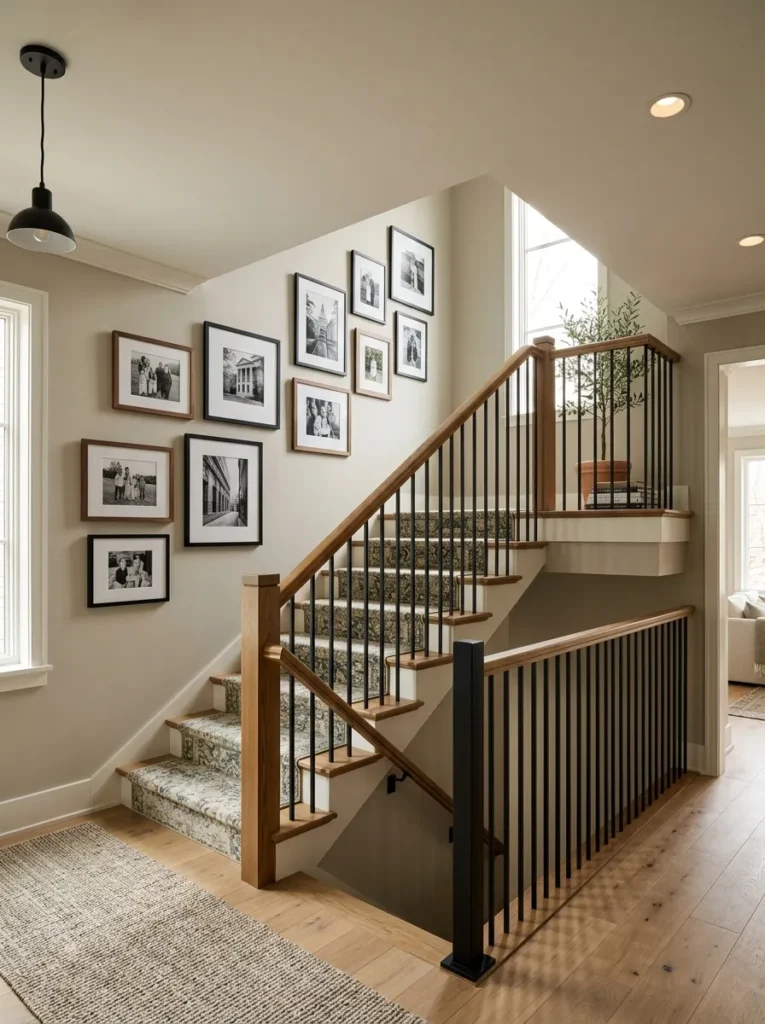
- A vertical layout follows the natural direction of a staircase.
- Repeated frame sizes make a tall wall feel organized.
- Family photographs personalize a transitional space.
- The corner connection visually links two parts of the stair hall.
Measure the staircase slope before installing anything and maintain a minimum 36-inch clear walking width on the stairs and landing. Use frames between 8 by 10 and 12 by 16 inches, with approximately 3 inches between neighboring pieces. Keep the center of each artwork roughly 57 inches from the stair tread line at its corresponding position, adjusting gradually as the staircase rises. Avoid placing frames directly above handrails or within the required clearance zone because they can become obstacles during daily movement.
A stairway is an excellent location for interior wall styling because its vertical architecture naturally supports a rising composition. These Corner Wall Gallery Ideas can connect family photographs from the lower floor to artwork displayed on the upper landing. Use warm greige as the dominant tone, walnut and black for the secondary palette, and olive as the small accent. Avoid using fragile glass frames in high-traffic stairways when acrylic glazing can provide a safer alternative.
Pro Tip: Create a full-size paper template of the staircase slope and tape each frame position before drilling, especially when the wall turns at a landing.
Coordinated Neutral Artwork
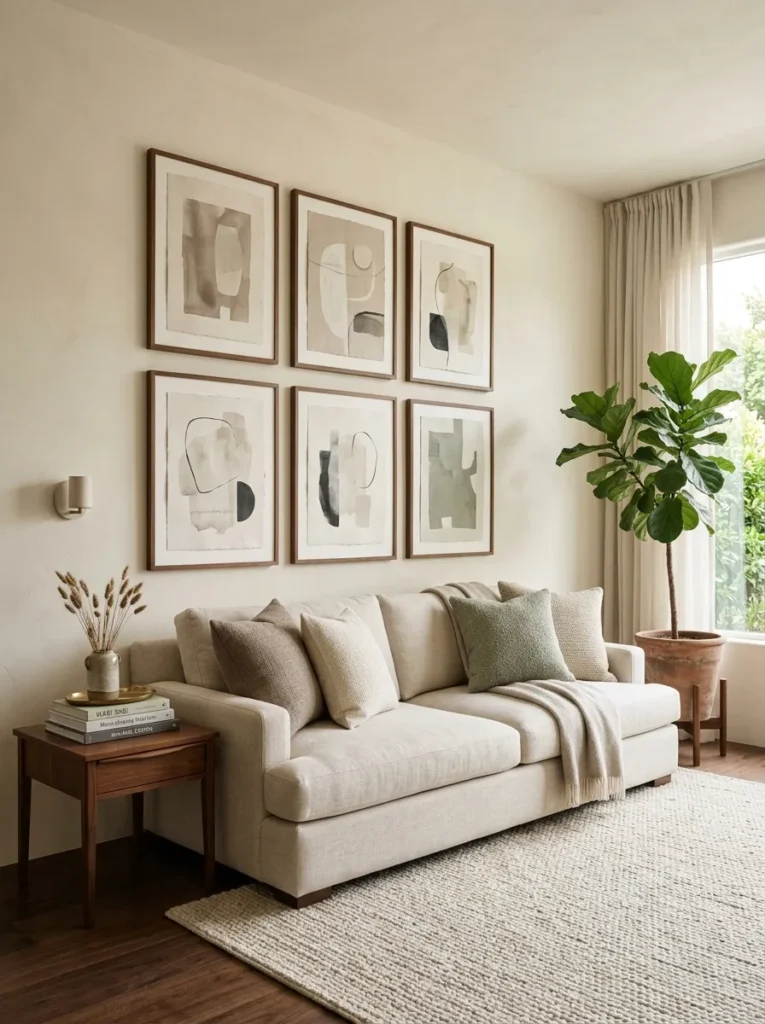
- Neutral artwork creates a calm backdrop for furniture.
- Matching frames simplify a large corner composition.
- Subtle tonal differences add depth without visual noise.
- The palette works with many existing furnishings.
Choose six artworks with related tones such as ivory, taupe, mushroom, warm gray, and muted sage. Frames between 12 by 16 and 16 by 20 inches work well on a medium living room wall, with 2 to 3 inches between each frame. Center the composition at 57 to 60 inches from the floor and keep at least 6 to 8 inches between the lowest frame and a sofa back. Avoid pure white mats beside cream walls because the small color difference can look accidental under warm lighting.
These Corner Wall Gallery Ideas suit homeowners who prefer a calm room where furniture and textiles remain the main focus. Coordinated artwork also makes living room gallery wall planning easier because the neutral palette can bridge several upholstery and wood tones. Use 60 percent warm ivory, 30 percent taupe and walnut, and 10 percent muted sage for a controlled color relationship. Avoid introducing a bright red or saturated blue print unless it already appears elsewhere in the room.
Pro Tip: View every print under the room’s actual light bulbs before framing because warm 2700K lighting can noticeably change the appearance of beige and gray artwork.
Vintage Frame Collection
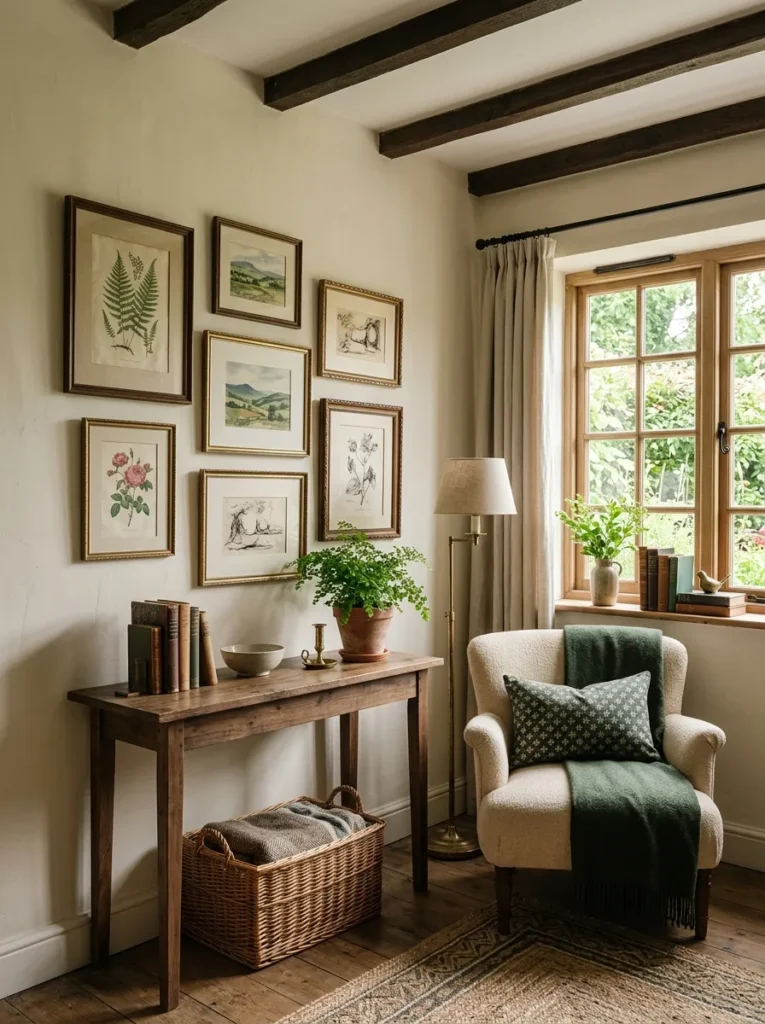
- Vintage frames add character without expensive furniture.
- Repeated aged finishes unify different artwork.
- Botanical and landscape prints suit traditional and cottage interiors.
- The corner provides enough vertical space for a layered collection.
Use seven frames ranging from 8 by 10 to 16 by 20 inches, with 2 to 3 inches between smaller pieces and up to 4 inches around the largest frame. Choose solid wood, resin, or metal frames with genuine aged finishes, and inspect old frames for loose corners before mounting them. Place the center of the overall arrangement at approximately 58 inches from the floor. Avoid hanging valuable antique frames in direct sunlight because ultraviolet exposure can fade artwork and weaken older finishes.
Vintage collections are among the most flexible art display ideas because imperfect frames can make a gallery feel collected rather than overly coordinated. Combine botanical illustrations, landscapes, and architectural sketches while repeating one frame tone, such as aged walnut. Keep 60 percent of the visual area warm cream, 30 percent aged walnut and brass, and 10 percent forest green. Avoid buying multiple distressed frames that look artificially identical because genuine variation usually creates a more convincing collection.
Pro Tip: Use archival backing and UV-filtering acrylic for valuable prints, particularly in rooms that receive more than 2 hours of direct sunlight each day.
Corner Wall Gallery Ideas for Renters
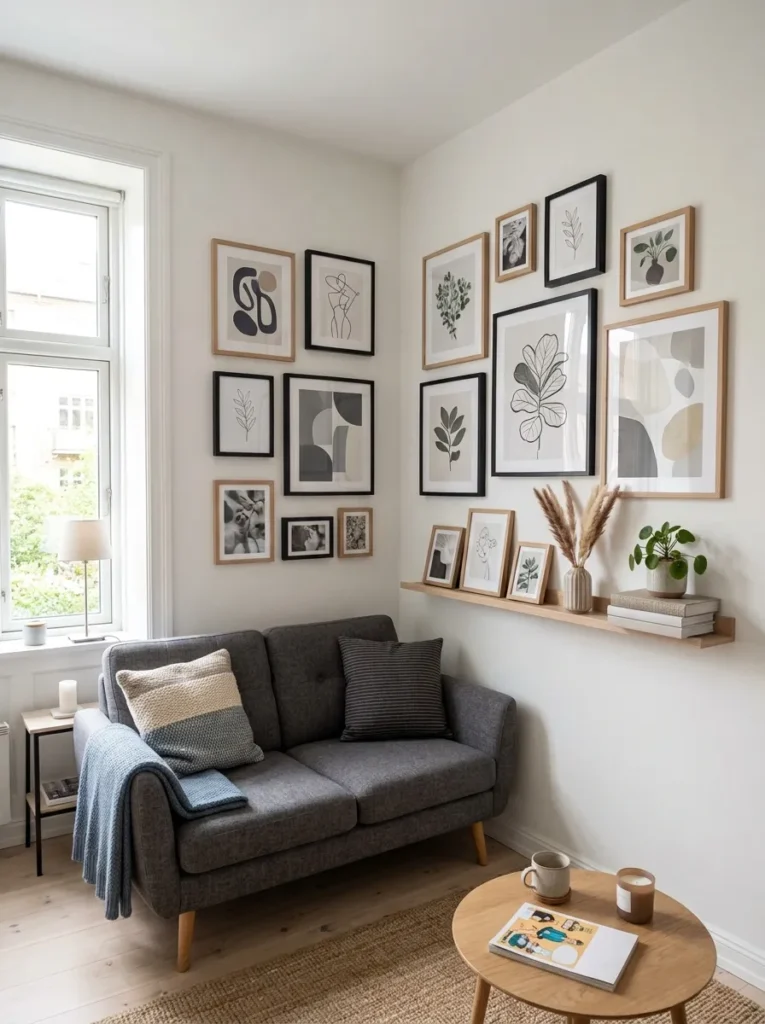
- Removable systems reduce permanent wall damage.
- Lightweight frames are easier to install securely.
- A picture ledge allows artwork to change frequently.
- The design suits apartments and short-term rentals.
For rental walls, select frames weighing no more than 4 to 5 pounds when using removable adhesive systems, and follow the manufacturer’s exact weight rating rather than estimating it. Keep artwork between 8 by 10 and 12 by 16 inches and maintain 2 to 3 inches between pieces. A 24 to 30-inch picture ledge can hold several lightweight frames while keeping the installation visually compact. Avoid using adhesive strips on textured, freshly painted, damp, or poorly bonded surfaces because they may fail or remove the paint.
These Corner Wall Gallery Ideas make renter-friendly wall decor more personal without committing to permanent alterations. A mix of removable frames and one lightweight ledge provides flexibility for seasonal prints, photographs, and small decorative objects. Use soft white as the dominant color, pale oak and charcoal for 30 percent of the visual weight, and dusty blue for a restrained 10 percent accent. Avoid heavy mirrors or oversized canvases unless your lease permits proper anchors and your wall construction can support them.
Pro Tip: Photograph the original wall before installation, keep the product packaging and weight instructions, and test one removable hanger in an inconspicuous area for 24 hours before installing the complete gallery.
Bold Color Pairing
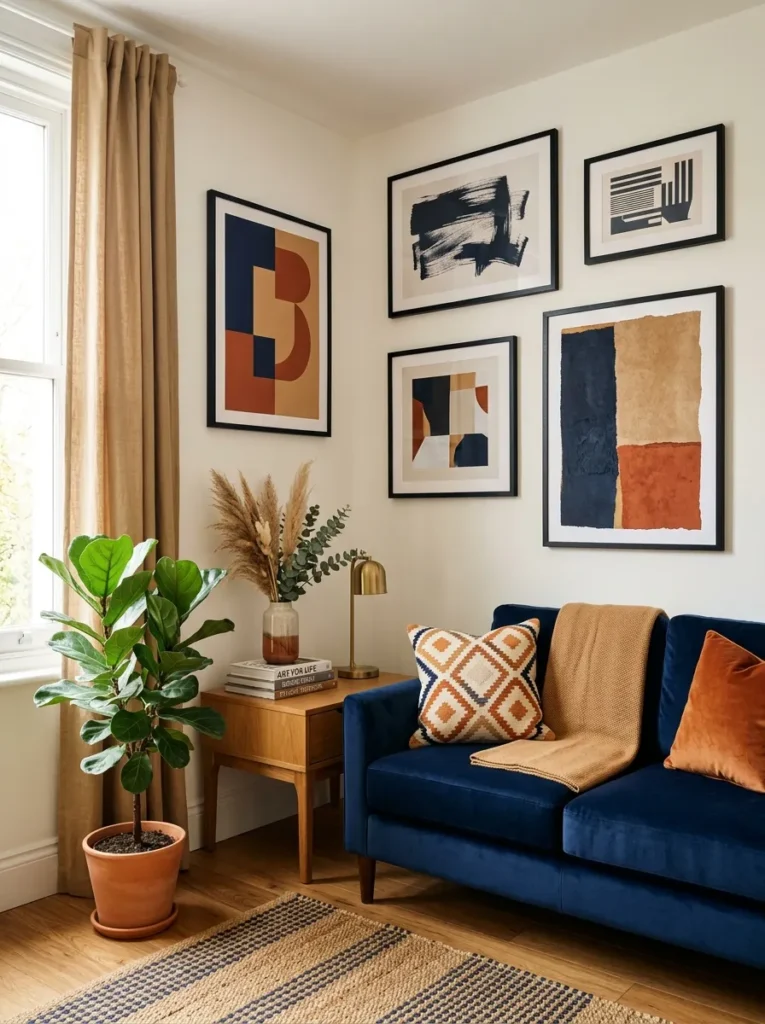
- Repeated colors make bold artwork feel coordinated.
- A 60, 30, 10 palette keeps saturated accents under control.
- Five pieces provide impact without covering the entire corner.
- The composition can echo colors already used in textiles.
Select five artworks from 12 by 16 to 18 by 24 inches and ensure at least two pieces repeat the same dominant color. Maintain 2 to 4 inches between frames and center the complete arrangement around 58 inches above the floor. Use slim frames when the artwork itself contains strong color and visual detail, since heavy frames can compete with the prints. Avoid using more than one high-saturation accent color unless the same color appears elsewhere in the room.
A controlled fall-inspired interiors approach can use warm seasonal colors such as burnt orange, camel, and deep navy without making the gallery feel temporary. These Corner Wall Gallery Ideas work particularly well when the accent colors repeat in cushions, rugs, books, or ceramics. Keep 60 percent warm white, 30 percent navy and camel, and 10 percent burnt orange so the eye has a stable background. Avoid choosing five unrelated colorful prints because a corner already has two intersecting visual planes.
Pro Tip: Pull one accent color from an existing rug or cushion, then repeat it in no more than two gallery pieces to create cohesion without overdecorating.
Minimalist Art Cluster
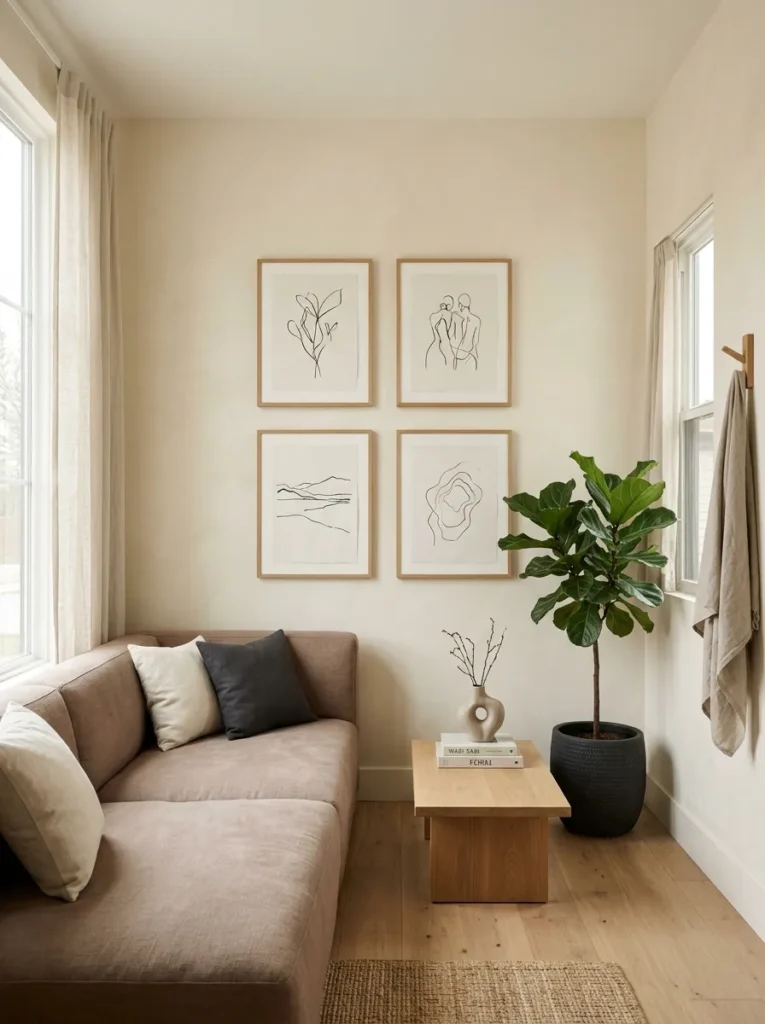
- Negative space gives a small corner visual breathing room.
- Simple line drawings support a calm interior.
- Four frames are easy to measure and install.
- Light wood introduces warmth without visual heaviness.
Use four frames measuring approximately 12 by 16 inches, leaving 4 to 5 inches between each piece for a deliberately airy arrangement. Position the center of the group at 57 to 60 inches from the floor and keep the lower edges at least 6 inches above nearby furniture. Choose 3/4-inch-thick oak frames or similarly slim profiles, with matte paper that reduces reflections. Avoid shrinking the gaps below 2 inches because a minimalist composition depends on visible negative space.
This approach suits homeowners who prefer small space decorating that feels intentional rather than crowded. Use line drawings, soft abstracts, or monochrome photography with one subtle clay accent to connect the artwork to nearby textiles. A 60 percent warm ivory, 30 percent oak and charcoal, and 10 percent muted clay palette provides enough contrast while maintaining a quiet mood. Avoid adding several decorative shelves, mirrors, and wall objects around the same gallery because the simplicity of the arrangement is its main feature.
Pro Tip: Stand at least 8 feet away from the finished wall before deciding whether another piece is needed because minimalist galleries often look sparse up close but balanced from normal viewing distance.
Oversized Corner Canvas
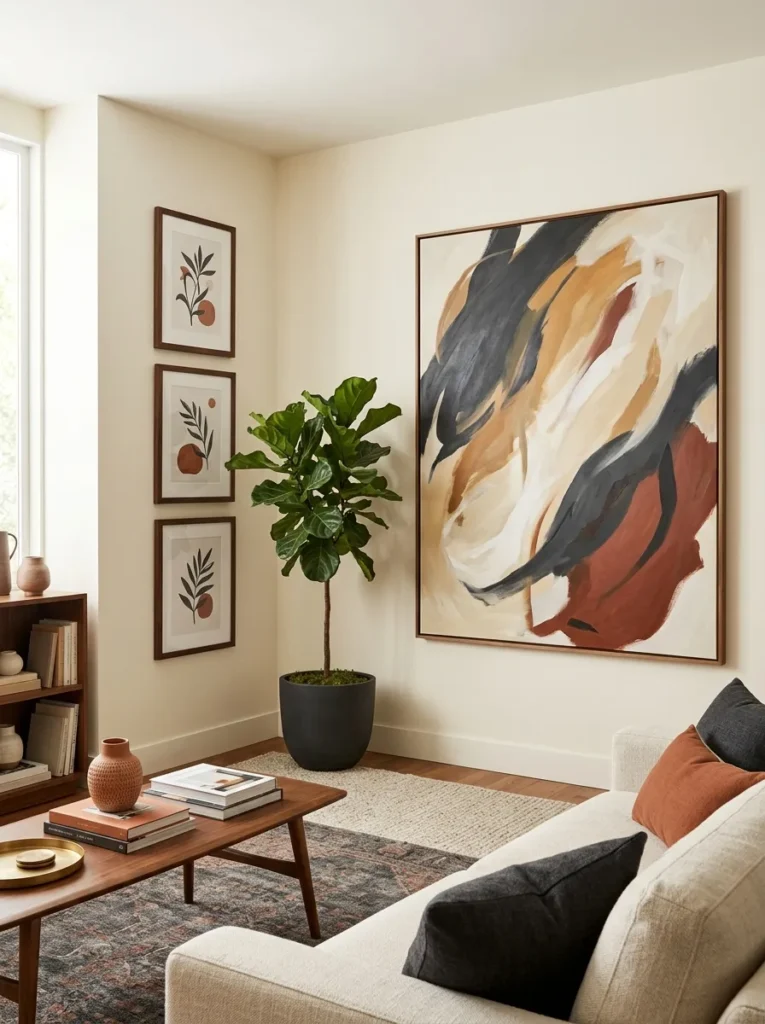
- One large canvas gives the corner a clear visual anchor.
- Smaller frames prevent the adjoining wall from feeling empty.
- The scale suits larger living rooms with generous wall height.
- A restrained palette keeps the composition sophisticated.
Choose a canvas between 30 by 40 and 40 by 60 inches, then balance it with three smaller frames measuring approximately 8 by 10 to 12 by 16 inches. Center the large canvas at 57 to 60 inches from the floor and leave 3 to 5 inches between it and the smaller pieces. Keep the canvas at least 8 inches away from the nearest corner so its visual mass does not dominate the junction. Avoid placing a 40 by 60 inch canvas in a narrow passage because its scale can reduce perceived clearance and overwhelm nearby furniture.
This arrangement is particularly effective when you want gallery wall decor to provide a strong focal point without covering every available surface. Place the oversized canvas above a sofa or low console, then use smaller pieces on the adjoining wall to guide the eye around the corner. A 60 percent warm ivory, 30 percent walnut and charcoal, and 10 percent terracotta palette keeps the composition connected to the rest of the room. Avoid adding several large decorative objects below the canvas because the artwork should remain the dominant feature.
Pro Tip: For a canvas over 20 pounds, use a French cleat secured into at least two studs whenever the wall construction allows it.
Botanical Print Display
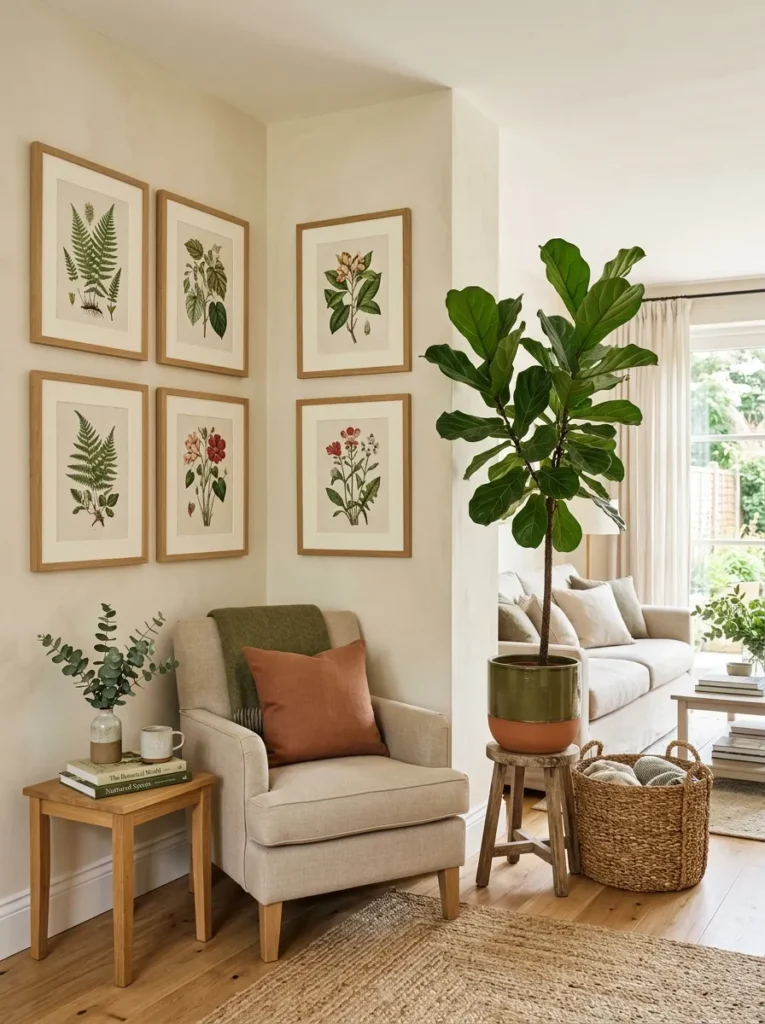
- Botanical prints introduce pattern without overwhelming the room.
- Natural oak frames complement real greenery.
- A six-foot plant creates a strong vertical anchor.
- The palette works with both traditional and contemporary interiors.
Use six botanical prints in 8 by 10 or 11 by 14-inch frames, keeping 2 to 3 inches between each frame. Position the center of the arrangement at approximately 58 inches from the floor and place a large floor plant at least 6 feet tall about 12 to 18 inches from the corner. Use matte paper to reduce glare, especially beside sunny windows. Avoid placing live plants directly beneath unsealed paper artwork because water splashes and humidity can damage the prints.
This setup combines botanical wall art with natural greenery to create a calm focal point in living rooms, bedrooms, and home offices. The artwork can feature ferns, olive branches, pressed-flower illustrations, or vintage herb studies while the real plant provides dimensional contrast. Keep 60 percent warm cream, 30 percent oak and olive, and 10 percent terracotta for pots or small accessories. Avoid using too many different plant species around the gallery because repeated leaf shapes can make the display look overly busy.
Pro Tip: Choose a plant with a mature height of 6 feet or more, but keep its leaves at least 12 inches away from framed artwork to prevent moisture and abrasion.
Gallery Wall With Mirrors
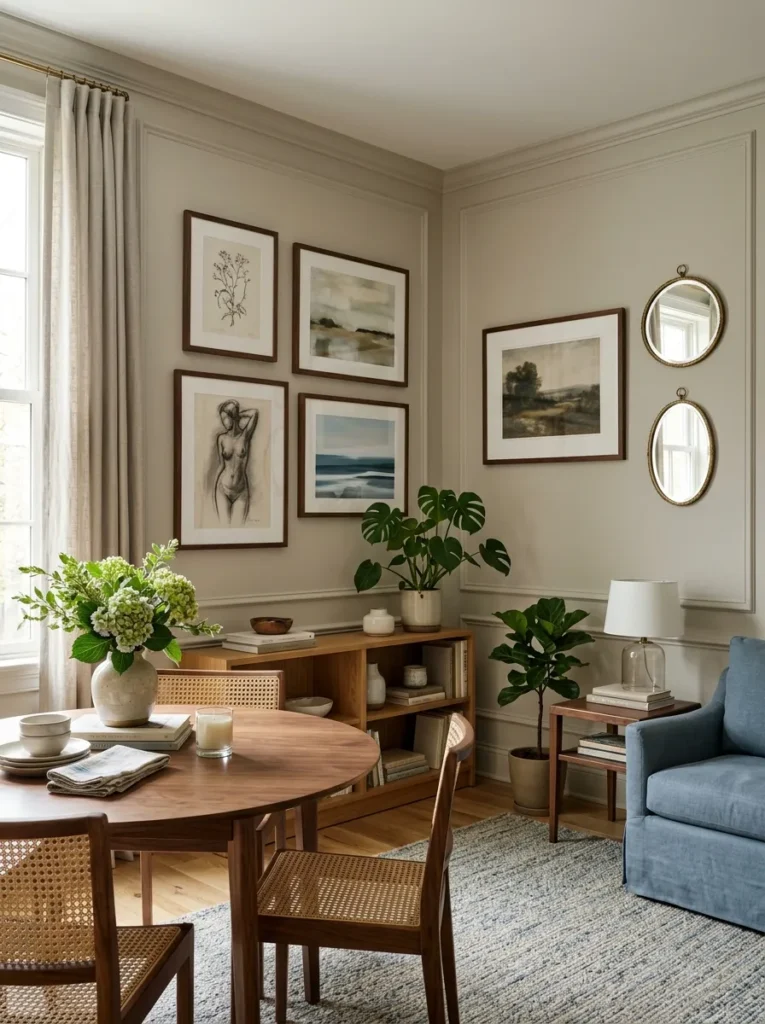
- Mirrors reflect light and make a corner feel more open.
- Artwork keeps the display personal rather than purely decorative.
- Repeated frame finishes connect different object types.
- Small mirrors add variation without dominating the gallery.
Choose four framed artworks between 10 by 14 and 16 by 20 inches and two mirrors between 10 and 18 inches in diameter. Maintain 2 to 4 inches between all pieces, and keep the mirror surfaces away from direct contact with frame edges. Center the main composition around 57 to 60 inches from the floor, while positioning smaller mirrors slightly higher or lower for rhythm. Avoid using large mirrors directly opposite harsh sunlight because intense reflected glare can make the room uncomfortable.
These Corner Wall Gallery Ideas are useful in darker rooms because mirrors can bounce daylight toward a visually neglected corner. Pair small round mirrors with botanical prints, photographs, or abstract artwork so the composition has both reflective and matte surfaces. Use 60 percent warm greige, 30 percent walnut and brass, and 10 percent dusty blue to prevent the mirrors from becoming the only focal point. Avoid using mirrored frames, mirrored furniture, and several large mirrors in the same corner because too much reflection can make the arrangement feel restless.
Pro Tip: Before mounting each mirror, check its reflection from the main seating position and adjust the height so it reflects an attractive light source, artwork, or architectural feature.
Eclectic Frame Mix
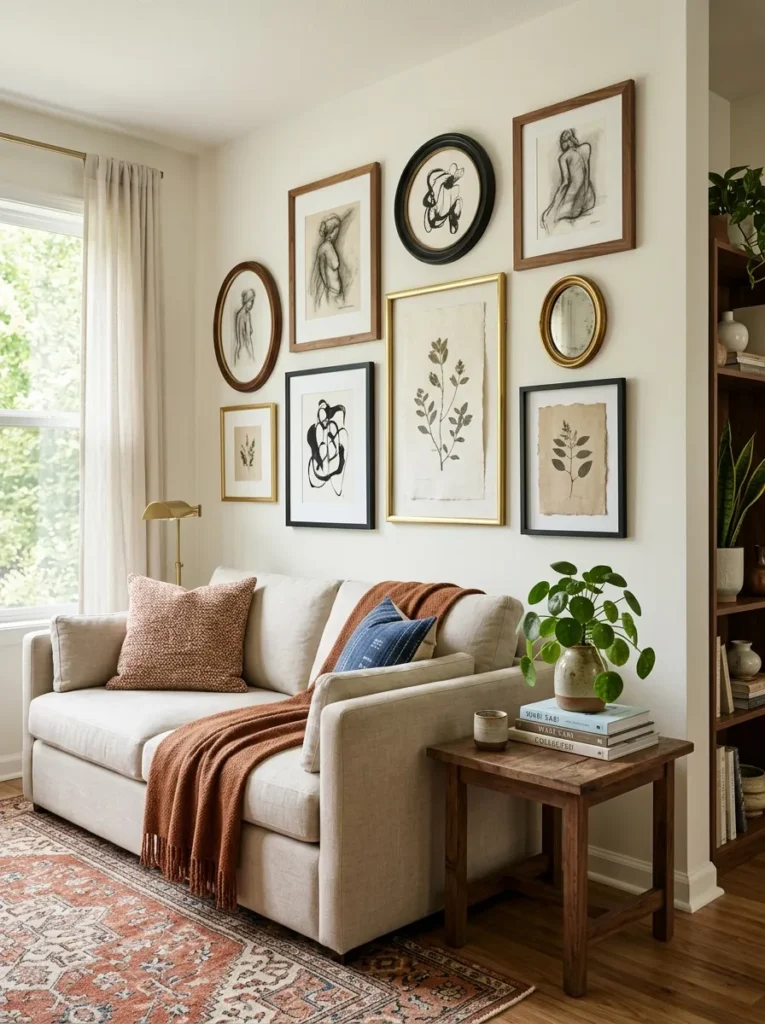
- Varied frames create personality and visual movement.
- Repeated colors prevent the mix from appearing random.
- Nine pieces fill a large corner without requiring identical artwork.
- Different shapes soften a rigid grid arrangement.
Choose seven to nine frames in a range from 8 by 10 to 18 by 24 inches, but repeat at least two frame finishes throughout the collection. Keep most gaps between 2 and 4 inches, with larger gaps of up to 5 inches around unusually shaped pieces. Position the center of the overall composition at about 58 inches from the floor and keep its outer edges clear of door swings. Avoid using more than four frame finishes because too much variation can make the gallery look disconnected.
This approach works especially well for homeowners who prefer eclectic wall art and want to combine inherited pieces with newer purchases. Start with one large artwork, then distribute smaller photographs, sketches, mirrors, and prints around it while repeating black, brass, or wood in several locations. Keep 60 percent creamy white, 30 percent walnut, black and brass, and 10 percent rust for a balanced visual hierarchy. Avoid placing all the dark frames together because distributing contrast helps the eye travel naturally across both walls.
Pro Tip: Arrange the frames on the floor first, then photograph the layout from 8 to 10 feet away to check whether the visual weight is balanced before making wall holes.
Tiny Apartment Corner
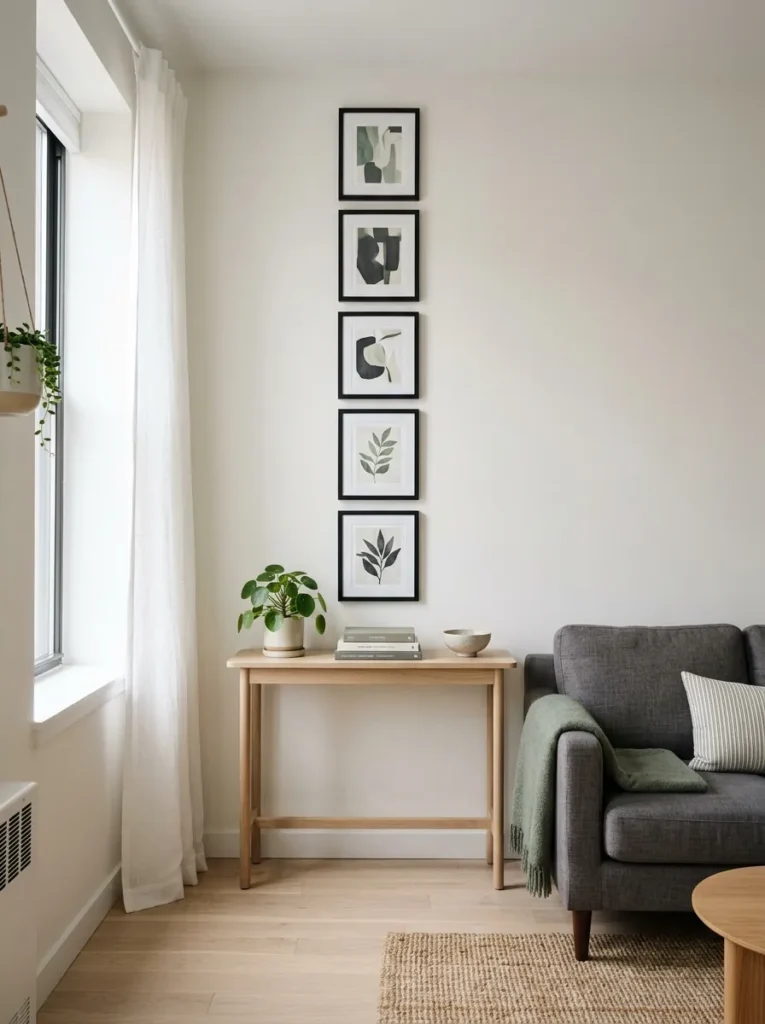
- Lightweight frames suit small apartments and rental walls.
- A vertical arrangement makes the corner feel taller.
- A narrow console adds function without consuming much floor area.
- The limited palette keeps a small room visually open.
Select five frames between 8 by 10 and 11 by 14 inches, and use frames less than 1 inch deep when floor space is tight. Keep the overall gallery width under 36 inches and maintain at least 30 inches of clear walking space in front of the arrangement. Position the center around 57 to 60 inches from the floor and choose a console no deeper than 12 inches. Avoid using a large 8 by 10 or 9 by 12 rug in this narrow zone if it blocks the main circulation path.
These small space decorating techniques allow a studio or compact flat to have personality without sacrificing usable floor area. A narrow console can hold keys, books, or a small lamp while the gallery supplies the visual interest above it. Keep 60 percent soft white, 30 percent pale oak and charcoal, and 10 percent muted green for an airy result. Avoid adding bulky baskets, oversized plants, or deep shelves directly beneath the artwork because those items can quickly consume the limited clearance.
Small apartments benefit from decor that adds personality without taking valuable floor space. These small living room ideas 2026 offer additional solutions for choosing furniture, improving circulation, and styling compact spaces.
Pro Tip: Use a 12-inch-deep console with a wall-mounted lamp instead of a table lamp when every inch of floor space matters.
Corner Wall Gallery Ideas for Living Rooms
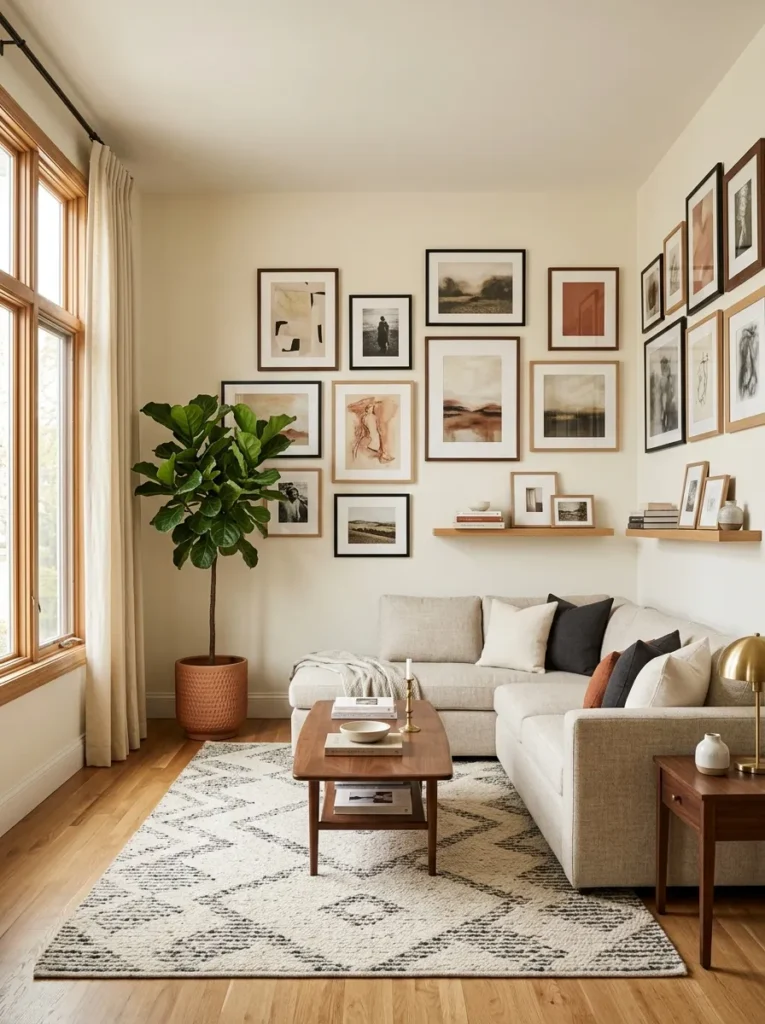
- The corner becomes a focal point without dominating the room.
- Mixed frames and a ledge provide controlled variety.
- Furniture dimensions remain proportionate to the gallery.
- The floor plant adds height and softens hard wall lines.
For a standard living room, use seven to nine frames between 10 by 14 and 18 by 24 inches, with 2 to 4 inches between pieces. Center the main gallery at 57 to 60 inches from the floor and leave 6 to 8 inches between the lowest artwork and the sofa back. A standard sofa depth is approximately 32 to 38 inches, while a coffee table should generally sit 16 to 18 inches high, allowing the gallery to remain visually dominant. Avoid using an oversized 9 by 12 rug in a small room because the furniture and gallery may become crowded; choose a 5 by 8 rug for a compact room, an 8 by 10 for a medium room, or a 9 by 12 for a genuinely large room.
These Corner Wall Gallery Ideas work especially well in living rooms because they connect the seating area to an otherwise unused wall junction. Combine family photographs, abstract prints, books, and one or two sculptural pieces, then repeat walnut or black across the frames for continuity. Keep 60 percent warm ivory, 30 percent walnut and charcoal, and 10 percent terracotta to coordinate with upholstery and accessories. Avoid placing artwork so low that it competes with the sofa or so high that the gallery appears disconnected from the seating arrangement.
A gallery wall can become the visual focal point of a living room when its scale works with the sofa, rug, and surrounding furniture. For more complete living room styling inspiration, explore our boho living rooms collection.
Pro Tip: Stand at the main sofa position and check the gallery from eye level before final mounting, then adjust the composition until the visual center sits close to 58 inches above the floor.
Kid-Friendly Art Corner
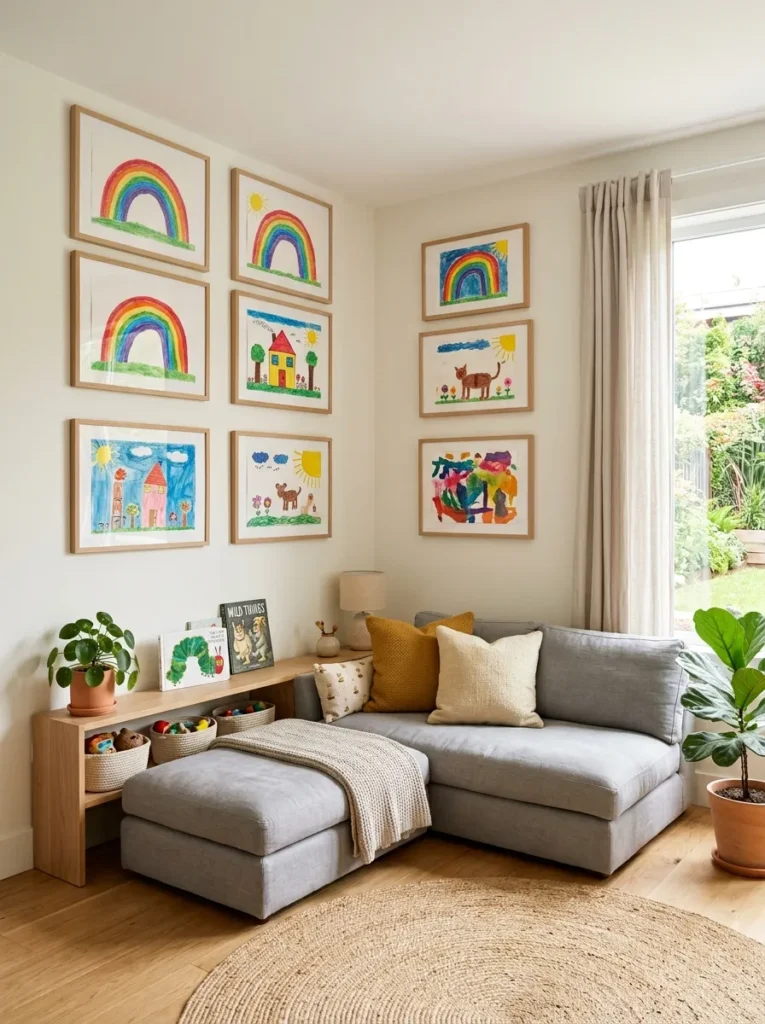
- Children’s artwork adds personality without expensive decor.
- Lightweight frames reduce risk around active family areas.
- Acrylic glazing is safer than ordinary glass.
- A consistent frame finish keeps different drawings cohesive.
Choose six frames between 8 by 10 and 11 by 14 inches, using lightweight wood or composite frames with acrylic glazing. Keep the lowest artwork at least 36 inches above the floor if children frequently play directly below it, and maintain 2 to 3 inches between frames. Use washable eggshell paint on the wall so fingerprints can be cleaned without extensive touch-ups. Avoid heavy glass frames, sharp metal corners, or unsecured decorative objects within easy reach of young children.
This arrangement turns Corner Wall Gallery Ideas into a practical way to display changing family artwork without making the room feel like a classroom. Rotate drawings every few months and keep a simple archive box for pieces that are not currently displayed. A 60 percent warm white, 30 percent light oak and soft gray, and 10 percent mustard palette gives colorful artwork a calm backdrop. Avoid trying to match every child’s drawing to the room because the personal artwork should remain the main source of color.
Pro Tip: Use acrylic glazing and child-safe frame corners, then attach each frame with hardware rated for at least twice its actual weight.
Balanced Asymmetrical Layout
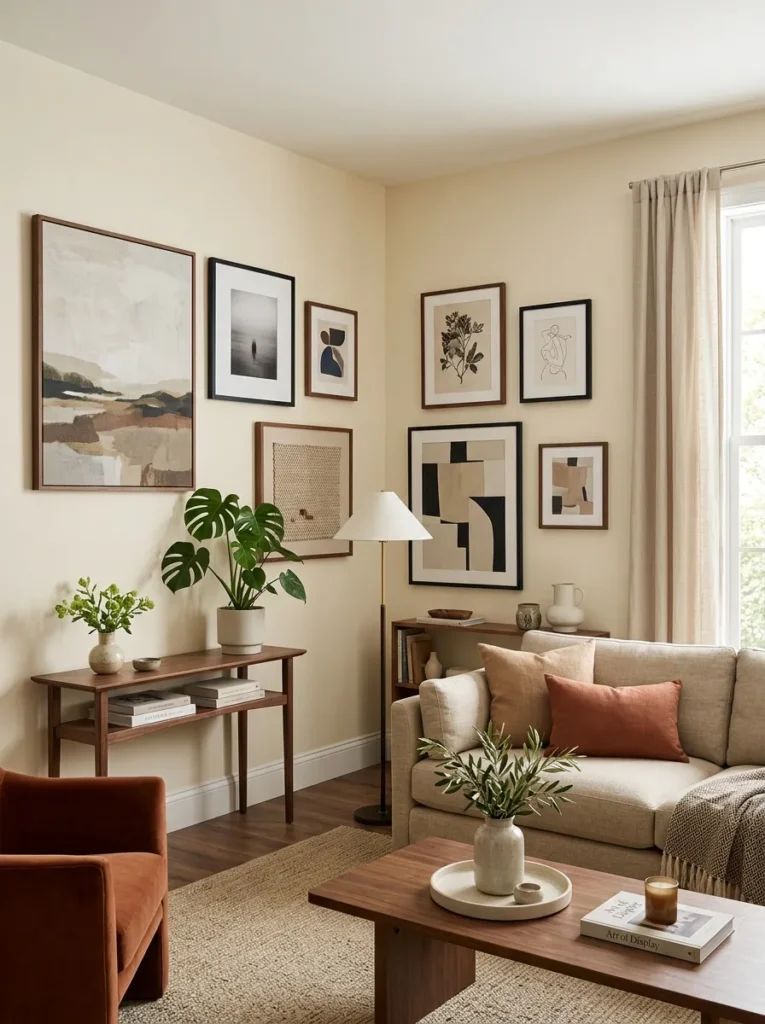
- Unequal frame sizes create movement without sacrificing balance.
- Visual weight can be distributed across both walls.
- The layout feels collected rather than overly rigid.
- It works with artwork acquired at different times.
Choose eight artworks ranging from 8 by 10 to 18 by 24 inches and distribute the largest pieces across opposite sides of the composition. Keep most gaps between 2 and 4 inches, with no more than 6 inches between pieces that intentionally create a visual break. Center the entire arrangement at approximately 58 inches from the floor and maintain at least 6 inches between the gallery’s lowest edge and nearby furniture. Avoid placing all large or dark frames on one wall because the corner will feel visually heavier on that side.
A balanced asymmetrical layout is useful when your collection includes different picture frame arrangement sizes, shapes, and artwork styles. Begin with the largest piece, then balance it with two or three medium frames and smaller pieces across the adjoining wall. Keep 60 percent warm cream, 30 percent walnut and matte black, and 10 percent terracotta so differences in size do not become visual chaos. Avoid measuring balance by symmetry alone because the goal is to distribute visual weight, not create identical patterns on both walls.
Pro Tip: Photograph the completed floor layout in black and white before mounting it; if one side appears noticeably darker or heavier, move one large frame or dark print to the opposite side.
People also ask
How do Corner Wall Gallery Ideas work in small rooms?
Corner Wall Gallery Ideas work best in small rooms when frame sizes and spacing are kept modest. Choose four to six pieces between 8 by 10 and 11 by 14 inches, leaving 2 to 3 inches between frames. Keep the overall arrangement centered around 57 to 60 inches from the floor and preserve at least 30 inches of walking clearance. Lightweight frames, picture ledges, and removable hanging systems are particularly useful in apartments and narrow hallways.
How high should corner gallery artwork hang?
Position the visual center of most gallery arrangements between 57 and 60 inches from the floor, which places the artwork near average eye level. When hanging artwork above furniture, leave approximately 6 to 8 inches between the furniture and the lowest frame. For a sofa, dresser, or console, measure from the furniture’s top edge rather than the floor. Avoid placing artwork so high that it becomes visually disconnected from the furniture below.
What frames work best for Corner Wall Gallery Ideas?
Corner Wall Gallery Ideas benefit from frames that repeat one or two finishes throughout the arrangement. Natural oak, walnut, matte black, and antique brass are versatile choices. For a mixed gallery, use two to four frame finishes and keep most gaps between 2 and 4 inches. Lightweight composite frames with acrylic glazing are practical for rentals and family rooms, while solid wood frames provide a more substantial appearance in permanent installations.
How many pieces should a corner gallery contain?
A compact corner usually needs four to six pieces, while a larger living room can support seven to nine. Start with one larger artwork between 16 by 20 and 18 by 24 inches, then balance it with smaller 8 by 10, 11 by 14, or 12 by 16 inch pieces. Keep 2 to 4 inches between most frames. Avoid filling every available section of wall because negative space helps each artwork remain visually distinct.
How can renters create a corner gallery without damage?
Renters can use lightweight frames, removable hanging strips, and narrow picture ledges where the wall surface and manufacturer’s weight limits allow. Keep individual frames around 4 to 5 pounds or less for many removable systems, but always follow the specific product rating. Test one hanger in an inconspicuous location before installing the full arrangement. Avoid adhesive products on damp, textured, freshly painted, or poorly bonded surfaces.
Conclusion
The best Corner Wall Gallery Ideas begin with accurate measurements, a controlled 60, 30, 10 color balance, and enough negative space to keep the corner visually calm. First, measure the wall and mark a 57 to 60-inch eye-level centerline before buying frames. Next, choose two or three frame finishes and keep most gaps between 2 and 4 inches. Finally, distribute artwork by visual weight rather than simply matching sizes on both walls.
These Corner Wall Gallery Ideas can work in living rooms, entryways, bedrooms, stairways, and rental apartments when scale and mounting methods suit the space. Save this to your Pinterest boards so you can refer back to it! Once your gallery is planned, you can continue refining the rest of the room with complementary furniture, lighting, and accessories. Browse our living room ideas for additional decorating inspiration that can help tie the entire space together.

Welcome to Homely Crafter! I am Muhammad Israr, the founder of Homely Crafter, bringing 4+ years of hands-on interior design and renovation experience to practical, budget-friendly home decor ideas for every room. Let’s decorate together!