
A five-star resort outdoor kitchen feels different the moment dinner starts. Surfaces stay cool and wipe clean, the grill holds a steady temperature, shade adjusts with a button, and nothing rusts after a season of rain. These luxury outdoor kitchen ideas borrow that resort logic for a home backyard: premium materials, high-end appliances and lighting that works after dark as well as at noon. According to The Spruce, 304 grade stainless steel resists rust in outdoor use, which is why resort kitchens build their cabinets and grills from it rather than painted steel.
Stone counters, pizza ovens, louvered roofs and heated floors all appear below, each one pinned down with the grade to order, the size to measure and the price range to budget for. Read the surface and shade ideas first, since those two choices set the tone for the rest of the build.
Stainless Steel Cabinetry
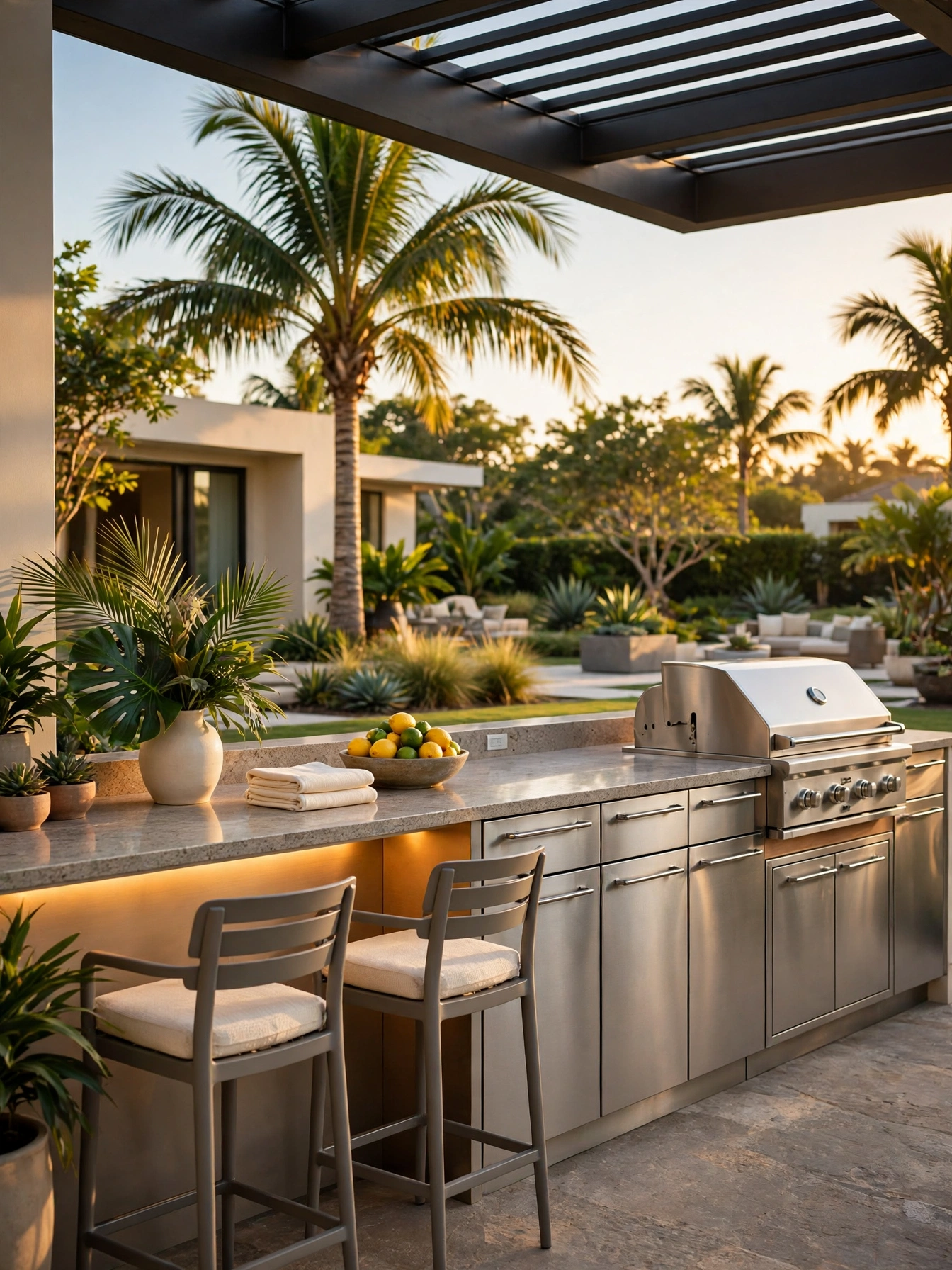
Why This Works:
- 304 grade steel shrugs off rain, salt air and pool splash
- A 16 gauge door feels solid and closes without flexing
- Brushed finishes hide fingerprints better than mirror polish
- Sealed cabinet interiors keep dishes dry through storm season
Resort kitchens choose stainless steel cabinets because the material asks almost nothing in return. Specify 304 grade steel at 16 gauge for doors and frames, since the thicker gauge resists dents from dropped pans and the 304 alloy holds up near pools and coasts where 430 grade steel spots within a year. Build the run 36 inches high and 24 inches deep, with soft-close hinges rated for 40 pounds per door. Powder-coated aluminum never rusts. It scratches more easily than steel, and its lighter doors suit a second-floor terrace. Reserve magnetic grades for indoor cabinets. Outdoors, their lower chromium lets rust start at the hinges.
Salt air and chlorine punish every other cabinet material, so coastal homes and pool owners get the most from a steel run. The surface stays cool to the touch in shade and wipes clean after a greasy cook, which is the daily payoff for the higher price. A 304 stainless steel cabinet run near 8 feet long lists at 4,000 to 9,000 dollars. In dry inland yards, powder-coated aluminum holds up well, since its coating sheds rain and the metal never rusts. Painted wood swells and peels after two wet winters, so it rarely survives a resort-grade build.
Natural Stone Counters
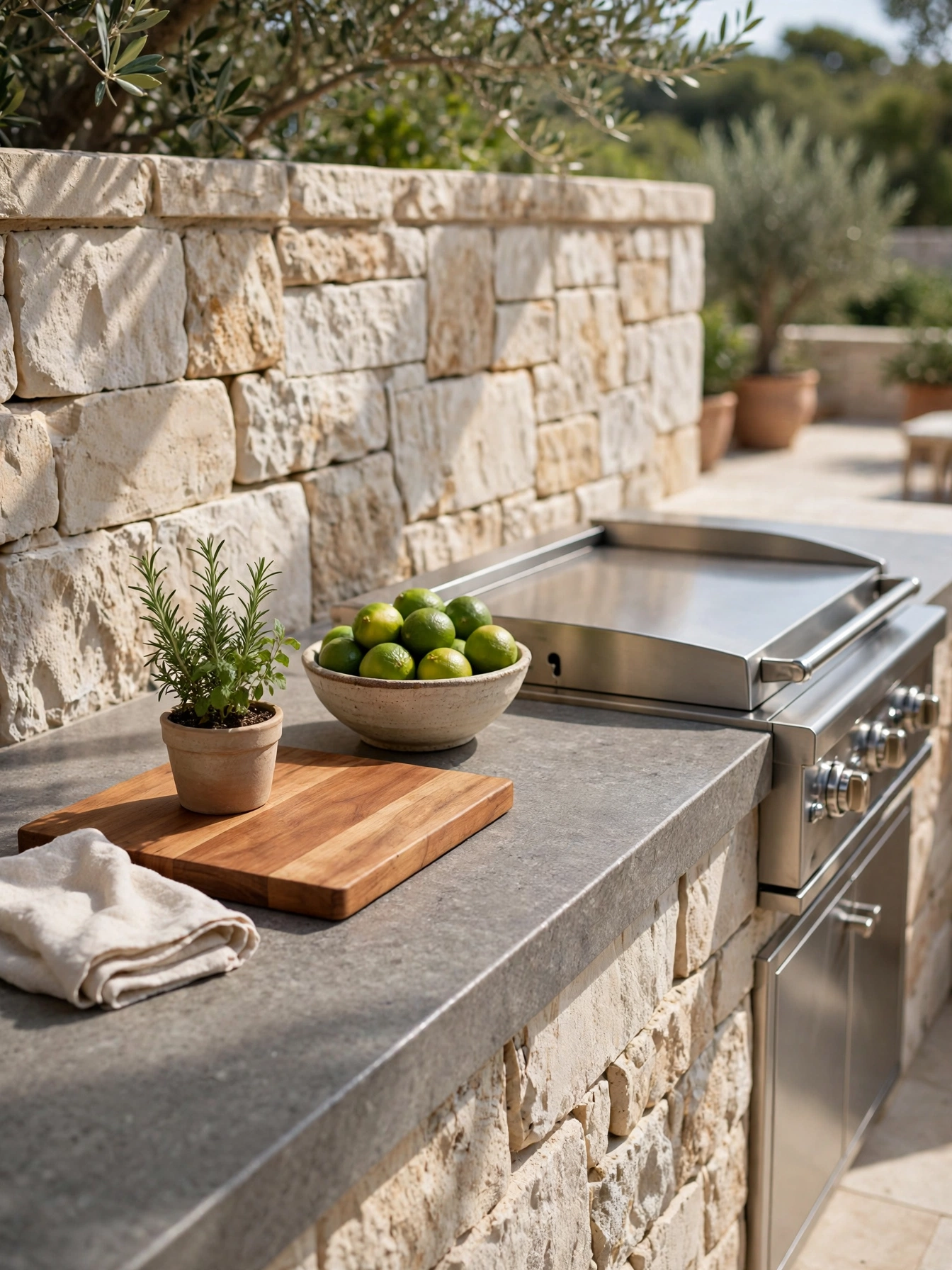
Why This Works:
- Granite at 3 centimeters thick resists heat from hot pans
- Honed finishes hide water spots better than polished stone
- Stone stays cool under sun and steadies dough and pastry
- A 2 inch overhang sheds rain away from cabinet doors
Natural stone gives a resort kitchen its weight, and thickness sets how the counter behaves. Order granite or quartzite at 3 centimeters thick, with a honed finish that hides water spots and fingerprints far better than a polished face. A 36 inch high counter with a 2 inch overhang sheds rain away from the cabinet doors, and the slab should extend 24 inches deep to hold a board, a bowl and a tray at once. Marble looks softer and more veined, yet citrus or wine left on it for 10 minutes leaves an etch mark. Granite resists both without sealing every season. An indoor laminate top lasts one rainy season outdoors before the chipboard core soaks, bubbles and lifts at the edges.
For a granite counter near 10 feet long, installed, the bill lands at 2,500 to 6,000 dollars. Quartzite resists heat even better. A hot pan straight off the grill can sit on this slab without leaving a mark, where the same heat would scorch wood or melt plastic. The finish also ages well, with granite holding its color for decades under sun. Porcelain never stains, yet a heavy pot dropped on the corner can chip its edge.
Wood Fired Pizza Oven
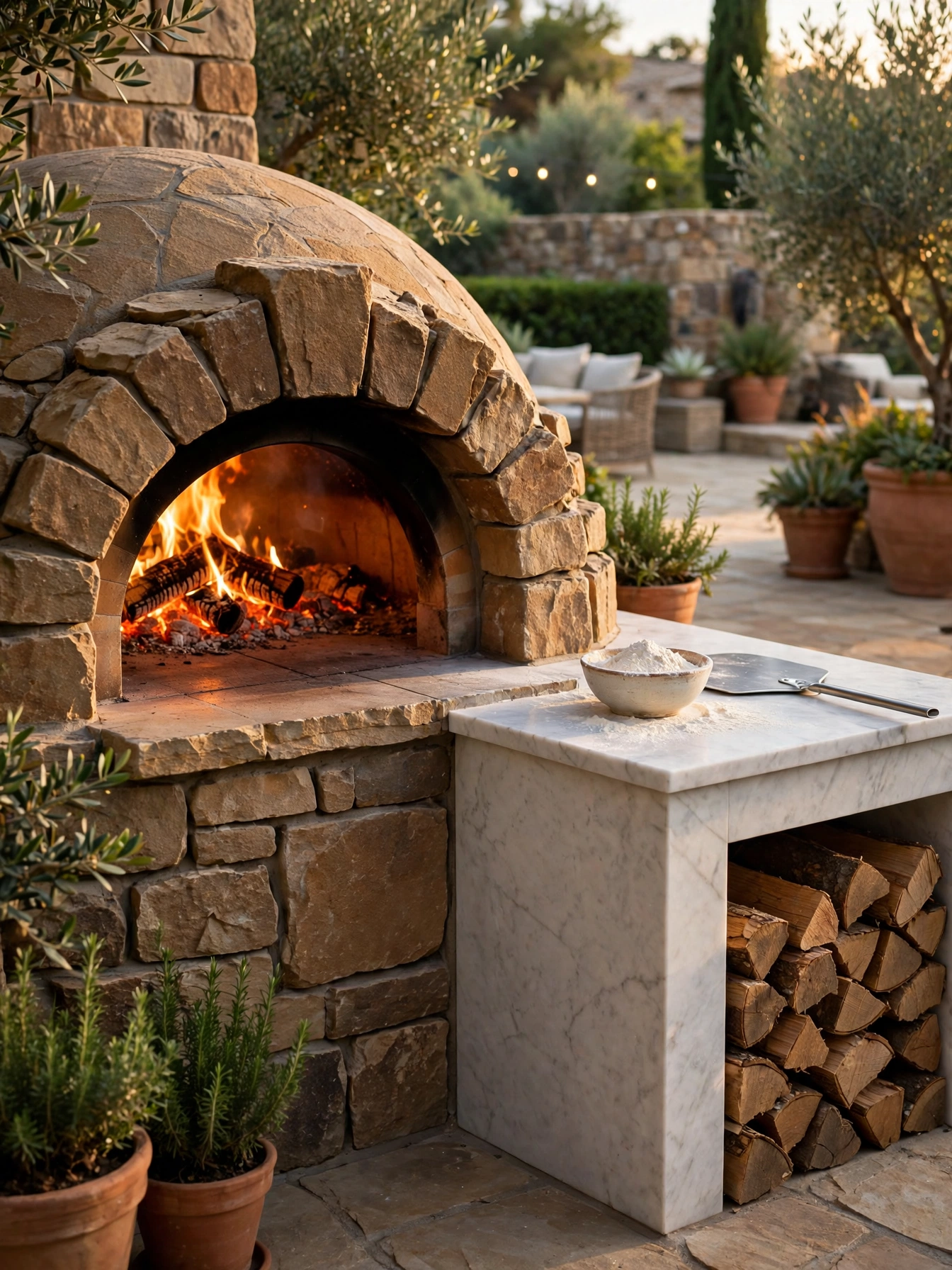
Why This Works:
- A dome at 800 degrees cooks a pizza in 90 seconds
- Refractory brick holds heat for hours after the fire dies
- A marble landing beside the oven stages dough without sticking
- The oven becomes the evening showpiece guests gather around
A wood fired oven gives the backyard a kitchen guests remember, and heat is the number that matters. Choose a refractory brick dome with a 36 inch cooking floor, which reaches 800 degrees Fahrenheit and cooks a pizza in about 90 seconds. Feed the fire with hardwood cut to 16 inches. Softwood burns fast and leaves resin on the dome. The oven needs 10 feet of clearance from the house and a stone base 48 inches square that carries a load near 2,000 pounds. A gas pizza oven heats faster and holds a steady temperature with a dial. Its crust never picks up the smoke a wood fire gives. Only refractory brick survives 800 degrees in a dome. Ordinary house brick cracks at that heat and the oven fails within a season.
Pizza night becomes a weekly ritual when the oven lights in 20 minutes and the whole family stretches dough at the marble counter. The fire itself becomes the evening’s centerpiece, with the family gathered at the marble counter while the dome heats. The wood oven demands practice and a wood supply, so it rewards patient cooks more than hurried weeknight meals. A freestanding wood fired oven, installed, comes to 3,000 to 8,000 dollars. A countertop gas pizza oven of similar output fits smaller patios, and it lights with a dial instead of a wood fire.
Beverage Center Fridge
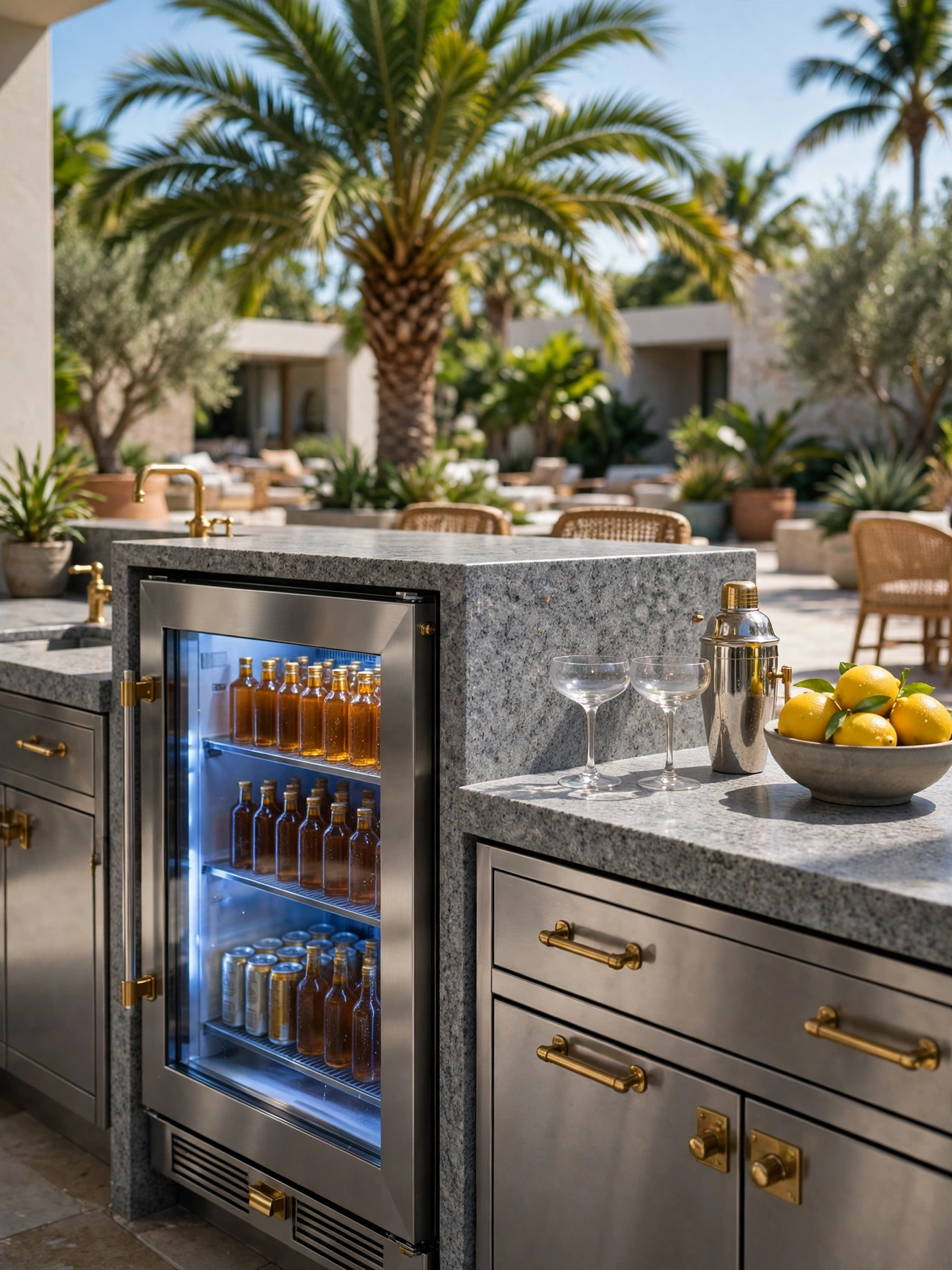
Why This Works:
- A 24 inch unit holds 120 cans at a steady 38 degrees
- An outdoor rated compressor runs in 100 degree heat
- A glass door shows the stock without opening the unit
- The center sits beside the grill, so drinks never interrupt cooking
A beverage center puts cold drinks steps from the grill, and the outdoor rating is what separates it from an indoor fridge moved outside. Choose a 24 inch wide outdoor rated unit that holds about 120 cans and keeps them at 38 degrees Fahrenheit, with a compressor built to run in 100 degree summer heat. The cabinet opening needs 1/4 inch of air space on each side, and the unit needs a dedicated 15 amp circuit on a GFCI outlet. An indoor fridge moved outside strains its compressor in summer heat and cracks its seals in winter cold within a year. Beside the pizza oven or the grill, the compressor runs constantly and drinks hold above 38 degrees.
Cold drinks within arm’s reach change how a party flows, since guests help themselves and the host stays at the grill. A quality outdoor rated beverage center carries a 1,500 to 3,500 dollar price tag; a simple cooler with ice needs fresh ice every 4 hours, so the host refills it through a long party. On pool days and long dinners, the 120-can capacity and the steady 38 degree chill keep the bar running without a trip indoors. A wine fridge holds fewer bottles and chills at a warmer temperature, so collectors get more from it than mixed drink service does.
Louvered Pergola Roof
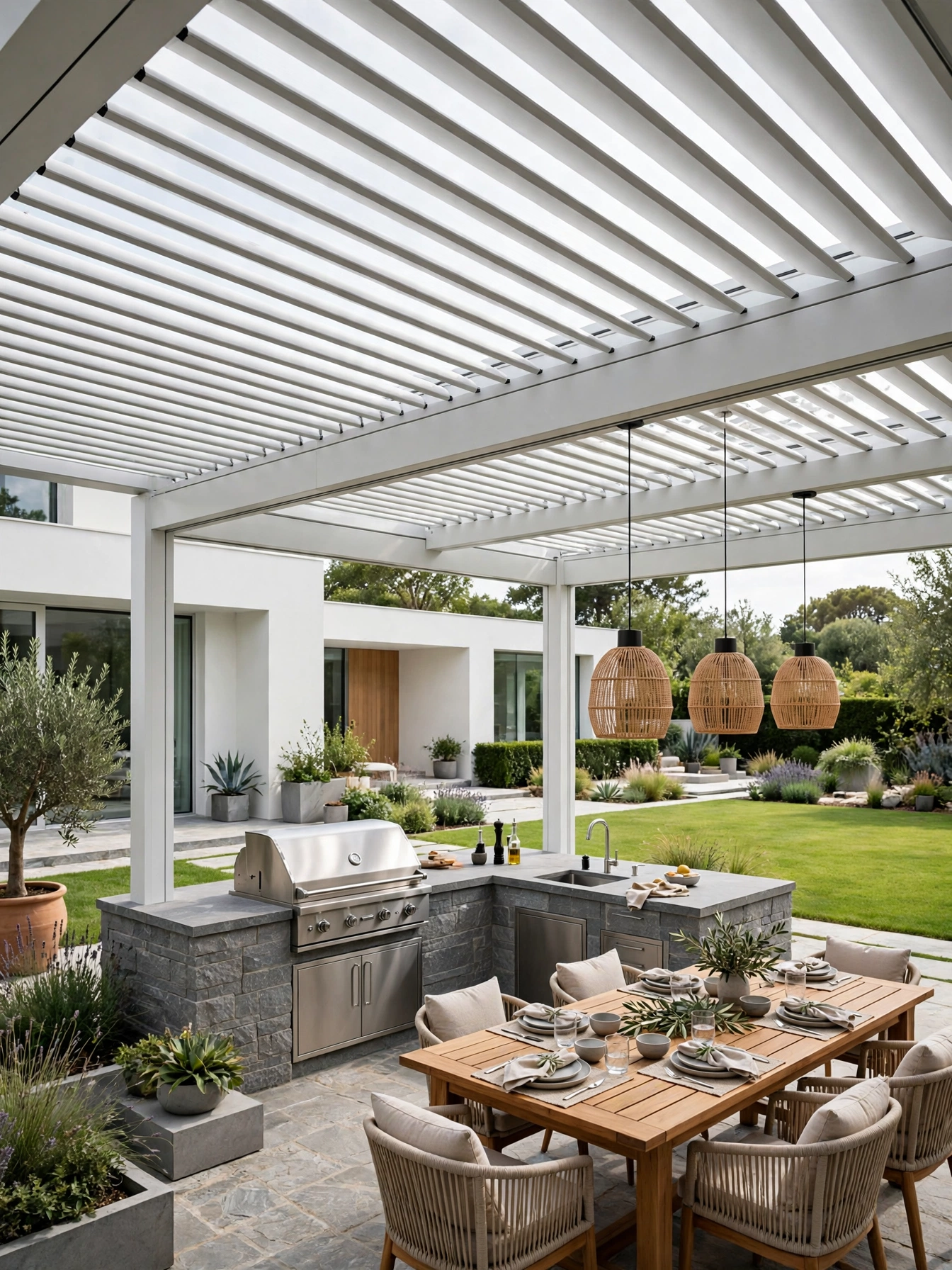
Why This Works:
- Louvers tilt 170 degrees, from full sun to full rain cover
- A 10 by 12 foot roof shades the kitchen and the table
- Powder-coated aluminum never rusts and needs no painting
- Integrated gutters carry rain away from the cooking zone
A louvered roof gives a resort kitchen the control a fixed roof cannot, since the slats move with the weather. Size the pergola at 10 by 12 feet to cover the kitchen run and the near end of the table, with aluminum louvers that tilt 170 degrees from open sky to sealed rain cover. Set the posts 8 feet high in concrete footings 24 inches deep, and keep the lowest beam clear of the grill hood by 36 inches so heat never reaches the mechanism. A fixed timber pergola looks warmer and needs sealing every 2 years, and its roof never closes against rain. Have a builder confirm the deck joists carry the frame plus a snow load before mounting.
Installed, a louvered pergola 10 by 12 feet runs 8,000 to 18,000 dollars. A fixed timber pergola brings warm wood grain to the terrace, and a yearly sealing coat keeps it looking fresh. Shade, rain cover and breeze all adjust from one control, which is why resort patios use this system over a fixed roof. Sunny mornings and rainy afternoons both work under it: the louvers open for morning light and close for an afternoon storm. A licensed electrician should wire the motor and the integrated lights, because the system runs on mains power and the connections must meet outdoor code.
Outdoor Rated Lighting
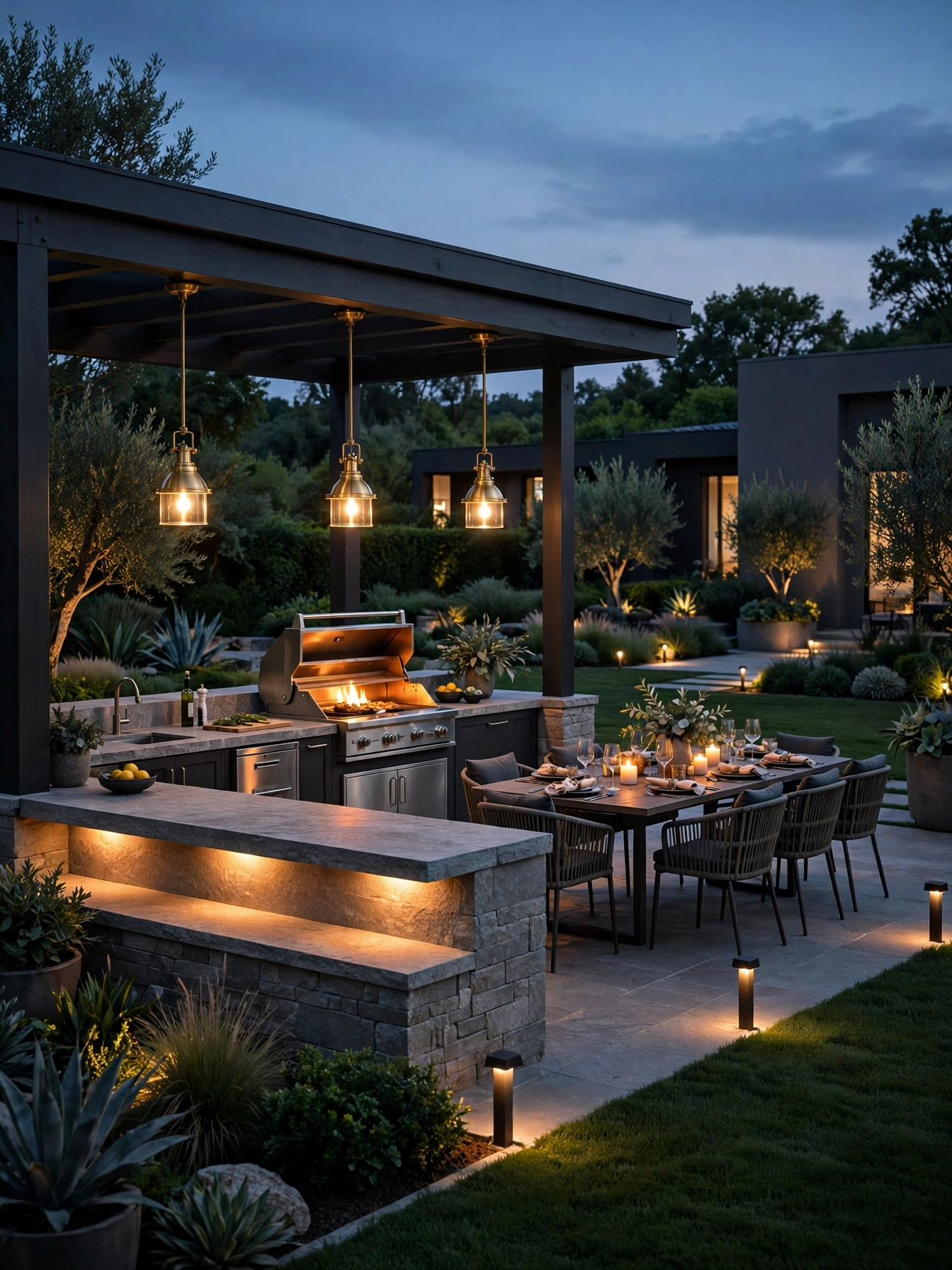
Why This Works:
- IP65 rated fittings survive rain, pool splash and hoses
- Warm 2700K light flatters food and skin after sunset
- Pendants at 30 to 36 inches light the counter without glare
- One slide lowers the pendants to a soft glow for evening meals
Resort lighting earns its keep after dark, when the cooking zone must stay safe and the table must stay inviting. Fit IP65 rated lights on every exposed fitting, and keep the color at 2700K to 3000K, which makes food look fresh and the stone glow warm. Hang pendants 30 to 36 inches above the counter and space them 24 to 30 inches apart, so the work surface lights evenly without shadows. Low voltage 12 volt systems run cheaper than mains lights and stay safer around pools and kids. Mains fixtures give a brighter beam for large kitchens. Rain enters unsealed indoor housings, greens the sockets within a month and trips the breaker mid-dinner.
Dinner stretches past sunset when the counter glows and the path stays lit. Dinner outside most summer nights turns these lights into the most used idea in the kitchen. A dimmer on the pendant circuit adds about 40 dollars and turns the same lights from prep brightness to dinner warmth in one slide. A full resort lighting setup with pendants, under-counter strips and path lights totals 900 to 2,500 dollars. A set of eight solar path lights glows too weakly for chopping safely after dark, so they suit edging a path rather than lighting a counter. Brass fixtures cost more than black metal. Age mellows them to a soft golden brown that sits well beside stone and teak.
Luxury Outdoor Kitchen Ideas for Entertaining
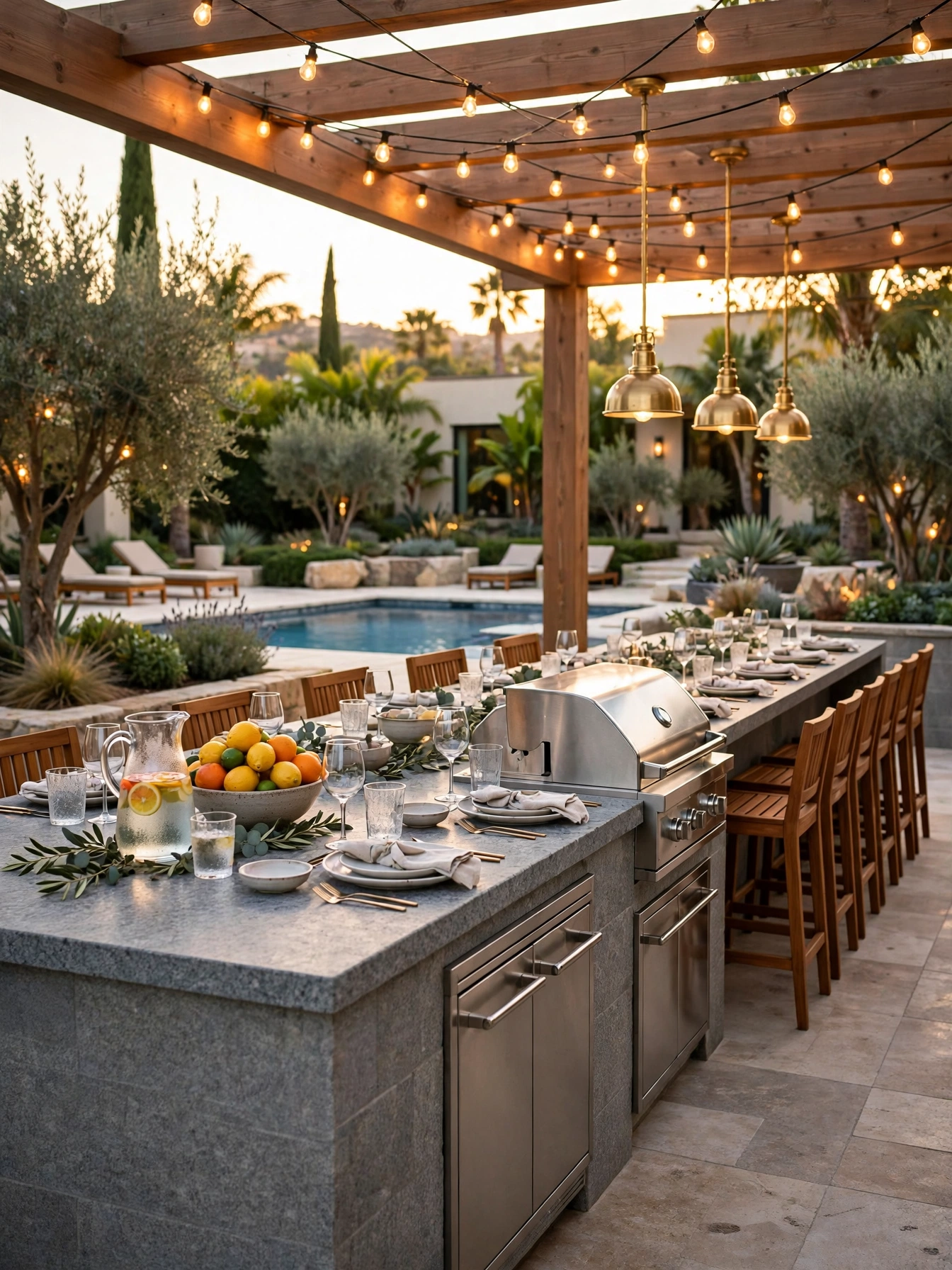
Why This Works:
- A 12 foot island seats six with 24 inches per guest
- The bar side faces the pool, so guests watch the water
- Two cooking zones let one person grill while another preps
- Stone and teak together read resort, not backyard barbecue
Entertaining at resort scale starts with an island long enough to hold the whole party. Build the island 12 feet long and 36 inches wide, with seating for six at 24 inches per person and 42 to 48 inches of walkway behind the stools. A 3 centimeter granite top resists heat and stains, and a teak bar front warms the stone and hides the steel frame. Two cooking zones, a grill on one end and a side burner on the other, let two cooks work without colliding. A single grill handles family dinners well, and twelve guests arriving at once bottleneck around one cooking zone. Bar seats placed upwind of the grill keep guests at the bar instead of drifting away from the smoke.
Guests gather at the island as the host cooks, which is the resort pattern that makes a party feel easy. 12,000 to 25,000 dollars buys a 12 foot resort island with grill, stone top and seating. A smaller 8 foot island with the same finishes comes in well under that figure and seats four comfortably. The island carries food, drinks and conversation at once, which pays off most at monthly dinners and summer pool parties. The larger island needs a yard at least 40 feet wide to keep walkways clear on every side.
Teak Bar Seating
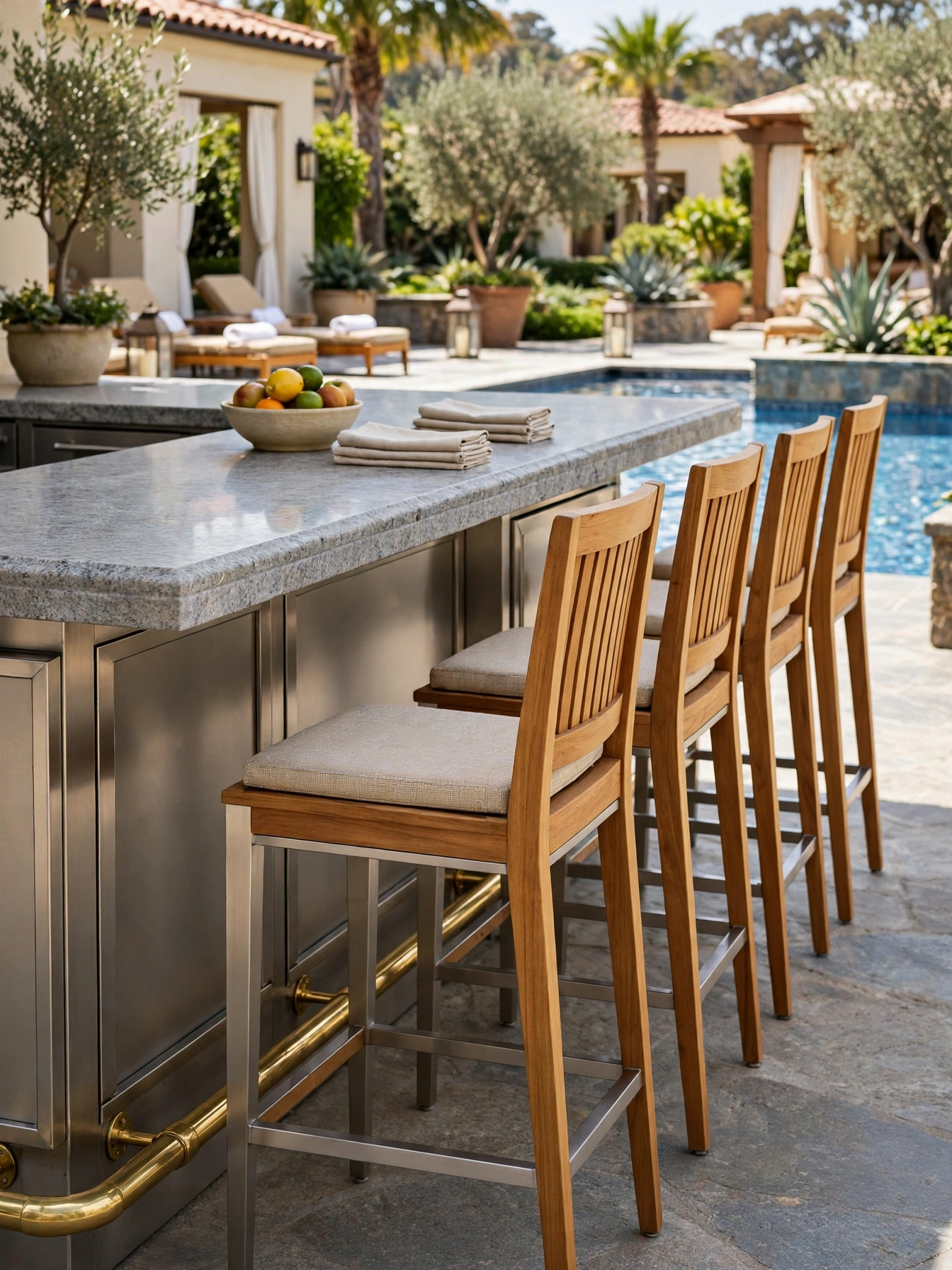
Why This Works:
- Grade A teak resists rot for 25 years with yearly oiling
- A 30 inch stool pairs exactly with a 42 inch bar counter
- A brass foot rail at 12 inches high eases long sits
- Teak silvering suits stone and steel without clashing
Teak bar seating adds the warmth that steel and stone cannot, and the grade decides how long it lasts. Choose Grade A teak with 1.5 inch thick slats. The heartwood resists rot for 25 years, but lower grades gray unevenly and crack within 5 seasons. Pair a 42 inch bar counter with 30 inch stools, and allow 24 inches of width per seat so elbows never collide. A brass foot rail at 12 inches high supports feet during long evenings. Stools without a rail tire legs within half an hour. Powder-coated aluminum stools stack for storage and shrug off rain. They feel cold in spring and lack the weight that keeps a stool steady in wind. Teak left unoiled in a sunny yard dries, splits and turns patchy gray within two summers, so the yearly oil coat is part of owning it.
Guests linger at the bar when the seats feel as considered as the kitchen. Teak gives a resort-style island its warmth, and the wood softens a run of steel cabinets so the kitchen reads warm rather than industrial. That warmth asks for upkeep in return: oil once a year and a cover in winter, where aluminum asks for nothing beyond a wipe. Four Grade A teak bar stools total 1,200 to 3,000 dollars. Aluminum stools skip the yearly oiling entirely and stack away for storage when the season ends.
Infrared Grill Burners
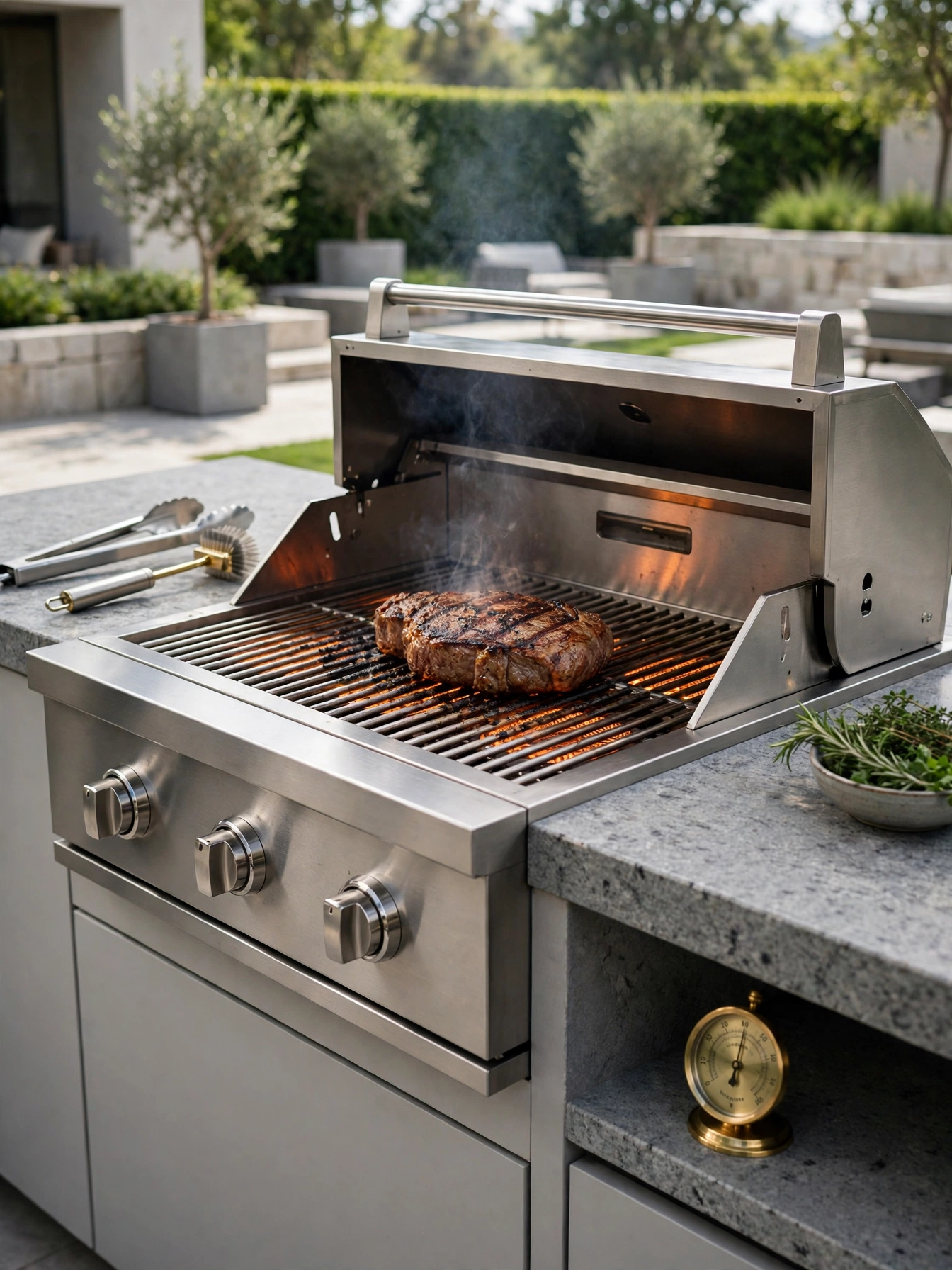
Why This Works:
- Infrared burners reach 1,000 degrees for a fast sear
- Even heat across the grate ends hot spots and raw centers
- A 36 inch grill holds 12 steaks at once for a party
- Ceramic plates shield the flame from dripping fat
Infrared burners sear steak the way a resort steakhouse does, with heat that a standard burner cannot reach. Choose a 36 inch built-in grill with ceramic infrared burners rated to 1,000 degrees Fahrenheit, which sears a steak in 90 seconds per side. A standard gas burner tops out near 500 degrees and needs 4 minutes per side for the same crust, so infrared saves time and keeps the inside juicy. Keep 24 inches of landing space on each side of the grill, and leave 10 feet of clearance from the house, since the intense heat demands the same safety gap as any gas grill. A standard burner handles slow cooking better, because infrared heat burns the outside before the center cooks through.
Infrared heat in a 36 inch built-in grill is priced at 2,500 to 6,000 dollars. A standard gas grill handles a wider range of foods, from slow roasts to delicate fish, without swapping burners. Steak night tastes different when the crust forms fast and the center stays pink. Meat lovers will notice that difference on the first cook. Infrared excels at searing and struggles with delicate fish or slow roasts, so one burner cannot do every job. The ceramic plates need brushing after each cook, since dripping fat carbonizes on the surface and blocks the heat.
Quartzite Prep Surfaces

Why This Works:
- Quartzite at 3 centimeters resists heat to 300 degrees
- A pale surface shows crumbs, so the counter stays clean
- The stone never stains from wine, oil or citrus
- A 48 inch prep run holds a board, a bowl and a tray
Quartzite prep surfaces give a resort finish to the hardest working part of the kitchen. Order a quartzite slab 3 centimeters thick for the prep run, with a honed finish that grips a cutting board instead of letting it slide. A 48 inch run at 36 inches high holds a board, a bowl and a tray side by side, and the stone resists heat to 300 degrees, so a hot pan rests safely for a minute. Granite handles heat well and needs yearly sealing to hold its color outdoors. Quartzite needs sealing only every 2 years and resists etching better. Citrus and wine etch marble in 10 minutes, and polishing cannot lift the marks they leave.
Chopping and plating feel calmer on a pale stone that shows every crumb, since the mess gets wiped as it happens. A board, a bowl and a tray fit the 48 inch run side by side, so salads and dough get prepped without shuffling things aside. A quartzite prep run near 8 feet long sits near 2,000 to 5,000 dollars. Granite asks for yearly sealing to hold its color outdoors. A porcelain slab stays stain-free for years, though a dropped pot can chip its corner edge.
Outdoor Dishwasher Drawer

Why This Works:
- Six place settings wash per cycle in this drawer
- The drawer sits at 36 inches high, so loading needs no bending
- Outdoor rated seals survive heat, cold and humidity
- Dishes wash beside the grill instead of traveling indoors
A dishwasher drawer outside ends the nightly parade of dirty plates back to the indoor kitchen. Fit a 24 inch outdoor rated drawer unit under a 36 inch high stone counter, which washes 6 place settings per cycle using about 3 gallons of water. The unit needs a water supply line and a drain with a 1/4 inch per foot fall, and the cabinet opening must match the maker spec, usually 24 inches wide with 1 inch of air behind the unit. A full-size outdoor dishwasher holds 12 place settings and needs a 30 inch cabinet. A drawer fits small parties and saves water on light loads. Cold cracks the seals of an indoor drawer unit and humidity kills its electronics within a year.
Plates wash where the meal happened, so the host joins dessert instead of stacking dishes in the sink. Frequent entertainers will feel the payoff every night: cleanup becomes one button press. The new water and drain lines must meet local code, so the plumbing work belongs in the build budget rather than an afterthought. An outdoor rated dishwasher drawer, installed, runs 1,800 to 3,500 dollars. For large parties, a full-size outdoor unit clears 12 place settings in one cycle, so dessert starts without a second load.
Heated Stone Flooring

Why This Works:
- Radiant mats at 12 watts per square foot warm stone evenly
- Warm floors dry puddles fast after rain or pool splash
- Stone holds heat for an hour after the system switches off
- Barefoot comfort extends the terrace season by months
Heated stone flooring makes a resort terrace a barefoot space, even on cool mornings. Lay electric radiant mats rated at 12 watts per square foot under 2 centimeter stone pavers, and control the zone with a thermostat that holds the surface near 80 degrees Fahrenheit. A 200 square foot terrace needs about 2,400 watts, so the circuit must carry a dedicated 20 amp supply on a GFCI breaker. Hydronic tubing suits terraces over 300 square feet. Electric mats fit terraces under 300 square feet. Mats belong only on open floor, never under a fixed grill base or a heavy stone island, where trapped heat damages the cable and ends the warranty.
Cool mornings stop ending the outdoor season when the floor stays warm. Pool owners and cold-climate yards get the longest season from this floor. Heating a 200 square foot terrace, installed, costs 3,000 to 7,000 dollars. A standard stone terrace needs no power at all, and its pavers dry in the sun after rain. The floor also dries fast after rain, which keeps the cooking zone safe underfoot. The running cost stays modest, since the thermostat heats only the hours the terrace gets used.
Cocktail Ice Maker
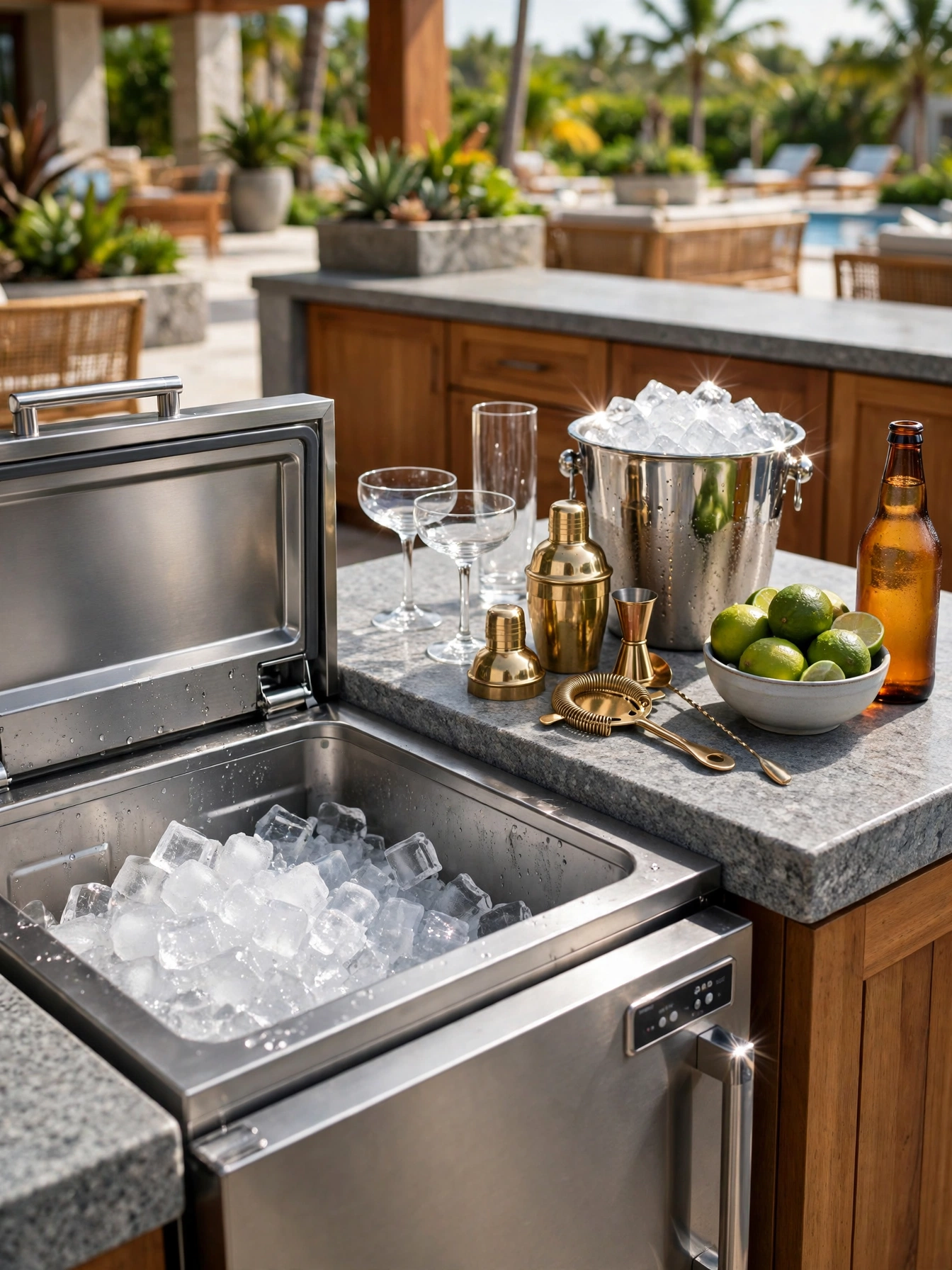
Why This Works:
- A 15 inch unit makes 28 pounds of ice per day
- Clear cubes melt slower than cloudy freezer ice
- The maker sits beside the beverage center for fast service
- A drain line stops melt water from pooling on the patio
A cocktail ice maker runs the bar without trips to the indoor freezer. Choose a 15 inch outdoor rated unit that makes 28 pounds of clear ice per day and stores 20 pounds at a time, with a drain line that carries melt water away from the patio. The unit needs a water supply and a dedicated 15 amp circuit, and the cabinet opening should leave 1/4 inch of air on each side for ventilation. Bagged ice melts fast and needs a cooler run every 4 hours. A built-in maker keeps the bar stocked all evening. An indoor ice maker stops making ice on the hottest days, when summer heat overwhelms its compressor.
An outdoor rated ice maker, installed, is 1,500 to 3,500 dollars. A portable countertop maker makes about 26 pounds per day yet needs manual draining, so the host empties it by hand after each use. Clear cubes chill a drink without watering it down fast, which is the small detail guests notice in a good cocktail. The bar stays stocked through cocktail evenings and pool parties without a trip to the freezer. The built-in unit also needs a winter drain-down, so the water line never freezes and splits.
Smart Grill Controls

Why This Works:
- WiFi controls hold the grill between 250 and 500 degrees
- A probe alerts the cook when the roast hits 145 degrees
- The app tracks a 6 hour cook without standing at the grill
- Dual zones sear on one side and roast low on the other
With smart grill controls, resort consistency reaches a home backyard, since the temperature holds itself. Choose a WiFi grill with dual zones that hold between 250 and 500 degrees Fahrenheit, and use the probe to alert the cook when a roast reaches 145 degrees inside. A 36 inch smart grill holds 12 burgers at once. A 30 inch model fits family dinners and is priced lower. Pellet smart grills feed fuel automatically and hold a steady 225 degrees for 10 hours, yet they need power and pellets on hand. Gas smart grills light instantly and run on a standard line. Alerts stop when the WiFi drops, and the grill keeps cooking unwatched until the cook checks it in person.
Long cooks run themselves, so the host joins the guests instead of standing at the grill. That freedom is the real luxury of the system. A 6 hour roast holds its temperature from the phone, with the probe sounding the moment the meat hits 145 degrees inside. A smart gas grill in the 36 inch size sells for 2,000 to 5,000 dollars. A pellet smart grill adds wood smoke flavor to a slow roast, and its hopper keeps feeding fuel while the host stays with guests. Power and software sit behind all of it: a dead app or a power cut returns the grill to manual control.
Compact Luxury Outdoor Kitchen Ideas
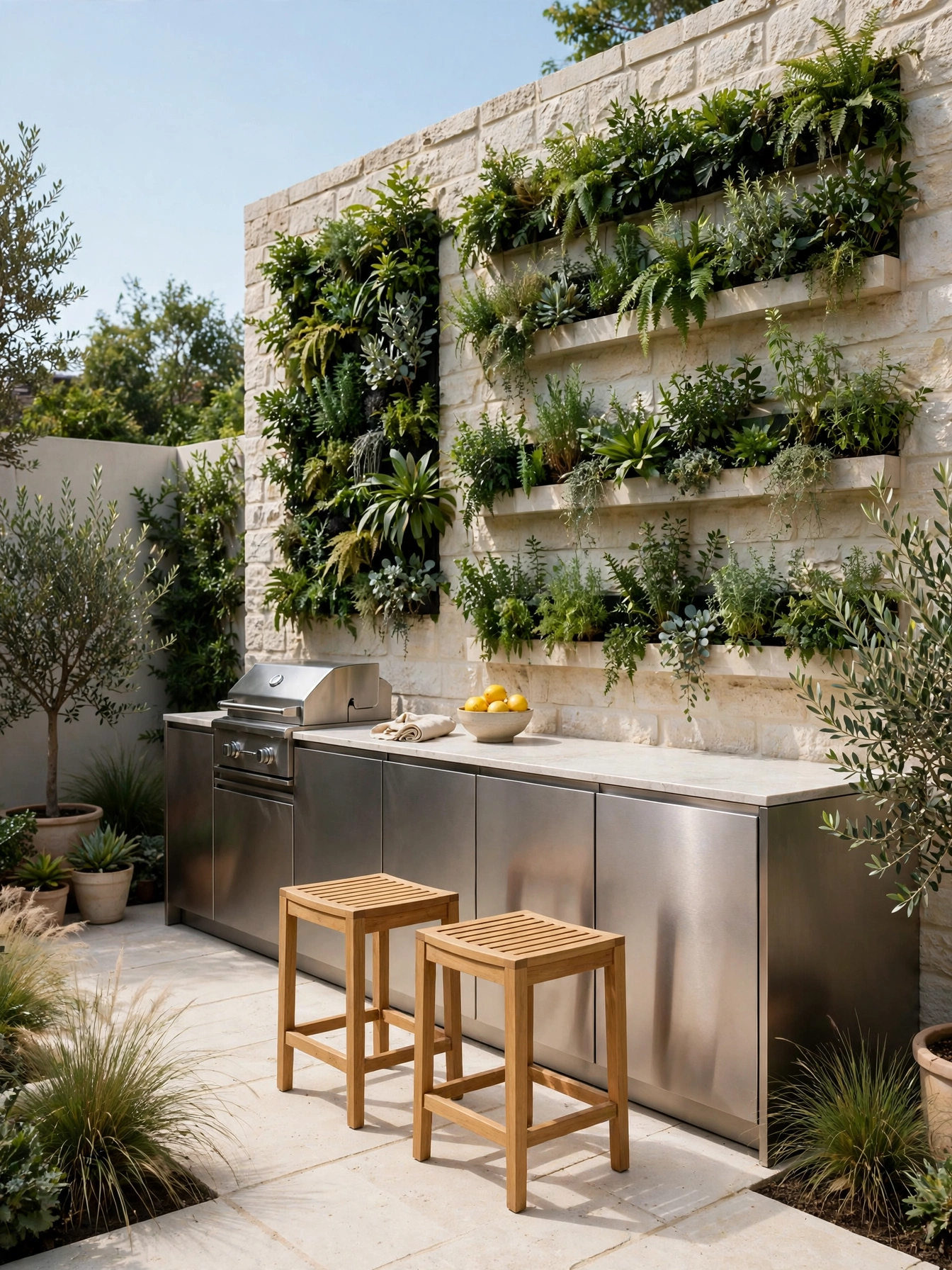
Why This Works:
- A 6 foot steel run fits a 30 foot yard without crowding it
- Quartzite at 3 centimeters gives a premium finish in a small space
- Two stools at 24 inches each turn the counter into a bar
- Wall storage holds tools without taking floor space
Compact luxury works when the materials stay premium and the footprint stays small. Build a 6 foot run in 304 grade stainless steel with a 3 centimeter quartzite counter, a 30 inch grill and 24 inches of landing space on one side. Keep 42 inches of walkway in front of the run, and mount tools on the garden wall so the counter stays clear. Choose the 24 inch depth over 30 inches for a narrow yard. The deeper counter takes walkway the small space needs for moving around. This run serves four guests in half the space. Adding a pizza oven to a 6 foot run eats the prep space and leaves the grill without a landing area.
Four guests eat well from a small run when every inch earns its place. Townhouses and courtyard homes are the natural fit for this layout. A compact luxury run with grill and quartzite comes in at 6,000 to 12,000 dollars. A basic steel run with a laminate top cannot match the finish or the lifespan: the chipboard core soaks, bubbles and lifts after one rainy season outdoors. With only 6 feet of cabinet, bulky cookware stays indoors, and the run keeps just the pieces the cook reaches for every meal. A rail with hanging hooks plus a narrow ledge above the counter holds the everyday tools, and the floor stays clear for moving around.
Marble Waterfall Island
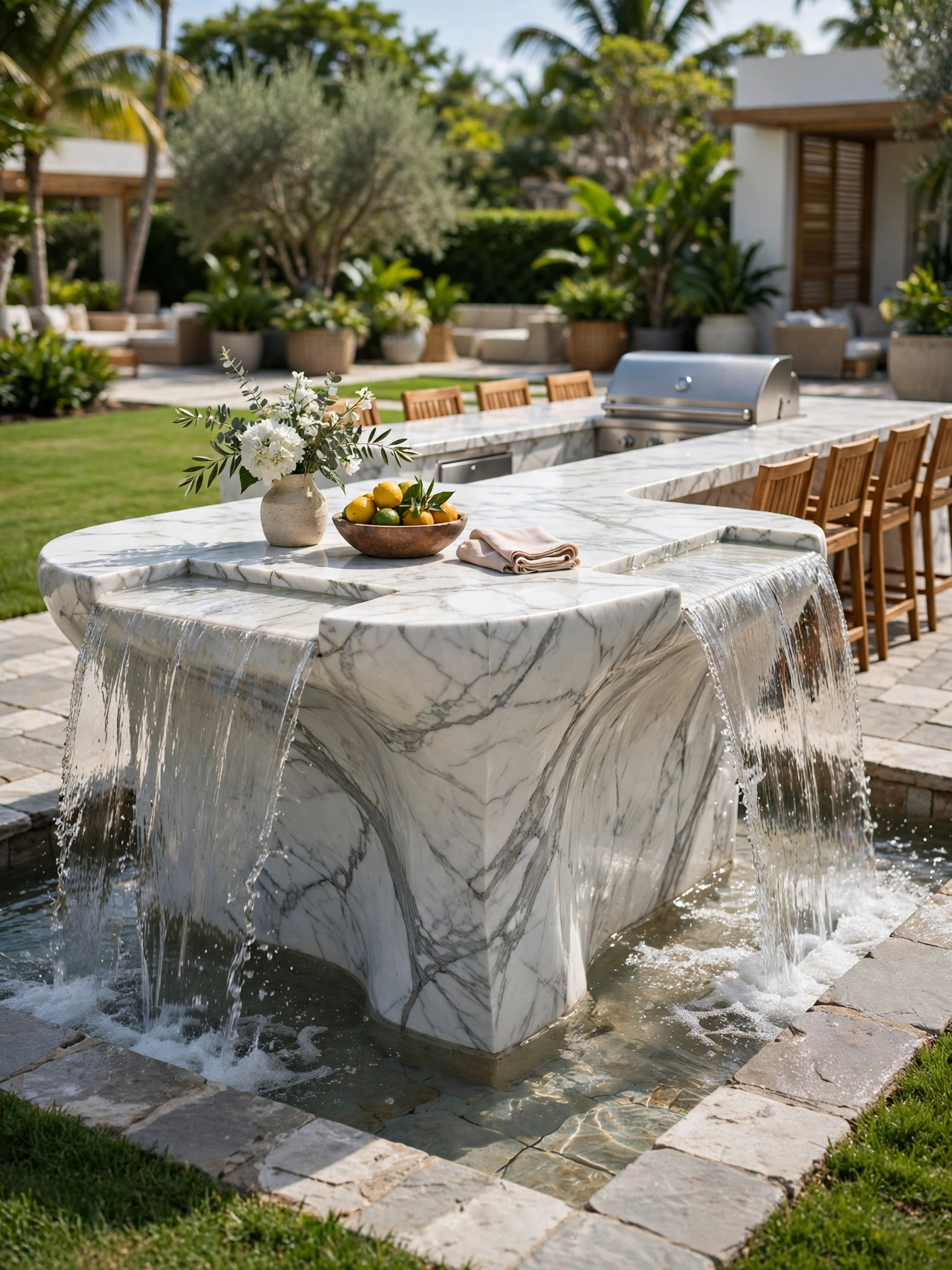
Why This Works:
- A 3 centimeter marble slab reads solid from every angle
- Book-matched veins flow down the sides without a visible joint
- The waterfall edge hides cabinet seams and scuffs
- White stone brightens the terrace even on cloudy days
A marble waterfall island makes a cooking surface the terrace centerpiece. Order a 3 centimeter marble slab with book-matched veining, mitered at the corners so the pattern flows down both ends to the floor. Size the island 8 feet long and 36 inches wide, which seats four at 24 inches each on the bar side. Quartzite resists etching better and shrugs off citrus that marks marble in minutes. Marble needs sealing every 6 months and etches when citrus sits on it for 10 minutes. A waterfall edge on an island under 6 feet long overwhelms the cabinet, so keep the length generous. A trivet under every hot pan protects the marble seal from pale heat rings that are hard to remove.
Dinner guests notice the island before the food, because the continuous stone reads like furniture rather than a workbench. The 8 foot run doubles as a serving table, with platters and drinks spread along the stone while the grill works at the other end. Marble pays for its looks with upkeep: sealing, coasters and quick wipe-downs after every citrus spill. An 8 foot marble waterfall island, installed, comes to 6,000 to 12,000 dollars. A quartzite waterfall shrugs off citrus and asks for sealing only every 2 years, so the stone keeps its look with little upkeep.
Warming Drawer Unit

Why This Works:
- A 30 inch drawer holds 12 plates at 170 degrees
- Warm plates keep food hot through a long dinner
- The drawer sits beside the grill for fast plating
- A humidity control stops bread from drying out
A warming drawer holds food at serving temperature through the final courses, which is the resort habit that ends cold plates. Fit a 30 inch stainless steel drawer under a 36 inch high counter, holding 12 plates at 170 degrees Fahrenheit with a range of 80 to 200 degrees for different dishes. The drawer needs a dedicated 15 amp circuit, and the cabinet opening must leave 1 inch of air behind the unit for ventilation. A simple heat lamp warms one platter at a time and dries food out within 20 minutes. The drawer holds humidity steady for an hour. Bacteria grow in the 40 to 140 degree range, which overlaps the drawer’s low settings, which makes it unsafe for raw food.
For a 30 inch outdoor warming drawer, the installed price is 1,200 to 2,800 dollars. A countertop warming tray holds only two dishes at a time, so it suits a small dinner rather than a full party. Plates arrive warm and food stays hot through seconds, which matters most at large dinners where courses stagger. The drawer also proofs dough and warms towels on pool days, so it earns its space beyond dinner service. The drawer takes 30 inches of cabinet from the kitchen, so plan the storage around it before ordering.
Glass Wind Barriers
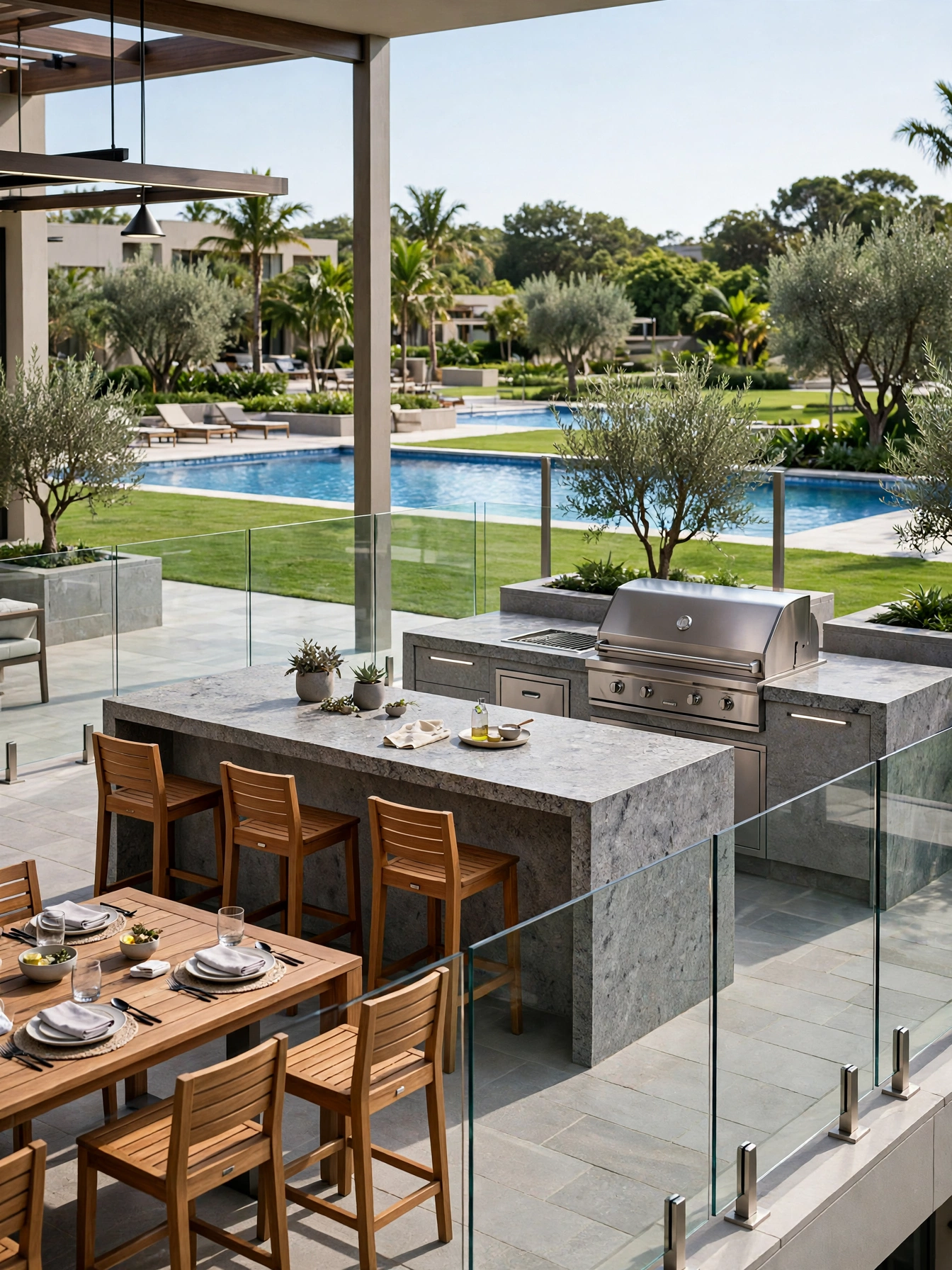
Why This Works:
- Tempered glass at 1/2 inch thick stops wind without blocking views
- A 42 inch height shields the grill flame from gusts
- Steel posts at 48 inch intervals hold panels firm in storms
- The barrier doubles as a safety rail beside a pool
Glass wind barriers calm the terrace and keep the pool view open, which is why resort rooftops and pool decks use them. Install tempered glass panels 42 inches high and 1/2 inch thick, set in stainless steel posts spaced 48 inches apart along the windy edge. A solid wall blocks wind fully. It hides the view and traps heat behind it. Glass slows the wind enough to steady the grill flame. Keep the panels 36 inches from the grill so heat never reaches the glass, and clean the panels weekly, since fingerprints and pool splash show on clear glass within days. Tempered glass breaks into small safe cubes, while standard window glass shatters into sharp pieces.
With the wind cut, the grill holds a steady heat with fewer flare-ups. Windy pool terraces are where this barrier proves its worth. The glass also keeps small children from running straight to the pool edge, since the rail marks the boundary clearly. A 12 foot glass barrier run, installed, totals 2,500 to 6,000 dollars. A timber slat screen skips the weekly wipe entirely, and its warm slats soften the terrace edge. Invisible glass needs a weekly wipe: skip it and the panels show every fingerprint.
Ceramic Kamado Grill
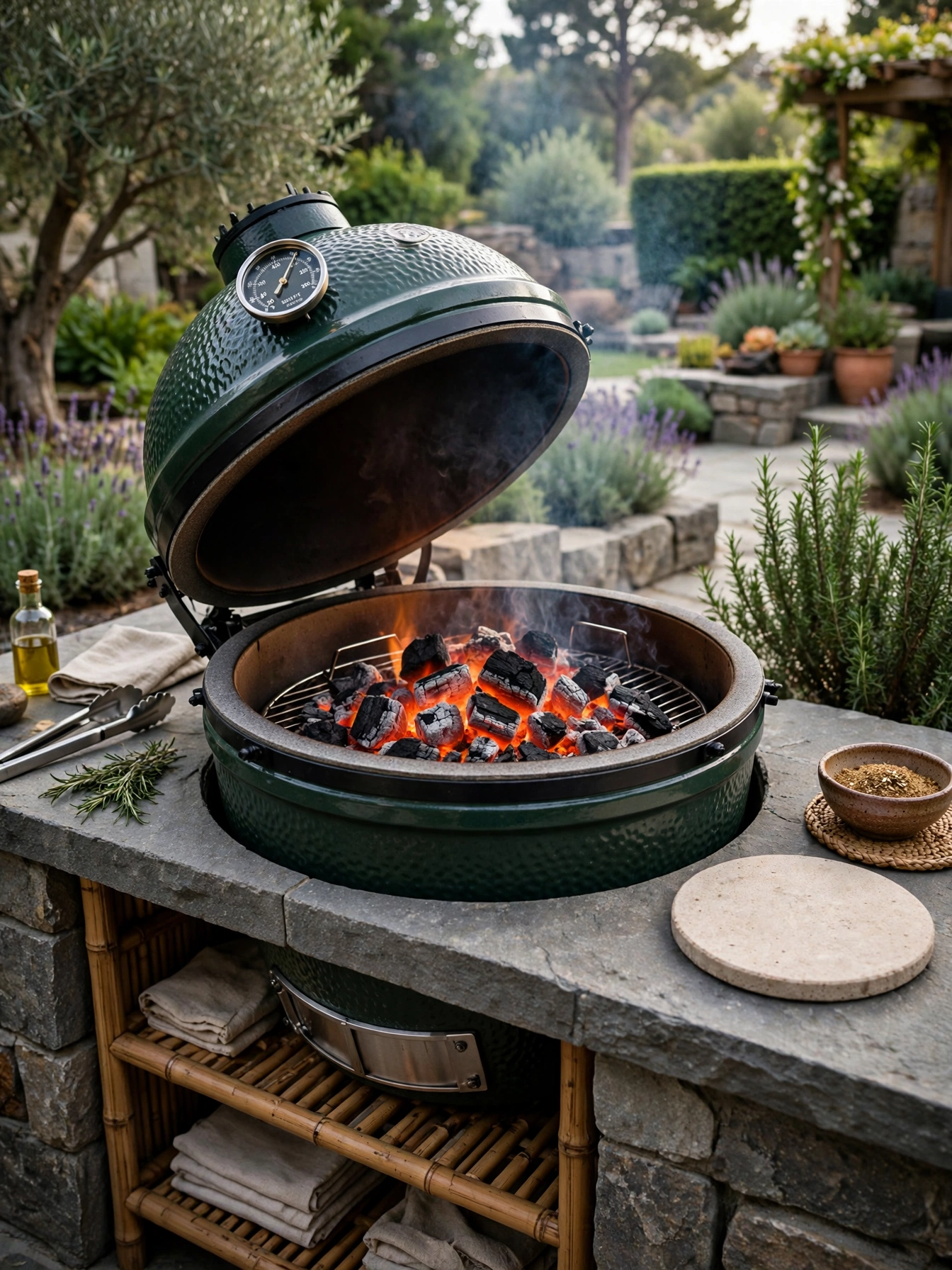
Why This Works:
- Ceramic walls hold 225 degrees steady for 10 hours
- An 18 inch grate sears steaks and bakes pizza alike
- The dome shape circulates heat evenly around the food
- A 200 pound body stays put in wind that topples light grills
A ceramic kamado grill cooks low and slow all day, then sears a steak at 700 degrees when the vents open wide. Choose an 18 inch diameter model with a ceramic body 1 inch thick, which holds 225 degrees Fahrenheit steady for 10 hours on one load of charcoal. A steel kettle grill heats fast and suits quick weeknight cooking. It loses temperature in wind and needs refueling every 2 hours. Keep 10 feet of clearance from the house, since the kamado runs hot at the dome and the coals stay live for hours after cooking. Set the grill in a stone table rated for 250 pounds. The ceramic body weighs near 200 pounds, so a light cart tips under the load. Wait until the kamado is cold and empty before moving it, or a knock against stone can crack the ceramic body.
Brisket, ribs and pizza all come from one cooker. One load of charcoal holds 225 degrees for 10 hours, then the vents open wide and the same dome sears a steak at 700 degrees. An 18 inch ceramic kamado is 800 to 2,000 dollars. A steel kettle heats fast for quick weeknight grilling, and its light body moves easily around the patio. The kamado also bakes bread and roasts whole chickens, so it replaces two or three single-purpose cookers. Weight and learning time are the price of that range: the vents take practice and the grill never moves once it sits in its table.
Copper Range Hood

Why This Works:
- A 600 CFM hood clears smoke from a 36 inch grill
- Hammered copper hides fingerprints better than smooth steel
- A 36 inch hood matches the grill width for full capture
- Copper ages into a patina that suits stone and teak
A copper range hood makes the grill wall the kitchen focal point and clears smoke that would otherwise hang over dinner. Fit a 36 inch hammered copper hood over a 36 inch grill, rated for 600 CFM and ducted outside through the wall or the roof. A stainless steel hood wipes clean easily and fits modern kitchens well. It shows every fingerprint and lacks the warmth copper brings to stone. Hang the hood 36 inches above the grill surface, which captures smoke without blocking the cook’s view. Keep the duct run under 20 feet with no more than two bends, since each bend cuts airflow by about 10 percent. Ducting the hood outside keeps grease out of the pergola roof and the attic, and the cooking smell clears with it.
Smoke clears before it reaches the table, so guests stay comfortable even when the grill flares. Covered kitchens are where this hood pulls its weight: open-air grills need no hood at all and the copper becomes pure decoration. Copper asks for a yearly wax to hold its shine, or it ages into a dark patina that many owners prefer. A 36 inch copper hood with ducting, installed, sits near 2,000 to 5,000 dollars. A stainless steel hood clears smoke well above the grill, and its bright finish stays sharp beside steel cabinets and stone.
Outdoor Sound System
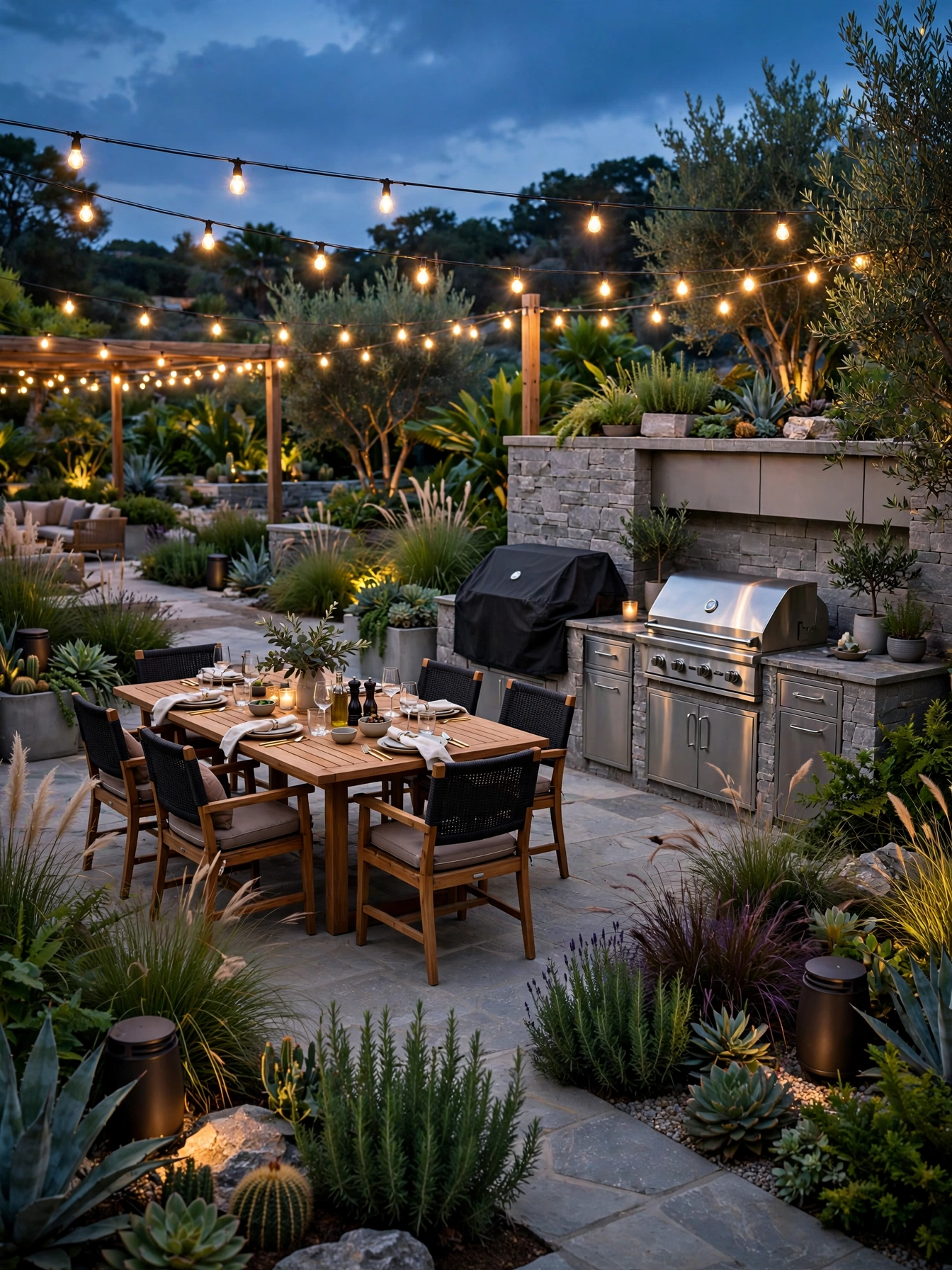
Why This Works:
- IP65 rated speakers survive rain, sprinklers and pool splash
- Four speakers at 60 watts each fill a terrace without blasting
- Landscape models hide among plants instead of hanging on walls
- A buried cable run keeps wires out of the walkway
Music at resort volume fills the terrace without shouting from one corner, and speaker placement does the work. Install four IP65 rated landscape speakers at 60 watts each, spaced 10 feet apart around a 40 foot terrace, and run the cables in conduit buried 6 inches deep. A single Bluetooth speaker moves anywhere. It sounds thin across a large yard and needs charging every 8 hours. A 70 volt system fits very large yards. A standard 8 ohm setup with a 200 watt amplifier covers most home terraces. Keep the amplifier indoors or in a weatherproof box rated IP65, since moisture kills electronics within one wet season. Mounting speakers on the grill wall coats the cones in heat and grease and dulls the sound within months.
Four landscape speakers, installed, add up to 1,500 to 4,000 dollars. A quality portable speaker fits small patios well, and it moves anywhere the party goes. Dinner music stays low and even, so conversation never competes with the speaker nearest the table. Evening dinners gain a finished feel on the terrace once music plays low in the background. Fixed speakers and buried cables stay where they are: the system cannot follow the party indoors.
Spa Towel Station
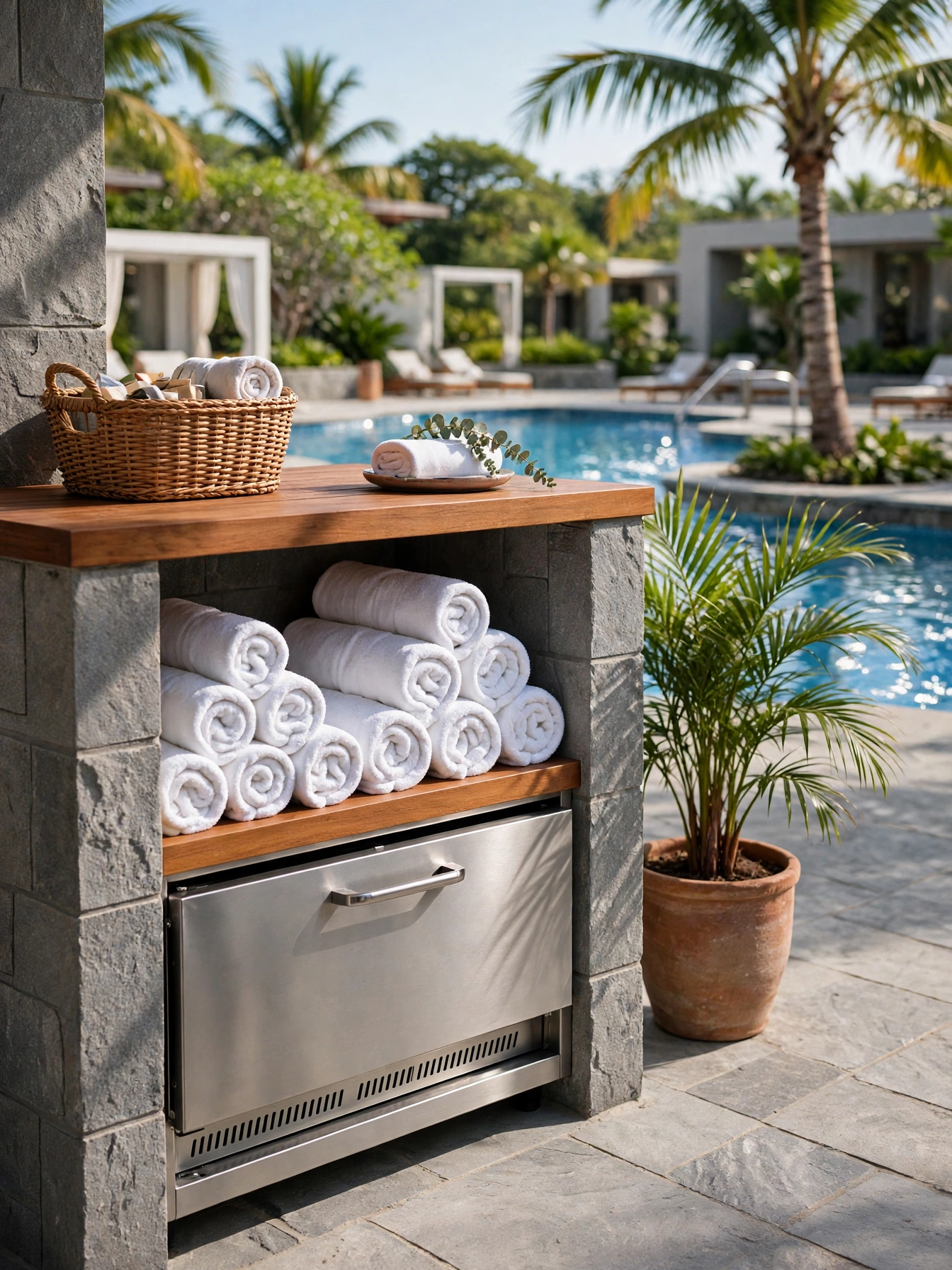
Why This Works:
- Twelve rolled towels fit in the cabinet within reach
- A warming drawer holds towels at 120 degrees for pool days
- Stone and steel shrug off pool splash and sun
- The station sits 6 feet from the pool edge, clear of the splash zone
A spa towel station carries the resort pool habit home, since warm towels wait beside the water instead of inside the house. Build a stone cabinet 24 inches wide and 36 inches high, holding 12 rolled towels, with a warming drawer below that holds them at 120 degrees Fahrenheit. A 304 grade stainless steel frame resists chlorine splash. A painted wood cabinet peels within two pool seasons. Keep the station 6 feet from the pool edge, which clears the splash zone and keeps towels dry until they get used. A simple towel hook leaves towels damp and sandy after a swim. The cabinet keeps them clean, dry and warm. Heat thins sunscreen and lotions in a warming drawer until the bottles leak, which is why they belong in the cabinet.
Pool days feel pampered when a warm towel waits at the ladder. The station stands through the whole pool season with towels clean, dry and warm at the ladder. The cabinet also stores goggles, floats and a first aid kit, so the pool gear stops living in the kitchen. A stone towel station with a warming drawer adds up to 1,500 to 4,000 dollars. A freestanding teak towel rack holds the same towels without warmth, and it moves wherever the pool chairs go. The warming drawer needs its own power: a dedicated 15 amp circuit on a GFCI outlet.
Resort Poolside Kitchen

Why This Works:
- A 12 foot quartzite island serves swimmers and diners at once
- The kitchen keeps 6 feet of deck between its burners and the pool water
- A louvered roof shades the cooking zone at midday
- Non-slip stone underfoot stays safe when wet
A resort poolside kitchen gathers every premium idea into one terrace, and distance from the water sets the layout. Place the kitchen run 6 feet from the pool edge, with a 12 foot quartzite island at 36 inches high, a built-in grill, a beverage center and a louvered roof 10 by 12 feet above. Non-slip stone pavers with a textured finish keep the terrace safe when wet. Smooth polished stone turns slick after one splash. A 304 grade stainless steel run resists chlorine, and IP65 lighting keeps the terrace glowing after dark. A poolside kitchen without a roof leaves cooks in full midday sun, and most cooks head indoors by noon. Six feet between the grill and the water keeps splashes off the burners and swimmers clear of the hot grill as they climb out.
Swimmers eat, drink and dry off without leaving the terrace, which is the resort pattern that makes a pool day feel complete. A full resort poolside kitchen is priced at 25,000 to 60,000 dollars. A basic grill and counter beside the same pool covers the essentials, and it leaves the terrace open for loungers and play. Large yards with a pool are the setting this kitchen needs: the terrace needs at least 40 feet of width to hold kitchen, pool and loungers safely. The premium build demands a bigger budget and a bigger yard, yet it turns the pool into the household gathering place all summer.
FAQs
What makes luxury outdoor kitchen ideas different from a basic grill setup?
Resort kitchens use 304 grade stainless steel, 3 centimeter stone counters and a louvered roof over a 10 by 12 foot zone. The materials resist weather for decades, the shade adjusts with the sun, and the cooking zone holds a steady temperature all evening.
What is the best countertop material for a luxury outdoor kitchen?
For an outdoor counter, quartzite leads. It takes heat to 300 degrees and asks for a fresh seal only once every 2 years. Granite handles heat too at a lower price. Marble demands a seal twice a year, and lemon juice can mark it in under ten minutes.
What should I budget for a luxury outdoor kitchen?
A compact premium run with a grill and quartzite usually costs 6,000 to 12,000 dollars, while a full resort kitchen with a louvered roof costs 25,000 to 60,000 dollars. Start with steel cabinets and stone counters, then add the roof and appliances over time.
How do luxury outdoor kitchen ideas handle rain and winter?
A louvered roof closes against rain, IP65 rated lights keep working through storms, and 304 grade steel resists rust through winter. Close the kamado vents to snuff the coals, seal stone counters on schedule, and keep the grill 10 feet from the house.
What size should a resort-style outdoor kitchen be?
Allow a 10 by 12 foot roof over the cooking zone, a 12 foot island for six seats, and 42 to 48 inches of walkway on every side. Measure the terrace before ordering so the island, roof and walkways fit without crowding.
Conclusion
A resort kitchen pays off twice: once in how the materials look, and again in how the measurements hold up through a summer of dinners. Build around 304 grade steel, 3 centimeter stone and a louvered roof, keep the grill 10 feet from the house, and leave walkways 42 to 48 inches clear. With those numbers settled, the rest is choosing the finishes you will enjoy living with. Follow HomelyCrafter on Pinterest for more ideas. Save this to your Pinterest boards so you can refer back to it!

Muhammad Israr is a home decor enthusiast and the writer behind Homely Crafter. He spends his days researching paint colors, layouts and budget-friendly styling ideas, then breaks them down into practical, easy-to-follow guides so you can decorate with confidence.