
Walk into a kitchen and your eyes land on the same place every time: the open shelf above the counter. Plates stack neatly or lean in a tired pile, jars line up or crowd together, and that stretch of wall says more about the kitchen than the cabinets below it.
Kitchen shelf decor ideas matter because open shelves sit at eye level, roughly 54 to 66 inches from the floor. The National Kitchen and Bath Association recommends pantry shelves at 12 to 16 inches deep; open display shelves usually run a little shallower, at 10 to 12 inches, so a dinner plate sits fully on the board.
Below are 24 shelf ideas, from floating oak boards to plate racks, jar displays and herb rows, each with exact depths and load limits. Inside are measurements to check and materials that hold up to steam and splashes, so the shelves fit a real kitchen.
Floating White Oak Shelves
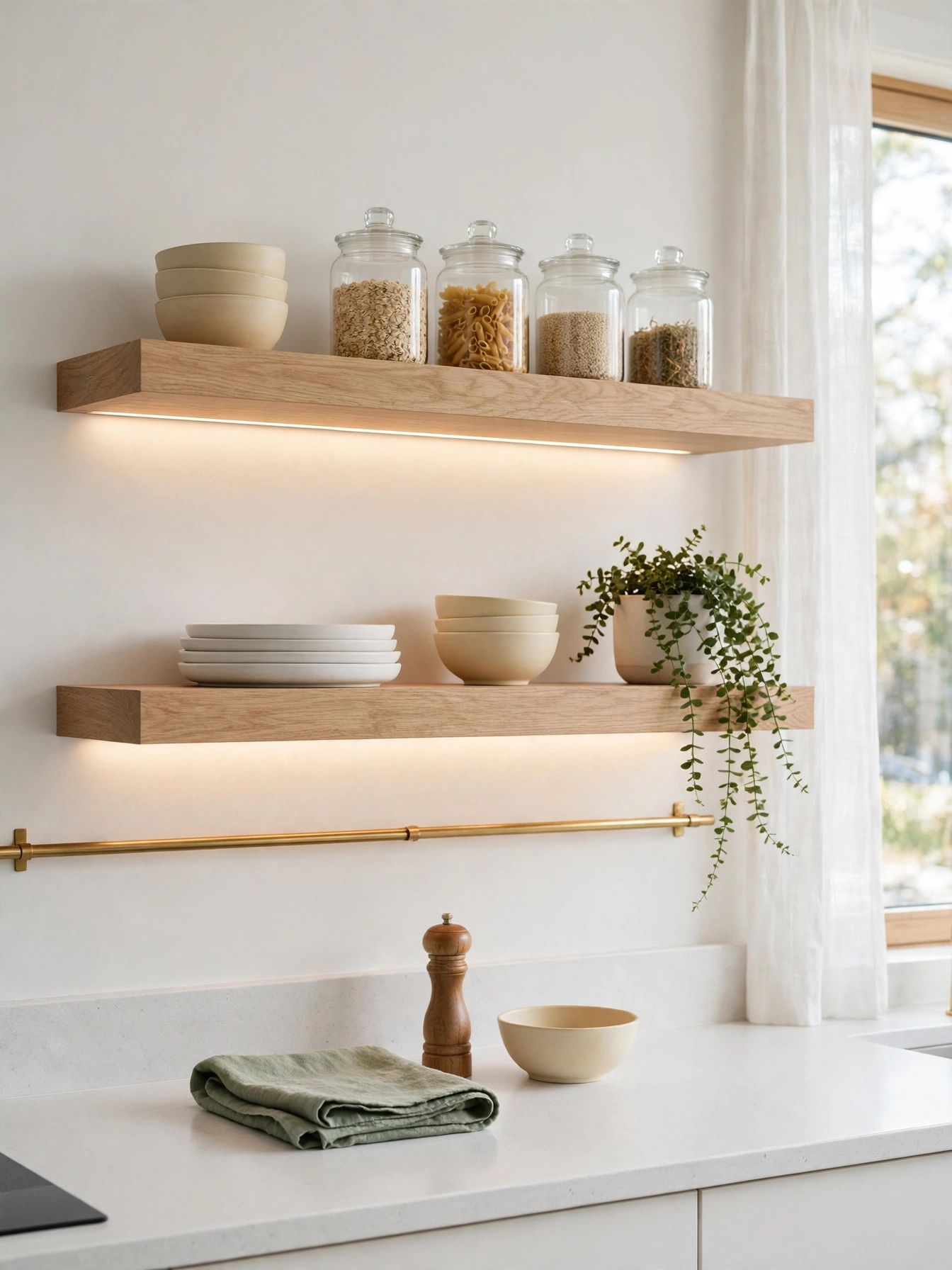
Why This Works:
- A 10 inch depth holds dinner plates without crowding the wall
- White oak resists dents better than soft pine boards
- Hidden steel rods keep the shelf looking weightless
- Two shelves at 14 inches apart fit plates, bowls and jars
A floating shelf needs a solid core to stay level under dishes, so choose white oak boards 1.5 to 2 inches thick and 10 to 12 inches deep. Mount each shelf on steel rods that sink at least 3 inches into wall studs spaced 16 inches apart, and a 36 inch shelf anchored this way holds 25 to 40 pounds. Keep the lower shelf 18 to 20 inches above the counter, matching the standard upper cabinet gap, and leave 12 to 14 inches of vertical space between shelves so stacked plates clear the shelf above. Skip drywall anchors alone for a loaded shelf, since they pull out under 30 pounds of stoneware.
White oak earns its keep through its tight grain, since steam and splashes wipe off without a trace. Pine runs about half the price per board, and a heavy pot sets down hard enough to dent it. Chipped plates and mismatched mugs stay in full view, since nothing hides on a floating shelf. Past 36 inches, or under a load of cast iron, bring in a professional carpenter or handyman to anchor the rods into studs, since one failed mount drops the whole shelf.
Black Metal Bracket Shelves
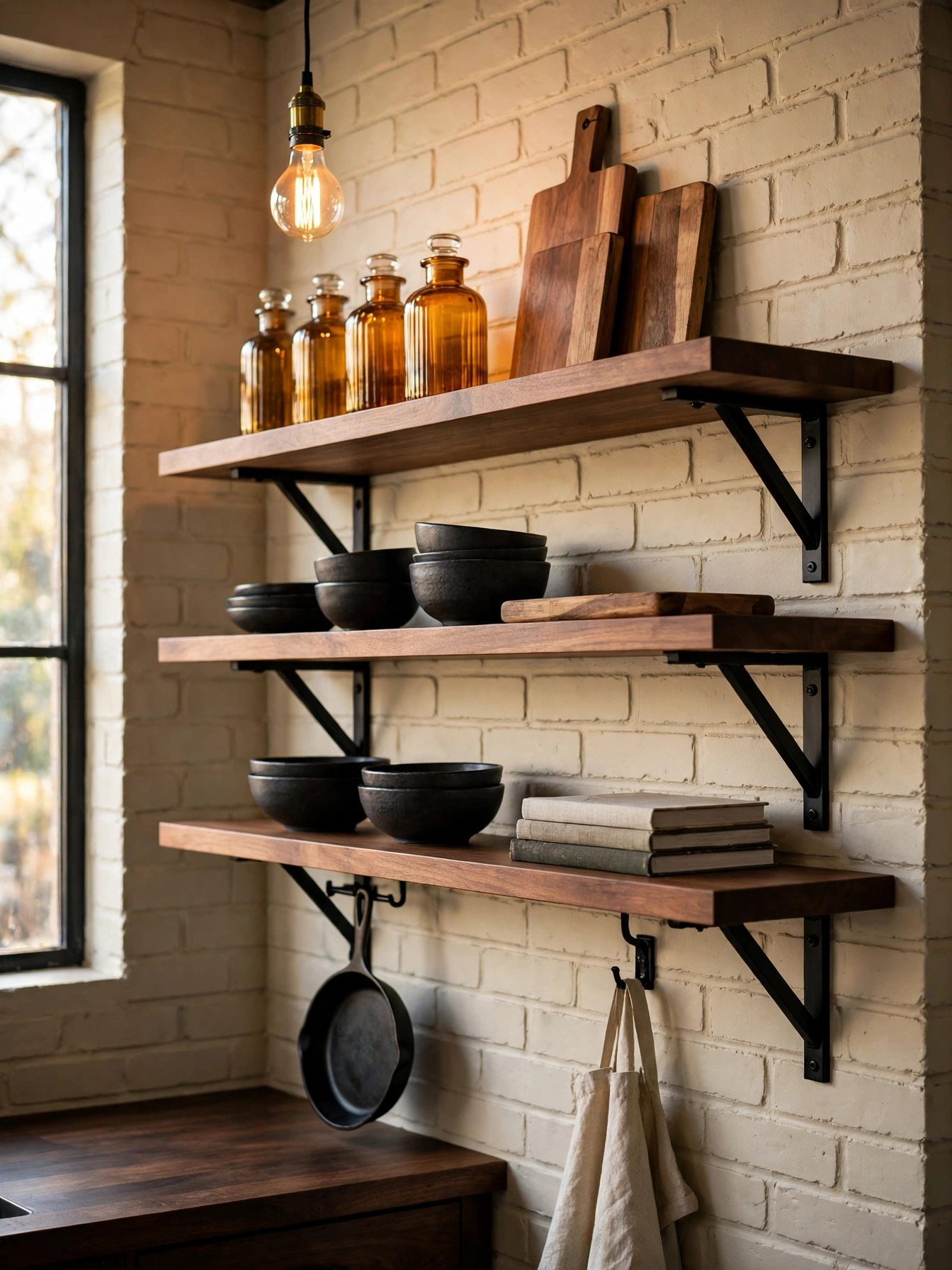
Why This Works:
- Visible brackets add an industrial edge without extra decor
- Steel brackets rated for 60 pounds hold heavy cast iron
- Brackets spaced 16 inches apart stop a long board from sagging
- Open sides let plates slide in from either end
Steel brackets work best when the shelf board measures 10 to 12 inches deep and 3/4 inch thick for plywood or 1 inch thick for solid wood. Space brackets 16 to 24 inches apart, with the end brackets 4 inches in from each board end, and drive screws at least 1.5 inches into studs. A 48 inch walnut board on three brackets carries 40 to 60 pounds of dishes safely. Never use brackets rated under 20 pounds for kitchen shelving, since a stack of six stoneware plates weighs about 12 pounds and adds up fast.
Powder-coated steel resists rust near a steamy stove, and raw iron, left bare, spots within months unless it gets a clear coat. Leave the brackets visible and they do double duty as decor, with the hardware on show in an industrial, modern farmhouse or loft kitchen. Wood corbels carry light loads only, and they read softer in a cottage kitchen. Expect to pay 60 to 120 dollars for a 36 inch shelf with two brackets. A 48 inch run with three brackets comes to 120 to 200 dollars installed.
Rustic Reclaimed Wood Shelves
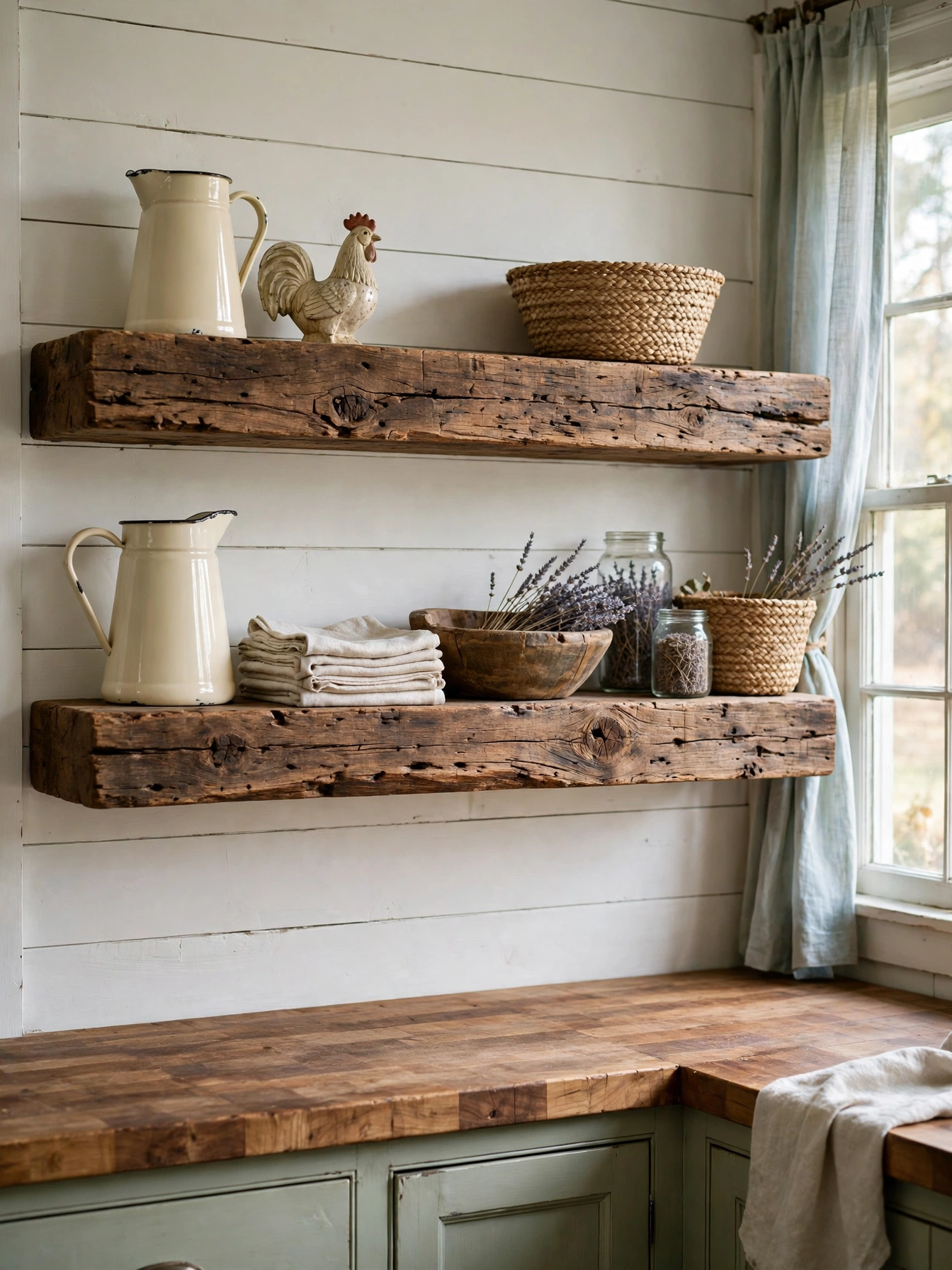
Why This Works:
- Thick 2 inch boards carry heavy enamelware without flexing
- Old wood grain hides small scratches from daily use
- A food-safe seal keeps steam and splashes from staining
- Warm tones soften white cabinets and pale walls
Reclaimed boards should measure 1.75 to 2 inches thick and 10 to 12 inches deep, with the back edge planed flat so the shelf sits flush against the wall. Seal every surface with a food-safe hardwax oil or polyurethane, applying 2 to 3 coats, since unsealed barn wood absorbs steam and holds cooking smells. Mount on hidden rods or heavy brackets rated for 50 pounds, with supports every 24 inches at most. Avoid boards with old nail holes near the front edge, since they weaken the board and snag cloths.
Weigh the board before you mount it: a 48 inch reclaimed board weighs 20 pounds before a single dish goes on it, so the wall anchors matter more than the shelf itself. No new lumber copies the grain and knots of old barn wood, and farmhouse and cottage kitchens get their character from it in a way a fresh board cannot match. Distressed pine looks similar at first glance, at 30 to 50 percent less than real reclaimed wood. It dents faster, and its fake wear fades unevenly. Budget 100 to 250 dollars per 48 inch board for real reclaimed wood. New distressed boards cost 60 to 120 dollars for the same length.
Corner Floating Shelves

Why This Works:
- Turns a dead corner into roughly 4 feet of extra shelf space
- Short 18 inch legs need only one stud each to stay solid
- Plates and bowls sit at eye level instead of deep in a cabinet
- A trailing plant softens the sharp corner line
A corner shelf works with two legs 18 to 24 inches long and 10 inches deep, meeting at a clean 90 degree miter joint. Find studs on both walls before drilling, since corner framing often places studs 24 inches apart instead of the usual 16. Do not float a corner shelf on drywall anchors alone, because the joint concentrates weight where the two boards meet and a single weak anchor lets the corner droop. A 24 inch leg on two rods holds about 20 pounds, enough for bowls and plates but not for a stack of cast iron.
Dead corners hold only dust in most small and L-shaped kitchens, and a shelf there turns the space into real storage. Getting to the back takes a stretch, since items at the very back sit 14 inches from the front edge, around the joint. A corner cabinet with a carousel swallows more, and it hides everything behind a door. Open shelves keep daily dishes visible, and a two-level pair runs 80 to 150 dollars. A carousel insert costs 300 dollars or more.
Kitchen Shelf Decor Ideas for Everyday Dishes
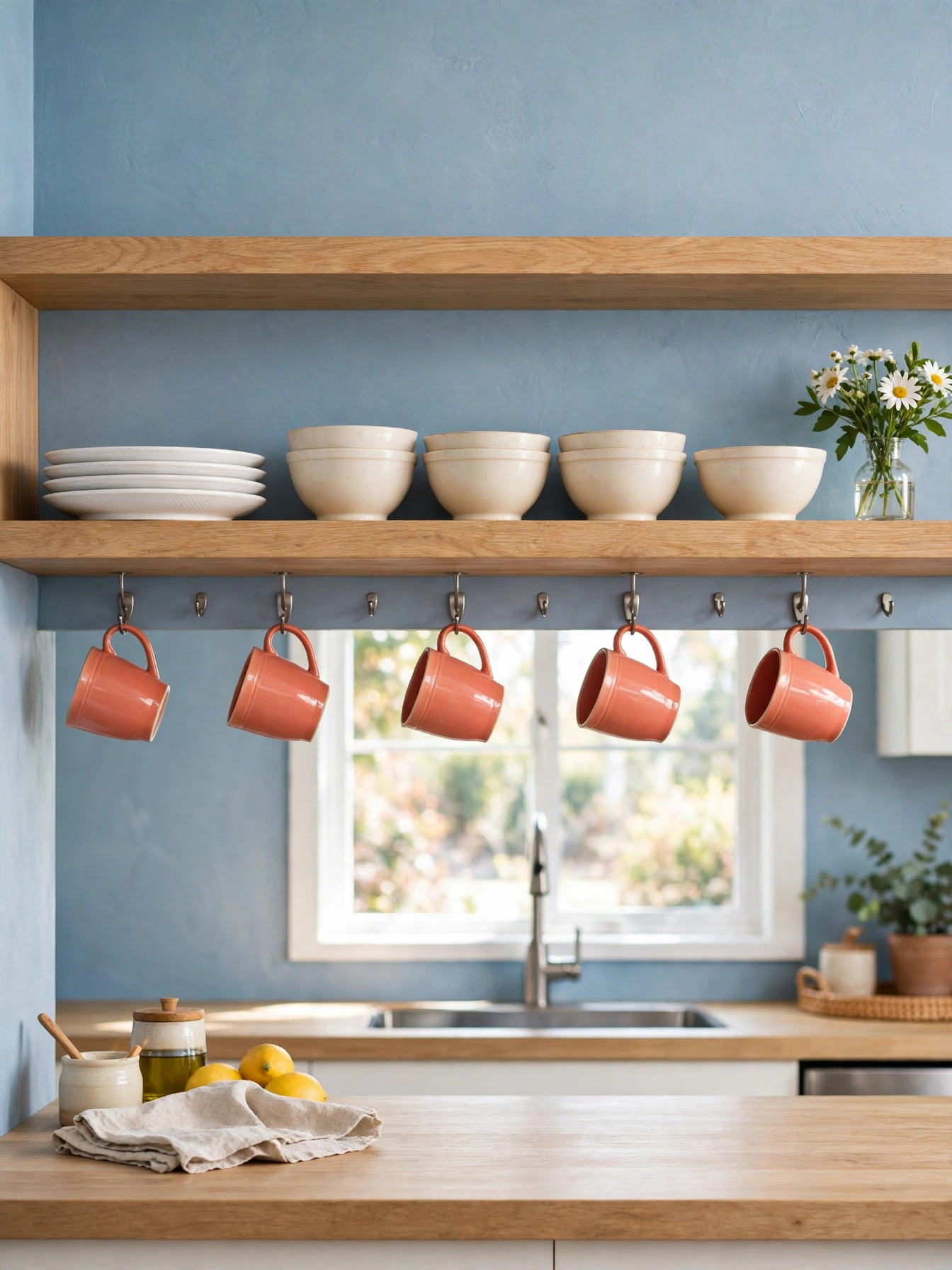
Why This Works:
- Everyday plates stay within a 60 inch reach, so setting the table takes seconds
- Stacks of 4 to 6 plates look tidy and show when supplies run low
- Mug hooks below the shelf add storage without a second board
- Matching dishes make an open shelf look calm instead of busy
Keep dinner plates in stacks of 4 to 6, since a stack taller than 8 plates wobbles and chips the rim of the bottom plate. Set shelves 12 to 14 inches apart so a 10 inch plate stack plus a 4 inch bowl stack clears the shelf above. Mount mug hooks 3 inches apart under the shelf, with each hook rated for 2 pounds, and hang mugs by the handle so they do not clink. Avoid mixing more than 2 dish colors on one shelf, since three or more patterns turn a neat row into visual noise.
Open dishes gather a light film in 7 to 10 days in a busy kitchen, so a quick rinse before use becomes part of the routine. Plates travel from shelf to table and back a dozen times a week in a household that eats at home most nights, so keeping them in sight saves steps every single day. Porcelain chips less than stoneware and weighs about 20 percent less per plate; stoneware feels warmer and hides small chips better. Closed cabinets keep dust off. They hide the dishes, and they slow down table setting.
Grooved Plate Rail Shelves
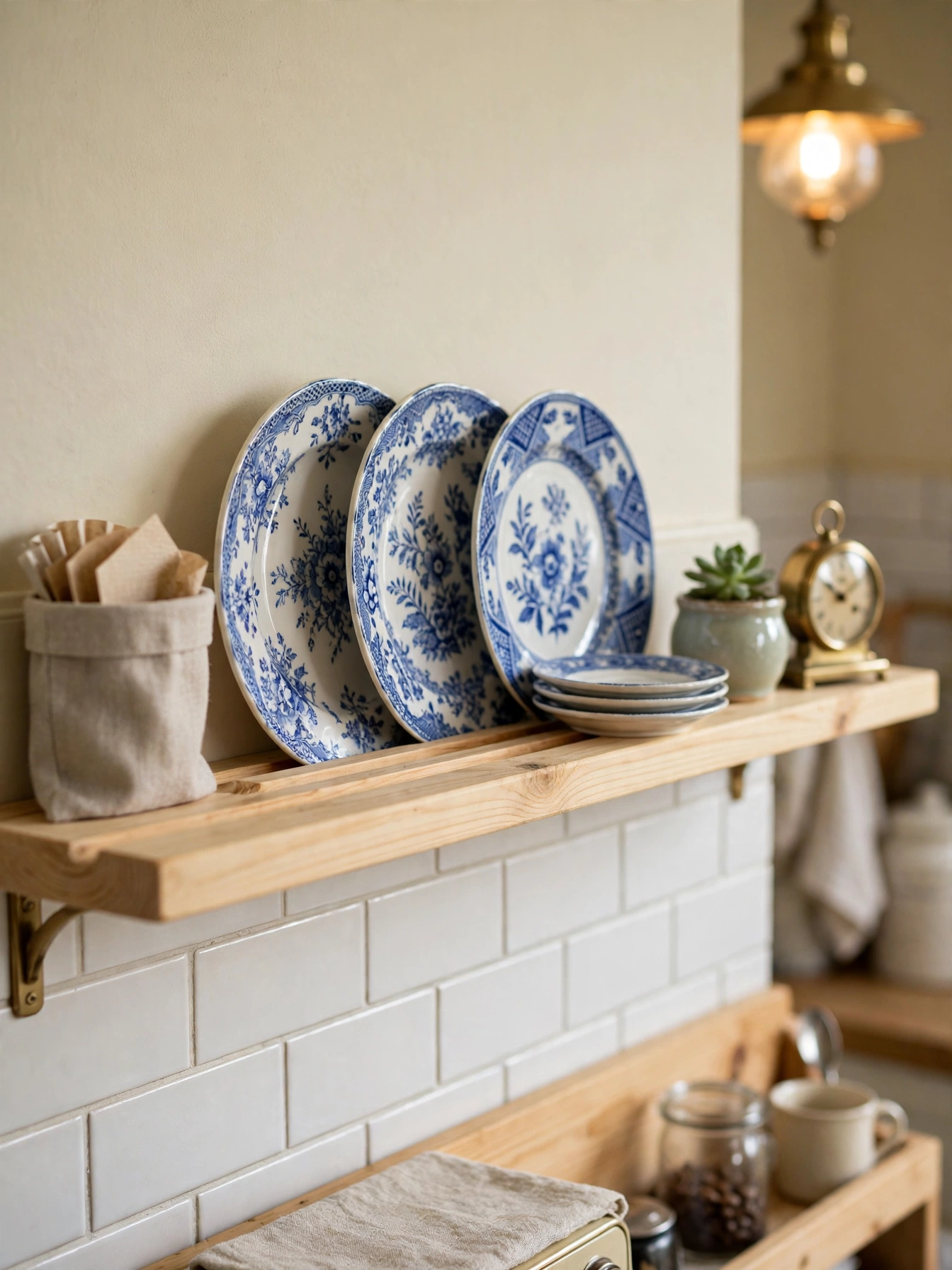
Why This Works:
- A routed groove holds plates upright at a safe lean angle
- Upright plates show their pattern instead of hiding it in a stack
- A narrow 4 inch board fits walls too small for full shelves
- Plates swap out in seconds for a seasonal change
A plate rail holds its plates in a groove 1/2 inch deep and 3/8 inch wide, routed 1 inch in from the front edge of a 4 to 5 inch deep board. Lean plates back at 10 to 15 degrees against the wall, and keep the shelf 14 to 16 inches below the shelf above so tall platters clear it. Mount with two screws into studs for a 36 inch rail, since a row of six plates weighs 8 to 10 pounds and leans outward. Never set a plate rail above a stove, since heat and steam loosen the grip and grease films the glaze.
Six plates is about all a 36 inch rail holds, so it works as decoration first and storage second. Pretty plates become wall art on a rail, and they still work at dinner. Plate stands hold one plate each, and they eat counter space. A rail keeps the counter clear, and the plates stay visible. A routed pine rail for a 36 inch length costs 25 to 60 dollars. The hardwood version sells for 60 to 110 dollars.
Glass Jar Display Shelves
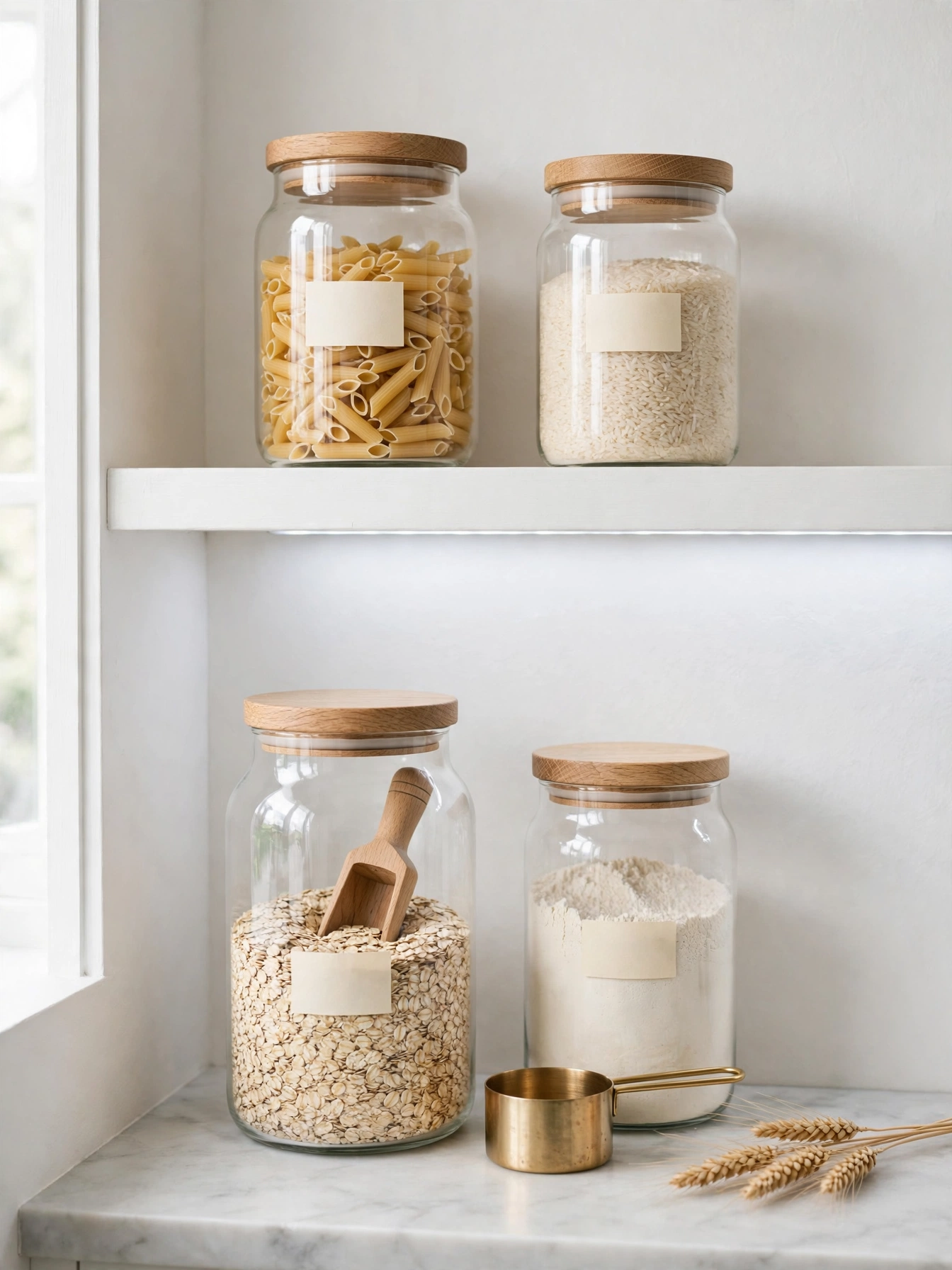
Why This Works:
- Clear glass shows fill levels, so refills happen before food runs out
- Jars in 32 and 64 ounce sizes fit most dry goods
- Uniform jars turn a shelf into a calm visual rhythm
- Airtight lids keep flour fresh for months
Rice and oats go in 32 ounce jars, flour and sugar in 64 ounce jars, and seeds and spices in 16 ounce jars, so three sizes cover the whole pantry. A 64 ounce jar stands about 8 inches tall, so set shelves 12 to 14 inches apart to clear the lid and a reaching hand. Pick jars with silicone-seal lids, since a loose seal lets damp air in and turns sugar lumpy. A full 64 ounce jar of flour weighs about 2 pounds, so keep total shelf load under 40 pounds for a 36 inch board. Avoid jars wider than 5 inches on a 10 inch shelf, since two rows will not fit side by side.
Start with the five dry goods used most and add jars as the budget allows, since a full matching set is a real purchase. Clear glass lets measuring take one glance, with no hunt through the pantry for flour, sugar and oats. Keep heavy jars below 48 inches, where a slip falls a shorter distance. Plastic jars weigh less, and they bounce when dropped. They scratch and cloud within a year.
Herb Garden Shelf Row
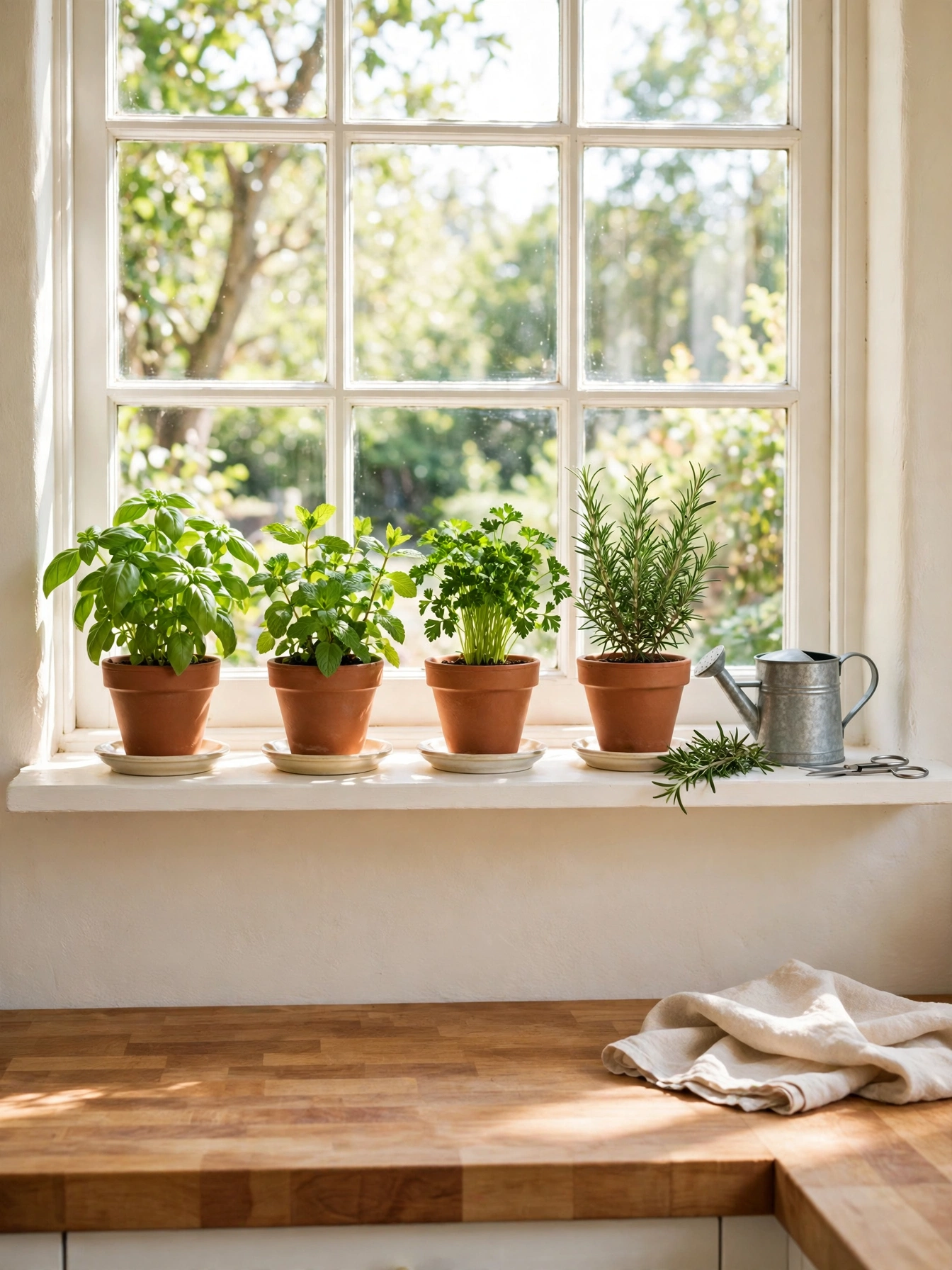
Why This Works:
- Fresh herbs sit within arm’s reach of the cutting board
- A 6 inch pot fits 5 to 6 herbs on a 36 inch shelf
- Porous clay lets air reach the roots, so soil stays drier than in plastic
- Green leaves add life to a wall of plain dishes
Pots 6 inches across, with drainage holes and saucers, fit an herb shelf 6 to 8 inches deep, so the pots sit fully on the board. Space pots 6 to 7 inches apart center to center, and keep 12 inches of vertical clearance so basil grows tall without brushing the shelf above. Herbs need 6 hours of direct light a day, so place the shelf on a south or west facing wall, or add a 12 inch LED grow light bar at 4000K mounted 6 inches above the leaves. Never water herbs on the shelf without a saucer, since runoff stains wood and warps the board within weeks.
In summer, herbs need water every 2 to 3 days, and one missed week kills mint faster than basil. Snipping basil beats opening a dried jar, and this row gets reached for first. Dried herbs cost 3 to 5 dollars a jar and last a year, and they lose the bright flavor fresh leaves give a sauce. A self-watering planter set comes to 60 to 90 dollars. A starter set of 5 pots, soil and seeds is priced at 25 to 45 dollars.
Cookbook Shelf Styling
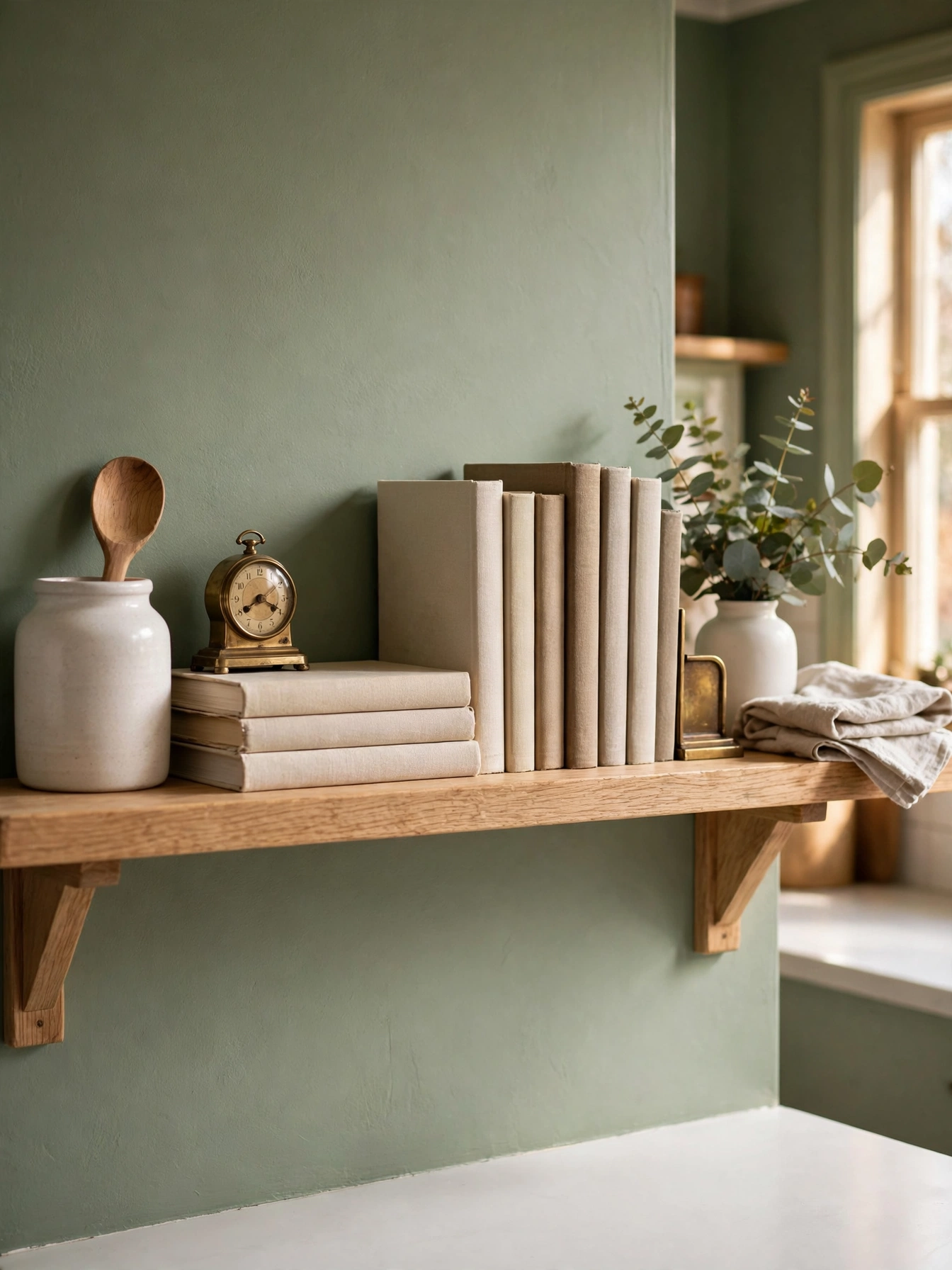
Why This Works:
- Upright cookbooks add color and height to a shelf
- A 14 inch shelf gap fits tall hardcover books standing up
- A small stack lying flat breaks the row and holds a vase
- Books within reach get used instead of gathering dust
Cookbooks need a shelf gap of 12 to 14 inches, since most hardcovers stand 9 to 11 inches tall and need 2 inches of finger room above the spine. Use a bookend rated for the weight of the row, because 10 hardcovers weigh about 15 pounds and lean hard once the row thins. Keep the shelf 10 to 12 inches deep so books stand fully on the board without the spine hanging over the edge. Never store cookbooks directly above a stove, since steam and grease stain the pages and warp the covers within months.
Before loading the shelf, do the math on weight: a full 36 inch run of hardcovers weighs 25 to 30 pounds, and solid stud anchors are not optional. The books themselves become the decor, and a shelf of well chosen books gets used daily. Digital recipes cost nothing, and they weigh nothing. A phone screen locks and smears with messy hands. A shelf of 10 well chosen cookbooks adds up to 150 to 250 dollars over time. The shelf itself costs 40 to 90 dollars.
Two-Tier Shelf Layers

Why This Works:
- Two levels double the display space on one wall
- A small riser lifts back-row items above the front row
- Daily bowls stay low while serving pieces sit higher
- Layered heights stop a shelf from looking flat
The trick to two-tier layering is a 14 to 16 inch gap between shelf boards, which leaves room for a 6 inch riser on the lower shelf plus a tall bowl above it. Place the riser 3 to 4 inches deep at the back of the shelf, and set smaller items on it so they rise 5 to 6 inches above the front row. Keep the top shelf no higher than 72 inches, since items above that need a step stool. A 36 inch shelf holds about 8 bowls on the front row and 6 smaller pieces on the riser behind. Avoid stacking more than 2 bowls high on a riser, since the top bowl slides when the shelf gets bumped.
Two levels mean two surfaces to wipe, and dust collects out of sight behind the riser. Daily dishes and serving pieces share one wall here, and the riser keeps the two groups apart without a second shelf. A single deep shelf holds the same items in one row, and the back row disappears behind the front. A wooden riser goes for 15 to 30 dollars. Expect 60 to 120 dollars for a second full shelf.
Under-Cabinet Shelf Lighting
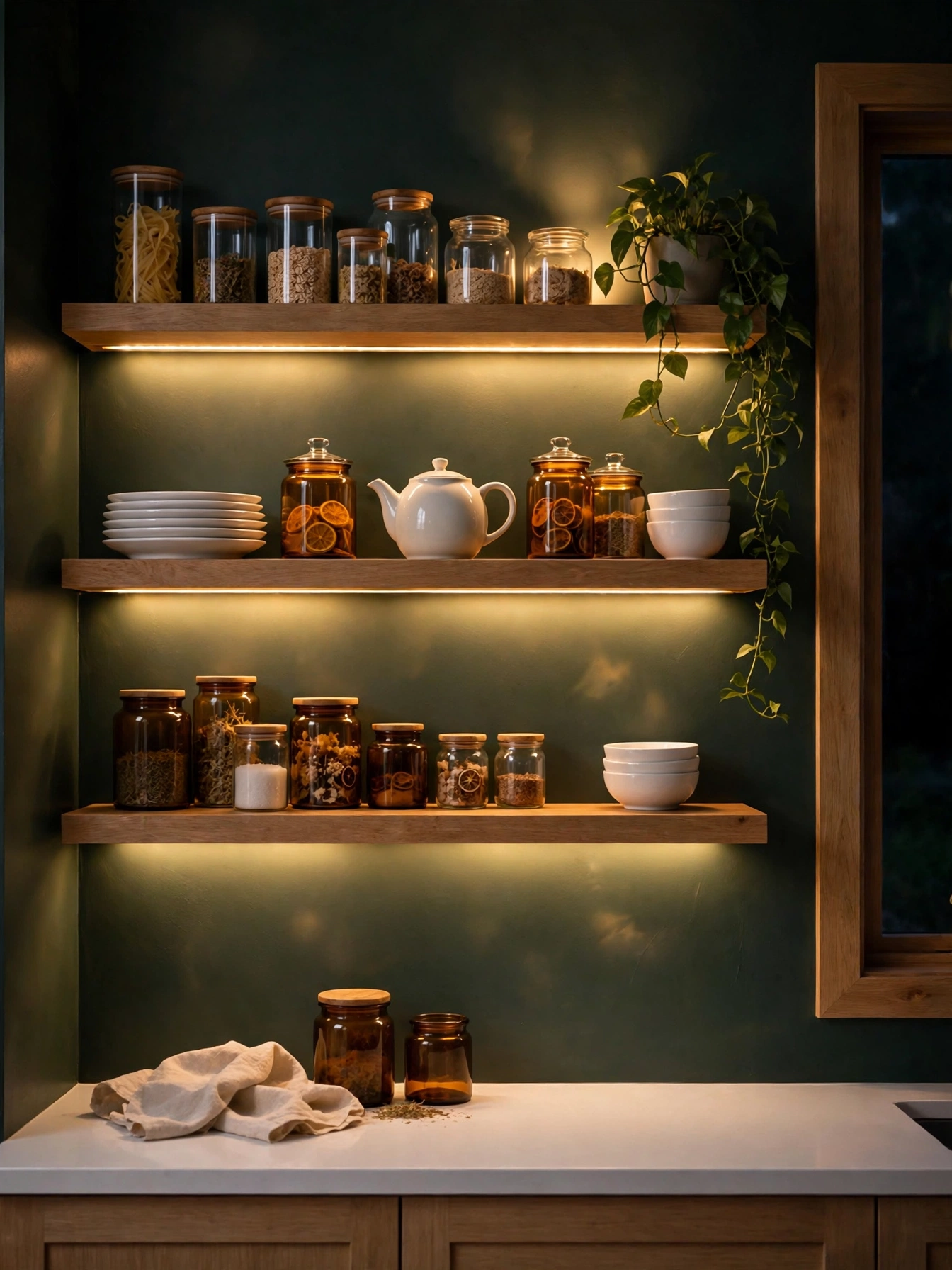
Why This Works:
- A 2700K strip makes white dishes glow after dark
- Light under each shelf removes shadows from the row below
- LED strips use about 5 watts per foot, so they cost little to run
- Warm light flatters wood shelves and ceramic glaze
LED strip lighting works best at 2700K to 3000K, the warm white range that matches kitchen pendants and under-cabinet lights. Mount the strip 1 inch back from the front edge of the shelf underside, so the light washes the wall and the dishes below without glaring into eyes. Choose strips rated at 300 to 400 lumens per foot for display shelves, and plug them into a dimmer so the glow softens in the evening. A 36 inch shelf needs about 3 feet of strip, drawing roughly 15 watts. Never use a strip without a channel and diffuser on a shelf at eye level, since bare diodes show as harsh dots and cheapen the look.
Power decides the install: a plug-in strip needs an outlet within 6 feet, and a hardwired strip needs a licensed electrician if no outlet sits nearby. A lit shelf keeps the kitchen warm and readable after the sun sets, and evening cooks and dinner hosts notice it most. Battery puck lights cost 10 to 20 dollars each and need no wiring, and they dim within weeks and need constant battery swaps. A hardwired dimmable system costs 120 to 250 dollars. For two shelves, a plug-in LED kit comes to 30 to 60 dollars.
Open Shelf Styling Rules
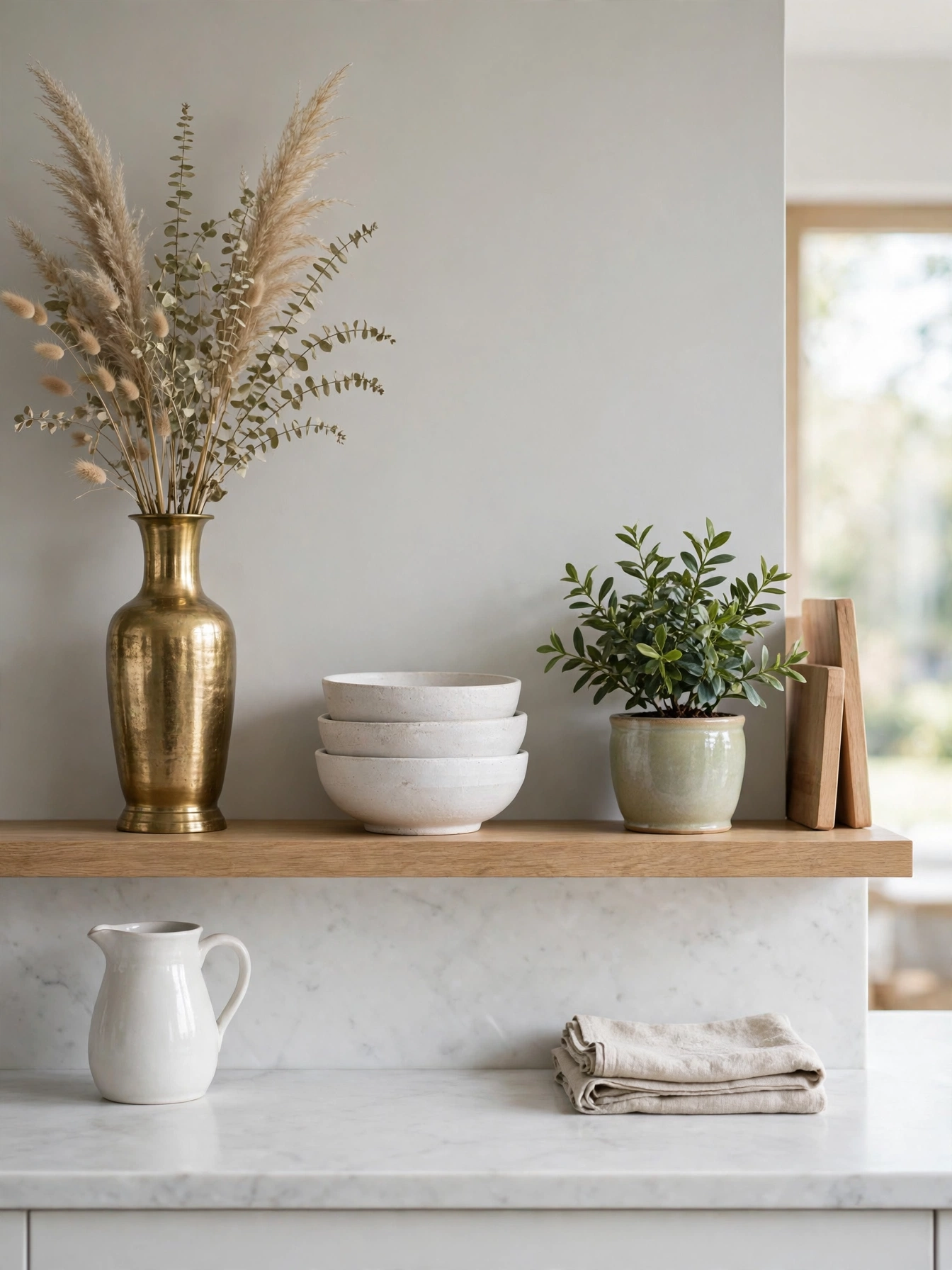
Why This Works:
- Groups of 3 and 5 look natural to the eye
- One tall item per shelf anchors the whole row
- Leaving 30 percent of the shelf empty keeps it calm
- Repeating one color ties the shelf to the room
The rule of thirds does the heavy lifting here: divide a 36 inch shelf into three 12 inch zones and place one group in each. Keep the tallest item 10 to 12 inches high so it clears the shelf above, and leave about 30 percent of the board empty so the shelf breathes. Mix heights in each group, with a tall piece, a medium piece and a small piece, and repeat one color across at least 2 groups to tie the row together. Houzz makes the same point about leaving breathing room: a shelf packed edge to edge reads as clutter even when the pieces match.
Daily use slowly turns neat groups into random piles, so plan on a 10 minute reset every week or two. These rules earn their keep on a shelf that has to look good in photos and in daily life, since they work whether the pieces are dishes or decor. A closed cabinet needs no styling at all. It shows nothing, and it invites no compliments. Restyling costs nothing when the pieces already live in the kitchen, and a new vase or plant adds 15 to 40 dollars.
Tidy Kitchen Shelf Decor Ideas
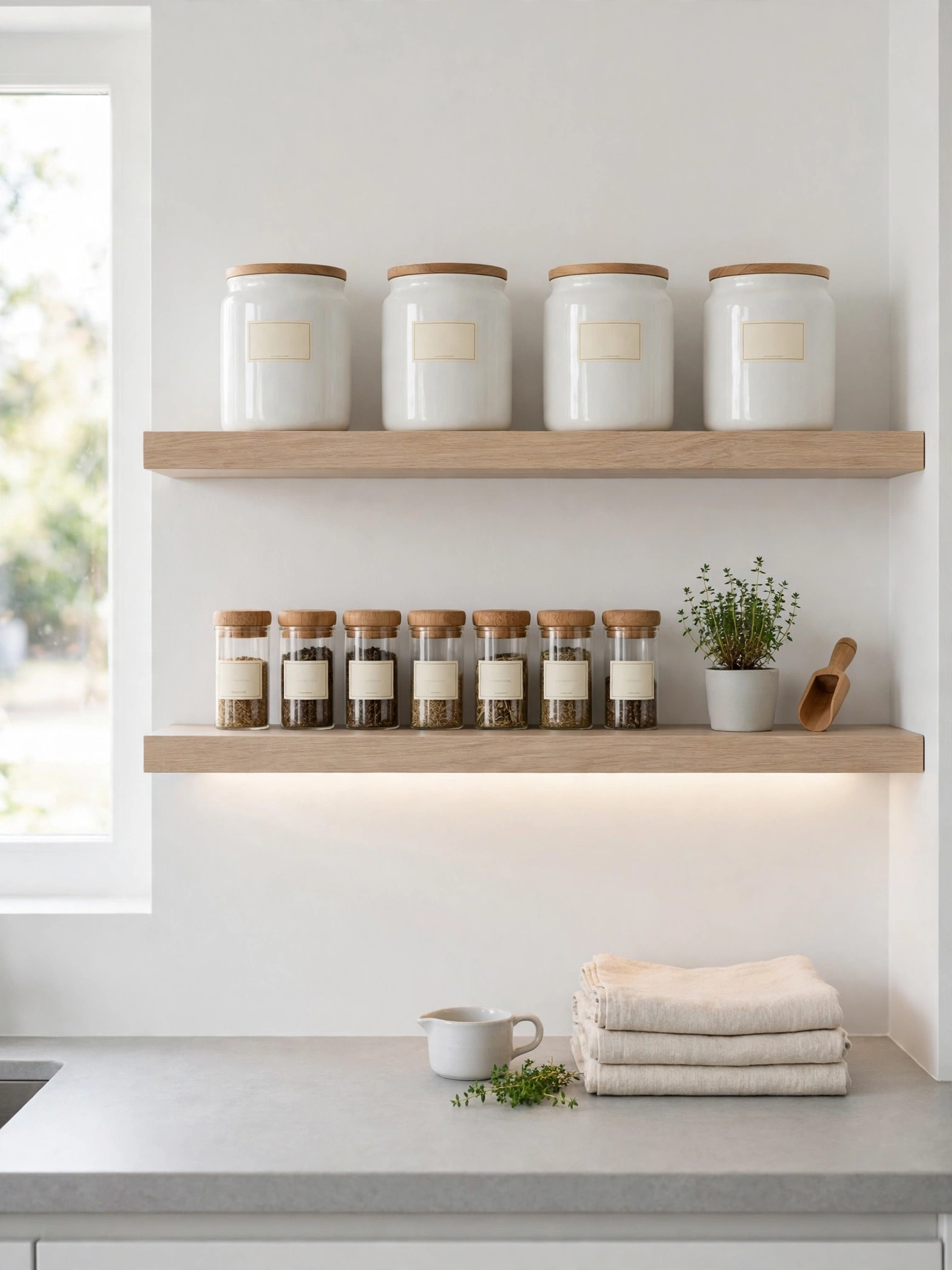
Why This Works:
- Matching canisters cut visual noise by half
- One label style across jars makes the shelf read as a set
- A 10 inch shelf depth keeps every jar in a single row
- Towels folded to the same width look deliberate, not random
Tidy kitchen shelf decor ideas start with matching containers: choose one canister style in 2 sizes, such as 32 ounce and 64 ounce, and repeat it across the shelf. Keep jars in a single row on a 10 to 12 inch deep shelf, with 1 inch of space between jars so a hand fits around each one. Label every jar the same way, with the label 2 inches wide and placed at the same height on each jar, roughly 4 inches from the base. Eight matching jars fit a 36 inch shelf with breathing room, and 10 to 11 fit the 48 inch length. Avoid mixing round and square jars on the same shelf, since the mixed shapes break the rhythm and look crowded.
Price the set first: a matching set runs 60 to 120 dollars for 12 jars, and the old jars still need a home after the swap. Matching jars make it obvious when flour or sugar runs low, so a tidy shelf earns its keep in a kitchen that cooks most nights. Glass jars show contents and stay honest. Ceramic canisters hide contents and look cleaner. A mix works too, with glass for dry goods and ceramic for coffee and tea.
Mug Hook Shelf Rail
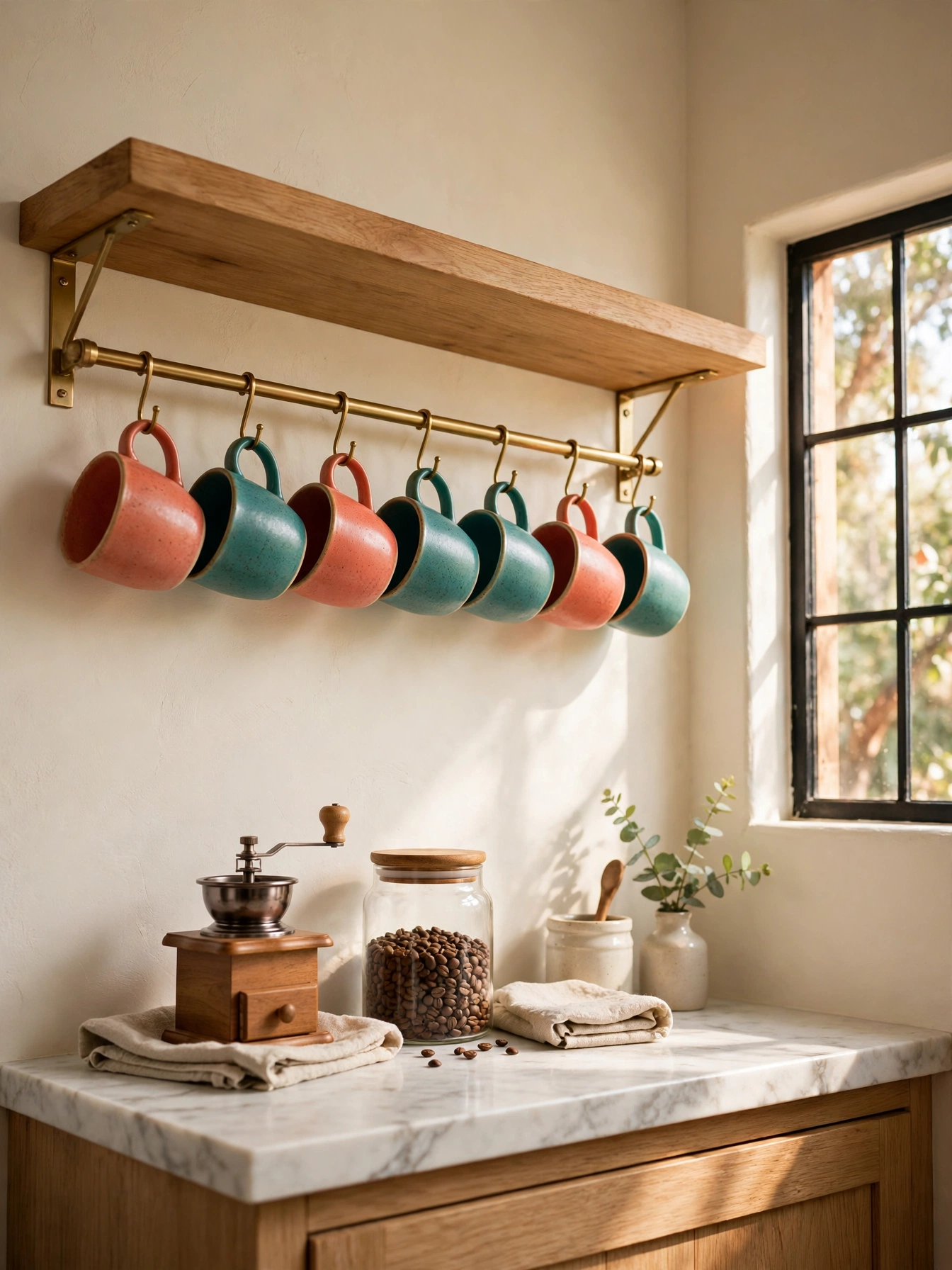
Why This Works:
- Mugs hang below the shelf, so the board above stays free
- Hooks spaced 3 inches apart keep mugs from clinking
- A brass rail adds a warm accent to a plain shelf
- Daily mugs stay visible and reachable at 60 inches
A mug rail mounts under a shelf with screws driven 1 inch into the shelf board, using hooks rated for 2 pounds each. Space hooks 3 inches apart center to center, which fits a standard 4 inch wide mug with room to lift it off without bumping its neighbor. Mount the shelf 60 to 66 inches from the floor so mugs hang at hand height and clear the counter by at least 18 inches. Ten to 12 mugs hang from a 36 inch rail, and 14 to 16 from a 48 inch rail. Never hang a mug heavier than 1 pound on a hook rated for 2 pounds once it fills with coffee, since the extra weight pulls the hook loose over time.
Dust settles inside an open mug in about a week, so a quick rinse becomes part of the routine. The morning mug comes off the hook in one motion, which is the whole point for coffee and tea drinkers. A mug tree holds 6 mugs on the counter, and it takes 8 inches of counter space. A rail holds 10 to 12 mugs on a 36 inch run, and it takes no counter space. A brass rail with 10 hooks costs 20 to 45 dollars. The stainless steel version comes to 15 to 35 dollars.
Copper Pot Shelf Display

Why This Works:
- Copper adds warmth that stainless steel never gives
- Hanging pots free a full cabinet of storage space
- A 12 inch shelf depth fits a copper saucepan flat
- Polished copper catches light and brightens a dark wall
Copper pots need strong support, since a 10 inch copper saute pan weighs about 4 pounds and a full set adds up to 20 pounds on one shelf. Use brackets or a rail rated for 60 pounds, with hooks rated for 5 pounds each, and space hooks 6 inches apart so pot handles do not tangle. Set the shelf 12 to 14 inches above the next surface so a hanging pot clears the counter by 18 inches. Copper tarnishes in 4 to 6 weeks near a steamy stove, so polish with a vinegar and salt paste once a month or let it age to a soft patina. Avoid hanging copper directly above a gas burner, since the heat discolors the metal and dries out the handles.
Shop the kettle first: a single statement kettle costs 60 to 120 dollars. A set of 3 copper pots costs roughly double, at 120 to 300 dollars. Warm metal beside wood tones and cream walls gives copper its natural home in traditional and French country kitchens. That warmth asks for a monthly polish; skip it and a neglected set turns dull brown in a season. Stainless steel needs no polishing and costs about half as much, yet it looks colder and shows water spots.
Woven Basket Shelf Storage
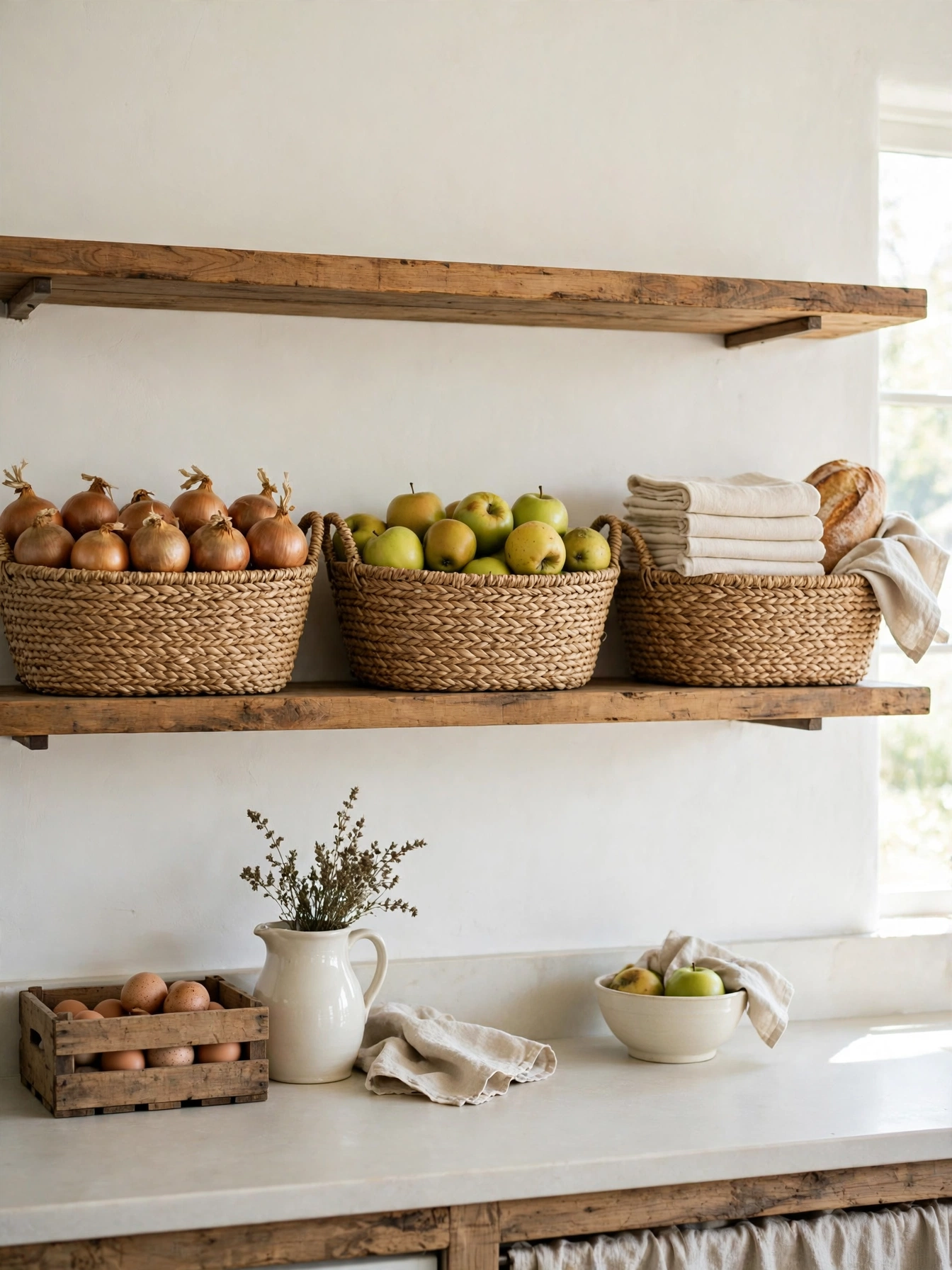
Why This Works:
- Baskets hide clutter while keeping it within reach
- Seagrass breathes, so onions and potatoes stay drier
- Baskets 12 inches long fit a 10 inch deep shelf with room to pull
- Woven texture softens a wall of hard ceramic and glass
A shelf takes three basket sizes: small 8 by 6 inches for onions and garlic, medium 12 by 8 inches for bread and linens, and large 16 by 10 inches for bulk produce. Set the basket with the 10 inch side front to back on a 12 inch deep shelf, leaving 2 inches of finger space at the front. Choose baskets with a tight weave and a reinforced rim, since a loose weave snags and a weak rim folds under 5 pounds of potatoes. Keep baskets 2 inches below the shelf above so a hand fits in to grab the last apple. Never store damp produce in a closed basket, since trapped moisture softens the weave and grows mold within 2 weeks.
Seagrass gives out after 2 to 3 years in a humid kitchen, when the weave starts to loosen. White walls and pale counters look softer with woven texture on them, and farmhouse and casual kitchens are where baskets get shown off most. Plastic bins last longer, and they cost about 8 to 15 dollars each. They look colder, and they trap moisture. Seagrass baskets are priced at 15 to 35 dollars each depending on size, and a full shelf needs 3 to 4 of them.
Stoneware Crock Shelf
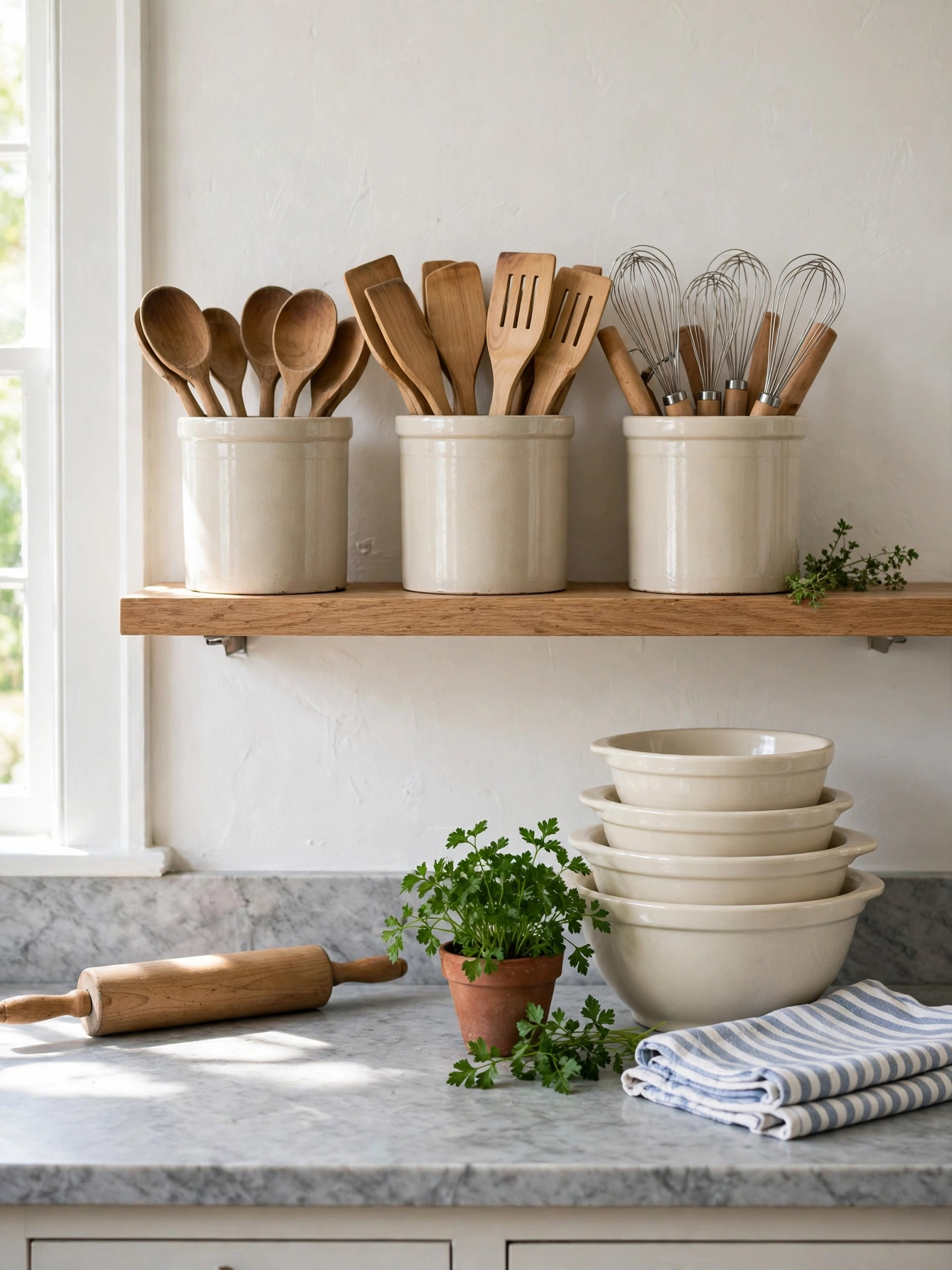
Why This Works:
- A 7 inch tall crock holds 12 to 15 utensils upright
- Heavy stoneware stays put when a spoon gets pulled out
- Utensils near the stove cut steps during cooking
- Matching crocks make a shelf look deliberate
A stoneware crock 6 to 7 inches tall and 5 to 6 inches wide, with a weighted base of at least 2 pounds, stays put when a heavy whisk comes out. Place the crock on a shelf 12 to 14 inches below the shelf above, leaving room to lift a 12 inch wooden spoon clear of the rim. Keep the crock within 3 feet of the stove, since utensils travel there most, and set it on a shelf 36 to 42 inches from the floor for a comfortable grab. Avoid a crock taller than 8 inches, since long spoons sink out of sight and short ones disappear inside.
Keep the count low, because a crock invites extra gadgets and 20 utensils in one crock tangle and jam. Every tool stands ready in one spot, which suits a session of stirring, flipping and whisking. A wall-mounted utensil rail holds the same tools flat on the wall. It needs hooks, and it looks busier. A ceramic utensil holder is priced at 15 to 30 dollars. A stoneware crock comes to 20 to 40 dollars.
Brass Rail Shelf Edge
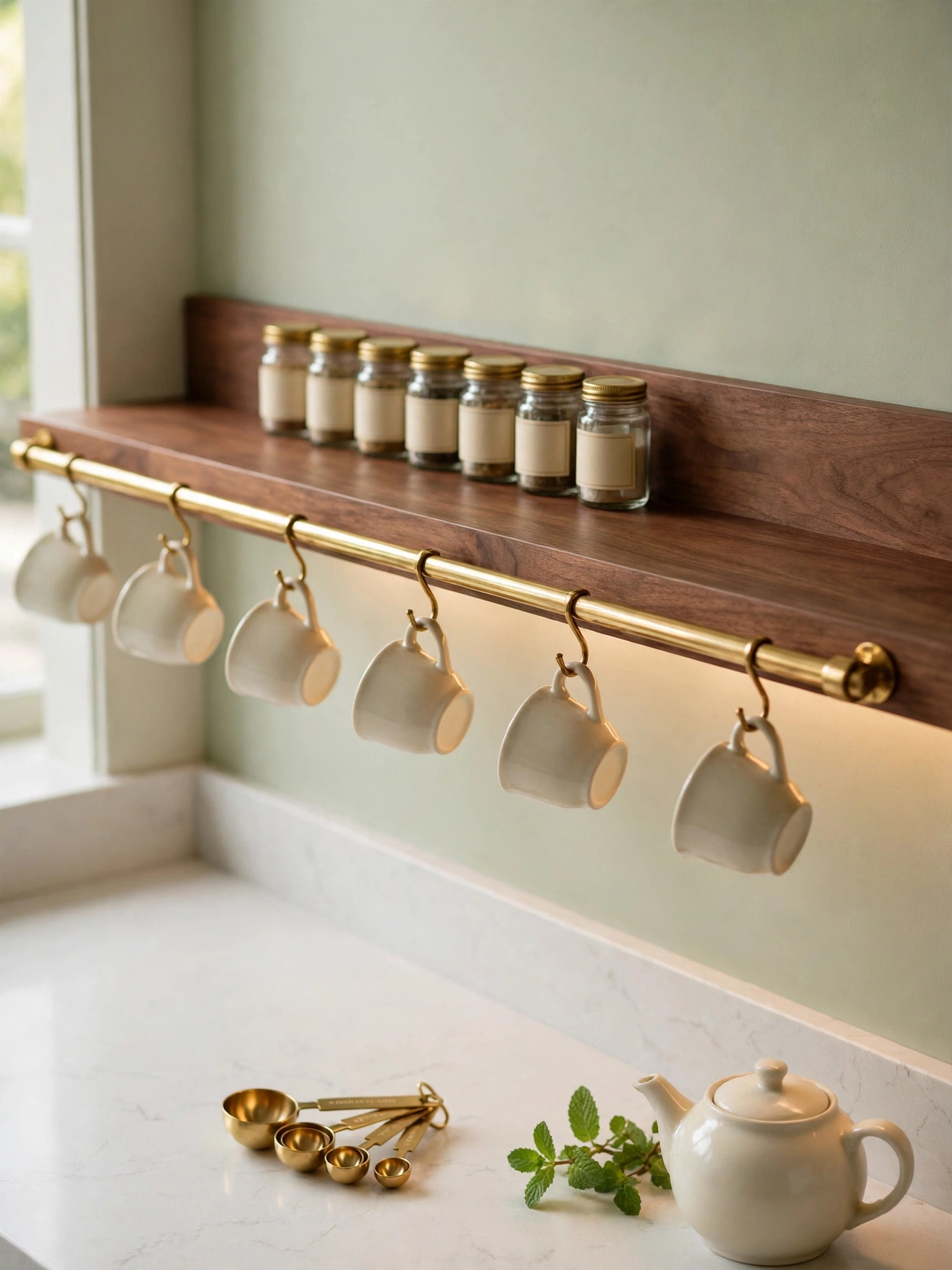
Why This Works:
- A brass rail stops small jars from sliding off the shelf
- The rail adds a jewelry-like line to a plain board
- Small cups hang from the rail without extra hooks
- Brass warms up pale wood and white walls
A brass rail mounts 1 inch above the shelf surface on standoffs spaced 12 inches apart, using a 3/8 inch diameter solid brass rod. Keep the rail 1 inch in from the front edge so jars sit behind it with 1/2 inch of clearance. The rail holds small items weighing up to 1 pound each, such as measuring cups and tiny jars, and it stops a 4 inch spice jar from sliding off when the shelf gets bumped. Never mount a rail on a shelf thinner than 3/4 inch, since the standoff screws need depth to hold. Expect 25 to 50 dollars for a 36 inch brass rail kit. The 48 inch length comes to 40 to 70 dollars.
Steam dulls brass fast, and near a stove it tarnishes in 6 to 8 weeks. A lacquered finish slows that to about a year. Set brass beside wood and stone and it reads as jewelry, a line that refined modern and traditional kitchens carry best. Stainless steel rails never tarnish and cost 20 to 40 dollars, and they look cooler and less warm. A small rail also limits what hangs from it, so keep the rail for cups and light tools, not heavy pots.
Seasonal Shelf Swaps

Why This Works:
- Swapping 3 to 4 pieces refreshes a shelf in 15 minutes
- Seasonal pieces store flat in a 12 inch bin between seasons
- One shelf changes the mood of the whole kitchen
- Small swaps cost less than a full restyle
A permanent base of dishes stays put all year, with only 3 to 4 pieces changing with the season. Store the seasonal pieces in a 12 by 10 inch bin on a high shelf, and swap them in 15 minutes at the start of each season, 4 times a year. Keep the swap pieces small, under 8 inches tall, so they fit the 12 to 14 inch shelf gap without moving the shelf. Avoid buying a full seasonal set every year, since 4 sets of decor fill a whole cabinet within 2 years. The Spruce suggests rotating a few accent pieces each season rather than redecorating the whole room, which keeps the cost low and the look fresh.
Each season needs one 12 inch bin, and 4 bins take a full cabinet shelf. Guests notice the shelf first, so a seasonal swap feels festive in a kitchen that hosts holidays, and those four swaps need somewhere to live. A permanent shelf needs no storage at all, and it looks the same in July and December. Seasonal pieces cost 10 to 30 dollars per season when bought after the holiday, when prices drop 50 percent or more.
Breakfast Shelf Station
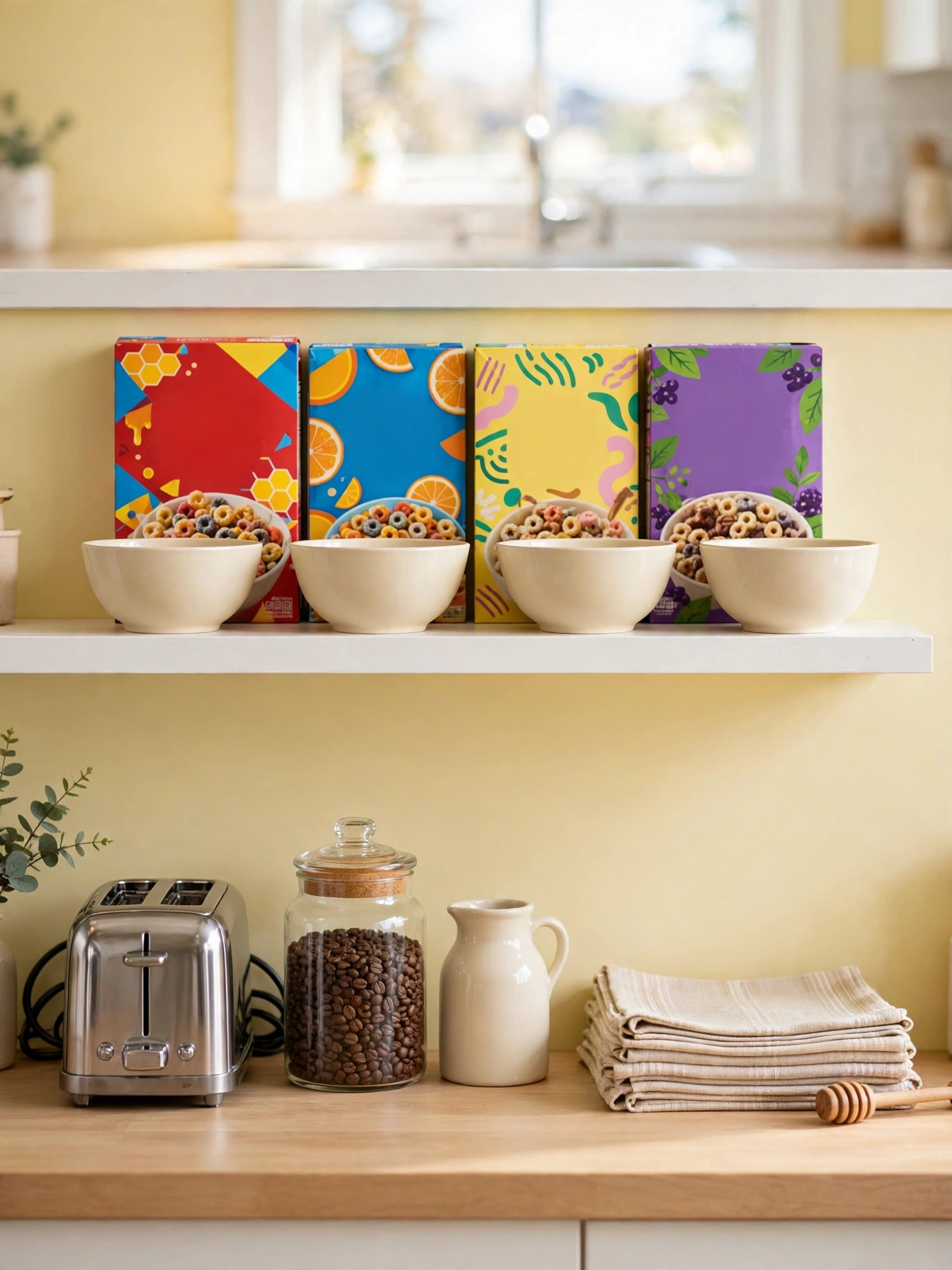
Why This Works:
- Cereal, bowls and coffee sit together in one 36 inch zone
- A 14 inch shelf gap fits cereal boxes standing upright
- Mornings run faster when nothing needs hunting
- Kids reach their own bowls at 48 inches high
A breakfast station fits on a shelf 36 to 48 inches wide, with the lower shelf set 48 inches from the floor so children reach bowls without a stool. Keep 14 inches between shelves, since a standard cereal box stands 12 inches tall and needs 2 inches of clearance to lift out. Place the toaster on the counter below the shelf, not on the shelf itself, since a toaster needs 6 inches of clearance on all sides and heats the board above it. Avoid placing the station above a sink, since steam from the tap fogs the cereal boxes and softens them within days. The National Kitchen and Bath Association recommends 15 inches of landing space beside a refrigerator, and the same idea applies here, so keep 12 inches of clear counter beside the station for bowls and mugs.
Cereal dust and coffee grounds collect under the jars, so a weekly wipe keeps the shelf clean. Kids serve themselves at this station, so mornings start 10 minutes earlier in a family with school-age children. A closed cabinet hides the mess, and it slows the morning routine by hiding the bowls. A breakfast station costs nothing beyond the shelf itself, since the boxes and bowls already live in the kitchen.
Small Kitchen Shelf Decor Ideas
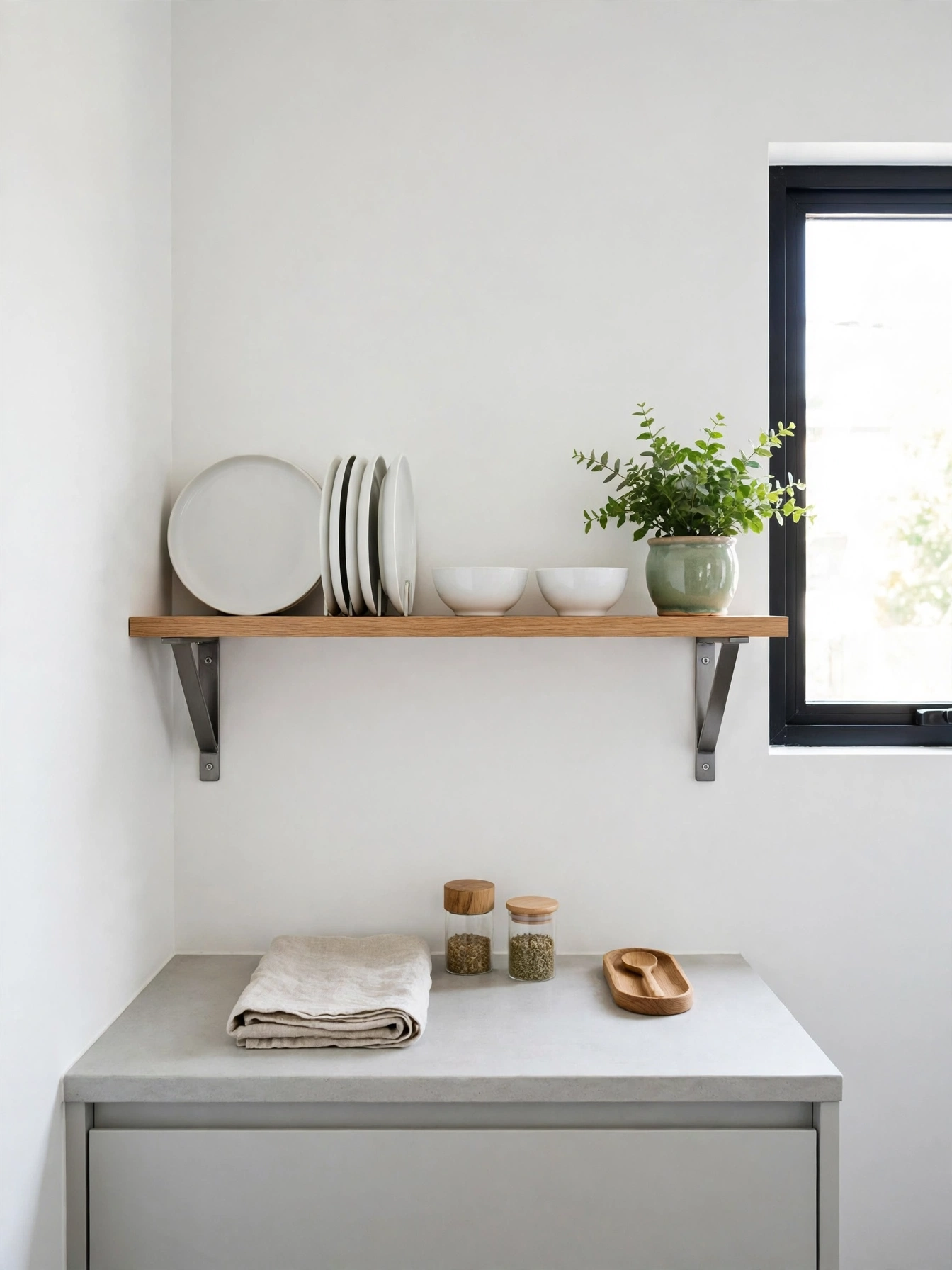
Why This Works:
- A 24 inch shelf adds storage without a cabinet
- Four plates and two bowls fit a shelf 8 inches deep
- One small plant adds life without eating space
- A slim shelf keeps a narrow walkway clear
In a tiny kitchen, a shelf 24 to 30 inches long and 8 to 10 inches deep, mounted 18 inches above the counter, clears a coffee maker and a cutting board. Hold the shelf on two brackets rated for 30 pounds, spaced 16 inches apart into studs, and load no more than 20 pounds total. Keep 4 plates, 2 bowls and 1 small item on the board, with 2 inches of empty space at each end. Avoid a shelf deeper than 10 inches in a galley kitchen, since it narrows the walkway below the 36 inch minimum for comfortable passage. The National Kitchen and Bath Association recommends 42 to 48 inches of clearance in a walkway used by two cooks, and a slim shelf protects that space.
A 24 inch oak shelf with two brackets is priced at 35 to 70 dollars. The renter-friendly version on adhesive mounts rated for 15 pounds costs 20 to 40 dollars. A small shelf adds storage without a remodel or a landlord approval, which is exactly what renters and apartment dwellers need. It supplements cabinets, holding about a quarter of a full cabinet on a 24 inch shelf. A rolling cart adds more storage and moves around, and it takes floor space a tiny kitchen cannot spare.
Marble Shelf Backsplash Ledge
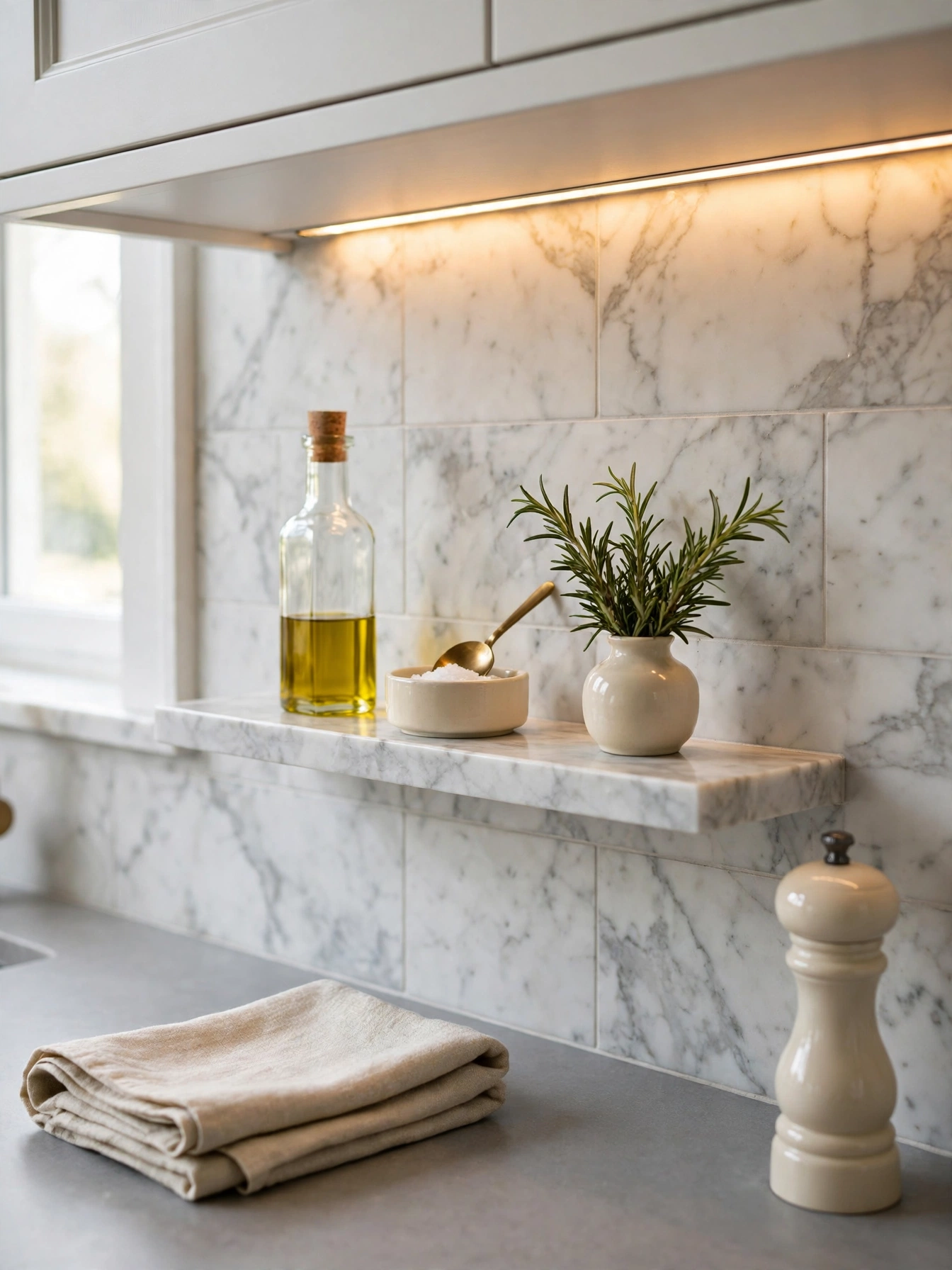
Why This Works:
- A 3 inch ledge holds daily cooking essentials within reach
- Marble matches the backsplash, so the ledge looks built in
- Oil and salt stay beside the stove, not across the room
- A slim ledge adds storage without a full shelf
A backsplash ledge 3 to 4 inches deep and 1 inch thick, cut from the same marble or quartz as the countertop, matches the colors around it. Mount the ledge 6 to 8 inches above the counter, which leaves room for a 10 inch oil bottle to stand below the upper cabinet. Support a 36 inch ledge with brackets every 18 inches, and keep the load under 15 pounds, since a marble ledge carries bottles, not dishes. Never set a ledge directly above a gas burner, since the heat cracks thin stone and dries out the sealant. Cut and installed, a marble ledge for 36 inches is priced at 80 to 150 dollars. Quartz in the same length comes to 60 to 120 dollars.
A 3 inch ledge holds 4 to 5 bottles at most, so it serves daily cooking, not storage. Oil and salt sit at hand height on this ledge, within reach of a cook who grabs them a dozen times per meal. A full shelf holds far more, and it juts 10 inches into the room and needs stronger mounts. Marble looks seamless beside a marble backsplash. Quartz resists stains better and needs sealing once a year, and marble needs sealing twice a year.
Vintage Crate Wall Shelves
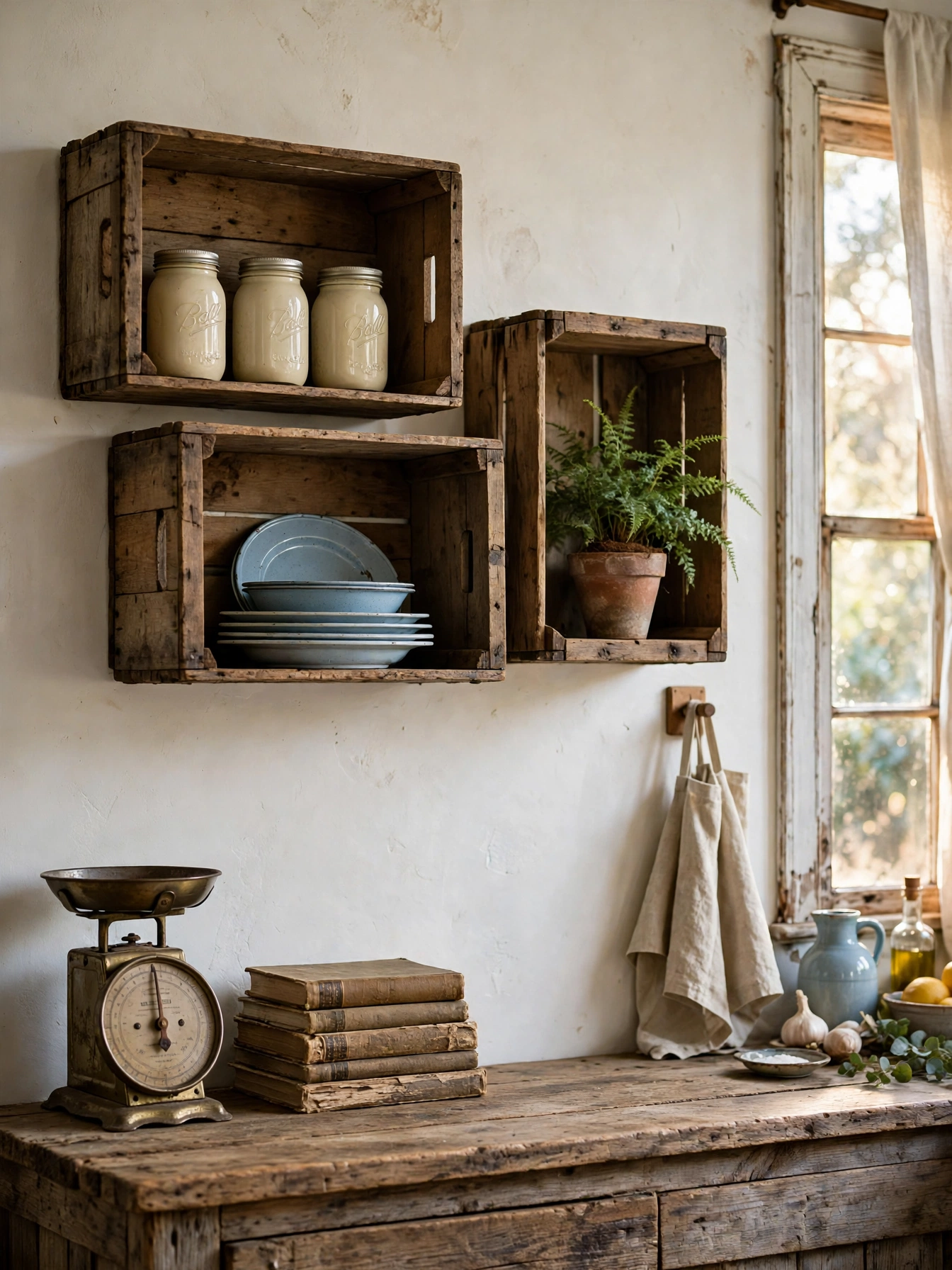
Why This Works:
- Old crates add instant character for 20 to 40 dollars each
- Crates 12 inches deep hold jars and plates like a cubby
- Crates mount in any arrangement, so the wall fits the room
- The open box shape keeps small items from sliding off
Vintage crates 12 to 16 inches wide, 12 inches deep and 8 to 10 inches tall, with solid wood sides at least 1/2 inch thick, make sturdy wall cubbies. Mount each crate with 2 screws into studs, using screws 2 inches long, and check the crate with a level before the second screw goes in. A single crate holds about 10 pounds of jars and plates, so keep heavy stoneware in lower crates and light items up high. Sand the inside edges smooth, since old crates splinter and snag linen. Avoid crates with old paint that flakes, since lead paint appears in crates made before 1978, and seal any painted crate with 2 coats of clear polyurethane.
Worn wood carries a story new shelves cannot copy, and eclectic and vintage kitchens show crates off best. Three crates cost 60 to 120 dollars, about the same as a 48 inch board, and they hold less between them. New wood boxes look cleaner, and they come to 25 to 50 dollars each. They lack the patina that makes a crate charming. A crate wall also collects dust inside each box, so a monthly wipe keeps the jars clean.
Staggered Asymmetric Shelves
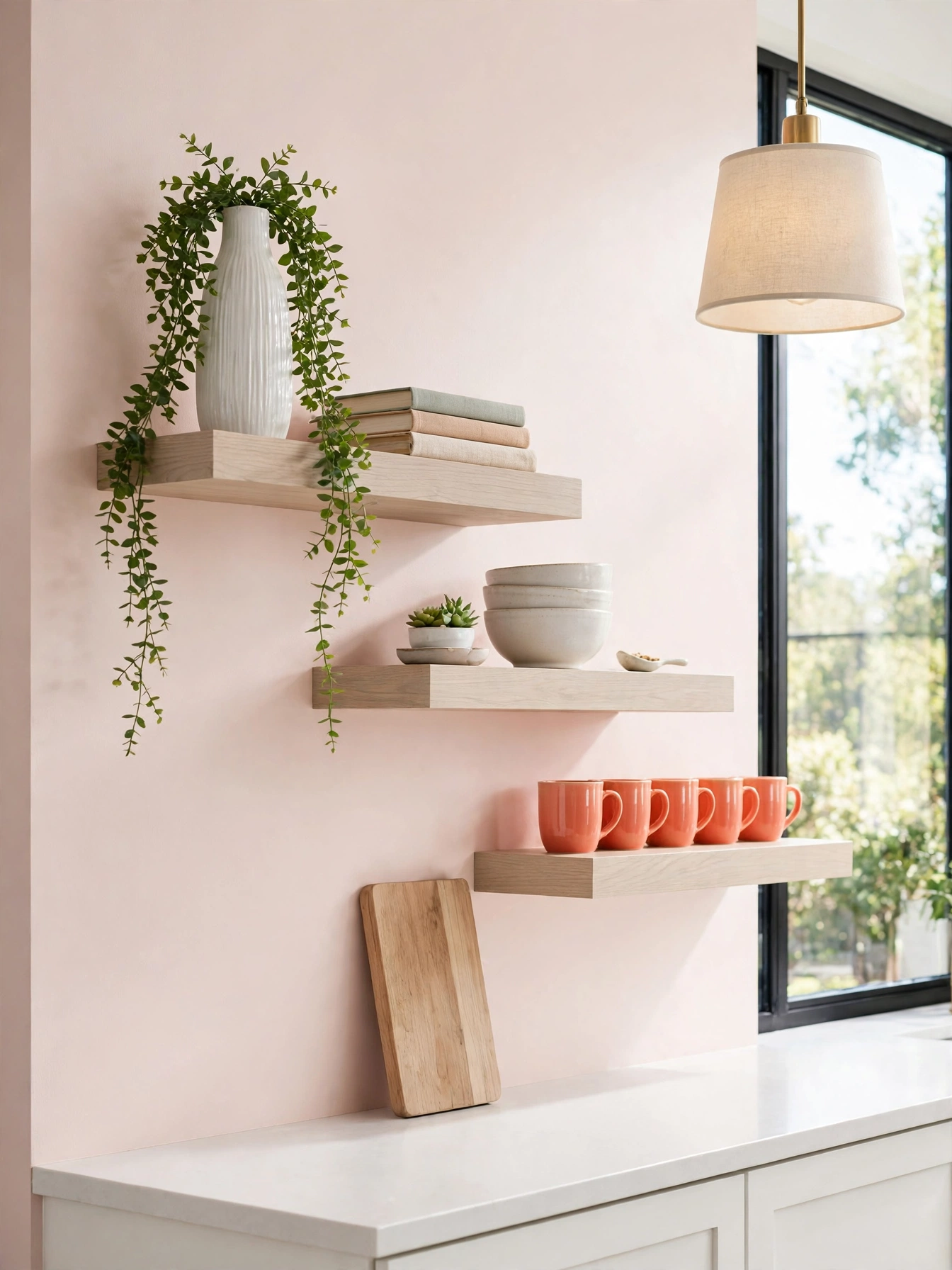
Why This Works:
- Staggered heights break a long wall into visual rhythm
- A tall vase fits the high shelf while mugs suit the low one
- Offsets of 6 to 8 inches look deliberate, not random
- Different shelf lengths stop the wall from feeling like a grid
Three boards of different lengths make a staggered wall: 36 inches, 24 inches and 18 inches, all 10 to 12 inches deep. Offset each shelf 6 to 8 inches horizontally from the one below, and vary the vertical gaps between 12 and 16 inches so the layout feels organic. Mount every shelf into studs with brackets or rods rated for 30 pounds, and keep the lowest shelf 18 inches above the counter. Two studs carry about 25 pounds on a 36 inch board, and one stud manages about 12 pounds on an 18 inch board. Avoid offsets smaller than 4 inches, since the shelves then look misaligned instead of intentionally staggered.
The offsets leave gaps, so a wall of staggered shelves holds about 20 percent less than straight rows. Modern and playful kitchens carry a staggered layout well, since it adds movement to a plain wall. Straight shelves hold more, and they cost less to install. They look calmer and more predictable. Three staggered ash shelves cost 120 to 220 dollars. Three straight boards are priced at 90 to 150 dollars.
FAQs
What are the best kitchen shelf decor ideas for a small kitchen?
For a small kitchen, fit a 24 inch shelf 8 to 10 inches deep, 18 inches above the counter. Four plates and 2 bowls fill it nicely without going past 20 pounds. The National Kitchen and Bath Association recommends 42 to 48 inches of walkway clearance.
How much weight can a floating kitchen shelf hold?
A floating shelf on steel rods sunk 3 inches into studs holds 25 to 40 pounds for a 36 inch board. Bracket shelves hold 40 to 60 pounds, and a single crate holds about 10 pounds. Check the bracket rating and mount into studs spaced 16 inches apart.
How deep should open kitchen shelves be for dishes and jars?
For kitchen shelf decor ideas that actually get used, 10 to 12 inches deep works for dishes and jars, 8 to 10 inches for small kitchens, and 3 to 4 inches for a ledge. The National Kitchen and Bath Association recommends pantry shelves at 12 to 16 inches deep.
How far apart should open kitchen shelves be spaced?
Open kitchen shelves need 12 to 14 inches of vertical space for plates and jars, 14 inches for cereal boxes and tall cookbooks, and 14 to 16 inches for two-tier layers. Keep the lower shelf 18 inches above the counter and the top shelf at or below 72 inches.
How do I keep open kitchen shelves from looking cluttered?
Keep open shelves tidy by using matching jars in 2 sizes, limiting each shelf to 2 colors, and leaving 30 percent of the board empty. Group items in sets of 3 or 5, repeat one color across the row, and reset the shelf for 10 minutes every 2 weeks.
Conclusion
Start with the shelf that helps most, not the prettiest one. A 10 to 12 inch deep board, mounted 18 inches above the counter into studs 16 inches apart, holds dishes safely and looks calm. Match the containers, leave 30 percent of the board empty, and add light at 2700K so the shelf glows after dark. A shelf that measures right looks right, so measure your wall, pick one shelf, and mount it this weekend. Follow HomelyCrafter on Pinterest for more ideas. Save this to your Pinterest boards so you can refer back to it!

Muhammad Israr is a home decor enthusiast and the writer behind Homely Crafter. He spends his days researching paint colors, layouts and budget-friendly styling ideas, then breaks them down into practical, easy-to-follow guides so you can decorate with confidence.
3 thoughts on “24 Tidy Kitchen Shelf Decor Ideas You’ll Love to Try”