
A kitchen makeover does not need a contractor or a five-figure budget. One gallon of paint on a single cabinet run, a bold island or a strip of tile can shift the whole room, and the change can be undone in a weekend if the household tires of it. Paint brands now sell deep greens, warm terracottas and soft lavenders in durable kitchen finishes, so color no longer means a fragile surface that marks at the first splash.
The 23 ideas below pair each color with paint names, finish choices, hardware sizes and the measurements that keep a bright room balanced, while upkeep and the rooms where strong color struggles get an honest look too. Every idea names the cabinet style, the finish worth asking for, and the small detail that stops the color feeling loud.
Sunny Yellow Cabinets
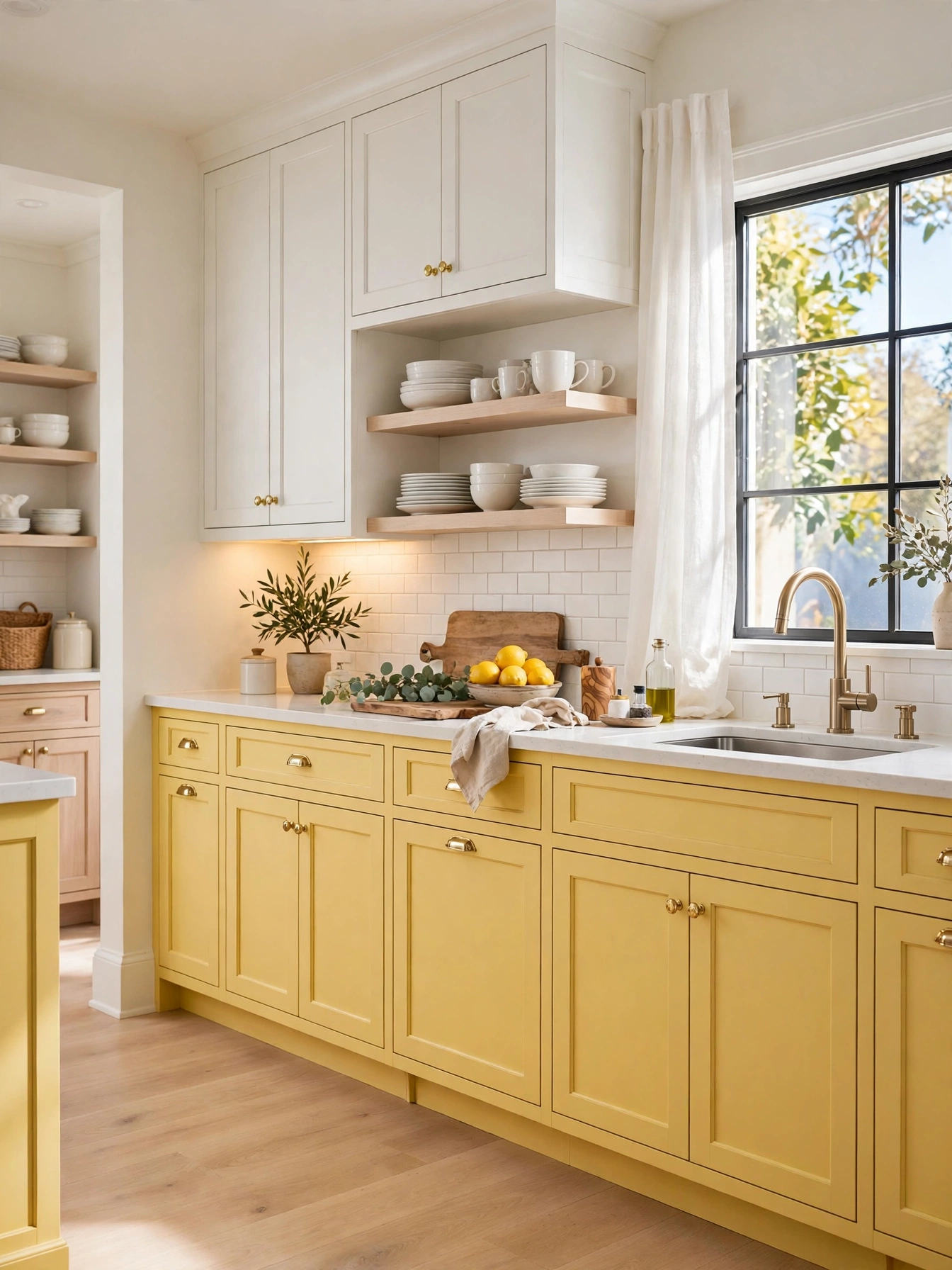
Why This Works:
- Yellow bases catch morning light and warm the floor line
- Pale uppers stop the bright color from closing the room in
- A satin finish wipes clean after breakfast splashes
- Brass pulls pick up the warm tone of the yellow
Benjamin Moore Hawthorne Yellow gives a mid-tone glow closer to sunshine than to a highlighter, laid on maple doors 3/4 inch thick in 2 coats of satin acrylic enamel over primer. Keep upper cabinets white and set them 18 inches above the 36 inch countertop. Cabinet doors need soft-close hinges rated for 100 pounds per pair, since painted doors carry more weight than bare wood. Avoid a neon yellow on every cabinet, because the glare tires the eye under bright kitchen lighting and the color looks harsh by evening.
Yellow holds its cheer in a north-facing room where daylight runs cool, and the color hides toast crumbs better than white. A water-based acrylic enamel dries quickly with almost no smell, and a foam roller keeps the finish smooth on flat doors. Test the yellow on a 2 foot by 2 foot board and view it at morning and evening light before committing, since yellow shifts more than any other color between daylight and lamplight.
Coral Range Wall
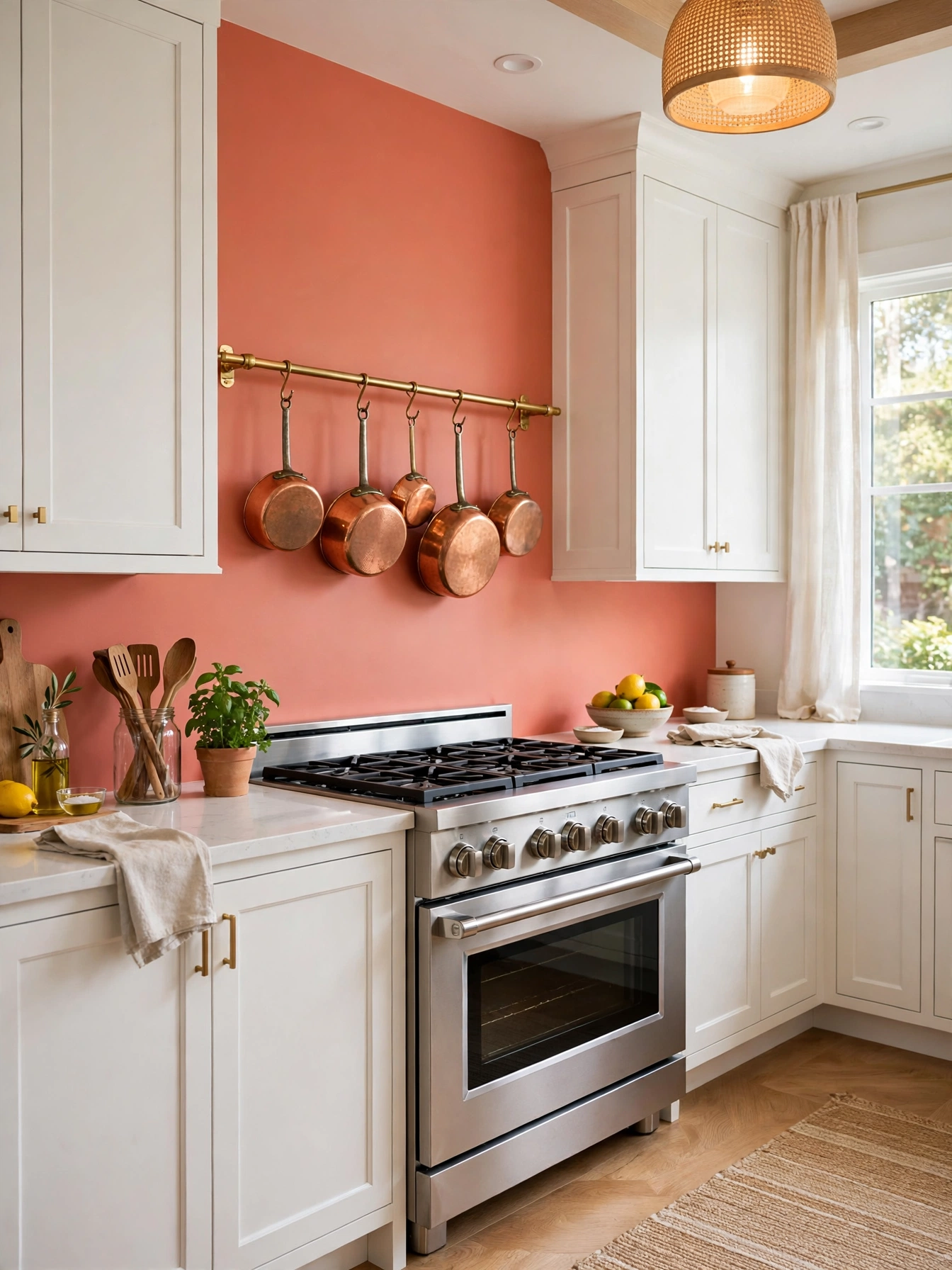
Why This Works:
- One coral wall adds color without painting a single cabinet
- White cabinets on both sides frame the warm accent
- A heat-resistant finish survives steam from the range
- Brass rails repeat the warm tone of the coral
Coral on the range wall works when the paint sits behind a 30 inch range with a 36 inch wide hood above it, and the hood should cover the full width of the range plus 3 inches on each side. Use a washable satin or semi-gloss latex rated for kitchens, since flat paint absorbs grease within weeks near a range. Keep the backsplash at the standard 18 inches high in white subway tile 3 by 6 inches, so the coral has a clean lower edge. Coral on a windowless wall with one ceiling light glows orange under the bulb, so the room needs daylight or a second light first.
Wipe the range wall with a damp cloth after cooking, and grease comes off semi-gloss paint without a cleaner. One gallon covers a single accent wall, and repainting it later takes an afternoon. Paint the coral wall edge to edge between the white cabinets, and the color becomes one deliberate focal point in the room.
Emerald Green Island
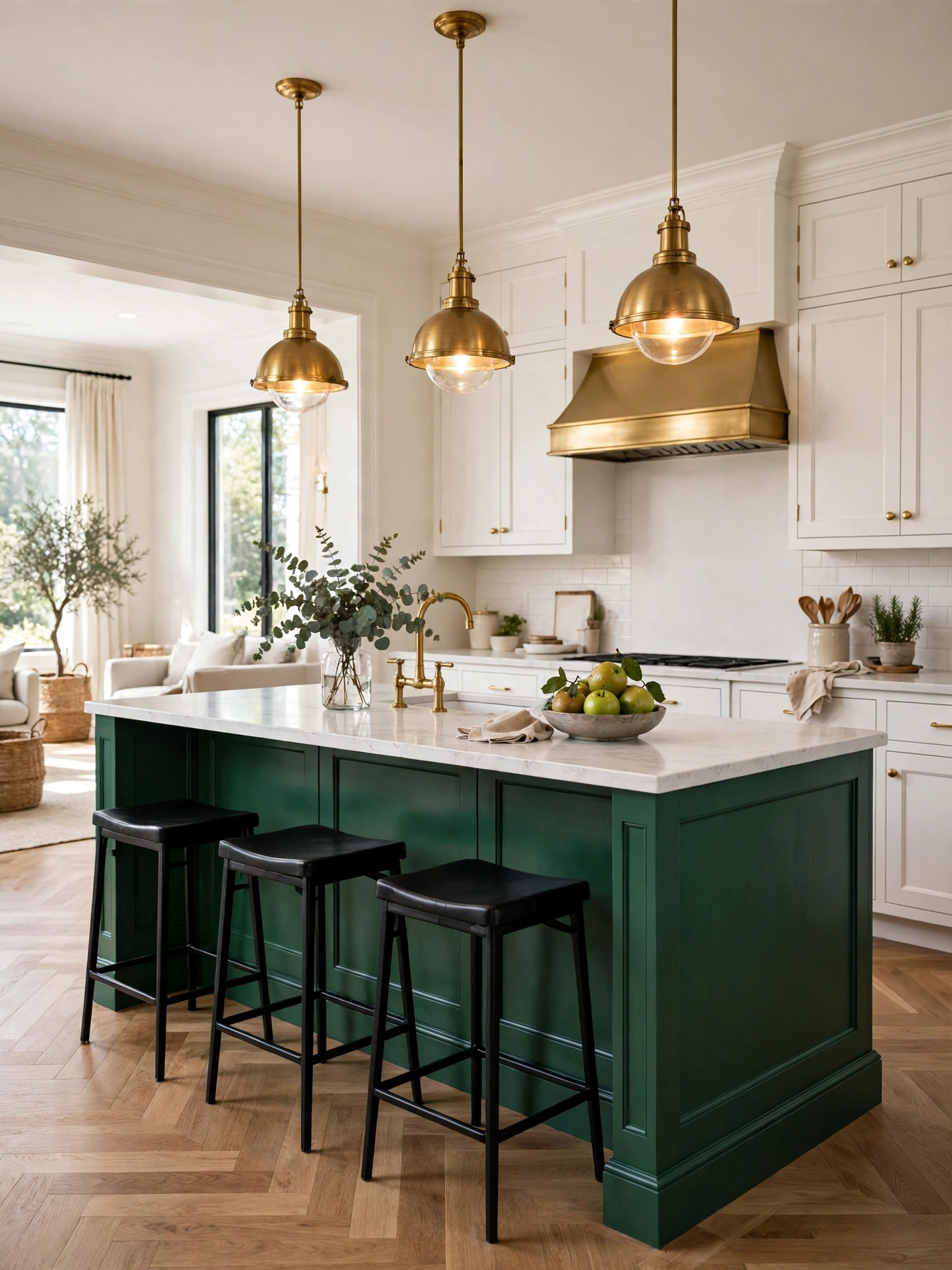
Why This Works:
- One green island brings deep color with no room-wide repaint
- Pale perimeter cabinets hold the kitchen bright around it
- Knees fit under the island thanks to the 12 inch overhang
- Brass pendants over the island echo the warm metal elsewhere in the room
A white perimeter lets one deep green island carry the whole room, so seating decides how large it should be. Pendants hung 30 to 36 inches above the countertop, spaced 24 to 30 inches apart, spread light evenly across the island. A working kitchen needs 42 to 48 inches clear around the island, the National Kitchen and Bath Association clearance. Three stools need a 72 to 96 inch island, 36 inches wide, with 24 inches of width per stool and a 12 to 15 inch overhang for knees. A green island needs at least 60 inches of length to hold the room as its centerpiece.
Painting only the island takes a weekend, and the change stays easy to reverse if the household tires of green. A stone waterfall edge adds drama, so a simple eased edge fits most rooms. A tough wipe-clean sheen suits the island base, where scuffs land first, and a deep green gives the island the presence of a piece of furniture.
Small Colorful Kitchens
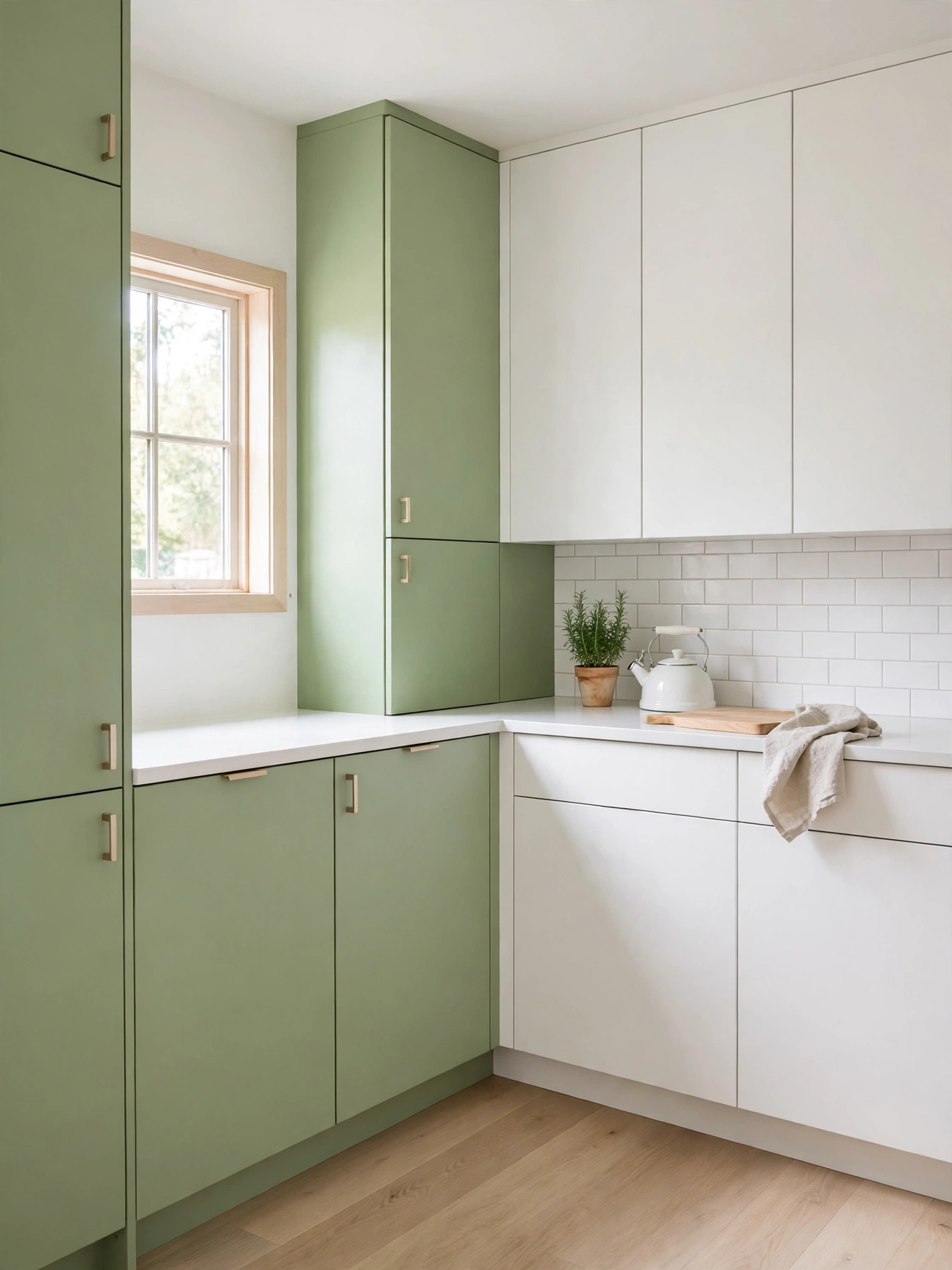
Why This Works:
- Color on one wall adds interest without shrinking the room
- White on the opposite wall keeps the light moving
- Pale green feels fresh rather than dark in a small space
- Slim bar pulls fit the small doors without overpowering them
One wall only should carry color in a kitchen under 10 feet by 12 feet, with the opposite wall kept white or open. Brush the cabinet wall in soft green over a stain-blocking primer, and keep the countertop white quartz 36 inches high. A 36 inch gap between the counter and the opposite wall lets one cook pass without turning sideways. Use slim bar pulls 3 inches long so the hardware matches the small doors. Two strong-colored walls close the narrow room in from both sides, and the cabinets look darker after sunset.
A single color wall gives a small kitchen a focal point without a full repaint, and the pale tone reflects daylight better than a dark one. The Spruce notes that light cabinet colors reflect more daylight than dark ones, which matters in a north-facing room. Pale oak underfoot bounces daylight around the room, and the small kitchen stays bright even with the door closed.
Teal Backsplash Tiles
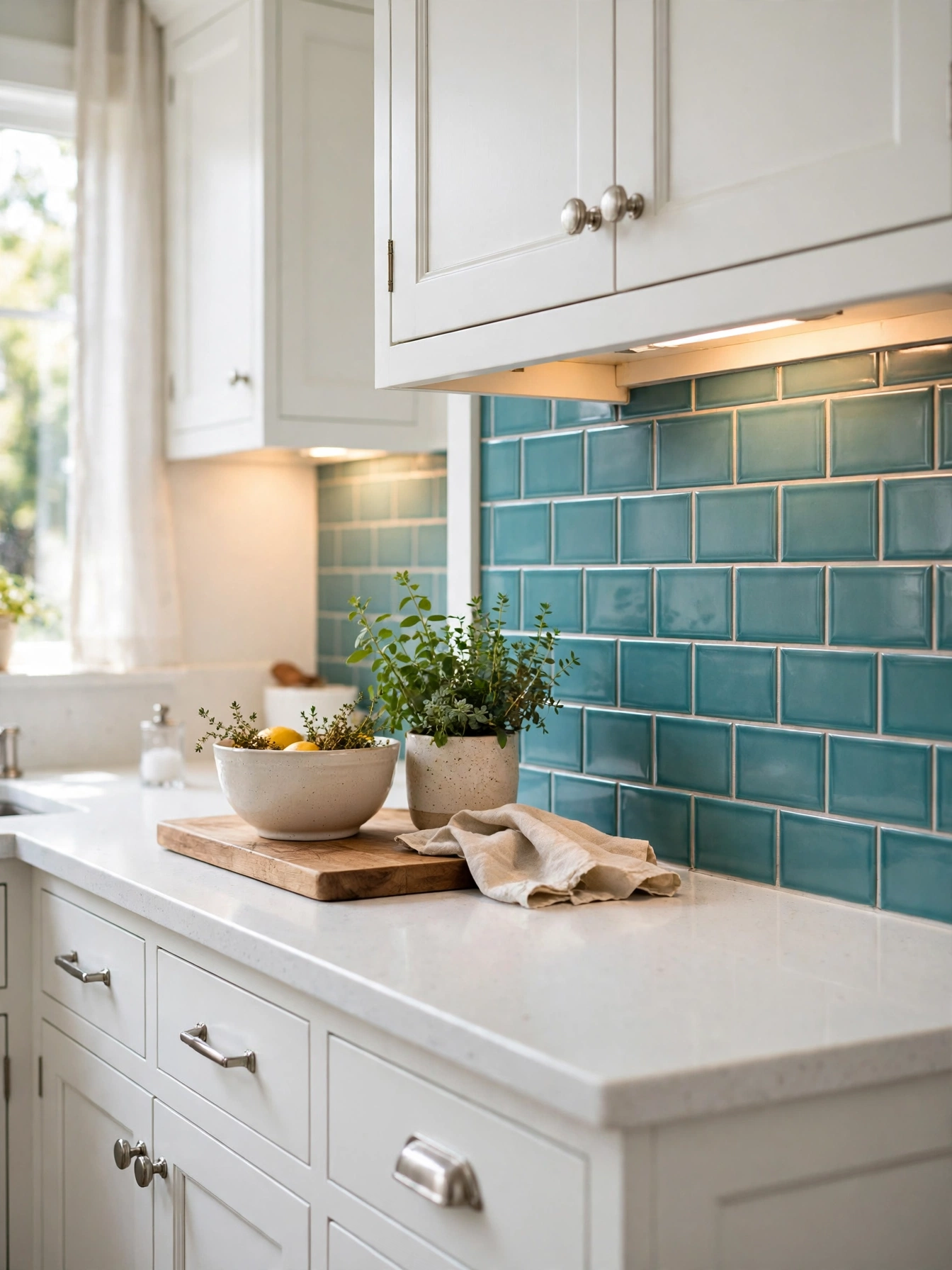
Why This Works:
- Teal tile adds color without painting cabinets
- Gloss glaze sends daylight back across the counters
- Plain cabinets stop the strong tile from overwhelming the room
- Brushed nickel cools the warm teal tone
Teal backsplash tile in a 3 by 6 inch subway size sets the standard 18 inch band between the 36 inch counter and the upper cabinets, with grout in a pale gray that hides stains. Gloss glaze suits the strip, since it wipes clean after cooking splashes. Matte tile holds grease near the range, so keep it off the cooking wall. A penetrating grout sealer, renewed once a year, stops kitchen grout soaking up grease near the range. A patterned teal tile beside a patterned counter makes two patterns compete, and the room turns restless.
Tile lets a household try teal without repainting, and the color stays easy to change later. Glossy plain subway tile keeps the band quiet, and one patterned row inside it supplies the lively note. Most households spend under 800 dollars on the whole band, since a standard run covers about 30 square feet at 10 to 25 dollars per square foot installed.
Pink Pantry Doors
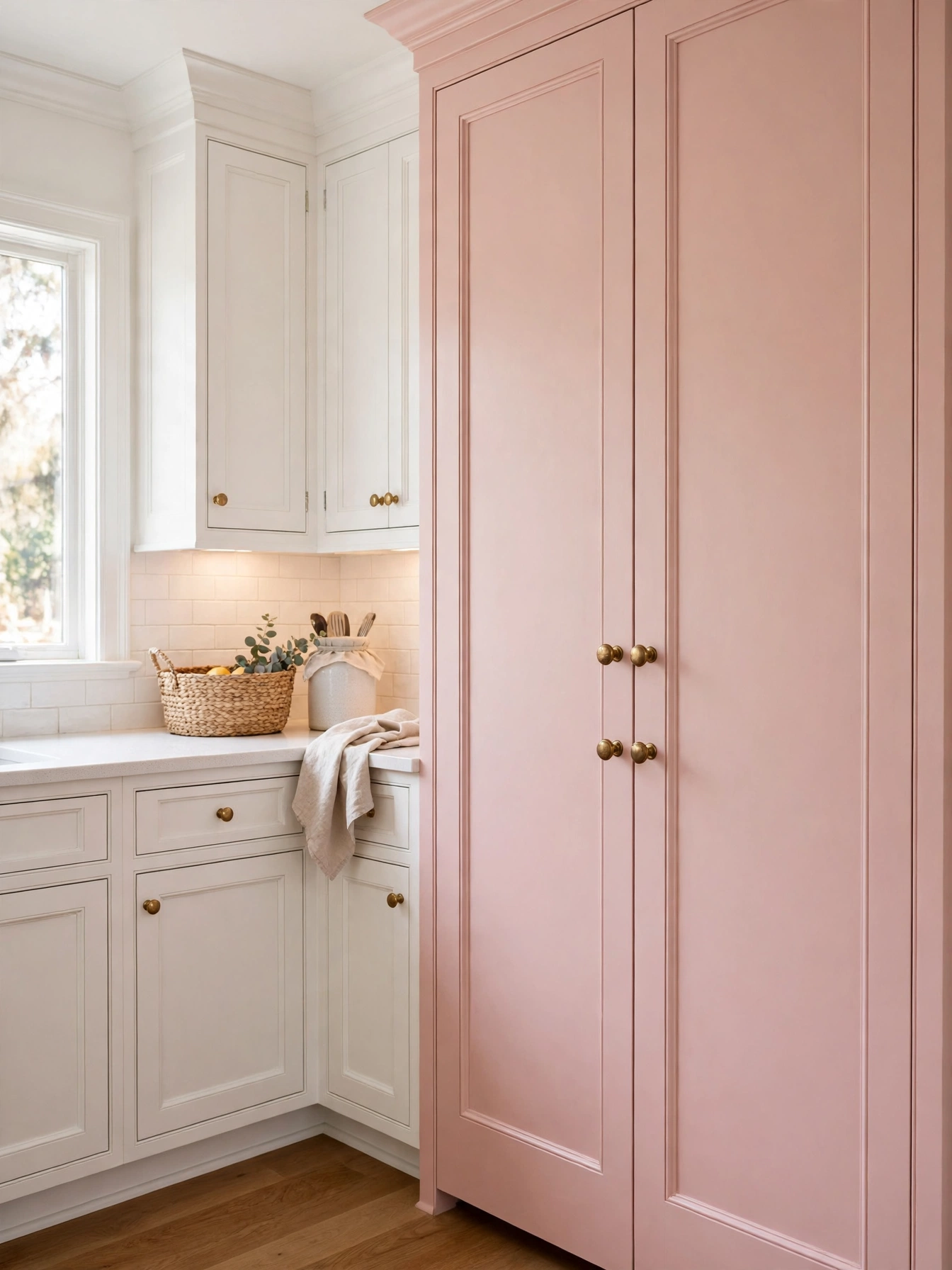
Why This Works:
- Blush pink doors put the color in one tall sweep
- A calm pink face hides the pantry food behind tall doors
- Brass knobs match the warm metal used on the other cabinets
- A single pink feature carries the color in a white kitchen
One tall sweep of blush pink turns pantry doors into the color statement of a mostly white kitchen. Tall doors of 84 inches by 24 inches, brushed blush pink over primer on maple, carry the color best. Order hinges rated for 100 pounds per pair for these doors, since a full-height door carries far more weight than a standard one. Shelves 12 inches deep, set 14 inches apart inside, hold cereal boxes and jars without stacking. A pink island beside a pink pantry splits attention between two large pink blocks, and the room loses its balance.
A tall pantry cabinet keeps food behind closed doors, and the soft pink tone feels warm beside brass. Pull-out shelves slide every jar forward to the front edge, where it can be reached without moving the jars in front. Sorting shelves by food type means nobody opens every door to find one jar.
Cobalt Blue Uppers
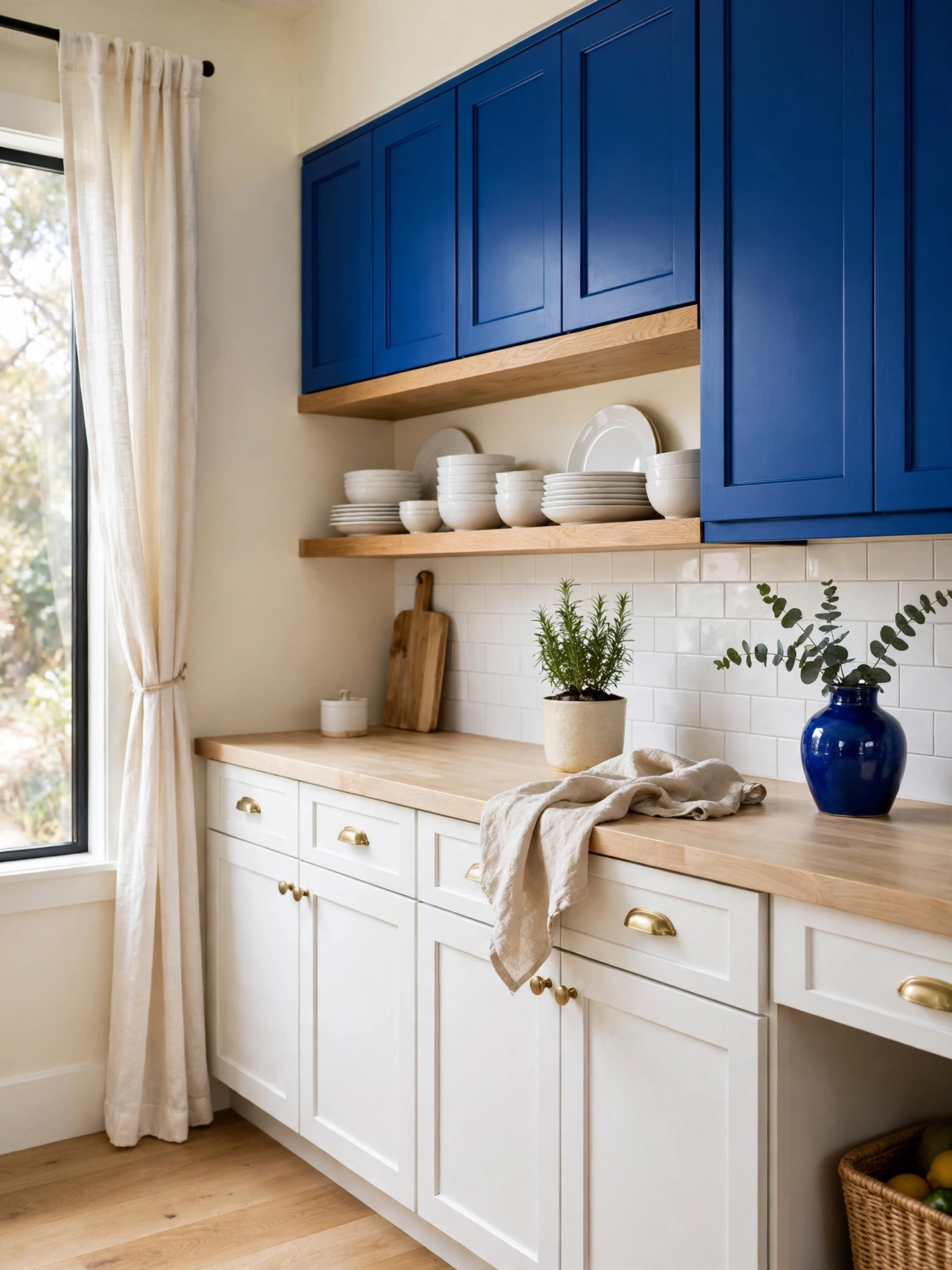
Why This Works:
- Cobalt uppers add a strong color at eye level
- Pale lowers hold the floor line bright and clean
- Bright blue sits well beside pale oak and cream
- Open shelves break up the bold cabinet run
Cobalt on uppers reads as confident color, so the tone has to carry enough depth to stay blue under kitchen lights. Choose a cobalt such as Benjamin Moore Blue Danube, in a satin finish on maple doors. Set 12 inch deep uppers so their undersides sit 18 inches above the 36 inch counter, and fit slim 5 inch bar pulls so the hardware suits the bold doors. White subway tile 3 by 6 inches behind the cobalt gives the blue a clean edge. One small window starves cobalt uppers of light, so the blue turns gray by evening in a dim room.
A bold upper run changes the room more than a pale one, so the test board matters twice as much here. A small pot of matching paint lives in the cupboard for brush touch-ups, since painted maple marks show on bold blue doors. Slim bar pulls leave the cobalt doors as the focus, and white counters give the blue a bright frame.
Orange Open Shelves
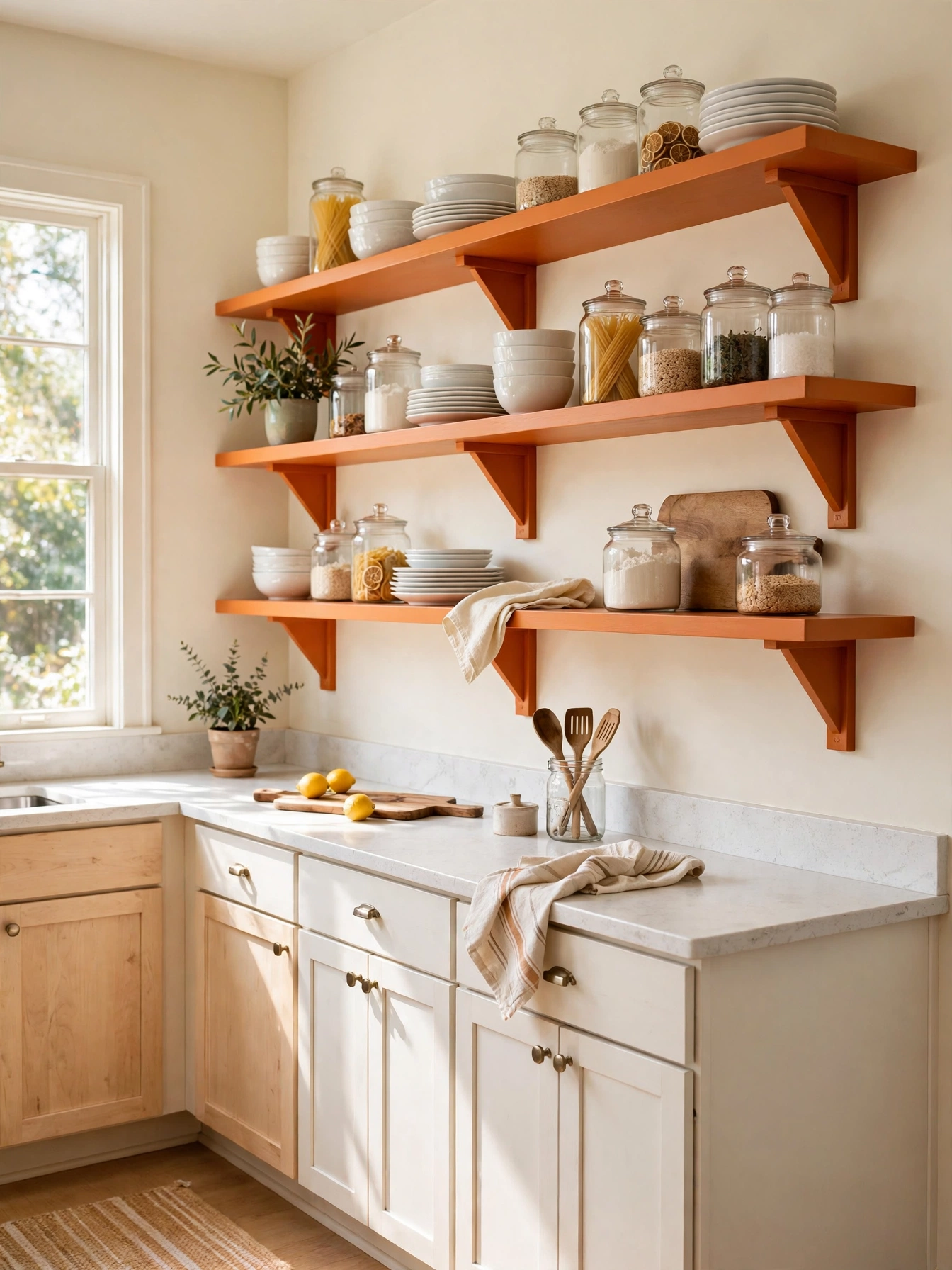
Why This Works:
- Orange shelves add warmth above white lowers
- Open shelves lighten a cabinet run that felt heavy
- Everyday dishes sit where hands reach them without stretching
- Two shelves bring color without new uppers
A loaded shelf weighs more than it looks, so the fixing above white lowers has to be solid. Steel brackets rated for 50 pounds per shelf, screwed into studs 16 inches apart, hold painted oak shelves 12 inches deep and 1.5 inches thick. Leave the usual 18 inch gap above the counter, and give each shelf a single job, plates on one and glasses on the next. A stack of cast iron pans bends shelf brackets and leaves a sag within months, so store the heavy pans in a lower cabinet.
Open shelves collect dust every week, so anyone who dislikes tidying will find the upkeep a chore. Two shelves mark the limit, since a third crowds the wall and pushes the white lowers out of focus. Two shelves hold the orange at eye level, and the white lowers below them carry no color at all.
Sage And Terracotta
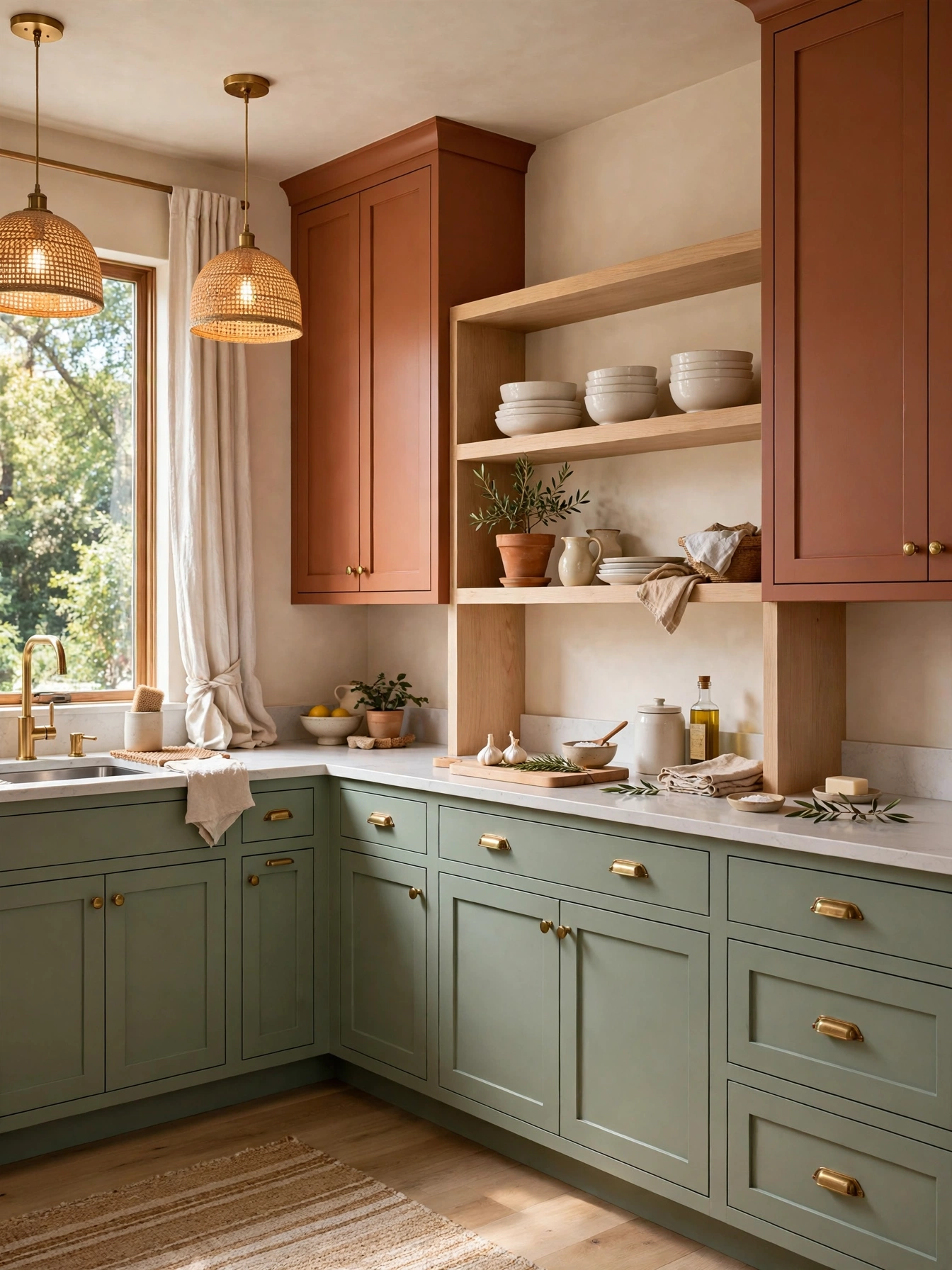
Why This Works:
- Sage and terracotta bring garden warmth indoors
- Dark lower cabinets hide scuffs and kicks near the floor
- Warm uppers keep the ceiling line from feeling cold
- Both tones come from one paint card, so they sit in the same family
The pairing holds when both shades share a warm undertone, sage with a yellow base beside terracotta with a clay base. Give lowers and uppers the same soft sheen and the same primer coat, so the finish matches across the room. A sage island grounds the floor. White counters and backsplash leave the two colors as the focus. Cool gray-green and bright orange terracotta pull the eye in opposite directions, and the pairing never settles.
Beside wood floors and cream walls, the earthy tones warm the room as the light changes across the day. Flat slab doors show every brush mark, so ask the painter for a spray finish. One hardware style across both tones, 5 inch bar pulls on drawers and knobs on doors, ties the room into a single plan.
Red Vintage Range
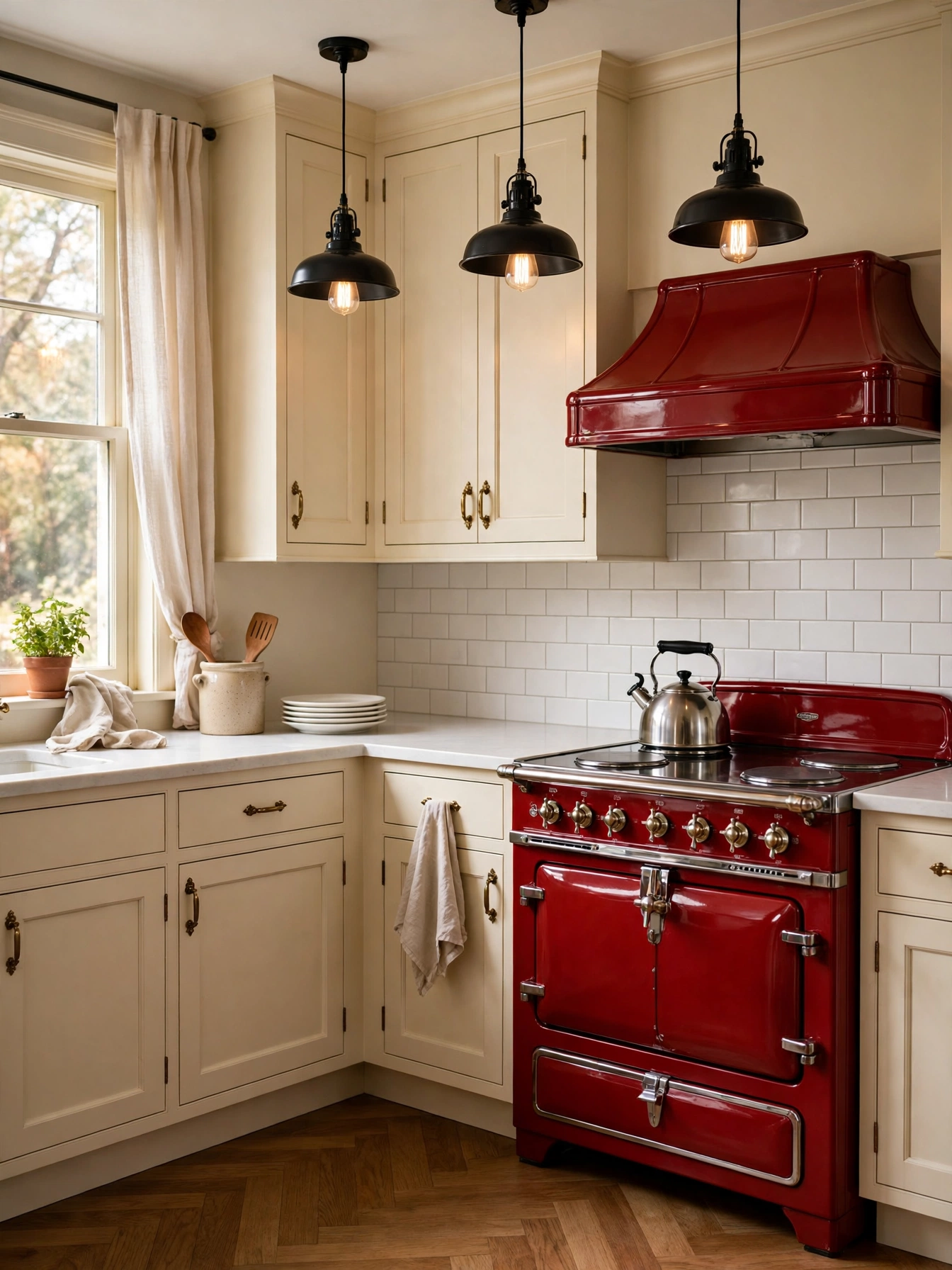
Why This Works:
- A red range becomes the room focal point at once
- Cream cabinets soften the strong red without white glare
- Enamel cleans with a damp cloth after cooking
- Black pendants give the vintage look a clear edge
A 30 inch red range needs a 36 inch wide hood above it, with the hood covering the full width plus 3 inches on each side. Set the range flush beside the cabinets following the maker installation guide, and leave at least 15 inches of counter beside it as a landing spot for hot pans. Choose an enamel finish rated for high heat, since standard cabinet paint blisters beside a range, and keep the backsplash in white subway tile 3 by 6 inches behind it. Doors 3/4 inch thick on soft-close hinges keep the vintage look working smoothly. Chrome hardware beside a red enamel range reads cold against the warm vintage palette.
The red range brings color through an appliance, so the color stays put through a cabinet repaint later. A licensed electrician should handle a new range circuit, since a 240 volt line is not a DIY job, and the wiring needs planning before ordering. A white quartz countertop resists stains and wipes clean after cooking, and the room holds to red, cream, wood and black.
Lavender Lower Cabinets
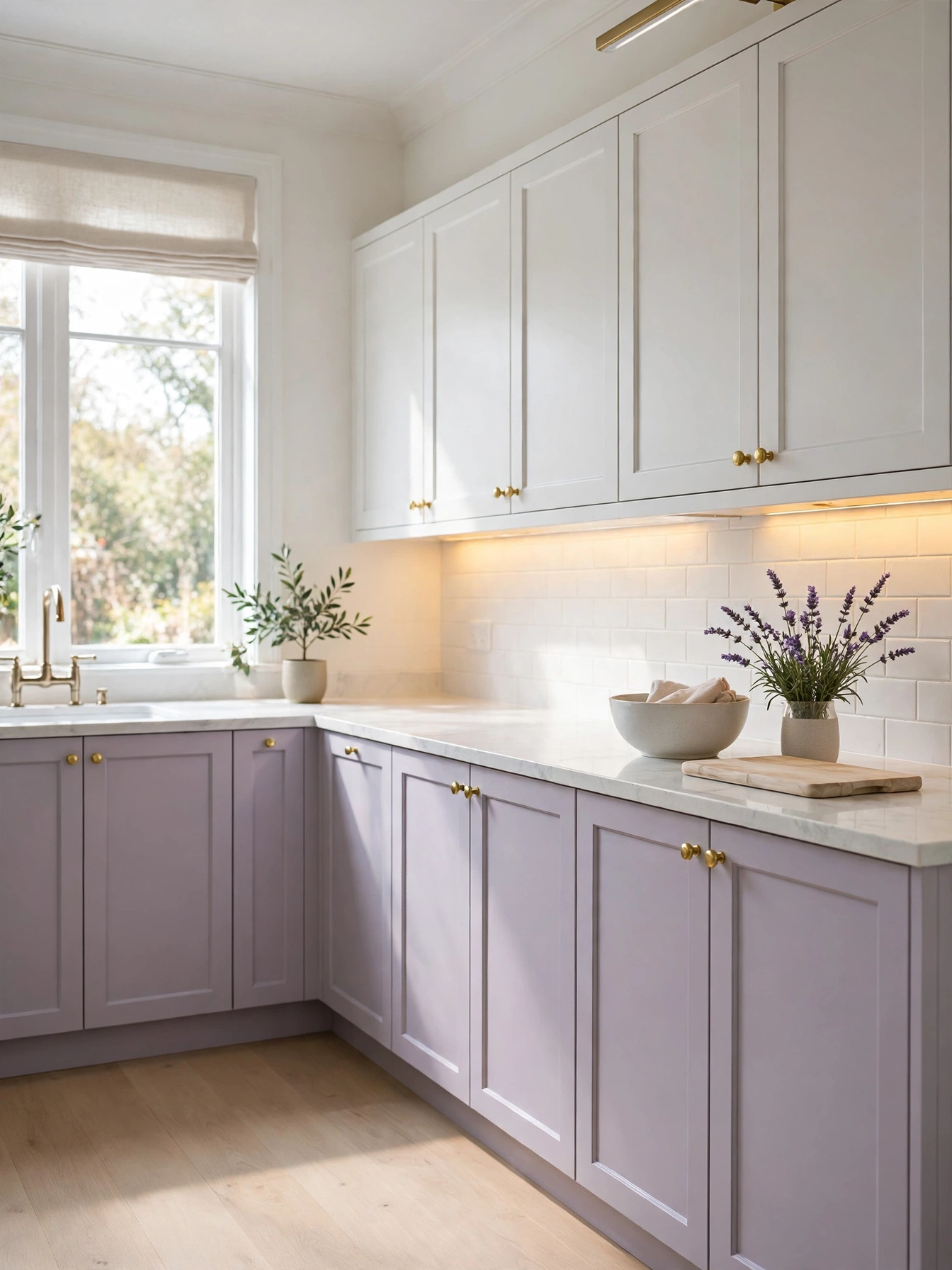
Why This Works:
- Lavender lowers add a soft color at floor level
- Pale uppers hold the room bright above the color
- Satin paint wipes clean and forgives small marks
- Warm metal softens the cool lavender tone
A soft lavender needs enough pigment to stay purple under kitchen lights, or it fades to gray by evening. Benjamin Moore French Lilac on maple doors 3/4 inch thick holds the soft tone, and a satin sheen keeps it washable. White uppers sit 18 inches above the 36 inch countertop, leaving the standard gap for countertop work. Kitchen paint needs a washable sheen rated for cooking spaces, since flat paint soaks up grease and marks within weeks. Bright purple on every cabinet dates fast. The room feels louder at night than it did in daylight.
This soft tone sits easily beside pale oak floors and white counters, and the lavender forms a quiet backdrop behind daily cooking. A wood countertop beside lavender needs oiling every 3 months to stay sealed. A white backsplash frames the lavender with a bright edge, and brass or white hardware keeps the metal light beside the soft color.
Colorful Kitchens With Brass
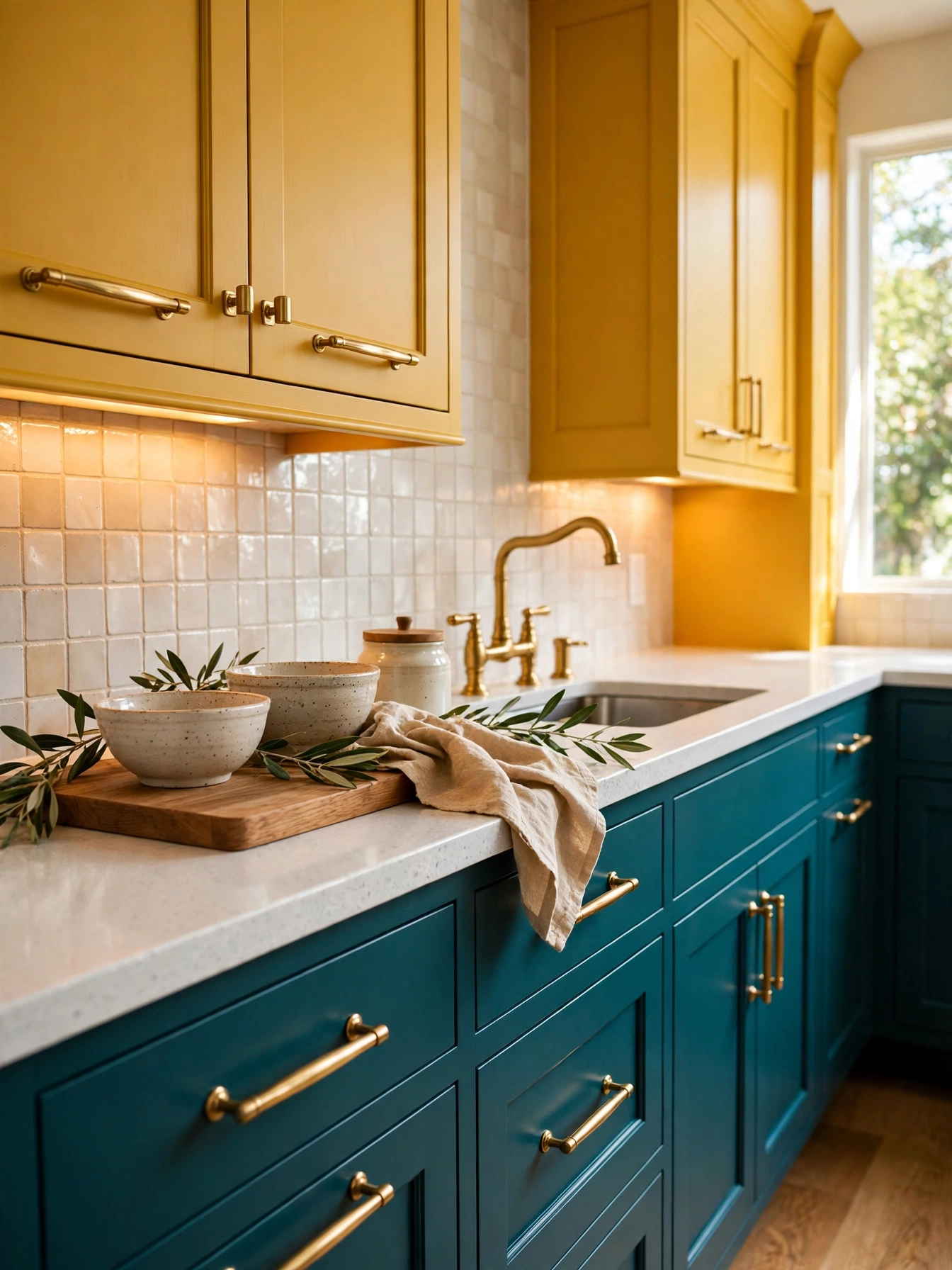
Why This Works:
- Brass warms two strong colors at once
- Wide drawers open easier with long bar pulls
- One brass tone on faucet and pulls keeps the metals calm
- Bare brass mellows into a soft patina with use
One brass tone across pulls, knobs and faucet keeps the metals from fighting each other at a glance. A 5 inch bar pull suits any drawer wider than 24 inches, and a 1.25 inch knob fits the doors. Match the screw length to the 3/4 inch door thickness before ordering. A centered pull with 2.5 inches clear of the drawer edge keeps hands off the door frame. Mixed metal finishes in one kitchen leave the hardware looking scattered, with no single tone for the eye to follow.
New hardware changes the feel of painted cabinets faster than any repaint, with no new paint needed at all. Zinc pulls with a thin plated coat lose that coating at the edges after a few years of daily use. Solid brass shows no flaking at the edges, and a quick polish restores its shine. Unlacquered brass darkens where hands grip it, and a lacquered finish holds its shine for years.
Turquoise Coastal Cabinets
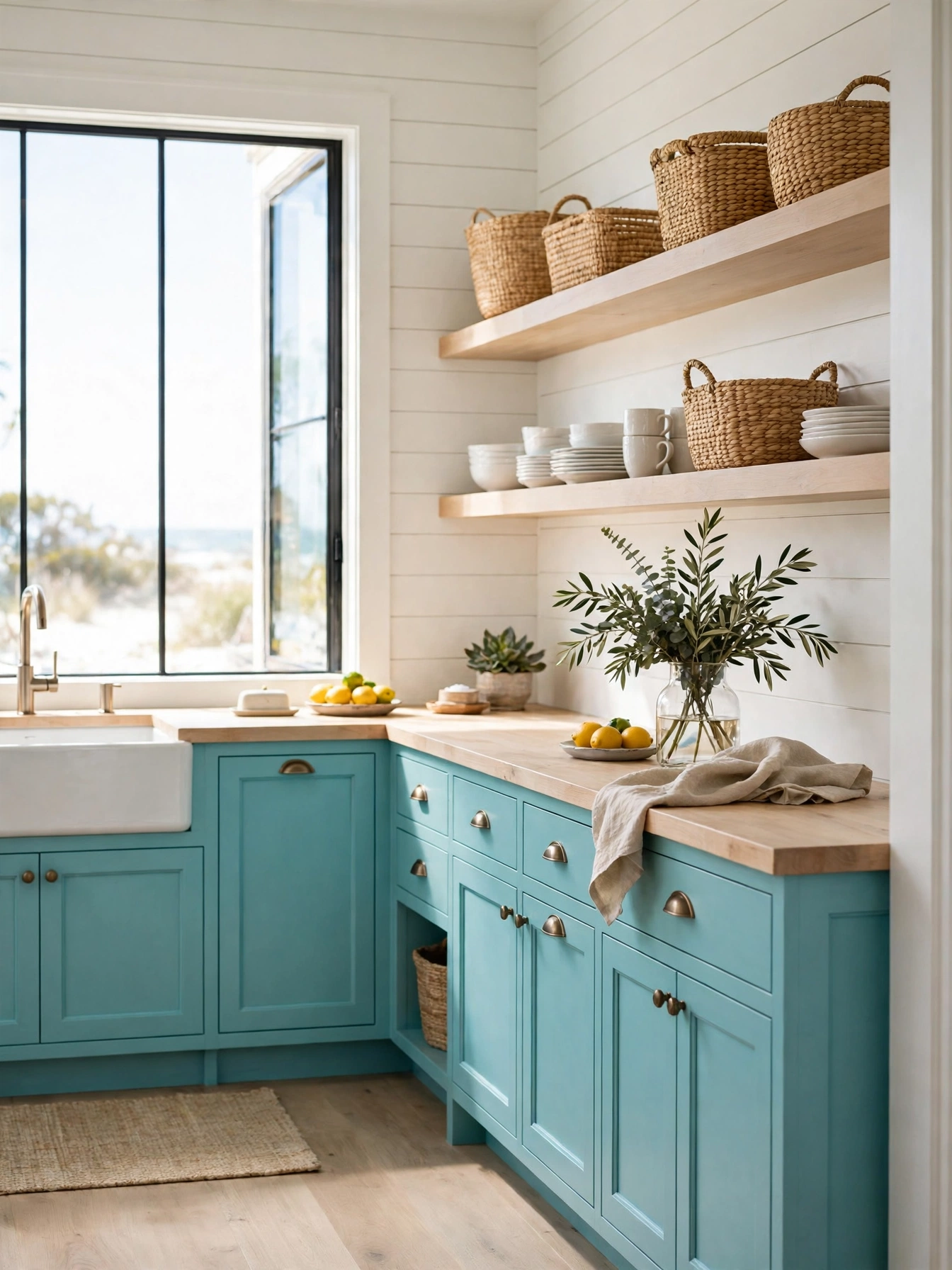
Why This Works:
- Turquoise hints at sea and sky without a theme
- White shiplap adds texture behind the bright cabinets
- Pale oak warms the cool coastal palette
- Woven baskets add natural texture to the shelves
A mid-tone turquoise with a touch of gray gives the cabinets a calm sea color under kitchen light. A soft turquoise on maple doors with a soft sheen pairs with white shiplap and pale oak counters. Keep the backsplash simple, with white subway tile 3 by 6 inches, so the turquoise stands out as the single strong color in the room. Do not add anchors, shells or rope handles, since themed accessories date the kitchen fast and fight the calm color.
Good daylight lets this coastal palette breathe, and the soft gray in the turquoise holds its color steady from morning to evening. A wood countertop needs fresh oil every 3 months to stay sealed. Open shelves with baskets leave the wall open and airy, and a weekly wipe keeps dust off the baskets. Brushed nickel or white hardware suits the turquoise, where heavy black would weigh it down.
Mustard Island Stools
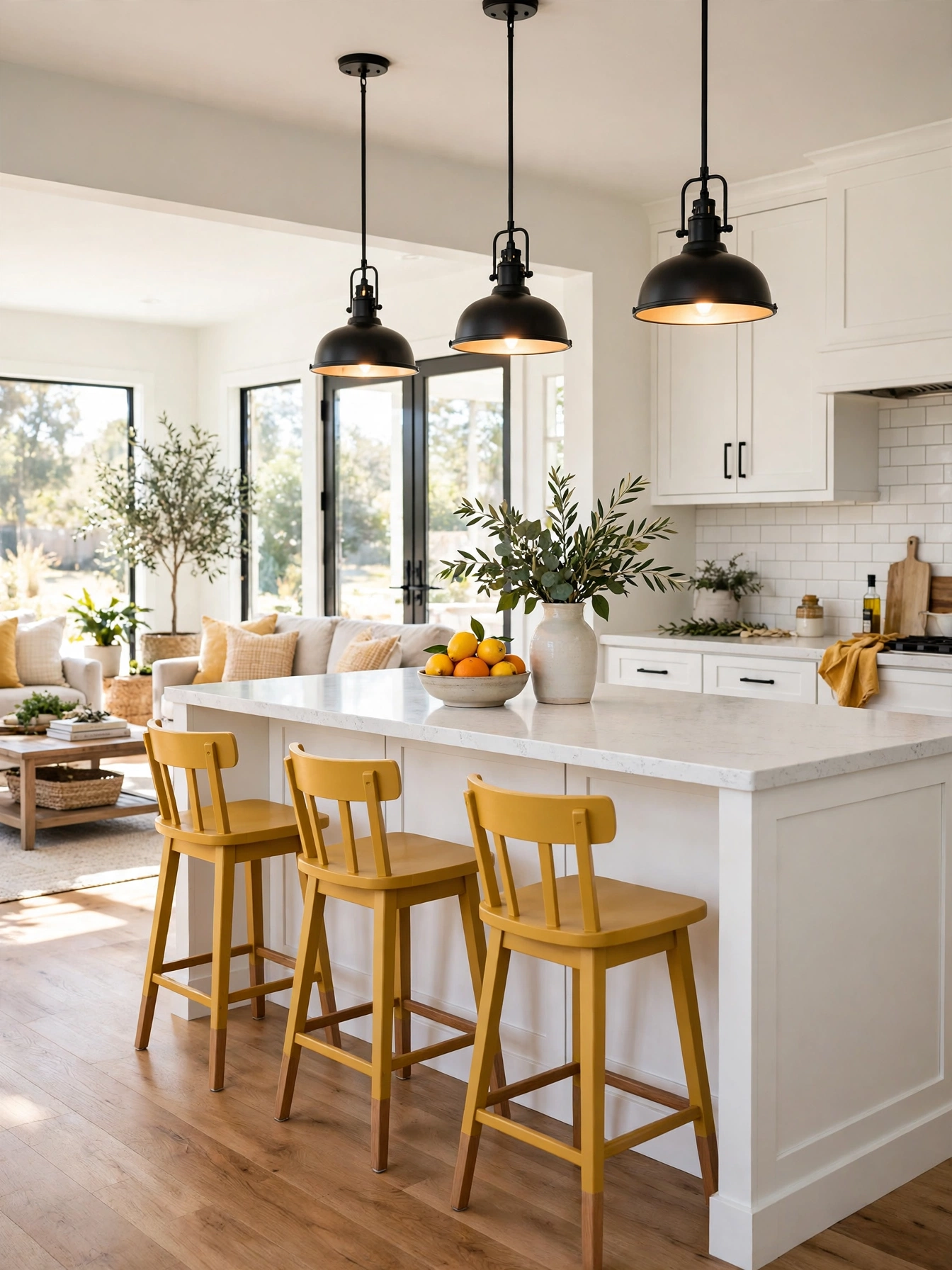
Why This Works:
- Mustard stools add color that moves with the room
- A plain island stops the bright stools from overwhelming the space
- Seated guests get knee room from the 12 inch overhang
- Black pendants give the cheerful stools a clear edge
Furniture carries the color here, so island size decides whether mustard stools work. Three 24 inch seats fill a 72 inch island exactly, and a 96 inch island holds four. The island measures 36 inches wide, with a 12 to 15 inch overhang for knees. Leave 42 to 48 inches clear on every side, the National Kitchen and Bath Association clearance, so the cook can pass behind seated guests. Two pendants over the island hang 30 to 36 inches above the countertop and sit 24 to 30 inches apart.
Wood stools wipe clean after meals with a damp cloth. Three painted wood stools usually land between 150 and 450 dollars for the set, far below the cost of repainting an island. Stools slide fully under the overhang when not in use, so the walkway stays clear for the cook.
Rainbow Tile Border
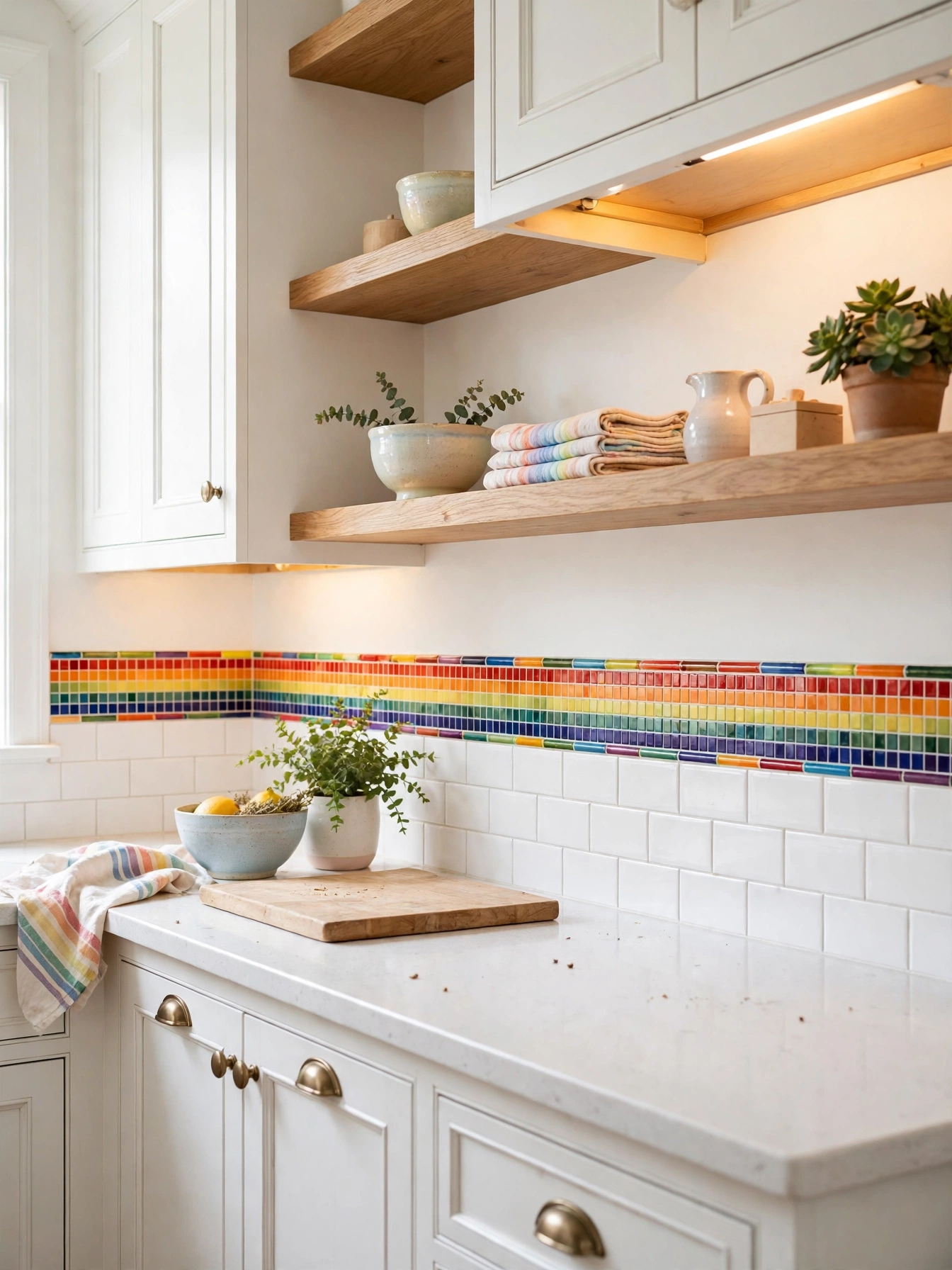
Why This Works:
- A rainbow strip adds every color in one thin line
- White tile above and below keeps the strip from taking over
- The gloss glaze wipes clean after cooking splashes
- One strip changes the room without painting a cabinet
A rainbow border strip works as a single 4 inch band of tile set across the 18 inch backsplash, with white subway tile 3 by 6 inches above and below it. Choose ceramic tile with a gloss glaze, since gloss wipes clean after cooking splashes. A matte tile near the range holds grease, and the strip would need scrubbing after every meal. Set the strip at eye level, about 48 inches from the floor, and the colors form one deliberate line across the backsplash. Grease soaks into unsealed grout near the range, so reseal the strip yearly. A rainbow strip around the whole room repeats the color too often for the eye to rest.
A narrow band keeps the playful note from dating the room, and the white tile around it does the calming work. White subway tile above and below the strip steadies the wall, and the strip alone supplies the lively note. Confine the rainbow to the backsplash, and leave counters and cabinets plain so the colors hold attention.
Plum Accent Wall
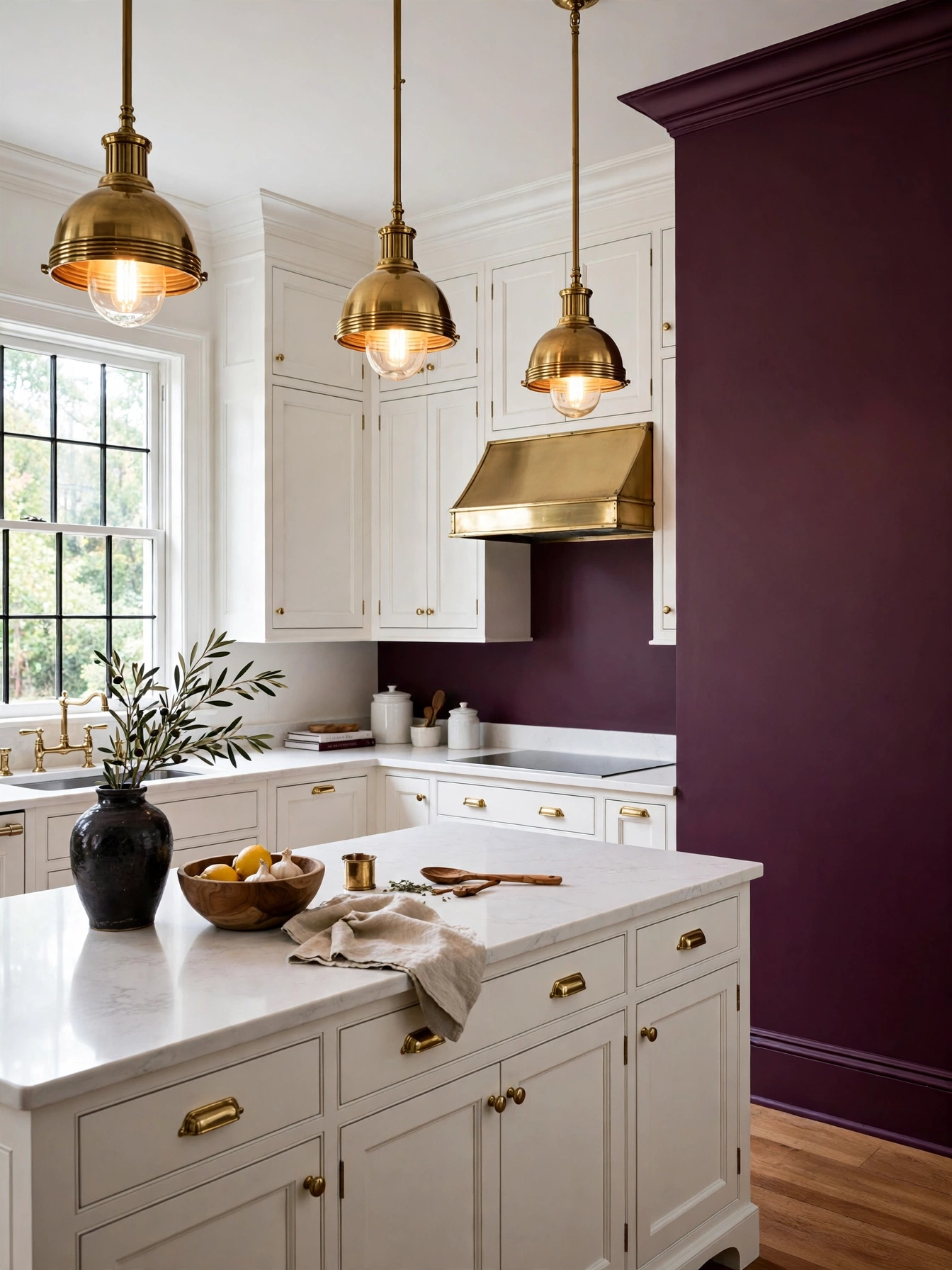
Why This Works:
- Plum adds drama without black
- Warm pendants keep the deep plum inviting after dark
- Pale cabinets frame the dark wall on both sides
- Brass hardware warms up against the deep plum
Pendant lights at 2700K and under-cabinet strips at the same temperature warm the plum and keep its color soft under evening light. Brush the accent wall in washable satin latex over primer, two coats, beside white cabinets with the same soft sheen. Pale oak underfoot bounces light back into the room, and brass hardware warms the dark wall. Plum on a windowless wall with a single ceiling light turns near-black. The room feels small after dark.
The moody wall brings evening drama to a kitchen with a dining table and good lighting. A dark wall shows dust sooner than a mid-tone color, so a weekly wipe with a damp cloth matters. White or cream tile on the backsplash lifts the plum wall, and the white counters keep the dark color in balance.
Mint Green Galley
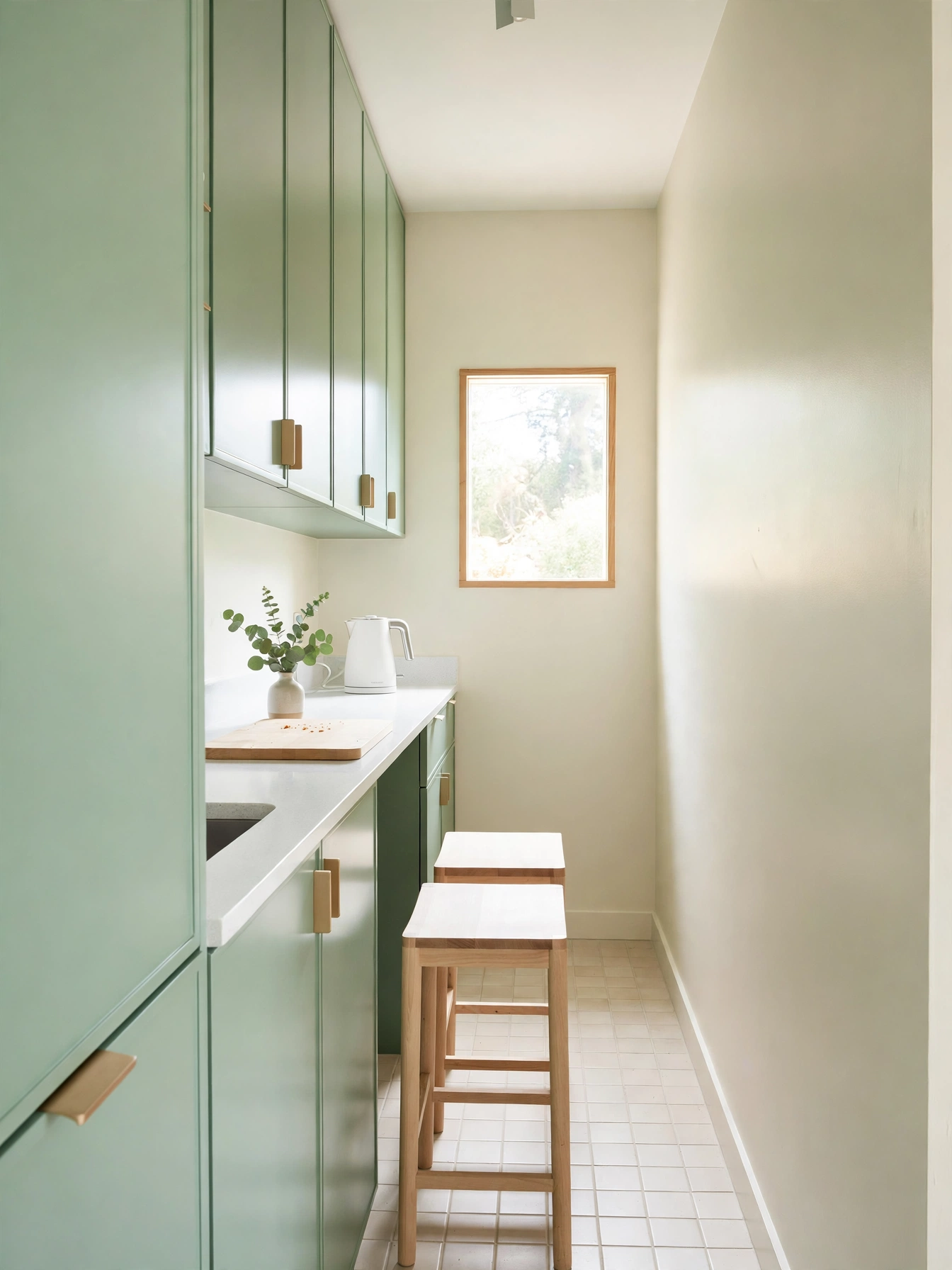
Why This Works:
- Mint green adds color without shrinking the galley
- One mint wall leaves the other side open and bright
- Two slim stools slide out of the way under the counter
- Pale counters bounce light down the narrow room
In a small galley, mint green belongs on one wall only, with the opposite wall kept white or open. A pale mint coat on the cabinet wall sits above a white quartz countertop 36 inches high. One cook passes comfortably when 36 inches separate the counter from the opposite wall. Slim stools 16 inches wide need 24 inches of elbow room each, above a 12 inch overhang. A second mint wall takes the last pale surface away, and the galley reads as a corridor.
One mint wall focuses the galley without a full repaint, and daylight bounces off the pale tone into the far end. Shelves on the white wall leave the galley open and keep the far window in view. A pale floor carries light down the room, and the mint wall glows softly at dusk.
Cherry Red Bar

Why This Works:
- A red bar adds color where guests gather
- Plain cabinets stop the strong red from taking over
- A 12 to 15 inch overhang lets knees slide under the bar
- Black stools frame the cheerful red with a sharp outline
A red bar earns its gathering spot at 72 inches long and 36 inches wide. Pendants set the light: hang them 30 to 36 inches above the countertop and space them 24 to 30 inches apart. Each stool takes 24 inches of width along the bar, with a 12 to 15 inch overhang for knees. Behind the stools, 42 to 48 inches of walkway meet the National Kitchen and Bath Association clearance for a working kitchen. Sixty inches is the minimum length for a red bar to work as a gathering spot.
Breakfast, homework and conversation gather at the bar, and the cook keeps the perimeter counter clear for prep. A soft-sheen finish on the red bar wipes clean after meals with a damp cloth. A 24 inch seat suits the 36 inch counter height, leaving knees clear of the bar front.
Retro Colorful Kitchens
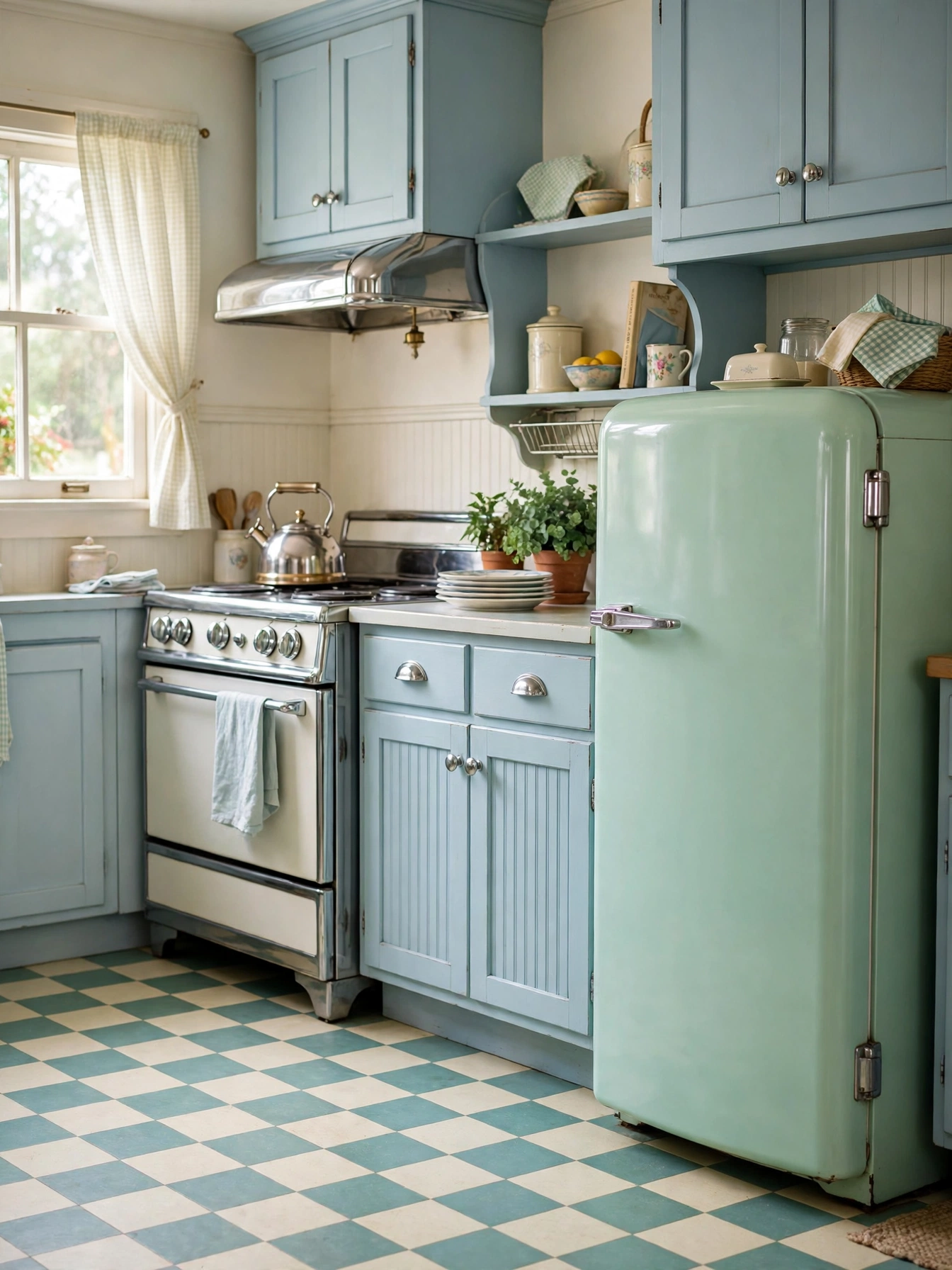
Why This Works:
- Retro color pairs blue cabinets with a mint fridge
- Checkerboard floors add pattern under the pastel palette
- Chrome hardware matches the vintage appliances
- Pastel tones keep the retro look soft rather than loud
A soft, slightly gray blue gives retro cabinets their aged-in-a-good-way feel, and the gray undertone keeps the blue soft under warm lamplight. Brush maple or wood doors in a soft sheen and pair them with a mint enamel refrigerator 36 inches wide, which needs a 38 inch opening to slide in. Use chrome knobs 1.25 inches in diameter, and order the range in cream to match the pastel palette. Cabinet doors should measure 3/4 inch thick, with hinges that close softly, so the vintage look still works smoothly. A bright royal blue sits wrong beside pastel mint, and the retro room loses its soft edge.
Pastel blue and mint suit a small kitchen with wood floors, and the pairing keeps its playful mood all day. Checkerboard vinyl tile wipes clean and asks little upkeep beyond a weekly mop. White quartz suits the retro room, since it wipes clean with a damp cloth and never needs sealing.
Navy And Sunshine
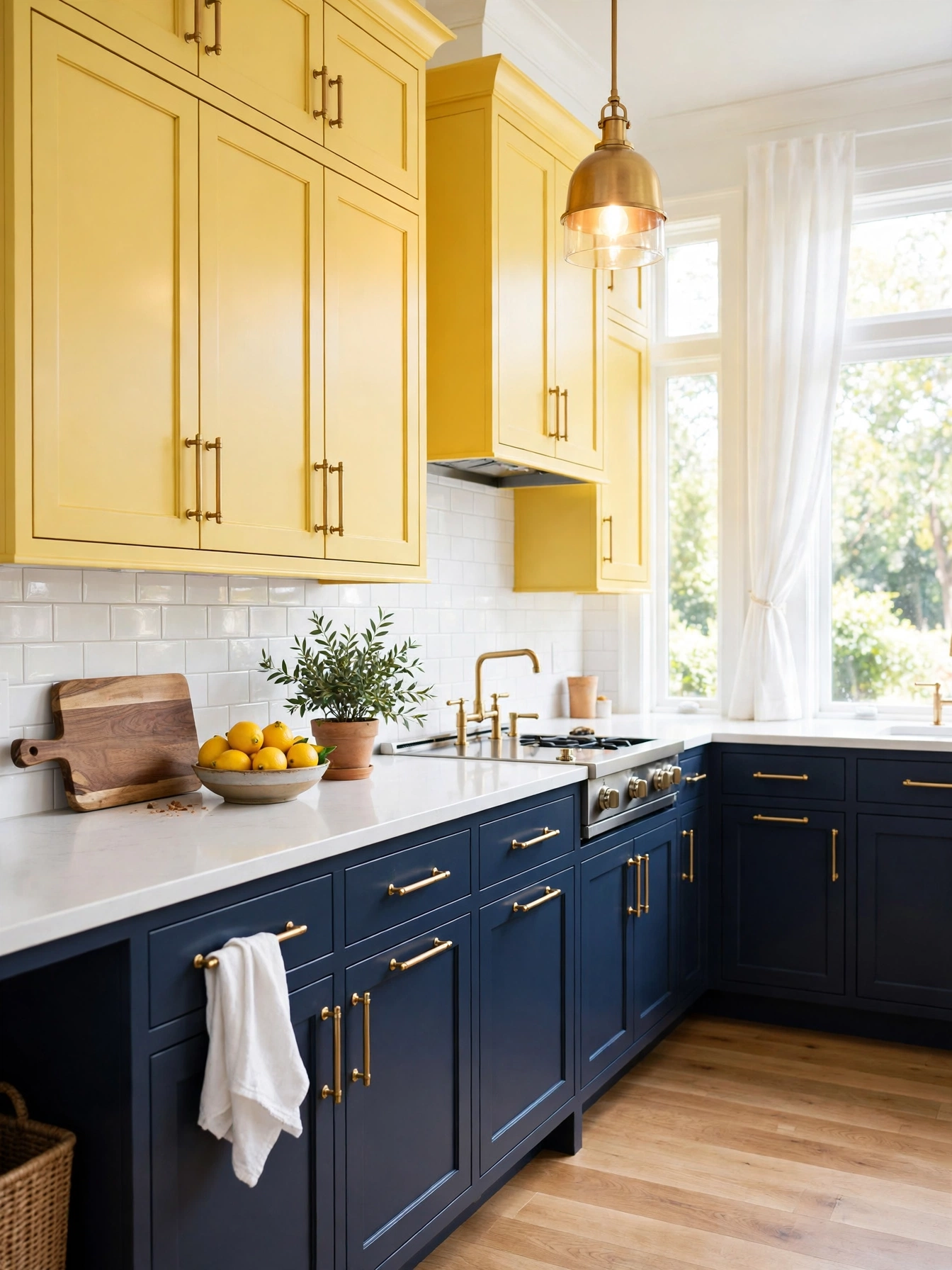
Why This Works:
- Navy and yellow balance dark and bright in one room
- Navy base cabinets take everyday kicks without showing marks
- Yellow uppers keep the ceiling line sunny
- Pale counters hold the two strong colors in balance
Marigold is the yellow that holds its warmth beside navy below, keeping the upper run sunny even on a gray morning. The same soft sheen and primer on lowers and uppers keeps the finish even across the room. White counters and backsplash keep the two colors as the focus, and the navy island grounds the floor. Set uppers with an 18 inch gap above the 36 inch countertop, the clearance the National Kitchen and Bath Association recommends. Lemon highlighter yellow beside navy looks harsh under bright lights, so marigold stays the safer yellow here.
Navy on lowers only, with yellow above, commits half the room to dark color, and the yellow keeps the lowers from feeling heavy. Houzz notes that two-tone kitchens remain popular because the split adds depth without a second color family. Matching hardware across both tones, 5 inch pulls on drawers and knobs on doors, keeps the split looking planned.
Peach Breakfast Nook
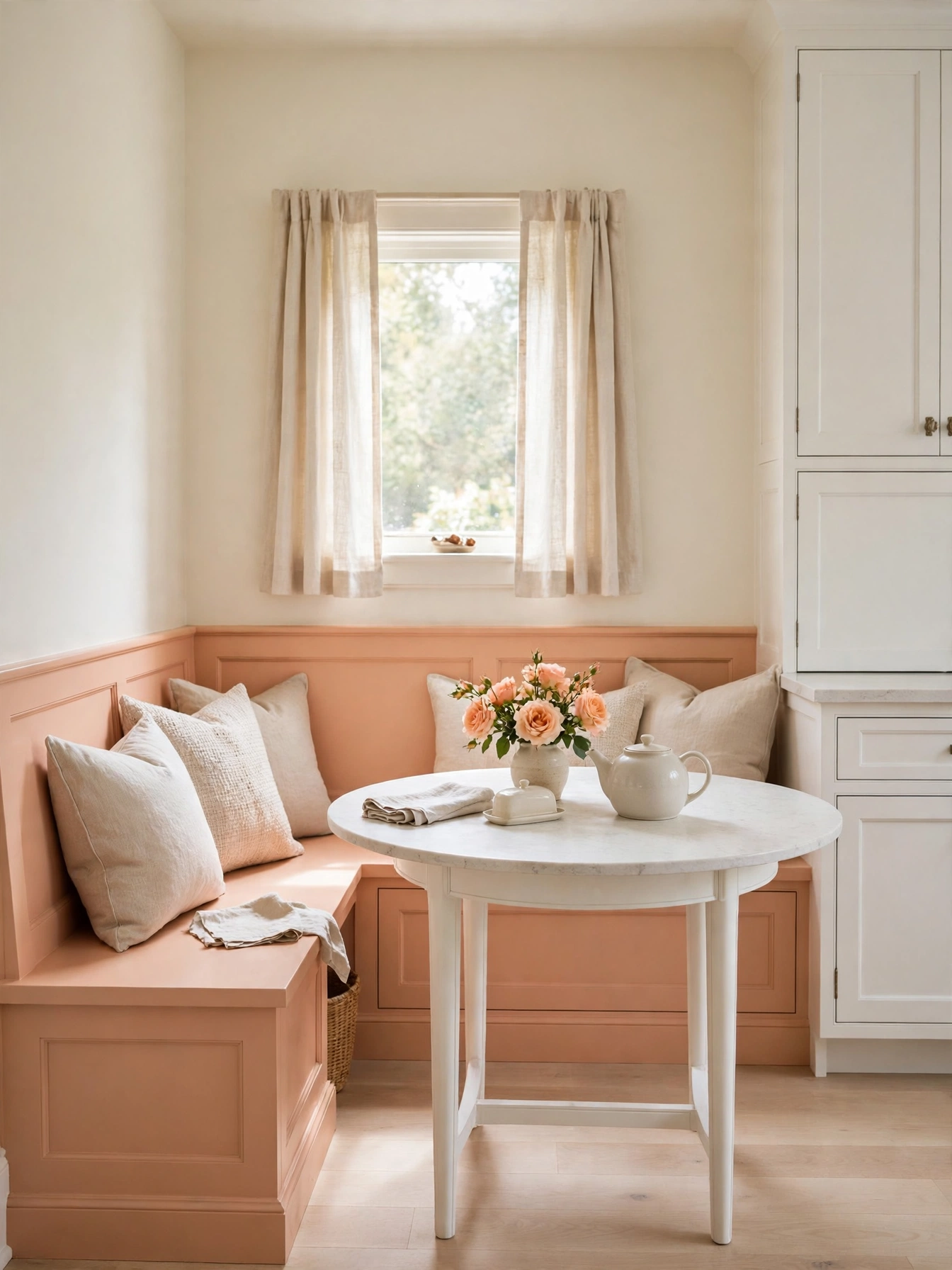
Why This Works:
- Peach benches add a soft color to the eating corner
- Built-in benches save floor space beside the table
- Linen cushions soften the painted wood
- A round table keeps the small nook easy to move around
Peach built-in benches work when each bench measures 18 inches deep and 18 inches high, with a 36 inch round table between them and 24 inches of elbow room per seat. Build the benches from maple plywood 3/4 inch thick, so spills wipe off the seats after meals. Keep the tabletop white quartz 1 inch thick, and leave 36 inches of walkway behind the outer bench for passing. A deep peach on the benches goes orange under warm lamplight, and the nook loses its soft color.
The nook becomes the morning spot for coffee and toast, and the built-ins add storage under the seats for placemats and linens. Cushions in washable linen covers ask for a weekly wash in the machine. Cream walls give the peach a soft frame, and plain linen curtains let the peach stay the only color in the nook.
Green Marble Counters
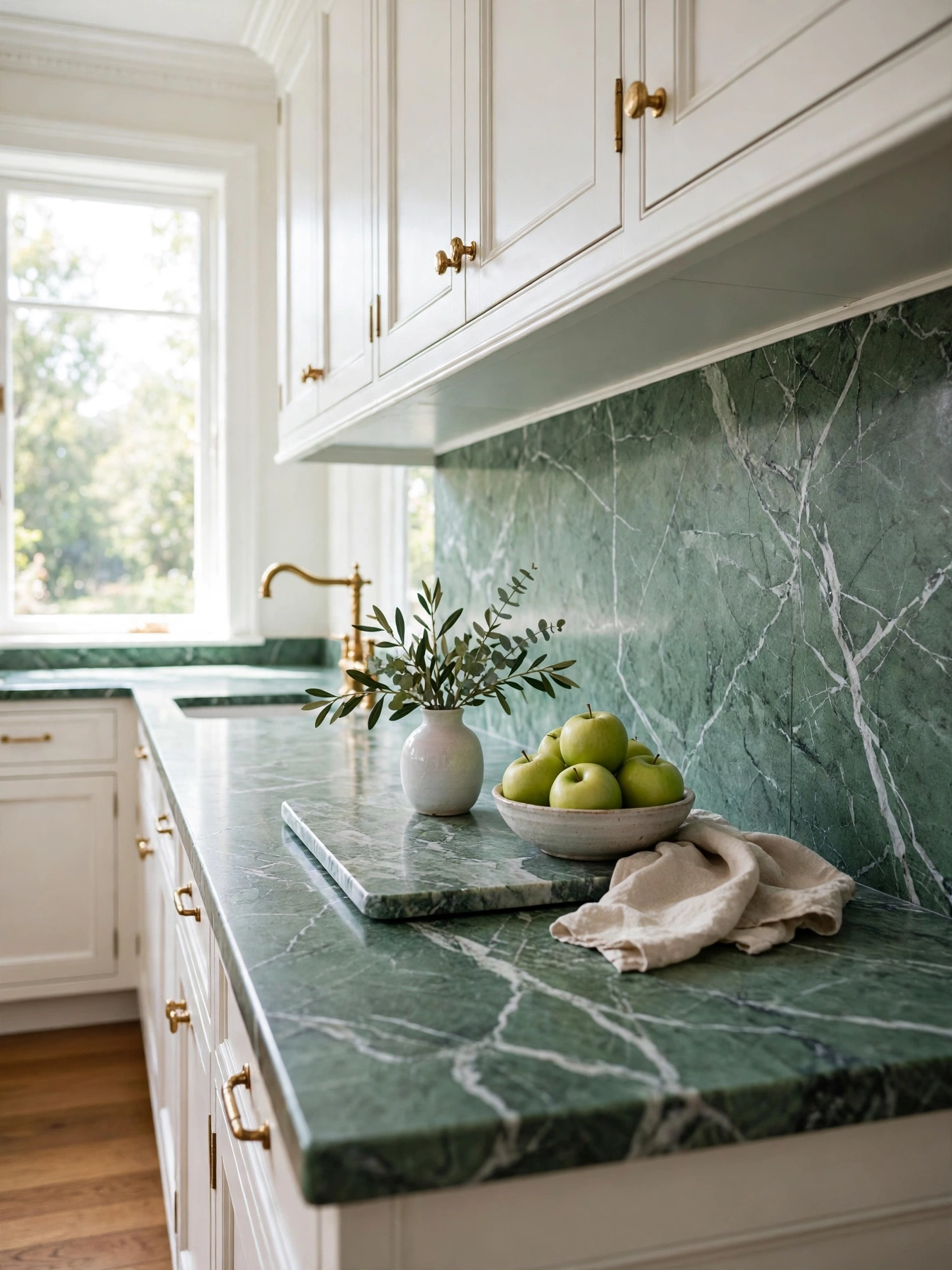
Why This Works:
- Green marble brings color through stone, not paint
- White veins connect the stone to the white cabinets
- A marble backsplash leaves no grout line where it meets the counter
- Warm metal softens the cool stone and white pairing
Lemon juice or vinegar left sitting for more than a few minutes will etch marble, so a sealer plan comes first when green marble tops white cabinets. Choose a marble slab 3 centimeters thick for the countertop, with a 4 inch backsplash or a full-height slab behind the range. White cabinets with a soft sheen let the green veins stand out without fighting a painted base. Pale green cabinets beside green marble blur into one green, and the stone loses its edge.
Every real marble slab carries veining no factory copy can match, and the green stays calm against white cabinets. Seal green marble every 6 months, and wipe spills at once before they soak in. A wooden cutting board protects the marble from knife marks, and citrus stays off the surface until the sealer has cured.
Confetti Pattern Floors
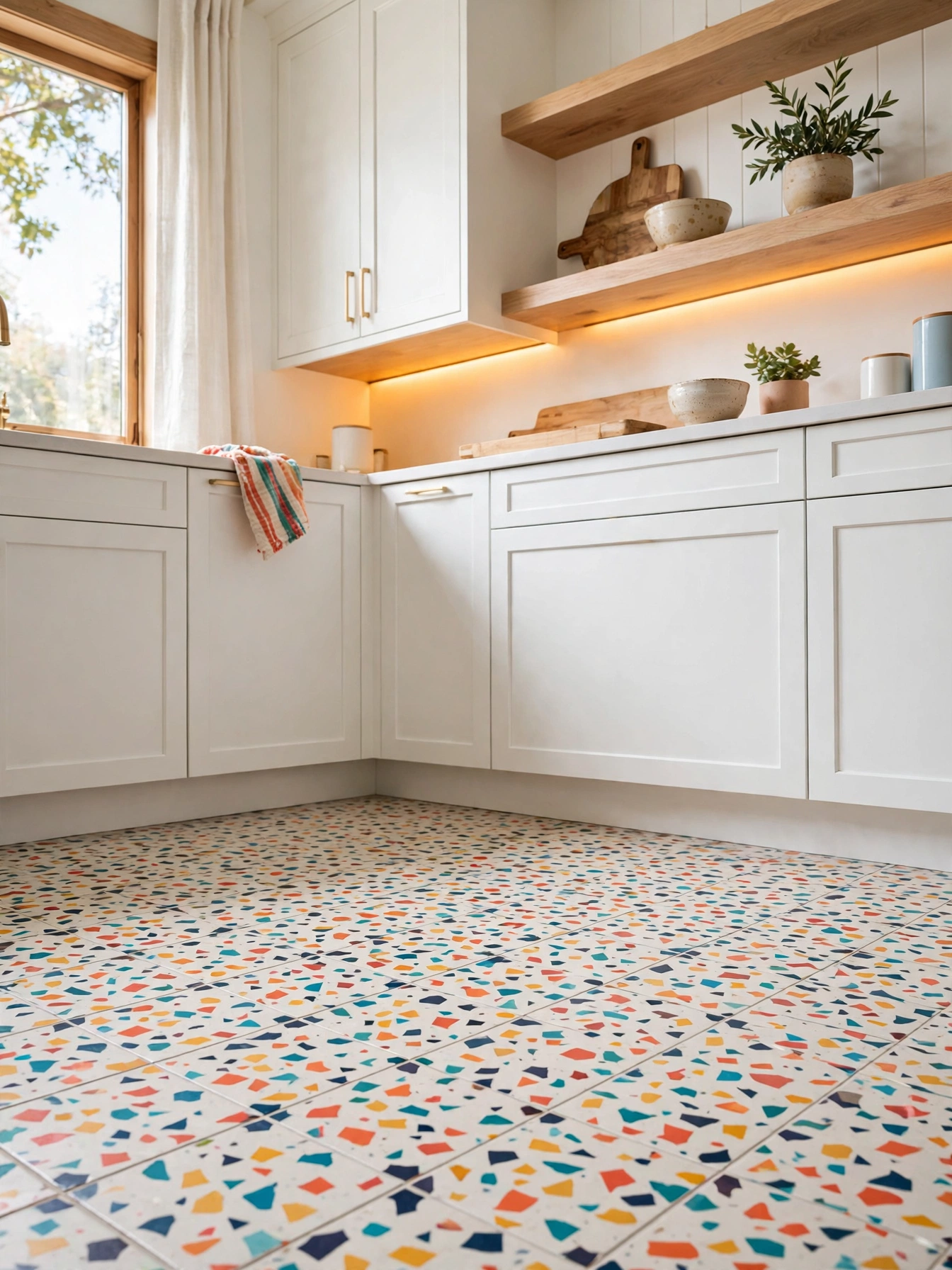
Why This Works:
- Confetti floors put the color underfoot, not on the walls
- Pale cabinets stop the patterned floor from overwhelming the room
- Encaustic tile hides crumbs and small marks well
- One patterned surface leaves the rest of the room calm
Confetti encaustic tile in an 8 by 8 inch size sets the floor pattern, with each tile carrying specks of coral, teal, yellow and navy on a cream base. Lay the tile on a level subfloor, with grout lines 1/8 inch wide, and seal the floor with a penetrating sealer before grouting, since encaustic tile absorbs stains fast. White cabinets with a soft sheen and a white quartz countertop leave the floor as the single pattern in the room. A patterned backsplash above a confetti floor makes two patterns compete, and the room turns restless.
Color underfoot never needs repainting, and the busy pattern hides daily crumbs better than a plain floor. True encaustic tile absorbs stains fast without a penetrating sealer, so seal the floor before grouting. From the doorway, the speckled floor draws the eye first, and the white cabinets above it remain plain.
FAQs
Are colorful kitchens hard to keep clean?
Colorful kitchens stay easy to keep clean when the finish is right, since satin or semi-gloss paint wipes down with a damp cloth after cooking. The National Kitchen and Bath Association recommends washable finishes near the range, and a 2 minute wipe of lower cabinets keeps marks from building up.
What paint finish lasts best on colorful kitchen cabinets?
Ask for a washable acrylic enamel in satin or semi-gloss, the finish for doors touched daily. A stain-blocking primer underneath stops old color showing through, and the sheen lets a damp cloth lift grease. Allow 2 days of drying before rehanging doors, and handle them gently for the first week.
How do I pick a color that will not date fast?
Pick a mid-tone color with a clear undertone, and test it on a door at 7 AM and 7 PM. A 2 foot by 2 foot board shows how the color shifts under daylight and lamplight, and a shade that reads well at both times stays fresh for 5 years.
How much color is too much in colorful kitchens?
One or two strong colors plus white keeps the room balanced, while a third strong color tips the palette into clutter. The Spruce notes that a 60-30-10 split works well, with 60 percent dominant, 30 percent secondary and 10 percent accent, so the color stays lively without overwhelming the room.
Which color works best in a small kitchen?
A pale shade on one wall suits a small kitchen best, since light tones bounce daylight around a tight room. Keep counters white, limit the color to under 30 percent of the cabinetry, and test the shade at 7 AM and 7 PM before painting.
Conclusion
Colorful kitchens come alive when the color lands in one confident place, whether that is a green island, a coral wall or a set of mustard stools. Start by painting one full door or one test board in the shade you like, checking it in morning and evening light, then commit to the finish and hardware that fit how the household cooks. Keep the palette to two strong colors plus white, and let brass or black hardware give the color its edge. Follow HomelyCrafter on Pinterest for more ideas. Save this to your Pinterest boards so you can refer back to it!

Muhammad Israr is a home decor enthusiast and the writer behind Homely Crafter. He spends his days researching paint colors, layouts and budget-friendly styling ideas, then breaks them down into practical, easy-to-follow guides so you can decorate with confidence.