
A house exterior gets judged from a moving car in about five seconds, and in December that whole judgment happens after dark. That is why the lights on the outside of a house carry more weight than almost any indoor decoration: neighbors, guests, and delivery drivers all see them before they see anything else. This guide covers 21 christmas lights on house ideas with exact measurements, materials, safety rules, and honest costs, so you can pick a display that fits your roof, your budget, and your patience for ladders.
You will find rooflines, trees, pathways, porches, and smart controls in the sections below, each with a clear plan for hanging, power, and takedown. Every idea names the strand length, clip type, and outlet setup it needs, plus the one mistake most often made with it. Read the safety notes before you climb: outdoor rated strands, a GFCI protected outlet, and a timer are the three items no display should skip.
Roofline Christmas Lights on House Ideas
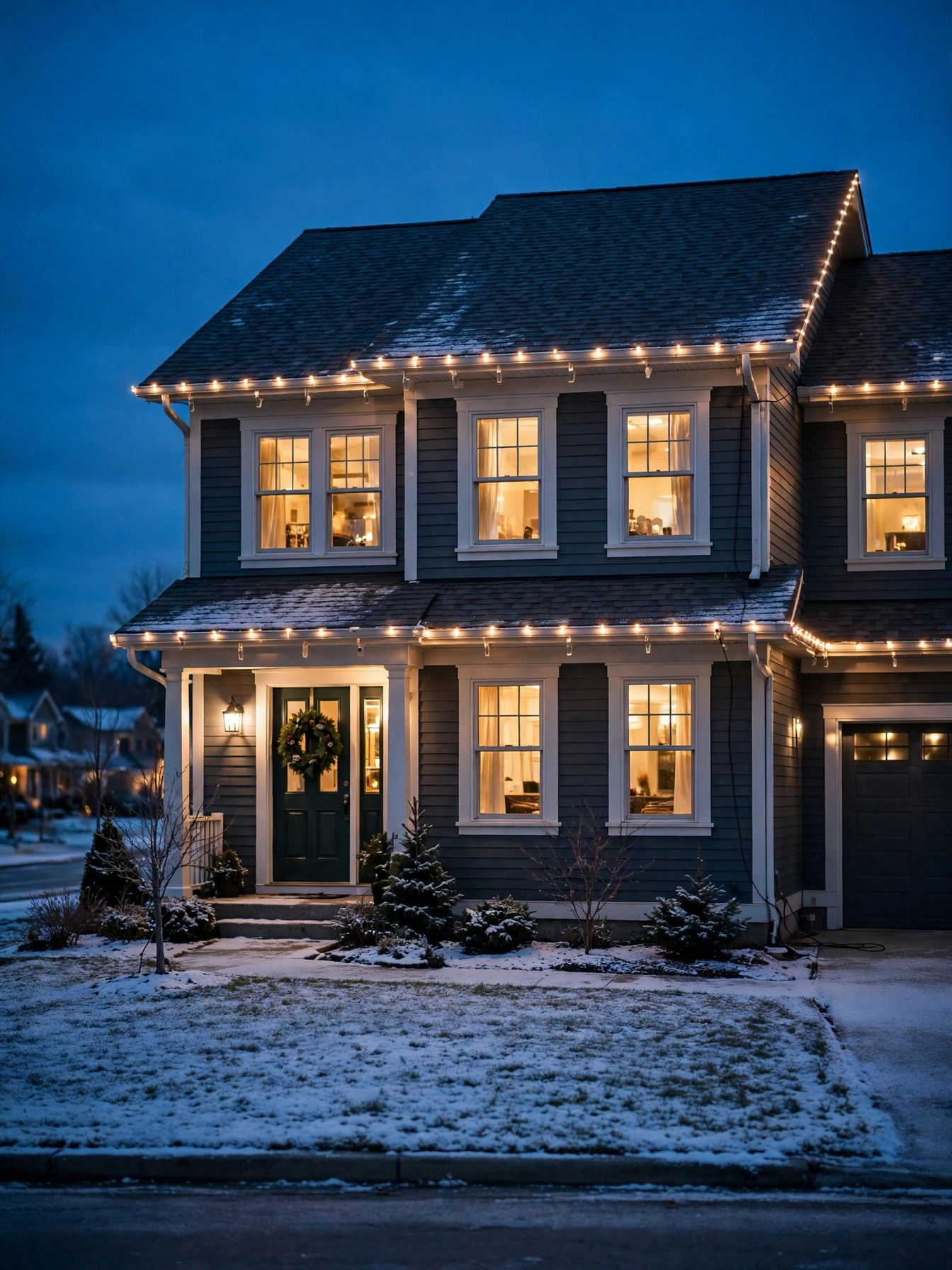
Why This Works:
- The roofline is the largest visible outline of the house, so one strand run defines the whole display.
- Warm white reads as classic from the street and suits brick, siding, and stone alike.
- Gutter clips install without holes, so the roof and gutters stay undamaged.
- A single timer can run the entire outline, which keeps nightly use simple.
A standard front roofline of 40 to 60 feet needs two to three 25 foot strands of C9 or mini LED lights, joined end to end within the manufacturer’s limit of three connected strands. Space plastic gutter clips every 12 inches so the line stays straight and does not sag between attachment points. Hang the strand 2 to 3 inches below the gutter lip so water still drains and ice cannot trap the wire. Avoid staples or nails, because a punctured wire jacket is the most common cause of a dead section mid season, and a staple through a live wire is a shock risk. LED strands beat incandescent here: they run cool enough to touch, draw a fraction of the power, and a 25 foot LED strand typically uses under 10 watts.
Almost any single or two story house can carry this layout, and it works best when the rest of the yard stays quiet so the outline does the talking. Height is the real constraint here: a two story peak needs a 24 foot extension ladder and a second person footing it, and wet or icy roofs should end the job for the day. If your only outdoor outlet is not GFCI protected, hire an electrician to fit one before you plug anything in, since outdoor receptacles must have ground fault protection under electrical code. Budget runs 30 to 60 dollars for clips and strands, mid range 80 to 150 dollars for commercial grade C9 LEDs, and premium pro installed rooflines start near 300 dollars.
Icicle Gutter Lights
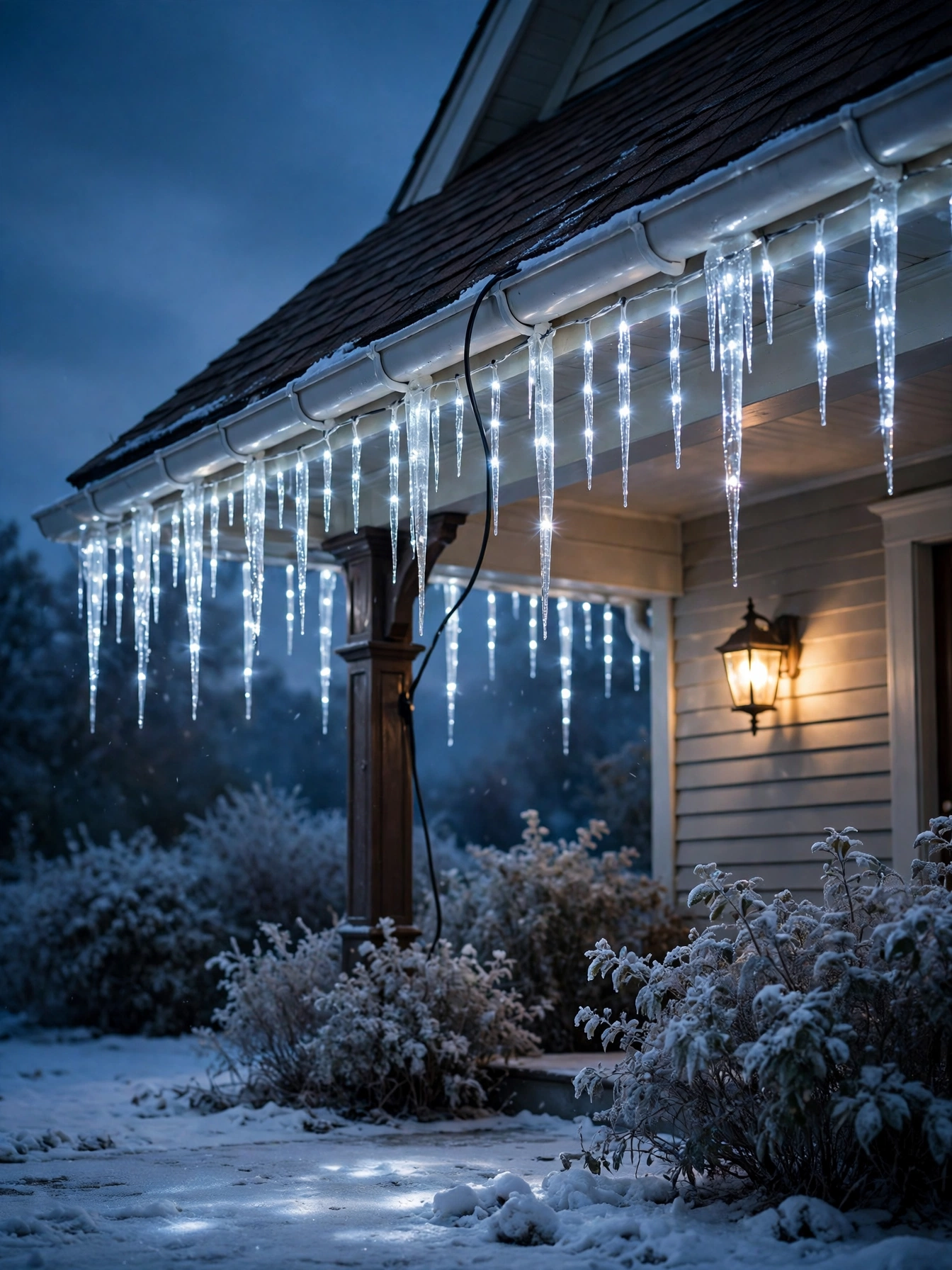
Why This Works:
- Hanging drops add depth that a flat roofline strand cannot give.
- Varied drop lengths of 6, 12, and 18 inches look natural instead of uniform.
- Cool white suits snow and reads clearly from across the street.
- One strand type covers gutters, porch eaves, and garage trim alike.
A 25 foot icicle strand usually carries 100 to 150 drops and covers the same length of gutter, so a 50 foot front eave needs two strands. Clip every 12 inches with gutter hooks rated for the strand weight, and keep the longest drops at least 7 feet above any walkway so no one brushes a lit drop. The drops themselves draw little power, but icicle strands tangle badly in storage, which is why winding each strand around a flat piece of cardboard at takedown saves an hour next year. Icicles give more sparkle per foot than a straight mini light run, but they show gaps sooner if one drop section fails, so check each strand lit before hanging.
Shorter eaves and porches are the best fit, because long unbroken icicle runs can look heavy on a small house. The trade off is wind: drops swing and can snag on gutter guards, so in exposed locations choose shorter 6 to 12 inch drops rather than 18 inch ones. A lighted gutter display pairs naturally with broader Outdoor Christmas Lights Ideas for the rest of the yard.
Smart Roofline Strips
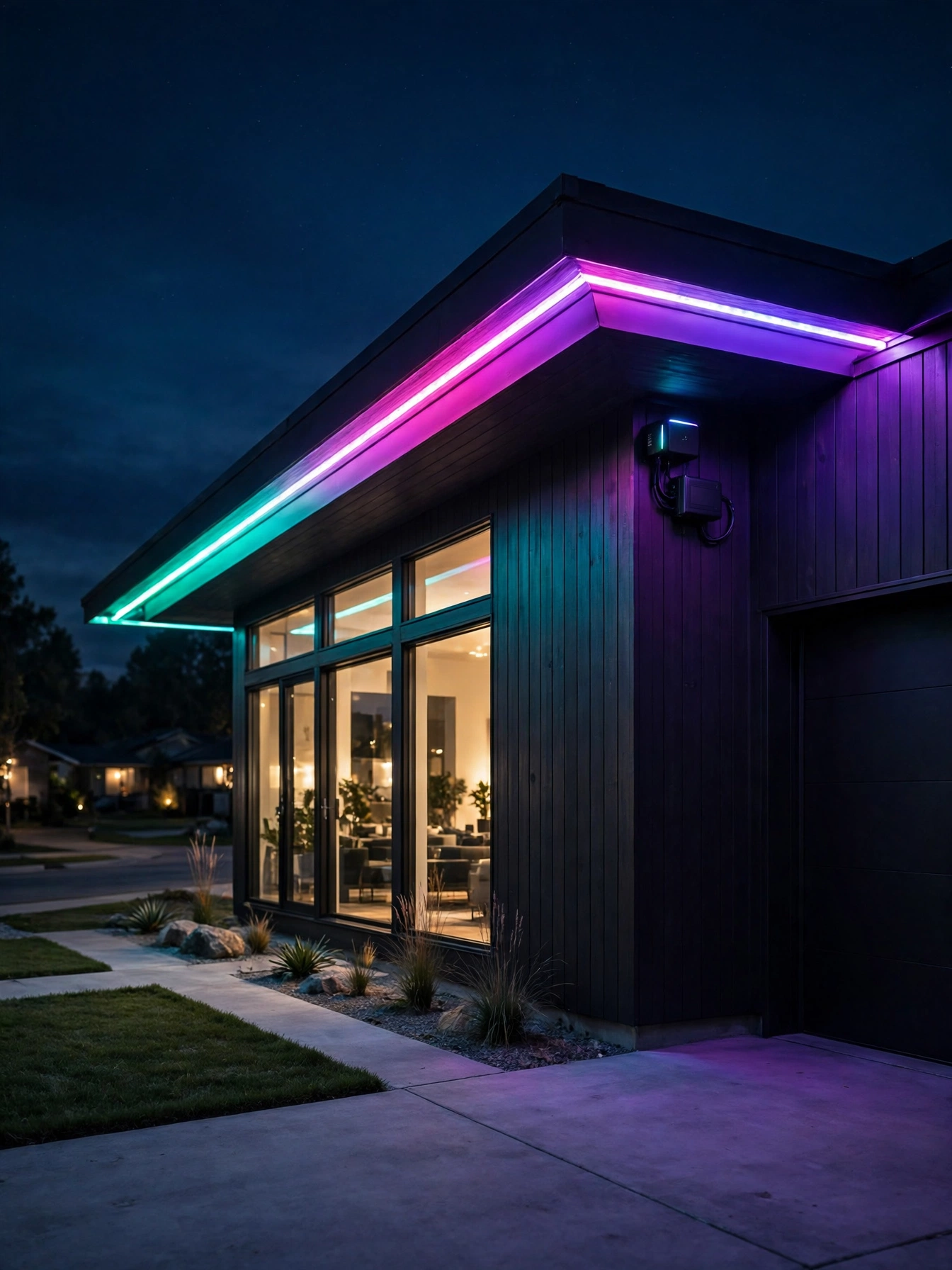
Why This Works:
- One permanent strip replaces yearly ladder work once it is mounted.
- App control changes colors for Christmas, New Year, and everyday evenings.
- Aluminum channels protect the strip and give a straight, finished line.
- Dimming lets the same display run soft on weeknights and bright on weekends.
Permanent smart strips are usually sold in 50 or 100 foot kits with a 24 volt low voltage power supply, and the strip mounts inside a slim aluminum channel screwed under the eave every 24 inches. Measure the full roofline twice, then order 10 percent extra for corners and peaks, since cutting a strip at the wrong point wastes a whole segment. The power supply must sit in a weatherproof box rated IP65 or better, and the low voltage cable run from supply to strip should stay under 16 feet to avoid dimming at the far end. Smart strips cost more up front than seasonal C9 strands, at 150 to 400 dollars for a typical front eave, but they stay up year round and need no reinstall each December.
Homeowners comfortable with a phone app and a one time install will like this option, and it is the best choice when ladders are a problem. Repairs are the weak point: a failed segment mid strip is harder to swap than a single seasonal strand, so buy from a maker that sells replacement segments. The strip itself is low voltage, but the power supply still plugs into a GFCI protected outdoor outlet.
Net Lights on Shrubs
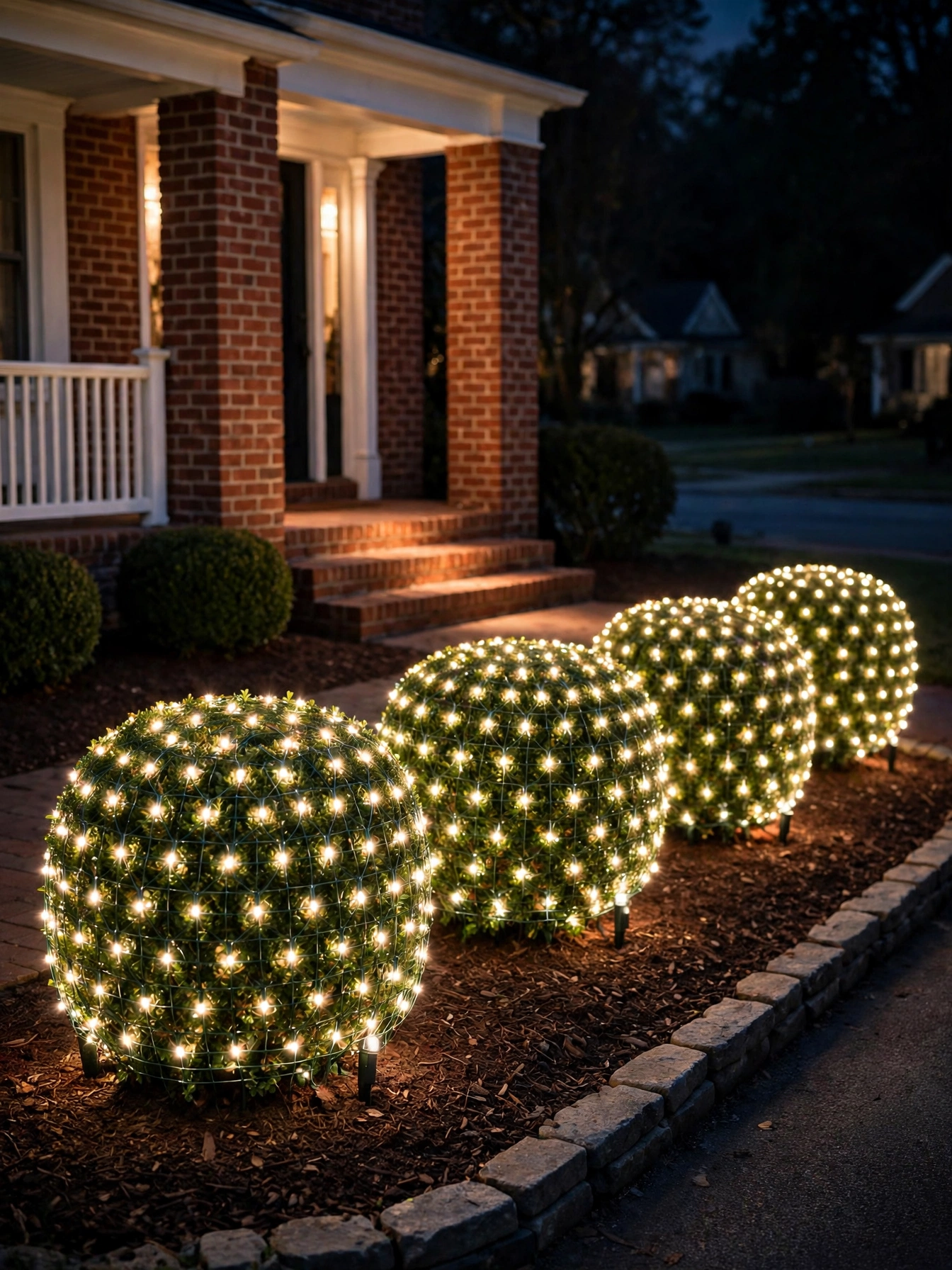
Why This Works:
- A net panel covers a whole shrub in under two minutes with no wrapping skill.
- Even spacing of bulbs avoids the bare patches that wrapped strands leave.
- Green wire disappears into foliage during the day.
- Panels connect end to end, so a row of shrubs lights as one run.
A 4 by 6 foot net panel fits most boxwood and holly shrubs up to 3 feet tall, and a 6 by 4 foot panel suits wider yews. Drape the panel over the top, pull the corners down evenly, and pin the bottom edge with two landscape stakes so wind cannot lift it. Count shrubs before buying: a typical front bed of five shrubs needs five panels, and joining more than three panels end to end risks dimming at the far end, so split long beds across two outlet runs. Nets give a fuller look in a tenth of the time a wrapped strand takes, but they fit poorly on irregular or very tall shrubs, where wrapping a strand by hand still wins.
Nets suit tidy, rounded foundation shrubs best. Shape is what limits this one: on a sparse or leggy shrub the net shows its grid, so prune lightly in autumn or choose a denser plant for the display. Net panels run 12 to 25 dollars each, and a full bed usually totals 60 to 125 dollars.
Pathway Stake Lights
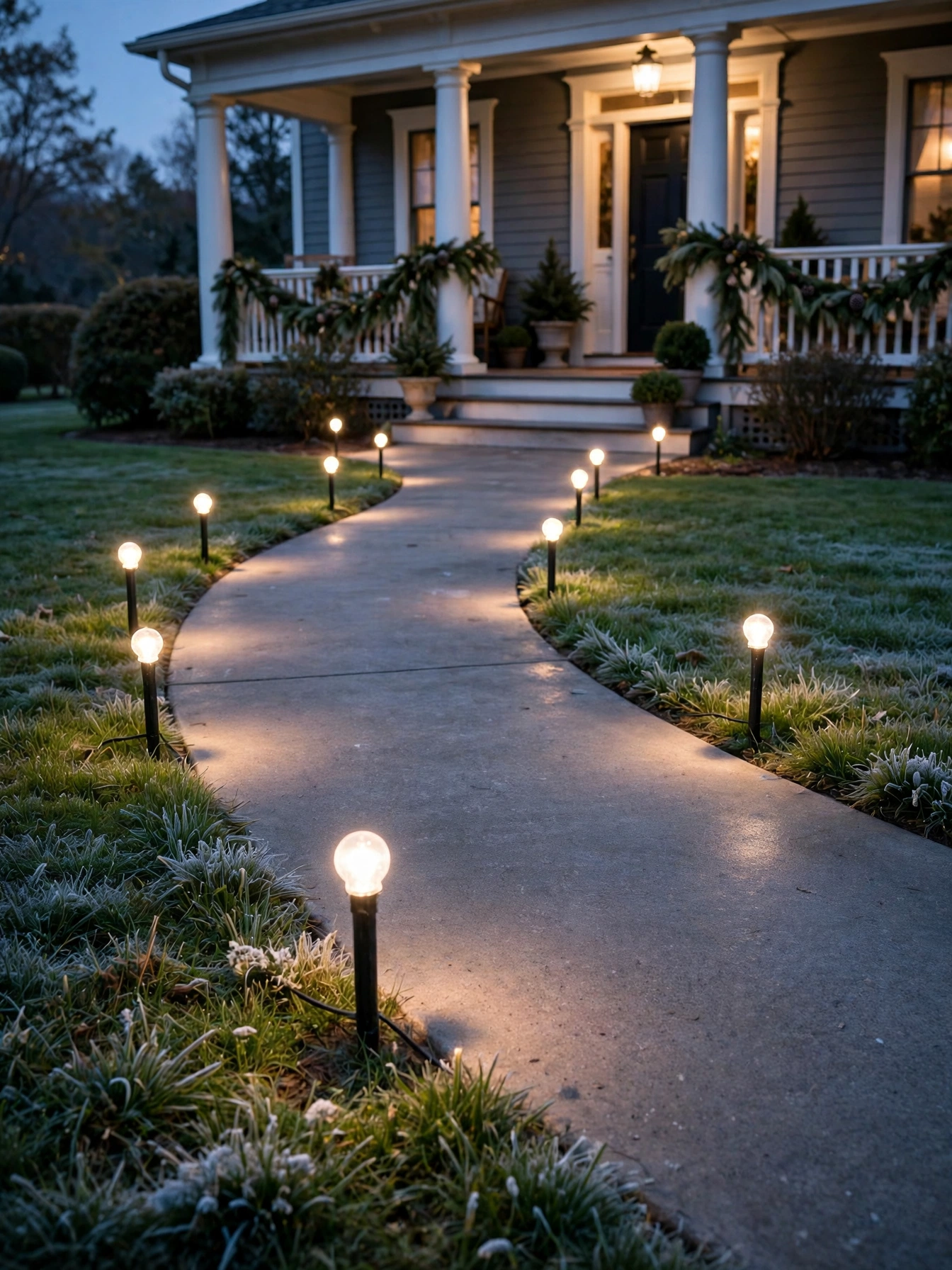
Why This Works:
- Lit edges guide guests safely to the door on dark December evenings.
- Low stakes keep light at ankle level, so the house display stays the star.
- A 10 light path kit covers most front walks with one plug.
- Stakes pull out in January with no trace left in the lawn.
A standard 10 light stake kit spans about 30 feet when lights sit 3 feet apart, which fits most front walks; longer walks need a second kit on a separate timer channel. Push stakes 4 inches into soil, never into frozen ground, and keep each globe 6 inches back from the path edge so snow shovels and boots miss them. The low voltage transformer should be rated for the total wattage plus 20 percent headroom, and the cable should run under mulch or a shallow 2 inch trench, not across the walk. Plug in kits stay bright through cloudy weeks where solar stakes fade, but they need an outlet within 25 feet of the path.
Any house with a defined front walk can use this idea, and it is one of the cheapest ways to make a display feel finished. Snow is the enemy of low globes: plowed or shoveled piles can bury them, so in heavy snow areas choose 18 inch tall stakes instead of 12 inch ones. Path kits run 25 to 60 dollars.
Wrapped Yard Trees
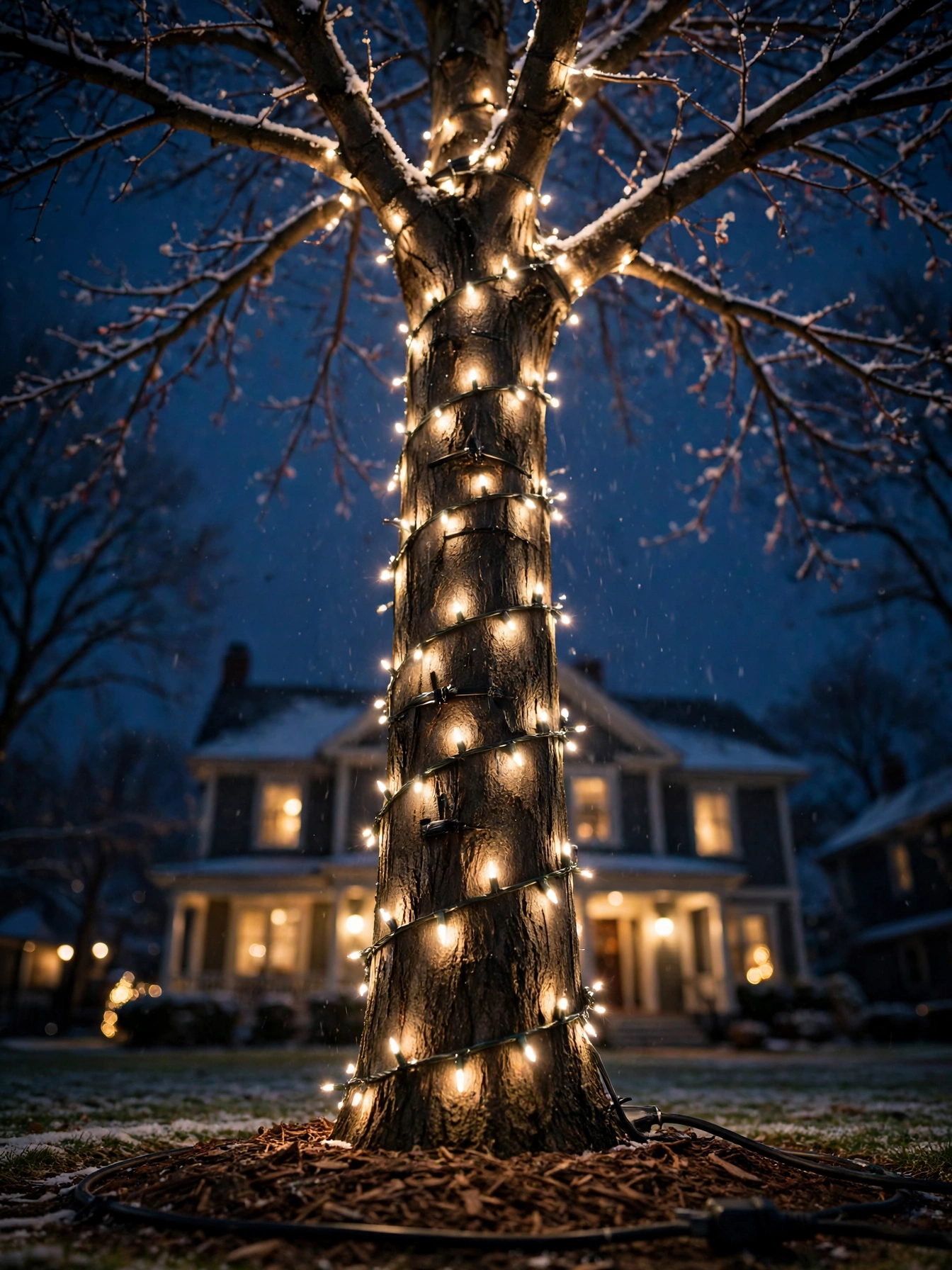
Why This Works:
- A wrapped trunk turns a bare winter tree into the yard’s centerpiece.
- Spiral spacing of 4 to 6 inches gives full coverage without wasting strands.
- Trunk wraps read clearly from the street even without branch lights.
- The same method works on birch, maple, and ornamental cherry trunks.
A trunk 12 inches in diameter and 8 feet tall needs about 100 feet of mini lights, roughly two 50 foot strands, wrapped with 4 inch spacing between spirals. Start at the base, work upward, and tie the strand to the trunk every 12 inches with a loose zip tie so bark is not cut as the tree moves in wind. Stop at the first major branch split unless you have a tall ladder and a helper, since branch work doubles the time and the risk. Trunk wrapping uses fewer lights than netting a whole canopy and looks intentional, but it leaves the upper tree dark, so pair it with one lit feature closer to the house.
Front yards with one strong specimen tree near the street are the natural home for this one. Young bark needs a gentle hand: tight wraps on thin barked trees like young maple can damage the cambium, so keep ties loose and remove lights by late January. Two strands and ties run 30 to 70 dollars.
Window Frame Outlines
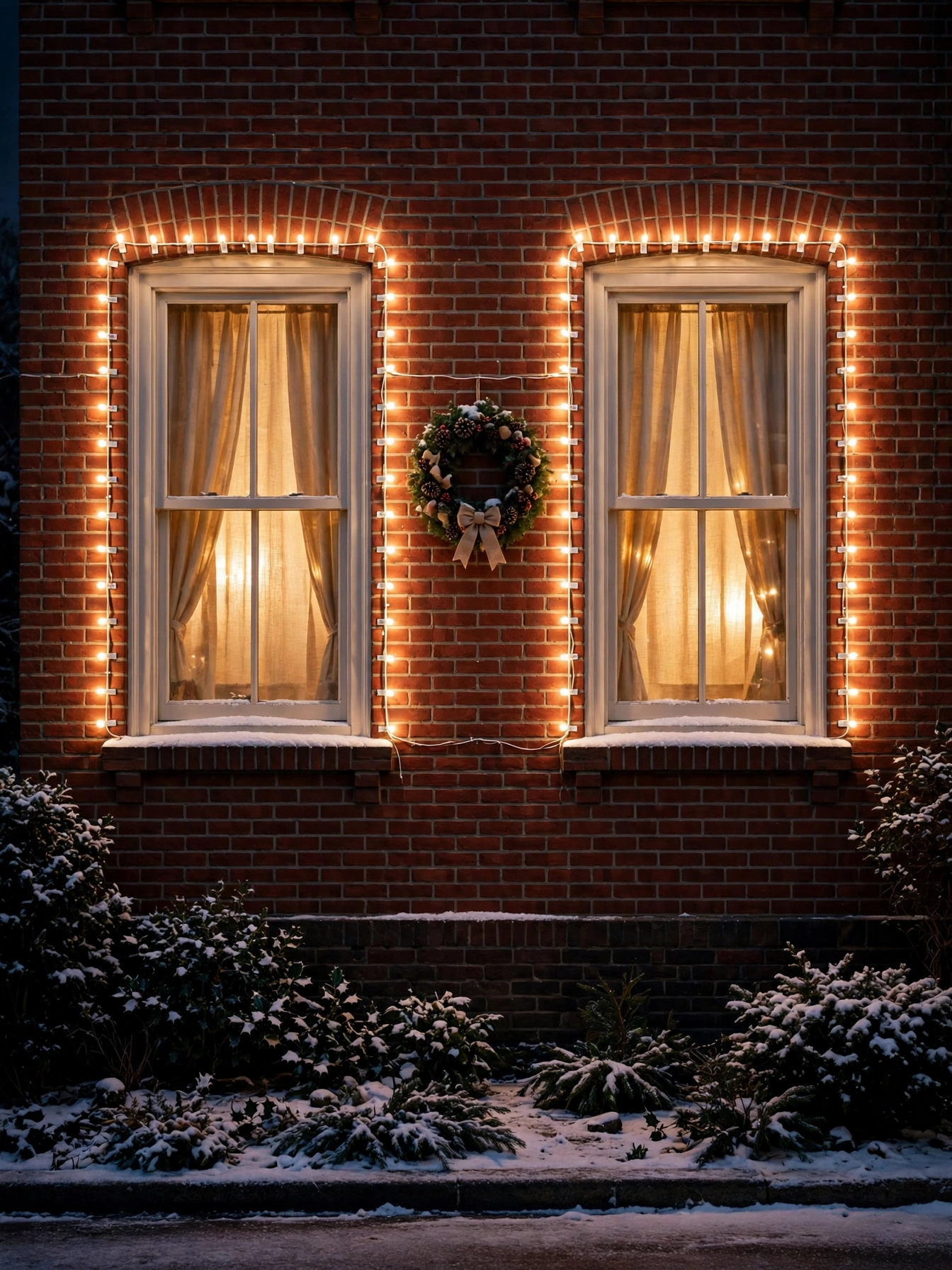
Why This Works:
- Outlined windows make the facade look finished even with no other decor.
- Rectangles echo the house architecture instead of fighting it.
- Small clips stick to trim without holes or paint damage.
- Each window runs on one short strand, so a dead section is easy to replace.
A standard 36 by 60 inch window needs about 16 feet of mini lights, so one 25 foot strand outlines a window with slack for the plug run. Use adhesive clips rated for outdoor use, placed every 8 inches, and press them onto clean, dry trim a full day before hanging so the bond sets in cool air. Keep the strand flat against the trim and avoid crossing the glass, because lights on glass glare inward at night. Window outlines cost less and install faster than a full facade wash, but they need matching color temperature across windows or one window will look yellow next to a white one.
Brick, siding, and stucco facades with clear front windows all take well to this idea. Upper story windows rarely justify the ladder work for such a small visual gain, so most displays outline ground floor windows only. Window outlines pair well with Christmas Window Decor Ideas for the glass itself.
Porch Column Wraps
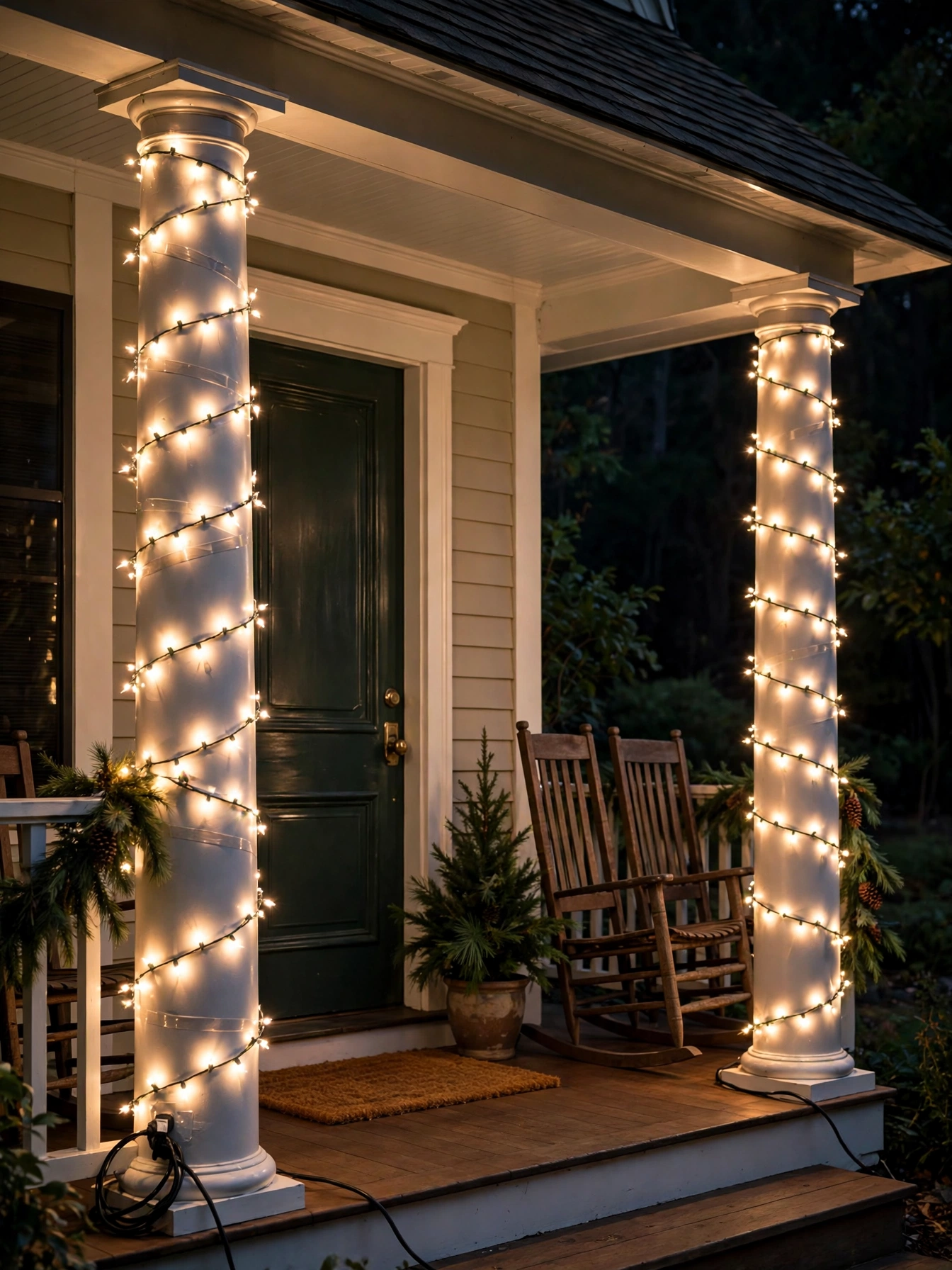
Why This Works:
- Wrapped columns frame the front door and pull the eye to the entrance.
- Spirals look neat from every angle, unlike flat strands on a round surface.
- Columns are reachable from the porch floor, so no ladder is needed.
- The same wrap works on round, square, and tapered columns.
A column 8 feet tall and 10 inches across needs about 50 feet of mini lights at 3 inch spiral spacing, which is one standard strand. Start at the bottom, tape the first 6 inches in place, and spiral upward keeping each turn level by eye against the previous one. On square columns, crease the strand gently at each corner rather than pulling it tight, since a tight corner cuts light output where the wire bends. Column wraps give more glow per foot than a porch roofline run because the light sits at eye level near the door, but they cover less of the house overall.
Covered porches with two or four columns are where this idea belongs. Cold weather defeats standard tape: it fails below freezing, so use outdoor rated clips or silicone tape strips instead. One column wrap runs 15 to 35 dollars.
Lit Railing Garland
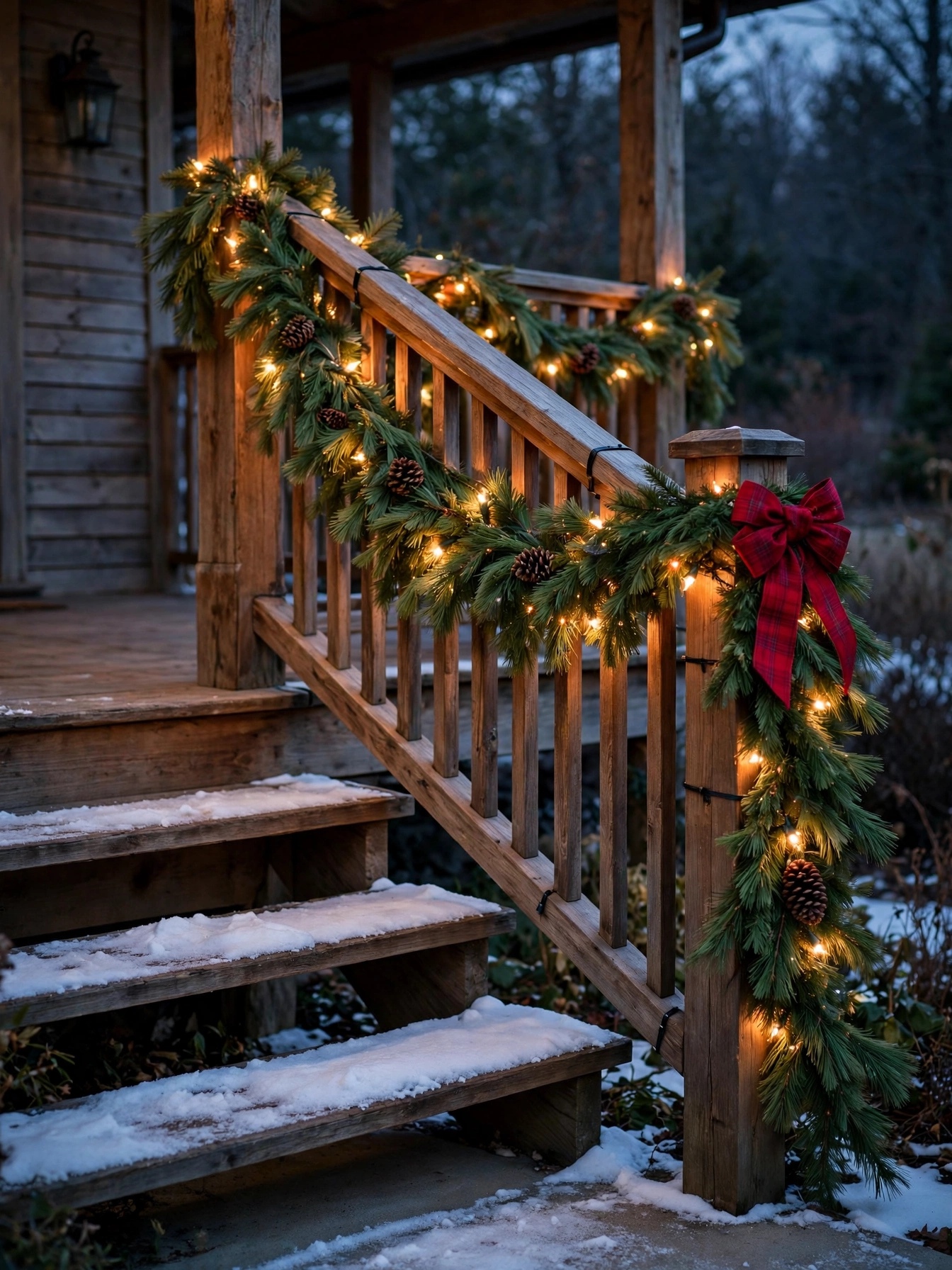
Why This Works:
- Greenery plus light reads as festive in daylight and at night.
- Garland softens plain railings better than lights alone.
- Zip ties hold garland tight through wind and snow.
- Fresh pine scent adds a sensory layer no bulb can give.
A 9 foot garland covers a standard 8 foot railing section with 6 inches of drape at each end, and one 50 light mini strand weaves through it in about ten minutes. Weave the strand in and out of the branches rather than laying it on top, so bulbs sit inside the greenery and glow through it. Tie the garland to the rail every 18 inches with a zip tie hidden under a branch, and keep the plug end at the porch outlet side. Lit garland looks fuller than a bare light strand on a rail and hides the wire, but fresh garland dries out in two to three weeks, so faux garland suits mild climates where a display stays up past New Year.
Porches with a straight railing run and an outlet nearby are the right setting. Wet snow adds real weight to fresh garland and can pull light clips loose, so check ties after the first storm. Fresh garland plus lights runs 40 to 90 dollars per railing section.
Snowflake Projector Display
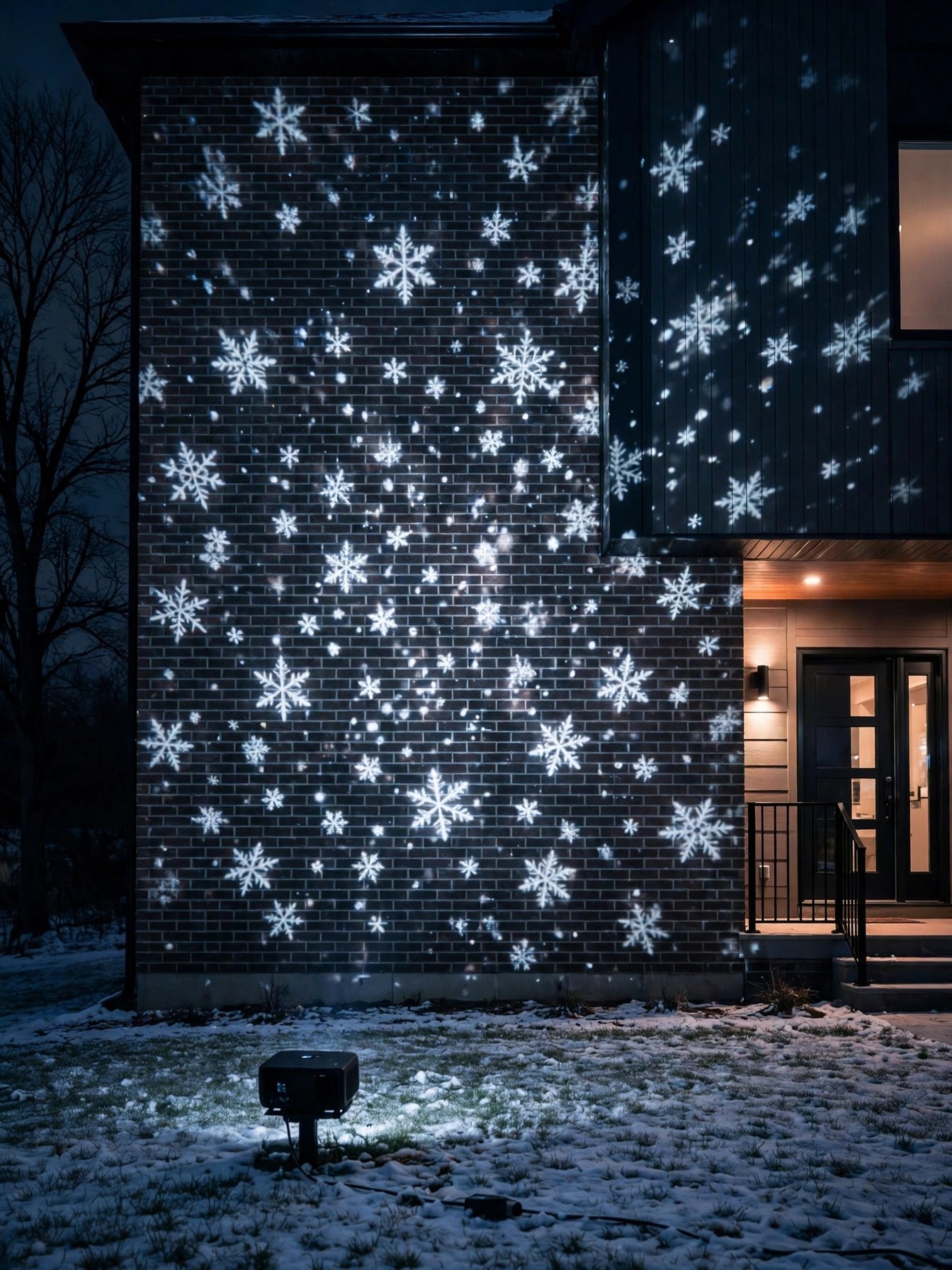
Why This Works:
- One projector covers a whole wall in minutes with no ladder work.
- Moving patterns give motion that static strands cannot match.
- A stake mount means no holes in siding or trim.
- Swapping the slide or mode changes the theme without new lights.
A typical LED projector throws a clear image 15 to 25 feet, so stake it about 20 feet from the wall for a full facade wash, and angle it slightly upward to cover the gable. The unit draws 5 to 15 watts and needs a weatherproof outlet cover, since the projector itself is rated for rain but the plug connection is the weak point. Focus the lens at dusk, not in full dark, because eyes adjust and the image looks sharper when set in low light. A projector costs 40 to 120 dollars and installs in minutes, which no hanging strand can match, but the image washes out under a bright porch light, so aim it at a wall section away from the main porch bulb.
Renters, steep roofs, and anyone short on time will get the most from this one. A staked projector has two enemies, wind and theft: it can shift in a storm and is easy to carry off, so bring it inside during high winds and on nights away. It also suits houses where the facade is the main canvas, and it pairs with Christmas Front Porch Decor Ideas at the entrance.
Driveway Christmas Lights on House Ideas
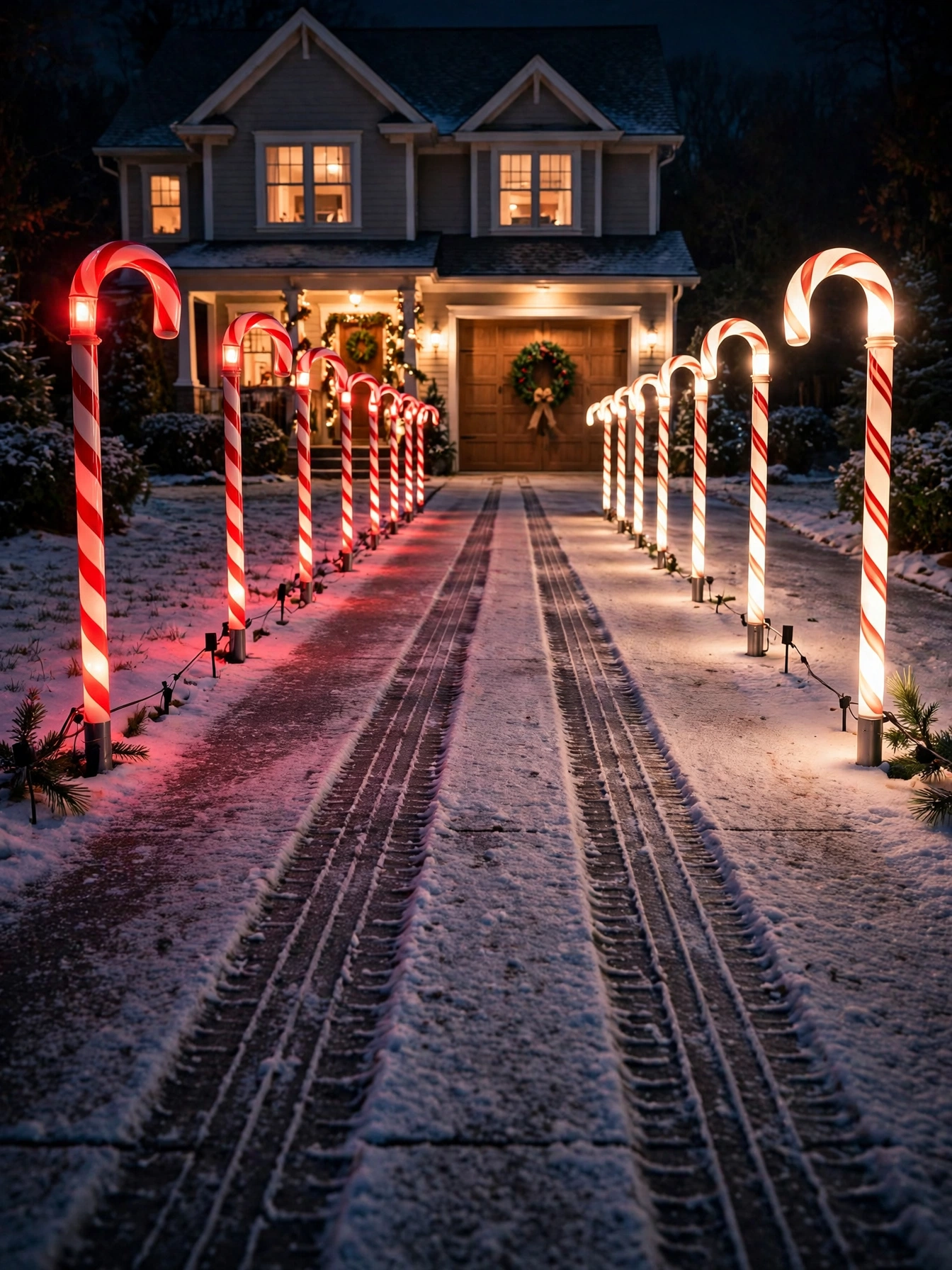
Why This Works:
- Lined edges turn a plain driveway into a clear arrival route.
- Candy cane poles read instantly as Christmas from a moving car.
- Stakes install without tools and remove cleanly in January.
- The line frames the house display instead of competing with it.
A straight 40 foot driveway needs 10 to 12 poles spaced 3 to 4 feet apart on each side for a full border, or half that for one side only. Push stakes 5 inches into soil and keep poles 12 inches back from the driving edge so tires and snow shovels clear them. Wire the poles in a single low voltage run with the transformer near the garage outlet, and bury the cable 2 inches under mulch where it crosses planting beds. Driveway poles are taller and bolder than pathway stake lights, which suits a wide drive, but they block snow blower passes, so in heavy snow regions use flexible poles that bend rather than snap.
Houses with a straight, visible driveway are the obvious candidates. Backing cars are the main risk: poles near the garage apron get clipped by mirrors, so end the line 6 feet short of the apron. A full driveway set runs 60 to 140 dollars.
Meteor Shower Tubes
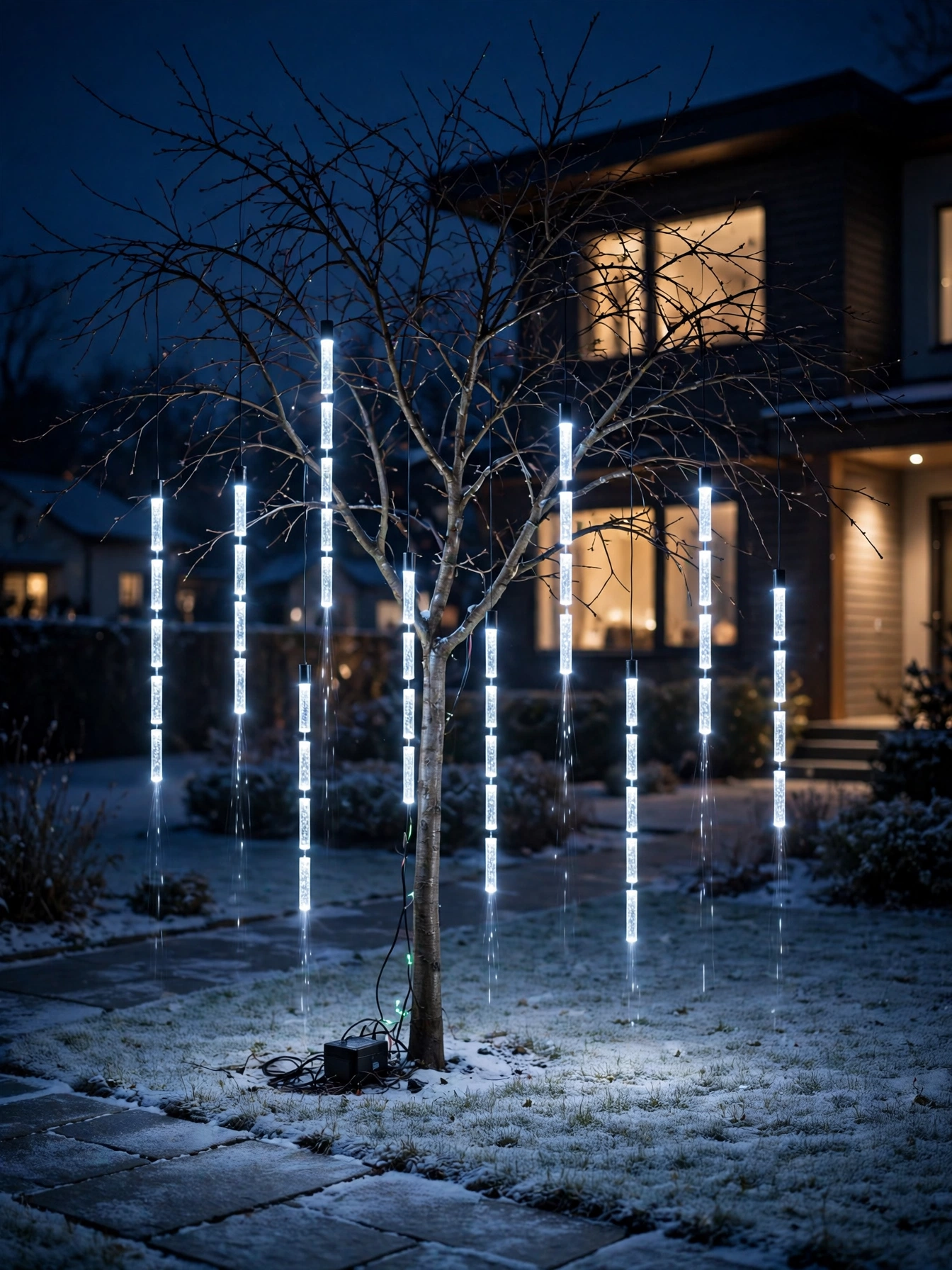
Why This Works:
- Falling light motion draws the eye more than any static strand.
- Tubes hang from existing branches, so no new structure is needed.
- A set of 8 tubes covers a small tree completely.
- Cool white reads as snow and ice, which fits a winter yard.
A standard set holds 8 tubes of 12 to 20 inches, spaced 12 inches apart on a single drop cord, and one set suits a tree up to 10 feet tall. Hang the cord from a branch at least 8 feet high so tubes clear heads, and space sets 18 inches apart on wider trees for even coverage. The controller cycles the fall effect at about one drop per second, and most sets offer 3 to 5 speed modes. Tubes install in minutes and use about 5 watts per set, far less fuss than wrapped branches, but they look thin in daylight, so they are a night only feature.
Small ornamental trees near the street are the perfect hosts. Gusts are the problem for tubes: they swing and can tangle, so in exposed yards choose shorter 12 inch tubes. Sets run 20 to 45 dollars each.
Lighted Door Wreath
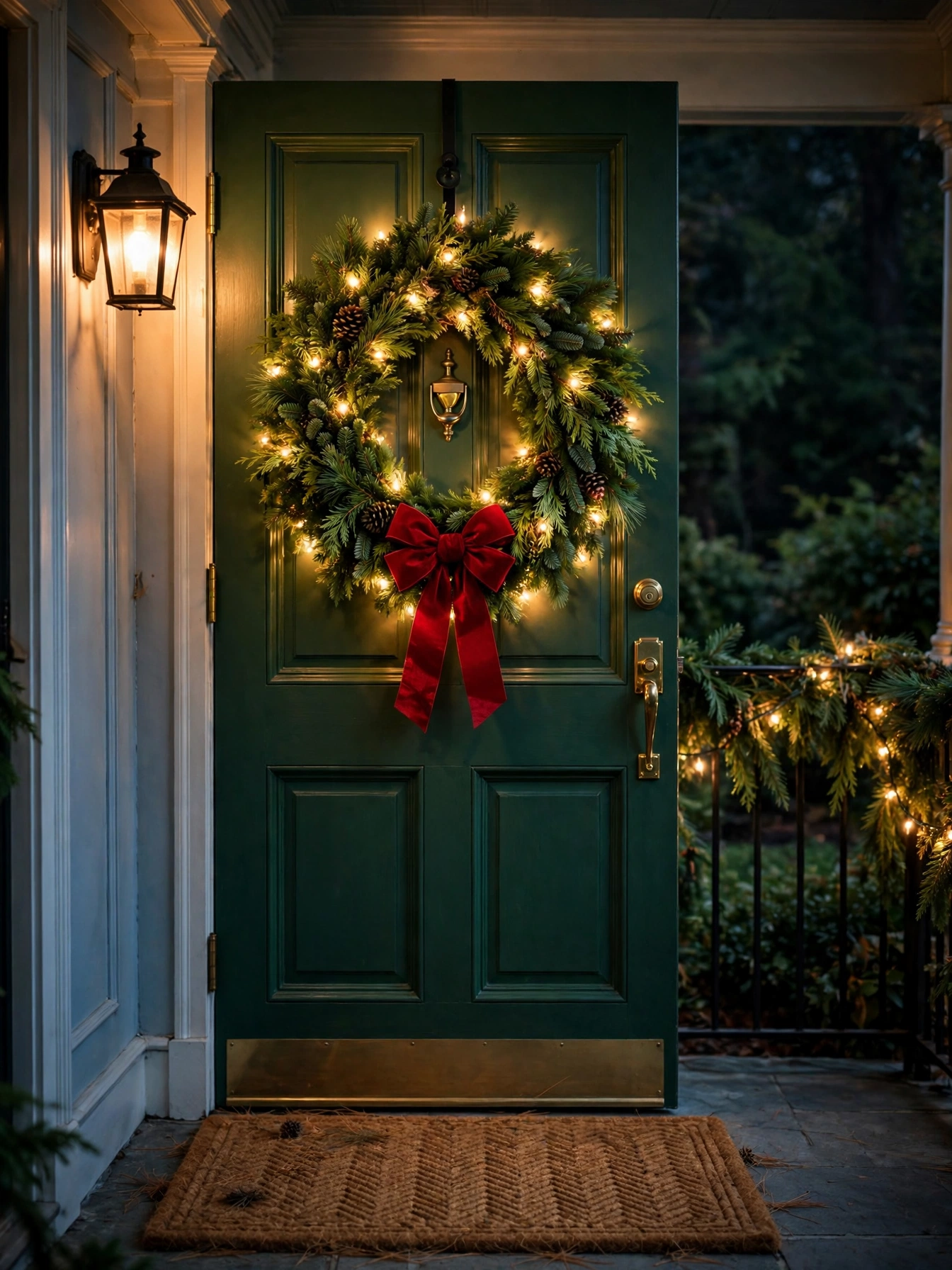
Why This Works:
- The wreath sits at eye level, so it is the first lit detail guests notice.
- A 24 inch wreath fits standard 36 inch doors without crowding the hardware.
- Battery lights avoid a cord across the porch floor.
- Swapping the bow changes the whole look next year for a few dollars.
A 24 inch wreath needs one 20 light mini strand woven through the outer branches, with the battery box tucked behind the wreath and out of rain. Hang it from an over door hook rated for 5 pounds, centered 60 inches from the porch floor so it clears the door handle and mail slot. Battery strands run 6 hours a night for about 3 weeks on one set of AA cells, while plug in strands run all season but need an outlet within 6 feet of the door. The lit version carries the entrance after dark in a way a plain wreath cannot, but battery boxes add weight and need a reminder to switch off, so a timer battery box is worth the extra 5 dollars.
Any front door with a porch roof above it can carry this wreath. Rain is the weak spot on uncovered doors, where a battery box must sit inside a small zip bag or the contacts corrode. A lit wreath runs 35 to 80 dollars finished, or 15 to 30 dollars to light a wreath you already own.
Dormer Chimney Accents
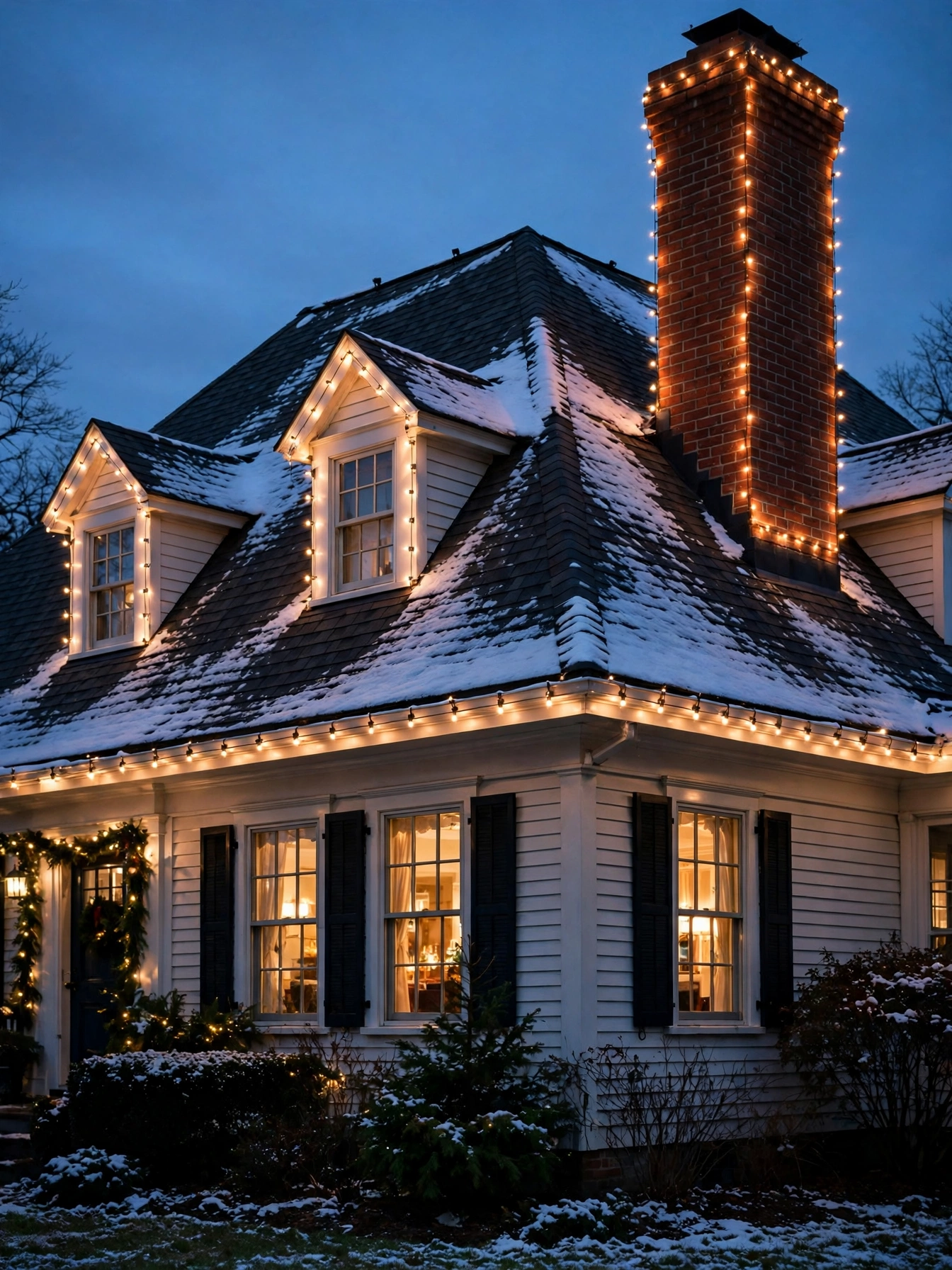
Why This Works:
- Outlined dormers and chimneys add detail that a plain roofline misses.
- Small accents make a large roof look intentional rather than bare.
- Brick clips grip mortar joints without drilling.
- Accents use short strands, so a failure affects only one feature.
A single dormer needs about 12 feet of mini lights around its three sides, and a chimney top needs 8 to 10 feet around the cap. Use roof clips on shingles and brick clips in mortar joints, spaced every 8 inches, and never clip into the chimney flashing, which must stay sealed against leaks. Run one extension from the roofline strand to the nearest dormer, keeping total connected strands within the maker’s limit of three. Accents take more ladder time per foot of light than a full roofline, but they turn a plain roof into a finished display.
Houses with visible dormers or a front facing chimney get the most from these accents. Access is the real issue: dormers on steep roofs need a roof harness or a professional, and no display is worth a fall. If the roof pitch exceeds 8 in 12, hire the install out. Accent strands run 15 to 40 dollars each.
Fence Line Lights
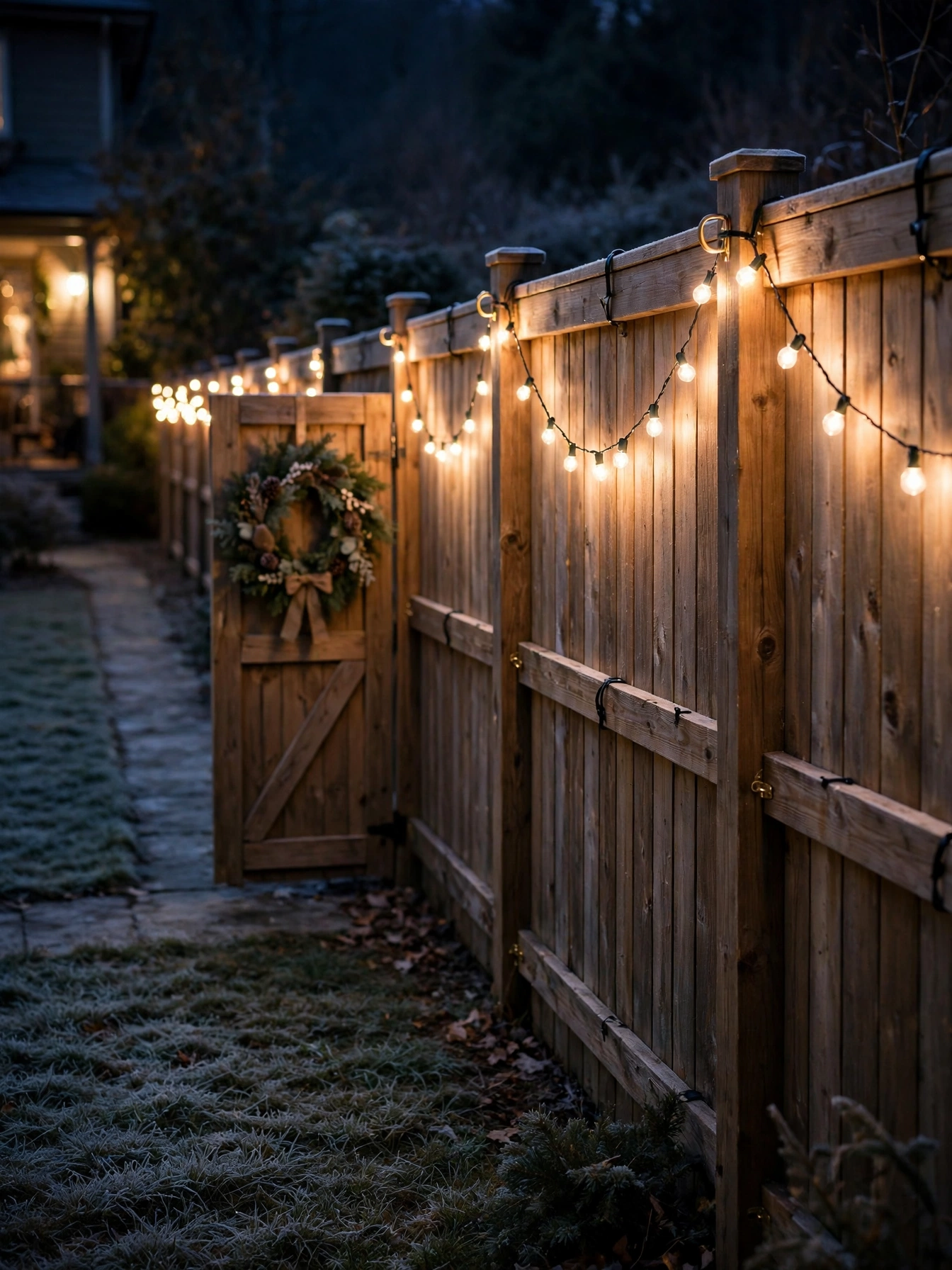
Why This Works:
- A lit fence extends the display along the property line for little cost.
- Gentle swags look relaxed and hide small spacing mistakes.
- Cup hooks screw in once and stay for future years.
- One long strand run covers a whole fence side.
A 50 foot fence side needs two 25 foot strands draped in swags 12 inches deep, with hooks every 6 feet so each swag hangs evenly. Screw cup hooks into the top rail, never into fence boards, which split more easily, and keep the strand 2 inches below the rail top so snow slides off rather than piling on the wire. The run should end at the gate post, not cross the gate opening, because a wire across a gate gets caught and pulled down. Fence lights sit at eye level and read clearly from the sidewalk, unlike a roofline far overhead, but they cover a long distance for modest impact, so they work best as a supporting line, not the main feature.
Corner lots and houses with a visible front fence are the best fit. Boundary fences belong to two households, so check with a neighbor before screwing hooks into a shared one. A fence run costs 40 to 90 dollars.
Fairy Light Lanterns
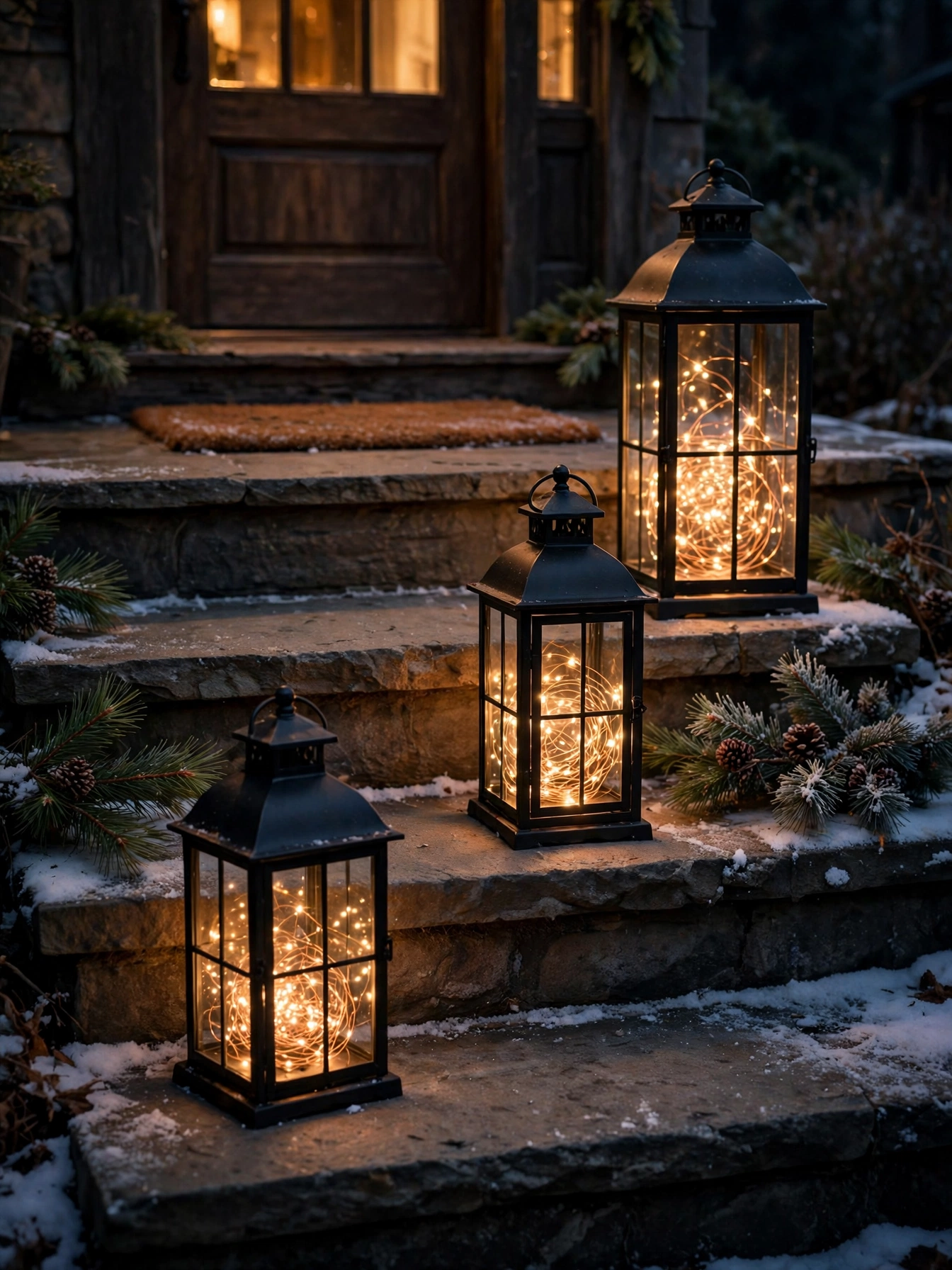
Why This Works:
- Lanterns give light at ground level where guests actually walk.
- Grouping three heights looks styled without any extra decor.
- Glass shields the lights from wind and rain.
- Battery fairy lights mean no cords on the steps.
Use lanterns of 8, 12, and 16 inches tall in one group, each holding a 10 foot copper wire fairy strand of 30 to 50 lights coiled loosely inside. Set the group 12 inches from the step edge so no one kicks it, and keep the tallest lantern at the back so all three read from the walk. Battery boxes hide under the lantern base or behind the group, and a 6 hour timer keeps nightly use simple. Lanterns give a warmer, more finished look at the door than stake lights, but they cost more per foot of light and need battery changes every 2 to 3 weeks.
Porches with wide steps or a landing give these lanterns room to shine. Light lanterns blow over in wind and walk off easily, so choose metal over plastic and add a small stone inside the base for weight. A group of three runs 45 to 110 dollars.
Lighted Yard Figures
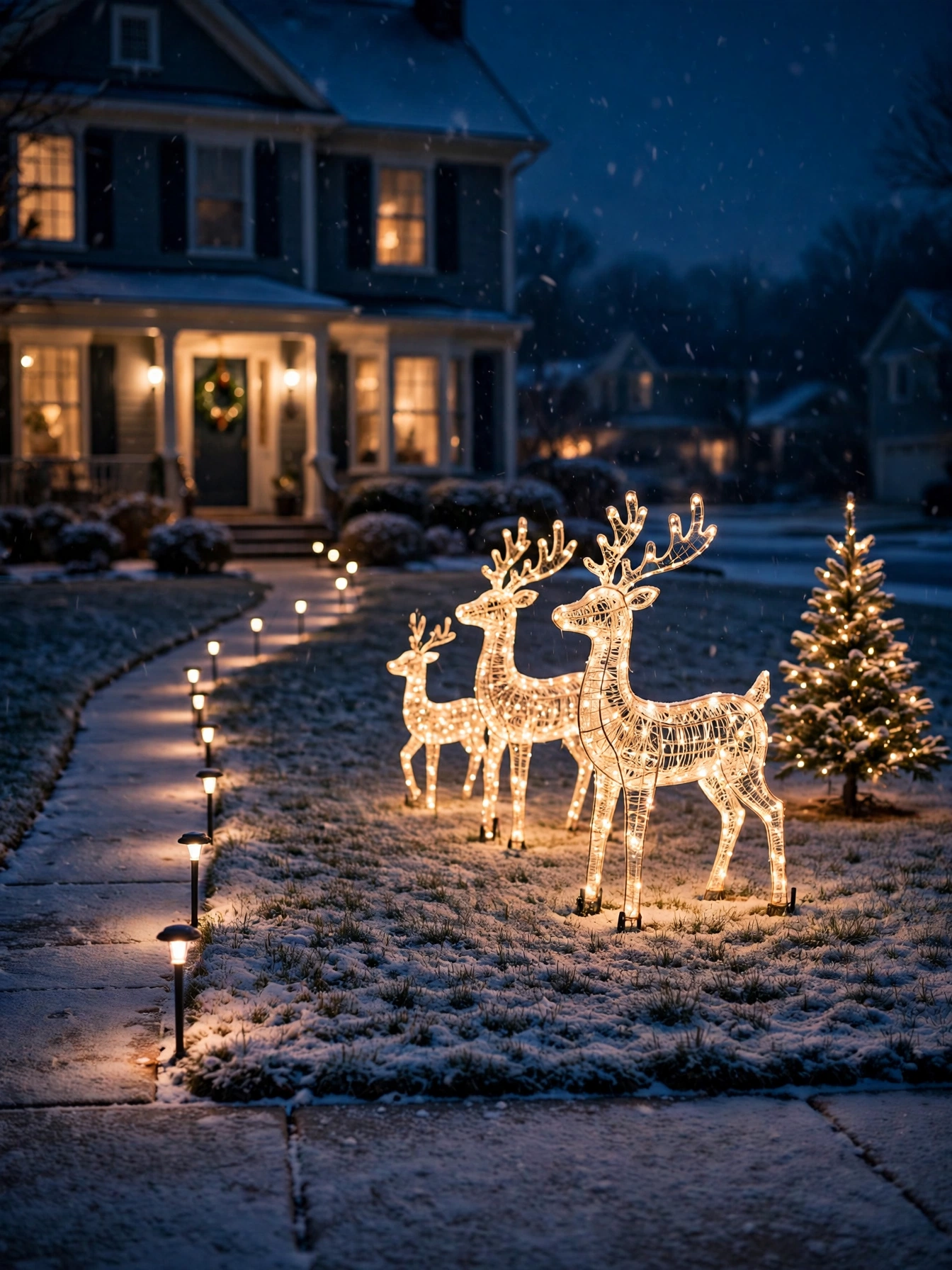
Why This Works:
- Figures give children and passersby something to look at beyond lines of light.
- Wire frames fold flat for storage, unlike bulky inflatables.
- Stakes hold figures steady through normal winter wind.
- One figure anchors a whole lawn display by itself.
A standard wire reindeer stands 36 to 48 inches tall and carries 100 to 150 mini lights on its frame, with a 6 foot lead cord to the next figure or the outlet. Stake each foot 4 inches into soil and angle the figure 10 degrees toward the street so its shape reads from passing cars. Keep figures at least 3 feet from the sidewalk so snow piles and boots miss them. Wire figures use less power than inflatables and stay up in wind, but they look thin in daylight, so place them where evening viewing matters most.
Front lawns with space for one or two figures are the right stage. Storage is the catch: even folded, large frames need garage wall space, so measure before buying a 5 foot piece. Figures run 40 to 120 dollars each.
Solar Path Lights
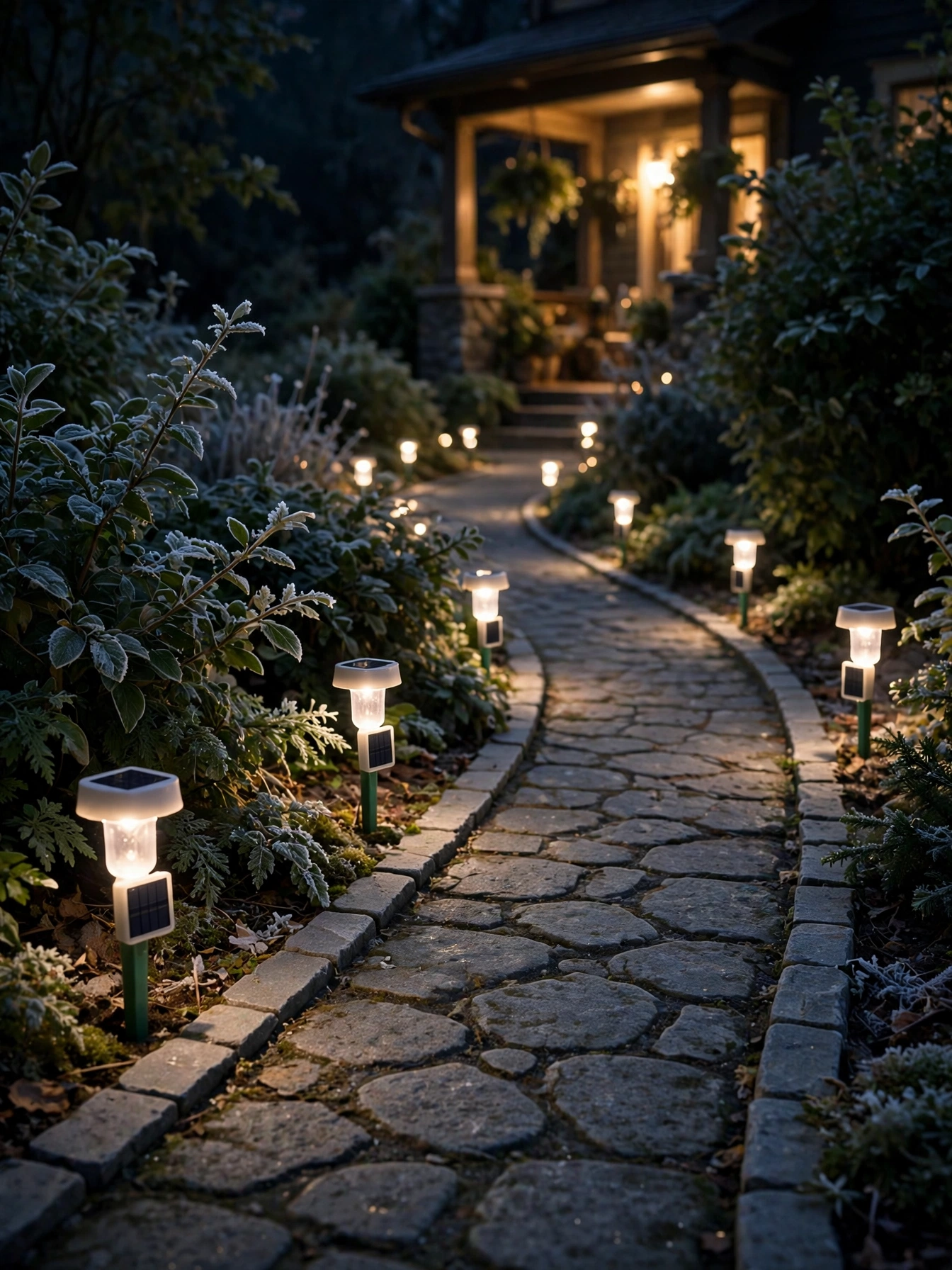
Why This Works:
- No wiring, no outlet, and no electric bill for the whole path.
- Stakes move easily if the layout needs adjusting.
- Solar cells charge by day and switch on automatically at dusk.
- A full path set costs less than one wired kit plus an electrician visit.
A solar stake with a 2 volt panel and one AA rechargeable cell gives 6 to 8 hours of light after a full day of sun, which covers most December evenings in southern and mid latitude states. Space stakes 3 feet apart and keep each panel facing south with no shrub shadow, since one shaded panel can cut the whole night’s run short. In northern states with short December days, expect 3 to 4 hours instead, so solar suits paths that matter most in the early evening. Solar is cheaper and simpler than plug in path kits, but brightness drops on cloudy weeks and cells need replacing every 1 to 2 years.
Garden paths away from outlets are exactly where solar earns its keep. A path under a porch roof or heavy tree cover gets too little winter sun to charge, so test one stake in place for three nights before buying a full set. Solar sets run 20 to 50 dollars for 10 lights.
Porch Curtain Lights
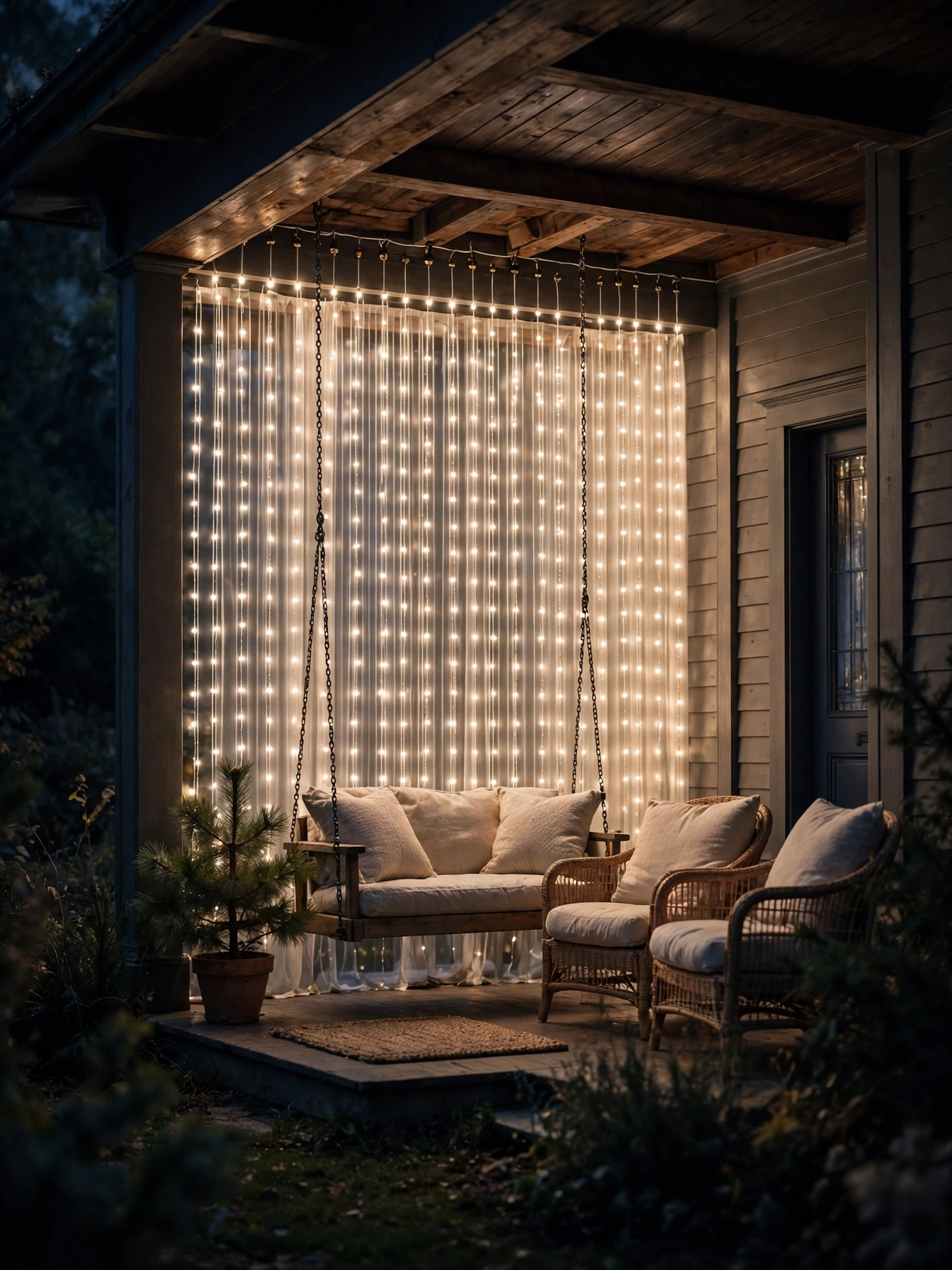
Why This Works:
- Vertical strands turn a plain porch ceiling into a glowing backdrop.
- The curtain frames the seating area like a stage.
- Hooks install once and hold the panel every season.
- Curtain light gives the porch a finished look from the street too.
A standard curtain panel measures 10 feet wide by 8 feet tall with vertical drops every 4 inches, which fits most porch openings. Hang it from cup hooks every 12 inches along the ceiling beam, and weight the bottom edge with two small clips so wind does not blow the strands sideways. The panel plugs into the porch outlet, and a dimmer or timer keeps it from glaring into the living room windows. Curtain lights give a fuller wall of light than icicle lights on the same porch, but they block the view out of the porch, so they suit porches used for display more than for sitting.
Deep covered porches with a clear ceiling beam are made for this panel. On open porches, rain reaches the panel unless it hangs under the roof edge, not beyond it, or the top connection gets wet. Curtain panels run 25 to 60 dollars.
Smart Christmas Lights on House Ideas
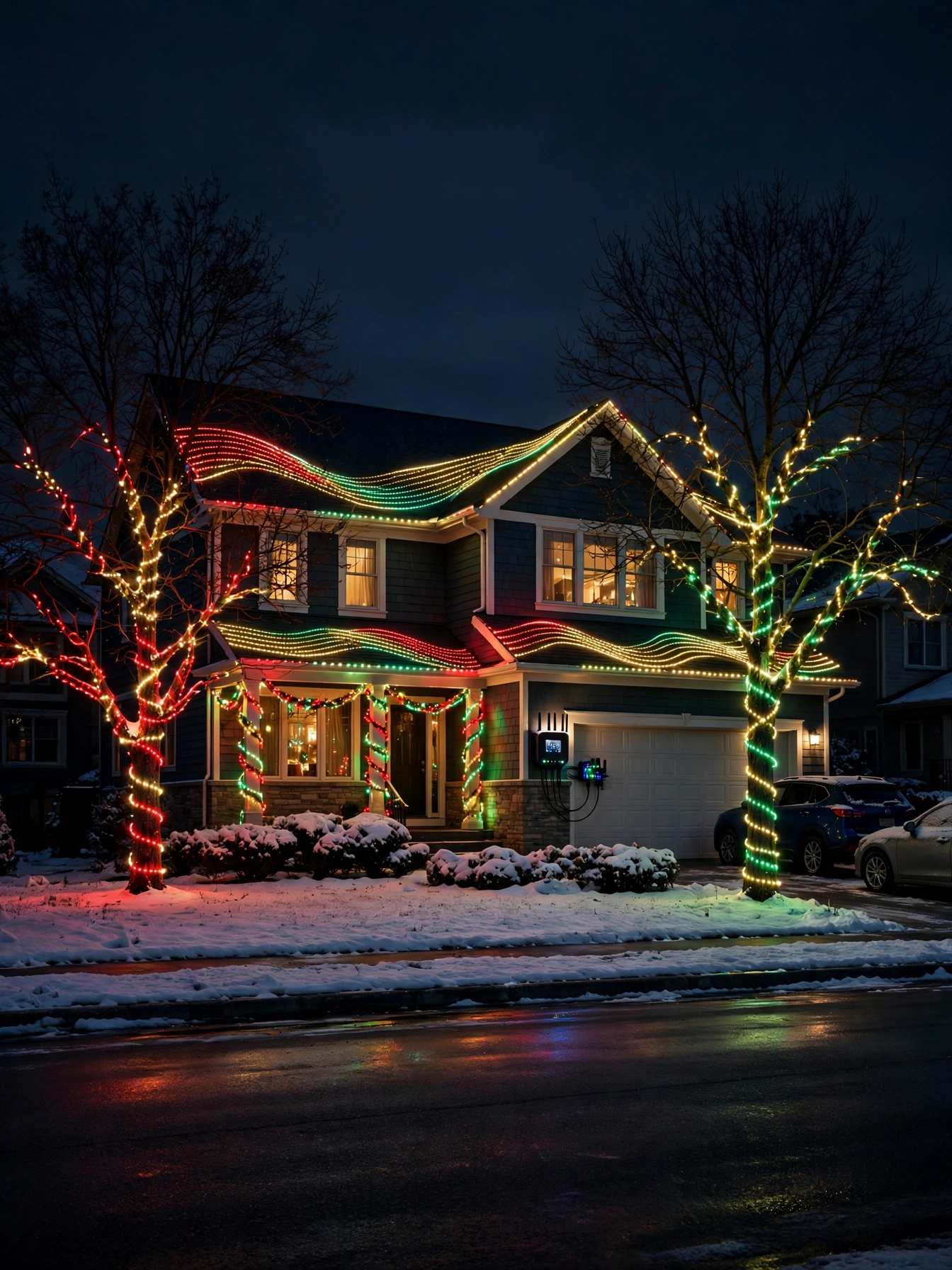
Why This Works:
- Music and motion turn a static display into an event neighbors plan around.
- One controller runs roof, trees, and yard from a single app.
- Schedules switch the show on at dusk and off at a set bedtime.
- Preset patterns mean no programming skill is needed to start.
A music synced system usually starts with a controller rated for 500 to 1000 lights, plus smart strands on each feature, all on one 2.4 GHz WiFi network. Keep the controller within 30 feet of the router or add an outdoor rated WiFi extender, since a weak signal is the top cause of a show freezing mid song. Budget 200 to 500 dollars for a starter synced system, and test the full show for three nights before inviting anyone, because one loose connection can silence a whole zone. Synced shows draw crowds and compliments that static displays never get, but they also draw traffic and noise questions, so set a firm off time of 9 or 10 PM as good neighbor practice.
Tech friendly households on streets where a show is welcome will love this setup. Complexity grows with every added zone, so start with roof and one tree, then expand next year. The whole display still runs through a GFCI protected outlet, and any new outdoor circuit is work for a licensed electrician, which is the one professional hire this article recommends for exterior power work.
Under Eave Glow
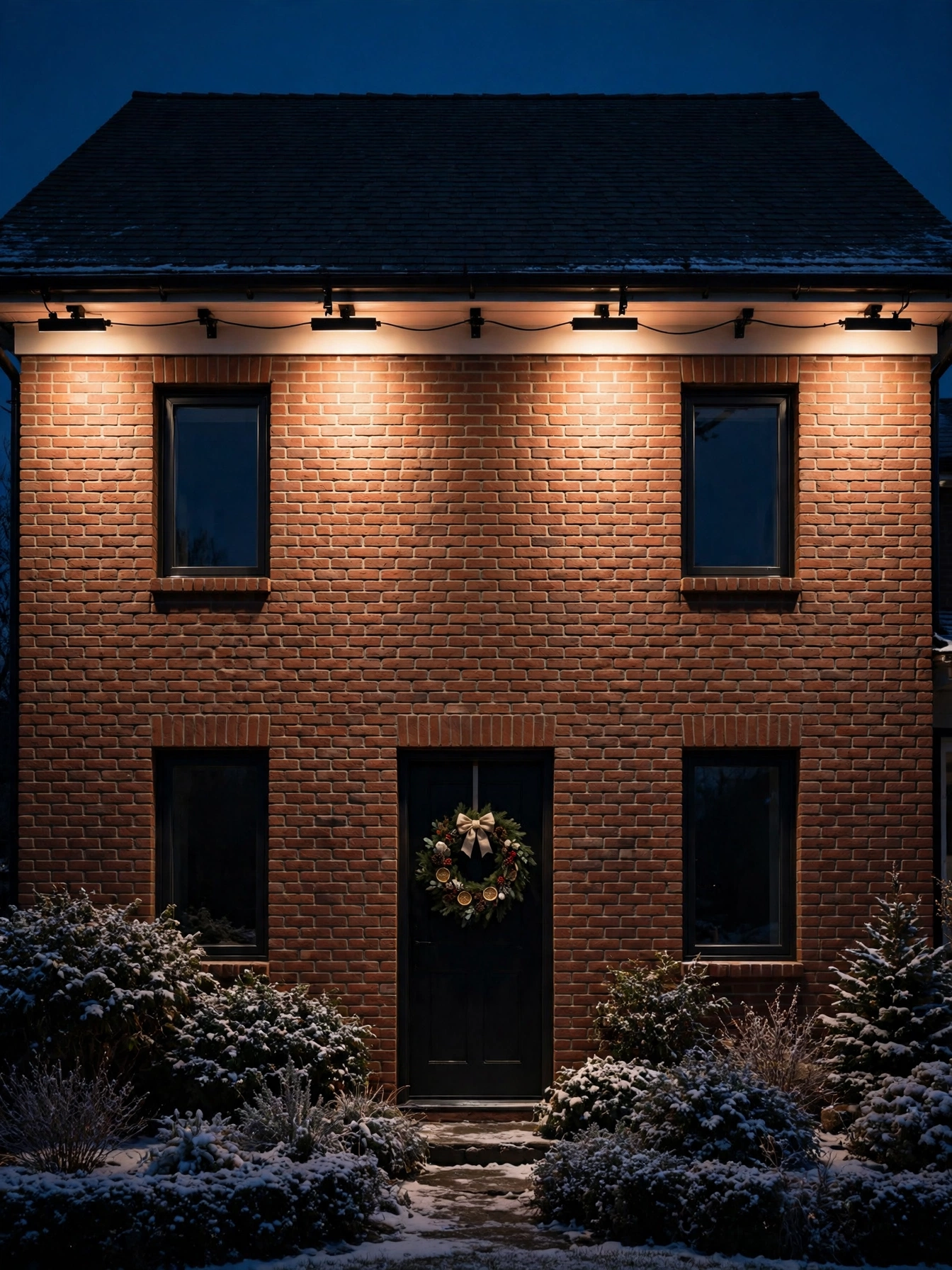
Why This Works:
- Wash light flatters brick and stone instead of outlining them harshly.
- A soft glow suits houses where bold color displays feel too loud.
- Fixtures hide under the eave, so daylight shows nothing at all.
- One wash row can carry the whole facade on its own.
Small LED wash fixtures mount under the eave every 4 to 6 feet, aimed down the wall at a 30 degree angle, and a 40 foot facade needs 8 to 10 fixtures on one low voltage run. Each fixture draws 3 to 7 watts, so the whole row stays under 70 watts, and a dimmer lets the wash run as a night light after the main display switches off. The fixtures must be rated IP65 for exposed eave positions, and the cable should clip to the soffit every 18 inches so it never dangles. Wash light is subtler and more architectural than a strand outline, but it shows wall flaws like patched brick, so it suits well kept facades best.
Brick, stone, and smooth stucco houses with a clear eave are the ideal canvas. Cost adds up fast: wash fixtures run 15 to 30 dollars each, so a full facade totals 150 to 300 dollars before the transformer. It is also the quietest option in this guide, which some streets prefer.
FAQs
What are the best christmas lights on house ideas for a first display?
Start with a warm white roofline, lit window frames, and pathway stakes. That trio covers the outline, the facade, and safe footing for under 150 dollars in most cases, and it looks complete without a single ladder trip above the first story.
How many strands do I need for a standard roofline?
Measure the roofline first, then divide by 25 feet per strand. A 50 foot front eave needs two strands, and most makers allow three connected strands maximum, so plan the plug point at one end before you climb.
Can I leave christmas lights on house eaves up all winter?
Yes, if the strands are rated for outdoor use under UL 588 and the connections stay dry. Strands left up past January face UV damage and brittle wire jackets, so take them down by late January and store them coiled in a dry bin.
Are LED strands really better than incandescent for outdoor use?
LED strands win for house exteriors because they run cool, draw a fraction of the power, and last far longer than incandescent bulbs. A 25 foot LED strand typically uses under 10 watts, while the same length in incandescent can draw 125 watts or more.
How do I keep outdoor Christmas lights safe in rain and snow?
Use only outdoor rated strands, plug them into a GFCI protected outlet as required by electrical code, and keep connections off the ground in weatherproof covers. A timer that switches lights off after 6 hours also cuts energy use and bulb wear.
Conclusion
The best christmas lights on house ideas share three habits: measure before buying, protect every connection from weather, and put the whole display on a timer. Start with the roofline, add one ground level feature like pathway stakes, and let the rest grow next season. Your first action is simple: walk the front of the house tonight, count the feet of roofline and path, and note the nearest GFCI outlet. Follow HomelyCrafter on Pinterest for more ideas. Save this to your Pinterest boards so you can refer back to it!

Muhammad Israr is a home decor enthusiast and the writer behind Homely Crafter. He spends his days researching paint colors, layouts and budget-friendly styling ideas, then breaks them down into practical, easy-to-follow guides so you can decorate with confidence.
6 thoughts on “21 Dazzling Christmas Lights on House Ideas to Try”